
Have you ever met someone who always seems convinced that they are right while judging everyone else for their choices? That behavior may be described as self righteous. The self righteous meaning refers to a person who believes their own opinions, actions, or morals are better or more correct than those of others.
Self righteous describes someone who acts as if they have the moral high ground and has little doubt that their behavior is justified. The term often carries a negative meaning because it suggests that a person judges others while overlooking their own mistakes or faults.
Examples:
- He sounded self righteous when he criticized everyone for making mistakes.
- Her self righteous attitude made it difficult to have an open discussion.
The confusion is understandable. People often search for what does self righteous mean, self righteous meaning in text, self righteous meaning in a relationship, or what does it mean to be self righteous because the word can describe anything from everyday criticism to a strong moral attitude. And here’s the kicker: being confident about your values isn’t automatically self righteousness. The term usually suggests an excessive sense of moral superiority.
In this guide, you’ll learn the complete self righteous meaning, its definition, pronunciation, origin, and correct usage. You’ll also discover self righteous examples, synonyms and antonyms, how to use it in a sentence, and the difference between being self righteous, confident, judgmental, and morally principled.
Self Righteous Meaning
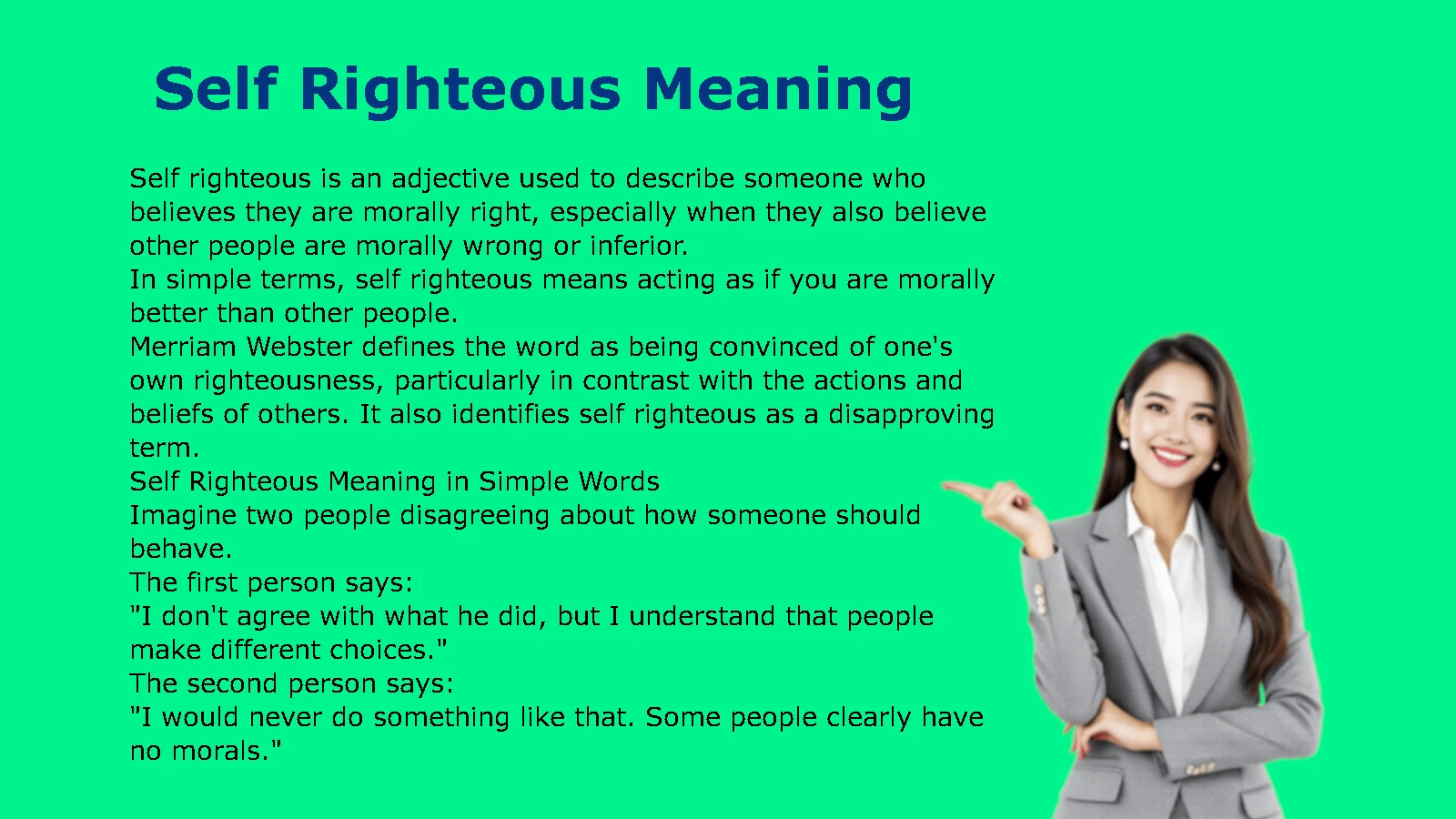
Self righteous is an adjective used to describe someone who believes they are morally right, especially when they also believe other people are morally wrong or inferior.
In simple terms, self righteous means acting as if you are morally better than other people.
Merriam Webster defines the word as being convinced of one’s own righteousness, particularly in contrast with the actions and beliefs of others. It also identifies self righteous as a disapproving term.
Self Righteous Meaning in Simple Words
Imagine two people disagreeing about how someone should behave.
The first person says:
“I don’t agree with what he did, but I understand that people make different choices.”
The second person says:
“I would never do something like that. Some people clearly have no morals.”
The second response sounds self righteous because the speaker doesn’t merely disagree. They place themselves above the other person morally.
That distinction matters.
Having a moral opinion isn’t self righteousness. Acting as though your moral opinion makes you superior to everyone who disagrees is much closer to self righteousness.
A Quick Definition
| Term | Simple meaning |
| Self righteous | Believing or acting as though you are morally better than others |
| Self righteousness | The attitude or quality of being self righteous |
| Self righteously | In a self righteous manner |
| Righteous | Morally right or good |
Oxford classifies self righteous as disapproving and defines it as feeling or behaving as though what you say or do is always morally right while other people are wrong.
What Does Self Righteous Mean?
When someone calls another person self righteous, they usually criticize the person’s attitude rather than simply describing their beliefs.
A self righteous person may:
- Believe their moral judgment is unquestionably correct
- Judge people who make different choices
- Focus heavily on other people’s mistakes
- Have difficulty admitting their own mistakes
- Speak in a preachy or superior tone
- Treat disagreement as evidence that someone else lacks character
- Apply one standard to themselves and another to everyone else
- Act as though they occupy the moral high ground
Not every person who does one of these things is automatically self righteous. Context matters.
For example, telling someone that stealing is wrong doesn’t make a person self righteous. The attitude becomes self righteous when the person uses that belief to present themselves as morally superior while dismissing everyone else’s circumstances or imperfections.
Self Righteous Pronunciation
The standard pronunciation of self righteous is:
/ˌselfˈraɪ.tʃəs/
An easy pronunciation guide is:
self RYE chus
The main stress falls on right.
Oxford and Cambridge both give essentially the same pronunciation.
How to Say Self Righteous
Break the expression into two parts:
- self → “self”
- righteous → “RYE chus”
Put them together:
self + RYE chus = self righteous
The word righteous itself is pronounced differently from how some learners might expect from its spelling. It sounds roughly like RYE chus, not “right-ee-us.”
Is Self Righteous Positive or Negative?
Self righteous is generally negative.
Major dictionaries mark the word as disapproving. Cambridge explicitly labels it disapproving, and Oxford does the same.
If you describe someone as self righteous, you’re usually saying that their attitude is irritating, arrogant, judgmental, or morally superior.
Compare these statements:
- “She is confident about her values.”
- “She is committed to her principles.”
- “She is self righteous.”
The first two can sound neutral or positive. The third usually sounds critical.
Self Righteous vs Positive Moral Confidence
| Expression | Typical meaning | Tone |
| Confident | Certain about yourself or your judgment | Neutral or positive |
| Principled | Guided by strong moral principles | Usually positive |
| Righteous | Morally right or justified | Neutral or positive depending on context |
| Moralistic | Strongly concerned with judging morality | Often negative |
| Judgmental | Too quick to judge others | Negative |
| Self righteous | Morally convinced of your own superiority | Negative |
This distinction helps prevent a common mistake: self righteous doesn’t simply mean “someone who believes in doing the right thing.”
Self Righteous Examples in Sentences
The easiest way to understand self righteous meaning is to see how people use it in real situations.
Everyday Examples
- He sounded self righteous when he criticized everyone else’s choices.
- Don’t become self righteous just because you made the better decision this time.
- Her self righteous attitude made an ordinary disagreement much worse.
- He can be helpful without sounding self righteous.
- The conversation became uncomfortable because everyone started taking a self righteous tone.
Workplace Examples
- Instead of helping his coworker fix the mistake, he gave a self righteous lecture.
- Her feedback was useful, but her self righteous tone made it difficult to accept.
- A manager shouldn’t sound self righteous when explaining company policies.
Social Media Examples
- The discussion quickly turned into a self righteous argument.
- His post sounded self righteous because he treated everyone who disagreed with him as ignorant.
- Social media debates can encourage self righteous behavior when people compete to appear morally superior.
Relationship Examples
- She apologized instead of becoming self righteous during the argument.
- His self righteous response made his partner feel judged rather than understood.
- They could have solved the problem if neither person had taken a self righteous position.
The word can describe a person, attitude, comment, tone, response, speech, argument, pose, or behavior.
Examples of Self Righteous Behavior
Self righteous behavior often becomes easier to recognize when you look beyond the person’s actual opinion.
Constantly Judging Other People
A self righteous person may quickly label other people’s choices as ignorant, immoral, lazy, or irresponsible.
For instance, someone might say, “I would never raise my children that way. Those parents clearly don’t care.”
The problem isn’t having an opinion about parenting. The problem is the assumption that one personal approach proves moral superiority.
Refusing to Admit Mistakes
Everyone gets things wrong. A self righteous attitude often appears when someone treats their own mistakes as exceptions while treating other people’s mistakes as evidence of bad character.
That double standard can make conversations exhausting.
Turning Advice Into a Lecture
Advice can help. A lecture can alienate.
Someone who says, “Here’s what worked for me” sounds very different from someone who says, “If you had any common sense, you’d do what I did.”
The second statement has a strong self righteous quality because it attacks the other person’s judgment rather than simply offering an alternative.
Treating Disagreement as Moral Failure
People can disagree honestly.
A self righteous person may assume that disagreement proves the other person is selfish, ignorant, dishonest, or immoral. That leap from “you disagree with me” to “there’s something wrong with you” often creates the impression of moral superiority.
Self Righteous vs Righteous
The difference between righteous and self righteous can be subtle but important.
Righteous generally means morally right or good. Oxford also notes that it can describe something a person considers morally acceptable or fair.
Self righteous, by contrast, focuses on a person’s attitude toward their own moral correctness and the perceived wrongness of others.
| Word | Meaning |
| Righteous | Morally right or good |
| Self righteous | Convinced that your own moral position is superior to others |
| Righteously | In a morally right or justified way |
| Self righteously | In a manner that shows moral superiority |
Consider these examples:
Righteous:
“She felt righteous anger after seeing the unfair treatment.”
Here, righteous describes anger that the speaker considers morally justified.
Self righteous:
“She became self righteous and started insulting everyone who disagreed.”
Here, the focus is on her attitude toward other people.
The prefix self changes the emphasis. It points toward an individual’s strong belief in their own moral correctness.
Self Righteous vs Sanctimonious
Sanctimonious is one of the closest synonyms for self righteous. Oxford lists it as a synonym, while Cambridge also identifies it as a disapproving synonym.
However, the words don’t always feel identical.
Self righteous emphasizes someone’s belief that they are morally right or superior.
Sanctimonious often emphasizes an outward display of moral goodness that sounds insincere, excessive, or preachy.
Example
“He was self righteous about his lifestyle.”
This suggests he believed his lifestyle was morally better than other people’s.
“His sanctimonious speech about virtue annoyed the audience.”
This places more emphasis on his preachy or affected display of virtue.
The meanings overlap, but the emotional emphasis differs.
Self Righteous vs Judgmental
Judgmental means being too ready to form negative opinions about other people.
Self righteous goes a step further by suggesting moral superiority.
Someone can be judgmental without presenting themselves as morally superior.
For example:
“She is judgmental about people’s clothing.”
This means she tends to judge how others dress.
Compare:
“She is self righteous about people’s clothing.”
Now the statement suggests that she believes her own choices are morally or personally superior.
The Main Difference
Judgmental = quick to judge.
Self righteous = convinced that your own moral position is superior.
The two qualities can appear together, but they’re not identical.
Synonyms for Self Righteous
There isn’t one perfect synonym for every context because each related word carries a slightly different shade of meaning.
Merriam Webster lists pious, sanctimonious, moralistic, hypocritical, pharisaical, and holier than thou among words related to self righteous.
Common Self Righteous Synonyms
- Sanctimonious — overly focused on appearing morally virtuous
- Holier than thou — acting as though you’re morally better than others
- Moralistic — excessively concerned with judging morality
- Smug — overly pleased with yourself or your position
- Pious — strongly religious or morally devoted, sometimes with a negative implication
- Preachy — giving unwanted moral advice or instruction
- Priggish — excessively concerned with proper behavior and morality
- Superior — acting as though you are better than others
- Hypocritical — claiming moral standards while failing to follow them yourself
- Pharisaical — extremely or hypocritically self righteous
Which Synonym Should You Choose?
| If you mean… | A useful word |
| Acting morally superior | Self righteous |
| Acting morally superior in a preachy way | Sanctimonious |
| Judging others by moral standards | Moralistic |
| Acting pleased with your own superiority | Smug |
| Acting like you’re better than everyone | Holier than thou |
| Judging people too quickly | Judgmental |
| Pretending to have virtues you don’t practice | Hypocritical |
| Giving unwanted moral lectures | Preachy |
Choosing the right synonym makes the sentence more precise.
Antonyms of Self Righteous
The opposite of self righteousness isn’t necessarily someone who has no moral standards. Instead, the contrast usually involves humility, openness, tolerance, and self awareness.
Useful antonyms and contrasting terms include:
- Humble
- Open minded
- Understanding
- Tolerant
- Compassionate
- Accepting
- Self critical
- Nonjudgmental
- Modest
- Considerate
For example:
“Instead of taking a self righteous approach, she listened to the other person’s experience.”
The opposite attitude doesn’t require abandoning your beliefs. You can hold strong principles while recognizing that other people may have different experiences, information, or circumstances.
Self Righteousness Meaning
Self righteousness is the noun form of self righteous.
It describes the attitude or quality of believing that your own ideas, actions, or behavior are morally better than those of other people. Cambridge defines self righteousness as the quality of believing that your ideas and behavior are morally better than other people’s.
Self Righteous vs Self Righteousness
The grammatical difference is simple:
- Self righteous = adjective
- Self righteousness = noun
Compare:
He is self righteous.
Here, self righteous describes the person.
His self righteousness annoyed the group.
Here, self righteousness names the attitude.
Self Righteousness Examples
- Her self righteousness made the discussion difficult.
- His argument contained more self righteousness than useful information.
- The debate became a contest in self righteousness.
- A little humility can prevent self righteousness from taking over a conversation.
The noun often appears with words such as smug, moral, arrogant, excessive, and unpleasant.
Self Righteously Meaning and Usage
Self righteously is the adverb form.
It means in a self righteous way, especially by behaving as though your ideas or actions are morally superior to other people’s. Cambridge lists self righteously as an adverb with this meaning.
Examples of Self Righteously
- He self righteously criticized everyone who disagreed with him.
- She spoke self righteously about other people’s decisions.
- They self righteously assumed that their approach was the only acceptable one.
The word tells the reader how someone performs an action.
Compare:
“He criticized his coworkers.”
This gives no information about his attitude.
“He self righteously criticized his coworkers.”
Now the sentence suggests that he criticized them from a position of perceived moral superiority.
How to Use Self Righteous in a Sentence
Because self righteous functions as an adjective, it usually describes a person, attitude, tone, response, comment, or similar noun.
Common Sentence Patterns
Subject + be + self righteous
“He is becoming self righteous.”
Self righteous + noun
“Her self righteous attitude frustrated the team.”
Seem + self righteous
“His response seemed self righteous.”
Sound + self righteous
“That comment sounds self righteous.”
Become + self righteous
“It’s easy to become self righteous during an argument.”
More Natural Examples
- Don’t sound self righteous when you’re trying to help.
- His self righteous tone turned a small disagreement into a serious argument.
- She tried to explain her position without becoming self righteous.
- The article makes a strong argument without sounding self righteous.
- He apologized instead of defending himself with a self righteous speech.
These examples show that the word can describe both what someone says and how they say it.
Why Is Someone Called Self Righteous?
People commonly use self righteous when someone appears to claim the moral high ground.
The expression can arise in many settings.
Moral Disagreements
People may use the term when someone treats their moral position as unquestionably superior.
Religious Discussions
Religious beliefs can become associated with self righteous behavior when someone uses their beliefs to condemn everyone who thinks differently.
Having strong religious convictions doesn’t automatically make someone self righteous. The word concerns the person’s attitude toward others.
Political Arguments
Political debates frequently involve accusations of moral superiority.
Someone might call another person’s argument self righteous when the speaker presents their political position as evidence of being a better or more ethical person.
Workplace Conflicts
A coworker who constantly lectures others about professionalism while refusing to accept criticism might come across as self righteous.
Online Discussions
Online conversations can make moral superiority especially visible because people often communicate in short, confident statements without the context of face to face conversation.
A comment such as:
“Anyone who disagrees with this clearly doesn’t care about people.”
may sound self righteous because it turns a disagreement into a judgment about another person’s character.
Is Being Self Righteous the Same as Being Confident?
No.
Confidence means trusting your abilities, judgment, or decisions.
Self righteousness involves believing that your own moral position is superior to other people’s.
A confident person might say:
“I believe this is the best choice for me.”
A self righteous person might say:
“I chose the right thing. Anyone who chooses differently is wrong.”
The difference is subtle but important.
Confidence vs Self Righteousness
| Confidence | Self righteousness |
| Focuses on confidence in yourself | Focuses on moral superiority |
| Can accept disagreement | May dismiss disagreement |
| Doesn’t require judging others | Often involves judging others |
| Can coexist with humility | Often sounds superior |
| Usually neutral or positive | Usually negative |
A person can be confident and humble at the same time. In fact, confidence often becomes healthier when it leaves room for uncertainty.
Self Righteous vs Hypocritical
These words often appear together, but they don’t mean the same thing.
Hypocritical describes someone who claims to follow a particular standard while behaving in a way that contradicts it.
Self righteous describes someone who acts as though their own moral position is superior.
A person can be self righteous without being hypocritical.
For example, imagine someone who genuinely follows a strict personal rule and constantly tells everyone else that they should follow it too. That person may be self righteous, even if they practice what they preach.
Now imagine that the same person secretly breaks the rule while criticizing everyone else for breaking it. That adds hypocrisy.
Simple Distinction
Self righteous: “My moral choices are better than yours.”
Hypocritical: “You should follow this rule even though I don’t follow it myself.”
The two qualities can overlap, but one doesn’t automatically imply the other.
Self Righteous vs Moralistic
Moralistic describes an excessive tendency to judge behavior according to moral standards.
For example:
“The novel takes a moralistic approach to family life.”
This can mean the work strongly pushes a particular moral lesson.
Self righteous, however, focuses more directly on the person or group believing their own moral position is superior.
Someone can be moralistic without constantly presenting themselves as better than others.
Common Mistakes When Using Self Righteous
Understanding the meaning is only half the job. You also need to know when not to use it.
Mistaking It for Confident
Don’t use self righteous simply because someone strongly believes something.
“She is self righteous because she supports her opinion.”
That isn’t enough.
A person needs to show some sense of moral superiority or judgment for the word to fit naturally.
Assuming It Always Means Hypocritical
Hypocrisy can accompany self righteousness, but it isn’t required.
Someone can sincerely follow their own standards and still act self righteous.
Calling Every Strong Opinion Self Righteous
Strong opinions aren’t automatically self righteous.
A person can firmly say:
“I think discrimination is wrong.”
That statement expresses a moral belief. By itself, it doesn’t demonstrate self righteousness.
Ignoring the Negative Tone
Because self righteous usually carries a disapproving meaning, using it in a compliment can sound strange.
If you admire someone’s principles, words such as principled, ethical, committed, compassionate, or responsible may work better.
Confusing Righteous With Self Righteous
The two words share righteous, but their meanings aren’t interchangeable.
Righteous can describe something considered morally right.
Self righteous usually criticizes the attitude of someone who believes their own morality makes them superior.
A Simple Case Study: When Does a Person Become Self Righteous?
Consider two coworkers, Maya and Jordan.
Maya believes employees should arrive on time. One morning, Jordan arrives late.
Maya says:
“Jordan, you missed the start of the meeting. Let’s make sure we’re ready on time tomorrow.”
That’s direct criticism, but it isn’t necessarily self righteous.
Now imagine Maya says:
“I can’t believe you were late. I always arrive early because I actually respect everyone else’s time. Some people clearly don’t understand professionalism.”
The second response sounds more self righteous.
Why?
Because Maya doesn’t merely point out the problem. She compares her own behavior with Jordan’s and presents herself as morally or professionally superior.
What Changed?
| Maya’s first response | Maya’s second response |
| Identifies the problem | Identifies the problem |
| Focuses on the behavior | Focuses on the person’s character |
| Offers a practical solution | Compares herself favorably |
| Doesn’t claim superiority | Implies moral superiority |
| Not necessarily self righteous | Strongly self righteous in tone |
This distinction explains why self righteous is often about tone and attitude, not just the subject of a person’s argument.
Why Self Righteousness Can Be Difficult to Recognize
Self righteousness can be tricky because people usually don’t describe themselves that way.
Most people believe their own position makes sense. They may also believe they’re standing up for something important.
The problem arises when certainty leaves no room for humility.
A useful test is to ask:
- Can the person acknowledge their own mistakes?
- Can they understand why someone else thinks differently?
- Do they criticize behavior without attacking character?
- Do they apply the same standards to themselves?
- Can they disagree without treating the other person as morally inferior?
The more an attitude centers on “I am right and you are a worse person because you disagree”, the more naturally self righteous fits.
Self Righteous in Everyday Conversation
The word appears frequently in informal criticism.
Here are some natural expressions:
- “Don’t get self righteous.”
- “You’re sounding a little self righteous.”
- “That came across as self righteous.”
- “He has a self righteous attitude.”
- “I don’t want to sound self righteous, but…”
- “Her response felt unnecessarily self righteous.”
The phrase “I don’t want to sound self righteous, but…” is particularly interesting. A speaker uses it to acknowledge that the next statement might sound morally superior.
For example:
“I don’t want to sound self righteous, but I think we should admit that we made a mistake.”
Here, the speaker is signaling caution. They want to make a criticism without sounding as though they’re claiming moral superiority.
Is Self Righteous an Insult?
Self righteous can function as an insult or criticism, especially when directed at a person.
Calling someone self righteous suggests that the person is behaving in an arrogant, judgmental, or morally superior way.
However, the exact force depends on context.
Compare:
“You sounded self righteous during that meeting.”
This is a criticism of someone’s communication style.
“You’re a self righteous hypocrite.”
This is much harsher because it combines self righteous with hypocrite.
In professional settings, a softer alternative might be:
“Your response came across as judgmental.”
That focuses on the behavior rather than making a broad judgment about the person’s character.
What Is the Opposite of Self Righteous?
The opposite attitude involves humility and openness.
A person doesn’t have to abandon their beliefs to avoid self righteousness. Instead, they can recognize that being convinced of something doesn’t make everyone who disagrees with them foolish or immoral.
For example:
Self righteous:
“Anyone who doesn’t agree with me clearly has bad values.”
Open minded:
“I strongly disagree, but I understand why someone might see it differently.”
The second approach still allows disagreement. It simply leaves room for another person’s perspective.
Self Righteous Meaning: Quick Facts
| Fact | Answer |
| Part of speech | Adjective |
| Standard spelling | Self righteous |
| Pronunciation | /ˌselfˈraɪ.tʃəs/ |
| Primary meaning | Believing your own moral position is superior to others |
| Tone | Usually negative or disapproving |
| Noun form | Self righteousness |
| Adverb form | Self righteously |
| Common synonym | Sanctimonious |
| Another common expression | Holier than thou |
| Opposite qualities | Humble, tolerant, open minded, understanding |
| First known use | Merriam Webster dates the word’s first known use to about 1680. |
Frequently Asked Questions About Self Righteous Meaning
What does self righteous mean?
Self righteous means believing or behaving as though your own ideas, actions, or moral standards are better than those of other people. The word usually has a negative or disapproving tone.
Is self righteous a negative word?
Yes. Dictionaries such as Cambridge and Oxford label self righteous as disapproving. It generally criticizes someone for acting morally superior to others.
What is another word for self righteous?
Common alternatives include sanctimonious, moralistic, smug, preachy, holier than thou, and priggish. The best choice depends on the exact behavior you want to describe.
What is the opposite of self righteous?
Useful opposites include humble, tolerant, understanding, open minded, compassionate, accepting, and nonjudgmental.
Is self righteous the same as judgmental?
Not exactly. Judgmental means being quick or overly willing to judge other people. Self righteous suggests that the person believes their own moral position is superior. Someone can be judgmental without being self righteous.
Is self righteous the same as hypocritical?
No. A hypocrite claims to follow a standard but doesn’t follow it themselves. A self righteous person acts as though their own moral position is superior. A person can be both, but the terms have different meanings.
What is the noun form of self righteous?
The noun is self righteousness. It refers to the attitude or quality of believing that your own ideas or behavior are morally better than other people’s.
What is the adverb form of self righteous?
The adverb is self righteously. It describes doing something in a self righteous manner.
Can self righteous describe a tone?
Yes. You can describe a self righteous tone, self righteous attitude, self righteous response, self righteous comment, or self righteous speech.
Can a person be self righteous without being wrong?
Yes. Self righteous doesn’t necessarily mean the person’s underlying opinion is wrong.
The term focuses on the person’s attitude and perceived moral superiority, not on whether their actual position is objectively correct.
That’s an important distinction.
Someone might have a completely reasonable argument and still present it in a self righteous way.
Is self righteous the same as being morally right?
No.
A person can be morally right about an issue without being self righteous. Self righteous describes the attitude of treating your own moral correctness as evidence that you’re better than other people.
Final Takeaway: Self Righteous Meaning
The simplest way to remember the self righteous meaning is this:
Self righteous describes someone who believes or acts as though their own moral choices, beliefs, or behavior make them better or more correct than other people.
The word usually carries a negative or disapproving tone. Cambridge, Oxford, and Merriam Webster all connect it with a strong belief in one’s own moral correctness, particularly in contrast with other people’s actions or beliefs.
The key difference is between having strong values and using those values to place yourself above others.
A principled person can say:
“I believe this is wrong.”
A self righteous person is more likely to communicate:
“I believe this is wrong, and anyone who thinks otherwise is morally beneath me.”
That small shift explains the heart of the word.
When you need to describe moral superiority, a preachy attitude, or an unwillingness to see anyone else’s perspective, self righteous may be exactly the word you need. For related forms, remember self righteousness for the noun and self righteously for the adverb.