
Have you ever come across the word “reinforce” and wondered exactly what it means? While REINFORCE Meaning may seem straightforward, this useful word can have different meanings depending on the sentence, context, and situation in which it is used.
Reinforce is a verb that means to make something stronger, more effective, or more likely to continue. It can refer to strengthening a physical structure, supporting an idea, or encouraging a behavior. For example, you might reinforce a wall, reinforce a positive habit, or reinforce an important message.
Examples:
- The workers reinforced the bridge to make it safer.
- Her kind words reinforced my confidence.
The confusion is understandable. People often search for what does reinforce mean, reinforce meaning in English, reinforce meaning in a sentence, or how to use reinforce correctly because the word can describe both physical and nonphysical forms of support. And here’s the kicker: reinforce can mean more than simply “make stronger.” It can also mean to strengthen an idea, feeling, belief, or behavior.
In this guide, you’ll learn the complete REINFORCE Meaning, its definition, pronunciation, synonyms, correct usage, and examples in sentences. You’ll also discover the difference between reinforce, reinforced, and reinforcement, along with practical examples to help you use the word correctly.
What Does “Reinforce” Mean?
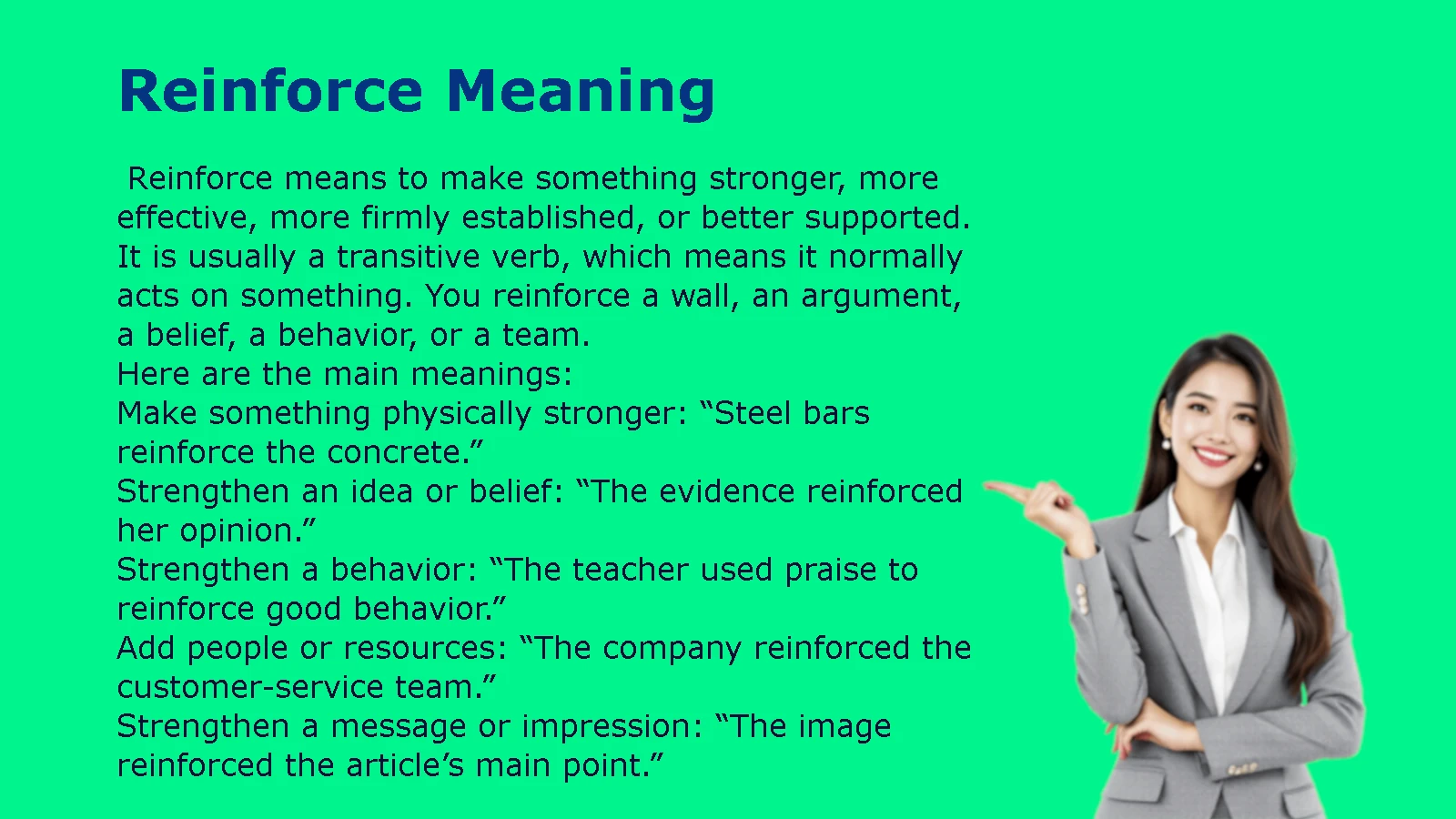
Reinforce means to make something stronger, more effective, more firmly established, or better supported.
It is usually a transitive verb, which means it normally acts on something. You reinforce a wall, an argument, a belief, a behavior, or a team.
Here are the main meanings:
- Make something physically stronger: “Steel bars reinforce the concrete.”
- Strengthen an idea or belief: “The evidence reinforced her opinion.”
- Strengthen a behavior: “The teacher used praise to reinforce good behavior.”
- Add people or resources: “The company reinforced the customer-service team.”
- Strengthen a message or impression: “The image reinforced the article’s main point.”
The easiest way to remember the word is:
Reinforce = add strength or support to something that already exists.
That last part matters. If you start something from scratch, reinforce usually isn’t the best word. You reinforce an existing structure, belief, behavior, argument, feeling, or group.
Reinforce Meaning in Simple English
In very simple English, reinforce means to make something stronger.
For example:
- A metal plate can reinforce a weak beam.
- Facts can reinforce an argument.
- Praise can reinforce a child’s good behavior.
- Extra workers can reinforce a team.
- Repeated practice can reinforce a skill.
Think of reinforcement as adding another layer of strength. A single piece of evidence may support an argument. Several strong pieces of evidence can reinforce it.
Reinforce Definition and Pronunciation
Word: reinforce
Part of speech: verb
US pronunciation: /ˌriː.ɪnˈfɔːrs/
Past tense: reinforced
Present participle: reinforcing
Noun: reinforcement
Cambridge lists reinforce as a verb and gives the U.S. pronunciation as /ˌriː.ɪnˈfɔːrs/.
Word Forms of Reinforce
| Form | Example |
| reinforce | They reinforce the wall. |
| reinforces | This evidence reinforces the theory. |
| reinforced | The bridge was reinforced with steel. |
| reinforcing | The teacher is reinforcing the lesson. |
| reinforcement | The building needs additional reinforcement. |
The noun reinforcement refers to the act of making something stronger or to something added to provide strength or support. In military contexts, reinforcements can also mean additional personnel sent to strengthen a force.
The Different Meanings of Reinforce
Although the word appears in many situations, its meanings connect to the same basic concept: strengthening something that already exists.
To Make Something Physically Stronger
The most literal meaning of reinforce involves physical objects and structures.
A weak part of a structure can receive additional material or support. That extra material helps the structure withstand forces that might otherwise damage or deform it.
For example:
- “Workers reinforced the wall with steel bars.”
- “The carpenter reinforced the wooden frame.”
- “The jacket has reinforced elbows.”
- “The bridge was reinforced to handle heavier loads.”
In this sense, reinforcement can involve metal, concrete, fabric, wood, or other materials.
Cambridge gives examples such as reinforced pockets and structures strengthened with metal components.
To Strengthen an Idea, Belief, or Argument
You can also reinforce something that isn’t physical.
Facts, evidence, experiences, and observations can reinforce an idea or opinion by giving it additional support.
For example:
“The latest research reinforced the scientists’ original conclusion.”
The research didn’t physically strengthen the conclusion. Instead, it gave the conclusion more evidence behind it.
You can reinforce:
- an argument
- an opinion
- a belief
- a conclusion
- a theory
- a viewpoint
- a message
- an impression
- a feeling
Consider this example:
“Her successful presentation reinforced her belief that she was ready for the promotion.”
Her belief existed before the presentation. The successful experience made that belief stronger.
This is one of the most common figurative uses of reinforce.
To Strengthen a Behavior
In everyday language, something can reinforce behavior when it makes a person more likely to continue that behavior.
For example:
“The manager’s praise reinforced the employee’s habit of checking every report carefully.”
The praise doesn’t physically strengthen the employee. Instead, it strengthens the connection between the behavior and its positive consequence.
This use becomes especially important in psychology, where reinforcement has a more precise technical meaning.
To Provide Additional Support
A person, group, or organization can also be reinforced by adding more people or resources.
For example:
“The hospital reinforced its emergency team during the busy weekend.”
Here, the team already exists. Additional staff provide more capacity.
The same idea can apply to military forces, police units, customer-service teams, project groups, and other organizations.
Cambridge also defines reinforce as providing an army with additional soldiers or weapons to make it stronger.
How to Use “Reinforce” in a Sentence
The most common pattern is:
reinforce + noun
The noun identifies what becomes stronger.
Reinforce a Physical Object
- “Steel beams reinforce the structure.”
- “The workers reinforced the damaged wall.”
- “Double stitching reinforces the pockets.”
- “A metal plate reinforced the wooden joint.”
Reinforce an Idea or Belief
- “The new evidence reinforced her argument.”
- “His experience reinforced his belief that preparation matters.”
- “The results reinforced the original conclusion.”
- “The incident reinforced public concerns about safety.”
Behavior
- “Positive feedback reinforced the student’s good study habits.”
- “The reward reinforced the behavior.”
- “Regular practice reinforced the skills she had learned.”
Reinforce a Message
- “The photograph reinforced the article’s central message.”
- “The speaker used statistics to reinforce his point.”
- “The campaign reinforced the importance of recycling.”
The word works especially well when something adds strength to an existing thing.
Reinforce Example Sentences
Seeing the word in different contexts makes its meaning easier to recognize.
Everyday Examples
- “That experience reinforced my decision.”
- “Her kind words reinforced my confidence.”
- “The results reinforced what we already suspected.”
- “The repeated reminder reinforced the importance of the deadline.”
- “The coach’s feedback reinforced the team’s confidence.”
School Examples
- “The teacher used practice exercises to reinforce the lesson.”
- “The quiz reinforced the concepts students learned in class.”
- “The experiment reinforced the principles discussed in the textbook.”
Workplace Examples
- “The manager’s feedback reinforced the importance of clear communication.”
- “The training program reinforced existing safety procedures.”
- “The new data reinforced the team’s recommendation.”
Writing Examples
- “The statistics reinforce the author’s argument.”
- “The example reinforces the main point.”
- “The final paragraph reinforces the central theme.”
Physical Examples
- “The engineers reinforced the bridge.”
- “The workers reinforced the concrete wall.”
- “The manufacturer reinforced the corners of the package.”
Social and Personal Examples
- “His reaction reinforced her feeling that something was wrong.”
- “Their support reinforced his confidence.”
- “The experience reinforced the value of patience.”
Reinforce Synonyms
Several words can replace reinforce, but they aren’t perfect substitutes in every sentence.
| Synonym | Meaning | Example |
| Strengthen | Make stronger | Exercise strengthens muscles. |
| Support | Give help or evidence | The facts support her claim. |
| Bolster | Strengthen confidence, support, or an argument | The figures bolstered the proposal. |
| Fortify | Make stronger or more secure | The walls were fortified. |
| Confirm | Establish that something is true | The test confirmed the diagnosis. |
| Encourage | Give someone reason to continue | Praise encouraged him to keep practicing. |
| Back up | Support a claim with evidence | The data backs up the conclusion. |
| Intensify | Make stronger in degree or effect | The criticism intensified public concern. |
Reinforce vs. Strengthen
Reinforce and strengthen often overlap.
In fact, strengthen is usually the simplest synonym for reinforce.
Compare:
“The workers reinforced the bridge.”
“The workers strengthened the bridge.”
Both sentences make sense.
However, reinforce often suggests that you are adding support to something that already exists. Strengthen has a broader range of uses.
For example:
“Exercise strengthens your muscles.”
You could technically say that exercise reinforces your muscles in certain contexts, but strengthens sounds much more natural.
On the other hand:
“The evidence reinforced her argument.”
That sentence sounds especially natural because evidence adds support to an existing argument.
Reinforce vs. Support
These words are close, but support is broader.
You can support a person, idea, organization, decision, or argument. To reinforce something usually suggests making its existing strength more substantial.
Compare:
- “Her friends supported her decision.”
- “The new evidence reinforced her decision.”
The first sentence focuses on assistance or approval.
The second focuses on something that made the decision seem stronger or more justified.
Reinforce vs. Bolster
Bolster means to strengthen or support something, especially an argument, confidence, reputation, or position.
For example:
“The new evidence bolstered the scientist’s argument.”
You could also say:
“The new evidence reinforced the scientist’s argument.”
Both work well.
Bolster can sound slightly more formal or literary, while reinforce is common in everyday and professional English.
Reinforce vs. Confirm
These words are often confused.
Confirm means to establish that something is true, accurate, or correct.
Reinforce means to make an existing belief, argument, or impression stronger.
Consider:
“The test confirmed the result.”
This means the test established that the result was correct.
Now compare:
“The test reinforced the researcher’s confidence in the result.”
Here, the result may already have seemed convincing. The new test made that confidence stronger.
The distinction is small but useful.
What Does “Reinforce” Mean in Psychology?
In psychology, reinforcement has a specific technical meaning connected to learning and behavior.
The APA Dictionary of Psychology defines reinforcement as a process in which the frequency or probability of a response increases because of its relationship with a reinforcer.
In simple terms:
A behavior is reinforced when a consequence makes that behavior more likely to happen again.
That definition is more precise than the everyday meaning of reinforce.
Positive Reinforcement
Positive reinforcement happens when a behavior becomes more likely because something is added after the behavior.
For example:
- A student completes homework.
- The teacher gives praise.
- The student becomes more likely to complete homework in the future.
The praise acts as the reinforcing consequence.
The APA defines positive reinforcement as an increase in the likelihood of an activity because that activity leads to the presentation of a stimulus or circumstance.
Other examples include:
- Giving a dog a treat after it follows a command.
- Giving an employee recognition after excellent work.
- Complimenting a child for completing a task.
- Giving a customer a reward for repeated purchases.
Negative Reinforcement
Negative reinforcement is often misunderstood.
It does not mean punishment.
Instead, negative reinforcement involves removing something unpleasant after a behavior, which increases the likelihood of that behavior happening again.
For example, imagine a car makes an annoying warning sound when the driver fails to buckle the seat belt. The driver buckles the belt and the sound stops. If that removal of the unpleasant sound increases the likelihood that the driver will buckle the belt promptly next time, the behavior has been negatively reinforced.
The key distinction is:
- Positive reinforcement: something is added to strengthen behavior.
- Negative reinforcement: something unpleasant is removed to strengthen behavior.
- Punishment: a consequence is used to reduce a behavior.
That distinction matters because everyday speech often treats “negative” as meaning “bad.” In behavioral psychology, negative means removal, not necessarily harmful or unpleasant.
What Does “Reinforce” Mean in Construction?
In construction, reinforce usually has a literal structural meaning.
Concrete handles compressive forces well but performs much less effectively in tension. Reinforcement helps address this weakness by adding materials that can carry tensile forces and work together with the concrete.
The American Concrete Institute explains that reinforcement can include bars, wires, strands, fibers, or other slender elements embedded in a matrix. It notes that steel reinforcement provides tensile strength where concrete is in tension and can also supplement concrete’s compressive and shear capacity in particular structural members.
The important point is that reinforcement isn’t simply “extra material.” Engineers select and position reinforcement based on how a structure will carry loads.
ACI materials explain that reinforcement can involve steel bars, welded wire fabric, fibers, and fiber-reinforced polymer bars.
Why Reinforcement Matters
Reinforcement can help a concrete member:
- Resist tension.
- Improve structural capacity.
- Control cracking.
- Carry shear forces in appropriate applications.
- Improve structural performance under expected loads.
- Work as part of a composite structural system.
The exact reinforcement design depends on factors such as concrete properties, bar size, bar spacing, steel strength, geometry, development length, and other design conditions. ACI research and guidance specifically address the bond between reinforcing steel and concrete because that interaction is critical to structural performance.
What Does “Reinforce” Mean in Writing and Arguments?
In writing, reinforce usually means to make an argument, idea, or message more convincing by adding relevant support.
Suppose an article claims that regular reading improves vocabulary. A bare statement makes the claim. The writer can then add:
- Research findings.
- Examples.
- Statistics.
- Expert evidence.
- Explanations.
- Real-world observations.
Those details can reinforce the argument.
For example:
“The survey results reinforced the author’s argument that employees wanted more flexible work options.”
The survey didn’t create the argument. It gave the argument additional support.
How Writers Reinforce a Point
A strong writer can reinforce a point by using:
- Evidence to establish credibility.
- Examples to make an abstract idea concrete.
- Statistics to show scale.
- Expert opinions to provide authoritative support.
- Comparisons to clarify differences.
- Case studies to show how an idea works in practice.
- Repetition of a key idea when used carefully.
However, reinforcement works only when the supporting material actually connects to the claim. Ten unrelated statistics won’t reinforce an argument simply because there are ten of them.
Good reinforcement is relevant reinforcement.
Case Study: How Evidence Reinforces an Argument
Consider a fictional but realistic workplace example.
A manager argues that a company’s onboarding process needs improvement. The manager could simply say:
“New employees struggle during their first month.”
That statement gives an opinion.
Now suppose the manager adds employee survey results showing that many new hires report difficulty finding essential information during their first weeks. The manager also points to higher error rates among employees who receive less structured onboarding.
Those findings reinforce the argument.
The logic looks like this:
Claim → Evidence → Stronger conclusion
This illustrates the figurative meaning of reinforce. The argument itself doesn’t become physically stronger. Its support becomes stronger.
Common Phrases With “Reinforce”
Certain combinations occur naturally in English.
Reinforce an Idea
“The documentary reinforced the idea that small changes can have significant effects.”
This means the documentary gave additional support to an existing idea.
Reinforce a Belief
“The experience reinforced her belief in careful planning.”
The experience made her existing belief stronger.
Reinforce an Argument
“The new evidence reinforced his argument.”
The evidence gave additional support to his argument.
Reinforce a Message
“The image reinforces the message of the campaign.”
The image helps communicate the same central message more strongly.
Reinforce Good Habits
“Regular feedback can reinforce good study habits.”
The feedback encourages the continuation of an existing behavior.
Reinforce a Point
“The speaker used a personal example to reinforce his point.”
The example gives the point more impact or clarity.
Reinforce Existing Skills
“The training program was designed to reinforce existing skills.”
The training strengthens skills that people already possess.
Reinforce a Structure
“Engineers reinforced the structure before adding the new equipment.”
The structure received additional support before taking on the extra load.
Reinforced Meaning
Reinforced is the past tense and past participle of reinforce. It can also work as an adjective.
When something is reinforced, it has been made stronger or given additional support.
Examples include:
- “The wall was reinforced with steel.”
- “The reinforced door provided additional protection.”
- “The evidence reinforced her conclusion.”
- “His confidence was reinforced by the successful result.”
Cambridge also uses reinforced to describe physical structures and things such as beliefs, plans, feelings, and determination that have become stronger than before.
Reinforcing Meaning
Reinforcing is the present participle of reinforce.
It describes an action that is currently strengthening something or an activity that serves to strengthen something.
Examples:
- “Workers are reinforcing the bridge.”
- “The teacher is reinforcing the lesson.”
- “The evidence is reinforcing the original conclusion.”
- “The campaign uses visuals for reinforcing its central message.”
Cambridge identifies reinforcing as the present participle of reinforce.
Common Mistakes When Using “Reinforce”
The word is straightforward once you understand its central meaning, but several mistakes are common.
Confusing Reinforce With Confirm
Don’t automatically use reinforce when you mean confirm.
Use confirm when something establishes that a fact is true.
Use reinforce when something strengthens an existing belief, argument, or impression.
Correct examples:
- “The laboratory test confirmed the result.”
- “The laboratory test reinforced the researcher’s confidence in the result.”
Confusing Reinforcement With Punishment
This mistake appears frequently in discussions of psychology.
Reinforcement increases the likelihood of a behavior.
Punishment aims to decrease the likelihood of a behavior.
Also remember that positive and negative reinforcement aren’t simply “good reinforcement” and “bad reinforcement.” The terms describe what happens to a stimulus after the behavior.
Using “Reinforce” When “Strengthen” Sounds More Natural
Although the words overlap, context matters.
For example:
“Exercise strengthens your muscles.”
This sounds more natural than:
“Exercise reinforces your muscles.”
Meanwhile:
“The evidence reinforces the conclusion.”
sounds very natural.
Choosing the right synonym isn’t just about dictionary definitions. Natural collocation matters.
Spelling It “Re-enforce”
The standard modern spelling is reinforce.
Use:
- reinforce
- reinforced
- reinforcing
- reinforcement
Avoid treating re-enforce as the normal spelling in contemporary standard English.
Is “Reinforce” a Positive or Negative Word?
Reinforce is neutral.
The word itself doesn’t tell you whether the thing being strengthened is good or bad.
For example:
“The teacher reinforced good study habits.”
That sounds positive.
But consider:
“The experience reinforced his mistaken belief.”
The belief becomes stronger, but that doesn’t make it correct.
This distinction is important. Reinforcement describes an increase in strength or support, not the value or truth of what is being reinforced.
In fact, an incorrect belief can become stronger when someone repeatedly encounters information that seems to support it.
So don’t assume that reinforce automatically means “improve.”
Reinforce Word Forms
Understanding the related forms makes the word easier to use correctly.
| Word | Type | Meaning | Example |
| reinforce | Verb | Make stronger | Facts reinforce the claim. |
| reinforces | Verb | Makes stronger | The evidence reinforces the theory. |
| reinforced | Verb/adjective | Made stronger | The wall was reinforced. |
| reinforcing | Verb/adjective | Making stronger | The evidence is reinforcing the conclusion. |
| reinforcement | Noun | The act or result of strengthening | The bridge needs reinforcement. |
| reinforcements | Plural noun | Additional people or resources | The team called for reinforcements. |
What Is the Opposite of Reinforce?
The best opposite depends on the context.
Possible opposites include:
- Weaken
- Undermine
- Reduce
- Diminish
- Damage
- Erode
- Discourage
For physical strength, weaken is usually the clearest opposite.
“The metal plate reinforced the joint.”
Opposite:
“The damage weakened the joint.”
For an argument or belief, undermine can be more precise.
“The new evidence reinforced her argument.”
Opposite:
“The contradictory evidence undermined her argument.”
For behavior, discourage may be appropriate when the goal is to make a behavior less likely.
Reinforce Meaning in Different Contexts
The word becomes much easier to understand when you see how its meaning changes slightly with context.
| Context | What Reinforce Means | Example |
| Construction | Make a structure stronger | Steel bars reinforce concrete. |
| Writing | Add support to an argument | Evidence reinforces the claim. |
| Education | Strengthen learning | Practice reinforces new skills. |
| Psychology | Increase the likelihood of behavior | Praise reinforced the behavior. |
| Workplace | Strengthen a process or team | Training reinforces safety procedures. |
| Personal life | Strengthen a belief or feeling | The experience reinforced her confidence. |
| Military | Add personnel or equipment | Extra troops reinforced the unit. |
| Marketing | Strengthen a message or image | The slogan reinforces the brand message. |
The underlying idea never changes very much: something gets stronger because additional support, evidence, material, people, or consequences are added.
A Quick Way to Remember the Reinforce Meaning
Imagine a wall.
The wall already exists. It has a weak point, so someone adds a steel support.
The wall becomes stronger.
Now replace the wall with an argument.
The argument already exists. Someone adds strong evidence.
The argument becomes more convincing.
Replace the argument with a behavior.
The behavior already exists. A consequence makes that behavior more likely to happen again.
The behavior becomes more firmly established.
That’s the central concept behind reinforce.
Existing thing + additional support = stronger result
This simple formula works across most uses of the word.
Frequently Asked Questions About Reinforce
What is the simple meaning of reinforce?
Reinforce means to make something stronger or better supported. It can describe physical structures as well as ideas, beliefs, arguments, behaviors, and groups.
What is an example of reinforce?
Here is a simple example:
“The evidence reinforced her argument.”
It means the evidence provided additional support and made her argument stronger.
What is another word for reinforce?
Common synonyms include strengthen, support, bolster, fortify, confirm, encourage, and back up. The best synonym depends on the sentence.
Does reinforce mean strengthen?
Yes, in many contexts. Strengthen is one of the closest synonyms for reinforce. However, reinforce often emphasizes adding support to something that already exists.
What does reinforce mean in psychology?
In psychology, reinforcement refers to a process that increases the likelihood or frequency of a behavior. The APA Dictionary of Psychology defines it in terms of a response becoming more probable because of its relationship with a reinforcer.
What is positive reinforcement?
Positive reinforcement occurs when a behavior becomes more likely because something is presented after the behavior. Praise following desirable behavior is a common example.
What is negative reinforcement?
Negative reinforcement occurs when removing an unpleasant stimulus increases the likelihood of a behavior. It is not the same as punishment.
What does reinforce mean in construction?
In construction, reinforce means to strengthen a material or structure by adding reinforcement. Reinforced concrete commonly combines concrete with steel or other reinforcement materials to improve structural performance.
Is reinforce positive or negative?
Neither. The word is neutral. Something can reinforce a positive behavior, a useful idea, a harmful habit, or an incorrect belief.
What is the noun form of reinforce?
The noun form is reinforcement.
For example:
“The bridge needs additional reinforcement.”
What is the past tense of reinforce?
The past tense is reinforced.
Example:
“The new evidence reinforced the conclusion.”
What is the opposite of reinforce?
Common opposites include weaken, undermine, diminish, reduce, and discourage, depending on the context.
Can you reinforce a person?
Usually, English speakers say that you reinforce a person’s behavior, confidence, belief, or decision rather than simply “reinforce a person.”
For example:
“Her manager’s feedback reinforced her confidence.”
That’s more natural than saying:
“Her manager reinforced her.”
Can evidence reinforce an argument?
Yes. This is one of the most common figurative uses of the word.
“The new evidence reinforced the argument.”
It means the evidence added support and made the argument more convincing.
Final Thoughts on Reinforce Meaning
The simplest way to understand reinforce meaning is to focus on one idea: making something that already exists stronger.
Sometimes the thing being strengthened is physical. Steel can reinforce concrete, a metal plate can reinforce a wooden joint, and extra stitching can reinforce a piece of clothing.
Other times, the thing is abstract. Evidence can reinforce an argument. An experience can reinforce a belief. Praise can reinforce behavior. Additional employees can reinforce a team.
The context changes, but the central meaning stays remarkably consistent.
If you’re unsure whether reinforce fits a sentence, ask yourself one quick question:
“Is something being made stronger, firmer, or better supported?”
If the answer is yes, reinforce may be exactly the word you need.