
Have you ever wanted something so deeply that you couldn’t stop thinking about it? That feeling is often captured by Yearning Meaning, a word that describes a strong and lasting desire for someone or something. Unlike a simple wish, yearning usually carries a deeper sense of longing, emotion, or even sadness.
Yearning means having a powerful desire or longing for something that you may not have. It can describe a deep emotional need for a person, place, experience, or change.
Examples:
- She felt a deep yearning for her family while living abroad.
- He had a strong yearning to return to his hometown.
The confusion is understandable. People often search for what does yearning mean, yearning meaning in love, yearning meaning in a relationship, or yearning meaning in text because the word can describe different kinds of emotional longing. It may express romantic desire, homesickness, nostalgia, or a strong wish for something that feels out of reach. In other words, yearning isn’t just wanting something. It’s wanting it with your heart fully in the game.
In this guide, you’ll learn the complete Yearning Meaning, its definition, pronunciation, synonyms, antonyms, and correct usage. You’ll also discover yearning meaning in love, examples of yearning in sentences, and the difference between yearning, longing, desire, and wanting.
What Does Yearning Mean?
The yearning meaning is a strong, persistent, and often emotional desire for someone or something.
In simple terms, yearning means wanting something very deeply.
The thing you want might be:
- A person
- A place
- A relationship
- Freedom
- Love
- Peace
- Success
- Adventure
- A past experience
- A better life
- An opportunity
- A sense of belonging
The important point is intensity. Saying, “I want to visit the beach,” expresses a normal desire. Saying, “I have a deep yearning for the sea,” suggests something more personal and emotionally powerful.
Cambridge explains that yearn means to wish very strongly, especially for something difficult or impossible to obtain. It also recognizes the common construction yearn to + verb, as in someone who yearns to be alone.
Yearning Definition
Yearning is a noun meaning a strong and emotional desire or longing for someone or something.
It can also appear as the present participle of the verb yearn.
| Word | Part of speech | Meaning |
| Yearn | Verb | To strongly desire or long for something |
| Yearning | Noun | A strong feeling of desire or longing |
| Yearned | Past tense | Strongly desired or longed for |
| Yearning | Present participle | Experiencing or expressing strong desire |
Oxford lists yearning as both countable and uncountable and gives common patterns such as yearning for somebody or something and yearning to do something.
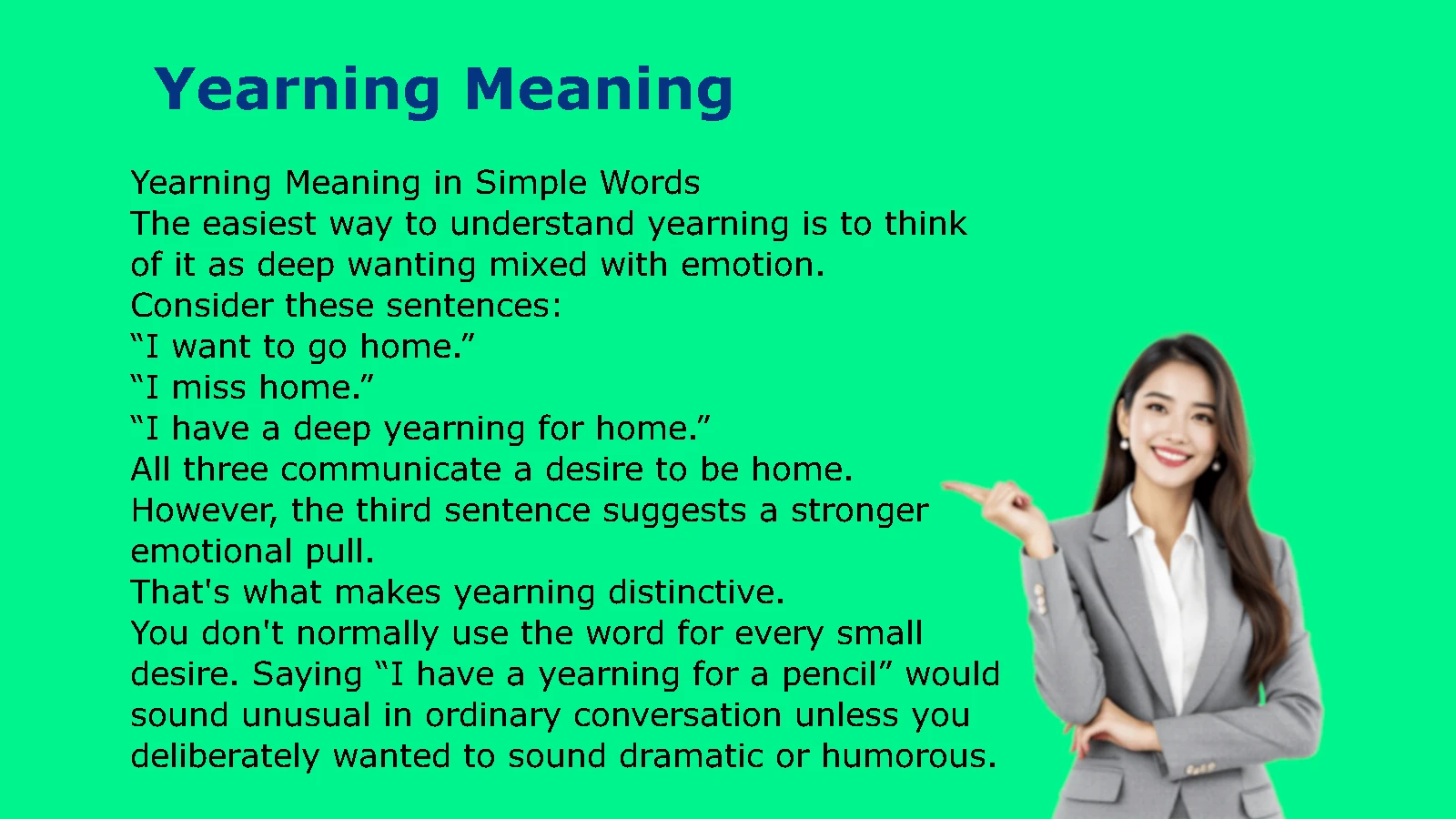
Yearning Meaning in Simple Words
The easiest way to understand yearning is to think of it as deep wanting mixed with emotion.
Consider these sentences:
- “I want to go home.”
- “I miss home.”
- “I have a deep yearning for home.”
All three communicate a desire to be home. However, the third sentence suggests a stronger emotional pull.
That’s what makes yearning distinctive.
You don’t normally use the word for every small desire. Saying “I have a yearning for a pencil” would sound unusual in ordinary conversation unless you deliberately wanted to sound dramatic or humorous.
Instead, yearning tends to appear when the desired thing matters on a deeper level.
Want vs. Yearning
| Want | Yearning |
| Usually general | Usually intense |
| Can be practical | Often emotional |
| May be temporary | Often feels persistent |
| Doesn’t require distance or difficulty | Often involves something distant, unavailable, or difficult |
| “I want coffee.” | “I yearn for a quiet life.” |
A useful rule is simple: a want asks for something; a yearning pulls you toward it emotionally.
What Does It Mean to Yearn for Something?
To yearn for something means to strongly and emotionally desire it.
The phrase often suggests that obtaining the thing isn’t easy. Cambridge specifically notes this connection between yearning and things that are difficult or impossible to have.
For example:
- “She yearned for a peaceful life.”
- “He yearned for freedom.”
- “They yearned for a return to normal life.”
- “I yearn for the quiet of the countryside.”
- “She had a deep yearning for adventure.”
The object of the yearning doesn’t have to be physical.
You can yearn for an emotion, condition, experience, or change. Someone can yearn for peace just as naturally as someone can yearn for a person.
Common Things People Yearn For
People often use yearning with ideas such as:
- Yearning for love
- Yearning for freedom
- Yearning for peace
- Yearning for home
- Yearning for connection
- Yearning for acceptance
- Yearning for adventure
- Yearning for success
- Yearning for belonging
- Yearning for change
- Yearning for independence
- Yearning for a better life
These expressions work because the desired thing carries emotional significance.
What Does It Mean to Yearn for Someone?
To yearn for someone means to strongly long for that person’s presence, affection, companionship, or return.
The expression can describe romantic feelings, but it isn’t limited to romance.
You might yearn for:
- A romantic partner
- A parent
- A child
- A close friend
- Someone who moved away
- Someone you lost
- Someone you haven’t seen in years
For example:
“After moving across the country, she felt a deep yearning for her family.”
Here, yearning emphasizes the emotional pain and intensity of being separated from loved ones.
Is Yearning for Someone Always Romantic?
No.
This is one of the most important points about the word.
Yearning can describe romantic attraction, but it can also describe homesickness, grief, friendship, family attachment, or a desire to reconnect.
Compare:
- “He yearned for his wife.” → potentially romantic.
- “She yearned for her children.” → familial.
- “He yearned for his childhood home.” → nostalgic.
- “They yearned for the friend they had lost touch with.” → friendship.
The context determines the kind of yearning.
Yearning Meaning With Examples
The best way to understand the word is to see how it works in different situations.
Yearning for a Person
“He had a deep yearning to see his daughter again.”
The sentence suggests more than simply missing someone. It conveys a powerful emotional desire to be reunited.
Yearning for a Place
“After ten years abroad, she felt a strong yearning for her hometown.”
Here, the word expresses homesickness and nostalgia.
Yearning for Freedom
“The prisoner had an overwhelming yearning for freedom.”
This example shows why yearning often appears with abstract ideas. Freedom isn’t an object you can simply pick up. It’s a condition someone deeply desires.
Yearning for Love
“His yearning for love made him search for a meaningful relationship.”
The phrase describes a strong emotional desire for affection, intimacy, or companionship.
Yearning for Adventure
“She felt a growing yearning for adventure.”
This doesn’t necessarily imply sadness. It can express excitement and an intense desire for new experiences.
Yearning to Do Something
“After years behind a desk, he was yearning to travel.”
The structure yearning to + verb is natural and common. Oxford provides the same grammatical pattern in examples involving a desire to return or pursue a particular action.
How to Use Yearning in a Sentence
You can use yearning in several natural sentence structures.
Yearning for + Noun
This is one of the most common patterns.
Examples:
- “She had a yearning for adventure.”
- “He felt a yearning for home.”
- “They shared a yearning for peace.”
- “His yearning for freedom grew stronger.”
The noun after for represents the thing being desired.
Yearning to + Verb
Use this pattern when the desired outcome is an action.
Examples:
- “She was yearning to leave.”
- “He had a yearning to travel.”
- “They were yearning to return home.”
- “I have a yearning to learn something new.”
Yearning as a Noun
You can use yearning as the subject or object of a sentence.
Examples:
- “Her yearning never disappeared.”
- “His yearning for home became stronger.”
- “The experience awakened a deep yearning for change.”
Yearning as Part of the Verb “Yearn”
You can also use yearning as the present participle of yearn.
Example:
“She was yearning for a fresh start.”
In this sentence, yearning describes an ongoing emotional state.
Yearning Synonyms
Several words overlap with yearning, but they don’t all carry exactly the same tone.
| Synonym | Basic meaning | How it differs from yearning |
| Longing | Strong desire for someone or something | The closest general synonym |
| Desire | Strong wish to have or do something | Broader and more neutral |
| Craving | Intense desire | Often suggests a powerful immediate urge |
| Pining | Deep longing, often for someone absent | Usually carries sadness |
| Hankering | Strong desire for something | More informal |
| Urge | Strong impulse to do something | Often more immediate |
| Wish | Desire for something to happen | Usually less emotionally intense |
| Hunger | Strong desire, often figurative | Works especially well in phrases such as “hunger for success” |
| Thirst | Intense desire | Often used figuratively for achievement or knowledge |
| Ache | Painful emotional longing | Strongly emphasizes emotional pain |
Merriam-Webster’s thesaurus lists longing, craving, desire, urge, thirst, hunger, and pining among words related to yearning.
The Closest Synonym: Longing
If you need one simple substitute for yearning, longing is usually the best choice.
Oxford directly identifies longing as a synonym of yearning.
For example:
- “She felt a deep yearning for home.”
- “She felt a deep longing for home.”
Both sentences work naturally.
The difference is mostly one of tone and context rather than a strict change in meaning.
Yearning vs. Longing
Yearning and longing overlap heavily.
Both describe a strong desire, especially when the desired person or thing feels distant or difficult to obtain.
| Yearning | Longing |
| Strong emotional desire | Strong emotional desire |
| Often persistent | Often persistent |
| Can suggest restlessness | Can suggest sadness or nostalgia |
| Common with abstract desires | Common with people, places, and past experiences |
| “Yearning for freedom” | “Longing for home” |
Merriam-Webster describes yearn as suggesting an eager, restless, or painful longing. It also distinguishes yearn from the broader verb long by emphasizing the emotional intensity that can accompany yearning.
Still, don’t treat these distinctions as rigid rules. Native speakers frequently use the two words interchangeably.
Yearning vs. Desire
Desire has a wider meaning than yearning.
You can have a desire for something without experiencing a deep emotional pull toward it.
For example:
“She has a desire to improve her writing.”
This sounds neutral and goal-oriented.
Now compare:
“She has a yearning to express herself.”
The second sentence sounds more personal and emotional.
Key Difference
Desire can describe almost any strong wish.
Yearning usually highlights the emotional depth of that wish.
That’s why desire works well in formal, professional, psychological, and everyday contexts, while yearning often sounds more expressive.
Yearning vs. Craving
These words both describe intense desire, but they often appear in different situations.
Craving commonly describes a powerful urge for something specific. Food provides the most familiar example:
“I have a craving for chocolate.”
You can also crave nonphysical things:
“She craved attention.”
Yearning, by contrast, often describes a deeper or more sustained emotional desire:
“She had a yearning for belonging.”
Merriam-Webster lists craving as a close synonym of yearning, which shows that the meanings overlap.
The distinction is therefore about typical usage, not an absolute rule.
Is Yearning a Positive or Negative Feeling?
Yearning can be either positive or negative.
The word itself doesn’t tell you whether the emotion feels pleasant.
Context does.
Yearning Can Feel Painful
Consider:
“He felt a deep yearning for the person he had lost.”
The yearning is painful because the desired person may never return.
Other examples include:
- Yearning for someone who has died
- Yearning for a relationship that ended
- Yearning for a home you can no longer visit
- Yearning for opportunities that have passed
- Yearning for a past that cannot return
Yearning Can Feel Hopeful
Yearning can also point toward something exciting:
“She felt a growing yearning for adventure.”
There’s no necessary sadness here.
The person simply feels a powerful desire to experience something new.
Yearning Can Feel Bittersweet
Sometimes yearning contains both hope and sadness.
Someone may yearn for childhood because those memories feel comforting while also knowing that childhood cannot return.
That combination gives yearning much of its emotional power.
Is Yearning Always Romantic?
No.
Although romantic writing often uses the word, yearning applies to far more than relationships.
You can yearn for:
- Home
- Family
- Freedom
- Peace
- Adventure
- Success
- Recognition
- Independence
- Purpose
- Connection
- Belonging
- Change
- A fresh start
For instance:
“After years of routine, she developed a yearning for adventure.”
Nothing about that sentence suggests romance.
Likewise:
“His yearning for freedom shaped every decision he made.”
Here, yearning describes a powerful desire for independence.
What Is the Difference Between Yearning and Missing Someone?
Missing someone and yearning for someone are closely related, but they aren’t identical.
Missing someone focuses on their absence.
Yearning focuses more strongly on the desire to have them present or regain the relationship.
For example:
“I miss my brother.”
This simply says that his absence affects you.
“I yearn for my brother.”
This sounds more intense and emotional. It suggests a deep longing for his presence or connection.
You can miss someone without yearning for them. However, yearning for someone often includes some sense of missing them.
What Is the Opposite of Yearning?
There isn’t one perfect antonym for yearning in every situation.
The best opposite depends on what you mean.
| Possible opposite | Why it works |
| Contentment | You feel satisfied with what you have |
| Satisfaction | Your desire has been fulfilled |
| Fulfillment | You have achieved or received what you wanted |
| Indifference | You don’t strongly care about the desired thing |
| Acceptance | You stop struggling against what you cannot change |
Contentment is often the clearest conceptual opposite.
If yearning means deeply wanting something you don’t have, contentment suggests feeling at peace with what you already have.
For example:
Yearning: “She yearned for a quieter life.”
Contentment: “She felt content with the life she had.”
The emotional direction changes completely.
Common Collocations With Yearning
Certain words naturally appear alongside yearning.
Oxford’s collocation information includes adjectives such as deep, desperate, and great as well as verbs such as feel, have, and find yourself.
adjective + yearning combinations
- Deep yearning
- Strong yearning
- Intense yearning
- Great yearning
- Desperate yearning
- Emotional yearning
- Inner yearning
- Secret yearning
noun phrases
- Yearning for love
- Yearning for freedom
- Yearning for peace
- Yearning for home
- Yearning for connection
- Yearning for adventure
- Yearning for acceptance
- Yearning for change
- Yearning for belonging
Common verb patterns
- Feel a yearning
- Have a yearning
- Experience a yearning
- Develop a yearning
- Suppress a yearning
- Express a yearning
- Awaken a yearning
These combinations help you use the word naturally rather than simply inserting it into a sentence because it sounds sophisticated.
Yearning in Different Contexts
The meaning stays broadly the same, but the emotional target changes depending on context.
Romantic Yearning
Romantic yearning describes a powerful desire for someone’s love, presence, affection, or attention.
“She felt a quiet yearning to be with him again.”
This kind of yearning often appears in poetry, novels, songs, and personal writing because the word captures emotional tension particularly well.
Nostalgic Yearning
Nostalgia can create yearning for an earlier period of life.
“He felt a strong yearning for the simplicity of childhood.”
The person isn’t necessarily trying to return literally. Instead, they miss the feelings associated with that period.
Yearning for Home
Someone who lives far from home may feel a deep yearning for familiar places, people, routines, or traditions.
“After years overseas, she developed a powerful yearning for home.”
This usage overlaps with homesickness, although yearning emphasizes the strength of the desire.
Yearning for Freedom
Freedom is another common object of yearning.
“The restrictions created a growing yearning for freedom.”
Here, the word describes a desire for a different condition rather than a physical object.
Yearning for Personal Growth
Yearning can also describe ambition or a desire for change.
“His yearning for a more meaningful career pushed him to learn new skills.”
This usage shows that yearning isn’t always passive. A strong desire can motivate action.
Word Forms of Yearning
Understanding the related forms makes the word easier to use correctly.
Yearn
Yearn is the verb.
It means to strongly desire or long for something.
Examples:
- “She yearns for a simpler life.”
- “He yearns to travel.”
- “They yearn for peace.”
Cambridge classifies yearn as an intransitive verb and gives both yearn for and yearn to constructions.
Yearned
Yearned is the past tense and past participle.
Examples:
- “She yearned for home.”
- “He yearned to return.”
- “They had yearned for freedom for years.”
Yearning
Yearning can function as a noun or as the present participle of yearn.
As a noun:
“His yearning for adventure was obvious.”
As part of a verb phrase:
“He was yearning for adventure.”
Common Mistakes With Yearning
Treating Yearning Like an Ordinary Want
Not every desire needs the word yearning.
“I have a yearning for a sandwich” might work humorously, but it sounds much more dramatic than “I want a sandwich.”
Use yearning when the desire has meaningful emotional weight or when the stronger tone is intentional.
Assuming Yearning Is Always Romantic
As discussed earlier, yearning can involve family, home, freedom, friendship, ambition, or almost any deeply desired thing.
Using the Wrong Grammar
Two especially useful structures are:
yearning for + noun
“She has a yearning for adventure.”
yearning to + verb
“She has a yearning to travel.”
Avoid forcing an incorrect construction when one of these natural patterns works.
Assuming Yearning Always Means Sadness
Yearning often has a wistful or painful quality, but it doesn’t have to.
“He felt a yearning for adventure.”
That sentence can express excitement rather than sadness.
Confusing Yearning With Craving
A craving often feels immediate and urgent.
Yearning tends to emphasize emotional depth and sustained longing.
Both can describe strong desire, but the context determines which sounds more natural.
Examples of Yearning in Everyday Sentences
Here are practical examples showing how the word works in different situations:
- She felt a deep yearning for home.
- He had a strong yearning for freedom.
- I have a growing yearning for adventure.
- She was yearning to see her family again.
- His yearning for connection became stronger over time.
- They shared a yearning for peace.
- The journey awakened her yearning for travel.
- He couldn’t ignore his yearning to start over.
- She carried a quiet yearning for the life she once had.
- His yearning for success motivated him to work harder.
- The old photograph triggered a sudden yearning for childhood.
- She felt an unexpected yearning to return to her hometown.
- His yearning for acceptance shaped many of his decisions.
- They had a deep yearning to belong somewhere.
- The experience left her with a powerful yearning for change.
Notice how most examples involve something meaningful rather than a minor everyday preference. That’s where the word feels most natural.
A Simple Case Study: Want, Longing, and Yearning
Imagine someone named Daniel who moved away from his hometown.
At first, Daniel might say:
“I want to visit home.”
This expresses a straightforward desire.
After several years, he might say:
“I miss home.”
Now the focus has shifted toward absence and emotion.
If the separation becomes especially meaningful, he might say:
“I have a deep yearning for home.”
The three statements describe related feelings, but their emotional intensity differs.
| Expression | Main idea | Emotional intensity |
| Want to visit home | Desire | Low to moderate |
| Miss home | Absence | Moderate |
| Yearn for home | Deep emotional longing | High |
This distinction explains why yearning often appears in emotionally expressive writing.
A Useful Quote to Remember the Meaning
“Yearning is desire with emotional weight.”
That isn’t a dictionary definition. It’s a simple way to remember how the word works.
If want describes the destination, yearning describes the emotional pull toward it.
Yearning Meaning in Literature and Everyday English
Writers often choose yearning because the word compresses several feelings into one expression.
It can suggest:
- Desire
- Distance
- Hope
- Sadness
- Nostalgia
- Restlessness
- Emotional attachment
- Unfulfilled wishes
That’s why the word works particularly well in literary and reflective writing.
Everyday English uses it too, especially when someone wants to emphasize emotion.
For example:
“I’m yearning for a quiet weekend.”
The sentence is slightly more expressive than “I want a quiet weekend.”
In a literary context, the same word can carry much more weight:
“She carried a lifelong yearning for the place she once called home.”
The surrounding context determines how dramatic or ordinary the word sounds.
What Does “Yearning for Love” Mean?
Yearning for love means having a strong emotional desire to experience love, affection, intimacy, or a meaningful romantic connection.
It doesn’t necessarily mean someone wants a particular person.
For example:
“He had a deep yearning for love and companionship.”
The person wants emotional connection in general.
By contrast:
“He yearned for her.”
This points toward a particular person.
That distinction matters when interpreting the phrase.
What Does “Yearning for Freedom” Mean?
Yearning for freedom means having a powerful desire to escape restrictions and experience independence or autonomy.
The restriction might be physical, social, emotional, or personal.
For example:
“After years of following other people’s expectations, she felt a yearning for freedom.”
Here, freedom means the ability to make her own choices.
The phrase can therefore describe much more than physical confinement.
What Does “Yearning for Home” Mean?
Yearning for home means deeply wanting to return to or reconnect with a place that feels like home.
That home could be:
- A childhood house
- A hometown
- A country
- A familiar community
- A family environment
- A place associated with safety and belonging
The phrase often combines homesickness and nostalgia.
Someone may not simply miss the physical location. They may yearn for the memories, people, routines, and sense of identity connected to it.
Frequently Asked Questions About Yearning
What does yearning mean?
Yearning means having a strong and emotional desire for someone or something, especially when that person or thing feels distant, unavailable, or difficult to obtain.
What is an example of yearning?
An example is:
“She felt a deep yearning for her hometown.”
The sentence suggests that she doesn’t merely want to visit. She feels a strong emotional longing for it.
Is yearning the same as longing?
Yearning and longing are very close in meaning. Both describe strong desire or emotional longing. Oxford lists longing as a synonym for yearning.
Is yearning a strong feeling?
Yes. Yearning describes an intense form of desire, particularly when the desired thing feels difficult or impossible to obtain.
Can you yearn for a person?
Yes. Yearn for someone means to deeply long for that person’s presence, affection, companionship, or return.
Can you yearn for something you never had?
Yes.
You can yearn for an experience, lifestyle, relationship, opportunity, or future that you’ve never actually had.
For example:
“She yearned for a life filled with adventure.”
She may never have lived that life, yet she can still strongly desire it.
Is yearning positive or negative?
It can be either. Yearning may feel painful when you desire something unavailable, but it can also express hope, ambition, excitement, or a desire for positive change.
What is another word for yearning?
Longing is probably the closest everyday synonym. Other related words include desire, craving, pining, hankering, urge, and hunger.
What is the opposite of yearning?
There is no single perfect opposite. Contentment, satisfaction, fulfillment, and indifference can all contrast with yearning depending on the context.
What does “yearning for love” mean?
It means having a deep emotional desire for love, affection, intimacy, or companionship.
What does “yearning for someone” mean?
It means strongly longing for someone’s presence or connection. The phrase can describe romantic, family, or friendship relationships.
Final Takeaway: Yearning Meaning
The simplest yearning meaning is a deep and emotional desire for someone or something.
Unlike an ordinary want, yearning often carries a sense of distance, difficulty, absence, or emotional importance. You might yearn for a person you miss, a home you left behind, freedom you don’t have, or a future you’ve always imagined.
The most useful patterns to remember are:
- Yearning for something: “She has a yearning for adventure.”
- Yearning for someone: “He has a yearning for his family.”
- Yearning to do something: “She has a yearning to travel.”
- Yearn for something: “He yearns for peace.”
- Yearn to do something: “She yearns to return home.”
If you remember one idea, make it this: yearning is more than wanting. It is wanting something with emotional depth.
Quick Definition
| Question | Answer |
| Meaning | A strong and emotional desire |
| Closest synonym | Longing |
| Verb form | Yearn |
| Common pattern | Yearning for something |
| Another pattern | Yearning to do something |
| Can it be romantic? | Yes |
| Is it always romantic? | No |
| Can it be positive? | Yes |
| Can it be painful? | Yes |
| Common opposite | Contentment |