
Ephemeral describes something that lasts for only a short time or fades quickly. It is often used to talk about moments, emotions, trends, or natural events that are temporary. Ephemeral meaning refers to anything that is brief, short-lived, or temporary.
The challenge is that ephemeral can describe anything that lasts for only a short time, from temporary moments and fleeting emotions to short-lived trends and digital content. And here’s the kicker: understanding its meaning and usage can help you communicate more accurately and expand your vocabulary.
In this guide, you’ll discover the ephemeral meaning, ephemeral definition, how to pronounce ephemeral, ephemeral synonyms, ephemeral antonyms, and how to use ephemeral in a sentence. You’ll also learn the origin of the word, explore real-life examples, and understand when ephemeral is the right word to use.
By the end, you’ll know exactly what ephemeral means, how to use it confidently in both writing and conversation, and why it’s one of the most useful words for describing things that don’t last long.
What Does Ephemeral Mean?
Ephemeral Definition
Ephemeral is an adjective that means lasting for a very short period of time.
In simple terms, something ephemeral exists briefly and then disappears. It does not continue for a long time.
The dictionary definition of ephemeral focuses on the idea of short duration. However, the word often includes a deeper meaning. It can describe something that feels delicate, rare, or meaningful because it cannot be kept forever.
For example:
- “The beauty of the rainbow was ephemeral.”
- “Social media trends are often ephemeral.”
- “She enjoyed the ephemeral moment of watching the sunrise.”
In each sentence, something exists temporarily. The rainbow fades, trends lose attention, and the sunrise changes within minutes.
The word does not mean something is worthless. In fact, many ephemeral things become more meaningful because they are limited.
A diamond may last for generations, but a perfect sunset lasts only a few minutes. The short lifespan of the sunset is what makes the experience feel unique.
Ephemeral Meaning in Simple Words
What Does Ephemeral Mean in Everyday Language?
If you want a simple explanation, ephemeral means something that doesn’t last long.
You can think of it as:
Ephemeral = short lived + temporary + quickly passing
Here are some everyday examples:
| Ephemeral Thing | Why It Is Ephemeral |
| A shooting star | It appears for only a few seconds |
| A snowflake | It melts quickly after landing |
| A social media story | It disappears after a limited time |
| A flower blossom | It blooms for a short season |
| A childhood moment | The experience passes quickly |
Imagine holding a bubble in your hand. It shines with beautiful colors for a moment, but then it bursts. That bubble represents something ephemeral.
The important idea is not only that it ends. The idea is that it exists briefly and creates an impact while it lasts.
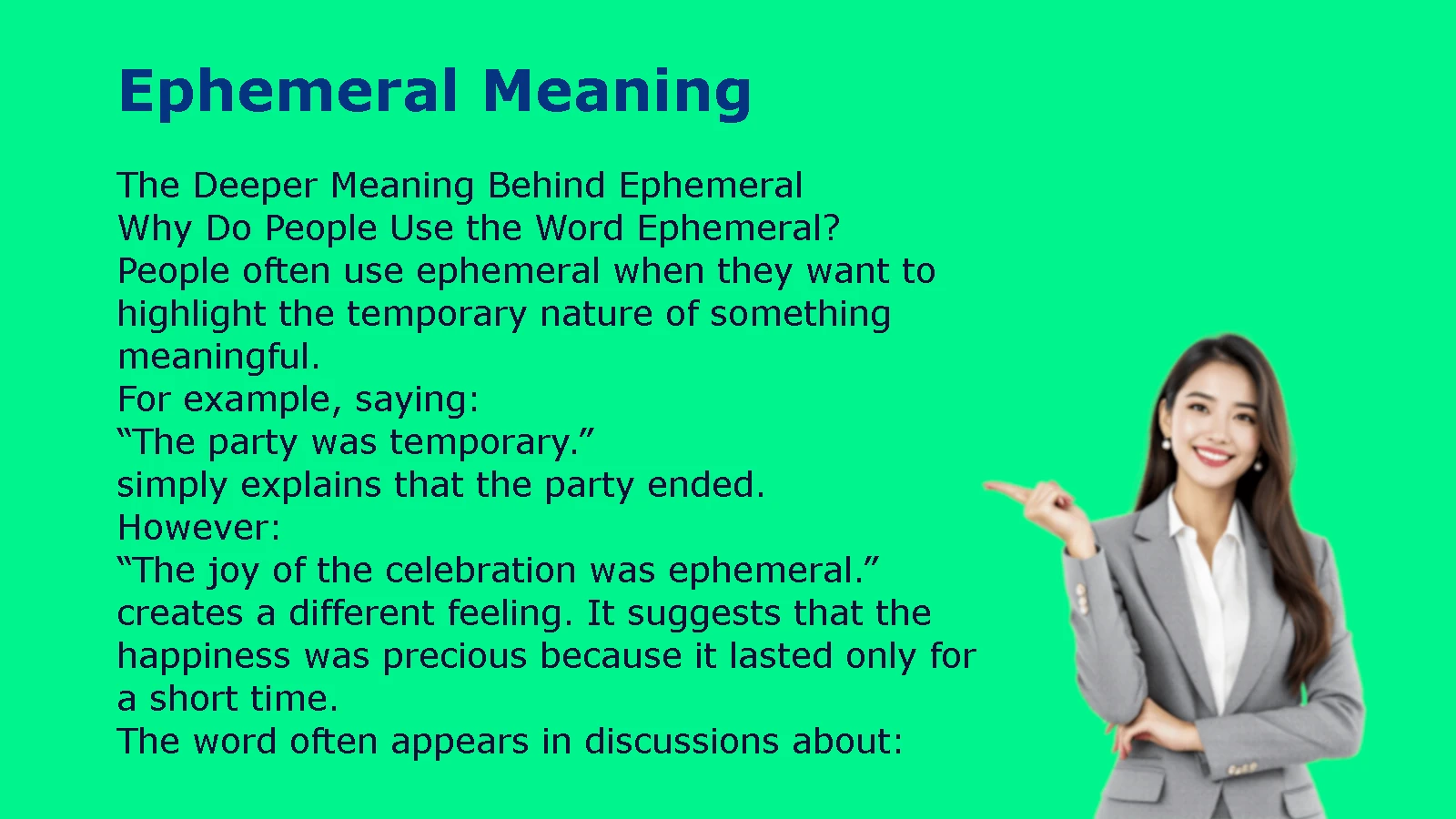
The Deeper Meaning Behind Ephemeral
Why Do People Use the Word Ephemeral?
People often use ephemeral when they want to highlight the temporary nature of something meaningful.
For example, saying:
“The party was temporary.”
simply explains that the party ended.
However:
“The joy of the celebration was ephemeral.”
creates a different feeling. It suggests that the happiness was precious because it lasted only for a short time.
The word often appears in discussions about:
- Beauty
- Memories
- Art
- Nature
- Technology
- Human emotions
- Life experiences
Many philosophers and writers explore the idea that life itself is ephemeral. Human experiences, emotions, and achievements change over time. Recognizing this can encourage people to appreciate the present moment.
Ephemeral Word Origin and History
Where Does the Word Ephemeral Come From?
The word ephemeral comes from the Greek word ephēmeros, which means “lasting only one day.”
The word combines two Greek parts:
- epi meaning “on” or “upon”
- hēmera meaning “day”
Originally, the word described things that existed for only a single day.
Over time, English speakers expanded the meaning. Instead of referring only to one day, ephemeral began describing anything with a very short lifespan.
The meaning developed from:
“lasting one day”
to:
“lasting briefly or existing for a short time.”
How the Meaning Changed Over Time
| Time Period | Meaning |
| Ancient Greek period | Something lasting one day |
| Early English usage | Something short lived |
| Modern English | Anything temporary, brief, or quickly disappearing |
Today, people use ephemeral in many areas, including technology, art, business, and everyday conversation.
Ephemeral Meaning According to Dictionaries
Different dictionaries explain the word with slightly different wording, but they all focus on the same central idea: short duration.
| Dictionary Source | Meaning |
| Merriam Webster | Lasting for a very short time |
| Oxford English Dictionary | Existing or popular for only a short period |
| Cambridge Dictionary | Continuing for only a short time |
The key idea remains consistent:
Ephemeral describes something that does not stay for long.
Examples of Ephemeral Things in Real Life
Ephemeral Examples in Nature
Nature provides some of the clearest examples of ephemeral experiences.
A sunrise appears every morning, but no two sunrises look exactly the same. Clouds move, colors change, and the scene disappears within minutes.
Other examples include:
Morning Dew
Tiny drops of water may cover grass in the early morning. As sunlight increases, the droplets evaporate.
The beauty exists briefly, making it an ephemeral sight.
Cherry Blossoms
Cherry blossoms create stunning landscapes during their blooming season. However, the flowers often remain for only a short period before falling.
Their short lifespan is part of their charm.
A Butterfly’s Life
Some butterflies live only for a few weeks. During that time, they complete their entire life cycle.
Their existence reminds us that short lived does not mean insignificant.
Ephemeral Meaning in Technology and Social Media
Why Digital Trends Are Often Ephemeral
Modern technology has created many examples of ephemeral content.
Social media platforms popularized the idea of temporary digital experiences. Features such as disappearing photos and stories allow users to share content that exists briefly.
Examples include:
- Temporary social media posts
- Viral challenges
- Internet memes
- Trending hashtags
- Short lived online conversations
A video may receive millions of views today and become forgotten next month.
This shows how attention itself can be ephemeral.
However, temporary content can still have a major impact. A single viral message can influence conversations, launch businesses, or create cultural movements.
Ephemeral Human Experiences
Moments That Feel Ephemeral
Many of life’s most meaningful experiences are brief.
Examples include:
- Meeting someone for the first time
- Watching a child take their first steps
- Hearing a favorite song live
- Sharing a special conversation
- Traveling to a new place
These moments cannot be repeated in exactly the same way.
A vacation may last one week, but the memories can remain for decades. The experience itself is ephemeral, but its influence may last much longer.
How to Use Ephemeral in a Sentence
Understanding the ephemeral meaning is only the first step. To use the word naturally, you need to know where it fits in a sentence.
Because ephemeral is an adjective, it describes a noun. It usually appears before the noun it modifies or after linking verbs such as is, was, or became.
Common sentence examples:
- “The beauty of the northern lights is ephemeral.”
- “The artist captured an ephemeral moment of peace.”
- “Many internet trends are ephemeral.”
- “Her happiness after winning the competition was ephemeral.”
- “The village festival created an ephemeral sense of community.”
In each example, ephemeral describes something that does not last forever.
Common Sentence Patterns With Ephemeral
Ephemeral + Noun
One of the easiest ways to use the word is by placing it before a noun.
Here are common combinations:
| Phrase | Meaning |
| Ephemeral beauty | Beauty that lasts briefly |
| Ephemeral moment | A short but meaningful experience |
| Ephemeral nature | The temporary quality of something |
| Ephemeral trend | A trend that quickly loses popularity |
| Ephemeral experience | An experience that happens briefly |
| Ephemeral art | Art designed to exist temporarily |
Examples:
Ephemeral beauty
“The photographer wanted to preserve the ephemeral beauty of the autumn leaves.”
The leaves change color and fall quickly, making their appearance temporary.
Ephemeral moment
“The first snowfall created an ephemeral moment of wonder for the children.”
The excitement came from experiencing something rare and short lived.
The Ephemeral Nature of Something
The phrase “the ephemeral nature of” is one of the most common ways people use this word.
It means something naturally changes, disappears, or does not last forever.
Examples:
- “The poem explores the ephemeral nature of human life.”
- “Technology companies must understand the ephemeral nature of online popularity.”
- “The artist’s work reflects the ephemeral nature of memories.”
This phrase often appears in:
- Literature
- Academic writing
- Art criticism
- Philosophy
- Essays
It helps explain that change and impermanence are normal parts of life.
Ephemeral Meaning in Literature and Writing
How Writers Use Ephemeral
Writers often use ephemeral to explore ideas about time, memories, and human existence.
A writer may describe a sunset as ephemeral not only because it disappears, but because it represents a larger idea:
- Moments pass quickly.
- Life changes constantly.
- Beautiful experiences cannot always be preserved.
For example, a poet might compare youth to an ephemeral flower. The flower blooms beautifully but eventually fades. The comparison highlights how quickly time moves.
Why Ephemeral Creates Emotional Impact
The word creates a feeling that something is precious because it is temporary.
Compare these two sentences:
Simple:
“The concert ended after two hours.”
More expressive:
“The magical atmosphere of the concert was ephemeral.”
The second sentence focuses on the feeling, not just the timeline.
That is why writers choose words like ephemeral. It adds emotional depth.
Ephemeral Meaning in Art
Temporary Art and Ephemeral Creativity
Many artists intentionally create works that do not last forever.
This type of art is called ephemeral art.
Examples include:
- Sand sculptures
- Ice sculptures
- Performance art
- Chalk drawings
- Environmental installations
The temporary nature becomes part of the artwork itself.
A sand sculpture disappearing with the tide is not a failure. Its disappearance is the message.
The artist encourages viewers to appreciate the moment instead of expecting the artwork to remain permanently.
Famous Examples of Ephemeral Art
Ice Sculptures
Ice sculptures demonstrate the idea perfectly.
An artist may spend hours creating a detailed sculpture, but warmth slowly changes it. The artwork exists only for a short period.
Its temporary nature creates urgency. People know they must experience it before it disappears.
Street Art
Some street art exists only until weather, cleaning, or construction removes it.
Although temporary, these works can influence communities and start conversations.
Ephemeral Meaning in Science
Ephemeral Events in Nature and Science
Scientists also use the word ephemeral to describe short lived natural phenomena.
Examples include:
Ephemeral Plants
Some plants grow quickly after rainfall and complete their life cycle within a short period.
These plants appear, reproduce, and disappear before conditions change.
Ephemeral Streams
An ephemeral stream only carries water during certain periods, such as after rainfall.
Unlike permanent rivers, these streams may remain dry most of the year.
Short Lived Species
Some organisms have very brief life cycles.
For example, certain insects spend most of their lives developing before living only a short adult stage.
Their existence may be brief, but they still play important roles in ecosystems.
Ephemeral Meaning in Business and Marketing
Why Businesses Study Ephemeral Trends
Businesses often deal with things that change quickly.
Consumer interests, online conversations, and viral products can become popular almost instantly and disappear just as fast.
Examples of ephemeral business trends:
- Viral products
- Short lived fashion styles
- Internet challenges
- Temporary marketing campaigns
A company that depends only on a temporary trend may struggle once attention moves elsewhere.
However, businesses can use ephemeral trends wisely by:
- Testing new ideas quickly
- Understanding customer behavior
- Creating timely campaigns
- Adapting to changing interests
Ephemeral Synonyms and Related Words
Several words have meanings similar to ephemeral, but each has a slightly different feeling.
Understanding these differences helps you choose the right word.
| Word | Meaning | Difference From Ephemeral |
| Temporary | Lasting for a limited time | The most general term |
| Brief | Short in length or duration | Focuses mainly on time |
| Fleeting | Passing quickly | Often describes feelings or moments |
| Transient | Existing briefly before changing | More formal |
| Momentary | Lasting only a moment | Usually extremely short |
| Short lived | Not lasting long | More casual |
Ephemeral vs Temporary: What Is the Difference?
Many people use ephemeral and temporary as if they mean exactly the same thing. They are similar, but there is an important difference.
Temporary
Temporary simply means something will not last forever.
Examples:
- Temporary job
- Temporary building
- Temporary solution
The word focuses on duration.
Ephemeral
Ephemeral suggests something disappears quickly and often carries an emotional or poetic feeling.
Examples:
- Ephemeral beauty
- Ephemeral happiness
- Ephemeral memories
The difference:
| Temporary | Ephemeral |
| General word | More expressive word |
| Can last days, months, or years | Usually suggests a shorter period |
| Focuses on practical duration | Focuses on the experience of passing away |
Example:
A temporary office may exist for five years.
A sunset is ephemeral because it changes within minutes.
Ephemeral vs Fleeting: Difference Explained
Fleeting and ephemeral are closely related, but they are not always interchangeable.
Fleeting
Fleeting usually describes something that passes quickly.
Examples:
- Fleeting happiness
- Fleeting glance
- Fleeting opportunity
It often describes emotions, thoughts, or moments.
Ephemeral
Ephemeral can describe:
- Objects
- Trends
- Experiences
- Natural events
- Ideas
Examples:
- Ephemeral flowers
- Ephemeral technology trends
- Ephemeral artwork
Comparison:
| Ephemeral | Fleeting |
| More formal and descriptive | More common in everyday speech |
| Often connected with beauty or change | Often connected with quick passing |
| Can describe physical things | Usually describes moments or feelings |
Is Ephemeral a Positive or Negative Word?
The word ephemeral is usually neutral.
It does not automatically mean something good or bad.
The meaning depends on the context.
Positive Examples
“The photographer captured the ephemeral beauty of the sunrise.”
Here, the short duration makes the sunrise feel special.
“Their friendship began with an ephemeral conversation that changed everything.”
The moment was brief but meaningful.
Negative Examples
“The company’s success was ephemeral.”
This suggests the success disappeared too quickly.
“The excitement surrounding the product was ephemeral.”
The popularity did not last.
Opposite of Ephemeral
The opposite of ephemeral is something that lasts a long time.
Common opposites include:
| Opposite Word | Meaning |
| Permanent | Lasting forever |
| Enduring | Continuing for a long time |
| Lasting | Remaining over time |
| Eternal | Without an end |
| Long lasting | Continuing for an extended period |
Examples:
- Ephemeral fame vs enduring reputation
- Ephemeral trend vs permanent change
- Ephemeral beauty vs timeless beauty
Common Mistakes When Using Ephemeral
Mistake: Thinking Ephemeral Means Unimportant
A common misunderstanding is assuming that something short lived has little value.
That is not true.
A single conversation may last five minutes but change someone’s life.
A sunset may disappear quickly but create a lifelong memory.
Short duration does not equal low importance.
Mistake: Using Ephemeral for Ordinary Temporary Things
Although ephemeral means temporary, it is not always the best choice.
For example:
“My ephemeral appointment lasted one hour.”
This sounds unnatural.
Better:
“My brief appointment lasted one hour.”
Ephemeral works better when the temporary nature feels meaningful, unusual, or worth noticing.
Mistake: Overusing Ephemeral
Because the word sounds elegant, some writers use it too often.
Using it once in the right place creates impact.
Using it repeatedly can make writing feel forced.
Choose it when you want to highlight the beauty or importance of something temporary.
Frequently Asked Questions About Ephemeral Meaning
What does ephemeral mean?
Ephemeral means lasting for a very short time. It describes things that appear briefly and then disappear.
Examples include sunsets, trends, emotions, and temporary experiences.
What is an example of something ephemeral?
Examples of ephemeral things include:
- A rainbow
- A shooting star
- A social media story
- A flower bloom
- A brief moment of happiness
Is ephemeral positive or negative?
Ephemeral is neither positive nor negative.
It depends on the situation.
It can describe beautiful temporary experiences or things that disappear too quickly.
What is the pronunciation of ephemeral?
The common pronunciation is:
ih FEM ur uhl
The stress falls on the second syllable:
FEM
Can ephemeral describe people?
Usually, people do not describe a person as ephemeral.
Instead, the word describes a person’s:
- Influence
- Fame
- Presence
- Moments with others
For example:
“The actor’s early fame was ephemeral.”
This means the popularity did not last long.
Final Thoughts: The Meaning Behind Ephemeral
The word ephemeral captures one of the most interesting parts of life: things do not have to last forever to matter.
An ephemeral moment may exist for only seconds, minutes, or days, yet it can leave a lasting impression.
A sunset disappears. A song ends. A conversation finishes. A season changes.
Still, these brief experiences often become the memories people treasure most.
Understanding the ephemeral meaning gives you a powerful word for describing temporary beauty, changing trends, and meaningful moments. It reminds us that sometimes the things that disappear the fastest are the ones we appreciate the most.