
Have you ever come across the word “extrapolate” and wondered what it really means? While EXTRAPOLATE Meaning may sound complicated at first, the word has a simple idea behind it: using known information to make a reasonable guess about something you don’t know yet.
Extrapolate is a verb that means to estimate or predict something by using existing facts, patterns, or trends. It is often used when you take information from a known situation and use it to make a conclusion about a different or future situation.
Examples:
- We can extrapolate future sales from the company’s current growth rate.
- Scientists extrapolated the results to predict what might happen next.
The confusion is understandable. People often search for what does extrapolate mean, extrapolate meaning in simple words, extrapolate meaning in a sentence, or how to use extrapolate because the word is common in academic, scientific, business, and everyday contexts. And here’s the kicker: extrapolate doesn’t simply mean to guess. It usually involves using existing information, patterns, or evidence to make that prediction.
In this guide, you’ll learn the complete EXTRAPOLATE Meaning, its definition, pronunciation, correct usage, and examples in sentences. You’ll also discover extrapolate meaning in simple English, synonyms for extrapolate, its opposite, and the difference between extrapolate and interpolate.
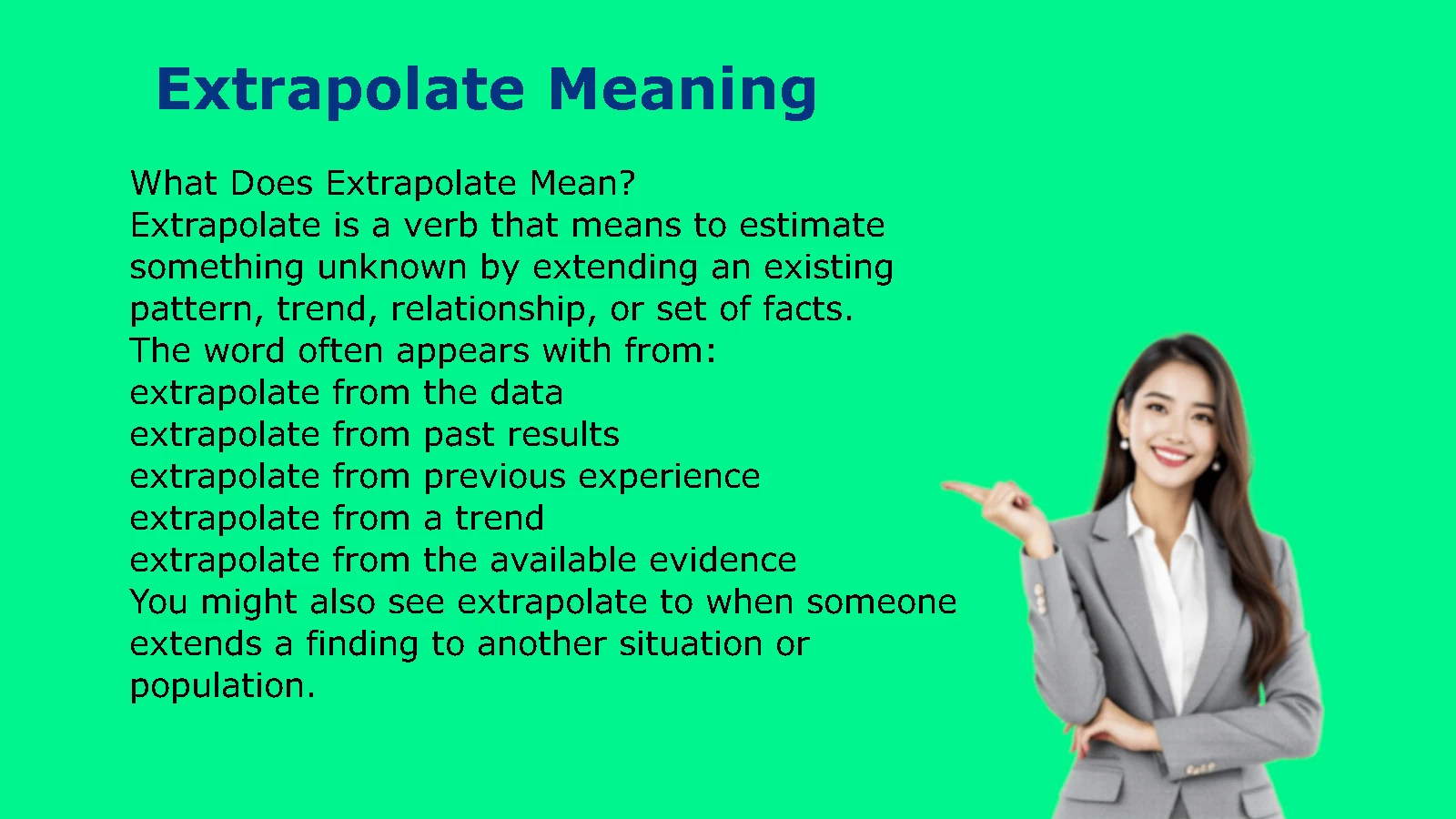
What Does Extrapolate Mean?
Extrapolate is a verb that means to estimate something unknown by extending an existing pattern, trend, relationship, or set of facts.
The word often appears with from:
- extrapolate from the data
- extrapolate from past results
- extrapolate from previous experience
- extrapolate from a trend
- extrapolate from the available evidence
You might also see extrapolate to when someone extends a finding to another situation or population.
For example:
Researchers extrapolated the results to a larger population.
The basic reasoning looks like this:
Known information → observed pattern → extension → estimated result
That last step matters. An extrapolation isn’t automatically a fact. It is an estimate based on an assumption that the observed pattern will continue or remain useful outside the information you already have.
Extrapolate Meaning in Simple Words
In plain English, extrapolate means “use what you know to make a reasonable estimate about what you don’t know.”
Imagine that you’ve tracked your commute for five days. You usually travel 20 miles in about 40 minutes. If you use that pattern to estimate how long the same trip might take tomorrow, you’re making a simple projection.
In real life, the calculation might involve traffic, weather, road construction, or other factors. That’s why extrapolation doesn’t guarantee the outcome.
A useful way to remember it is:
Extrapolate = extend a known pattern beyond the information you have.
Extrapolate Pronunciation and Word Forms
The US pronunciation of extrapolate is approximately ik-STRAP-uh-layt. Cambridge gives the US pronunciation as /ɪkˈstræp.ə.leɪt/.
Here are the main forms of the word:
| Word form | Example |
| extrapolate | We can extrapolate the trend. |
| extrapolates | The model extrapolates future demand. |
| extrapolated | Analysts extrapolated the results. |
| extrapolating | They are extrapolating from historical data. |
| extrapolation | The forecast relies on extrapolation. |
| extrapolative | The analysis uses an extrapolative method. |
Extrapolate functions as both a transitive and intransitive verb. In practical writing, however, it usually sounds most natural when you explain what information someone is extrapolating from or what they are extrapolating.
For example:
- Natural: Analysts extrapolated future demand from recent sales.
- Natural: We can extrapolate from these results.
- Less informative: Analysts extrapolated.
The final sentence is grammatically possible, but the reader may wonder, Extrapolated what? From what?
How to Use “Extrapolate” in a Sentence
The word works best when the sentence makes the source of the estimate clear.
Everyday Examples of Extrapolate
Here are some natural examples:
- We can extrapolate future costs from the company’s spending history.
- She extrapolated next year’s expenses from the previous three years.
- You can’t extrapolate someone’s personality from one conversation.
- The team extrapolated future demand from recent sales.
- Researchers used the available results to extrapolate what might happen next.
- It’s risky to extrapolate a long-term trend from one unusual month.
Notice the recurring structure. Something known provides the starting point for something unknown.
Academic and Professional Examples
The word becomes especially common when people discuss evidence, research, models, and forecasts.
Business:
The company extrapolated next quarter’s revenue from its recent growth rate.
Science:
Researchers extrapolated the population trend using measurements collected over several years.
Economics:
Economists may extrapolate future demand from historical spending patterns.
Research:
The researchers cautioned against extrapolating the findings to populations that weren’t included in the study.
That final example highlights an important point: extrapolation has limits. A pattern observed in one group doesn’t automatically apply to every other group.
Extrapolate Meaning in Different Contexts
The central meaning stays the same across fields. What changes is the type of information being extended.
Extrapolate in Mathematics
In mathematics, extrapolation involves estimating values outside the range of known data.
Imagine that you have these values:
| x | y |
| 1 | 10 |
| 2 | 20 |
| 3 | 30 |
| 4 | 40 |
The pattern increases by 10 each time.
If you estimate the value at x = 5, you’re extending the pattern beyond the observed values. Under this simple pattern, you would estimate 50.
That’s extrapolation.
The important phrase is outside the known range.
If you instead estimated the value at x = 2.5, you would be estimating a value inside the known range. That is interpolation.
In actual mathematical work, the relationship may be far more complicated than a straight line. A model might involve curves, polynomials, logarithms, exponential relationships, or other functions.
Extrapolate in Statistics and Data Analysis
Statistics uses extrapolation to estimate values or outcomes beyond the observed data.
Suppose a business records customer growth for five years. Analysts could use a statistical model to estimate future customer numbers.
That estimate is an extrapolation if it extends beyond the period represented by the available data.
However, the farther an estimate moves beyond the observed data, the more important the underlying assumptions become.
Why?
Because the original pattern might change.
A company might grow rapidly for three years and then slow down. A population might increase before reaching a resource limit. Consumer behavior might change after a new competitor enters the market.
A mathematical model can extend a trend perfectly while reality takes a sharp turn.
That’s one reason analysts shouldn’t treat an extrapolated figure as a guaranteed future value.
Extrapolate in Science
Scientists sometimes use extrapolation when direct measurements aren’t available for every condition or period.
For example, researchers might observe a measurable trend over a certain range and use a model to estimate what happens outside that range.
However, scientific extrapolation requires careful attention to whether the relationship remains valid.
If a physical process changes behavior beyond the observed range, simply extending the old pattern can produce a misleading result.
Extrapolate in Business
Businesses frequently extrapolate when making forecasts.
Common examples include:
- future revenue
- sales volume
- customer growth
- operating costs
- demand
- inventory needs
- website traffic
- market trends
Suppose an online store sells 10,000 units in January, 11,000 in February, and 12,000 in March. A simple trend might suggest 13,000 units in April.
That’s an extrapolation if the estimate extends the observed pattern.
A real business forecast, however, would usually consider more than a simple trend. Seasonal demand, pricing, promotions, competition, economic conditions, and supply constraints could all affect the result.
What Does “Extrapolate From” Mean?
Extrapolate from means to use existing information as the basis for an estimate or conclusion.
Cambridge specifically lists extrapolate from something as a common construction.
For example:
We can extrapolate from the available data.
Here, the available data provides the basis for the estimate.
More examples include:
- We extrapolated from historical sales figures.
- Scientists extrapolated from previous observations.
- The researchers extrapolated from the study results.
- Analysts extrapolated from several years of financial data.
- You shouldn’t extrapolate from such a small sample.
The last example is especially important. A small amount of information may not provide a strong enough basis for extrapolation.
“Extrapolate To” vs. “Extrapolate From”
These two prepositions describe different parts of the reasoning.
Extrapolate from tells you where the information comes from.
Analysts extrapolated from past sales.
Extrapolate to can identify where the conclusion is being extended.
Researchers extrapolated the findings to a larger population.
Both constructions appear in professional and academic writing. Cambridge gives examples of extrapolating findings to populations outside the original evidence.
What Is Extrapolation?
Extrapolation is the noun form of extrapolate.
It refers to the process of using existing information to estimate something beyond what is directly known. Cambridge defines extrapolation as the process of using known information to think about what might happen.
Compare the two:
- Extrapolate: the action
- Extrapolation: the process or result
For example:
Analysts extrapolated future sales from past data.
The sales forecast involved significant extrapolation.
Merriam Webster also lists extrapolation as the noun form and extrapolative as an adjective.
A Simple Extrapolation Example
Imagine a plant grows approximately 2 inches every week.
After four weeks, it has grown about 8 inches.
If the same growth pattern continues, you might estimate that it will have grown about 12 inches after six weeks.
The reasoning is straightforward:
4 weeks → 8 inches
6 weeks → estimated 12 inches
The 12-inch figure isn’t an observation from the original four weeks. It’s an estimate based on extending the observed pattern.
That’s extrapolation in its simplest form.
Extrapolate vs. Interpolate
Extrapolate and interpolate sound similar because both involve estimating values from known information. The crucial difference is where the estimate falls.
| Term | What it does | Location of estimate |
| Extrapolate | Extends a pattern beyond known data | Outside the known range |
| Interpolate | Estimates a value between known data points | Inside the known range |
Think of a line on a graph.
If your known data runs from January through June:
- Estimating April from the surrounding data is interpolation.
- Estimating August from the same trend is extrapolation.
Simple Interpolation Example
Suppose you know:
- Day 1: 10 units
- Day 3: 20 units
If you estimate Day 2 at 15 units, you’re interpolating because Day 2 sits between the known points.
Simple Extrapolation Example
Using the same data, suppose you estimate the value for Day 5.
Day 5 lies beyond the known observations. That’s extrapolation.
The easiest memory trick is:
Interpolation = inside. Extrapolation = outside.
The distinction matters because predictions outside the observed range depend heavily on the assumption that the underlying relationship continues. In more advanced statistical and machine learning settings, researchers also treat interpolation and extrapolation as meaningfully different prediction problems.
Extrapolate vs. Predict
These words overlap, but they aren’t identical.
Predict means to say what you think will happen in the future or what an outcome is likely to be.
Extrapolate means to make that estimate by extending existing information or a pattern.
For example:
The meteorologist predicted heavy rain tomorrow.
That’s a prediction.
Now consider:
The analyst extrapolated next year’s sales from the company’s recent growth rate.
That’s an extrapolation.
An extrapolation can produce a prediction, but not every prediction comes from extrapolation.
A person could predict that a team will win because they believe it has stronger players. That’s a prediction. Unless they’re extending a measurable pattern or existing data, it isn’t necessarily an extrapolation.
Extrapolate vs. Infer
Infer means to reach a conclusion from evidence or reasoning. Extrapolate is more specific because it involves extending known information beyond the information directly available.
Consider these examples:
The road is wet, so I infer that it rained.
That’s an inference.
It has rained every afternoon for the past week, so I extrapolate that tomorrow may also be rainy.
That’s extrapolation.
The difference becomes clearer when you focus on the direction of the reasoning.
- Infer: evidence → conclusion
- Extrapolate: known pattern → conclusion beyond the known range
Merriam Webster lists infer, deduce, conclude, and related terms among words associated with extrapolate, but these terms aren’t perfect substitutes in every sentence.
Synonyms for Extrapolate
Several words can replace extrapolate in certain contexts. The best choice depends on what you’re trying to say.
| Word | Basic meaning | Best used when |
| Estimate | Give an approximate value | You want an approximate number |
| Predict | Say what may happen | You’re discussing a future outcome |
| Project | Estimate a future result | You’re discussing forecasts |
| Infer | Reach a conclusion from evidence | You’re reasoning from clues |
| Deduce | Reach a conclusion through reasoning | The evidence supports a logical conclusion |
| Conclude | Decide something based on evidence | You’re stating a reasoned conclusion |
| Speculate | Consider what might be true | Evidence is limited or uncertain |
Extrapolate vs. Estimate
These words are especially easy to confuse.
You might estimate the cost of a repair based on its parts and labor.
You might extrapolate future repair costs from several years of maintenance records.
An estimate doesn’t necessarily require a trend. Extrapolation usually does.
Extrapolate vs. Project
Project often sounds natural in business and financial contexts.
The company projected $5 million in revenue.
You could also say:
The company extrapolated its revenue from recent growth patterns.
The second sentence emphasizes the method behind the estimate.
Antonyms of Extrapolate
There isn’t one perfect opposite of extrapolate in every context.
However, several words contrast with the idea of extending known information:
- observe
- measure
- verify
- confirm
- record
- establish
For example, a scientist who measures a temperature directly is obtaining an observation. A scientist who uses previous measurements to estimate an unmeasured temperature is extrapolating.
That distinction is conceptual rather than a strict dictionary antonym.
Common Phrases With “Extrapolate”
You’ll often see extrapolate in a few recurring expressions.
Extrapolate From the Data
Analysts extrapolated future demand from the available data.
This means they used existing data to estimate something beyond it.
Extrapolate From Past Trends
The company extrapolated future revenue from past trends.
The historical pattern provides the basis for the forecast.
Extrapolate Future Growth
Investors should be cautious about extrapolating future growth from one exceptional quarter.
This construction is common when discussing business performance.
Extrapolate the Results
Researchers shouldn’t automatically extrapolate the results to every population.
Here, the concern is whether findings from one setting apply elsewhere.
Extrapolate Beyond the Available Data
The model shouldn’t extrapolate too far beyond the available data.
This phrase emphasizes one of the biggest limitations of extrapolation: distance from evidence matters.
Common Mistakes When Using “Extrapolate”
The word sounds technical, but the biggest mistakes involve reasoning rather than grammar.
Treating an Extrapolation as a Fact
An extrapolated value is generally an estimate.
Suppose a company has grown 10% annually for three years. You might extrapolate another year of 10% growth.
That doesn’t mean the company will grow by exactly 10%.
A better sentence is:
Based on its recent growth, the company could reach approximately 110% of its current size next year.
The wording reflects uncertainty instead of disguising an estimate as a certainty.
Confusing Extrapolation With Interpolation
Remember:
Inside the known range = interpolation
Outside the known range = extrapolation
This distinction is one of the most common things people need to understand when they encounter the two terms together.
Using “Extrapolate” When “Infer” Fits Better
Not every conclusion from evidence is an extrapolation.
If you see dark clouds and conclude that rain might be coming, you’re making an inference.
If you’ve tracked rainfall patterns over many years and extend the pattern to estimate future rainfall, you’re extrapolating.
Assuming Every Trend Will Continue
This is perhaps the biggest practical problem.
A trend is not a law of nature simply because it appears in a dataset.
For example, imagine a startup’s revenue grows:
- Year 1: $100,000
- Year 2: $200,000
- Year 3: $400,000
A simplistic model might double revenue again and predict $800,000.
But real business growth rarely follows a clean pattern indefinitely. Market size, competition, costs, customer demand, and other factors can change the trajectory.
A straight line on a chart doesn’t guarantee a straight line in reality.
Why Extrapolation Can Become Unreliable
Extrapolation works best when the pattern you’re extending has a reasonable basis for continuing.
It becomes riskier when:
- The dataset is very small.
- The observed trend is unstable.
- The estimate extends far beyond the known range.
- Important variables may change.
- The original sample doesn’t represent the population.
- The model doesn’t fit the underlying relationship.
- An unusual event affected the original data.
- The available data contains significant measurement error.
Cambridge specifically warns against extrapolating a trend from a small sample and gives examples where researchers shouldn’t automatically extend findings to populations outside the original evidence.
Case Study: A Small Sample
Imagine a restaurant surveys 20 customers on Monday.
Nineteen customers say they enjoyed a new menu item.
It would be tempting to extrapolate that 95% of all customers will enjoy it.
But that’s a weak extrapolation if Monday’s customers don’t represent the restaurant’s wider customer base.
The problem isn’t the arithmetic. The problem is the assumption.
Good extrapolation depends on good evidence.
A Practical Example of Extrapolation
Consider a fictional online retailer that tracks monthly orders:
| Month | Orders |
| January | 1,000 |
| February | 1,100 |
| March | 1,200 |
| April | 1,300 |
| May | 1,400 |
The store has gained roughly 100 orders per month.
A simple linear extrapolation would estimate approximately 1,500 orders for June.
That doesn’t mean June will definitely produce 1,500 orders.
A promotion could push the number higher. A supply shortage could lower it. A seasonal change could disrupt the pattern entirely.
The extrapolation simply says:
If the observed pattern continues, 1,500 is a reasonable estimate.
That’s the heart of the word.
Extrapolate Meaning in Research
Research requires particular care because people often want to apply findings beyond the exact conditions under which researchers collected the evidence.
Suppose a study examines 500 adults in one city.
If researchers find a particular pattern, they may ask whether the result applies to:
- people in other cities
- different age groups
- different populations
- different time periods
- different environments
Extending the result beyond the original evidence can involve extrapolation.
The further the new situation differs from the original conditions, the more carefully researchers need to justify the extension.
This is why phrases such as “cannot be extrapolated to” appear frequently in scientific and academic writing. Cambridge provides examples of this construction in its definition and usage examples.
Extrapolate Meaning in Business and Finance
Business writers often use extrapolate when discussing forecasts.
A financial analyst might examine:
- historical revenue
- profit margins
- customer acquisition
- sales volume
- operating expenses
- market growth
They can then use those patterns to estimate future performance.
For example:
Analysts extrapolated future revenue from the company’s three-year sales trend.
The sentence doesn’t claim that future revenue is known. It describes a method for estimating it.
This distinction becomes especially important when financial forecasts rely heavily on assumptions.
If the assumption changes, the extrapolated result can change too.
Is “Extrapolate” Formal or Informal?
Extrapolate is a standard English word with a formal and analytical feel.
You can use it in everyday writing, but it appears especially often in:
- academic writing
- scientific papers
- business reports
- financial analysis
- statistics
- mathematics
- data science
- research
- policy analysis
In casual conversation, people might choose simpler words such as guess, estimate, or predict.
Compare:
Can we extrapolate what sales might look like next year?
with:
Can we estimate what sales might look like next year?
Both can work. The first emphasizes extending an existing pattern. The second is broader and more casual.
Extrapolate Meaning in a Sentence: More Examples
Business Examples
- The company extrapolated future sales from its five-year growth trend.
- Analysts extrapolated demand from recent purchasing patterns.
- The manager used current expenses to extrapolate next quarter’s budget.
- Investors should avoid extrapolating one strong quarter into a long-term growth forecast.
Science Examples
- Researchers extrapolated the observed trend to estimate future population levels.
- The team extrapolated the measurements beyond the range of the experiment.
- Scientists warned against extrapolating the results to unrelated conditions.
Education Examples
- A teacher might extrapolate a student’s likely performance from several years of test results.
- Researchers should be careful when extrapolating results from one classroom to an entire school system.
Everyday Examples
- You can’t extrapolate someone’s entire personality from one bad day.
- We extrapolated our travel time from yesterday’s traffic.
- She extrapolated future expenses from her recent spending habits.
Data Examples
- The model extrapolates future demand from historical sales.
- Analysts extrapolated the missing future values from the established trend.
- The researchers compared observed data with extrapolated values.
Frequently Asked Questions About Extrapolate Meaning
What does extrapolate mean in simple terms?
Extrapolate means to use known information to estimate something beyond what you already know.
For example, if sales have risen steadily for several months, you can extrapolate the trend to estimate future sales.
What is an example of extrapolate?
Suppose a company sells 1,000 units in January, 1,100 in February, and 1,200 in March. If you estimate 1,300 units for April based on that pattern, you’re extrapolating.
The estimate extends beyond the observed data.
What does extrapolate mean in math?
In mathematics, extrapolate generally means estimating a value outside the range of known data by extending an observed mathematical relationship or trend.
For example, estimating the value of a function beyond the x-values for which you have observations is extrapolation.
What does “extrapolate from” mean?
Extrapolate from means to use existing information as the basis for an estimate.
For example:
We extrapolated future demand from historical sales data.
The historical sales data provides the starting point.
What is the difference between extrapolate and interpolate?
Extrapolation estimates outside the known range. Interpolation estimates within the known range.
Think of a graph:
- Between known points: interpolation
- Beyond known points: extrapolation
Is extrapolate the same as predict?
Not exactly.
Predict is a broad term for estimating what may happen. Extrapolate specifically involves extending known information or a pattern to make that estimate.
Therefore, extrapolation can be a method of prediction.
What is the noun form of extrapolate?
The noun form is extrapolation.
Example:
The forecast depends on extrapolation from historical data.
What is another word for extrapolate?
Depending on the context, possible alternatives include:
- estimate
- project
- predict
- infer
- deduce
- conclude
- derive
However, these words don’t have exactly the same meaning. Extrapolate specifically emphasizes extending known information beyond its original range.
Is extrapolate a positive or negative word?
Extrapolate is generally neutral.
The word doesn’t automatically mean that an estimate is good or bad. Its quality depends on the evidence, assumptions, method, and distance between the known data and the estimate.
Can you extrapolate from one example?
You technically can make an extrapolation from very limited information, but that doesn’t mean the result will be reliable.
A single example rarely provides enough evidence to establish a dependable trend.
That’s why statements such as “don’t extrapolate from one example” often make sense when someone is warning against drawing a broad conclusion from weak evidence.
Key Takeaway: Extrapolate Meaning
The simplest way to understand extrapolate is to think about extending a known pattern into the unknown.
If you have information about what has already happened, you can use that information to estimate what might happen next or what might be true beyond the available evidence.
The essential points
- Extrapolate is a verb.
- It means to estimate or reason beyond known information.
- You usually extrapolate from data, evidence, experience, or trends.
- Extrapolation is the process or result of extrapolating.
- Interpolation estimates within a known range.
- Extrapolation estimates outside a known range.
- Prediction is broader than extrapolation.
- Inference involves drawing conclusions from evidence but doesn’t necessarily involve extending a trend.
- Extrapolated results are estimates, not guaranteed facts.
- Reliable extrapolation depends on the quality and relevance of the available evidence.
In short, to extrapolate means to use what you already know to make a reasoned estimate about something beyond the information you have.