
Have you ever come across the word “perpetual” and wondered exactly what it means? While Perpetual Meaning may seem straightforward, this word can describe something that continues forever, without stopping, or for an unlimited period of time, depending on the context in which it is used.
Perpetual is an adjective used to describe something that continues indefinitely or happens repeatedly. It often refers to something that seems endless, constant, or ongoing.
Examples:
- The machine requires perpetual maintenance.
- She complained about the perpetual noise outside her window.
The confusion is understandable. People often search for what does perpetual mean, perpetual meaning in English, perpetual meaning in a sentence, or what does perpetual mean in simple words because the word can describe both something that lasts forever and something that happens again and again.
In this guide, you’ll learn the complete Perpetual Meaning, its definition, pronunciation, synonyms, antonyms, correct usage, and examples in sentences. You’ll also discover how perpetual differs from words like permanent, continuous, and eternal, so you can use it confidently in everyday and formal English.
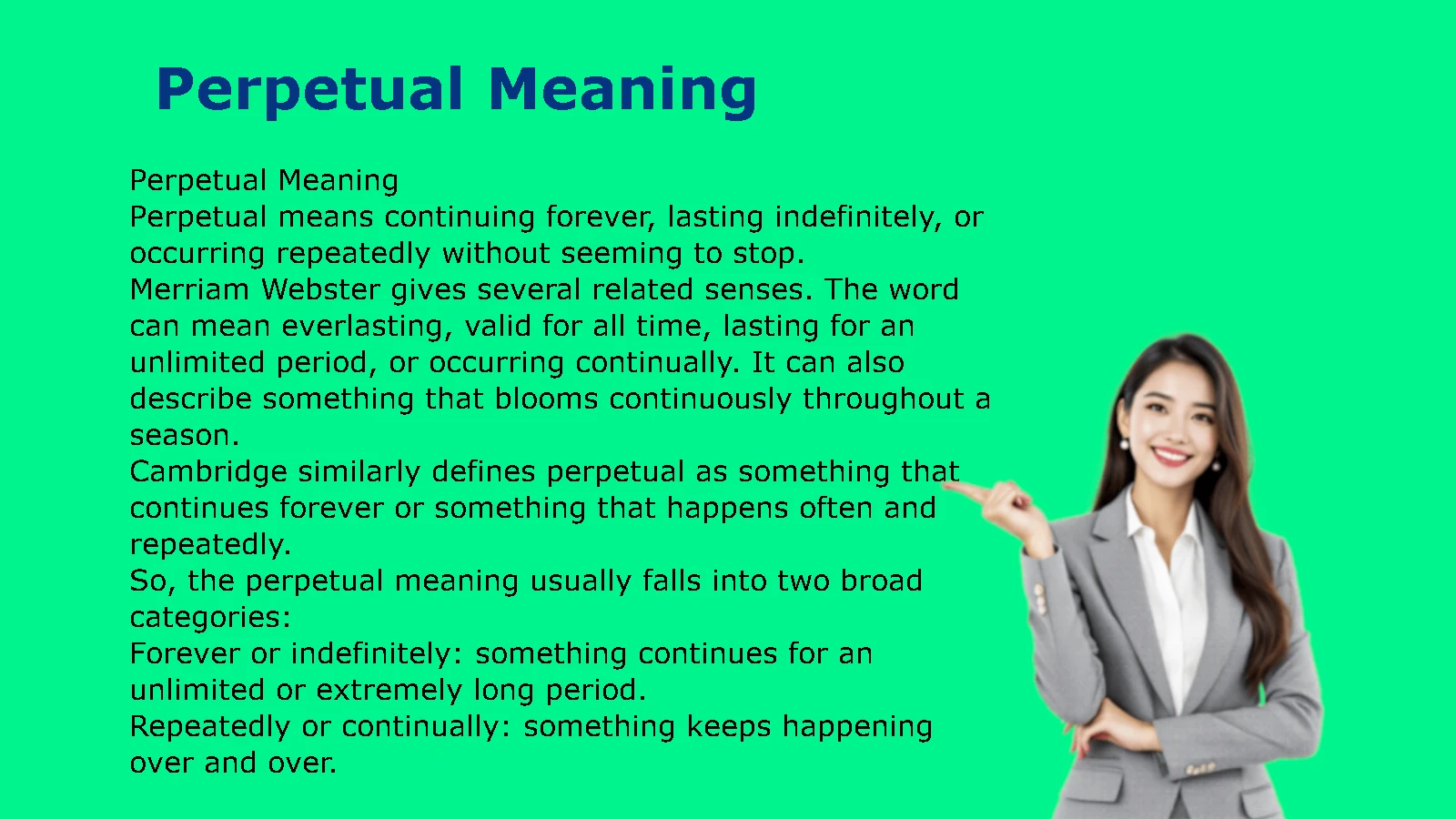
Perpetual Meaning
Perpetual means continuing forever, lasting indefinitely, or occurring repeatedly without seeming to stop.
Merriam Webster gives several related senses. The word can mean everlasting, valid for all time, lasting for an unlimited period, or occurring continually. It can also describe something that blooms continuously throughout a season.
Cambridge similarly defines perpetual as something that continues forever or something that happens often and repeatedly.
So, the perpetual meaning usually falls into two broad categories:
- Forever or indefinitely: something continues for an unlimited or extremely long period.
- Repeatedly or continually: something keeps happening over and over.
Perpetual meaning in simple words
In everyday English, you can think of perpetual as meaning:
Something that keeps going and doesn’t seem to end.
Consider these examples:
- Perpetual peace = peace that lasts indefinitely.
- Perpetual noise = noise that seems to continue without stopping.
- Perpetual complaints = complaints that keep coming.
- Perpetual change = change that continues over time.
- Perpetual motion = motion imagined as continuing indefinitely.
The word doesn’t always make a literal claim about eternity. Sometimes it simply emphasizes how long, frequent, or persistent something feels.
What Does Perpetual Mean?
If you’re looking for a quick answer to “What does perpetual mean?”, the simplest definition is:
Perpetual means continuing forever, lasting indefinitely, or happening repeatedly.
However, context matters.
Imagine someone says:
“The company has a perpetual problem with late deliveries.”
That doesn’t necessarily mean late deliveries will continue until the end of time. Instead, it means the problem keeps returning and seems difficult to eliminate.
Now consider:
“The agreement grants a perpetual right to access the land.”
Here, perpetual has a much stronger sense of indefinite duration.
This difference is important because perpetual can describe both duration and recurrence.
The two main meanings of perpetual
| Meaning | Explanation | Example |
| Lasting indefinitely | Continuing for an unlimited or very long time | perpetual peace |
| Repeated continually | Happening again and again | perpetual complaints |
| Continuing without apparent interruption | Seeming to never stop | perpetual noise |
| Lasting for someone’s lifetime | Continuing throughout a person’s life | perpetual president |
Oxford lists these major uses separately. It describes perpetual as something continuing for a long period without stopping, something frequently repeated, and a job or position lasting for someone’s whole life.
Perpetual Definition and Part of Speech
Perpetual is an adjective.
That means it describes a person, thing, situation, action, or condition.
For example:
- perpetual conflict
- perpetual motion
- perpetual change
- perpetual fear
- perpetual student
- perpetual problem
In each phrase, perpetual modifies a noun.
Perpetual word family
The word also belongs to a small family of related terms.
| Word | Part of speech | Meaning | Example |
| Perpetual | Adjective | Continuing indefinitely or repeatedly | perpetual change |
| Perpetually | Adverb | Continually or repeatedly | She is perpetually late. |
| Perpetuity | Noun | An unlimited duration | The land was protected in perpetuity. |
| Perpetuate | Verb | To cause something to continue | The policy may perpetuate the problem. |
Merriam Webster traces perpetuity to the same Latin root as perpetual, while perpetuate means to cause something to continue indefinitely.
How to Pronounce Perpetual
The US pronunciation of perpetual is:
/pərˈpetʃuəl/
A simple pronunciation guide is:
per-PECH-oo-uhl
The stress falls on the middle part of the word.
Cambridge gives the US pronunciation as /pɚˈpetʃ.u.əl/.
Pronunciation example
You can practice it in a sentence:
“The city experienced perpetual traffic problems.”
Try saying:
per-PECH-oo-uhl
Don’t worry about making every sound perfectly distinct. In natural American speech, the middle sounds often blend together.
Perpetual Examples in Sentences
Seeing perpetual in different contexts makes its meaning much easier to understand.
Everyday examples
- The construction created perpetual noise in the neighborhood.
- His perpetual complaining annoyed his coworkers.
- She seemed to live in perpetual fear.
- The children were in perpetual motion during the party.
- Their car had a perpetual need for repairs.
In these examples, perpetual suggests something that keeps happening or seems never ending.
Positive examples
The word doesn’t have a negative meaning by itself.
For example:
- The couple wished for perpetual happiness.
- The monument symbolizes perpetual peace.
- She has a perpetual interest in learning.
- The artist explored the idea of perpetual beauty.
- The organization hopes to create perpetual access to education.
Here, the continuing nature of the situation is desirable.
Negative examples
The same word can describe frustrating situations:
- The team faced perpetual delays.
- His perpetual excuses became tiresome.
- The neighborhood suffered from perpetual traffic noise.
- They lived under perpetual stress.
- Her perpetual interruptions made the meeting difficult.
Formal examples
Perpetual also fits formal writing:
- The contract established a perpetual right of access.
- The institution maintains a perpetual record of its activities.
- The region remained in a state of perpetual conflict.
- The agreement was designed to provide perpetual protection.
Oxford uses examples such as perpetual noise, perpetual conflict, perpetual fear, and perpetual problem to illustrate this sense of ongoing duration.
Perpetual vs. Continuous
Perpetual and continuous are close in meaning, but they aren’t identical.
Continuous usually focuses on something that happens without interruption.
Perpetual can focus on something that continues indefinitely or keeps happening repeatedly.
| Perpetual | Continuous |
| Emphasizes lasting duration or recurrence | Emphasizes uninterrupted continuation |
| Can suggest “seemingly never ending” | Often suggests “without a break” |
| perpetual complaints | continuous rainfall |
| perpetual conflict | continuous operation |
| perpetual change | continuous flow |
Consider this example:
The machine ran continuously for eight hours.
This tells you that the machine operated without a break during those eight hours.
Now compare:
The machine seemed to run perpetually.
This suggests that the machine appears capable of continuing indefinitely or that it simply never seems to stop.
Merriam Webster explains that continuous usually implies an uninterrupted flow, while perpetual suggests lasting duration or unfailing repetition.
A simple way to remember the difference
Think of continuous as a straight line:
──────────────
There are no breaks.
Think of perpetual as a loop:
↻
The activity may continue indefinitely or keep returning.
That’s not a strict grammatical rule, but it’s a useful way to remember the difference.
Perpetual vs. Continual
Continual is another close synonym.
The difference can be subtle.
Continual often describes something that happens repeatedly, sometimes with brief breaks.
Perpetual can suggest that the repetition feels endless or that the situation continues for an indefinitely long period.
Compare the examples
The continual interruptions made it difficult to work.
The interruptions happened repeatedly.
The perpetual interruptions made it difficult to work.
The interruptions seemed to go on and on.
Merriam Webster explains that continual often suggests prolonged recurrence or succession, while perpetual suggests unfailing repetition or lasting duration.
The distinction isn’t absolute. In many sentences, either word can work.
Perpetual vs. Permanent
Perpetual and permanent sometimes overlap, but they emphasize different ideas.
Permanent generally means something is not temporary and is intended or expected to remain.
Perpetual focuses more strongly on continued duration or recurrence.
| Word | Main idea | Example |
| Perpetual | Continuing indefinitely or repeatedly | perpetual conflict |
| Permanent | Not temporary | permanent address |
| Perpetual | Seemingly never ending | perpetual complaints |
| Permanent | Intended to remain | permanent position |
Merriam Webster notes that permanent commonly carries an implication of something designed or planned to continue indefinitely.
Compare:
She found a permanent job.
The focus is on the job’s status. It isn’t temporary.
She faced perpetual problems at work.
The focus is on problems that keep occurring.
Can perpetual and permanent be synonyms?
Sometimes.
For example:
perpetual peace
and
permanent peace
can both suggest peace that lasts indefinitely.
Yet they aren’t interchangeable in every context.
You’d normally say permanent address, not perpetual address. You’d also naturally say perpetual conflict when emphasizing recurring or long lasting conflict.
Perpetual vs. Eternal
Eternal carries a particularly strong sense of having no beginning or end, especially in philosophical, religious, and literary contexts.
Perpetual can also describe something everlasting, but it has a broader everyday use.
| Perpetual | Eternal |
| Can mean indefinitely continuing | Strongly suggests no end |
| Common in everyday descriptions | Often sounds more absolute |
| perpetual problems | eternal life |
| perpetual change | eternal truth |
| perpetual peace | eternal existence |
For example:
They hoped for perpetual peace.
The phrase emphasizes peace that continues indefinitely.
The poem explores eternal life.
Here, eternal has a stronger philosophical or religious sense.
The two words overlap considerably. The important difference lies in tone and emphasis.
Perpetual Synonyms
There isn’t one perfect synonym for every use of perpetual.
The best synonym depends on what you want to emphasize.
Synonyms meaning “lasting forever”
- Eternal
- Everlasting
- Enduring
- Permanent
- Endless
- Unending
- Undying
- Immortal
For example:
perpetual peace → everlasting peace
perpetual existence → eternal existence
Synonyms meaning “happening repeatedly”
- Continual
- Constant
- Persistent
- Incessant
- Ceaseless
- Unceasing
- Nonstop
- Repeated
- Continuous
For example:
perpetual interruptions → continual interruptions
perpetual noise → constant noise
Cambridge’s thesaurus lists terms including lasting, permanent, everlasting, eternal, enduring, constant, sustained, endless, continuous, ceaseless, incessant, unceasing, repeated, and continual.
Perpetual synonym comparison
| Synonym | What it emphasizes | Example |
| Eternal | No end | eternal life |
| Everlasting | Lasting forever | everlasting peace |
| Permanent | Not temporary | permanent home |
| Continuous | No interruption | continuous flow |
| Continual | Repeated occurrence | continual interruptions |
| Constant | Persistent presence | constant noise |
| Incessant | No stopping, often annoyingly | incessant chatter |
| Persistent | Continuing despite resistance | persistent problem |
| Ceaseless | Never seeming to stop | ceaseless activity |
| Endless | No apparent end | endless debate |
Antonyms of Perpetual
The most common general antonym of perpetual is temporary.
However, the right opposite depends on the context.
Common antonyms
- Temporary
- Brief
- Fleeting
- Momentary
- Short lived
- Transient
- Passing
- Occasional
- Intermittent
- Discontinuous
Cambridge lists temporary, impermanent, brief, fleeting, momentary, passing, short lived, transitory, transient, and ephemeral as antonyms or related opposites.
Again, context matters. Occasional is a better opposite for repeated activity, while temporary is a better general opposite for something lasting indefinitely.
Perpetually Meaning
Perpetually is the adverb form of perpetual.
It means continually, constantly, repeatedly, or seemingly without end.
Cambridge gives the example:
“She is perpetually late.”
In this sentence, perpetually means that being late happens repeatedly or very often.
Examples of perpetually
- She is perpetually late.
- He is perpetually asking for advice.
- The two teams are perpetually competing.
- The machine seems to be perpetually running.
- They are perpetually searching for better solutions.
Notice the grammatical difference:
perpetual + noun
perpetual noise
perpetually + verb or verb phrase
She perpetually complains.
A useful memory trick is:
Perpetual describes a thing.
Perpetually describes how something happens.
Common Phrases With Perpetual
Some expressions appear frequently enough that they’re worth learning as complete phrases.
Perpetual motion
Perpetual motion describes motion that theoretically continues indefinitely without an external energy source.
The idea has fascinated inventors for centuries. However, a machine that produces endless useful energy without the required energy input conflicts with established physical principles.
The phrase also has a figurative use.
The toddler was in perpetual motion all afternoon.
Here, nobody is making a physics claim. The sentence simply means the child seemed unable to stop moving.
Perpetual conflict
Perpetual conflict describes conflict that continues for a very long time or repeatedly returns.
The organization struggled with perpetual conflict between its departments.
The phrase suggests an ongoing cycle rather than one isolated disagreement.
Perpetual change
Perpetual change means constant or ongoing change.
Technology exists in a state of perpetual change.
The phrase works particularly well when describing fields where new developments regularly replace older ones.
Perpetual fear
Perpetual fear describes an ongoing state of fear.
The villagers lived in perpetual fear of another attack.
The phrase emphasizes duration and persistence.
Perpetual student
A perpetual student is someone who remains a student for a very long time. The expression can be literal or humorous.
After earning several degrees, she jokingly called herself a perpetual student.
Oxford specifically recognizes perpetual student as an example of this use.
Perpetual problem
A perpetual problem is a problem that repeatedly appears or seems impossible to resolve.
Staff shortages became a perpetual problem for the company.
This is one of the most natural everyday uses of the word.
Perpetual Meaning in Different Contexts
The word becomes more interesting when you see how different fields use it.
Perpetual in everyday English
In casual English, perpetual often means constant, recurring, or seemingly never ending.
Common expressions include:
- perpetual noise
- perpetual questions
- perpetual complaints
- perpetual delays
- perpetual arguments
- perpetual stress
- perpetual change
For example:
“I’m tired of these perpetual delays.”
The speaker isn’t predicting delays for eternity. The word simply highlights the fact that delays keep happening.
Perpetual in finance
In finance, perpetual has a more technical meaning.
A perpetual bond is a bond without a conventional maturity date. It is designed to continue paying interest indefinitely, subject to its terms.
Cambridge’s Business English Dictionary specifically uses perpetual for a bond or other investment that pays interest indefinitely.
This illustrates an important feature of English vocabulary: an ordinary word can acquire a precise technical meaning within a particular field.
Perpetual in law
Legal documents may use perpetual to describe a right, status, or arrangement intended to continue indefinitely.
For example:
The agreement granted a perpetual right to use the property.
The exact legal effect depends on the document and jurisdiction. In legal writing, you shouldn’t assume that perpetual automatically overrides every later law, contractual condition, or legal limitation.
The word’s general meaning remains the same: indefinite continuation.
Perpetual in science
Science commonly uses the expression perpetual motion.
A perpetual motion machine would theoretically continue operating without the energy input required to sustain its operation. Real machines cannot achieve this ideal because physical systems involve energy losses and must obey the laws of thermodynamics.
The word therefore takes on a specialized meaning while retaining its basic idea of endless continuation.
Perpetual in horticulture
Perpetual also has a botanical use.
Merriam Webster lists blooming continuously throughout the season as one definition of the adjective.
So, when a plant is described as perpetual in the appropriate horticultural context, the word can refer to repeated or continuous blooming.
That sense connects neatly with the everyday meaning: the process keeps returning or continues over time.
Is Perpetual a Positive or Negative Word?
Perpetual is neutral.
It doesn’t automatically express praise or criticism.
The noun that follows it usually determines the emotional tone.
Positive uses
- perpetual peace
- perpetual happiness
- perpetual learning
- perpetual beauty
- perpetual growth
- perpetual renewal
Negative uses
- perpetual pain
- perpetual conflict
- perpetual stress
- perpetual delays
- perpetual complaints
- perpetual problems
Neutral uses
- perpetual motion
- perpetual change
- perpetual snow
- perpetual record
- perpetual right
This makes perpetual a flexible adjective. It tells readers about duration or repetition, not whether the situation is good or bad.
Perpetual Word Origin
The word perpetual has a long history.
Merriam Webster traces it through Middle English perpetuel and Anglo French to the Latin perpetuus, meaning uninterrupted. It records the first known English use of perpetual in the 14th century.
Oxford traces the word through Old French perpetuel to Latin perpetuus, connected with the idea of continuing throughout.
Perpetual etymology at a glance
Latin perpetuus
↓
Old French / Anglo French perpetuel
↓
Middle English perpetuel
↓
Modern English perpetual
The history reinforces the word’s modern meaning. From its Latin roots onward, the concept centers on continuity, duration, and lack of interruption.
Perpetuity Meaning
Perpetuity is the noun related to perpetual.
It means a state of continuing forever or for an unlimited period.
For example:
The land was preserved in perpetuity.
This means the preservation was intended to continue indefinitely.
Merriam Webster defines perpetuity as eternity, the quality or state of being perpetual, and several specific legal and financial concepts. It also recognizes an annuity payable forever as a technical financial sense.
Perpetual vs. perpetuity
The distinction is simple:
Perpetual = adjective
Perpetuity = noun
Compare:
The agreement created a perpetual right.
The right continues in perpetuity.
Both sentences express the idea of indefinite duration, but they use different grammatical forms.
Perpetuate Meaning
Perpetuate is a verb that means to cause something to continue or last indefinitely.
For example:
The outdated system may perpetuate inequality.
Here, the system doesn’t merely continue by itself. The sentence says that the system helps keep something going.
Merriam Webster traces perpetuate to Latin perpetuatus, from perpetuare, which comes from perpetuus.
Compare the word family
A perpetual problem continues.
The problem happens perpetually.
The problem exists in perpetuity.
Certain actions may perpetuate the problem.
The four words share the same basic idea but play different grammatical roles.
Common Mistakes When Using Perpetual
Although the word looks simple, several mistakes appear frequently.
Assuming perpetual always means literally forever
This is the biggest misunderstanding.
Consider:
“He has perpetual headaches.”
The sentence usually means that headaches happen frequently or persist for a long time. It doesn’t necessarily claim they will continue until the end of existence.
Perpetual often means “seemingly never ending” rather than “literally eternal.”
Treating perpetual and continuous as exact synonyms
The words overlap, but they aren’t identical.
Continuous usually stresses the absence of interruption.
Perpetual can stress duration or recurrence.
So:
continuous rainfall
focuses on rainfall without a break.
Meanwhile:
perpetual complaints
focuses on complaints that keep recurring.
Using perpetual when you mean temporary
These words point in opposite directions.
The position is temporary.
The position is perpetual.
The first suggests a limited duration. The second suggests indefinite continuation.
Confusing perpetual with perpetually
Remember:
Perpetual modifies a noun.
Perpetually modifies a verb or describes how an action occurs.
Correct:
She has perpetual problems.
Correct:
She perpetually complains.
Assuming perpetual always sounds formal
Although perpetual can appear in formal writing, people also use it in ordinary conversation.
For example:
“I’m sick of the perpetual noise.”
That’s perfectly natural.
Still, in very casual speech, words such as constant, endless, or nonstop may sound more conversational.
A Practical Case Study: How Context Changes the Perpetual Meaning
Consider a fictional manager named Alex who uses the word perpetual three times during a meeting.
First, Alex says:
“We’re dealing with perpetual delays.”
Here, perpetual means the delays keep happening.
Later, Alex says:
“The new system should provide perpetual access to the records.”
Now the word means access that is intended to continue indefinitely.
Finally, Alex says:
“The team has a perpetual interest in improving the process.”
This describes an ongoing interest rather than a single event.
What changed?
The word stayed exactly the same.
The noun changed, and that changed the precise shade of meaning.
| Phrase | Meaning |
| perpetual delays | Repeated delays |
| perpetual access | Indefinite access |
| perpetual interest | Continuing interest |
| perpetual conflict | Ongoing or recurring conflict |
| perpetual motion | Theoretical endless motion |
This is why memorizing a single translation of perpetual isn’t enough. Understanding its relationship with surrounding words is much more useful.
Facts About the Word Perpetual
Here are the most useful facts to remember:
- Word: perpetual
- Part of speech: adjective
- US pronunciation: /pərˈpetʃuəl/
- Primary idea: continuation without an apparent end
- Meaning 1: lasting forever or indefinitely
- Meaning 2: occurring repeatedly or continually
- Related adverb: perpetually
- Related noun: perpetuity
- Related verb: perpetuate
- Common antonym: temporary
- Common synonyms: continuous, continual, eternal, constant, endless
- First known English use: 14th century
- Latin source: perpetuus
- Specialized uses: finance, law, science, and horticulture
Perpetual Meaning: Quick Comparison Table
| Term | Meaning | Example |
| Perpetual | Continuing indefinitely or repeatedly | perpetual change |
| Perpetually | Continually or repeatedly | He perpetually complains. |
| Perpetuity | Unlimited duration | The land is protected in perpetuity. |
| Perpetuate | Cause something to continue | The policy may perpetuate the problem. |
| Continuous | Continuing without interruption | continuous rainfall |
| Continual | Happening repeatedly | continual interruptions |
| Permanent | Not temporary | permanent residence |
| Eternal | Without end | eternal life |
| Temporary | Lasting for a limited period | temporary solution |
Frequently Asked Questions About Perpetual Meaning
What is the simple meaning of perpetual?
Perpetual means continuing forever, indefinitely, or repeatedly without seeming to stop.
Does perpetual mean forever?
Yes, perpetual can mean forever. However, it can also describe something that continues for an indefinitely long time or happens repeatedly.
For example, perpetual conflict usually doesn’t mean conflict occurring every second forever. It suggests conflict that keeps returning or continues for a very long time.
What is an example of perpetual?
The children were in perpetual motion.
This means they seemed to keep moving continuously.
Another example is:
The company faced perpetual delays.
Here, perpetual means the delays repeatedly occurred.
What is another word for perpetual?
Depending on the context, alternatives include eternal, everlasting, continuous, continual, constant, endless, ceaseless, permanent, persistent, and unending.
No single synonym works equally well in every sentence.
What is the opposite of perpetual?
The most common opposite is temporary.
Other possibilities include brief, fleeting, momentary, intermittent, transient, and occasional, depending on the context.
What does perpetually mean?
Perpetually means continually, constantly, repeatedly, or seemingly without end.
Example:
She is perpetually late.
This means she is late repeatedly or very often.
Is perpetual positive or negative?
Neither. Perpetual is a neutral word.
Perpetual peace sounds positive, while perpetual conflict sounds negative.
What is the difference between perpetual and permanent?
Perpetual emphasizes ongoing or indefinite continuation. Permanent emphasizes something that isn’t temporary and is intended or expected to remain.
What is the difference between perpetual and continuous?
Continuous usually emphasizes something happening without interruption. Perpetual can emphasize something lasting indefinitely or happening repeatedly.
What is the difference between perpetual and continual?
Continual often describes repeated occurrences. Perpetual can describe repeated occurrences as well as something that lasts indefinitely.
Can perpetual mean repeated?
Yes. This is one of its established meanings.
For example:
perpetual interruptions
means interruptions that happen repeatedly and seem never ending.
Final Takeaway on Perpetual Meaning
The easiest way to remember the perpetual meaning is to focus on one central idea:
Perpetual describes something that continues indefinitely or keeps happening again and again.
The key points at a glance
- Perpetual is an adjective.
- It means lasting indefinitely, continuing forever, or occurring repeatedly.
- Perpetually is the adverb form.
- Perpetuity is the related noun.
- Perpetuate is the related verb.
- Temporary is its clearest general antonym.
- Eternal, everlasting, continuous, continual, constant, and endless can work as synonyms depending on context.
- The word entered English through Middle English and Anglo French from Latin roots associated with continued or uninterrupted existence.
Once you understand that core idea of ongoing duration or repeated occurrence, words such as perpetual, perpetually, and perpetuity become much easier to recognize and use accurately.