
Have you ever heard the word “liberty” and wondered what it really means? While Liberty Meaning may seem simple, this powerful word can have different meanings depending on the context, situation, and way it is used.
Liberty means the freedom to act, speak, think, or live as you choose without unfair control or restrictions. It is often used when talking about personal freedom, legal rights, independence, and the ability to make your own choices.
Examples:
- Everyone deserves the liberty to express their opinions.
- The country fought for its liberty and independence.
The confusion is understandable. People often search for what does liberty mean, liberty meaning in English, liberty meaning in a sentence, or liberty meaning in law because the word can describe personal freedom, political rights, or freedom from control. And here’s the interesting part: liberty doesn’t always mean doing whatever you want. It can also refer to the rights and freedoms protected by society and law.
In this guide, you’ll learn the complete Liberty Meaning, its definition, pronunciation, correct usage, and examples in sentences. You’ll also discover liberty meaning in law, common synonyms for liberty, and the difference between liberty, freedom, and independence.
What Does Liberty Mean?
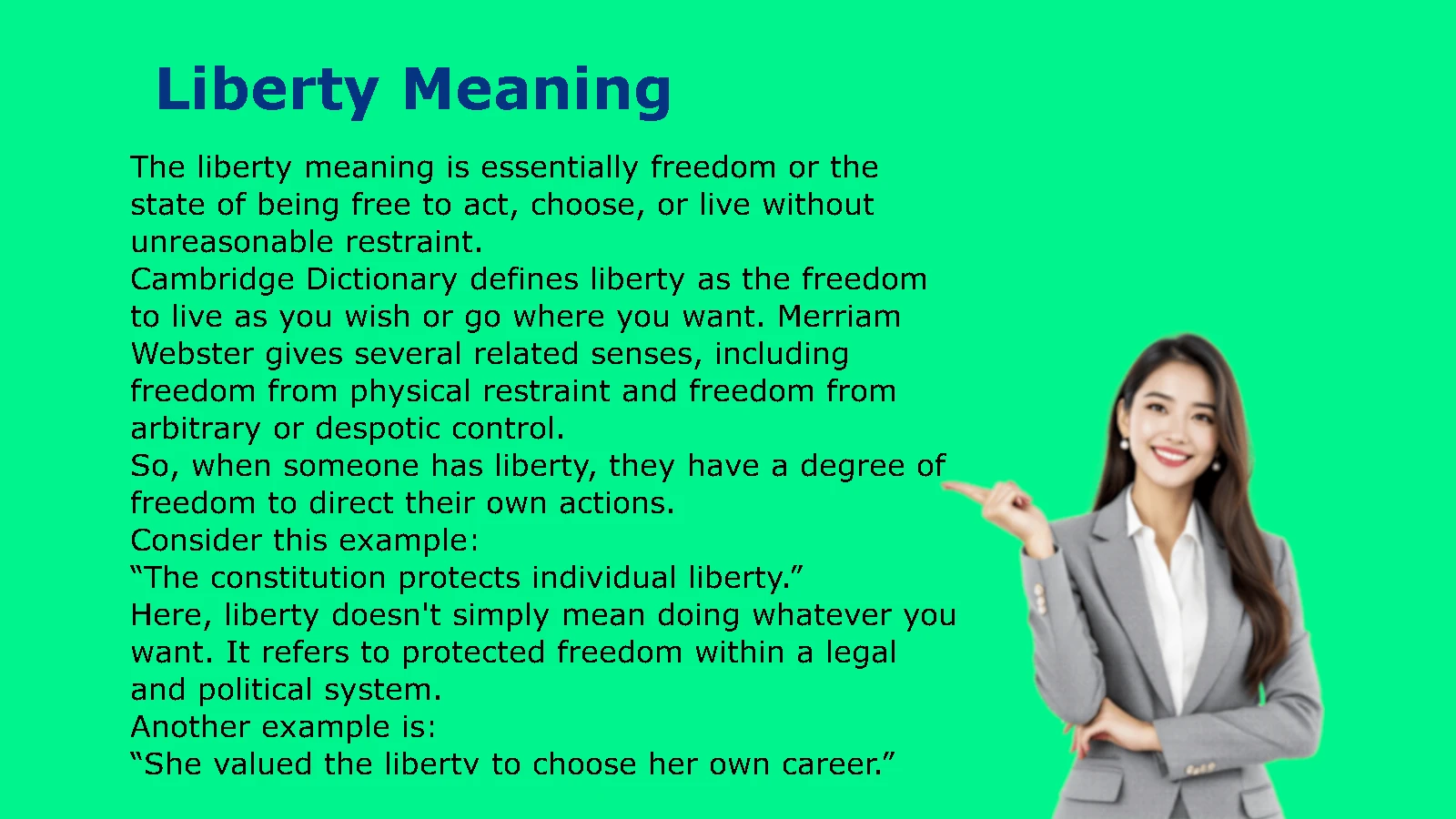
The liberty meaning is essentially freedom or the state of being free to act, choose, or live without unreasonable restraint.
Cambridge Dictionary defines liberty as the freedom to live as you wish or go where you want. Merriam Webster gives several related senses, including freedom from physical restraint and freedom from arbitrary or despotic control.
So, when someone has liberty, they have a degree of freedom to direct their own actions.
Consider this example:
“The constitution protects individual liberty.”
Here, liberty doesn’t simply mean doing whatever you want. It refers to protected freedom within a legal and political system.
Another example is:
“She valued the liberty to choose her own career.”
In this sentence, liberty means having the freedom to make an important personal decision.
Liberty in Simple Words
If you need the definition quickly, remember this:
Liberty = the freedom to choose, act, or live without unjust or unreasonable restrictions.
The word can describe several kinds of freedom:
- Personal freedom: making choices about your own life.
- Political freedom: participating in political life.
- Civil freedom: exercising protected freedoms such as expression or religion.
- Legal freedom: being protected from certain forms of arbitrary restraint.
- Philosophical freedom: having the ability or conditions needed to direct your own life.
The exact meaning depends on context.
Liberty Definition and Pronunciation
Liberty is a noun.
In US English, it is pronounced approximately:
LIB-er-tee
The Cambridge US pronunciation is /ˈlɪb.ɚ.t̬i/.
Word Forms
| Form | Example |
| liberty | Liberty matters in a democratic society. |
| liberties | The law protects certain civil liberties. |
The plural liberties usually refers to particular freedoms or protected freedoms.
For example:
“The new policy could affect individual liberties.”
Here, liberties means specific freedoms rather than one broad condition of being free.
Liberty vs. Freedom: What’s the Difference?
Liberty and freedom overlap heavily. In many sentences, you can use one instead of the other without changing the basic meaning.
However, they don’t always sound equally natural.
Freedom is more common in everyday conversation:
“Everyone deserves the freedom to make their own choices.”
Liberty often sounds more formal, legal, political, or philosophical:
“The law protects individual liberty.”
That’s why you commonly hear freedom of speech in everyday language and civil liberties in legal and political discussions.
The distinction isn’t absolute. Philosophers and legal scholars use both terms in different ways, and the exact boundaries depend on the context.
Quick Comparison
| Freedom | Liberty |
| Common everyday word | Often more formal |
| Broad meaning | Often emphasizes protected freedom |
| Common in casual conversation | Common in law and politics |
| “Freedom to travel” | “Personal liberty” |
| “Freedom of speech” | “Civil liberties” |
A useful rule is simple: freedom is usually the more natural everyday choice, while liberty often fits formal discussions about rights, government, law, and individual choice.
Types of Liberty
Liberty isn’t one narrow concept. Different fields use the word to describe different kinds of freedom.
Personal Liberty
Personal liberty concerns your ability to make choices about your own life without unjust interference.
It can involve decisions about:
- Where you live
- What occupation you pursue
- What beliefs you hold
- What lawful activities you engage in
- Whom you marry
- How you organize your personal life
- Where you travel
Personal liberty doesn’t mean every personal decision receives unlimited legal protection. The exact protections depend on the applicable law and circumstances.
The key idea is personal autonomy and freedom from unjust restraint.
Civil Liberty
Civil liberties are freedoms and protections associated with individuals in relation to government and society.
Depending on the legal system, examples can include protections involving:
- Freedom of speech
- Freedom of religion
- Freedom of assembly
- Freedom of movement
- Due process
- Protection from certain unreasonable government actions
In the United States, constitutional law gives the term liberty a particularly important legal role. The Fifth and Fourteenth Amendments contain Due Process Clauses that protect liberty against certain forms of government deprivation.
Civil liberty is therefore more specific than simply saying, “I can do whatever I want.”
Political Liberty
Political liberty concerns your ability to participate in political life.
Depending on the system and applicable laws, this can include activities such as:
- Voting
- Expressing political opinions
- Joining political organizations
- Petitioning government
- Participating in public debate
- Seeking political office
Political liberty matters because a person can have substantial personal freedom while having very little ability to influence political decisions.
Economic Liberty
Economic liberty relates to freedom in economic activity.
It can involve the ability to:
- Choose an occupation
- Start a business
- Enter lawful contracts
- Buy or sell property
- Participate in markets
- Make economic decisions
However, economic liberty doesn’t mean that economic activity operates without rules. Businesses and individuals can still face laws involving contracts, taxation, safety, competition, labor, and property.
Positive and Negative Liberty
Philosophy adds another important distinction: negative liberty and positive liberty.
The Stanford Encyclopedia of Philosophy explains negative liberty as the absence of obstacles, barriers, or constraints. Positive liberty concerns the possibility of acting in a way that allows someone to take control of their life and pursue fundamental purposes.
Think of a person who wants to attend college.
Negative liberty asks:
“Is anyone preventing this person from attending?”
Positive liberty asks something different:
“Does this person have the real ability or conditions needed to pursue that goal?”
The distinction matters because simply removing a restriction doesn’t always create a practical opportunity.
Liberty in Law
The legal meaning of liberty becomes more precise than its everyday meaning.
In US constitutional law, liberty appears in the Due Process Clauses of the Fifth and Fourteenth Amendments. The Legal Information Institute explains that constitutional liberty includes freedom from arbitrary or unreasonable government restraint. It can involve more than freedom from physical confinement and may include autonomy in personal decisions.
This makes an important point: legal liberty isn’t limited to whether someone is behind bars.
A Major Constitutional Example
In Meyer v. Nebraska (1923), the US Supreme Court considered the meaning of liberty under the Fourteenth Amendment.
The Court explained that liberty involved more than freedom from bodily restraint. It also referred to interests such as pursuing an occupation, acquiring knowledge, marrying, establishing a home, raising children, and practicing religion according to conscience.
That case illustrates how the legal concept of liberty can reach questions about personal autonomy and the direction of one’s life.
It also shows why the legal definition shouldn’t be reduced to the simple phrase “freedom to do whatever you want.”
Liberty Doesn’t Mean Unlimited Choice
Law constantly balances individual liberty with other legal interests.
For example, a person may generally have freedom to express an opinion. That doesn’t mean every possible action involving speech is immune from legal regulation.
Similarly, someone may have personal liberty while still being required to obey valid laws.
The central legal question is often not:
“Does this person have absolute freedom?”
Instead, it may be:
“What kind of restraint is being imposed, by whom, under what authority, and does the law permit it?”
That distinction makes legal discussions of liberty much more precise.
Liberty in Politics and Government
In political discussions, liberty usually concerns the relationship between individuals and government power.
A government can create rules that restrict certain actions. At the same time, government can establish legal protections that preserve individual freedom.
That creates a constant balancing problem.
| Individual liberty | Government regulation |
| Freedom of expression | Laws governing certain conduct |
| Freedom of movement | Safety and public order rules |
| Religious liberty | Neutral legal requirements |
| Property interests | Property and zoning laws |
| Political participation | Election regulations |
The important point isn’t that regulation automatically destroys liberty. Some rules can protect one person’s liberty from another person’s interference.
Imagine a neighborhood where anyone can play loud music at any hour. One person’s unrestricted activity may interfere with another person’s ability to sleep.
A noise rule restricts one action. Yet it can also protect other people’s ability to use their homes peacefully.
That’s why liberty becomes complicated in real societies. One person’s freedom can sometimes affect another person’s freedom.
Liberty in Philosophy
Philosophers have debated liberty for centuries because the simple definition raises difficult questions.
If nobody physically stops you from doing something, are you free?
What if you technically can do it but lack the resources or practical ability?
What if another person doesn’t directly force you but controls your options through threats?
These questions push liberty beyond a dictionary definition.
Negative Liberty
Negative liberty focuses on freedom from interference.
If someone has negative liberty to perform an action, other people or institutions aren’t preventing that action in the relevant sense.
The Stanford Encyclopedia of Philosophy connects this idea with the absence of obstacles, barriers, constraints, or interference.
For example:
A writer has negative liberty to publish an opinion if no external authority is unjustly preventing the publication.
Positive Liberty
Positive liberty focuses on self direction and the ability to control one’s life.
Suppose two people are legally free to pursue higher education. One has access to transportation, money, schools, and time. The other has none of these.
Both may have formal permission. Their practical opportunities can still differ dramatically.
Positive liberty asks whether a person has the meaningful ability to pursue important goals.
The distinction between positive and negative liberty became especially influential through the work of philosopher Isaiah Berlin, whose famous discussion of the two concepts appeared in 1958.
Neither concept completely settles the broader question of what a free society should look like. That’s where philosophical debate begins.
Examples of Liberty in a Sentence
Seeing liberty in context makes its meaning much easier to understand.
- The constitution protects individual liberty.
- She valued the liberty to choose her own career.
- Citizens defended their civil liberties.
- He was finally given his liberty after years of imprisonment.
- The government must respect individual liberty.
- They fought for political liberty.
- She wasn’t at liberty to reveal the information.
- The new rule raised questions about personal liberty.
- He believed economic liberty encouraged innovation.
- The prisoner regained his liberty after his release.
- Religious liberty allows people to practice their faith within the law.
- The journalist argued that the restriction threatened freedom and liberty.
Notice how the meaning changes slightly with context.
That’s why context matters.
Common Phrases With Liberty
Several expressions use liberty in ways that aren’t obvious from the basic definition.
What Does “At Liberty” Mean?
At liberty can mean free, not imprisoned, or not under restraint.
For example:
“The suspect remains at liberty.”
Here, the person hasn’t been captured or confined.
But at liberty to do something has another meaning: having permission to do something.
“I’m not at liberty to discuss the details.”
This means:
“I’m not permitted or authorized to discuss the details.”
Cambridge Dictionary identifies both uses.
What Does “Take the Liberty of” Mean?
Take the liberty of doing something means doing something without first asking for explicit permission, often in a polite or formal way.
For example:
“I took the liberty of reserving a table for us.”
The speaker made the decision independently.
The phrase doesn’t necessarily suggest disrespect. In formal English, it can sound courteous:
“I took the liberty of forwarding your message to the appropriate department.”
Cambridge lists this as a formal expression.
What Does “Take Liberties” Mean?
Take liberties has a different and often negative meaning.
It can mean behaving in a way that exceeds acceptable boundaries.
For example:
“He took liberties with the company’s confidential information.”
It can also mean changing something too freely:
“The movie takes liberties with the historical record.”
In that case, the creator has altered facts or details instead of following the original material closely.
Cambridge also records take liberties with something in this sense.
What Does “Give Someone Their Liberty” Mean?
Give someone their liberty means release them from confinement or imprisonment.
For example:
“After the sentence ended, he was given his liberty.”
This use appears frequently in formal and historical writing.
Liberty vs. Rights
Liberty and rights are closely connected, but they aren’t identical.
A right is generally an entitlement, claim, protection, or legal or moral status recognized within a particular framework.
Liberty, by contrast, emphasizes freedom to act, choose, or live without certain forms of interference or restraint.
Here’s a simple way to see the relationship:
A right can protect an area of liberty.
For example, a legal protection for freedom of expression can protect a person’s liberty to express certain views.
However, not every right is simply a liberty. Some rights involve claims to particular treatment, procedures, benefits, or protections.
So, while the words frequently appear together, treating them as perfect synonyms can create confusion.
Liberty vs. Independence
Independence focuses on freedom from dependence, control, or outside authority.
Liberty focuses more directly on freedom of action, choice, or status.
Consider a country that becomes politically independent from another country. Its new status is independence.
Now consider a person who can choose where to live and what lawful career to pursue. That person exercises personal liberty.
The two concepts overlap, but they answer different questions.
| Term | Main idea |
| Liberty | Freedom to act, choose, or live without certain restraints |
| Independence | Freedom from dependence or external control |
| Autonomy | Ability to direct one’s own decisions and life |
| Freedom | Broad general term for being free |
Liberty vs. Autonomy
Autonomy means having meaningful control over your own decisions or life.
That’s why autonomy often appears in discussions of personal liberty.
For example, if a person can make an informed decision about a personal matter without coercion, that situation may involve autonomy.
Liberty is broader. It can refer to political freedoms, civil liberties, release from confinement, or freedom from government restraint.
So:
Autonomy is often one part of liberty, while liberty can cover a much wider field.
Liberty Synonyms
The best synonym depends on the sentence.
Common Synonyms for Liberty
- Freedom
- Independence
- Autonomy
- Self determination
- Release
- Choice
- Self rule
- Leeway
These words aren’t interchangeable in every situation.
For example, release works well when liberty means freedom from imprisonment:
“He was granted his liberty.”
You could say:
“He was released.”
But replacing civil liberties with civil releases would make no sense.
Liberty Synonyms by Context
| Meaning | Suitable alternatives |
| General freedom | freedom |
| Personal control | autonomy |
| Freedom from outside control | independence |
| Freedom after confinement | release |
| Freedom to choose | choice |
| Political self rule | self government |
| Room to act | leeway |
Context is the key. A synonym should preserve the meaning of the original sentence rather than merely look similar in a thesaurus.
Antonyms of Liberty
The opposite of liberty varies according to context.
Common antonyms include:
- Confinement
- Captivity
- Imprisonment
- Restriction
- Restraint
- Oppression
- Subjection
- Enslavement
For example:
Liberty ↔ confinement
works when discussing imprisonment.
But:
Liberty ↔ oppression
works better when discussing political domination.
Likewise, restriction is useful when discussing limits placed on an action.
Liberty as a Noun
Liberty is a noun, and it can refer to the general condition of being free or to a particular freedom.
For example:
“Liberty is important to a free society.”
Here, liberty refers to freedom as a broad concept.
The plural form appears when referring to individual freedoms:
“The constitution protects civil liberties.”
Merriam Webster lists liberties as the plural form of liberty.
Abstract Noun Use
Liberty often behaves like an abstract noun because you can’t physically touch liberty.
You can discuss it, protect it, restrict it, lose it, or regain it.
Common combinations include:
- personal liberty
- individual liberty
- civil liberties
- political liberty
- religious liberty
- economic liberty
- loss of liberty
- defense of liberty
- restriction of liberty
These word combinations help reveal how English speakers normally use the term.
Liberty Meaning in Different Contexts
The meaning becomes clearer when you compare the major contexts.
| Context | Liberty meaning |
| Everyday English | Freedom to live or act as you choose |
| Personal life | Freedom to make lawful personal decisions |
| Law | Freedom protected against certain unlawful or arbitrary restraints |
| Politics | Freedom connected with rights, participation, and government power |
| Philosophy | A complex concept involving freedom, interference, self direction, and opportunity |
| Imprisonment | Freedom from confinement |
| Formal expressions | Permission or freedom to do something |
This range explains why a single dictionary definition can’t capture every use.
The History and Origin of Liberty
The English word liberty has deep historical roots.
It entered English through Old French and ultimately traces to the Latin libertas, meaning freedom or the condition of being free.
Over centuries, the word developed several related meanings. It came to describe not only freedom from physical restraint but also freedom from arbitrary control and the enjoyment of certain social and political freedoms.
That history helps explain why liberty sounds particularly natural in formal political and legal language.
It also explains expressions such as:
- liberty
- liberties
- civil liberties
- personal liberty
- at liberty
The word has retained its central idea while expanding into different fields.
A Practical Case Study: Liberty in Everyday Life
Imagine that Maya receives two job offers.
The first job pays more but requires her to move to another city and gives her little control over her schedule.
The second job pays less but allows her to choose her working hours and remain close to her family.
Maya chooses the second position because she values personal choice.
Does that automatically mean she has more liberty?
Not necessarily.
Her situation illustrates why liberty can involve several dimensions.
- Personal liberty: She has greater control over her daily schedule.
- Economic liberty: She has made a voluntary employment choice.
- Practical opportunity: Her financial circumstances affect which choices she can realistically make.
- Social factors: Family responsibilities influence her options.
This example shows why liberty isn’t simply a synonym for having unlimited options. Real freedom often involves both the absence of coercion and the ability to make meaningful choices.
Why Liberty Matters
Liberty matters because choices shape almost every part of human life.
Your ability to speak, move, work, worship, associate with others, make personal decisions, and participate in society can all involve questions of freedom.
At the same time, liberty exists alongside other people’s interests.
Imagine a society where everyone has unlimited freedom to interfere with everyone else. One person’s supposed liberty could quickly destroy another person’s ability to live freely.
That’s why serious discussions of liberty usually involve boundaries, responsibility, law, and competing rights.
The goal isn’t simply to count how many rules exist.
The deeper question is whether restrictions are justified and whether people retain meaningful areas in which they can direct their own lives.
Facts About Liberty
Here are several useful facts that clarify the concept:
- Liberty is a noun.
- Its plural form is liberties.
- The common US pronunciation is approximately LIB-er-tee.
- Liberty and freedom are often synonyms, although liberty tends to sound more formal in many contexts.
- At liberty can mean free from confinement.
- At liberty to do something can mean permitted to do it.
- Take the liberty of means doing something, often politely, without first asking explicit permission.
- Take liberties can mean exceeding acceptable boundaries or altering something too freely.
- US constitutional law uses liberty in the Fifth and Fourteenth Amendments’ Due Process Clauses.
- Political philosophy distinguishes negative liberty from positive liberty.
- Liberty can involve freedom from physical restraint as well as broader questions of autonomy and choice.
Frequently Asked Questions About Liberty Meaning
What does liberty mean in simple terms?
Liberty means freedom to make choices, act, or live without unjust or unreasonable restraint. It can refer to personal freedom, political freedom, legal protections, or freedom from confinement.
Is liberty the same as freedom?
Not always, but the two words are closely related and often interchangeable. Freedom is more common in everyday speech, while liberty often sounds more formal and appears frequently in legal, political, and philosophical contexts.
What is an example of liberty?
A simple example is having the lawful freedom to choose your occupation. Other examples include practicing a religion, expressing an opinion, traveling, or making personal decisions without unjust interference.
What does “at liberty” mean?
At liberty can mean free or not imprisoned.
For example:
“The suspect is still at liberty.”
However, at liberty to do something means having permission to do it:
“I’m not at liberty to discuss the matter.”
What does “take the liberty of” mean?
It means doing something without first asking explicit permission, usually in a polite or formal way.
“I took the liberty of sending the documents to your office.”
What are civil liberties?
Civil liberties are protected freedoms and protections that individuals have within a legal and political system. In the United States, constitutional protections involving speech, religion, due process, and other freedoms form important parts of civil liberties.
What is the opposite of liberty?
Depending on the context, possible opposites include confinement, captivity, imprisonment, restriction, restraint, oppression, and subjection.
Is liberty a noun?
Yes. Liberty is a noun. Its plural form is liberties.
Example:
“Individual liberty matters.”
Plural:
“Civil liberties matter.”
What is negative liberty?
Negative liberty means freedom from obstacles, interference, barriers, or constraints. It asks what prevents a person from acting.
What is positive liberty?
Positive liberty concerns the ability to direct your life and pursue meaningful goals. It asks not only whether someone is free from interference but also whether they have the practical capacity for self direction.
What is the difference between liberty and autonomy?
Autonomy focuses on self direction and control over one’s decisions. Liberty is broader and can include personal, political, legal, and civil freedoms.
Can liberty have limits?
Yes. Liberty doesn’t generally mean unlimited permission to do anything. Laws and social rules can limit conduct, particularly when actions affect other people or violate legally protected interests. The important question is whether a particular restriction is justified and lawful.
Final Thoughts on the Meaning of Liberty
The simplest liberty meaning is freedom. Yet that short definition only opens the door.
So, when you encounter liberty, don’t treat it as a fancy substitute for freedom in every sentence. Look at the context.
At its heart, however, the idea remains remarkably consistent: liberty gives people space to direct their lives without unjust restraint.