
Have you ever heard someone make a thoughtful observation that gives you a new way to understand a situation? That is where insightful meaning comes into play. The word insightful describes something that shows a deep understanding of a person, situation, idea, or subject.
Insightful means showing a clear and deep understanding of something. It often describes comments, questions, advice, observations, books, conversations, or ideas that help you see something in a new or meaningful way.
Examples:
- She made an insightful comment about the problem.
- His insightful advice helped me understand the situation better.
The confusion is understandable. People often search for what does insightful mean, insightful meaning, insightful meaning in a sentence, or what does it mean when someone says you are insightful because the word can describe both a person’s ability and something that demonstrates deep understanding.
In this guide, you’ll learn the complete insightful meaning, its definition, pronunciation, synonyms, antonyms, and correct usage. You’ll also discover how to use insightful in sentences, what it means when someone calls you insightful, and the difference between insightful, intelligent, wise, and thoughtful.
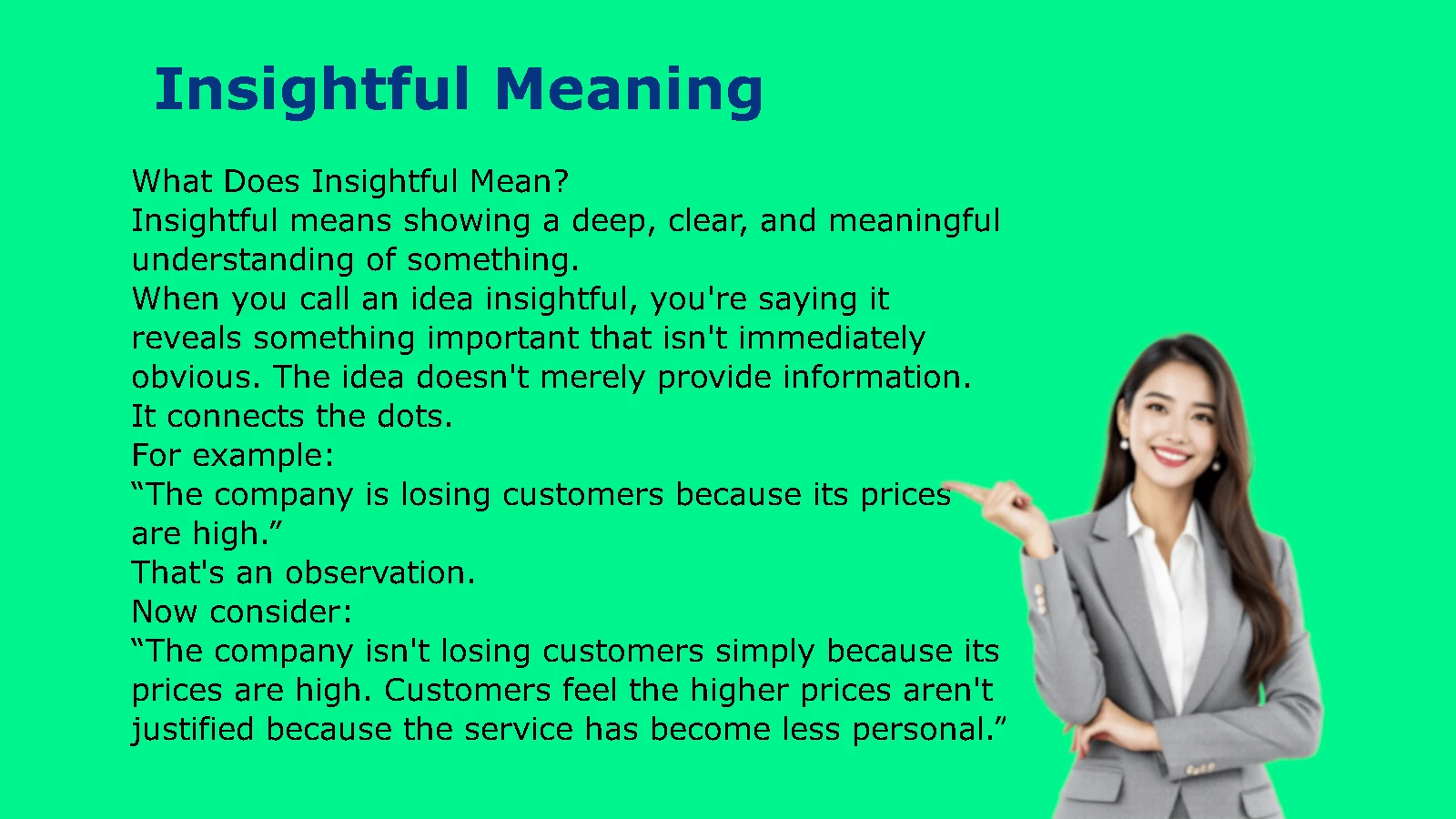
What Does Insightful Mean?
Insightful means showing a deep, clear, and meaningful understanding of something.
When you call an idea insightful, you’re saying it reveals something important that isn’t immediately obvious. The idea doesn’t merely provide information. It connects the dots.
For example:
“The company is losing customers because its prices are high.”
That’s an observation.
Now consider:
“The company isn’t losing customers simply because its prices are high. Customers feel the higher prices aren’t justified because the service has become less personal.”
The second statement is more insightful because it identifies a deeper reason behind the problem.
That’s the heart of the insightful meaning: seeing beneath the surface.
Cambridge connects insight with a clear and deep understanding of a complicated situation. Merriam Webster similarly defines insight in terms of understanding people and situations clearly and discerning what isn’t immediately obvious.
Insightful Meaning in Simple Words
In simple English, insightful means good at understanding things deeply.
An insightful person may notice patterns, recognize hidden causes, understand emotions, or explain complicated ideas clearly.
Think of it like looking at a puzzle.
Anyone can see the individual pieces. An insightful person starts to understand how those pieces fit together.
A Quick Definition
| Term | Simple meaning |
| Insightful | Showing deep understanding |
| Insight | Deep understanding or awareness |
| Insightfully | In a way that shows deep understanding |
| Insightful person | Someone who notices and understands things deeply |
| Insightful comment | A comment that reveals an important point |
Insightful Definition and Core Meaning
The adjective insightful comes from the noun insight.
An insight isn’t simply a fact. It’s an understanding that helps you interpret a fact or situation.
Suppose a manager notices that employees are leaving the company.
The basic fact is:
“Employee turnover increased this year.”
An insightful analysis might be:
“Employees aren’t leaving because of workload alone. Many feel that their extra effort goes unnoticed.”
The first sentence reports what happened. The second attempts to explain why it happened.
That distinction matters.
What Makes an Observation Insightful?
An observation usually feels insightful when it does one or more of the following:
- Reveals something that isn’t immediately obvious
- Explains an underlying cause
- Connects several facts or ideas
- Identifies a meaningful pattern
- Shows a deeper understanding of human behavior
- Changes the way you look at a situation
- Makes a complicated issue easier to understand
- Adds an original or useful perspective
- Separates the important details from the unimportant ones
Oxford describes insightful as showing a clear understanding of a person or situation and lists perceptive as a synonym.
Insightful Pronunciation
The word insightful is pronounced approximately:
in-SITE-ful
Its pronunciation is represented in dictionaries as /ɪnˈsaɪt.fəl/. The main stress falls on the second syllable, which contains the sound from sight.
The word comes from:
insight + ful = insightful
The ending -ful means “full of” or “characterized by.”
So, in a basic sense, insightful describes something characterized by insight.
Merriam Webster gives the concise definition “exhibiting or characterized by insight.”
Is Insightful an Adjective?
Yes. Insightful is an adjective.
An adjective describes a noun, and insightful tells you that a person, statement, idea, or work demonstrates deep understanding.
For example:
- an insightful person
- an insightful comment
- an insightful question
- an insightful analysis
- an insightful observation
- an insightful explanation
- an insightful article
- an insightful book
- an insightful discussion
- an insightful response
The related adverb is insightfully.
Insight vs. Insightful vs. Insightfully
| Word | Part of speech | Example |
| Insight | Noun | “She offered valuable insight.” |
| Insightful | Adjective | “She gave an insightful answer.” |
| Insightfully | Adverb | “He analyzed the problem insightfully.” |
Merriam Webster identifies insightfully as the adverbial form of insightful.
What Does It Mean to Be Insightful?
Being insightful means more than being smart.
A person can know hundreds of facts without understanding how those facts connect. Another person might know less information but recognize a pattern that others completely overlook.
That’s insight.
An insightful person often pays attention to details that other people ignore. More importantly, they can interpret those details.
For example, imagine someone who notices that a normally talkative friend becomes quiet whenever a particular subject comes up.
Simply noticing the change is observant.
Recognizing that the subject may make the friend uncomfortable is perceptive.
Understanding how that reaction connects to the friend’s past experiences could be insightful.
Common Traits of an Insightful Person
An insightful person often shows:
- Curiosity: They want to understand why something happens.
- Observation: They notice details and changes.
- Pattern recognition: They connect related events.
- Empathy: They consider how other people may feel or think.
- Critical thinking: They don’t automatically accept the first explanation.
- Reflection: They think carefully about experiences.
- Discernment: They separate meaningful information from noise.
- Clarity: They can explain complex ideas in understandable terms.
Insight doesn’t require someone to sound complicated. In fact, one of the clearest signs of genuine insight is the ability to express a complex idea simply.
Insightful Examples in a Sentence
Seeing insightful in different contexts makes its meaning easier to understand.
Everyday Examples
- “That was an insightful comment.”
- “She gave me some insightful advice.”
- “His answer was surprisingly insightful.”
- “You made an insightful observation about the situation.”
- “That conversation was more insightful than I expected.”
In each example, insightful suggests that something provided more than ordinary information.
Workplace Examples
- “The manager offered an insightful analysis of the team’s performance.”
- “Her report contains several insightful observations about customer behavior.”
- “That was an insightful question during the meeting.”
- “The consultant gave us an insightful perspective on the problem.”
- “His comments helped the team understand the issue from a different angle.”
Academic Examples
- “The essay provides an insightful interpretation of the novel.”
- “The researcher offered an insightful explanation of the findings.”
- “Her analysis of the historical events was particularly insightful.”
- “The book provides an insightful examination of social change.”
Examples About People
- “She’s an insightful teacher who understands what her students need.”
- “He’s remarkably insightful about human behavior.”
- “The interviewer asked several insightful questions.”
- “Her comments showed an insightful understanding of the issue.”
What Is an Insightful Comment?
An insightful comment reveals something meaningful rather than simply stating the obvious.
Consider a movie discussion.
A basic comment might be:
“The main character was unhappy.”
An insightful comment could be:
“The main character wasn’t unhappy because she failed. She was unhappy because she measured success by someone else’s expectations.”
The second comment gives the listener a new way to understand the character.
That’s what makes it insightful.
An insightful comment often answers a question that wasn’t immediately visible:
Why?
How?
What does this reveal?
What pattern is hiding underneath?
Why does this matter?
Insightful Comment Example
Imagine a team keeps missing deadlines.
A basic comment:
“The team needs to work faster.”
A more insightful comment:
“The team doesn’t have a time problem as much as a priority problem. Every new request changes what people were already working on.”
The second statement identifies a deeper issue. It could even lead to a practical solution.
What Is an Insightful Question?
An insightful question encourages deeper thinking or exposes an issue that people haven’t considered.
For example, instead of asking:
“Why did the project fail?”
someone might ask:
“At what point did the team stop solving the customer’s problem and start solving the wrong problem?”
That question changes the conversation.
An insightful question doesn’t necessarily have a complicated vocabulary. Often, the simplest questions can open the biggest doors.
Examples of Insightful Questions
- “What caused the problem in the first place?”
- “What are we assuming that might not be true?”
- “Why does this pattern keep happening?”
- “Who is affected even though they aren’t part of the discussion?”
- “What happens if we solve the immediate problem but ignore the underlying cause?”
- “What does this behavior tell us about what people actually value?”
These questions move beyond surface information.
What Is an Insightful Person Like?
An insightful person tends to understand people, situations, and ideas at a deeper level.
However, being insightful doesn’t mean always being right.
Insight involves interpretation. Interpretations can be mistaken.
That distinction is important because an insightful observation should still have a reasonable basis. A confident guess isn’t automatically insight.
Insightful Does Not Mean Mind Reading
Someone who accurately understands a person’s behavior may seem almost psychic. Usually, however, the process is much less mysterious.
They may be combining:
- What the person said
- What the person did
- Changes in behavior
- Previous experiences
- Context
- Patterns they’ve noticed
- Likely motivations
The result can look like a sudden realization.
That’s often what people mean by insight.
Insightful Synonyms
Several words overlap with insightful, but each one has its own emphasis.
| Synonym | Main emphasis | Example |
| Perceptive | Notices and understands things quickly | “She is very perceptive about people’s moods.” |
| Thoughtful | Shows careful consideration | “That was a thoughtful response.” |
| Wise | Shows sound judgment | “His advice was wise.” |
| Discerning | Recognizes important differences | “She has a discerning eye for quality.” |
| Astute | Shows sharp practical judgment | “He made an astute business decision.” |
| Intelligent | Shows strong mental ability | “She is highly intelligent.” |
| Observant | Notices details | “He is extremely observant.” |
| Analytical | Examines information carefully | “Her analytical approach uncovered the error.” |
| Penetrating | Goes deeply beneath the surface | “The writer offered a penetrating analysis.” |
| Reflective | Shows deep thought | “His reflective essay explored the experience.” |
Merriam Webster’s thesaurus includes related words such as wise, perceptive, thoughtful, intelligent, discerning, astute, penetrating, reflective, and knowledgeable.
Insightful vs. Thoughtful
Insightful and thoughtful often overlap, but they aren’t identical.
Thoughtful emphasizes care and consideration.
Insightful emphasizes depth of understanding.
For example:
“She sent a thoughtful birthday message.”
This means she put care into the message.
But:
“She gave an insightful explanation of why the conflict happened.”
This means her explanation revealed something important about the situation.
A thoughtful response can be kind and considerate without being particularly insightful. An insightful response can be intellectually revealing even when it isn’t especially emotional.
Insightful vs. Intelligent
Calling someone intelligent means they have strong mental ability or demonstrate intellectual skill.
Calling someone insightful means they show deep understanding of a particular issue, person, or situation.
Consider these two sentences:
“Daniel is intelligent.”
“Daniel’s explanation was insightful.”
The first describes Daniel’s ability.
The second describes the quality of his explanation.
Someone can be extremely intelligent and still give a shallow answer. Likewise, someone doesn’t need extraordinary academic knowledge to make an insightful observation.
Intelligence gives you mental ability. Insight shows how deeply you understand something.
Insightful vs. Perceptive
These two words are especially close.
Perceptive often emphasizes the ability to notice or recognize something accurately.
Insightful emphasizes the deeper understanding that follows.
For example:
“She was perceptive enough to notice that he was uncomfortable.”
That’s about noticing a subtle signal.
“She gave an insightful explanation of why he felt uncomfortable.”
That’s about understanding the underlying situation.
The difference can be small, which explains why dictionaries often list perceptive as a synonym for insightful. Oxford does exactly that in its definition of insightful.
Insightful vs. Wise
Wise usually involves good judgment, experience, or sensible decision-making.
Insightful focuses more specifically on deep understanding.
For example:
“Her decision to wait before responding was wise.”
The decision shows good judgment.
“Her explanation of why the argument escalated was insightful.”
The explanation reveals deeper understanding.
A person can be insightful without being wise in every area of life. Likewise, a wise person may give practical advice without offering a particularly deep analysis.
Common Collocations With Insightful
A collocation is a combination of words that naturally appear together.
Insightful commonly describes things that involve analysis, communication, interpretation, or understanding.
Common combinations include:
- insightful comment
- insightful observation
- insightful analysis
- insightful question
- insightful advice
- insightful discussion
- insightful response
- insightful perspective
- insightful explanation
- insightful article
- insightful book
- insightful review
- insightful interview
- insightful commentary
- insightful account
Oxford specifically lists combinations such as insightful article, insightful comment, and insightful commentary.
These combinations matter because they show how native speakers commonly use the word.
How to Use Insightful in Everyday Conversation
You don’t need a formal setting to use insightful.
It works naturally in everyday conversations when someone says something that gives you a deeper understanding.
For example:
“That’s an insightful way to look at it.”
“That was really insightful.”
“You made an insightful point.”
“That’s a very insightful observation.”
“I hadn’t thought about it that way. That’s insightful.”
“She gave me some insightful advice.”
The word can sound slightly more polished than interesting or helpful. Still, it remains natural in ordinary conversation.
When “Insightful” Sounds Better Than “Interesting”
Compare:
“That was an interesting point.”
with:
“That was an insightful point.”
Interesting means the idea caught your attention.
Insightful means the idea helped you understand something more deeply.
That’s a stronger compliment.
Can Insightful Be Used as a Compliment?
Yes. Insightful is generally a positive or approving word.
Cambridge explicitly labels the adjective as approving and provides examples such as “an insightful observation” and “a very thoughtful, insightful analysis.”
When someone tells you that your comment was insightful, they’re usually praising your ability to see something clearly or explain it meaningfully.
How to Respond When Someone Calls You Insightful
You could simply say:
- “Thank you. I appreciate that.”
- “Thanks. I’m glad that perspective helped.”
- “I appreciate it.”
- “Thank you. I hadn’t thought about it that way at first either.”
- “Thanks. That’s an interesting issue to think about.”
The best response depends on the situation. A simple “Thank you” is perfectly natural.
When Should You Use “Insightful”?
Use insightful when something reveals meaningful understanding.
It works especially well when describing:
Analysis
“The report offers an insightful analysis of consumer behavior.”
Questions
“She asked an insightful question during the interview.”
Observations
“His insightful observation changed the direction of the discussion.”
Advice
“Her advice was practical and insightful.”
Writing
“The author provides an insightful account of life in a changing society.”
Conversations
“We had an insightful conversation about career choices.”
Research
“The study provides new insight into how the system works.”
In each case, the word suggests that the subject adds depth rather than merely adding information.
When Shouldn’t You Use “Insightful”?
Not every useful, smart, or interesting thing deserves the label.
Calling every comment insightful weakens the word.
For example:
“The meeting starts at 9 a.m.”
That’s useful information. It isn’t necessarily insightful.
Likewise:
“The store closes at 8 p.m.”
That’s a fact. There’s no deeper interpretation involved.
Now consider:
“The store closes earlier on weekdays because most customers shop during their commute home.”
That statement provides an explanation and connects behavior with a business decision. In the right context, it could be insightful.
A Useful Test
Before calling something insightful, ask:
Did this help reveal something beneath the surface?
If the answer is yes, insightful may be appropriate.
If it only states a basic fact, another adjective may work better.
Common Mistakes With Insightful
The word looks simple, but several usage mistakes are common.
Mistake 1: Treating Insightful as a Direct Synonym for Smart
Smart and insightful overlap, but they focus on different qualities.
“He’s smart.”
describes ability.
“His analysis was insightful.”
describes depth of understanding.
Use the word that matches the point you’re making.
Mistake 2: Calling Everything Interesting Insightful
An idea can be fascinating without revealing a deeper truth.
Interesting means something catches your attention.
Insightful suggests that it helps you understand something better.
That’s a meaningful difference.
Mistake 3: Using Insightful as Empty Praise
If someone says:
“That’s insightful.”
but can’t explain what was insightful about the comment, the compliment can sound automatic.
Strong praise works better when it’s specific:
“That’s insightful because it explains why customers aren’t responding to the campaign.”
Now the compliment has substance.
Mistake 4: Confusing Information With Insight
Information answers questions such as:
What happened?
Insight often explores:
Why did it happen?
What does it reveal?
What pattern does it show?
Why does it matter?
The two can work together, but they’re not the same.
Mistake 5: Assuming Insightful Means Complicated
An insightful statement doesn’t need difficult vocabulary.
Consider:
“People don’t always resist change. Sometimes they resist feeling powerless.”
That’s simple language. Yet it can offer a meaningful insight into human behavior.
Depth doesn’t require complexity.
Insightful Word Forms
The word family is easy to remember.
| Word | Type | Example |
| Insight | Noun | “The report provides useful insight.” |
| Insights | Plural noun | “The study produced several insights.” |
| Insightful | Adjective | “She made an insightful observation.” |
| Insightfully | Adverb | “The issue was analyzed insightfully.” |
Merriam Webster records insightful as an adjective and insightfully as its adverbial form.
Insightful Meaning in Different Contexts
The exact flavor of the word can shift depending on what it describes.
Insightful in Psychology and Human Behavior
An insightful observation about a person often identifies a motivation, emotional pattern, or behavior that isn’t immediately obvious.
“He realized that she wasn’t avoiding responsibility. She was avoiding situations where she expected to fail.”
The statement interprets behavior instead of merely describing it.
Insightful in Business
In business, insight often means understanding customer behavior, market patterns, operational problems, or strategic opportunities.
“The survey revealed that customers didn’t want more features. They wanted the existing features to work more reliably.”
That’s potentially valuable because it turns raw feedback into a useful conclusion.
Insightful in Education
A student’s answer can be insightful when it goes beyond repeating material.
For example:
“The character’s silence is important because the story repeatedly uses silence when the character feels powerless.”
That’s more than recalling the plot. It interprets the author’s choices.
Insightful in Writing
An insightful article doesn’t simply collect facts. It explains relationships between those facts.
A strong writer might show:
Fact → Pattern → Explanation → Meaning
That progression turns information into understanding.
A Simple Case Study: From Observation to Insight
Imagine a coffee shop notices that weekday afternoon sales are falling.
Surface observation
“Afternoon sales are down.”
Useful, but limited.
More detailed analysis
“Afternoon sales are down mostly among office workers.”
Better. The audience has become clearer.
Deeper observation
“Office workers aren’t buying because a nearby competitor introduced a faster pickup system.”
Now there’s a likely cause.
Insightful conclusion
“The biggest problem isn’t the coffee or the price. Customers value speed during their afternoon break, and the slower ordering process makes the competitor more convenient.”
That final statement explains the meaning behind the data.
It can also guide action.
The business might improve ordering speed rather than simply discounting its coffee.
That’s why insight matters. Good insight can change what you do next.
How to Become More Insightful
Insight isn’t limited to naturally perceptive people. You can improve it by changing how you examine information.
Look Beyond the First Explanation
When something happens, ask:
“Why?”
Then ask again.
The first answer may explain the immediate cause. A second or third question can reveal a deeper one.
Look for Patterns
One event might be random.
Repeated behavior is more revealing.
If the same problem happens every Friday, after every policy change, or whenever a particular person joins a meeting, that pattern deserves attention.
Separate Facts From Interpretations
Write down what you actually know.
Then separate it from what you think it means.
This simple habit reduces the chance of confusing assumptions with evidence.
Listen Carefully
Insight often comes from details people casually mention.
A person’s repeated concerns, unusual reactions, or changes in language can provide useful clues about what matters to them.
Ask Better Questions
Instead of asking only:
“What happened?”
also ask:
- “Why?”
- “What changed?”
- “What pattern do we see?”
- “What are we missing?”
- “Who sees this differently?”
- “What assumption are we making?”
- “What would explain all these facts at once?”
Those questions encourage deeper thinking.
Insightful Meaning: Quick Comparison
| Word | Core idea |
| Insightful | Shows deep understanding |
| Interesting | Captures attention |
| Smart | Shows mental ability |
| Thoughtful | Shows careful consideration |
| Perceptive | Notices and understands subtle things |
| Wise | Shows good judgment |
| Observant | Notices details |
| Analytical | Examines information systematically |
| Astute | Shows sharp practical judgment |
| Knowledgeable | Possesses substantial information |
The distinctions aren’t absolute. These words overlap in real speech. However, insightful is especially useful when the focus is on understanding something beneath the surface.
Frequently Asked Questions About Insightful Meaning
What does insightful mean in simple terms?
Insightful means showing a deep and clear understanding of something. An insightful comment or observation reveals an important idea that may not be obvious at first.
Is insightful a positive word?
Yes. Insightful is generally a positive or approving adjective. Calling someone’s comment insightful usually means you appreciate the depth or originality of their thinking. Cambridge explicitly marks the word as approving.
Does insightful mean smart?
Not exactly.
Smart generally describes intelligence or mental ability. Insightful describes deep understanding of a particular issue, situation, person, or idea.
Someone can be intelligent without making an insightful observation.
What is another word for insightful?
Depending on the context, alternatives include perceptive, thoughtful, discerning, wise, astute, intelligent, observant, analytical, penetrating, and reflective. The best synonym depends on what aspect of insight you want to emphasize.
What does it mean when someone calls you insightful?
It usually means they think you understand something deeply and can recognize or explain an important point that others may have missed.
It’s generally a compliment.
What is an example of an insightful statement?
Consider:
“People may not dislike the new policy itself. They may dislike the feeling that the policy was imposed without asking for their input.”
This is insightful because it moves beyond the visible reaction and suggests an underlying reason for it.
Is insightful a formal word?
Insightful works in both everyday and formal English.
You can use it in casual conversation:
“That was insightful.”
You can also use it in academic or professional writing:
“The study offers an insightful analysis of consumer behavior.”
What is the opposite of insightful?
Possible opposites include:
- Unperceptive
- Superficial
- Shallow
- Unobservant
- Unaware
- Inattentive
The best opposite depends on the context.
For example, an unperceptive person may fail to notice subtle details, while a superficial analysis may fail to examine the deeper issues.
Final Takeaway: Insightful Meaning
The insightful meaning centers on deep, clear, and meaningful understanding.
When something is insightful, it doesn’t merely tell you what happened. It can help you understand why it happened, what it reveals, or why it matters.
The easiest way to remember the word is this:
Insightful = showing understanding that goes beyond the surface.
It isn’t exactly the same as smart, thoughtful, interesting, perceptive, or wise. Those words overlap, but each highlights something different.
So, when a comment makes a complicated situation suddenly click into place, insightful is often the right word.