
Have you ever tried to describe something you can feel, understand, or experience but cannot physically touch? That is where Intangible Meaning comes into play. While intangible may sound like a complex word, its meaning is quite simple when you look at how it is used in everyday conversation, writing, and different contexts.
Intangible describes something that cannot be touched or physically measured. It often refers to ideas, feelings, qualities, experiences, or benefits that exist but do not have a physical form.
Examples:
- Trust is an intangible quality that takes time to build.
- The company offers intangible benefits, such as a strong reputation.
The confusion is understandable. People often search for what does intangible mean, intangible meaning in a sentence, intangible meaning in business, or intangible meaning in simple words because the word can describe many different things. And here’s the kicker: something can be real and valuable even when you can’t see or touch it.
In this guide, you’ll learn the complete Intangible Meaning, its definition, pronunciation, synonyms, antonyms, and correct usage. You’ll also discover intangible meaning in business, examples of intangible things, how to use intangible in sentences, and the difference between intangible and tangible.
Intangible Meaning in Simple Words
In everyday language, intangible means “real or important but not physically touchable.”
Here is an easy comparison:
| Tangible | Intangible |
| A table | Trust |
| A car | Knowledge |
| A phone | Creativity |
| A house | Reputation |
| A printed book | An idea |
| A physical painting | A memory |
| Cash in your hand | Goodwill |
The key distinction is physical form.
You can see a company’s office. You can’t physically pick up its reputation.
What Is the Definition of Intangible?
Intangible is primarily an adjective. It describes something that lacks physical existence or something that is difficult to describe, quantify, or value precisely. Cambridge also lists intangible as a noun, usually in the plural intangibles, for things such as creativity, communication, leadership, or other qualities that are difficult to quantify.
Merriam Webster gives the core adjective sense as something that is “not capable of being touched.” It also recognizes a broader sense involving things that cannot be thought of as matter or substance.
Intangible as an Adjective
As an adjective, intangible comes before a noun or follows a linking verb.
Examples:
- She has an intangible quality that makes people trust her.
- The team gained several intangible benefits from the training.
- The company has valuable intangible assets.
- There was an intangible sense of excitement in the room.
- His leadership created an intangible advantage.
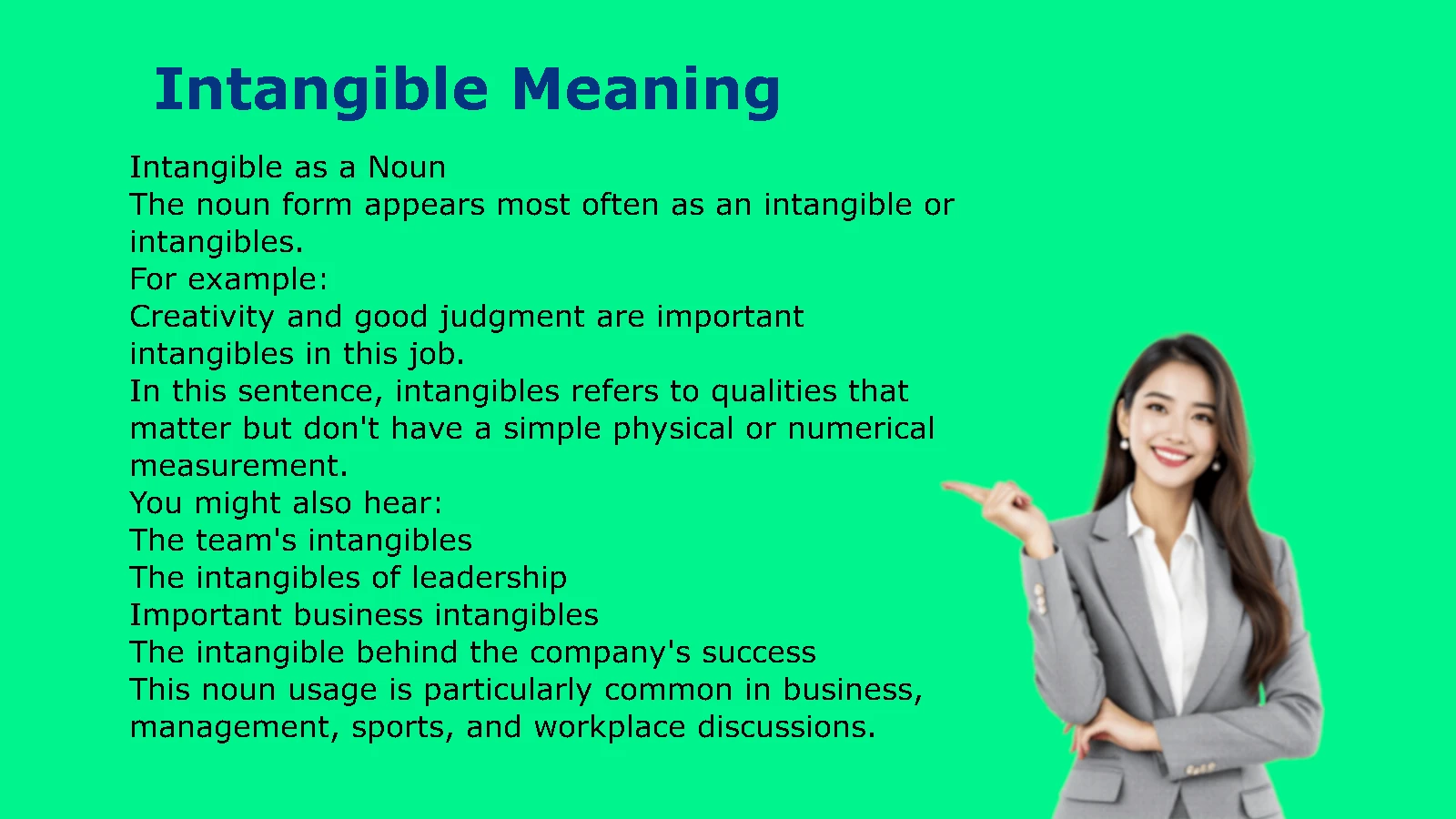
Intangible as a Noun
The noun form appears most often as an intangible or intangibles.
For example:
Creativity and good judgment are important intangibles in this job.
In this sentence, intangibles refers to qualities that matter but don’t have a simple physical or numerical measurement.
You might also hear:
- The team’s intangibles
- The intangibles of leadership
- Important business intangibles
- The intangible behind the company’s success
This noun usage is particularly common in business, management, sports, and workplace discussions.
Intangible Meaning in Different Contexts
The exact shade of meaning depends on context. That’s where things get interesting.
Intangible in Everyday English
In ordinary conversation, intangible often describes a feeling, quality, or idea.
Consider this sentence:
“There was something intangible about their friendship.”
The speaker doesn’t mean the friendship isn’t real. The opposite is closer to the truth. The friendship feels real and meaningful, but its special quality can’t be physically measured.
Other examples include:
- She brings an intangible warmth to the team.
- The trip gave him an intangible sense of freedom.
- There is an intangible connection between the two artists.
- The experience provided an intangible benefit that money couldn’t buy.
Intangible as Something Difficult to Describe
Sometimes, intangible means more than simply “not physical.” It can describe something you sense or recognize but can’t define precisely.
Charisma provides a good example. You might recognize that someone has charisma without being able to point to one physical feature responsible for it. Cambridge specifically uses charisma as an example of an intangible quality.
The same idea applies to:
- Atmosphere
- Charm
- Motivation
- Team spirit
- Confidence
- Loyalty
- Emotional connection
- Creativity
These qualities can influence behavior even though you can’t put them on a scale and measure them with perfect accuracy.
Intangible in Business
Business uses the word in two related ways.
First, companies talk about intangible benefits. These might include employee morale, customer loyalty, brand recognition, or improved relationships.
Second, accounting uses the more technical term intangible asset.
This distinction matters. A business may describe something as an intangible benefit without that item automatically qualifying as an intangible asset under accounting standards.
What Are Intangible Assets?
An intangible asset is a nonphysical asset that can provide economic value to a business.
Examples can include certain:
- Patents
- Copyrights
- Trademarks
- Software
- Licenses
- Franchise rights
- Other identifiable intellectual property
Merriam Webster’s legal definition also gives examples such as goodwill and patent rights.
However, accounting treatment requires more care than simply asking whether something is physical.
Under IAS 38, Intangible Assets, an intangible asset generally needs to meet specific recognition requirements. The standard focuses on characteristics such as identifiability, control, and expected future economic benefits. Accounting treatment can also differ depending on how an asset arose and which accounting standard applies.
That means this shortcut isn’t always correct:
“It can’t be touched, so it’s automatically an intangible asset.”
That’s too broad.
A nonphysical item can be intangible in ordinary English without meeting the accounting requirements for recognition as an asset.
Why Intangible Assets Matter
Imagine two companies with similar factories, equipment, and inventory.
One company owns a valuable patent and has a recognizable brand. The other doesn’t.
The physical assets may look similar, yet the companies could have very different competitive positions.
That’s the power of intangible value.
Intellectual property, software, contractual rights, and other nonphysical resources can help a company:
- Create products
- Protect inventions
- Build customer loyalty
- Differentiate itself from competitors
- Generate licensing revenue
- Reduce costs
- Enter new markets
Modern businesses often rely heavily on things that don’t look like traditional physical property.
Intangible vs. Tangible
The clearest opposite of intangible is tangible.
What Does Tangible Mean?
Tangible describes something that has a physical form and can generally be touched or physically experienced.
For example:
- A building
- A computer
- A chair
- A vehicle
- A printed document
- A piece of machinery
The difference becomes easy when you put the words side by side.
| Tangible | Intangible |
| Physical equipment | Knowledge |
| Office furniture | Employee morale |
| A vehicle | Brand reputation |
| A printed contract | A contractual right |
| A machine | A patent right |
| Inventory | Customer loyalty |
The distinction concerns physical form, not importance.
That’s worth remembering.
Something intangible can be far more valuable than something tangible.
A company’s physical sign may cost $500 to replace. Its reputation could take decades to build.
Intangible vs. Abstract
Intangible and abstract overlap, but they aren’t perfect synonyms.
Abstract generally refers to an idea, concept, quality, or thought rather than a specific physical object.
Intangible emphasizes the absence of physical form or the difficulty of touching, precisely describing, measuring, or valuing something.
For example:
- Justice is an abstract concept.
- Trust is intangible.
- A painting can be abstract but still tangible.
That last example shows why the distinction matters.
An abstract painting may represent ideas, emotions, or shapes in a nonrepresentational way. Yet the physical canvas and paint remain tangible.
So:
Abstract and concrete are opposites in one common sense.
Tangible and intangible are opposites concerning physical existence or touchability.
The categories can overlap, but they aren’t interchangeable in every situation.
Intangible vs. Immaterial
These words sometimes cause confusion because immaterial has more than one meaning.
In one sense, immaterial can mean nonphysical. In another very common sense, it means unimportant or irrelevant. Cambridge defines immaterial in this latter sense as something that isn’t important or doesn’t affect the matter being considered.
Compare these sentences:
- The company’s reputation is intangible.
- The employee’s age is immaterial to the decision.
The first sentence says the reputation lacks physical form.
The second says the employee’s age isn’t relevant.
Changing intangible to immaterial could completely change the meaning.
Quick Comparison
| Word | Main idea |
| Intangible | Not physical or difficult to quantify |
| Tangible | Physical or touchable |
| Abstract | Conceptual rather than concrete |
| Immaterial | Often unimportant or irrelevant |
| Invisible | Unable to be seen |
Context decides which word fits best.
Intangible vs. Invisible
Invisible means something cannot be seen.
Intangible is broader.
Something can be intangible without being merely an unseen physical object.
For example:
- Air can be invisible but has physical properties.
- Trust is intangible.
- Knowledge is intangible.
- A person’s reputation is intangible.
So it would be misleading to define intangible simply as “invisible.”
The better definition is nonphysical or difficult to touch, describe, measure, or value exactly, depending on context.
Examples of Intangible Things
The easiest way to understand intangible meaning is to see the word in action.
Feelings
Many emotions are intangible because you can’t physically hold them.
Examples include:
- Love
- Fear
- Happiness
- Trust
- Pride
- Anxiety
- Gratitude
- Hope
You can experience these emotions. You can also see their effects on behavior. Yet the emotion itself has no physical shape.
Ideas and Knowledge
Ideas are another major category of intangible things.
Examples include:
- Knowledge
- Beliefs
- Opinions
- Plans
- Theories
- Memories
- Imagination
- Creativity
A notebook can contain written information, making the notebook itself tangible. The underlying knowledge isn’t a physical object.
Human Qualities
Some qualities are difficult to measure precisely.
Examples include:
- Courage
- Leadership
- Charisma
- Kindness
- Wisdom
- Patience
- Determination
- Common sense
A company may value these qualities even though they don’t appear as physical objects on a shelf.
Relationships
Relationships are intangible as well.
Consider:
- Friendship
- Loyalty
- Respect
- Trust
- Cooperation
- Team spirit
You can’t touch friendship, but a strong friendship can affect your choices, behavior, and well-being.
Business Value
Businesses can have significant nonphysical value.
Examples include:
- Brand recognition
- Customer loyalty
- Intellectual property
- Certain contractual rights
- Software
- Patents
- Copyrights
- Licenses
Again, ordinary business language and accounting language aren’t always identical. A business might casually call customer loyalty an intangible asset, while accounting rules may treat it differently from a recognized balance-sheet asset.
Examples of “Intangible” in Sentences
Seeing the word in complete sentences makes its meaning easier to remember.
Everyday Examples
- Trust is an intangible part of any healthy relationship.
- The old house had an intangible sense of warmth.
- She gained an intangible benefit from volunteering.
- His charisma gave him an intangible advantage during the interview.
- The memory has an intangible value that money can’t replace.
Workplace Examples
- Good communication is an intangible quality that strengthens a team.
- The manager recognized the intangible benefits of flexible working.
- Leadership is one of the most important intangibles in a successful organization.
- The training improved employee confidence, an intangible benefit that may take time to measure.
Business Examples
- The patent is an intangible asset with commercial value.
- The company has invested heavily in its intangible assets.
- Brand reputation can create intangible value beyond a company’s physical property.
- The software license represents a nonphysical right and may be treated as an intangible asset under applicable accounting rules.
Common Phrases With “Intangible”
Some combinations appear frequently in everyday and professional English.
Intangible Asset
An intangible asset is a nonphysical asset recognized under applicable accounting rules.
Example:
The company reported an intangible asset related to acquired intellectual property.
Intangible Benefit
An intangible benefit is a benefit that doesn’t have a straightforward physical or monetary form.
Example:
Volunteering can provide intangible benefits such as confidence, social connection, and a sense of purpose.
Intangible Value
Intangible value describes value that is difficult to express through physical measurements alone.
Example:
The company’s reputation has intangible value that extends beyond its physical property.
Intangible Quality
An intangible quality is a characteristic that’s difficult to define or measure precisely.
Example:
Her ability to make people feel comfortable is an intangible quality.
Intangible Property
Intangible property refers to nonphysical rights or interests, especially in legal and business contexts.
Patents and certain intellectual property rights are common examples.
Intangible Cultural Heritage
The phrase intangible cultural heritage refers to living cultural practices, knowledge, traditions, skills, and expressions rather than physical objects alone.
Examples can include:
- Oral traditions
- Performing arts
- Traditional knowledge
- Rituals
- Craft skills
- Community practices
Here, intangible highlights the living knowledge and practices rather than a physical artifact.
A Practical Case Study: Why Intangible Value Matters
Consider a fictional but realistic company called BrightBean Coffee.
It owns:
- Coffee machines
- Store furniture
- Delivery equipment
- Inventory
- A physical storefront
Those are tangible resources.
But BrightBean also has:
- A recognizable brand
- Loyal customers
- A reputation for excellent service
- Recipes and proprietary processes
- Employee expertise
- Strong relationships with suppliers
Those elements don’t all qualify as accounting assets simply because they’re valuable. However, they can create real competitive advantages.
Imagine that two coffee shops have identical equipment and similar locations. One has a loyal customer base that returns every morning because customers trust its service.
That loyalty is intangible.
Yet the effect can be very tangible: more repeat purchases, stronger customer retention, and potentially higher revenue.
This is why intangible doesn’t mean insignificant.
Sometimes the hardest things to touch are the things that shape behavior most strongly.
Intangible Assets and Accounting: An Important Distinction
Accounting requires more precision than everyday English.
Under IAS 38, the accounting treatment of intangible assets involves specific recognition and measurement rules. Not every nonphysical resource becomes a recognized intangible asset on a company’s financial statements.
This matters especially for internally developed resources.
For example, a business might spend money developing a new technology. The accounting treatment can depend on whether the spending relates to research or development and whether the applicable recognition requirements have been satisfied.
The broader lesson is simple:
“Intangible” describes a characteristic. “Intangible asset” is a technical accounting category.
Those aren’t interchangeable concepts.
Why Valuing Intangibles Can Be Difficult
Physical property often has observable characteristics that make valuation easier to conceptualize.
A building has:
- A location
- A size
- A physical condition
- Comparable properties
- Construction characteristics
An intangible resource may be much harder to evaluate.
How much is a brand worth?
There may be useful valuation methods, market comparisons, forecasts, and financial models. However, uncertainty remains.
Research also continues to examine the challenge of measuring intangible capital, particularly as digitalization and globalization increase the importance of assets such as innovation, intellectual property, and branding.
What Are Some Common Intangible Assets?
In business contexts, common examples can include:
| Intangible asset | Why it is intangible |
| Patent | Represents a legal right rather than a physical object |
| Copyright | Protects rights in creative works |
| Trademark | Represents protected branding or identification |
| Software | The software itself has no physical form |
| License | Represents permission or a legal right |
| Franchise right | Represents contractual rights to operate under a system or brand |
| Certain customer relationships | Can represent identifiable economic value under applicable rules |
| Goodwill | Represents value associated with a business combination and other factors |
The precise accounting treatment depends on the relevant accounting framework and circumstances.
For example, goodwill deserves special attention. In ordinary language, people often describe goodwill as an intangible asset. In accounting, however, goodwill has specialized treatment and isn’t simply handled as though it were an ordinary identifiable intangible asset under IAS 38.
That distinction prevents a common oversimplification.
Is “Intangible” Positive, Negative, or Neutral?
Intangible is a neutral word.
It doesn’t automatically mean something is good, bad, valuable, vague, or unimportant.
Context creates the tone.
Positive Use
The team gained intangible benefits from the leadership program.
Here, intangible describes benefits that aren’t easily measured.
Neutral Use
The artist wanted to capture an intangible feeling of nostalgia.
The word simply describes something difficult to physically define.
Potentially Negative Use
The proposal promises several intangible benefits but provides little evidence of measurable results.
Here, the word isn’t inherently negative. The surrounding context makes the statement skeptical.
So don’t assume intangible = useless.
That’s a common misunderstanding.
Common Mistakes When Using “Intangible”
Mistake: Treating Intangible as Meaning Unreal
Something intangible can be completely real.
Incorrect idea:
“Trust is intangible, so it isn’t real.”
Better understanding:
“Trust is real, but it doesn’t have a physical form.”
The same principle applies to knowledge, emotions, relationships, and reputation.
Mistake: Using Intangible as a Synonym for Invisible
Not everything intangible is simply invisible.
Invisible focuses on sight.
Intangible focuses primarily on physical touch or physical existence, with broader meanings involving precise description and valuation.
Mistake: Assuming Intangible Means Unimportant
This is perhaps the most damaging misunderstanding.
An intangible quality such as trust can determine whether someone accepts advice, buys a product, or stays in a relationship.
An intangible asset such as intellectual property can generate significant economic benefits.
Mistake: Treating Intangible and Immaterial as Exact Synonyms
Remember the distinction:
- Intangible: nonphysical or difficult to quantify.
- Immaterial: often unimportant or irrelevant.
For example:
The company’s brand is intangible.
The exact color of the office walls is immaterial to the financial decision.
The words aren’t interchangeable.
Mistake: Calling Every Nonphysical Business Resource an Accounting Asset
A company can have many valuable nonphysical resources. That doesn’t mean every one qualifies as a recognized intangible asset under accounting standards.
Accounting classification requires specific criteria.
Synonyms for Intangible
The best synonym depends on the context.
When You Mean “Not Physical”
- Nonphysical
- Immaterial
- Incorporeal
- Untouchable
However, immaterial can create ambiguity because it also means irrelevant or unimportant.
When You Mean “Hard to Define”
- Elusive
- Indefinable
- Hard to describe
- Difficult to quantify
- Difficult to measure
- Subtle
These aren’t exact replacements in every sentence.
For example, elusive often suggests something difficult to capture or understand, while nonphysical focuses directly on physical form.
When You Mean “Conceptual”
- Abstract
- Theoretical
- Conceptual
- Ideational
Again, context matters. An abstract thing isn’t necessarily intangible in every possible sense.
Antonyms of Intangible
The clearest antonym is tangible.
Other words may work depending on context:
- Physical
- Concrete
- Material
- Corporeal
- Touchable
For example:
The company has both tangible and intangible resources.
The report separates physical assets from nonphysical rights.
The best opposite depends on what aspect of intangible you’re contrasting.
How to Use “Intangible” Correctly
The word works naturally in several sentence patterns.
Intangible + Noun
This is one of the easiest structures.
- Intangible benefits
- Intangible value
- Intangible qualities
- Intangible assets
- Intangible rewards
- Intangible resources
The Intangible Value of + Noun
This construction emphasizes value that isn’t easily measured.
The intangible value of a trusted brand can influence customer decisions.
An Intangible + Noun
Use this when describing a specific nonphysical quality or benefit.
The experience gave her an intangible sense of confidence.
Intangibles
Use the noun when referring to multiple difficult-to-measure qualities.
The coach focused on the team’s intangibles, including confidence, discipline, and leadership.
Quick Facts About “Intangible”
| Fact | Detail |
| Part of speech | Adjective and noun |
| Basic meaning | Not physically touchable |
| Broader meaning | Difficult to describe, measure, or value exactly |
| Main opposite | Tangible |
| Common noun form | Intangible / intangibles |
| Common business phrase | Intangible asset |
| Common examples | Trust, knowledge, creativity, reputation |
| Common confusion | Invisible, abstract, immaterial |
| First known use listed by Merriam Webster | 1640 |
| Pronunciation | in-TAN-juh-bul |
Merriam Webster lists the first known use of intangible as 1640 and recognizes both adjective and noun forms.
Frequently Asked Questions About Intangible Meaning
What is the simple meaning of intangible?
Intangible means not physically touchable or something that is difficult to describe, measure, or value exactly.
For example, trust, knowledge, creativity, and reputation are intangible.
What is an example of something intangible?
Love, trust, knowledge, creativity, confidence, reputation, and friendship are everyday examples of intangible things.
They can be real and influential without having a physical shape.
What is the opposite of intangible?
The direct opposite is tangible.
A tangible thing has a physical form that you can touch or physically experience.
Does intangible mean invisible?
No.
Invisible means something can’t be seen. Intangible generally refers to something that lacks physical form or is difficult to touch, describe, measure, or value precisely.
Is an idea intangible?
Yes.
An idea doesn’t have a physical form, although you can represent an idea through a physical object such as a book, drawing, or model.
Is money tangible or intangible?
It depends on what form of money you’re discussing.
Physical cash is tangible because you can hold the notes and coins.
Electronic balances and financial claims don’t have the same physical form. However, describing all forms of money simply as “intangible” can oversimplify the legal and financial concepts involved.
Is reputation intangible?
Yes.
A reputation isn’t a physical object. It represents perceptions and judgments that people hold about a person, organization, or brand.
Is an intangible asset the same as an intangible thing?
No.
“Intangible” is a broad descriptive word.
“Intangible asset” is a more specific business and accounting term. Applicable accounting standards determine whether a particular nonphysical resource qualifies for recognition as an asset.
Is intangible a noun or adjective?
It can be both.
As an adjective:
The company gained an intangible benefit.
As a noun:
Creativity is one of the intangibles we value.
Can a physical object be associated with something intangible?
Yes.
A physical object can represent or contain something intangible.
A printed contract, for example, is physical. The legal rights and obligations created by the agreement aren’t simply the same thing as the paper itself.
Likewise, a computer is tangible while software is generally nonphysical.
Intangible Meaning: The Key Takeaway
The word intangible describes something that lacks physical form or something that is difficult to touch, describe precisely, measure, or value.
Its meaning becomes clearer when you compare it with tangible:
Tangible = physical and touchable.
Intangible = nonphysical or difficult to physically grasp or precisely quantify.
In everyday life, trust, love, knowledge, creativity, reputation, and friendship are intangible. In business, intellectual property, software, licenses, and certain other rights can be intangible assets when they meet the relevant requirements.
The most important point is that intangible doesn’t mean unreal or worthless. Some of the most influential things in life have no physical shape at all. A company’s reputation can influence customer behavior. Trust can strengthen a relationship. Knowledge can change a career. A patent can protect an invention.
You can’t always put these things in your hand.
That doesn’t make them any less real.