
Have you ever understood something right away without knowing exactly how you knew it? That feeling is often connected to Intuitive Meaning. While the word intuitive may seem simple, its meaning can change slightly depending on the context, situation, and way it is used.
Intuitive means something that you understand, recognize, or know naturally without needing to think about it deeply or use a step by step process. It often describes a feeling, idea, decision, or action that seems easy to understand or comes naturally.
Examples:
- She had an intuitive feeling that something was wrong.
- The app has an intuitive design that makes it easy to use.
The confusion is understandable. People often search for what does intuitive mean, intuitive meaning in English, intuitive meaning in a sentence, or intuitive meaning in psychology because the word can describe both a natural understanding and something that is easy to use. And here’s the kicker: being intuitive doesn’t always mean you can explain how you reached the answer.
In this guide, you’ll learn the complete Intuitive Meaning, its definition, pronunciation, correct usage, and examples in sentences. You’ll also discover what intuitive means in different contexts, how it differs from instinctive, intelligent, and logical, and how to use intuitive correctly in everyday English.
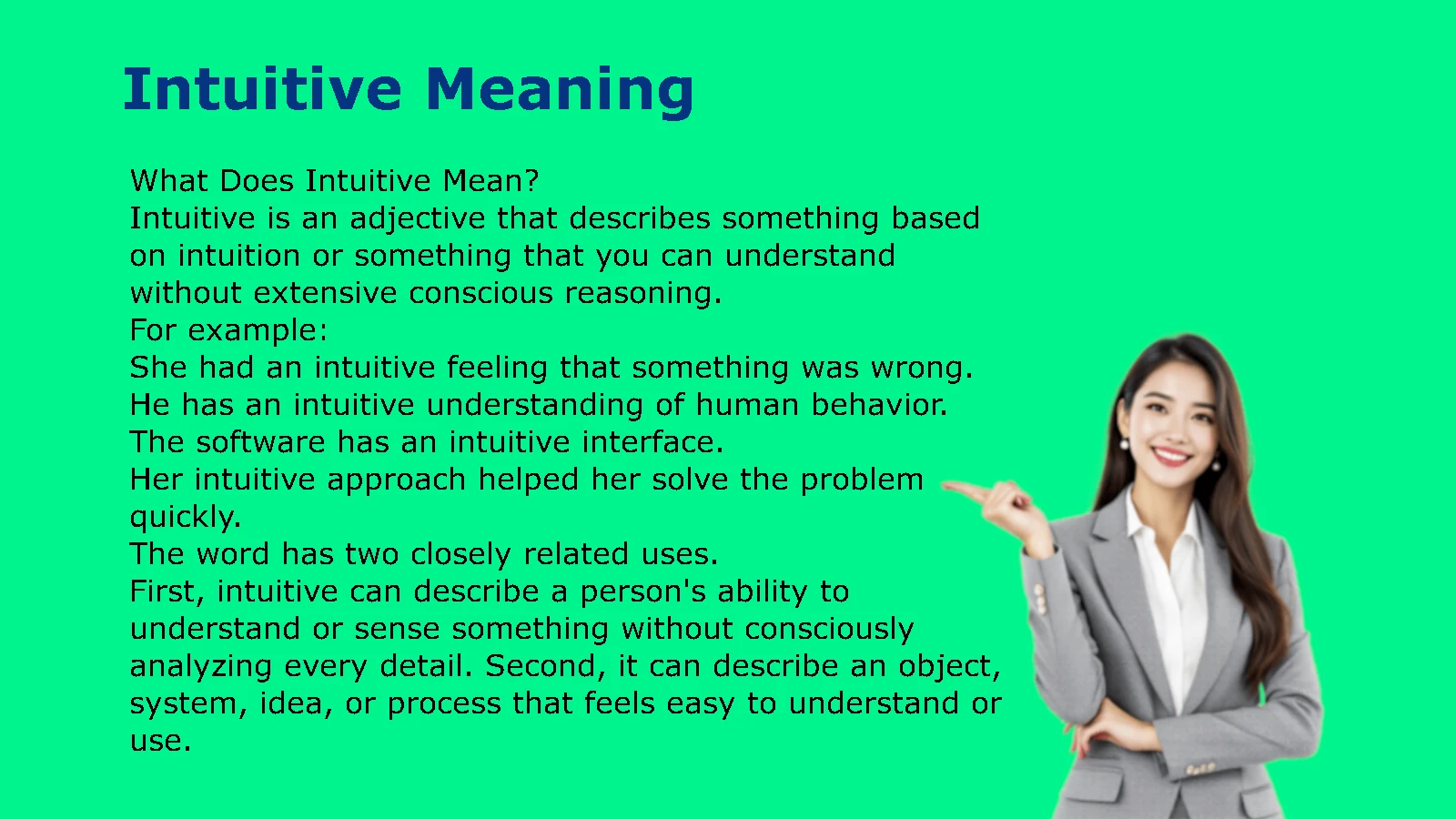
What Does Intuitive Mean?
Intuitive is an adjective that describes something based on intuition or something that you can understand without extensive conscious reasoning.
For example:
- She had an intuitive feeling that something was wrong.
- He has an intuitive understanding of human behavior.
- The software has an intuitive interface.
- Her intuitive approach helped her solve the problem quickly.
The word has two closely related uses.
First, intuitive can describe a person’s ability to understand or sense something without consciously analyzing every detail. Second, it can describe an object, system, idea, or process that feels easy to understand or use.
| Use of “intuitive” | Meaning | Example |
| Intuitive person | Someone who quickly senses or understands things | “She’s very intuitive.” |
| Intuitive feeling | A strong feeling without an obvious explanation | “I had an intuitive feeling that we should wait.” |
| Intuitive decision | A decision influenced by an immediate sense or judgment | “He made an intuitive decision.” |
| Intuitive understanding | Immediate or natural understanding | “She has an intuitive understanding of music.” |
| Intuitive design | Design that’s easy to use without instructions | “The website has an intuitive layout.” |
The important idea is immediate understanding. You don’t necessarily have to explain every step that led you there.
Intuitive Meaning in Simple Words
In simple English, intuitive means knowing or understanding something without having to think about it carefully first.
Imagine you’ve used dozens of smartphone apps. When you see a familiar menu icon, you probably know what it does immediately. You don’t stop and think, “What does this symbol represent? What might happen if I tap it?”
You just know.
That response can be called intuitive.
Another example involves people. You might talk to a friend for only a few minutes and sense that they’re worried. They may not tell you anything directly. Still, their voice, facial expression, pauses, or behavior may give you an immediate impression.
Your conscious mind might not identify every clue. Your brain can still put those clues together.
A Simple Definition
Intuitive means based on an immediate feeling or understanding rather than conscious reasoning or detailed proof.
That doesn’t mean the person has no reason for the judgment. The reasons may simply operate below conscious awareness.
What Is the Meaning of Intuition?
Intuition is the noun form related to intuitive.
Cambridge describes intuition as the ability to understand or know something without needing to think it through or use reason to discover it.
The relationship is easy to remember:
- Intuition = the feeling, ability, or understanding.
- Intuitive = describing something that comes from intuition.
- Intuit = the verb meaning to understand or know something through a feeling rather than facts or information.
- Intuitively = the adverb describing an action performed through intuition.
Consider these examples:
I had an intuition that he was nervous.
I had an intuitive feeling that he was nervous.
She intuitively understood what the customer needed.
He intuited that something had changed.
The grammar changes, but the central idea stays the same: understanding without consciously explaining every step.
What Does It Mean When Someone Is Intuitive?
When someone is described as intuitive, it usually means they can notice, understand, or sense things quickly without needing an explicit explanation.
An intuitive person might notice that a conversation feels uncomfortable even when everyone is being polite. They might recognize a problem before they can identify its exact cause. They may also understand what another person needs from subtle cues.
Being intuitive doesn’t mean someone possesses a mysterious ability to predict the future.
More often, intuition draws on information that a person has absorbed without consciously analyzing it.
Signs of an Intuitive Person
An intuitive person may:
- Notice small changes in behavior
- Pick up on social cues
- Recognize familiar patterns quickly
- Sense when something feels unusual
- Understand a situation without a lengthy explanation
- Make quick judgments based on experience
- Notice emotional changes in other people
- Anticipate likely problems
- Recognize when an explanation doesn’t quite make sense
- Connect pieces of information quickly
- Trust a strong gut feeling
- Adjust their response without needing explicit instructions
For instance, an experienced teacher may notice that a student isn’t understanding a lesson before the student raises a hand. The teacher may recognize the student’s expression, hesitation, or body language because they’ve seen similar situations many times.
That’s a useful way to think about intuition: the brain can recognize a pattern before the conscious mind puts the pattern into words.
Intuitive Examples in Everyday Life
You encounter intuitive behavior far more often than you might realize.
Intuitive Decisions
Imagine you’re walking home and suddenly decide to take a different route. You can’t immediately explain why. Perhaps the usual route seems unusually quiet. Maybe you noticed something in your surroundings without consciously focusing on it.
Your decision may be intuitive.
Another example is choosing between two options when both appear reasonable. One option simply seems like the better fit. You may later discover that your choice matched information you hadn’t consciously considered.
Intuitive Social Awareness
Suppose a friend says, “I’m fine,” but their voice sounds different. They avoid eye contact and respond more briefly than usual.
You might sense that they’re not actually fine.
Your brain may be comparing their current behavior with what you’ve seen from them before. The resulting feeling can appear almost instantly.
Intuitive Learning
An experienced musician can often tell that a note or chord doesn’t sound right without calculating why. A skilled athlete may move into the right position before consciously describing the opposing player’s strategy.
Experience matters.
The more patterns you encounter in a particular field, the more material your intuition has to work with.
Intuitive Meaning in Different Contexts
The word intuitive changes slightly depending on the context.
Intuitive Meaning in Psychology
In psychology and decision making, intuition generally refers to judgments or impressions that arise quickly without deliberate, step by step analysis.
This doesn’t mean intuitive thinking is always emotional. It can involve learned patterns and information that a person processes rapidly.
For example, an experienced emergency worker might notice that a situation looks dangerous almost immediately. That reaction may reflect years of exposure to similar situations.
However, intuition can also produce errors. People can develop strong impressions from incomplete information, stereotypes, emotional reactions, or misleading patterns.
So the useful distinction is:
Intuition can be fast without being infallible.
Intuitive Meaning in Technology
In technology, intuitive often means easy to use or understand without special training.
For example:
- An intuitive app is easy to navigate.
- An intuitive website makes important features easy to find.
- An intuitive interface doesn’t force users to study a manual before performing basic tasks.
- An intuitive tool makes its controls understandable through familiar design patterns.
This use is slightly different from describing a person’s intuition.
When someone says, “This app is intuitive,” they’re usually praising the design, not saying the app has feelings or instincts.
Intuitive Meaning in Decision Making
An intuitive decision is one that comes from an immediate impression rather than a long conscious comparison of every possible factor.
Imagine a hiring manager who interviews an experienced candidate and quickly senses that the candidate understands the work. That impression might come from tone, language, examples, confidence, and other subtle cues.
The judgment may be useful. It can also be biased.
For important decisions, intuition works best as a starting point for investigation, not as unquestionable proof.
Intuitive Meaning in Learning
An intuitive understanding develops when a concept becomes natural enough that you can work with it without consciously recalling every rule.
A child who learns that a tall, narrow glass can hold the same amount of liquid as a shorter, wider glass may develop an intuitive understanding of volume.
Similarly, a fluent speaker often uses grammar correctly without consciously naming the grammatical rule behind each sentence.
Intuitive vs. Instinctive
Intuitive and instinctive overlap, but they aren’t exact synonyms.
Instinctive usually describes a natural or automatic response. It often carries a stronger connection to innate behavior.
Intuitive, by contrast, can involve experience, perception, learned patterns, and immediate understanding.
| Word | Core idea | Example |
| Intuitive | Immediate understanding or judgment | “She had an intuitive sense that the plan would fail.” |
| Instinctive | Natural, automatic, or inborn response | “His instinctive reaction was to protect the child.” |
Consider an experienced chef. She may intuitively know when a sauce needs more seasoning because she’s cooked the dish hundreds of times.
Now consider pulling your hand away from something extremely hot. That’s much closer to an instinctive or automatic physical response.
The distinction isn’t always absolute, but context makes the difference clearer.
Intuitive vs. Natural
The words intuitive and natural sometimes overlap, yet they focus on different ideas.
Natural can mean something that happens easily, exists inherently, or doesn’t feel forced.
Intuitive focuses more specifically on understanding, sensing, or using something without deliberate reasoning or special instruction.
Compare:
- “She has a natural talent for drawing.”
- “She has an intuitive understanding of color.”
- “The controls feel natural.”
- “The controls are intuitive.”
The first sentence emphasizes talent. The second emphasizes understanding. The last two focus on ease of use, with intuitive carrying the more specific meaning of being easy to understand without much instruction.
Intuitive vs. Logical
This comparison causes confusion because people sometimes treat intuitive and logical as complete opposites.
They’re better understood as different ways of reaching a judgment.
Intuitive thinking can happen quickly and without conscious analysis.
Logical thinking deliberately examines information, relationships, evidence, and conclusions.
For example, imagine a mechanic hears an unfamiliar sound from a car.
An experienced mechanic might immediately think, “That sounds like a problem with the belt.”
That’s an intuitive judgment.
The mechanic can then inspect the belt, check related components, and test the vehicle.
That’s analytical reasoning.
The two approaches can work together.
Intuition can point you toward a possibility. Evidence can help you determine whether that possibility holds up.
This combination is often more useful than treating intuition and logic as enemies.
Intuitive vs. Rational
Rational usually describes reasoning that follows evidence, logic, or deliberate thought.
Intuitive describes an immediate impression or understanding.
Suppose you’re considering whether to buy a used car.
Your intuition might tell you, “Something about this deal feels wrong.”
A rational response isn’t necessarily to ignore that feeling. You can investigate it.
Check the vehicle history. Inspect the car. Compare the price. Ask questions. Look for evidence.
Your intuition raised a flag. Rational analysis tells you whether the flag has a solid reason behind it.
That’s an important point: using intuition doesn’t require abandoning reason.
Intuitive Synonyms
The best synonym for intuitive depends on the sentence. Some words overlap strongly with it, while others only match one part of its meaning.
Synonyms Related to Natural Understanding
- Instinctive
- Natural
- Innate
- Inherent
Related to Perception
- Perceptive
- Observant
- Insightful
- Sensitive
- Discerning
Related to Immediate Judgment
- Instinctive
- Unconscious
- Gut
- Impromptu
Be careful with impulsive, however. An impulsive action happens suddenly without much thought, but it doesn’t necessarily involve genuine intuitive understanding.
Likewise, innate means present naturally from birth or inherent. Something can be intuitive without being innate.
Antonyms of Intuitive
Depending on the context, possible opposites include:
- Analytical
- Deliberate
- Logical
- Reasoned
- Calculated
- Conscious
- Systematic
- Methodical
These aren’t perfect opposites in every sentence.
For example, an intuitive solution can still be logical. A person can also make a deliberate decision after an initial intuitive reaction.
Common Phrases With Intuitive
The word appears in several common combinations.
Intuitive Understanding
An intuitive understanding means you grasp something naturally without needing to consciously work through every detail.
Example:
“She has an intuitive understanding of how children learn.”
Intuitive Sense
An intuitive sense refers to an immediate awareness or feeling.
Example:
“He had an intuitive sense that the timing wasn’t right.”
Intuitive Feeling
An intuitive feeling is a feeling that seems to provide information even when you can’t immediately explain its source.
Example:
“I had an intuitive feeling that we should wait.”
Intuitive Approach
An intuitive approach relies partly on immediate understanding or perception rather than a rigid analytical process.
Example:
“The designer took an intuitive approach to solving the problem.”
Intuitive Design
Intuitive design makes a product or system easy to understand and operate.
Example:
“The website’s intuitive design makes it easy for new visitors to find information.”
Intuitive Interface
An intuitive interface lets users understand how to interact with a system without extensive instruction.
Example:
“The editing software has an intuitive interface.”
How to Use Intuitive Correctly
Intuitive is an adjective. It commonly appears before a noun or after a linking verb.
Before a Noun
- An intuitive decision
- An intuitive response
- An intuitive approach
- An intuitive design
- An intuitive understanding
- An intuitive feeling
After a Linking Verb
- “The software is intuitive.”
- “Her approach was intuitive.”
- “The controls feel intuitive.”
- “His response seemed intuitive.”
With “Intuitively”
Use intuitively when you need an adverb.
- “She intuitively understood the situation.”
- “The system is intuitively designed.”
- “He intuitively recognized the pattern.”
With “Intuit”
Intuit is a formal verb meaning to understand or know something through a feeling rather than through facts or information.
For example:
“She intuited that her colleague was uncomfortable.”
In everyday conversation, however, people are more likely to say:
“She sensed that her colleague was uncomfortable.”
Is Intuitive a Positive Word?
Usually, intuitive has a positive or neutral meaning.
Calling a person intuitive often suggests that they are perceptive, observant, or good at recognizing patterns.
Calling a product intuitive usually praises its usability.
For example:
- “She’s an intuitive teacher.”
- “He has an intuitive grasp of the subject.”
- “The app is remarkably intuitive.”
- “The controls are intuitive and easy to learn.”
Still, context matters.
An intuitive judgment can be wrong. A person may feel strongly about something without having enough information to support that feeling.
That’s why intuitive doesn’t mean correct.
It means the understanding or response comes quickly and without conscious step by step reasoning.
Does Intuitive Mean Easy?
Sometimes, but not always.
When people describe software, instructions, or a system as intuitive, they often mean it’s easy to understand or use without special knowledge. Cambridge specifically includes this sense in its definition of intuitive.
But intuitive and easy aren’t interchangeable.
Something can be easy because it requires little effort. Something can be intuitive because its structure makes sense without detailed instruction.
For example:
“The math problem is easy.”
This tells you the problem isn’t difficult.
“The software is intuitive.”
This tells you the software’s operation is easy to understand.
A complicated tool can still have an intuitive interface.
Does Intuitive Mean Smart?
No.
Intuitive and smart describe different things.
A smart person may reason carefully, solve complex problems, learn quickly, or understand difficult concepts.
An intuitive person may notice patterns or make rapid judgments without consciously explaining the reasoning.
Someone can be highly intelligent but poor at a particular intuitive task. Likewise, someone can have excellent intuition in an area where they’ve gained extensive experience.
Think of a professional chess player. After thousands of games, the player may recognize that a position “looks wrong” almost instantly.
That reaction doesn’t mean the player skipped all reasoning throughout their career. Their experience helped build the pattern recognition behind the quick judgment.
How Does Intuition Develop?
Intuition often becomes stronger through experience and repeated exposure to meaningful patterns.
Imagine two people looking at a cracked wall.
A beginner might see only a crack.
An experienced structural engineer may notice its shape, direction, location, surrounding damage, and other clues. The engineer might quickly suspect a particular problem.
The expert’s response can look intuitive because it happens quickly.
But years of training helped create that speed.
Ways to Develop Better Intuition
You can strengthen useful intuition in a specific field by:
- Building experience: Repeated exposure gives you more patterns to recognize.
- Studying outcomes: Look back at previous judgments and see whether they were accurate.
- Paying attention: Notice small signals instead of operating entirely on autopilot.
- Learning from feedback: Correct mistakes instead of reinforcing them.
- Recognizing patterns: Ask what successful and unsuccessful situations have in common.
- Separating feelings from facts: Notice an intuitive reaction without automatically treating it as proof.
- Using deliberate practice: Work on the same type of problem repeatedly.
- Checking your assumptions: Strong feelings can sometimes come from bias rather than useful information.
The goal isn’t to make every decision based on a gut feeling.
The goal is to develop better judgment.
A Practical Case Study: Intuition at Work
Consider a restaurant manager who has worked in the industry for 15 years.
One evening, a normally reliable employee arrives late, speaks less than usual, and repeatedly checks their phone. The manager immediately senses that something is wrong.
The manager’s first reaction is intuitive.
But instead of assuming the employee is careless or dishonest, the manager asks whether everything is okay.
The employee explains that there’s a family emergency.
This example shows why intuition needs context.
The manager’s intuition correctly identified a change, but intuition alone couldn’t explain the cause.
That distinction matters.
Intuition can tell you that something deserves attention. It doesn’t necessarily tell you exactly what happened.
Another Case Study: Intuitive Design
Consider a banking app.
A user wants to transfer money. If the app places the transfer option where users naturally expect to find it, labels the controls clearly, and follows familiar interaction patterns, many users can complete the task without reading instructions.
They may describe the app as intuitive.
Now imagine the same function hidden behind an unfamiliar icon with unclear labels. Users may need a tutorial to figure it out.
The underlying banking function hasn’t changed. The user experience has.
This is why the phrase intuitive design usually means more than “simple.” It suggests that the design communicates its intended use clearly enough for people to figure it out with little instruction.
Intuitive Does Not Mean Magical
The phrase “I just knew” can make intuition sound mysterious.
In reality, an intuitive judgment can arise from information you noticed without consciously analyzing it.
For example, an experienced editor might read a paragraph and immediately think, “Something isn’t working here.”
They may not know the exact problem yet.
After rereading it, they might discover that the paragraph changes topics too abruptly, repeats an idea, or lacks a clear transition.
The initial reaction came first.
The explanation came later.
That pattern appears in many areas of life.
Fast recognition first. Detailed explanation second.
When Should You Trust Your Intuition?
Intuition can be useful when you have relevant experience, enough context, and a situation where rapid pattern recognition works well.
For example, an experienced professional may have developed strong instincts in a familiar field.
You should be more cautious when:
- You lack experience
- The situation is completely unfamiliar
- The decision involves significant financial or personal consequences
- You have strong emotional biases
- The available evidence contradicts your impression
- You’re judging someone based on a first impression
- The situation contains misleading or incomplete information
A useful rule is simple:
Use intuition as a signal, not as unquestionable evidence.
If something feels wrong, investigate it.
If something feels right, check it.
That middle ground protects you from both extremes: blindly following every gut feeling and ignoring useful instincts altogether.
Intuitive Meaning: Quick Comparison
| Term | Meaning | Main emphasis |
| Intuitive | Based on immediate understanding or feeling | Rapid perception |
| Intuition | The ability or feeling behind that understanding | Inner judgment |
| Instinctive | Natural or automatic response | Innate reaction |
| Logical | Based on reasoning and relationships | Deliberate reasoning |
| Rational | Based on reason and evidence | Reasoned judgment |
| Natural | Existing or happening easily or inherently | Ease or inherent quality |
| Analytical | Based on detailed examination | Breaking information down |
| Impulsive | Done suddenly with little deliberation | Sudden action |
Frequently Asked Questions About Intuitive Meaning
What is the simple meaning of intuitive?
Intuitive means understanding, sensing, or responding to something without consciously reasoning through every step.
For example, if you immediately sense that a friend is upset even though they haven’t said anything, that can be an intuitive response.
What does intuitive mean in a person?
An intuitive person tends to notice patterns, emotions, changes, or social cues quickly. They may understand something without needing a detailed explanation.
Being intuitive doesn’t mean being psychic or always being right.
What is an example of intuitive?
A simple example is opening a new app and immediately knowing where to tap because its layout makes sense.
Another example is an experienced teacher sensing that a student doesn’t understand a lesson before the student says anything.
Is intuitive the same as instinctive?
No.
The words overlap, but instinctive usually refers to a natural or automatic response, while intuitive can involve learned experience, pattern recognition, and immediate understanding.
Is intuitive a positive or negative word?
Intuitive is generally positive or neutral. It can describe a perceptive person, an effective decision, or an easy to use product.
However, an intuitive judgment isn’t automatically accurate.
What is the opposite of intuitive?
Depending on the context, possible opposites include analytical, deliberate, logical, systematic, calculated, and reasoned.
There isn’t one perfect opposite for every use.
What is another word for intuitive?
Depending on the context, alternatives include instinctive, perceptive, insightful, observant, natural, discerning, and innate.
They’re not all exact synonyms, so choose one based on the sentence.
Does intuitive mean you just know?
In everyday language, yes, that’s close.
An intuitive feeling can seem like immediate knowledge even when you can’t explain its source. However, intuition doesn’t guarantee that the conclusion is true.
Can intuition be wrong?
Absolutely.
Intuition can rely on incomplete information, inaccurate assumptions, emotional reactions, or bias. It can also be useful when it draws on strong experience and accurate pattern recognition.
That’s why important decisions often benefit from combining intuition with evidence.
Final Takeaway: Intuitive Meaning in One Sentence
The simplest intuitive meaning is:
The word can describe a person’s perception, a decision, an understanding, a feeling, or even a product’s design.
Most importantly, intuitive doesn’t mean irrational, magical, or always correct. Intuition can draw on experience and pattern recognition that operate outside conscious awareness. Yet strong feelings still deserve a reality check when the stakes are high.
So when you hear someone say, “It was intuitive,” think of a judgment that seemed to arrive before the detailed explanation.
The feeling came first.
The reasoning may come afterward.
And sometimes, that’s how the mind spots the signal before it has time to put the signal into words.