
Finesse describes the ability to handle a situation with skill, subtlety, or precision. It can refer to smooth technique, clever problem-solving, or stylish confidence in everyday conversations, sports, and slang. Finesse meaning refers to using intelligence, tact, or refined skill to achieve the best result.
That’s where the confusion begins. Finesse can describe someone who accomplishes something smoothly and intelligently, but it can also mean persuading, outsmarting, or even getting something through clever manipulation in slang. But here’s the kicker: the meaning changes based on where and how the word is used.
In this guide, you’ll discover the complete Finesse Meaning, including the definition of finesse, finesse slang meaning, finesse pronunciation, how to use finesse in a sentence, and the difference between its traditional and modern uses. You’ll also learn common examples, synonyms, and when the word has a positive or negative meaning.
By the end, you’ll understand exactly what finesse means, why it’s become so popular online, and how to use it naturally in everyday conversations.
What Does Finesse Mean?
The finesse meaning centers on skillful handling, subtle technique, and careful judgment. Rather than forcing an outcome, finesse involves achieving success through intelligence, precision, and graceful execution.
Unlike simple talent or strength, finesse often suggests that someone succeeded because they knew how to approach a situation.
Finesse Meaning as a Noun
As a noun, finesse refers to someone’s ability to deal with situations skillfully and delicately.
Definition
Finesse (noun): Exceptional skill, delicate handling, or refined technique used to achieve a desired result.
People often use the noun form when describing someone’s abilities.
Examples
- She handled the customer complaint with remarkable finesse.
- The surgeon completed the operation with incredible finesse.
- His speech showed both confidence and finesse.
- Their negotiation required patience and finesse.
- The artist painted every detail with finesse.
Notice that each example highlights how something was done rather than simply stating that it was successful.
Finesse Meaning as a Verb
As a verb, finesse means to manage, manipulate, or resolve something through cleverness and careful strategy instead of force.
Definition
Finesse (verb): To achieve something by using skill, diplomacy, or subtle methods.
Examples include:
- She managed to finesse the difficult conversation.
- The attorney finessed the agreement until both parties accepted it.
- He finessed the presentation after receiving feedback.
- They finessed the schedule to accommodate everyone.
- The manager finessed the conflict before it escalated.
The verb often appears in professional settings where people solve complicated problems through thoughtful action.
Quick Definition Table
| Form | Meaning | Example |
| Noun | Skillful and graceful handling of a situation | She solved the issue with finesse. |
| Verb | To handle something cleverly or tactfully | He finessed the negotiation successfully. |
How to Pronounce Finesse
Many English learners hesitate when saying finesse aloud because the spelling doesn’t immediately reveal its pronunciation.
Standard Pronunciation
IPA: /fɪˈnɛs/
It sounds like:
fi-NESS
The stress falls on the second syllable.
Syllable Breakdown
fi + nesse
Think of it as:
“fi” (short i sound) + “NESS”
Common Pronunciation Mistakes
Some people mistakenly pronounce it as:
- Fine-ess
- Fee-ness
- Fin-ees
These pronunciations aren’t considered standard English.
Easy Memory Tip
Imagine someone saying:
“Finesse isn’t force. It’s skill.“
Repeating the phrase aloud helps reinforce both the pronunciation and the meaning.
Origin and Etymology of Finesse
Understanding a word’s history often makes it easier to remember.
The word finesse entered English from French during the 15th century. It comes from the French word finesse, which referred to refinement, subtlety, and delicate skill.
The French term itself traces back to the Latin word finis, meaning end, boundary, or completion. Over time, the concept evolved to describe someone who could achieve an objective through refinement instead of brute strength.
Today, although centuries have passed, the central idea remains almost identical.
Whether discussing business, sports, diplomacy, or personal relationships, finesse still emphasizes elegant problem-solving through skill rather than force.
Quote
“Strength may win battles. Finesse often wins people.”
This simple idea captures why the word continues to appear across so many different fields.
What Does Finesse Really Mean in Everyday English?
Dictionary definitions provide a foundation, but everyday conversations give the word real life.
When people say someone has finesse, they usually mean that person knows how to navigate situations smoothly.
Imagine two managers facing an unhappy client.
The first argues loudly and insists the company is right.
The second listens carefully, acknowledges concerns, proposes practical solutions, and leaves the client satisfied.
Both managers addressed the same problem.
Only one demonstrated finesse.
Finesse Means Working Smarter
People often associate finesse with:
- Careful communication
- Emotional intelligence
- Strategic thinking
- Precision
- Diplomacy
- Confidence without arrogance
It’s less about raw ability and more about how that ability is applied.
Everyday Examples
Workplace
A supervisor calms an upset employee without creating more conflict.
That takes finesse.
Relationships
Instead of criticizing a friend harshly, someone chooses thoughtful words that protect the friendship.
That’s finesse.
Customer Service
A representative turns an angry customer into a loyal one through patience and understanding.
Again, that’s finesse.
Public Speaking
A speaker answers difficult questions confidently without embarrassing anyone.
That demonstrates finesse.
Parenting
Parents often need finesse when teaching children difficult lessons.
Patience usually produces better results than shouting.
Real-Life Case Study
Resolving a Workplace Conflict with Finesse
Two coworkers disagreed over who should lead an important project.
Instead of assigning blame, the department manager scheduled a private meeting with each employee.
She listened carefully.
Next, she identified their strengths.
Finally, she redesigned responsibilities so both employees contributed in meaningful ways.
The conflict disappeared.
Productivity increased.
Neither employee felt ignored.
The manager didn’t rely on authority alone.
She relied on finesse.
Lesson: Skillful communication often creates better long-term outcomes than direct confrontation.
How to Use Finesse in a Sentence
Learning definitions helps, but examples make new vocabulary stick.
Below are examples that show how native English speakers naturally use finesse.
Using Finesse as a Noun
- She answered every difficult question with finesse.
- His negotiation skills impressed everyone because of his finesse.
- The chef decorated the dessert with artistic finesse.
- Great leaders combine confidence with finesse.
- The musician played every note with remarkable finesse.
- Her writing displays elegance and finesse.
- They handled the legal dispute with admirable finesse.
- The coach praised the player’s finesse instead of his strength.
- Success often requires patience and finesse.
- The designer approached the project with creativity and finesse.
Using Finesse as a Verb
- She finessed the budget until everyone approved it.
- He finessed the contract during negotiations.
- They finessed the travel plans after the flight was canceled.
- The lawyer finessed the settlement.
- She finessed the conversation away from politics.
- He finessed the interview by answering difficult questions calmly.
- The project manager finessed several scheduling conflicts.
- They finessed the proposal before presenting it.
- She finessed the disagreement into a productive discussion.
- The executive finessed a complex merger over several months.
Formal Examples
These examples suit professional writing.
- The committee demonstrated considerable finesse while developing the new policy.
- Diplomatic finesse helped both nations reach an agreement.
- The architect completed the restoration with exceptional finesse.
- Effective leadership requires both authority and finesse.
- The company’s response reflected professionalism and finesse.
Informal Examples
You’ll hear these in everyday conversation.
- She handled that awkward moment with real finesse.
- Nice job. You totally finessed that situation.
- He always knows how to finesse difficult conversations.
- I wish I had your finesse during interviews.
- She finessed her way through the meeting without upsetting anyone.
When Should You Use the Word Finesse?
Choose finesse when someone succeeds through:
- Skill instead of force
- Patience instead of pressure
- Strategy instead of aggression
- Precision instead of speed
- Diplomacy instead of conflict
Common Situations Where People Use the Word Finesse
The word finesse appears in many areas because the idea behind it is universal: achieving a result through thoughtful skill rather than unnecessary force.
A basketball player uses finesse when they rely on footwork instead of strength. A business leader uses finesse when they resolve conflicts without damaging relationships. A writer uses finesse when they choose the perfect words to express a complicated idea.
Although the setting changes, the meaning stays connected to one central concept: smart, careful, and skillful execution.
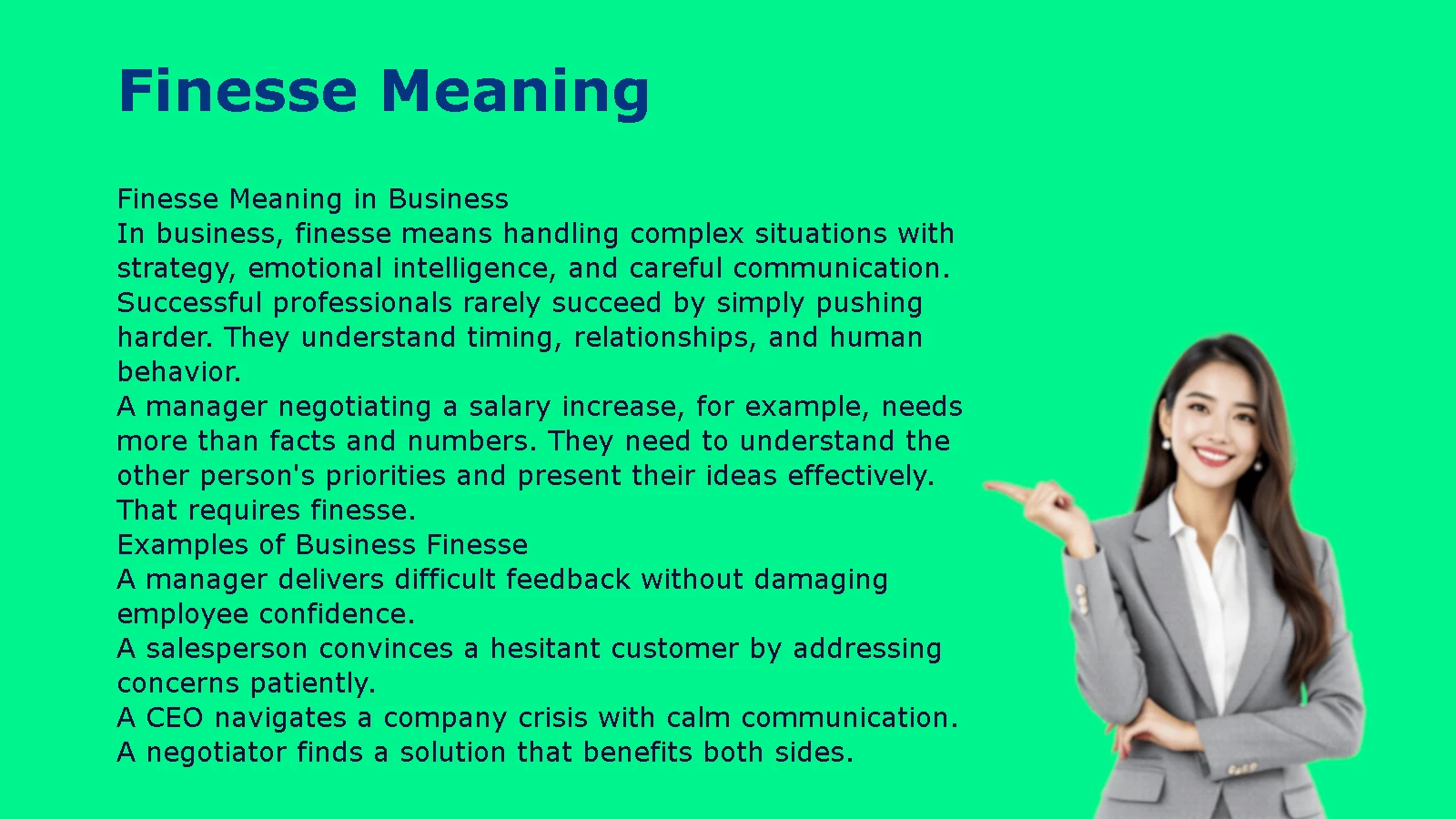
Finesse Meaning in Business
In business, finesse means handling complex situations with strategy, emotional intelligence, and careful communication.
Successful professionals rarely succeed by simply pushing harder. They understand timing, relationships, and human behavior.
A manager negotiating a salary increase, for example, needs more than facts and numbers. They need to understand the other person’s priorities and present their ideas effectively.
That requires finesse.
Examples of Business Finesse
- A manager delivers difficult feedback without damaging employee confidence.
- A salesperson convinces a hesitant customer by addressing concerns patiently.
- A CEO navigates a company crisis with calm communication.
- A negotiator finds a solution that benefits both sides.
Business Situations That Require Finesse
| Situation | How Finesse Helps |
| Negotiations | Creates agreements without unnecessary conflict |
| Leadership | Builds trust and respect |
| Customer service | Turns problems into positive experiences |
| Team management | Resolves disagreements smoothly |
| Presentations | Communicates ideas clearly and persuasively |
A person with business finesse understands that relationships often matter as much as results.
Finesse Meaning in Sports
In sports, finesse describes skillful technique, precision, and controlled movement.
Athletes often succeed in two different ways:
- Power
- Finesse
A powerful athlete may overpower opponents through speed or strength.
A player with finesse wins through timing, accuracy, creativity, and technique.
Examples of Finesse in Sports
Soccer
A striker who places the ball perfectly into the corner of the goal instead of simply kicking with maximum force shows finesse.
Basketball
A player who uses smooth footwork, clever passes, and accurate shots demonstrates finesse.
Tennis
A player who uses a precise drop shot to defeat a stronger opponent uses finesse.
Golf
A golfer who carefully adjusts their swing based on wind conditions relies on finesse.
Power vs Finesse in Sports
| Power Approach | Finesse Approach |
| Relies on strength | Relies on technique |
| Uses force | Uses precision |
| Direct approach | Strategic approach |
| Physical advantage | Mental advantage |
Neither approach is always better.
The best athletes often combine both.
A champion doesn’t only hit harder. They know when to use power and when to use finesse.
Finesse Meaning in Politics and Diplomacy
Politics often requires finesse because leaders must balance different opinions, interests, and expectations.
A politician or diplomat cannot solve every disagreement through direct demands. They often need patience, negotiation, and careful language.
That is where finesse becomes valuable.
Examples
- A diplomat prevents conflict through peaceful negotiation.
- A government leader addresses criticism without creating more tension.
- A politician builds support among groups with different views.
Diplomatic finesse involves:
- Listening carefully
- Choosing words wisely
- Understanding opposing viewpoints
- Finding common ground
A person with political finesse knows that one careless statement can create problems while one thoughtful statement can create cooperation.
Finesse Meaning in Music and Entertainment
Artists often use finesse to describe creativity, technique, and attention to detail.
A musician with finesse doesn’t simply play notes. They understand emotion, timing, and expression.
A filmmaker with finesse doesn’t only tell a story. They carefully combine visuals, dialogue, pacing, and emotion.
Examples of Artistic Finesse
- A singer controls their voice with emotion and precision.
- A dancer performs movements with elegance and control.
- A writer creates powerful scenes through carefully chosen words.
- A director builds tension through subtle storytelling choices.
In creative fields, finesse separates technical ability from true artistry.
Someone may know the rules of their craft, but finesse allows them to create something memorable.
Finesse Meaning in Gaming
In gaming, finesse often refers to advanced skill, clever strategies, and precise execution.
Gamers may use the word when describing someone who wins through intelligence and technique rather than simply having better equipment or more power.
Examples of Gaming Finesse
- A player avoids enemies through smart movement.
- A strategist predicts an opponent’s next move.
- A competitive gamer performs difficult actions with accuracy.
- A player wins by using creative tactics.
A beginner may rely on obvious strategies.
An experienced player uses finesse.
Finesse Meaning in Sales and Marketing
Sales professionals often need finesse because buying decisions involve emotions, trust, and timing.
A salesperson with finesse doesn’t pressure customers aggressively.
Instead, they:
- Ask the right questions
- Understand customer needs
- Offer helpful solutions
- Build long-term relationships
Example
A customer says:
“I’m not sure this product is right for me.”
A salesperson without finesse might respond:
“You should buy it anyway because it’s popular.”
A salesperson with finesse might say:
“Let’s look at what you’re trying to solve. Then we can decide if this option fits your needs.”
The second approach builds trust.
Finesse Meaning in Negotiation
Negotiation is one of the clearest examples of finesse.
A skilled negotiator understands that winning doesn’t always mean defeating the other person.
Sometimes the best outcome happens when everyone feels respected.
Negotiation Finesse Includes:
- Knowing when to speak
- Knowing when to listen
- Staying calm under pressure
- Understanding motivations
- Creating solutions instead of arguments
Case Study: Contract Negotiation
Imagine two companies negotiating a partnership.
Company A wants a lower price.
Company B wants a longer contract.
Instead of arguing over one issue, the negotiators create a flexible agreement:
- Lower initial pricing
- Longer partnership period
- Performance-based bonuses
Both companies benefit.
That solution required finesse because the negotiators looked beyond the obvious disagreement.
Finesse Meaning in Education
Teachers and students also use finesse, even if they don’t always describe it that way.
A teacher demonstrates finesse by adjusting their approach for different learners.
A student demonstrates finesse by finding effective ways to solve difficult problems.
Examples
Teacher
A teacher notices a student struggles with reading and changes the teaching method instead of repeating the same explanation.
Student
A student breaks a complicated assignment into smaller steps and creates a study strategy.
Both examples involve thoughtful problem-solving.
Finesse Meaning in Leadership
Strong leaders need more than authority.
They need finesse.
A leader who only gives commands may get short-term compliance. A leader who understands people creates lasting commitment.
Leadership finesse involves:
- Emotional awareness
- Clear communication
- Fair decision-making
- Adaptability
- Problem-solving
Leadership Example
A team misses an important deadline.
A weak leader immediately blames employees.
A leader with finesse asks:
- What caused the delay?
- What obstacles did the team face?
- How can we improve next time?
The second leader focuses on solutions instead of punishment.
Finesse Meaning Across Different Contexts
The meaning of finesse changes slightly depending on where you use it.
| Context | Finesse Meaning |
| Business | Strategic and professional handling |
| Sports | Technical skill and precision |
| Relationships | Sensitivity and emotional awareness |
| Leadership | Intelligent decision-making |
| Gaming | Advanced technique and strategy |
| Art | Creative control and refinement |
| Negotiation | Diplomatic problem-solving |
Finesse vs Similar Words
Many English words seem close to finesse meaning, but each one has a slightly different focus.
Understanding these differences helps you choose the right word.
Finesse vs Skill
Both words describe ability, but they are not identical.
Skill is a broad term for the ability to do something well.
Finesse suggests a more refined, careful, or subtle type of skill.
Examples
- A carpenter has skill.
- A master carpenter who creates delicate designs with perfect detail has finesse.
Skill focuses on ability.
Finesse focuses on the quality and style of that ability.
Finesse vs Tact
Tact means knowing how to communicate without offending people.
Finesse is broader because it includes tact but also covers technique, strategy, and execution.
Example
A manager politely explains a mistake to an employee.
That requires tact.
A manager restructures the entire situation so the employee improves without losing motivation.
That requires finesse.
Finesse vs Diplomacy
Diplomacy focuses mainly on handling relationships and disagreements.
Finesse can include diplomacy but applies to many other areas.
| Word | Main Focus |
| Finesse | Skillful handling |
| Diplomacy | Managing relationships and conflicts |
| Tact | Careful communication |
Finesse vs Precision
Precision means accuracy and exactness.
Finesse includes precision but also involves judgment and style.
A surgeon making an exact cut demonstrates precision.
A surgeon adapting technique during a complicated procedure demonstrates finesse.
Finesse vs Elegance
Elegance refers to beauty, simplicity, or grace.
Finesse often creates elegance, but they are not the same.
A solution can have finesse because it works brilliantly.
It may also look elegant because it appears simple.
Synonyms of Finesse
The best synonym depends on the situation.
Close Synonyms
| Synonym | Meaning |
| Skill | Ability to perform something well |
| Expertise | Advanced knowledge or ability |
| Tact | Sensitivity in communication |
| Diplomacy | Handling relationships carefully |
| Dexterity | Physical or mental skill |
| Refinement | Improvement and sophistication |
| Mastery | Exceptional command of a skill |
| Grace | Smooth and elegant action |
Antonyms of Finesse
Words with opposite meanings include:
- Clumsiness
- Awkwardness
- Carelessness
- Bluntness
- Insensitivity
- Ineptitude
- Roughness
- Inexperience
For example:
A person who handles a sensitive conversation with finesse chooses words carefully.
A person who handles it poorly may appear blunt or careless.
Idioms and Expressions Related to Finesse
Several English expressions communicate a similar idea.
Handle Something With Finesse
Meaning: To manage something skillfully.
Example:
She handled the difficult interview with finesse.
Use a Light Touch
Meaning: To deal with something gently and carefully.
Example:
The manager used a light touch when introducing the new policy.
Walk a Fine Line
Meaning: Balance between two difficult choices.
Example:
Good leaders often walk a fine line between confidence and arrogance.
Thread the Needle
Meaning: Successfully achieve something difficult by finding the perfect approach.
Example:
The negotiator threaded the needle and created an agreement everyone accepted.
Smooth Operator
Meaning: Someone who handles situations confidently and skillfully.
Example:
He is a smooth operator when dealing with customers.
Is Finesse Positive or Negative?
The finesse meaning is usually positive because it describes someone who handles situations with intelligence, skill, and care. When people say someone has finesse, they are normally giving a compliment.
For example:
“She handled the negotiation with finesse.”
This means she managed the situation impressively. She likely stayed calm, understood the other side, and found an effective solution.
However, context matters.
In some situations, finesse can suggest clever manipulation. If someone uses charm or strategy to trick others, the word may carry a slightly negative meaning.
When Finesse Has a Positive Meaning
Finesse is positive when it describes:
- Professional skill
- Creative ability
- Emotional intelligence
- Careful communication
- Strategic thinking
- Elegant problem-solving
Examples
- The chef prepared the meal with finesse.
- The teacher handled the difficult classroom situation with finesse.
- The athlete won through finesse rather than aggression.
In these examples, finesse represents excellence.
When Finesse Can Have a Negative Meaning
Sometimes people use finesse when describing someone who cleverly avoids responsibility or influences others unfairly.
Examples
- He finessed his way out of answering the question.
This could mean he handled the situation cleverly, but it might also suggest he avoided giving a direct answer.
- The salesperson finessed the customer into buying an unnecessary product.
Here, finesse suggests manipulation.
The difference depends on intent.
Using skill to create a positive outcome is finesse.
Using cleverness to deceive others is manipulation.
Common Mistakes When Using Finesse
Although finesse meaning seems simple, many people use the word incorrectly. Understanding common mistakes helps you use it naturally.
Using Finesse When You Mean Force
Finesse and force represent opposite approaches.
Force involves direct pressure.
Finesse involves careful technique.
Incorrect Example:
He used finesse to break down the door.
Breaking down a door requires force, not finesse.
Correct Example:
He used finesse to solve the disagreement between the two teams.
Confusing Finesse With Intelligence
Finesse does involve smart thinking, but it does not simply mean intelligence.
A person can be intelligent without having finesse.
For example:
Someone may know the facts about a difficult conversation but still communicate poorly.
Another person may not know every detail but can handle the conversation gracefully.
The second person demonstrates finesse.
Using Finesse Too Broadly
Not every successful action requires finesse.
Sometimes simple effort, strength, or speed creates success.
Example:
A runner winning because of incredible physical endurance does not necessarily show finesse.
A runner winning because of perfect pacing and strategic timing does.
Mispronouncing Finesse
Because of its spelling, some speakers pronounce the word incorrectly.
The correct pronunciation is:
fi NESS
Not:
- FINE ess
- FIN ease
- FEE ness
Remember that the second syllable receives the emphasis.
Confusing Finesse With Perfection
Finesse does not mean something is flawless.
A person can make mistakes and still demonstrate finesse if they handle challenges skillfully.
For example:
A public speaker may forget a line during a presentation. If they recover calmly and continue confidently, they show finesse.
Frequently Asked Questions About Finesse Meaning
Is Finesse a Compliment?
Yes, finesse is usually a compliment.
When someone says you handled something with finesse, they are praising your ability to manage it smoothly and skillfully.
Example:
“You handled that difficult customer with finesse.”
This means you showed patience, professionalism, and good judgment.
Can Finesse Be Used as a Verb?
Yes.
Finesse can function as both a noun and a verb.
Noun Example:
Her performance showed incredible finesse.
Verb Example:
He finessed the negotiation successfully.
As a verb, it means to handle something cleverly or skillfully.
What Is Someone With Finesse Called?
A person with finesse may be described as:
- Skilled
- Talented
- Refined
- Tactful
- Diplomatic
- Sophisticated
- Graceful
- Strategic
The best word depends on the situation.
A skilled athlete may be called refined or technically gifted.
A skilled negotiator may be called diplomatic.
Is Finesse Formal or Informal?
The word finesse works in both formal and informal situations.
Formal Uses:
- Business reports
- Academic writing
- Professional discussions
- Speeches
Example:
The leader demonstrated considerable finesse during the crisis.
Informal Uses:
- Conversations
- Social media
- Sports discussions
Example:
That player scored with pure finesse.
Is Finesse the Same as Skill?
Not exactly.
Skill is a general ability to perform something well.
Finesse refers to a more refined type of skill involving precision, subtlety, or elegance.
Think of skill as the foundation.
Finesse is the polished finish.
Comparison:
| Skill | Finesse |
| General ability | Refined ability |
| Can involve strength | Often involves subtlety |
| Focuses on performance | Focuses on technique and approach |
Can You Finesse a Conversation?
Yes.
To finesse a conversation means to guide it carefully and handle sensitive topics skillfully.
Examples:
- Changing a difficult topic without causing tension
- Explaining criticism respectfully
- Finding common ground during disagreement
A person who finesses conversations understands that words can either build bridges or create walls.
What Does Finesse Mean in Sports?
In sports, finesse means using technique, accuracy, and creativity instead of relying only on physical power.
Examples:
- A soccer player making a precise shot
- A basketball player using clever footwork
- A tennis player using a perfect drop shot
A finesse player often wins through intelligence and control.
What Does Finesse Mean in Gaming?
In gaming, finesse refers to advanced technique, clever strategies, and precise execution.
A player using finesse might:
- Predict opponents
- Make difficult moves look easy
- Use strategy instead of random actions
- Win through skillful decisions
It often describes players who make complex actions appear effortless.
What Does “With Finesse” Mean?
The phrase “with finesse” means doing something in a skilled, graceful, and thoughtful way.
Examples:
- She answered the difficult question with finesse.
- The artist completed the painting with finesse.
- He solved the conflict with finesse.
The phrase highlights the quality of the action, not just the result.
How Can You Remember the Meaning of Finesse?
A simple way to remember finesse meaning is:
Finesse = Skill with style.
Imagine two people solving the same problem.
One person struggles, forces the solution, and creates new problems.
The other person studies the situation, chooses the right approach, and solves it smoothly.
The second person uses finesse.
Key Takeaways About Finesse Meaning
The word finesse carries the idea of refined ability, careful judgment, and thoughtful execution.
Here are the main points to remember:
- Finesse means handling something skillfully and delicately.
- It can be used as both a noun and a verb.
- The pronunciation is fi NESS.
- The word comes from French and has connections to refinement and subtle skill.
- Finesse appears in business, sports, art, leadership, negotiation, and everyday conversations.
- It differs from simple skill because it emphasizes technique, control, and elegance.
- It is usually positive but can suggest manipulation in certain contexts.
- Using finesse often means achieving results without unnecessary conflict.
Final Thoughts on Finesse Meaning
Understanding the finesse meaning helps you recognize a powerful quality that appears everywhere around you.
A person with finesse does not simply complete tasks. They understand the best way to approach them. They notice details, adapt to challenges, and use thoughtful methods to create better results.
In many situations, raw strength can solve a problem quickly. However, finesse often creates a solution that lasts longer because it considers people, timing, and consequences.
Think about the difference between forcing open a locked door and finding the right key.
Both may get you inside.
Only one requires finesse.
Whether you are improving your communication, building a career, competing in sports, creating art, or managing relationships, finesse is a valuable skill. It represents the combination of knowledge, patience, creativity, and emotional awareness.
The next time you see someone handle a difficult situation smoothly, make a complicated task look easy, or solve a problem without unnecessary conflict, you’ll know exactly what to call it:
Finesse.