
Have you ever called someone “obnoxious” and wondered exactly what the word means? While Obnoxious Meaning may seem straightforward, this adjective can describe more than just someone who is annoying. Its meaning often depends on a person’s behavior, attitude, and the context in which the word is used.
Obnoxious means extremely annoying, unpleasant, or offensive, especially because of someone’s behavior. It is often used to describe a person who acts in a rude, loud, arrogant, or irritating way.
Examples:
- His obnoxious behavior annoyed everyone at the party.
- She found his loud and obnoxious comments difficult to tolerate.
The confusion is understandable. People often search for what does obnoxious mean, obnoxious meaning in text, obnoxious meaning in chat, or what does it mean when someone is obnoxious because the word can describe different types of unpleasant behavior. And here’s the kicker: calling someone obnoxious is usually much stronger than simply saying they are annoying.
In this guide, you’ll learn the complete Obnoxious Meaning, its definition, pronunciation, correct usage, and examples in sentences. You’ll also discover obnoxious meaning in texting, how to use the word naturally, common synonyms, and the difference between obnoxious, annoying, rude, and other similar words.
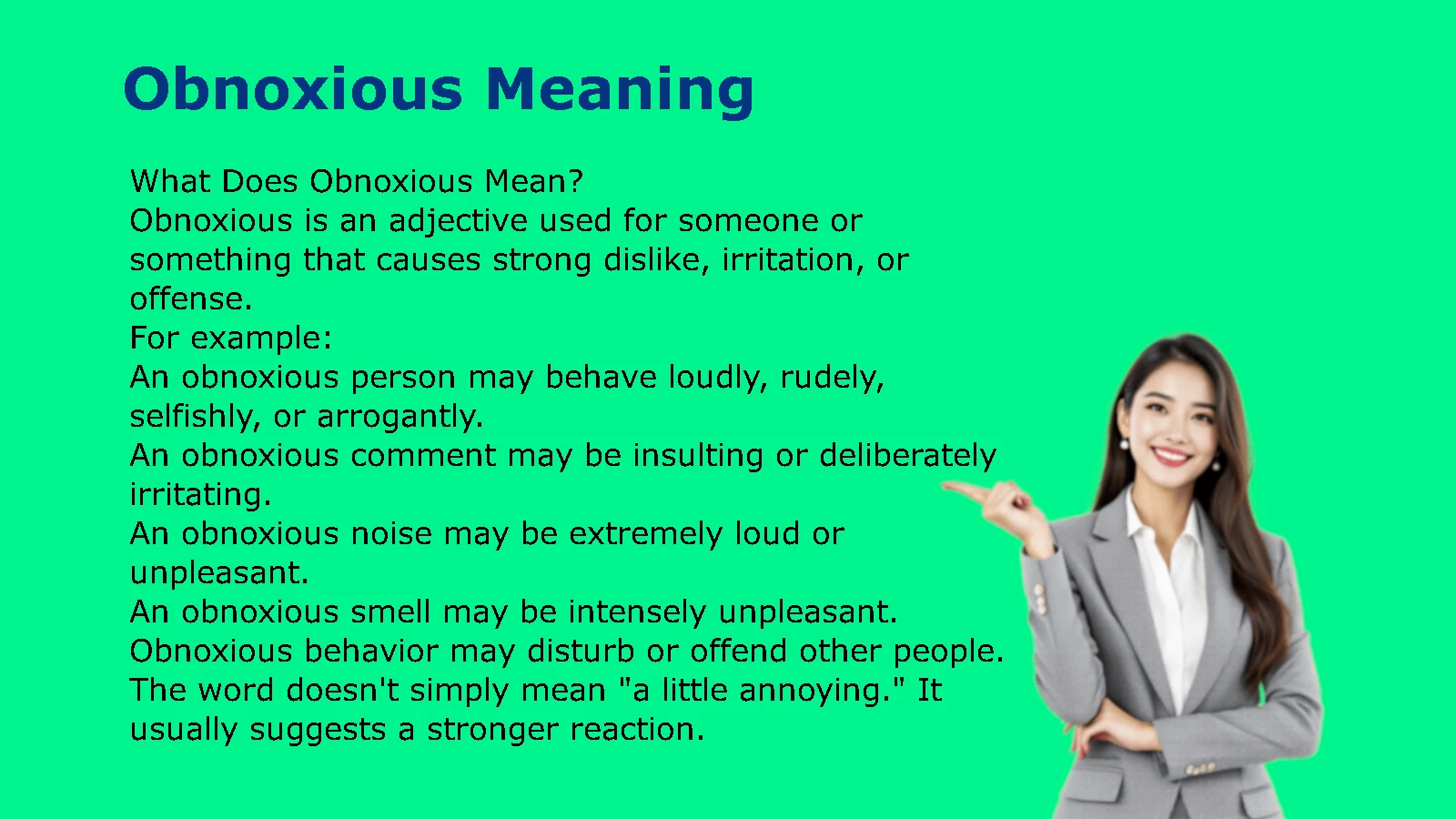
What Does Obnoxious Mean?
Obnoxious is an adjective used for someone or something that causes strong dislike, irritation, or offense.
For example:
- An obnoxious person may behave loudly, rudely, selfishly, or arrogantly.
- An obnoxious comment may be insulting or deliberately irritating.
- An obnoxious noise may be extremely loud or unpleasant.
- An obnoxious smell may be intensely unpleasant.
- Obnoxious behavior may disturb or offend other people.
The word doesn’t simply mean “a little annoying.” It usually suggests a stronger reaction.
Compare these two sentences:
- The buzzing sound is annoying.
- The constant, painfully loud buzzing is obnoxious.
The first sentence says the sound bothers you. The second suggests that the sound is so unpleasant that you strongly object to it.
Oxford’s American English dictionary gives the sense as extremely unpleasant, especially in a way that offends people.
Obnoxious Meaning in Simple English
In simple English, obnoxious means very unpleasant or rude.
You can think of it this way:
Annoying → very annoying → obnoxious
That’s not a strict scale in every situation, but it helps explain the word’s usual force.
For example, someone who occasionally interrupts might be annoying. Someone who repeatedly talks over everyone, mocks people, shouts across the room, and ignores every social cue might be called obnoxious.
The word focuses on the effect of someone’s behavior or something’s qualities on other people.
A Simple Example
Imagine you’re at a restaurant. One customer keeps shouting across the room, interrupts the server, makes insulting comments, and plays videos loudly on their phone.
You could say:
That customer is being obnoxious.
You’re not merely saying the person made one mistake. You’re describing a pattern of behavior that has become seriously unpleasant for everyone around them.
What Is the Definition of Obnoxious?
The modern definition of obnoxious centers on something that is extremely unpleasant, offensive, objectionable, or rude.
Here are the main ideas behind the word:
| Meaning | What it suggests | Example |
| Very unpleasant | Something causes strong dislike | The smell was obnoxious. |
| Rude | Someone behaves without proper consideration | He was obnoxious to the staff. |
| Offensive | Something insults or upsets people | Her obnoxious comments offended everyone. |
| Irritating | Something repeatedly gets on your nerves | The obnoxious noise continued all night. |
| Objectionable | Something is difficult to tolerate or accept | His obnoxious behavior disrupted the meeting. |
Cambridge’s American English entry specifically includes the sense “very unpleasant or offensive.”
Obnoxious Meaning With Examples
Context makes the word much easier to understand.
Here are natural examples of obnoxious in everyday English:
- The man at the next table was obnoxious and kept shouting.
- Her obnoxious behavior made the meeting uncomfortable.
- Someone in the apartment upstairs played obnoxious music until 2 a.m.
- His obnoxious attitude made it difficult to work with him.
- The comedian’s character was intentionally obnoxious.
- She made an obnoxious comment about her coworker’s appearance.
- The television produced an obnoxious buzzing sound.
- His constant bragging became obnoxious.
- The smell coming from the garbage was obnoxious.
- Don’t be obnoxious just because you disagree with someone.
Notice that the word can describe both people and things.
Obnoxious Used to Describe a Person
Calling someone obnoxious usually means that their behavior is extremely unpleasant or irritating.
An obnoxious person might:
- Interrupt conversations constantly
- Talk much louder than necessary
- Brag about themselves
- Ignore other people’s boundaries
- Make rude comments
- Mock people for attention
- Act as though they’re better than everyone else
- Deliberately provoke others
- Refuse to listen
- Behave selfishly in public
However, obnoxious doesn’t describe one fixed personality type. Someone can behave obnoxiously in one situation without being obnoxious all the time.
For example:
He was obnoxious at the party, but he apologized the next morning.
That sentence describes his behavior at a particular time. It doesn’t necessarily claim that his entire personality is obnoxious.
Obnoxious Used to Describe Behavior
The phrase obnoxious behavior is common because the adjective can focus on actions rather than a person’s identity.
For example:
His obnoxious behavior distracted everyone during the presentation.
Here, the speaker isn’t simply labeling the person. The sentence points to conduct that caused a problem.
This distinction can matter in professional or sensitive situations. Saying “Your behavior was disruptive” sounds more specific than “You’re obnoxious.”
Obnoxious Used to Describe a Sound
Obnoxious can also describe something you hear.
For example:
- An obnoxious alarm
- An obnoxious ringtone
- An obnoxious noise
- An obnoxious laugh
- An obnoxious volume level
- Obnoxious music
In these examples, the word emphasizes how unpleasant or intrusive the sound feels.
The obnoxious alarm kept everyone awake.
The alarm isn’t rude in the human sense. Instead, it’s extremely unpleasant or disruptive.
Obnoxious Used to Describe Smells
The word can also describe unpleasant odors.
For example:
An obnoxious odor filled the hallway.
Oxford specifically includes “obnoxious odours” among its examples of usage.
In this context, obnoxious means strongly unpleasant rather than socially rude.
Obnoxious Pronunciation
In American English, obnoxious is commonly pronounced:
/əbˈnɑːkʃəs/
A simple pronunciation guide is:
uh-NOK-shus
The stress falls on the second syllable:
ob-NOX-ious
Cambridge gives the American pronunciation as /əbˈnɑːk.ʃəs/, while Oxford gives the American form as /əbˈnɑkʃəs/.
The ending -ious does not sound like three separate syllables here. The word finishes with a sound similar to “shus.”
Is Obnoxious a Positive or Negative Word?
Obnoxious is a negative word.
It expresses disapproval. If you describe someone as obnoxious, you’re criticizing their behavior, manner, or personality.
For example:
He’s obnoxious.
That statement will usually sound insulting.
By contrast:
He’s friendly and considerate.
The second sentence carries a clearly positive meaning.
How Strong Is the Word Obnoxious?
The strength depends on the situation, but obnoxious is generally stronger than annoying.
Someone may find a repeated pen click annoying. Calling the person who deliberately clicks it during an important meeting obnoxious adds a stronger judgment about the behavior.
A rough comparison looks like this:
bothersome → annoying → irritating → obnoxious
This isn’t a formal scale. Context matters. Still, it shows why obnoxious often feels more forceful.
Synonyms for Obnoxious
The best synonym depends on exactly what you want to communicate. Obnoxious covers several related ideas, so replacing it with any random synonym can change the meaning.
Synonyms Meaning Annoying
When you want to emphasize irritation, consider:
- Annoying
- Irritating
- Bothersome
- Aggravating
- Irrksome
- Pesky
- Exasperating
For example:
The constant tapping was annoying.
This focuses on irritation. It doesn’t necessarily suggest that the person was rude or offensive.
Synonyms Meaning Offensive or Unpleasant
When the behavior crosses into stronger disapproval, these words may fit:
- Offensive
- Disagreeable
- Unpleasant
- Objectionable
- Repulsive
- Distasteful
- Odious
Merriam-Webster’s thesaurus includes words such as offensive, unpleasant, odious, objectionable, disagreeable, and repulsive among related terms.
These words aren’t perfect substitutes in every sentence. Repulsive, for example, usually expresses a much stronger sense of disgust.
Synonyms for an Obnoxious Person
If you’re specifically describing a person, useful alternatives include:
- Rude
- Irritating
- Unpleasant
- Arrogant
- Insufferable
- Disrespectful
- Inconsiderate
- Offensive
- Unbearable
Each word highlights something different.
Antonyms of Obnoxious
The opposite of obnoxious depends on the quality being contrasted.
Useful antonyms include:
- Pleasant
- Polite
- Respectful
- Considerate
- Agreeable
- Friendly
- Charming
- Likeable
- Amiable
- Inoffensive
Compare:
He was obnoxious during the meeting.
with:
He was respectful and considerate during the meeting.
The contrast becomes obvious. The first person makes the social situation unpleasant. The second makes it easier for everyone to participate.
Obnoxious vs. Annoying
Obnoxious and annoying overlap, but they’re not identical.
Annoying means causing irritation or annoyance. Merriam-Webster defines it as something that causes vexation or irritation.
Obnoxious generally adds a stronger sense of unpleasantness, rudeness, offensiveness, or objectionability.
| Word | Main idea | Example |
| Annoying | Causes irritation | The buzzing sound is annoying. |
| Obnoxious | Extremely unpleasant, rude, or offensive | His obnoxious behavior upset everyone. |
Consider two situations.
Situation one: Your friend keeps sending you memes while you’re trying to work.
That’s annoying.
Situation two: Your friend deliberately interrupts an important meeting, insults the speaker, laughs loudly, and refuses to stop.
That’s obnoxious.
The second situation involves more than simple irritation.
Obnoxious vs. Offensive
These words can overlap, but they emphasize different things.
Offensive focuses on something that causes offense. It may involve an insult, inappropriate remark, discriminatory statement, or other behavior that violates someone’s sense of respect or decency.
Obnoxious has a broader range. It can describe offensive behavior, but it can also describe behavior that is simply extremely irritating or unpleasant.
For example:
His offensive remark upset several people.
The sentence focuses on the content of the remark.
His obnoxious behavior ruined the dinner.
The second sentence focuses on the person’s overall conduct.
A loud person can be obnoxious without saying anything offensive. Likewise, a single offensive remark can be offensive without making the speaker’s entire behavior obnoxious.
Obnoxious vs. Rude
Rude usually means lacking politeness or showing poor manners.
Obnoxious often goes further. It suggests behavior that is not only impolite but also intensely unpleasant, irritating, or objectionable.
Compare:
He was rude to the waiter.
This tells you that he treated the waiter poorly.
He was obnoxious to everyone in the restaurant.
This suggests a broader pattern of highly unpleasant behavior.
So, rude is often about manners, while obnoxious can describe the overall impact of someone’s behavior.
Obnoxious vs. Arrogant
These words are easy to confuse because arrogant people can certainly behave obnoxiously.
Arrogant means having an exaggerated sense of one’s importance, abilities, or status.
Obnoxious doesn’t require arrogance.
For example, someone who constantly boasts about their intelligence may be arrogant. If they also interrupt everyone, insult people, and dominate every conversation, you might call them obnoxious.
| Word | Core meaning |
| Arrogant | Believes they are superior |
| Rude | Lacks good manners |
| Annoying | Causes irritation |
| Offensive | Causes offense |
| Obnoxious | Extremely unpleasant, irritating, rude, or objectionable |
Understanding this distinction helps you choose the most accurate word instead of treating all negative descriptions as interchangeable.
How to Use Obnoxious in a Sentence
Obnoxious is an adjective.
You can place it before a noun:
He made an obnoxious comment.
You can also use it after a linking verb:
His behavior was obnoxious.
Another useful structure is:
Someone + be + obnoxious + to + person/group
For example:
She was obnoxious to everyone at the party.
Cambridge specifically records the construction “be obnoxious to” in its usage information.
Common Sentence Patterns
| Pattern | Example |
| obnoxious + noun | His obnoxious attitude annoyed me. |
| be + obnoxious | They were obnoxious all evening. |
| be obnoxious to + person | He was obnoxious to the staff. |
| find + object + obnoxious | I find that behavior obnoxious. |
| become + obnoxious | His jokes became obnoxious. |
More Example Sentences
- Don’t be obnoxious just to get attention.
- His obnoxious comments made everyone uncomfortable.
- The children found the character funny, even though the adults thought he was obnoxious.
- She couldn’t tolerate the obnoxious noise coming from the next apartment.
- His confidence was appealing at first, but it became obnoxious when he started insulting everyone.
- The advertisement uses an intentionally obnoxious character to make the campaign memorable.
- That was an obnoxious thing to say.
- Nobody wanted to sit near the obnoxious group.
Common Phrases With Obnoxious
Certain combinations appear naturally in English.
Obnoxious Behavior
Obnoxious behavior describes actions that are extremely unpleasant, disruptive, rude, or offensive.
The manager asked the customer to stop his obnoxious behavior.
Obnoxious Person
An obnoxious person behaves in a way that strongly irritates or offends others.
Nobody wanted to argue with the obnoxious person at the party.
Obnoxious Attitude
An obnoxious attitude usually involves arrogance, disrespect, hostility, or an irritating sense of superiority.
His obnoxious attitude made teamwork difficult.
Obnoxious Noise
An obnoxious noise is intensely unpleasant, intrusive, or irritating.
The obnoxious noise continued throughout the night.
Obnoxious Comment
An obnoxious comment is usually rude, offensive, inappropriate, or deliberately irritating.
She regretted making such an obnoxious comment.
Obnoxious Laugh
An obnoxious laugh is one that the speaker considers extremely irritating, loud, exaggerated, or inappropriate.
His obnoxious laugh echoed across the room.
Obnoxious Examples in Everyday Situations
The meaning becomes clearer when you see how the word works in different settings.
At School
A student might act obnoxiously by constantly interrupting the teacher, shouting across the classroom, mocking classmates, or deliberately disrupting lessons.
For example:
The student’s obnoxious behavior made it difficult for everyone else to concentrate.
That sentence focuses on the disruption rather than simply labeling the student.
At Work
In a workplace, obnoxious behavior might include repeatedly talking over coworkers, making inappropriate jokes, belittling other employees, or refusing to respect reasonable boundaries.
For example:
His obnoxious comments made the team meeting uncomfortable.
In professional communication, however, a more specific word such as disruptive, disrespectful, or inappropriate may communicate the problem more clearly.
In Public
Public behavior often gets called obnoxious when someone ignores the comfort of people around them.
Examples include:
- Playing loud music on public transportation
- Shouting in a quiet restaurant
- Cutting into conversations
- Making rude comments toward strangers
- Blocking walkways while refusing to move
- Talking loudly during a movie
For example:
The group became obnoxious when they started shouting throughout the movie.
Online
Online conversations can also involve obnoxious behavior.
Someone might repeatedly provoke others, post insulting comments, interrupt discussions with irrelevant remarks, or deliberately annoy people.
For example:
His obnoxious comments turned a normal discussion into an argument.
The digital setting changes the medium, but the basic idea remains the same: the behavior creates an unusually unpleasant experience for others.
Can You Call a Person Obnoxious?
Yes. You can describe a person as obnoxious.
Examples include:
- He’s obnoxious.
- She’s being obnoxious.
- That guy is incredibly obnoxious.
- I find him obnoxious.
- They were obnoxious at dinner.
However, the phrase can sound harsh.
There’s an important difference between:
You’re obnoxious.
and:
That comment came across as rude.
The first attacks the person more directly. The second identifies a specific behavior.
When you need to give constructive feedback, describing the behavior usually works better.
Is Obnoxious a Rude Word?
Yes, calling someone obnoxious can be rude or insulting.
The word itself isn’t a swear word or profanity. Still, it expresses strong disapproval.
Cambridge labels the word disapproving, which reflects its normal tone.
If you want to soften your criticism, choose a more precise alternative:
| Stronger | Softer alternative |
| You’re obnoxious. | You’re being disruptive. |
| That’s obnoxious. | That’s a little inappropriate. |
| He’s obnoxious. | He’s difficult to work with. |
| Her behavior was obnoxious. | Her behavior was inconsiderate. |
| That comment was obnoxious. | That comment was unnecessary. |
The softer option isn’t always better. If the situation genuinely calls for strong language, obnoxious may be exactly the right word.
Word Forms of Obnoxious
Obnoxious belongs to a small word family.
Obnoxious
This is the adjective.
His behavior is obnoxious.
Obnoxiously
This is the adverb.
He spoke obnoxiously during the meeting.
It describes the manner in which someone behaves or does something.
Obnoxiousness
This is the noun form.
Everyone was tired of his obnoxiousness.
The noun is less common in everyday conversation than obnoxious or obnoxiously.
Obnoxious Word Origin and Etymology
The history of obnoxious is surprisingly different from its modern meaning.
Oxford traces the word to the late 16th century. It came from Latin obnoxiosus, from obnoxius, meaning exposed to harm. Oxford explains that the Latin elements relate to being exposed or subject to harm, while the modern unpleasant sense developed later.
Merriam-Webster notes that the word entered English around the middle of the 16th century. Its earlier uses commonly carried the sense of being exposed to something unpleasant or harmful. The modern meaning associated with being objectionable or offensive developed during the 17th century and became increasingly common later.
That creates an interesting historical contrast:
Earlier sense: exposed or liable to harm
Modern sense: extremely unpleasant, offensive, or objectionable
Language changes over time. Words don’t always stay in the same lane.
By modern standards, using obnoxious to mean simply “exposed to danger” would sound unusual and potentially confusing. The current meaning is firmly established in English dictionaries.
Obnoxious in American English
In American English, obnoxious commonly describes people or behavior that are extremely unpleasant, rude, or offensive.
The American pronunciation is approximately:
uh-NOK-shus
Cambridge lists the US pronunciation as /əbˈnɑːk.ʃəs/, and Oxford’s American dictionary gives /əbˈnɑkʃəs/.
Common American English combinations include:
- obnoxious behavior
- obnoxious person
- obnoxious attitude
- obnoxious comments
- obnoxious noise
- obnoxious smell
- obnoxious laugh
- obnoxious question
The word works in both casual and formal writing, but its tone remains strongly disapproving.
A Practical Case Study: Annoying or Obnoxious?
Consider this situation.
A coworker brings a loud keyboard into a shared office. The clicking bothers you, but they aren’t doing anything deliberately rude.
You might say:
The keyboard is annoying.
Now imagine that the coworker starts slamming the keys, plays loud music without headphones, interrupts other people, and laughs whenever someone asks them to lower the volume.
At that point, you might describe the behavior as:
His behavior is obnoxious.
The difference isn’t simply volume. It’s the overall pattern and social impact.
The first situation creates irritation. The second combines irritation with disregard for other people.
A Second Case Study: Rude or Obnoxious?
Imagine a waiter accidentally forgets your drink.
You complain politely, but the waiter responds rudely.
You might say:
The waiter was rude.
Now imagine a customer starts shouting at the waiter, insults the staff, interrupts other customers, refuses to follow basic restaurant rules, and continues after being asked to stop.
You might say:
The customer was obnoxious.
The word captures the broader pattern of unpleasant conduct.
Facts About the Word Obnoxious
Here are the key facts worth remembering:
- Part of speech: Adjective
- Modern meaning: Extremely unpleasant, rude, offensive, or objectionable
- American pronunciation: /əbˈnɑːkʃəs/
- Typical tone: Negative and disapproving
- Common subjects: People, behavior, comments, attitudes, noises, smells, and other unpleasant things
- Related adverb: Obnoxiously
- Related noun: Obnoxiousness
- Historical origin: Latin
- Earlier English sense: Exposed or liable to harm
- Modern unpleasant sense: Developed in English from the 17th century onward
The historical meaning is especially interesting because it shows how dramatically word meanings can shift.
Frequently Asked Questions About Obnoxious Meaning
What does obnoxious mean in simple words?
Obnoxious means very unpleasant, rude, annoying, or offensive. It often describes behavior that strongly bothers other people.
Is obnoxious a bad word?
Obnoxious is a negative word, but it isn’t profanity. Calling someone obnoxious usually expresses strong criticism and can sound insulting.
Is obnoxious an insult?
It can be. If you directly tell someone “You’re obnoxious,” you’re making a strongly negative judgment about their behavior or manner.
Can obnoxious describe a person?
Yes. Obnoxious person is a common phrase. It describes someone whose behavior is extremely unpleasant, irritating, rude, or offensive.
What is another word for obnoxious?
Depending on the context, alternatives include annoying, irritating, unpleasant, offensive, rude, objectionable, disagreeable, and insufferable.
No single synonym works perfectly in every sentence.
What is the opposite of obnoxious?
Common opposites include pleasant, polite, respectful, considerate, friendly, agreeable, and inoffensive.
Is obnoxious the same as annoying?
Not exactly. Annoying means causing irritation. Obnoxious usually suggests a stronger level of unpleasantness and may also imply rudeness or offensiveness.
Is obnoxious the same as rude?
No. Rude focuses on poor manners or disrespect. Obnoxious has a broader meaning and can describe behavior that is intensely irritating, unpleasant, or offensive.
What does an obnoxious person act like?
An obnoxious person may interrupt others, talk excessively loudly, brag, insult people, ignore boundaries, deliberately provoke others, or behave without regard for those around them.
How do you use obnoxious in a sentence?
You can use it before a noun or after a linking verb:
He made an obnoxious comment.
His behavior was obnoxious.
Is obnoxious always used for people?
No. You can describe sounds, smells, comments, behavior, attitudes, advertisements, questions, and other things as obnoxious when they are extremely unpleasant or objectionable.
Final Takeaway: Obnoxious Meaning
The simplest way to remember the obnoxious meaning is this:
Obnoxious describes someone or something that is extremely unpleasant, irritating, rude, offensive, or objectionable.
When you use the word for a person, you’re usually criticizing their behavior or manner. When you use it for a sound, smell, comment, or other thing, you’re emphasizing how strongly unpleasant or objectionable it is.
The word is stronger than annoying in many contexts, although the two overlap. It also differs from rude, offensive, and arrogant because each word highlights a different quality.
Think of it as a word for behavior that doesn’t merely rub you the wrong way. It gets under your skin.
If someone talks too loudly once, they may be annoying. If they repeatedly interrupt everyone, insult people, ignore boundaries, and seem determined to make the room miserable, obnoxious may be the more accurate description.
That distinction is the key to using the word naturally and correctly.