
Have you ever caught yourself gazing at something for a long moment without realizing how much time has passed? While Gazing Meaning may seem straightforward, this word can express more than simply looking at something. The meaning can change depending on the context, emotion, and situation in which it is used.
Gazing means looking steadily and attentively at someone or something, usually for a period of time. It often suggests a calm, thoughtful, curious, or admiring way of looking. Unlike a quick glance, gazing usually involves keeping your eyes focused on something for longer.
Examples:
- She was gazing at the stars in the night sky.
- He stood by the window, gazing at the beautiful view.
The confusion is understandable. People often search for what does gazing mean, gazing meaning in text, gazing meaning in a relationship, or what does it mean when someone is gazing at you because the word can describe many different emotions. Someone might gaze at a person because they feel attracted to them, admire them, feel curious about them, or simply find something interesting.
In this guide, you’ll learn the complete Gazing Meaning, its definition, pronunciation, part of speech, synonyms, and examples in sentences. You’ll also discover the difference between gazing, staring, looking, and glancing, along with what gazing can mean in different situations and conversations.
What Does Gazing Mean?
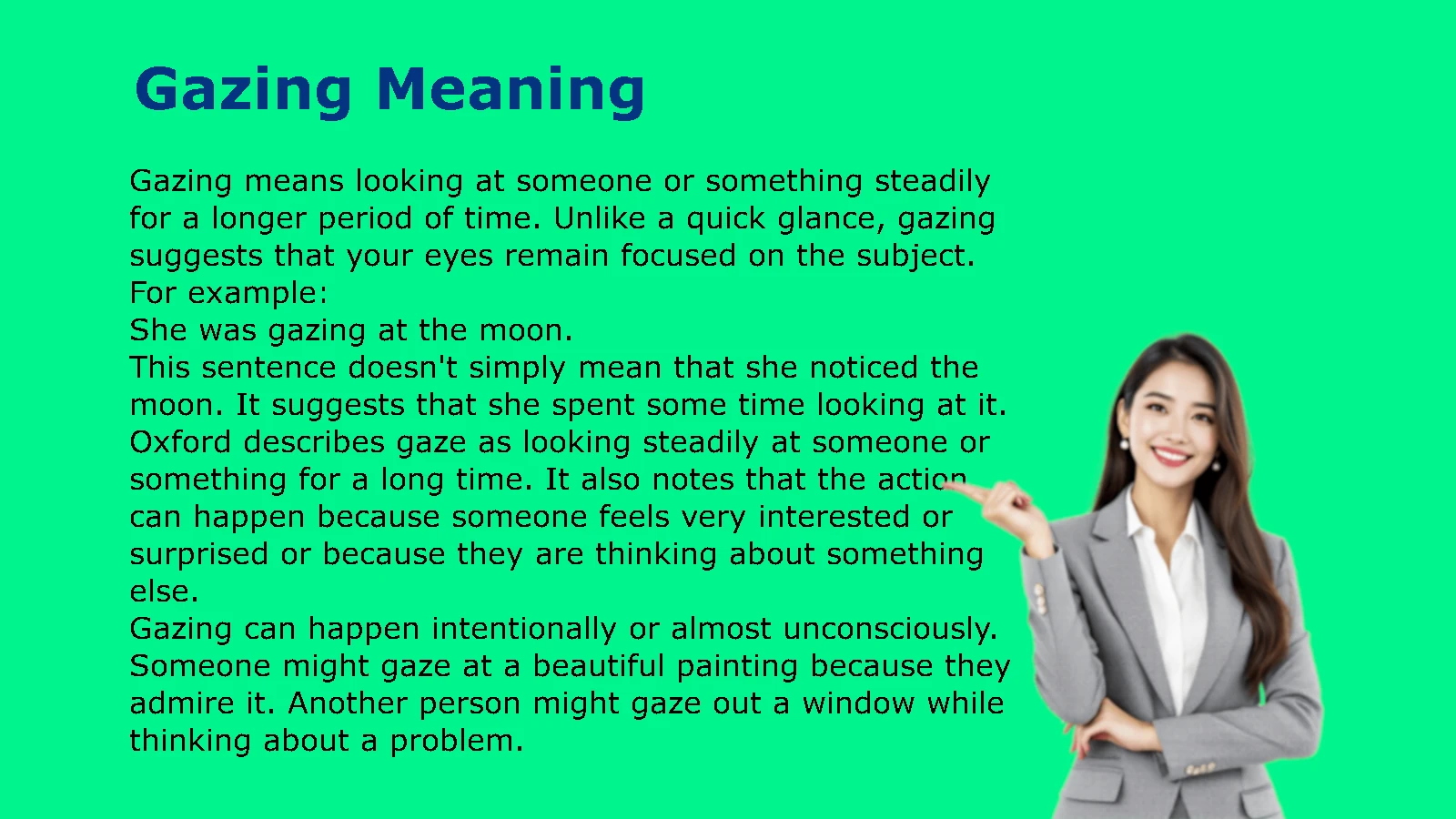
Gazing means looking at someone or something steadily for a longer period of time. Unlike a quick glance, gazing suggests that your eyes remain focused on the subject.
For example:
She was gazing at the moon.
This sentence doesn’t simply mean that she noticed the moon. It suggests that she spent some time looking at it.
Oxford describes gaze as looking steadily at someone or something for a long time. It also notes that the action can happen because someone feels very interested or surprised or because they are thinking about something else.
Gazing can happen intentionally or almost unconsciously. Someone might gaze at a beautiful painting because they admire it. Another person might gaze out a window while thinking about a problem.
The word therefore tells you more than look. It gives the action a sense of duration and focus.
Gazing meaning in simple words
In simple English:
Gazing = looking at something for a while without quickly looking away.
Consider these examples:
- Looking: She looked at the mountain.
- Glancing: She glanced at the mountain.
- Gazing: She gazed at the mountain.
- Watching: She watched the climbers on the mountain.
Each verb describes a visual action, but each one emphasizes something different.
Gazing usually suggests a steady, absorbed look. It can feel peaceful, thoughtful, admiring, or affectionate.
What Does It Mean to Be Gazing at Someone?
When someone is gazing at someone, they are looking at that person steadily for a period of time.
The reason can vary.
They might be:
- Admiring the person
- Feeling affection
- Thinking about the person
- Fascinated by what the person is doing
- Surprised by the person
- Lost in thought while looking at them
- Feeling romantic attraction
For example:
He was gazing at her from across the room.
This could suggest affection or attraction, but the sentence alone doesn’t prove that. Context matters.
Compare it with:
He was staring at her from across the room.
The second sentence can sound more uncomfortable or intrusive. Gazing tends to have a gentler tone, while staring can suggest surprise, discomfort, fear, or rudeness depending on the situation. Oxford makes a similar distinction, describing gaze as a long, steady look and stare as a long look that can carry surprise or an unfriendly quality.
Examples of gazing at someone
- She gazed at her newborn baby with affection.
- He gazed at his partner across the table.
- The child gazed at the magician in amazement.
- She gazed at the speaker, completely absorbed in the story.
- He sat quietly, gazing at his old friend.
Notice how the word doesn’t automatically mean romance. A person can gaze at a child, friend, performer, stranger, or loved one.
What Does Gazing at Something Mean?
Gazing at something means looking at it steadily for some time.
The object might be beautiful, unusual, interesting, surprising, or simply something that has captured your attention.
For example:
They spent the evening gazing at the stars.
The sentence suggests more than simply seeing the stars. It creates an image of people stopping what they’re doing and quietly looking upward.
You can gaze at almost anything:
- The stars
- The moon
- A sunset
- The ocean
- A mountain
- A painting
- A photograph
- A fire
- A city skyline
- A beautiful landscape
- An unusual object
Cambridge provides examples involving gazing at people, looking out over landscapes, and gazing out a window.
Is Gazing Positive or Negative?
Gazing is usually neutral to positive, but the context can change its tone.
The word often appears when someone feels admiration, wonder, affection, or deep interest.
For example:
She gazed at the sunset in wonder.
That sounds peaceful and positive.
However:
He sat gazing blankly at the wall.
Here, gazing doesn’t suggest admiration. It suggests that he isn’t focusing on anything meaningful or may be lost in thought.
The surrounding words often tell you how to interpret the gaze.
Positive examples
- gazing lovingly
- gazing admiringly
- gazing in wonder
- gazing affectionately
- gazing happily
Neutral examples
- gazing out the window
- gazing into space
- gazing at the landscape
- gazing at the crowd
More emotional examples
- gazing in amazement
- gazing in disbelief
- gazing sadly at the photograph
So, gazing itself isn’t automatically positive or negative. Its emotional meaning comes from the situation and the words around it.
Gazing vs. Staring
One of the most important distinctions to understand is gazing vs. staring.
Both words can describe looking at someone or something for a long time. The difference often lies in tone, intention, and emotional suggestion.
Oxford distinguishes the two by describing gaze as a long, steady look and stare as a long look that can show surprise or feel unfriendly.
| Word | Meaning | Common impression |
| Gazing | Looking steadily for a while | Often admiration, affection, interest, or thought |
| Staring | Looking fixedly for a while | Can suggest surprise, shock, discomfort, or rudeness |
| Glancing | Looking briefly | Quick and casual |
| Watching | Looking at something as it happens | Attention and observation |
| Peering | Looking closely | Trying to see something clearly |
| Glaring | Looking angrily | Hostility or anger |
Consider this pair:
She gazed at the painting.
The sentence sounds appreciative.
Now compare:
She stared at the painting.
This could mean she was shocked, confused, or fascinated. The reason isn’t clear.
With people, the difference can become even stronger:
He gazed at her with affection.
versus:
He stared at her without saying anything.
The first sounds warm. The second may make the reader wonder whether the behavior is uncomfortable.
Is gazing the same as staring?
No. They overlap because both can describe a prolonged look. However, gazing generally carries a more peaceful, admiring, thoughtful, or affectionate tone.
Staring has a broader emotional range and can sound more intense or socially uncomfortable.
Gazing vs. Looking
Looking is the broadest and most ordinary word.
You can look at something for one second or several minutes. The word itself doesn’t tell us much about the length or emotional quality of the action.
Gazing, however, suggests a longer and steadier look.
Compare:
He looked at the mountains.
This simply tells us where he directed his eyes.
He gazed at the mountains.
Now we can picture him standing there and taking in the view.
That’s the key distinction.
| Looking | Gazing |
| General visual action | Steady, prolonged visual attention |
| Can be very brief | Usually lasts longer |
| Usually neutral | Often suggests interest or emotion |
| Very common in everyday speech | More descriptive and expressive |
If you’re writing a story, gazing can add atmosphere that looking doesn’t provide.
Gazing vs. Watching
Gazing and watching aren’t interchangeable in every situation.
When you watch something, you often pay attention to an activity, movement, event, or change.
For example:
She watched the children play.
The children are doing something. She follows their activity with her eyes.
Now consider:
She gazed at the children.
This focuses more on her steady visual attention toward the children rather than on following their activity.
Another useful comparison:
He watched the waves.
The focus shifts toward the movement of the waves.
A simple rule
- Gaze = look steadily.
- Watch = observe something as it moves, changes, or happens.
There can be overlap, but the emphasis differs.
Gazing vs. Glancing
These words sit almost at opposite ends of the duration spectrum.
A glance is a quick look.
A gaze is a long, steady look.
Oxford specifically defines glance as a quick look and gaze as a long, steady look.
Compare:
She gazed at the clock.
Now something seems unusual. Why would she spend a long time looking at a clock?
That example shows why word choice matters. Sometimes changing one verb can change the entire implication of a sentence.
Quick comparison
Glance: “I looked quickly.”
Gaze: “I kept looking.”
How to Use Gazing in a Sentence
The word gazing commonly appears with prepositions such as at, into, and out. Oxford lists at, in, and into among common patterns associated with gaze.
Gazing at someone
She was gazing at him with admiration.
This means she was looking at him steadily and admiringly.
Gazing at something
They were gazing at the stars.
The sentence suggests sustained attention to the night sky.
Gazing out a window
He sat by the window, gazing out at the rain.
Here, gazing out emphasizes looking outward from the window.
Gazing into space
She was gazing into space when I called her name.
This usually suggests that she wasn’t concentrating on a specific object and may have been thinking or daydreaming.
Gazing up at something
The children stood gazing up at the enormous tree.
The phrase tells us both the direction and the sustained nature of the look.
Gazing down at something
He stood on the balcony, gazing down at the busy street.
The direction of the gaze becomes part of the scene.
20 Examples of Gazing in a Sentence
Seeing the word in different contexts makes its meaning much easier to understand.
- She was gazing at the stars.
- He sat quietly, gazing out the window.
- They spent the afternoon gazing at the ocean.
- She gazed at the painting in admiration.
- He was gazing into space and didn’t hear the question.
- The baby gazed at her mother with wide eyes.
- They stood together, gazing at the sunset.
- She gazed at him with affection.
- The tourists stopped to gaze at the enormous waterfall.
- He sat by the fire, gazing into the flames.
- The child gazed at the magician in amazement.
- She was gazing up at the night sky.
- He gazed across the valley.
- They gazed in wonder at the snow covered mountains.
- She sat on the porch, gazing at the passing clouds.
- He gazed at the old photograph for several minutes.
- The audience gazed at the performer in silence.
- She gazed thoughtfully at the empty chair.
- He stood there, gazing out over the lake.
- The child was gazing at the colorful fish in the aquarium.
Each sentence shows the same basic action, but the context gives the gaze a different emotional color.
Common Phrases With Gazing
Certain combinations sound especially natural in English.
Gazing at
Gazing at is one of the most common patterns.
It means looking steadily at a person or thing.
Examples:
- gazing at the stars
- gazing at a painting
- gazing at someone
- gazing at the ocean
- gazing at the sunset
They sat together, gazing at the stars.
Gazing out
Gazing out usually refers to looking outward from a window or another location.
She was gazing out the window.
Cambridge specifically gives gaze out of the window as a common construction.
You can also say:
He gazed out over the valley.
Gazing into space
Gazing into space means looking into the distance without focusing on a particular object.
It often suggests that someone is thinking, daydreaming, distracted, or mentally absorbed.
He sat quietly, gazing into space.
Oxford uses this expression to illustrate the idea of looking steadily while thinking about something else.
Gazing up at
This phrase describes looking upward.
The children were gazing up at the fireworks.
Gazing down at
This phrase describes looking downward.
She stood on the bridge, gazing down at the river.
Synonyms for Gazing
Several words can replace gazing in certain contexts. However, they don’t all carry the same meaning.
| Synonym | What it emphasizes |
| Looking | General visual attention |
| Staring | Prolonged, fixed looking |
| Watching | Observing activity or movement |
| Observing | Careful attention |
| Viewing | Looking at something, often deliberately |
| Peering | Looking closely, especially when visibility is poor |
| Admiring | Looking with appreciation |
| Contemplating | Looking while thinking deeply |
Looking
This is the most general alternative.
She was looking at the ocean.
It doesn’t necessarily imply that she looked for a long time.
Staring
This can describe a prolonged fixed look.
He was staring at the strange object.
It often sounds more intense than gazing.
Watching
This works best when something is moving or happening.
They were watching the birds.
Peering
Peering means looking closely or carefully, often because something is difficult to see.
He was peering through the fog.
Contemplating
This emphasizes thought rather than simply visual attention.
She sat by the window, contemplating the view.
These words overlap, but each carries its own shade of meaning.
What Is the Difference Between Gazing and Gawking?
Gazing and gawking both involve looking for a noticeable amount of time, but their social tone differs sharply.
Gawking usually suggests looking openly and often rudely at someone or something. It can imply that the person is staring in an obvious or socially awkward way.
Compare:
The tourists gazed at the beautiful cathedral.
This sounds natural and appreciative.
The tourists were gawking at the celebrity.
Now the behavior sounds more obvious and potentially rude.
That’s why gazing is often a better word when you want to describe appreciation or wonder.
Is Gazing the Same as Staring?
Gazing and staring are similar, but they’re not exact synonyms.
Both can involve a long look. The emotional message separates them.
Oxford describes gaze as a steady, prolonged look that can express interest, surprise, love, or thought. It describes stare as a prolonged look that can involve surprise or fear.
Consider these examples
She gazed at the baby.
The image feels gentle and affectionate.
She stared at the baby.
The sentence sounds more intense. Perhaps the baby is doing something surprising.
Another example:
He gazed at the sunset.
This suggests appreciation.
He stared at the sunset.
This might suggest amazement or shock.
Neither word is inherently wrong. The writer chooses the verb based on the feeling they want to communicate.
Grammar of Gazing
Gazing is the present participle and -ing form of the verb gaze. Oxford lists the main forms as gaze, gazes, gazed, and gazing.
The main forms of gaze
| Form | Example |
| Base form: gaze | They gaze at the stars. |
| Third person: gazes | She gazes at the painting. |
| Past tense: gazed | He gazed at the ocean. |
| Present participle: gazing | They are gazing at the moon. |
| Past participle: gazed | She has gazed at the view before. |
Gazing with the present progressive
Use am, is, or are + gazing to describe an action happening around the present time.
She is gazing at the mountains.
They are gazing out the window.
For the past progressive, use was or were + gazing:
He was gazing at the stars.
They were gazing across the valley.
Gazing as a participial phrase
You can also place gazing at the beginning of a sentence.
Gazing out the window, she remembered her childhood home.
The phrase gives the reader two connected actions without creating unnecessary repetition.
Gazing Pronunciation
Gazing is pronounced approximately:
GAY-zing
The base word gaze is pronounced /ɡeɪz/, while Oxford gives the -ing form as /ˈɡeɪzɪŋ/.
The first part sounds like “gaze.”
So:
- gaze → /ɡeɪz/
- gazing → /ˈɡeɪzɪŋ/
The final -ing sounds like the ending in looking, watching, and reading.
Common Mistakes With Gazing
Although gazing seems simple, a few usage mistakes can make a sentence sound unnatural.
Using gazing when you mean glancing
A glance is quick. A gaze is sustained.
Incorrect choice for a quick action:
She gazed at her phone to check the time.
If she only looked for a second, this is more natural:
She glanced at her phone to check the time.
Treating gazing and staring as identical
They overlap, but their emotional tones differ.
Use gazing when you want to suggest admiration, affection, wonder, or thought.
Use staring when the prolonged look feels more intense, surprising, or potentially uncomfortable.
Assuming gazing always means romance
It doesn’t.
Someone can gaze at:
- A mountain
- A painting
- A child
- A sunset
- A friend
- A stranger
- A photograph
- The ceiling
Romance is only one possible interpretation.
Using gazing when watching is more precise
If someone follows an event or moving object, watching may communicate the action more accurately.
She watched the soccer match.
You wouldn’t normally replace watched with gazed here.
Forgetting natural prepositions
The most common patterns include:
- gaze at something
- gaze into space
- gaze out the window
- gaze up at something
- gaze down at something
Oxford’s usage information supports patterns such as gaze at, gaze into, and gaze out.
Gazing Meaning in Different Contexts
Context can completely change what a person’s gaze communicates.
Gazing in romance
She gazed at him with affection.
Here, the gaze suggests emotional closeness.
Gazing at nature
They gazed at the mountains in silence.
The emphasis is on beauty, wonder, and appreciation.
Gazing while thinking
He sat gazing out the window, lost in thought.
The person’s eyes are directed outward, but their mind may be somewhere else.
Gazing in surprise
The audience gazed at the stage in amazement.
Here, the prolonged look comes from surprise.
Gazing with admiration
She gazed at the painting for several minutes.
The person studies the artwork because it has captured their attention.
This flexibility makes gazing useful in both everyday writing and descriptive prose.
A Simple Case Study: How One Verb Changes the Meaning
Imagine a person standing on a hill at sunset.
You could describe the scene in several ways.
Version one: Look
He looked at the sunset.
This is straightforward. It tells the reader what he saw.
Version two: Glance
He glanced at the sunset.
Now the action seems brief. Perhaps he only noticed it before turning away.
Version three: Watch
He watched the sunset.
This suggests that he paid attention as the sunset developed or changed.
Version four: Gaze
He gazed at the sunset.
Now the scene feels slower and more reflective. The reader can imagine him standing still and taking in the view.
Version five: Stare
He stared at the sunset.
The emotional tone becomes stronger. Perhaps he is shocked by something extraordinary about the scene.
The situation stays almost identical. The verb changes the reader’s impression.
That’s why understanding the subtle meaning of gazing matters.
Gazing and the Idea of a Long, Steady Look
The central idea behind gazing is not simply that the eyes remain open. It is the combination of duration and steadiness.
Oxford’s noun definition describes gaze as a “long, steady look.”
That distinction helps explain why some visual actions sound natural with gaze while others don’t.
For instance:
She gazed at the painting.
The painting stays in front of her while she takes it in.
But:
She gazed at the runners during the race.
This is possible, but watched may be more natural if the emphasis lies on following the runners’ movement.
The choice depends on what the sentence wants the reader to notice.
Gazing Meaning vs. Related Words at a Glance
Here’s a quick reference for choosing the right word.
| Word | Main idea | Example |
| Look | Direct your eyes toward something | She looked at the door. |
| Glance | Look quickly | She glanced at the clock. |
| Gaze | Look steadily for a while | She gazed at the stars. |
| Watch | Observe movement or activity | She watched the birds fly. |
| Stare | Look fixedly for a long time | He stared at the strange object. |
| Peer | Look closely or with difficulty | She peered through the darkness. |
| Glare | Look angrily | He glared at his opponent. |
| Gawk | Look openly and often rudely | The crowd gawked at the celebrity. |
Oxford places these terms in the same family of words for looking while distinguishing them by duration, purpose, and emotional tone.
Frequently Asked Questions About Gazing
What does gazing mean in simple words?
Gazing means looking at someone or something steadily for a relatively long time. It often suggests interest, admiration, affection, surprise, or thought.
Does gazing mean staring?
Not exactly. Both involve prolonged looking, but gazing usually sounds softer and more positive. Staring can sound intense, rude, frightening, or surprising depending on the situation.
What does gazing at someone mean?
It means looking steadily at that person. Depending on the context, it can show admiration, affection, interest, surprise, or deep thought.
Is gazing a positive word?
Usually, yes, although context matters. Gazing often appears in descriptions involving beauty, love, admiration, wonder, or peaceful reflection.
What is another word for gazing?
Possible alternatives include looking, staring, watching, observing, viewing, peering, and admiring. However, each has a slightly different meaning.
What is the difference between gazing and looking?
Looking is a general term for directing your eyes toward something. Gazing suggests a longer, steadier look and often carries an emotional or thoughtful quality.
What is the difference between gazing and watching?
Gazing focuses on a steady look. Watching usually focuses on observing something that is moving, changing, or happening.
What is the opposite of gazing?
There isn’t one perfect opposite. Depending on the context, possible opposites include looking away, ignoring, or avoiding eye contact.
What does gazing into space mean?
Gazing into space means looking into the distance without focusing on a particular object. It often suggests that someone is thinking, daydreaming, distracted, or mentally absorbed.
Is gazing always romantic?
No. Someone can gaze at nature, artwork, scenery, a child, a photograph, or a person without any romantic meaning.
What does gazing out the window mean?
It means looking outward through a window for a period of time. The person may be observing the outside world, thinking, daydreaming, or simply enjoying the view.
Is gazing the same as looking deeply?
Not necessarily. Gazing suggests a long, steady look, while “looking deeply” can suggest careful examination or emotional intensity. Context determines the exact meaning.
Final Takeaway: What Does Gazing Mean?
The gazing meaning is simple at its core: to look steadily at someone or something for a relatively long time.
However, the word carries more nuance than the basic definition suggests. A person might gaze because they feel admiration, affection, wonder, surprise, curiosity, or because they’re lost in thought.
The easiest way to remember the difference is this:
- Glance = a quick look
- Look = a general visual action
- Watch = observe something as it happens
- Gaze = look steadily for a while
- Stare = look fixedly, often with stronger or less comfortable emotions
- Peer = look closely, especially when something is difficult to see
- Glare = look angrily
- Gawk = look openly and often rudely
In everyday English, gazing is especially useful when you want to describe a prolonged look without making it sound automatically rude or aggressive. As Cambridge and Oxford both show, the word commonly connects with admiration, surprise, interest, love, and thought.
In short: gazing is more than simply looking. It suggests that something has held your attention long enough for you to stop, focus, and take it in.