
Have you ever come across the word “emancipation” and wondered exactly what it means? While Emancipation Meaning may seem straightforward, this powerful word can have different meanings depending on the context, history, and situation in which it is used.
Emancipation means the act of setting someone free from legal, social, political, or other forms of control. It is often used when talking about freedom from slavery, oppression, restrictions, or dependence.
Examples:
- The Emancipation Proclamation helped mark a major step toward freedom for enslaved people in the United States.
- The teenager sought legal emancipation from parental control.
The confusion is understandable. People often search for what does emancipation mean, emancipation meaning in history, emancipation meaning in law, or emancipation meaning in a sentence because the word can describe different types of freedom. And here’s the kicker: emancipation isn’t always about physical freedom. It can also refer to gaining independence, rights, or control over your own life.
In this guide, you’ll learn the complete Emancipation Meaning, its definition, pronunciation, origin, correct usage, and examples in sentences. You’ll also discover the meaning of emancipation in history and law, related words, synonyms, and how to use emancipation correctly in everyday English.
What Does Emancipation Mean?
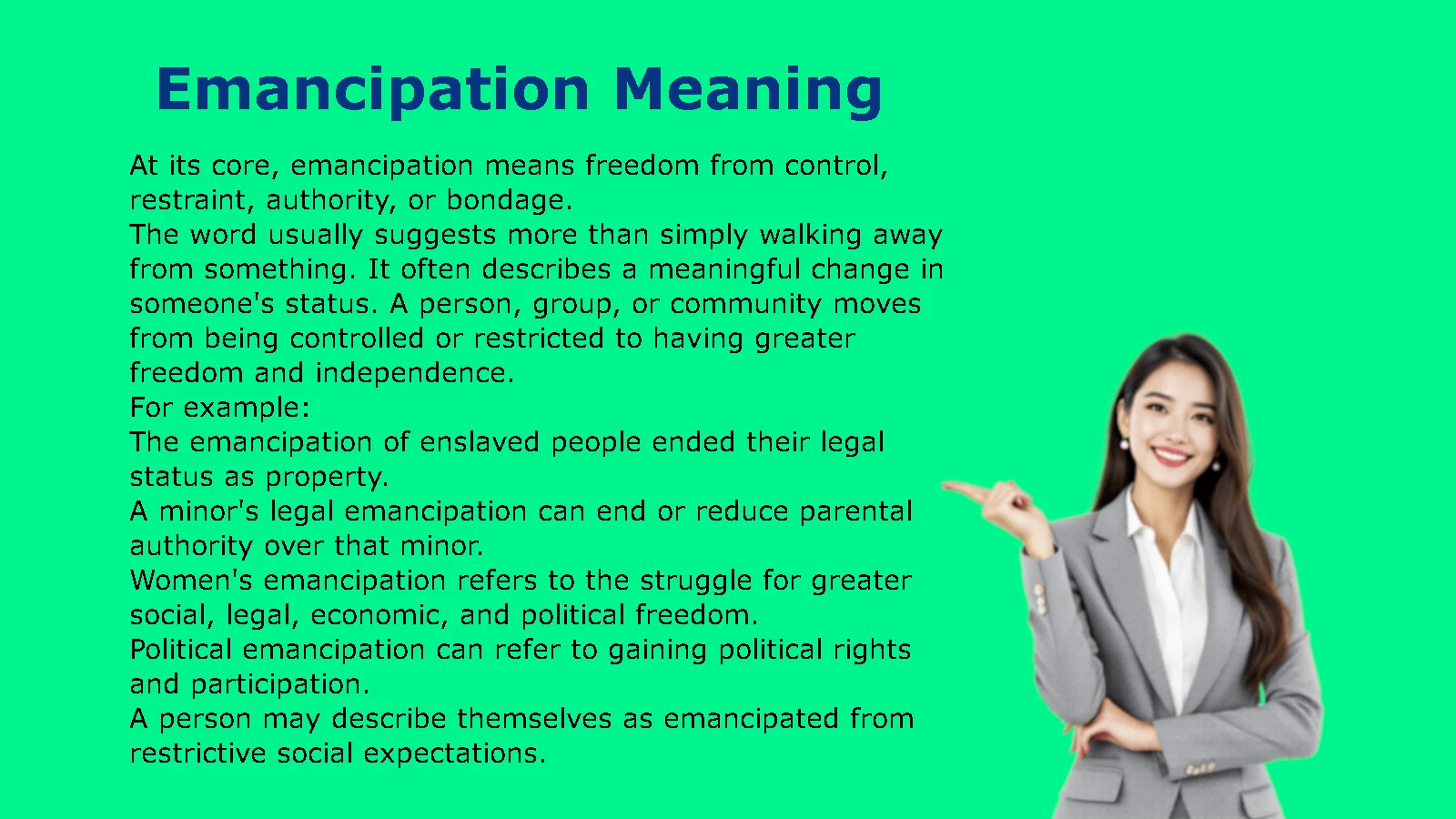
At its core, emancipation means freedom from control, restraint, authority, or bondage.
The word usually suggests more than simply walking away from something. It often describes a meaningful change in someone’s status. A person, group, or community moves from being controlled or restricted to having greater freedom and independence.
For example:
- The emancipation of enslaved people ended their legal status as property.
- A minor’s legal emancipation can end or reduce parental authority over that minor.
- Women’s emancipation refers to the struggle for greater social, legal, economic, and political freedom.
- Political emancipation can refer to gaining political rights and participation.
- A person may describe themselves as emancipated from restrictive social expectations.
In simple terms:
Emancipation = the process of gaining freedom from control or restriction.
The exact kind of freedom depends on the context.
Emancipation Meaning in Simple Words
If you need the easiest possible definition, think of emancipation as being set free.
Imagine someone has always needed another person’s permission to make important decisions. If that authority ends and the person can make those decisions independently, that change can be described as emancipation.
The same basic idea applies to groups.
If a government denies a group political rights and those rights are later recognized, that can be described as political emancipation. If enslaved people gain freedom from bondage, that is emancipation from slavery.
So, while the word can sound formal, its central idea isn’t complicated:
Someone who was restricted gains greater freedom and control over their own life.
Emancipation Pronunciation
In American English, emancipation is pronounced:
ih man suh PAY shun
The International Phonetic Alphabet representation is:
/ɪˌmæn.səˈpeɪ.ʃən/
The main stress falls on PAY. Cambridge gives the US pronunciation as /ɪˌmæn.səˈpeɪ.ʃən/.
Break it into parts:
e · man · ci · PA · tion
You might hear the word in a sentence like:
“The movement became an important force for political emancipation.”
Emancipation as a Part of Speech
Emancipation is a noun.
It names the act, process, or condition of becoming free. The related verb is emancipate.
| Word | Part of speech | Meaning | Example |
| emancipation | Noun | The act or process of gaining freedom | The movement demanded emancipation. |
| emancipate | Verb | To free someone from control | The law helped emancipate the group. |
| emancipated | Adjective | Freed from control or restrictions | She became an emancipated minor. |
| emancipatory | Adjective | Intended to provide freedom or rights | The reform had an emancipatory effect. |
| emancipator | Noun | A person who emancipates others | The leader became known as an emancipator. |
Cambridge defines emancipate as giving people social or political freedom and rights or freeing a person from another person’s control.
Emancipation vs. Emancipate
The distinction is straightforward:
- Emancipation is the act or process of becoming free.
- Emancipate is the action of freeing someone.
Compare these sentences:
The country celebrated its emancipation.
The reform helped emancipate people from an oppressive system.
In the first sentence, emancipation names the process or achievement. In the second, emancipate describes the action.
Emancipation Etymology and Word Origin
The history of emancipation goes back much further than its modern political uses.
The English noun appeared in the early 17th century. Etymonline traces emancipation to French émancipation and Latin emancipatio, a noun formed from emancipare. The Latin verb referred to releasing someone from authority, particularly within Roman family law.
The Roman legal background is especially interesting because the original idea did not specifically refer to freeing enslaved people. It concerned the release of a person, particularly a son or wife, from the legal authority of the pater familias, the head of the Roman household.
Over time, English expanded the word’s meaning.
It became associated with freedom from religious restrictions, then with antislavery movements, and later with broader struggles against social and political limitations. Etymonline records its use in connection with antislavery causes in the 18th century and with women’s freedom from restrictive customs in the 19th century.
That history explains why emancipation still carries a sense of breaking away from an established form of control.
Emancipation vs. Liberation
Emancipation and liberation are close synonyms, but they don’t always carry exactly the same emphasis.
Liberation generally means being freed from confinement, oppression, occupation, or another restrictive condition.
Emancipation often emphasizes the process of gaining independence from authority, legal restrictions, bondage, or social limitations.
| Word | Main idea | Typical emphasis |
| Emancipation | Gaining freedom from control or authority | Independence and release from a restrictive status |
| Liberation | Being set free | Release from oppression, confinement, or domination |
| Freedom | The condition of being free | Broadest everyday meaning |
| Independence | Self government or self reliance | Ability to act without outside control |
| Release | Being let go | Removal of a specific restraint or obligation |
For example, a prisoner might receive release from prison. A country might fight for liberation from occupation. A social movement might seek emancipation from political or social restrictions.
These distinctions aren’t absolute. The words overlap, and context determines which one sounds most natural.
Emancipation vs. Freedom
Freedom is the broader and more common word.
You can use freedom for almost any situation involving the absence of unwanted control. Emancipation, however, often points to a specific process of becoming free or a historical or legal change in status.
Consider these examples:
“Everyone deserves freedom.”
This is a broad statement.
“The movement fought for the emancipation of enslaved people.”
This sentence identifies a specific historical struggle to remove a system of bondage.
A useful way to remember the difference is:
Freedom is the condition. Emancipation often describes the process or act that brings about that condition.
That isn’t a strict grammatical rule. English speakers sometimes use the words interchangeably. Still, the distinction helps you understand why emancipation sounds more formal and specific.
Emancipation in a Legal Context
Legal emancipation has a narrower meaning than the general concept of freedom.
In the United States, emancipation of a minor refers to a legal process through which an eligible minor gains some or all of the rights and responsibilities normally associated with adulthood before reaching the ordinary age of majority.
The details vary significantly by state. Cornell’s Legal Information Institute notes that all states have laws concerning when and under what conditions minors become independent from their parents for legal purposes. It also notes that state rules differ considerably.
This matters because emancipation doesn’t automatically mean that a minor receives every right an adult has.
Depending on the jurisdiction, an emancipated minor may gain greater control over areas such as:
- Living arrangements
- Personal finances
- Employment
- Certain contracts
- Medical or personal decisions
- Responsibility for personal support
The precise rights and obligations depend on the applicable law.
How Does Minor Emancipation Work?
The legal process differs from one jurisdiction to another. A court may review whether emancipation is appropriate and whether the minor can support themselves and manage adult responsibilities.
Cornell’s Legal Information Institute describes emancipation as an act that releases someone from another person’s authority. In modern legal use, that person is often a minor.
Some jurisdictions recognize emancipation through a court order. Others recognize particular circumstances that can create legal independence without a separate emancipation order.
Possible circumstances discussed in legal sources include:
- Reaching the age of majority
- Marriage
- Military service
- Establishing an independent residence
- Other conditions established by state law
However, these conditions aren’t universal. A person should look at the law of the specific state or jurisdiction rather than assume that a rule from another state applies.
What Does an Emancipated Minor Mean?
An emancipated minor is generally a young person who has been legally released from some or all parental authority before reaching the ordinary age of majority.
The change can carry both rights and responsibilities.
For instance, greater independence may mean the minor can make certain decisions without parental permission. At the same time, the minor may become responsible for supporting themselves.
Cornell’s legal reference materials emphasize that emancipated minors are generally expected to support and care for themselves.
The key point is that emancipation isn’t simply a legal way to say, “I don’t want my parents telling me what to do.”
It’s a change in legal status that can create serious responsibilities.
Emancipation and Slavery
Few historical uses of the word emancipation are more important than its connection to slavery.
In this context, emancipation means the freeing of enslaved people from bondage and the legal system that treated them as property.
The word became especially prominent in the United States during the 19th century. It is closely associated with the Civil War, the abolition of slavery, Abraham Lincoln, and the Emancipation Proclamation.
However, one important distinction often gets lost:
The Emancipation Proclamation did not by itself abolish slavery throughout the United States.
That distinction matters.
The Emancipation Proclamation
President Abraham Lincoln issued the Emancipation Proclamation on January 1, 1863, during the Civil War.
The proclamation declared that enslaved people in designated areas of the Confederacy were free. The National Archives explains that it applied to areas in rebellion against the United States and did not apply to loyal border states or certain Confederate areas already under Union control.
The proclamation famously declared that enslaved people in the designated areas “are, and henceforward shall be free.”
Yet the document’s practical effect depended heavily on military events.
The Union needed to control territory for the proclamation’s promise of freedom to become enforceable there. As Union forces advanced, more enslaved people came within areas where federal authority could enforce the proclamation.
What the Emancipation Proclamation Did
The proclamation had several major effects.
| Effect | Why it mattered |
| Declared freedom for enslaved people in designated rebellious areas | It made emancipation an official Union war policy |
| Changed the purpose and character of the Civil War | The conflict increasingly became a war involving the destruction of slavery |
| Allowed Black men to join Union forces | Nearly 200,000 Black soldiers and sailors ultimately served for the Union and freedom |
| Strengthened the Union cause | It gave the war a stronger moral and political purpose |
| Undermined the Confederacy | Slavery was central to the Confederate social and economic system |
The National Archives reports that almost 200,000 Black soldiers and sailors fought for the Union by the end of the Civil War.
What the Emancipation Proclamation Did Not Do
The proclamation did not immediately free every enslaved person in the United States.
It did not apply to enslaved people in loyal border states. It also excluded certain areas already under Union control. Most importantly, its practical enforcement depended on Union military victory.
This is why historians generally treat the proclamation as a major milestone toward the destruction of slavery, rather than as the single legal act that ended slavery everywhere.
The constitutional abolition of slavery came later through the 13th Amendment, which was ratified in December 1865.
Case Study: Why the Emancipation Proclamation Was a Process, Not a Single Moment
The history of US emancipation shows why the word process matters.
Consider the sequence:
Civil War → Preliminary Emancipation Proclamation → Emancipation Proclamation → Union military advance → destruction of Confederate slavery → 13th Amendment
The Emancipation Proclamation marked a decisive turning point, but freedom developed through military action, constitutional change, political struggle, and the actions of enslaved people themselves.
The National Archives notes that enslaved people had already been acting to secure their own freedom from the earliest days of the Civil War.
That detail changes the way the word emancipation should be understood. Emancipation wasn’t simply something handed down by a government document. Enslaved people actively pursued their own liberty, while legal and military developments transformed the status of slavery.
Emancipation and Juneteenth
The history of emancipation also connects to Juneteenth, which commemorates the arrival of federal emancipation news in Galveston, Texas, on June 19, 1865.
Texas remained under Confederate control for much of the Civil War. General Gordon Granger arrived in Galveston and announced General Order No. 3 on June 19, 1865.
The date later became known as Juneteenth.
Merriam Webster notes that the news of the Emancipation Proclamation took more than two years to reach enslaved communities in distant Texas and identifies June 19, 1865, as the date now commemorated by Juneteenth or Emancipation Day.
The historical lesson is important: declaring freedom and experiencing freedom were not always simultaneous events.
Legal declarations require enforcement. Information has to reach people. Institutions have to change. Communities have to navigate the realities that follow a major political transformation.
Social and Political Emancipation
The word isn’t limited to slavery or family law.
Social emancipation describes freedom from social restrictions that limit a person’s choices, status, participation, or opportunities.
Political emancipation refers to gaining political rights and the ability to participate more fully in public life.
Cambridge specifically uses emancipation for the process of giving people social or political freedom and rights.
You might therefore encounter phrases such as:
- women’s emancipation
- political emancipation
- social emancipation
- economic emancipation
- religious emancipation
- national emancipation
- emancipation from oppression
These expressions share the same underlying idea: removing restrictions that prevent people from exercising meaningful freedom or rights.
Women’s Emancipation
Women’s emancipation refers broadly to movements and social changes aimed at increasing women’s freedom, legal equality, political participation, education, economic independence, and control over their own lives.
The phrase became particularly important in discussions of women’s rights and changing social roles.
It can encompass different issues in different historical periods, including:
- Access to education
- Property rights
- Employment
- Political participation
- Voting rights
- Legal status
- Economic independence
- Freedom from restrictive social expectations
Because the term covers many movements and periods, its exact meaning depends on the historical context.
Emancipation in Everyday and Figurative Use
You don’t have to discuss law or history to use emancipation correctly.
The word can describe freedom from a less formal form of control.
For example:
“Leaving the restrictive workplace felt like an emancipation.”
A more natural version in many everyday situations might be:
“Leaving the restrictive workplace felt liberating.”
That’s a useful point about register. Emancipation is a relatively formal word. In casual conversation, freedom, independence, or liberation may sound more natural.
Still, emancipation works well when you want to emphasize a significant break from restrictions.
Examples of Figurative Emancipation
- The new technology brought emancipation from tedious manual work.
- Education can contribute to intellectual emancipation.
- The reform represented an important step toward political emancipation.
- She viewed financial independence as a form of personal emancipation.
- The movement sought emancipation from outdated social expectations.
These examples use the word beyond its historical association with slavery while preserving its central idea of freedom from restriction.
How to Use Emancipation in a Sentence
Here are examples across several contexts:
- The movement demanded the emancipation of enslaved people.
- The law provided a path toward legal emancipation for eligible minors.
- Education played an important role in her intellectual emancipation.
- Political emancipation gave the population greater participation in government.
- The reform became a major step toward social emancipation.
- He described financial independence as his personal emancipation.
- The country celebrated its emancipation from colonial rule.
- The historian examined the long process of emancipation after the Civil War.
- Women’s emancipation changed expectations about education and employment.
- The organization viewed access to information as a form of emancipation.
Notice that the noun usually appears with of, from, or a phrase describing the type of freedom.
Common Sentence Patterns
Several structures are especially useful:
emancipation of + person or group
The emancipation of enslaved people transformed American history.
emancipation from + restriction or authority
The movement sought emancipation from colonial rule.
emancipation through + means
Education became a path to intellectual emancipation.
emancipation as + concept
She viewed economic independence as personal emancipation.
These patterns can help you use the word naturally rather than simply replacing freedom with a longer word.
Common Collocations With Emancipation
A collocation is a combination of words that naturally appear together.
Here are several useful combinations:
| Collocation | Meaning | Example |
| emancipation from slavery | Freedom from enslavement | The movement fought for emancipation from slavery. |
| emancipation of slaves | The freeing of enslaved people | The book examines the emancipation of slaves. |
| political emancipation | Freedom or rights in political life | Political emancipation changed public participation. |
| social emancipation | Freedom from social restrictions | Education can support social emancipation. |
| women’s emancipation | Greater freedom and rights for women | Women’s emancipation reshaped social institutions. |
| legal emancipation | Legally recognized independence | The teenager sought legal emancipation. |
| economic emancipation | Greater financial independence | Stable employment can support economic emancipation. |
| emancipation movement | A movement seeking freedom or rights | The emancipation movement challenged the existing system. |
| Emancipation Proclamation | Lincoln’s 1863 wartime proclamation | The Emancipation Proclamation became a major Civil War document. |
These combinations are useful because they show how the word behaves in real English.
Synonyms for Emancipation
The best synonym depends on the context.
Liberation
Liberation emphasizes release from oppression, confinement, occupation, or domination.
The army’s arrival brought liberation to the city.
Freedom
Freedom is the broadest and most familiar alternative.
Everyone deserves freedom of expression.
Independence
Independence emphasizes the ability to act without relying on or being controlled by another person or authority.
Financial independence gave her greater control over her life.
Release
Release focuses on being freed from a specific restraint, obligation, or confinement.
The prisoner received an early release.
Deliverance
Deliverance often suggests rescue from danger, suffering, or oppression. It can sound more literary or religious than emancipation.
Enfranchisement
Enfranchisement is more specific. It usually concerns granting political rights, particularly the right to vote.
So, while enfranchisement can be related to political emancipation, the two words aren’t interchangeable in every sentence.
Antonyms of Emancipation
The opposite of emancipation depends on what kind of freedom you’re discussing.
Common contrasting terms include:
- Enslavement — being forced into slavery or bondage
- Bondage — a condition of being controlled or restricted
- Captivity — the state of being held or confined
- Subjugation — being brought under another person’s or group’s domination
- Oppression — prolonged or systematic unjust control
- Restraint — something that limits freedom or action
- Dependence — reliance on another person or authority
- Domination — control exercised over another person or group
For example:
Emancipation gave the group greater freedom.
The opposite idea might be:
Subjugation kept the group under another power’s control.
Emancipation vs. Enfranchisement
These two terms can appear together in historical writing, but they describe different ideas.
Emancipation concerns freedom from control, bondage, or restrictions.
Enfranchisement concerns the granting or restoration of political rights, especially voting rights.
A person or group can therefore experience one without immediately receiving the other.
For example, the abolition of slavery represents emancipation. Granting formerly excluded citizens the right to vote represents enfranchisement.
This distinction becomes especially important when discussing historical periods in which formal freedom did not automatically produce full political equality.
Emancipation vs. Independence
The words overlap, but independence focuses more strongly on self rule and freedom from reliance or outside authority.
A country can achieve independence from a colonial power.
A young person can become legally independent from parental control.
A worker can achieve financial independence.
By contrast, emancipation often highlights the removal of a previous restriction or subordinate status.
That is why both words may fit the same situation while emphasizing different aspects of it.
Emancipated Meaning
Emancipated is the adjective or past participle related to emancipate.
It means freed from control, authority, or social or political restrictions.
For example:
“The emancipated minor became responsible for managing their own affairs.”
The word can also have a broader social meaning:
“She considered herself emancipated from traditional expectations.”
Cambridge defines emancipated as free from another person’s control or from social and political limitations.
In everyday English, however, free, independent, or liberated may sound less formal.
Emancipatory Meaning
Emancipatory is an adjective meaning intended to provide freedom or social or political rights.
For example:
“The reform had an emancipatory effect on the community.”
The word often appears in academic, political, social, and philosophical writing.
Cambridge defines emancipatory as something that gives people social or political freedom and rights.
A useful distinction is:
- Emancipation = the process or act of gaining freedom
- Emancipated = already freed from a restriction
- Emancipatory = contributing to or promoting freedom
Why Emancipation Often Implies a Process
One of the most important details in the emancipation meaning is the idea of transition.
The word often describes a movement from one condition to another:
Restriction → struggle or legal change → greater freedom
That’s why phrases such as emancipation movement, emancipation struggle, and process of emancipation are so common.
Freedom can describe a final condition. Emancipation often draws attention to how that freedom was achieved.
Consider a locked door.
Being outside the room represents freedom. Emancipation describes the process of getting the door opened and ending the condition that kept you inside.
The analogy isn’t perfect, but it captures the word’s basic sense.
Quick Facts About Emancipation
- Emancipation is a noun.
- The related verb is emancipate.
- The common American pronunciation is /ɪˌmæn.səˈpeɪ.ʃən/.
- Merriam Webster lists the first known use of emancipation as 1631.
- The word ultimately traces to Latin emancipare through French émancipation.
- Modern legal usage often concerns emancipation of minors.
- Abraham Lincoln issued the Emancipation Proclamation on January 1, 1863.
- The proclamation applied to designated areas in rebellion rather than every place where slavery existed in the United States.
- Almost 200,000 Black soldiers and sailors served the Union by the end of the Civil War.
- The 13th Amendment later provided the constitutional basis for abolishing slavery in the United States.
Frequently Asked Questions About Emancipation Meaning
What does emancipation mean in simple terms?
Emancipation means becoming free from another person’s control, authority, restraint, or oppression. It can describe personal, legal, social, political, or historical freedom.
What is an example of emancipation?
The freeing of enslaved people during the abolition of slavery is a major example of emancipation. Another example is the legal emancipation of an eligible minor from parental authority.
Is emancipation the same as freedom?
Not exactly. Freedom is the broader concept. Emancipation often describes the act or process through which someone gains freedom from a previous restriction or authority.
What does emancipation mean legally?
In legal contexts, emancipation commonly refers to releasing a person, especially a minor, from another person’s legal authority. The exact rules vary by jurisdiction.
What does emancipation mean in history?
Historically, emancipation often refers to the freeing of enslaved people or to broader movements that sought political, social, or legal freedom.
What is the difference between emancipation and liberation?
Both involve freedom. Liberation often emphasizes release from oppression or domination, while emancipation often emphasizes freedom from authority, bondage, legal restrictions, or a subordinate status.
What is the opposite of emancipation?
Common opposites include enslavement, bondage, captivity, subjugation, oppression, and restraint. The best antonym depends on the context.
What does emancipate mean?
Emancipate is a verb meaning to free someone from control, authority, restraint, or social or political limitations.
What does emancipated mean?
Emancipated means free from another person’s control or from social or political restrictions.
What does emancipatory mean?
Emancipatory describes something that promotes or provides freedom, rights, or release from restrictive conditions.
Final Takeaway: Emancipation Meaning
The simplest emancipation meaning is the act or process of gaining freedom from control, authority, restraint, or bondage.
The most useful distinction is this:
Freedom describes being free. Emancipation often describes the process of becoming free or the act of removing the conditions that prevented freedom.
Once that distinction clicks, the word becomes much easier to understand and use.