
Have you ever come across the word “enigma” and wondered what it really means? While ENIGMA Meaning may sound mysterious, the word is commonly used to describe a person, thing, or situation that is difficult to understand, explain, or figure out. Its meaning can change slightly depending on the context in which it is used.
Enigma is a noun that means something or someone mysterious, puzzling, or difficult to understand. It can describe a complicated problem, a strange situation, or a person whose thoughts and behavior are hard to figure out.
Examples:
- The sudden disappearance remains an enigma.
- She is an enigma to everyone around her.
The confusion is understandable. People often search for what does enigma mean, enigma meaning in English, enigma meaning in a sentence, or enigma meaning in text because the word can describe both a mystery and a person who seems mysterious. And here’s the kicker: calling someone an enigma doesn’t necessarily mean they’re secretive. It can simply mean they’re difficult to understand or predict.
In this guide, you’ll learn the complete ENIGMA Meaning, its definition, pronunciation, word forms, correct usage, and examples in sentences. You’ll also discover enigma synonyms, common phrases, its origin, and the difference between enigma, mystery, and other words used to describe something difficult to understand.
What Does Enigma Mean?
The most common enigma meaning is someone or something that is mysterious and difficult to understand.
Cambridge Dictionary defines an enigma as something mysterious that seems impossible to understand completely.
For example:
“His sudden change in behavior was an enigma.”
This means his behavior was difficult to explain or understand.
The word can describe either a person or a thing. That’s important because many people associate enigma only with mysterious people. In reality, the word has a much wider use.
Enigma Meaning in Simple English
In everyday language, you can think of enigma as:
- A mystery
- Something puzzling
- Something difficult to explain
- Something difficult to understand
- A person whose thoughts or motives are unclear
- An unexplained problem
- A confusing situation
A useful shortcut is:
Enigma = a mystery that is hard to figure out.
Imagine looking at a locked box with no key, no combination, and no obvious way to open it. The box itself isn’t necessarily an enigma. But if you’re trying to understand what’s inside, why it’s locked, and who locked it, the unanswered questions can create an enigma.
Enigma Definition
As a noun, enigma refers to something that remains difficult to understand or explain.
It can refer to:
| Use | Meaning | Example |
| Person | Someone difficult to understand | “She is an enigma to her coworkers.” |
| Event | Something unexplained | “The disappearance remains an enigma.” |
| Problem | A difficult question or mystery | “The origin of the artifact is an enigma.” |
| Idea | Something confusing or difficult to interpret | “The philosopher’s argument became an enigma.” |
| Phenomenon | Something not fully explained | “The behavior remains an enigma to researchers.” |
The central idea doesn’t change: there is something you cannot easily make sense of.
Enigma Pronunciation
In American English, enigma is pronounced:
ih-NIG-muh
Its common American English pronunciation is represented as /ɪˈnɪɡ.mə/. Cambridge lists the same pronunciation for US English.
Break it into three parts:
ih + NIG + muh
The stress falls on the middle syllable:
ih-NIG-muh
Don’t pronounce it as “en-ig-MA.” The final syllable is short and unstressed.
Is Enigma a Noun?
Yes. Enigma is primarily a noun.
For example:
- “The case is an enigma.”
- “He remains an enigma.”
- “Scientists are investigating the enigma.”
- “Her motives were an enigma.”
The first sentence uses a noun. The second uses an adjective.
Enigma Meaning With Examples
The easiest way to understand a word is to see it doing real work in a sentence.
Enigma Used for a Person
When you call someone an enigma, you mean you can’t easily understand that person’s personality, motives, thoughts, or behavior.
For example:
“Despite knowing him for years, he remains an enigma.”
The speaker isn’t necessarily saying the person is bad or dishonest. The person may simply be private, complicated, unpredictable, or hard to read.
Consider another example:
“The quiet artist was an enigma to the reporters.”
The artist may rarely give interviews or discuss personal matters. As a result, people struggle to understand the person behind the public image.
Calling someone an enigma can therefore sound intriguing rather than insulting.
Enigma Used for a Situation
The word can also describe an event that doesn’t have an obvious explanation.
For example:
“The disappearance remains an enigma.”
This means people still don’t understand what happened.
You could also say:
“Why the machine suddenly stopped working remains an enigma.”
Here, enigma refers to an unexplained problem.
Enigma Used for an Object
An object can become an enigma when its purpose, origin, or meaning isn’t clear.
For example:
“The ancient inscription remains an enigma.”
Perhaps historians can read parts of it but don’t know who created it or what the entire message means.
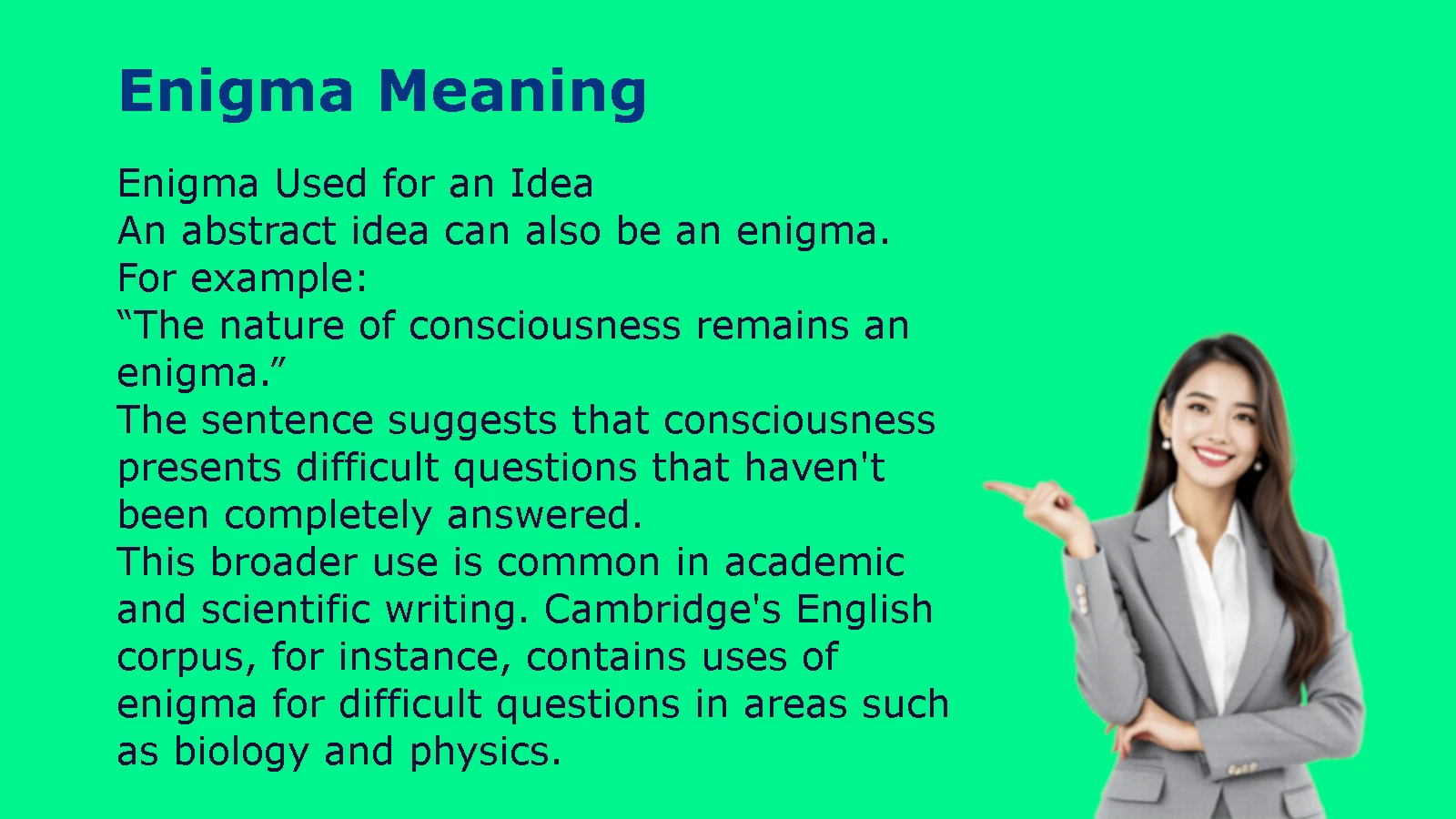
Enigma Used for an Idea
An abstract idea can also be an enigma.
For example:
“The nature of consciousness remains an enigma.”
The sentence suggests that consciousness presents difficult questions that haven’t been completely answered.
This broader use is common in academic and scientific writing. Cambridge’s English corpus, for instance, contains uses of enigma for difficult questions in areas such as biology and physics.
Enigma in Everyday Conversation
Enigma is a relatively formal word. You can use it in everyday conversation, but people often choose simpler words such as mystery, puzzle, or riddle.
For example, instead of:
“Your brother is an enigma.”
You might casually say:
“I can’t figure your brother out.”
However, enigma adds a particular flavor. It can make the mystery sound more intriguing, complex, or profound.
Compare these:
- “He’s a mystery.” — straightforward
- “He’s an enigma.” — more literary or sophisticated
- “He’s hard to figure out.” — casual
- “He’s a puzzle.” — informal and metaphorical
The best choice depends on your audience.
Enigma Synonyms
Several words overlap with enigma, but they don’t all mean exactly the same thing.
The closest synonyms include:
- Mystery
- Puzzle
- Riddle
- Conundrum
- Question
- Secret
- Perplexity
- Hidden meaning
Cambridge’s thesaurus lists puzzle, riddle, question, perplexity, conundrum, and mystery among words related to enigma.
Enigma vs. Mystery
Mystery is the closest everyday synonym for enigma.
A mystery is something unknown, unexplained, or difficult to understand.
An enigma often carries a stronger sense of puzzling complexity.
| Word | Main idea | Example |
| Enigma | Something difficult to understand | “His motives remain an enigma.” |
| Mystery | Something unknown or unexplained | “The disappearance remains a mystery.” |
The two words often work interchangeably.
However, enigma can sound more intellectual or literary.
For example:
“The origin of the universe is one of science’s greatest mysteries.”
This sounds perfectly natural.
You could also say:
“The origin of the universe remains an enigma.”
The second version emphasizes the difficulty of understanding the problem.
Enigma vs. Riddle
A riddle is usually a question, statement, or problem designed to challenge someone to find an answer.
An enigma is broader.
A riddle generally has a solution. An enigma doesn’t necessarily have one that you can easily find.
For example:
“What has keys but can’t open locks?”
That’s a riddle. The answer is a piano.
By contrast:
“Why did the ancient civilization suddenly disappear?”
That could be an enigma because the evidence may not provide a definitive answer.
Enigma vs. Puzzle
A puzzle is usually something you can solve by reasoning, knowledge, or experimentation.
A crossword is a puzzle.
A jigsaw is a puzzle.
A difficult mathematical problem can be a puzzle.
An enigma, on the other hand, may remain unexplained even after serious investigation.
That’s why scientists, historians, journalists, and writers sometimes use enigma for questions that resist easy answers.
Enigma vs. Conundrum
A conundrum usually describes a difficult or confusing problem.
For example:
“The company faces a conundrum: raising prices could reduce sales, but keeping prices low could cause losses.”
An enigma focuses more strongly on mystery and lack of understanding.
A conundrum often involves a difficult choice or problem.
An enigma often involves something you simply can’t figure out.
Enigma Antonyms
There isn’t one perfect opposite of enigma, but several words express the opposite idea.
Possible antonyms include:
- Explanation
- Answer
- Solution
- Certainty
- Clarity
- Understanding
- Knowledge
For example:
“The cause was an enigma.”
The opposite idea would be:
“The cause was clearly understood.”
Or:
“The investigation finally provided an explanation.”
The exact antonym depends on the context.
Where Does the Word Enigma Come From?
The history of enigma is particularly interesting because the word itself began with the idea of speaking indirectly.
English enigma comes from Latin aenigma, meaning “riddle.” Latin borrowed it from Greek ainigma, meaning a “dark saying” or “riddle.” The Greek term is connected with ainissesthai, meaning to speak obscurely or in riddles.
The history can be simplified like this:
Greek ainigma
↓
Latin aenigma
↓
English enigma
The Online Etymology Dictionary records English enigma from the 1530s, while an earlier form, enigmate, appeared in the mid-15th century. Its broader English sense of something inexplicable developed around 1600.
That shift matters.
At first, the word centered on obscure or hidden meaning. Over time, English speakers expanded it to describe almost anything that seemed inexplicable.
What Did Enigma Originally Mean?
The original Greek connection points toward a dark saying, riddle, or obscure statement.
The underlying idea was not simply “something unknown.” It involved indirect communication.
Someone could say something in a way that concealed its meaning. The listener then had to interpret it.
That’s remarkably close to the modern sense.
Whether you’re decoding an ancient statement or trying to understand someone’s strange behavior, you’re doing essentially the same thing: looking for meaning beneath something that isn’t immediately clear.
Enigma Meaning and the Word “Enigmatic”
One of the most important related words is enigmatic.
What Does Enigmatic Mean?
Enigmatic is an adjective meaning mysterious, difficult to understand, or difficult to interpret.
Cambridge gives examples such as an “enigmatic smile” and an “enigmatic message.”
Compare:
“Her behavior is an enigma.”
Here, enigma is a noun.
“Her behavior is enigmatic.”
Here, enigmatic is an adjective.
A simple way to remember the difference:
| Word | Part of speech | Meaning |
| Enigma | Noun | A mystery or something difficult to understand |
| Enigmatic | Adjective | Mysterious or difficult to understand |
| Enigmatically | Adverb | In a mysterious or difficult-to-understand way |
The adjective enigmatic entered English in the 1640s from Late Latin aenigmaticus.
Enigma vs. Enigmatic Examples
Enigma:
“The scientist’s discovery remains an enigma.”
Enigmatic:
“The scientist gave an enigmatic answer.”
Enigmatically:
“She smiled enigmatically and walked away.”
These words belong to the same family, but they don’t perform the same grammatical job.
Common Ways to Use “Enigma”
Some phrases appear naturally again and again.
“Remain an Enigma”
This is one of the most common constructions.
“The reason for his departure remains an enigma.”
It means the reason is still unexplained.
You can use the phrase for people, events, ideas, and problems.
“Be an Enigma to Someone”
This structure means that someone or something is difficult for another person to understand.
“His behavior is an enigma to his parents.”
The parents can’t figure out why he behaves that way.
Another example:
“The ancient symbols are an enigma to modern researchers.”
“A Complete Enigma”
Adding words such as complete, total, or absolute emphasizes the mystery.
“The device was a complete enigma to the engineers.”
This suggests they had little or no idea how it worked.
“Solve the Enigma”
Because an enigma is a mystery or difficult problem, you can talk about solving it.
“Researchers are trying to solve the enigma.”
This expression is especially common in journalism, history, science, and literature.
Enigma in Literature
Writers have long used mystery to create curiosity.
An enigmatic character may hide their motives, refuse to reveal personal information, or behave unpredictably. The reader then has to interpret clues.
This technique works because humans naturally want incomplete stories to become complete.
Imagine a novel introducing a character who:
- Never discusses their past
- Appears only at night
- Knows information they shouldn’t know
- Gives vague answers
- Disappears whenever someone asks direct questions
That character is an enigma.
The word doesn’t mean the character is necessarily supernatural or dangerous. It simply means the reader cannot fully understand them.
Why Writers Use Enigmatic Characters
An enigmatic character can:
- Create suspense
- Encourage readers to form theories
- Hide important information
- Make a story more psychologically interesting
- Keep readers turning pages
In other words, an enigma can function like a locked door in a story. You want to know what’s behind it.
Enigma in Science
Science often deals with questions that don’t yet have complete answers.
That’s why enigma appears frequently in scientific discussions.
A scientific enigma isn’t necessarily a contradiction. It may simply be a phenomenon that researchers haven’t adequately explained.
For example, researchers might understand what happens while still investigating why it happens.
That distinction is useful.
A Scientific Example
Suppose scientists observe an unexpected behavior in a species.
They know:
- Where the behavior occurs
- When it occurs
- How frequently it occurs
But they don’t know:
- Why it evolved
- What triggers it
- What advantage it provides
The underlying question could be described as an evolutionary enigma.
The word therefore doesn’t mean scientists have no information. Quite the opposite. An enigma can remain even after researchers collect enormous amounts of evidence.
Enigma in History
History contains plenty of unresolved questions.
Historians may have letters, artifacts, government records, eyewitness accounts, and archaeological evidence. Yet those sources don’t always produce one definitive explanation.
That’s where historical enigma becomes a useful phrase.
For example:
“The purpose of the structure remains an enigma.”
This doesn’t mean historians know nothing about the structure. They might know when it was built and who used the surrounding area. They simply don’t know its exact purpose.
The distinction between unknown and enigmatic is subtle but important.
An unknown fact may simply require more information.
An enigma can involve conflicting evidence, missing evidence, hidden motives, or a problem that remains difficult to interpret even when evidence exists.
Is Enigma a Positive or Negative Word?
Enigma is generally neutral.
The surrounding context determines whether it sounds positive, negative, or simply descriptive.
Positive or Intriguing Use
“The novelist is an enigma who fascinates everyone.”
Here, enigma suggests mystery and intrigue.
Negative Use
“His refusal to explain the decision made him an enigma to the team.”
Here, the word may suggest frustration.
Neutral Use
“The origin of the artifact remains an enigma.”
This simply states that researchers don’t have a complete explanation.
So, calling someone an enigma doesn’t automatically insult them.
Is Calling Someone an Enigma a Compliment?
It can be.
If you call someone an enigma, you may mean that they’re fascinating, complex, private, or intriguing.
For example:
“She’s an enigma, and that’s what makes her so interesting.”
That’s clearly positive.
However, context matters.
Compare:
“He’s an intriguing enigma.”
This sounds complimentary.
With:
“He’s an enigma. Nobody knows what he’s thinking.”
This sounds more neutral.
And:
“He’s a complete enigma to everyone on the team.”
This may express frustration.
The word itself doesn’t decide the emotional meaning. The surrounding language does.
Enigma in Popular Culture
The word appears frequently in descriptions of mysterious characters, celebrities, artists, fictional worlds, and unexplained events.
You’ll often see phrases such as:
- “An enigma to fans”
- “A political enigma”
- “A musical enigma”
- “An enigmatic character”
- “The enigma surrounding his disappearance”
- “One of history’s great enigmas”
This popularity makes sense. Enigma is more precise than simply saying “strange.”
A strange person might behave unusually.
An enigmatic person goes a step further: their behavior is difficult to interpret.
Case Study: Why “Enigma” Fits Better Than “Strange”
Consider two descriptions of the same person.
Description A:
“Marcus is strange. He rarely talks to anyone and sometimes leaves meetings without explanation.”
Description B:
“Marcus is an enigma. He rarely talks to anyone, gives little away about his motives, and often leaves meetings without explanation.”
The first sentence tells you Marcus behaves unusually.
The second emphasizes that you can’t understand him.
That’s the core difference.
Strange describes unusual behavior.
Enigma describes the mystery created by that behavior.
Enigma vs. Strange
These words are sometimes confused, but they serve different purposes.
| Word | What it emphasizes |
| Strange | Unusual or unfamiliar behavior |
| Mysterious | Something not easily explained |
| Enigma | A person or thing that remains difficult to understand |
| Enigmatic | Having mysterious or difficult-to-interpret qualities |
Someone can be strange without being an enigma.
For instance, someone might wear unusual clothes. That’s strange, but there’s no mystery involved.
However, if someone behaves in a way that leaves everyone wondering about their motives, enigma becomes more appropriate.
Common Mistakes With “Enigma”
Although enigma is straightforward once you understand it, several mistakes are common.
Using Enigma Only for People
An enigma can be a person, but it can also be an event, object, problem, idea, or phenomenon.
Incorrect assumption:
“An enigma always means a mysterious person.”
Better understanding:
“An enigma is anything that is difficult to understand or explain.”
Confusing Enigma With Riddle
A riddle is generally constructed as a problem that someone can solve.
An enigma is broader and may have no known solution.
Confusing Enigma With Enigmatic
Remember:
Enigma = noun
Enigmatic = adjective
You can say:
“The mystery is an enigma.”
But:
“The mystery is enigmatic.”
Both are grammatically possible, but they use the words differently.
Assuming Enigma Means Something Bad
It doesn’t.
An enigma can be fascinating, frustrating, neutral, or even admirable.
Enigma in a Sentence
Here are several natural examples showing different uses of the word:
- “Her sudden disappearance remains an enigma.”
- “He has always been an enigma to his closest friends.”
- “The origin of the ancient symbol is an enigma.”
- “Why the system failed remains an enigma.”
- “The quiet musician became something of an enigma.”
- “The scientist described the phenomenon as a major enigma.”
- “His motives remain an enigma to the public.”
- “The mysterious letter created a new enigma.”
- “The meaning of the inscription is still an enigma.”
- “She gave an enigmatic smile but didn’t answer.”
Notice how the word works across different contexts. It doesn’t have to involve a literal riddle.
Enigma Synonyms and Their Differences
Here’s a more detailed comparison of related words:
| Word | Meaning | Best used for |
| Enigma | Something difficult to understand | People, events, ideas, phenomena |
| Mystery | Something unknown or unexplained | General situations |
| Riddle | A question or statement requiring interpretation | Games, literature, questions |
| Puzzle | A problem requiring a solution | Games, logic, problems |
| Conundrum | A difficult or confusing problem | Choices and complex problems |
| Secret | Information deliberately kept hidden | Private information |
| Paradox | An apparent contradiction | Logic, philosophy, ideas |
| Mystery | An unexplained matter | Broad everyday use |
The words overlap, but they aren’t interchangeable in every sentence.
For example, a secret is hidden information. An enigma is something you struggle to understand.
Someone could know a secret without being an enigma.
Why Is the Word Enigma So Powerful?
The word works because it captures more than simple uncertainty.
If you say:
“I don’t know.”
You’re describing a lack of knowledge.
If you say:
“It’s an enigma.”
You’re suggesting something more intriguing: the thing itself resists easy understanding.
That distinction gives the word its punch.
An enigma invites questions:
- Why did this happen?
- What does it mean?
- What is being hidden?
- How does it work?
- What motivated this person?
- What information are we missing?
- Will we ever find the answer?
In that sense, an enigma isn’t merely an unanswered question. It’s a problem that keeps pulling your attention back.
Quick Facts About “Enigma”
- Part of speech: Noun
- Plural: Enigmas
- Pronunciation: ih-NIG-muh
- Related adjective: Enigmatic
- Related adverb: Enigmatically
- Origin: Greek through Latin
- Greek source: ainigma
- Original sense: A dark saying or riddle
- English usage: Recorded from the 1500s
- Broader sense: Developed into the idea of something inexplicable around 1600
Frequently Asked Questions About Enigma Meaning
What does enigma mean in simple terms?
Enigma means a mystery or something that is difficult to understand or explain. It can describe a person, event, object, idea, or problem.
What is an example of an enigma?
“The cause of the strange phenomenon remains an enigma.”
This means nobody has completely figured out why the phenomenon occurs.
Is enigma a positive or negative word?
Enigma is generally neutral. Depending on context, it can suggest that someone is fascinating and mysterious or confusing and difficult to understand.
Is calling someone an enigma a compliment?
It can be. Calling someone an enigma may suggest that they’re intriguing, complex, or fascinating. However, it can also express frustration if the person’s motives or behavior are impossible to understand.
What is the best synonym for enigma?
Mystery is usually the closest everyday synonym. Other related words include puzzle, riddle, conundrum, and perplexity.
What is the opposite of enigma?
There isn’t one exact antonym in every situation. Explanation, answer, solution, clarity, certainty, and understanding can express the opposite idea.
What is the difference between enigma and mystery?
Both words describe something difficult to understand or explain. Mystery is more common and broader, while enigma often emphasizes something particularly puzzling or difficult to interpret.
What is the difference between enigma and enigmatic?
Enigma is a noun.
“His behavior is an enigma.”
Enigmatic is an adjective.
“His behavior is enigmatic.”
How do you pronounce enigma?
In American English, pronounce it ih-NIG-muh or /ɪˈnɪɡ.mə/.
Can enigma describe a person?
Yes. If someone is difficult to understand, especially because their motives, personality, or behavior aren’t clear, you can call that person an enigma.
Can enigma describe a problem?
Yes. An unexplained scientific problem, historical question, strange event, or complex situation can all be described as an enigma.
Is enigma a formal word?
Yes. Enigma is more formal and literary than everyday expressions such as mystery or something I can’t figure out. It’s especially common in journalism, literature, academic writing, and serious discussion.
Final Thoughts on Enigma Meaning
The simplest enigma meaning is a person, thing, or situation that remains mysterious and difficult to understand or explain.
The word has a fascinating history. English inherited enigma from Latin aenigma, which came from the Greek ainigma, a term connected with riddles and obscure speech. By around 1600, English had developed the broader sense of something inexplicable to an observer.
Today, you can use enigma in many settings. A person can be an enigma. An unexplained event can be an enigma. A scientific question can be an enigma. So can an ancient inscription or a baffling decision.
The key idea is always the same: something doesn’t give up its meaning easily.
If you remember only one distinction, make it this:
An enigma is something you can’t easily figure out. An enigmatic thing or person is one that creates that mystery.
Once you understand that difference, enigma becomes a remarkably useful word for describing the puzzles, people, and unanswered questions that refuse to fit neatly into a box.