
Have you ever said something clever that made everyone in the room laugh? That’s where Witty Meaning comes into play. The word witty describes someone who uses quick thinking, clever ideas, and humor to make amusing or intelligent remarks.
Witty means clever and funny, especially in a quick and skillful way. A witty person can often think on their feet and respond with a clever comment that makes people smile or laugh.
Examples:
- She gave a witty reply that made everyone laugh.
- His witty sense of humor makes conversations more enjoyable.
The confusion is understandable. People often search for what does witty mean, witty meaning in text, witty meaning in a sentence, or what does it mean to be witty because the word can describe a person, comment, response, joke, or sense of humor. And here’s the fun part: being witty isn’t simply about being funny. It often involves quick thinking, clever wordplay, and good timing.
In this guide, you’ll learn the complete Witty Meaning, its definition, pronunciation, synonyms, correct usage, and examples in sentences. You’ll also discover what it means to be a witty person, how witty differs from funny, and how to use the word naturally in everyday conversations.
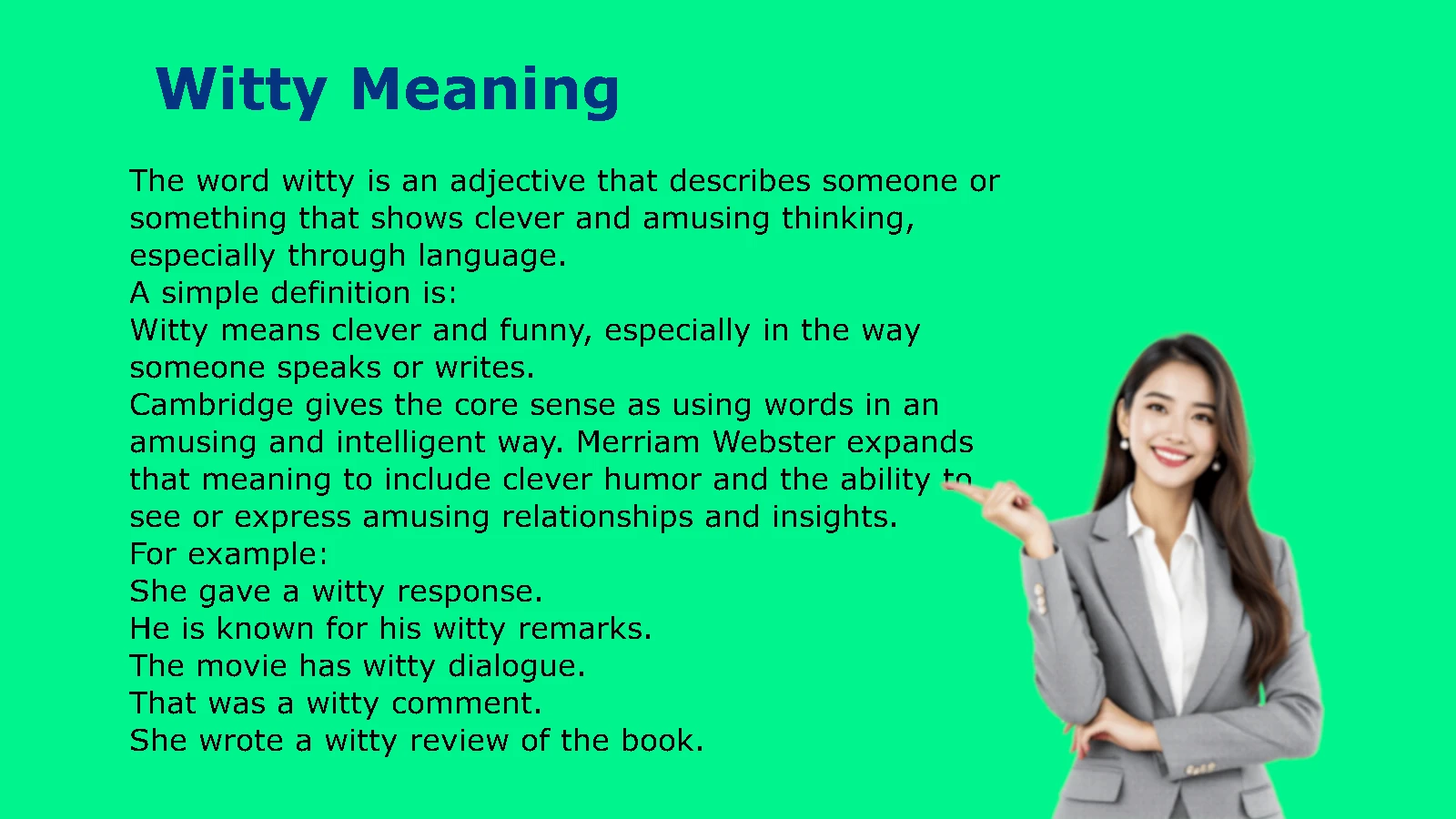
Witty Meaning
The word witty is an adjective that describes someone or something that shows clever and amusing thinking, especially through language.
A simple definition is:
Witty means clever and funny, especially in the way someone speaks or writes.
Cambridge gives the core sense as using words in an amusing and intelligent way. Merriam Webster expands that meaning to include clever humor and the ability to see or express amusing relationships and insights.
For example:
- She gave a witty response.
- He is known for his witty remarks.
- The movie has witty dialogue.
- That was a witty comment.
- She wrote a witty review of the book.
In each case, the word suggests more than ordinary humor. The person or writing shows some mental sharpness behind the amusement.
Think of it this way: funny makes you laugh; witty makes you notice how cleverly the joke was made.
Witty Meaning in Simple Words
If you want the shortest possible explanation, witty means cleverly funny.
Imagine someone asks:
“Why are you carrying an umbrella? It’s sunny outside.”
The person replies:
“I’m preparing for the weather’s plot twist.”
That response is potentially witty because it turns an ordinary situation into a clever observation.
A person doesn’t need to tell a long joke to be witty. Sometimes five words are enough.
Quick Definition of Witty
| Feature | Meaning |
| Part of speech | Adjective |
| Basic meaning | Clever and amusing |
| Pronunciation | WIT-ee |
| Comparative | WITtier |
| Superlative | Wittiest |
| Adverb | Wittily |
| Nouns | Wit, wittiness |
| Common phrases | Witty remark, witty response, witty comment |
| General tone | Usually positive |
Merriam Webster lists wittier and wittiest as the comparative and superlative forms and gives wittily and wittiness as related forms.
Witty Pronunciation
In American English, witty is pronounced approximately:
WIT-ee
The Cambridge US pronunciation is /ˈwɪt̬.i/. The British pronunciation is /ˈwɪt.i/.
The word has two syllables:
wit + ty
The first syllable sounds like wit, while the second sounds like the ending in city.
How to Pronounce Witty
Say it naturally:
WIT-ee
Example:
“She’s a witty writer.”
Don’t confuse witty with whit. Whit is a different word that means a very small amount or particle.
What Does It Mean to Be Witty?
Being witty means you can notice amusing or clever connections and express them effectively.
Wit often depends on several things working together:
- Quick thinking
- Good timing
- Clever word choice
- Observation
- Humor
- Unexpected connections
- Understanding of context
- A sense of proportion
However, being witty doesn’t mean making jokes every few seconds.
A witty person might listen quietly for several minutes and then make one sharp observation that changes the whole mood of the conversation.
That’s one reason wit feels different from constant joking. Wit often depends on timing as much as humor.
Merriam Webster’s definition of wit includes the ability to connect seemingly unrelated things in ways that illuminate or amuse.
Examples of Witty
The easiest way to understand witty meaning is to see the word in realistic contexts.
Witty Person
Maya is witty and always has a clever response ready.
Here, witty describes Maya’s ability to make clever and amusing comments.
Witty Remark
His witty remark made everyone at the table laugh.
A witty remark is a short statement that combines humor with cleverness.
Witty Response
She gave a witty response instead of taking the criticism personally.
The emphasis falls on her clever way of responding.
Witty Comment
He left a witty comment under the photo.
This works especially well for online conversations.
Witty Joke
The comedian opened the show with a witty joke about office meetings.
The joke isn’t merely amusing. Its construction or observation shows cleverness.
Witty Writing
The author uses witty language to make the serious subject easier to read.
Here, wit becomes a writing technique rather than simply a personality trait.
Witty Dialogue
The characters exchange witty dialogue throughout the movie.
This describes clever, amusing exchanges between characters.
Witty Observation
Her witty observation captured exactly what everyone else was thinking.
This example shows an important part of wit: recognizing something familiar and presenting it in an unexpected way.
Witty vs. Funny
The difference between witty and funny is one of the most important parts of understanding the word.
Both words relate to humor, but they emphasize different qualities.
| Witty | Funny |
| Combines cleverness and humor | Mainly creates amusement |
| Often involves wordplay or insight | Can involve any type of humor |
| Often requires quick thinking | Doesn’t necessarily require cleverness |
| Can describe a remark or response | Can describe a person, event, story, or situation |
| Often highlights mental sharpness | Mainly highlights the ability to cause laughter |
Cambridge describes witty as using words in a clever and funny way. Merriam Webster likewise says that witty suggests cleverness and quickness of mind, while humorous has a broader application.
Example of Funny but Not Necessarily Witty
Suppose someone slips on a banana peel in a cartoon.
That’s funny because the situation creates humor. It doesn’t necessarily involve clever language or an insightful observation.
Now imagine someone watches the scene and says:
“Even the banana had a better plan.”
That response has a witty quality because it adds a clever interpretation to the situation.
Example of Both Witty and Funny
A comedian might make a clever observation about everyday life that makes the audience laugh.
That’s both witty and funny.
The key difference is simple:
Funny describes the humorous effect. Witty describes the clever way the humor is expressed.
Witty vs. Clever
Clever and witty overlap, but they’re not interchangeable.
Clever generally describes intelligence, skill, ingenuity, or effective thinking. Witty adds an element of humor or amusing expression.
Compare these sentences:
She found a clever solution to the problem.
This doesn’t necessarily mean the solution is funny.
Now consider:
She gave a witty answer to the question.
The answer is clever and amusing.
Quick Comparison
| Word | Main Focus |
| Clever | Intelligence or ingenuity |
| Witty | Cleverness expressed through humor |
| Funny | Ability to cause laughter |
| Humorous | Having or expressing humor |
So, a mathematical solution can be clever, but it probably isn’t witty unless it also contains an amusing or playful element.
Witty vs. Humorous
Humorous is a broader word.
Something humorous contains or creates humor. It doesn’t necessarily require the quick thinking or clever expression associated with witty.
For example:
The book contains humorous stories about family life.
The stories can be funny without relying heavily on clever wordplay.
Compare that with:
The book contains witty observations about family life.
Now the focus shifts toward clever insights and sharp observations.
Merriam Webster explains that humorous applies broadly to things that evoke laughter, while witty specifically suggests cleverness and quickness of mind.
Witty vs. Sarcastic
Witty and sarcastic can overlap, but they describe different things.
Sarcasm often involves saying something that differs from the speaker’s intended meaning, frequently to mock, criticize, or make a pointed joke.
Wit doesn’t require that technique.
A witty statement can be:
- Playful
- Clever
- Observational
- Lighthearted
- Self-deprecating
- Word based
- Unexpected
A sarcastic statement can be:
- Mocking
- Critical
- Ironic
- Cutting
- Playful
- Humorous
Example of Wit
“My productivity has reached a level where I now need a vacation from my to-do list.”
This is a humorous observation.
Example of Sarcasm
Someone arrives two hours late.
You say:
“Wow, you’re early.”
The literal statement and intended meaning contradict each other. That’s sarcasm.
Can Something Be Both Witty and Sarcastic?
Absolutely.
A sarcastic remark can also be witty if the wording is particularly clever.
However, sarcasm describes a method or tone, while wit describes clever humor.
Merriam Webster distinguishes sarcasm from wit by explaining that sarcasm often uses irony with an intention to cut or wound, whereas wit centers on clever and inventive humorous expression.
What Is a Witty Remark?
A witty remark is a clever and amusing statement.
It might respond directly to something someone says, or it might offer an unexpected observation about a situation.
For example:
“I don’t procrastinate. I simply give my future self more opportunities.”
The sentence creates humor by presenting procrastination in an unexpected way.
A witty remark often has three ingredients:
- A familiar situation
- An unexpected connection
- A concise expression
That doesn’t mean every witty remark follows a formula. Wit can come from wordplay, irony, understatement, exaggeration, or sharp observation.
Cambridge specifically uses “witty comment” and “witty remark” as standard examples of the word in use.
What Is a Witty Person?
A witty person has a natural or developed ability to make clever and amusing observations or responses.
Such a person might:
- Respond quickly during conversations.
- Notice amusing details.
- Use language creatively.
- Make unexpected connections.
- Use wordplay effectively.
- Understand when a joke will work.
- Turn ordinary observations into humorous ones.
- Keep conversations lively.
Still, wit doesn’t mean someone must be loud or outgoing.
A quiet person can be extremely witty. In fact, some of the best witty comments come from people who wait until they have something worth saying.
Example
Imagine a meeting where someone says:
“Let’s keep this meeting short.”
After 90 minutes, someone quietly says:
“We’ve certainly redefined the word short.”
That’s a witty observation because it turns the obvious contradiction into a concise joke.
Is Witty a Compliment?
Yes. Witty is usually a compliment.
When you call someone witty, you’re generally praising their intelligence, humor, timing, or communication skills.
For example:
“You’re really witty.”
“That was a witty response.”
“I love your witty sense of humor.”
These statements usually express admiration.
Calling someone witty can be more specific than calling them funny. You’re not only saying that they make people laugh. You’re recognizing the cleverness behind their humor.
However, context still matters. Tone can change how almost any adjective sounds.
Witty Meaning in Texting and Social Media
Online conversations give wit plenty of room to shine.
A short comment can become memorable because it says something familiar in an unexpected way. That’s why people often describe social media replies, captions, posts, and comments as witty.
Common examples include:
- “That was a witty reply.”
- “Your caption is so witty.”
- “She always leaves witty comments.”
- “His posts are short but incredibly witty.”
- “That comeback was witty.”
Cambridge’s examples include witty online comments, showing that the word naturally applies to digital communication as well as traditional speech and writing.
Witty Captions
A witty caption doesn’t need to explain the joke.
For example:
“Currently accepting applications for a personal chef.”
paired with a photo of someone eating takeout can create a playful, witty effect.
The humor comes from the contrast between the image and the caption.
Witty Replies
A witty reply often works because it’s quick.
Person A: “You have way too many books.”
Person B: “That’s not a problem. It’s a storage strategy.”
The response reframes the criticism in a clever way.
Witty in a Sentence
Here are natural examples showing different uses of witty:
- She is known for her witty sense of humor.
- His witty response caught everyone by surprise.
- The writer has a witty and engaging style.
- Her witty comment broke the tension in the room.
- The movie features witty dialogue.
- He made a witty observation about modern work culture.
- The comedian is famous for his witty remarks.
- That was a surprisingly witty answer.
- The novel has several witty characters.
- She wrote a witty review of the restaurant.
- His witty banter kept the conversation interesting.
- The speaker delivered a witty and entertaining presentation.
- Her witty caption received thousands of likes.
- The show’s witty dialogue makes it easy to watch.
- He has a quick and witty style of humor.
These examples show that witty most often modifies communication, people, writing, humor, or creative work.
Common Collocations With Witty
A collocation is a group of words that commonly appear together.
Knowing these combinations helps you use witty naturally.
| Collocation | Example |
| Witty remark | He made a witty remark. |
| Witty response | She gave a witty response. |
| Witty comment | His witty comment made everyone laugh. |
| Witty joke | The comedian told a witty joke. |
| Witty observation | She made a witty observation. |
| Witty dialogue | The film has witty dialogue. |
| Witty banter | Their witty banter was entertaining. |
| Witty writer | She’s a witty writer. |
| Witty speaker | He’s a witty public speaker. |
| Witty character | The story has a witty main character. |
| Witty caption | She posted a witty caption. |
| Witty sense of humor | He has a witty sense of humor. |
Cambridge and Merriam Webster both provide examples involving witty remarks, comments, dialogue, and similar forms of expression.
Synonyms for Witty
The best witty synonyms depend on exactly what you want to emphasize.
Closest Synonyms
- Clever
- Humorous
- Funny
- Amusing
- Smart
- Playful
- Jocular
- Jocose
- Facetious
Merriam Webster identifies humorous and clever as particularly relevant synonyms and explains that witty specifically suggests cleverness and quickness of mind.
Why These Synonyms Aren’t Identical
Clever focuses more on intelligence.
Funny focuses more on amusement.
Humorous is broader and can describe anything that produces or expresses humor.
Playful suggests a lighthearted approach.
Facetious can carry a negative suggestion when someone makes jokes at an inappropriate time.
Jocular suggests a tendency toward joking.
So, don’t replace witty with every synonym in every sentence. The nuance matters.
Antonyms of Witty
There isn’t one perfect opposite for witty because the word combines cleverness and humor.
Depending on context, useful antonyms include:
- Dull
- Unfunny
- Boring
- Humorless
- Unimaginative
- Serious
- Unamusing
For example:
“His speech was witty.”
The opposite might be:
“His speech was dull.”
But if the focus is humor, unfunny or humorless may work better.
If the focus is cleverness, unimaginative or dull may be more appropriate.
Word Forms of Witty
Understanding related forms makes the word easier to use accurately.
| Word | Part of Speech | Meaning | Example |
| Witty | Adjective | Clever and amusing | She is witty. |
| Wittier | Comparative adjective | More witty | His reply was wittier. |
| Wittiest | Superlative adjective | Most witty | She gave the wittiest answer. |
| Wittily | Adverb | In a witty manner | He responded wittily. |
| Wittiness | Noun | Quality of being witty | Her wittiness was obvious. |
| Wit | Noun | Clever humor or mental quickness | His wit impressed everyone. |
| Witticism | Noun | A clever or amusing remark | She made a witty remark, or witticism. |
Merriam Webster lists wittier, wittiest, wittily, and wittiness as forms associated with witty.
Witty vs. Wit
These words are closely connected.
Witty is an adjective:
She is witty.
Wit is a noun:
She has a sharp wit.
Merriam Webster defines wit as including the ability to relate seemingly unrelated things in ways that illuminate or amuse, as well as clever humor and quick verbal exchanges.
Witty Meaning and the Word “Wit”
The history of witty becomes clearer when you understand wit.
Today, wit often refers to clever humor or quick intelligence. Historically, however, the word had a broader connection with knowing, knowledge, intelligence, and mental ability.
Merriam Webster traces wit to Middle English and Old English roots associated with knowing. The older intellectual sense survives in expressions such as “wit and wisdom” and “out of one’s wits.”
Merriam Webster also notes that the older meaning of witty involved intellectual capacity or intelligence. That sense is now largely archaic, while modern English mainly uses witty for clever humor.
This history explains why wit still carries a sense of mental sharpness. The modern meaning didn’t appear from nowhere. It developed from the older idea of intelligence and perception.
Is Witty Always Funny?
Not necessarily in the loud, laugh-out-loud sense.
A witty comment can make you laugh. It can also make you smile or simply make you appreciate the cleverness of the observation.
For example:
“Experience is what you get when you didn’t get what you wanted.”
The humor comes partly from the unexpected way the idea is framed.
This illustrates an important point: wit doesn’t depend entirely on a big punchline.
Sometimes the pleasure comes from recognizing the clever connection.
Merriam Webster describes wit as the ability to relate seemingly different things in ways that illuminate or amuse.
How to Use Witty in Everyday Conversation
The word fits naturally into everyday speech.
You can use it to compliment someone:
“You’re very witty.”
You can describe something someone said:
“That was a witty response.”
You can describe writing:
“The article has a witty tone.”
You can describe entertainment:
“The show has witty dialogue.”
You can describe someone’s personality:
“She’s intelligent, friendly, and witty.”
You can also use it with sense of humor:
“He has a very witty sense of humor.”
However, remember that witty usually describes the style or quality of humor. If you simply mean that something made you laugh, funny may be the better choice.
What Makes a Remark Witty?
A strong witty remark often has a sense of surprise.
The listener expects one direction, but the speaker takes another.
Consider:
Situation: Someone complains about having too much work.
Ordinary response:
“Yeah, work has been really busy.”
Witty response:
“At this point, my to-do list needs its own calendar.”
The second response transforms an ordinary complaint into a humorous image.
Several techniques can create this effect:
- Wordplay
- Unexpected comparisons
- Irony
- Understatement
- Exaggeration
- Double meanings
- Clever observations
- Unexpected reversals
Not every witty statement uses all of these. Often, one well-timed idea does the job.
Witty Humor in Writing
Wit isn’t limited to conversation.
Writers use it in:
- Essays
- Novels
- Reviews
- Speeches
- Advertisements
- Scripts
- Social media
- Personal correspondence
A witty writing style can make complicated or ordinary subjects feel more engaging.
For instance, instead of writing:
“The office meeting lasted longer than expected.”
A more playful writer might say:
“The meeting began at nine and apparently applied for permanent residency.”
The second sentence creates an unexpected image. That’s where the wit lives.
Why Writers Use Wit
Wit can:
- Keep readers interested.
- Make ideas memorable.
- Add personality to writing.
- Reduce the heaviness of serious subjects.
- Create memorable lines.
- Build a distinct voice.
- Make ordinary observations feel fresh.
However, too much wit can become distracting. A clever line should serve the writing rather than compete with it.
Witty Meaning in Professional Communication
You can use wit at work, but context matters.
A light witty comment may help break tension during a casual team conversation.
For example:
“Looks like the spreadsheet has decided to test our patience today.”
That can sound friendly in an informal workplace.
However, a witty comment isn’t always appropriate in a serious situation, especially when someone is dealing with a sensitive issue.
Professional wit works best when it is:
- Brief
- Inclusive
- Respectful
- Relevant
- Easy to understand
- Appropriate for the audience
The goal isn’t to prove that you’re the cleverest person in the room.
Good wit opens a door. Badly timed wit closes one.
Witty Meaning in Literature and Entertainment
Wit has a long relationship with literature, drama, comedy, and popular entertainment.
A character can be described as witty because of sharp dialogue, clever observations, or quick exchanges with other characters.
That’s why descriptions such as these are common:
- A witty character
- Witty dialogue
- A witty novel
- A witty comedy
- A witty script
- A witty performance
Merriam Webster’s current examples include references to witty novels, talk show hosts, bloggers, dialogue, and creative work.
Wit can also help define a character. A character who constantly responds with clever observations may seem intelligent, confident, playful, sarcastic, or even arrogant depending on how that wit affects other people.
Case Study: Funny vs. Witty in a Conversation
Consider this simple situation.
A friend says:
“I need to start going to the gym.”
Funny Response
“Good luck surviving leg day.”
This can be funny because it refers to a familiar gym experience.
Witty Response
“My gym membership is currently an expensive donation to the fitness industry.”
This response creates humor through an unexpected way of describing an unused membership.
What Changed?
The second response doesn’t just make a joke about the gym. It reframes the situation.
That’s a common feature of wit.
The speaker takes something ordinary and gives it a clever angle.
Case Study: Witty vs. Sarcastic
Imagine someone submits a report three days late.
A colleague says:
“Great timing. I was beginning to think we’d get it next year.”
This is sarcastic because the speaker means the opposite of the literal praise.
It can also be witty if the phrasing is clever and amusing.
Now consider:
“This report has developed a strong relationship with the concept of patience.”
That’s more playful and metaphorical. It can be witty without relying as heavily on direct sarcasm.
The examples demonstrate why witty and sarcastic sometimes overlap but shouldn’t be treated as synonyms.
Witty Meaning: Facts to Remember
Here are the most useful facts at a glance:
- Witty is an adjective.
- It generally means clever and amusing.
- It often describes speech, writing, remarks, comments, responses, or people.
- The US pronunciation is approximately WIT-ee.
- The comparative form is wittier.
- The superlative form is wittiest.
- Wittily is the adverb.
- Wittiness is a noun.
- Wit is the closely related noun.
- Witty is generally a positive description.
- Being witty isn’t exactly the same as being funny.
- Being witty isn’t the same as being sarcastic.
- The modern sense centers on clever humor and quickness of mind.
- The word has older connections with intelligence and knowing.
Frequently Asked Questions About Witty Meaning
What does witty mean in simple terms?
Witty means clever and funny. It usually describes someone who can express amusing ideas or observations in a clever way.
Does witty mean funny?
Not exactly. Funny means something causes amusement or laughter. Witty adds the idea of cleverness or quick thinking.
A statement can be funny without being witty.
Is witty a compliment?
Yes. Calling someone witty is usually a compliment. It suggests that the person is clever, amusing, and good at expressing humorous ideas.
What is a witty person?
A witty person is someone who often makes clever and amusing observations, comments, or responses.
What is a witty remark?
A witty remark is a short statement that combines cleverness with humor. It often presents an ordinary situation in an unexpected way.
What is the difference between witty and clever?
Clever focuses on intelligence or ingenuity. Witty usually combines cleverness with humor.
What is the difference between witty and humorous?
Humorous is broader. It describes something that contains or produces humor. Witty specifically suggests cleverness and quickness of mind.
What is the difference between witty and sarcastic?
Witty describes clever humor. Sarcastic often involves saying something that differs from the intended meaning, frequently to mock or criticize.
A remark can be both witty and sarcastic, but the words aren’t interchangeable.
What are synonyms for witty?
Common witty synonyms include:
- Clever
- Humorous
- Funny
- Amusing
- Smart
- Playful
- Jocular
- Jocose
- Facetious
The best synonym depends on the context.
What is the opposite of witty?
Depending on the context, possible opposites include dull, boring, unfunny, humorless, and unimaginative.
What is the noun form of witty?
The closest noun forms are wit and wittiness.
Wit refers to clever humor or mental quickness, while wittiness refers to the quality of being witty.
What is the comparative form of witty?
The comparative form is wittier.
“Her second response was wittier than her first.”
What is the superlative form of witty?
The superlative form is wittiest.
“That was his wittiest response of the evening.”
What does witty mean in texting?
In texting, witty usually describes a clever and amusing message, reply, comeback, or comment.
For example:
“That was a witty text.”
It suggests that the message was more than merely funny. It had a clever angle.
Witty Meaning: Final Takeaway
The simplest way to remember the witty meaning is:
Witty means cleverly funny, especially in speech or writing.
The word describes more than laughter. It points to the cleverness behind the humor.
A funny person can make you laugh. A witty person can make you laugh while making you think, “That’s a clever way to put it.”
That distinction explains why we talk about witty remarks, witty responses, witty comments, witty dialogue, witty writers, and witty people.
When you use witty, you’re usually praising someone’s ability to spot an interesting connection and express it in an amusing way. Wit is quick, clever, and often brief. Sometimes one sharp sentence can do more than a whole paragraph of jokes.
In short:
| Question | Answer |
| What does witty mean? | Clever and amusing |
| Is witty positive? | Usually, yes |
| Does witty mean funny? | Not exactly; wit adds cleverness |
| Does witty mean sarcastic? | No, although they can overlap |
| What is a witty person? | Someone skilled at clever, amusing expression |
| What is a witty remark? | A clever and amusing statement |
| Synonyms | Clever, humorous, funny, amusing, smart |
| Comparative | Wittier |
| Superlative | Wittiest |
| Related noun | Wit or wittiness |
| Pronunciation | WIT-ee |
Once you understand that wit combines cleverness with humor, the word becomes much easier to recognize and use naturally.