
Have you ever dealt with someone who ignored your feelings, needs, or personal boundaries and wondered what to call their behavior? While Inconsiderate Meaning may seem straightforward, this word can describe different actions depending on the situation, behavior, and impact on others.
Inconsiderate is an adjective used to describe someone who does not think about other people’s feelings, needs, comfort, or circumstances before acting. An inconsiderate person may behave in a selfish, careless, or thoughtless way without considering how their actions affect others.
Examples:
- It was inconsiderate of him to interrupt her while she was speaking.
- Leaving the door open in the middle of winter was inconsiderate.
The confusion is understandable. People often search for what does inconsiderate mean, inconsiderate meaning in a relationship, inconsiderate meaning in text, or what does it mean when someone is inconsiderate because the word can describe anything from a small social mistake to behavior that repeatedly hurts or frustrates others. And here’s the kicker: someone can be inconsiderate without necessarily intending to be rude or hurtful.
In this guide, you’ll learn the complete Inconsiderate Meaning, its definition, pronunciation, synonyms, antonyms, and correct usage. You’ll also discover what it means to be inconsiderate in relationships, conversations, and everyday situations, along with clear examples of inconsiderate behavior and sentences to help you understand the word better.
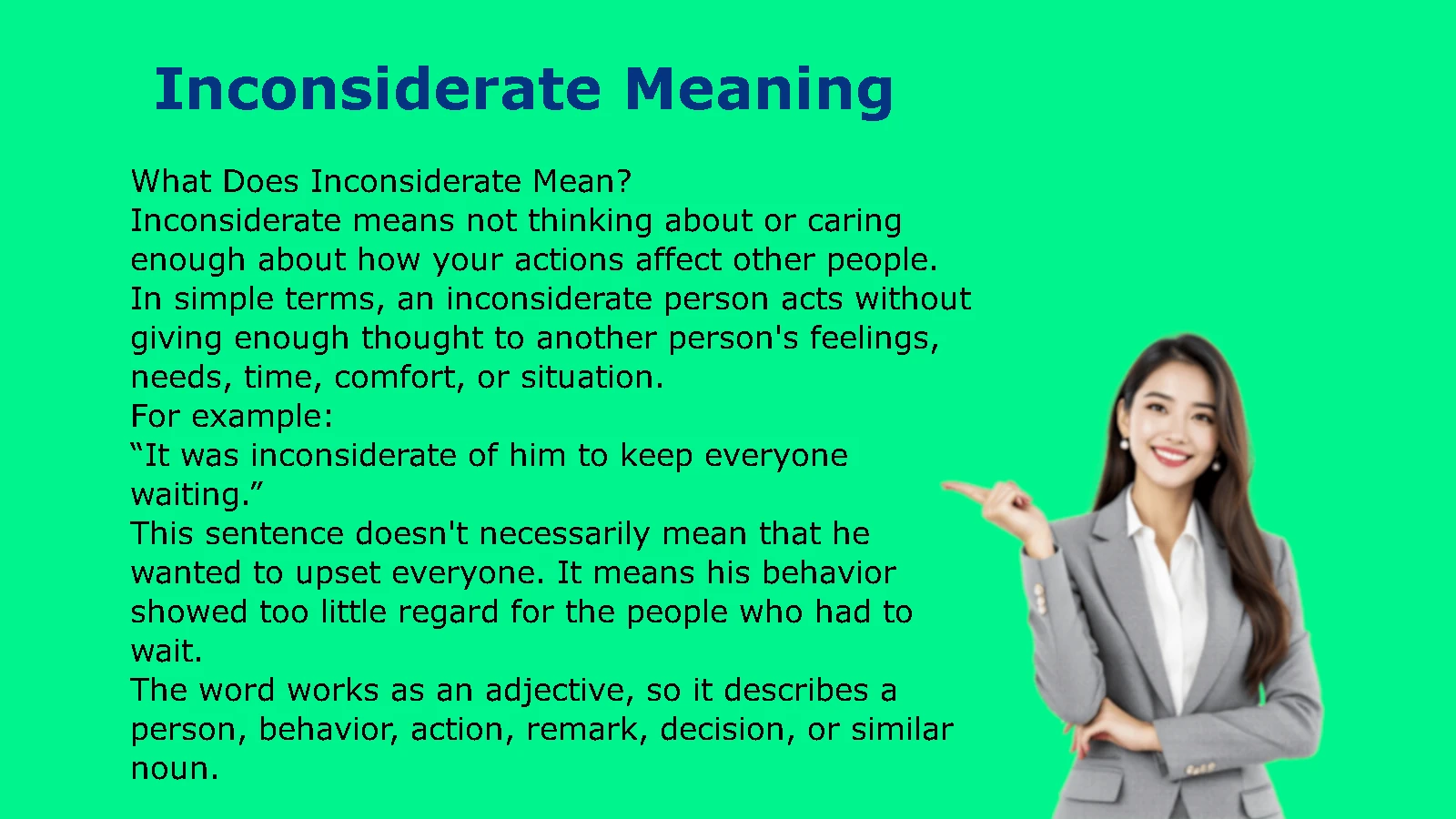
What Does Inconsiderate Mean?
Inconsiderate means not thinking about or caring enough about how your actions affect other people.
In simple terms, an inconsiderate person acts without giving enough thought to another person’s feelings, needs, time, comfort, or situation.
For example:
“It was inconsiderate of him to keep everyone waiting.”
This sentence doesn’t necessarily mean that he wanted to upset everyone. It means his behavior showed too little regard for the people who had to wait.
The word works as an adjective, so it describes a person, behavior, action, remark, decision, or similar noun.
Simple Definition of Inconsiderate
A simple definition is:
Inconsiderate means failing to think about other people’s feelings, needs, rights, time, or comfort.
Here are a few everyday examples:
- Playing loud music late at night while neighbors are sleeping.
- Interrupting someone every time they speak.
- Canceling an important appointment at the last minute without explanation.
- Leaving a mess for someone else to clean.
- Making a personal joke about someone in front of a group.
- Ignoring another person’s reasonable boundaries.
- Taking up an entire shared space without considering others.
In each case, the central idea remains the same: the person doesn’t give enough consideration to others.
Inconsiderate Meaning in Different Contexts
The meaning stays fairly consistent across situations, but the behavior that qualifies as inconsiderate can change.
For instance, arriving 30 minutes late to a casual gathering may bother people. Arriving 30 minutes late to an important appointment without warning can be considerably more disruptive.
Context matters.
Inconsiderate in Personal Relationships
In relationships, inconsiderate behavior often involves ignoring another person’s feelings or needs.
For example, imagine that two friends agree to meet for dinner. One friend arrives an hour late without sending a message. The delay itself may not prove that the person is inconsiderate. An emergency could explain it. However, if the person could have communicated but simply didn’t bother, the behavior may reasonably seem inconsiderate.
Inconsiderate at Work
At work, inconsiderate behavior often involves wasting people’s time, disrupting their concentration, ignoring responsibilities, or failing to respect professional boundaries.
Examples include:
- Interrupting coworkers during meetings.
- Taking credit for someone else’s contribution.
- Scheduling unnecessary meetings without considering people’s workload.
- Leaving shared areas messy.
- Missing deadlines without warning others.
- Playing distracting audio in a shared workspace.
Inconsiderate in Public
Public behavior can also be inconsiderate when it creates unnecessary problems for others.
Examples include:
- Cutting in line.
- Blocking a doorway.
- Speaking loudly in a quiet library.
- Leaving trash behind.
- Standing in a way that prevents others from moving through a crowded area.
- Playing videos loudly on public transportation.
Cambridge gives loud music late at night as a straightforward example because the behavior affects other people’s ability to rest.
Inconsiderate Meaning With Examples
Examples make the meaning much easier to understand because inconsiderate describes behavior rather than one single type of action.
| Situation | Example of Inconsiderate Behavior | Why It May Be Inconsiderate |
| Friendship | Canceling plans at the last minute without explanation | It disregards the other person’s time |
| Family | Making loud noise while someone sleeps | It ignores their need for rest |
| Workplace | Constantly interrupting a coworker | It prevents them from speaking |
| Public place | Cutting in line | It disregards people who arrived earlier |
| Conversation | Looking at your phone while someone shares something important | It can signal a lack of attention |
| Shared home | Leaving dirty dishes for others | It creates extra work for someone else |
| Neighborhood | Playing loud music late at night | It can disturb other residents |
| Online | Sharing someone’s private message without permission | It ignores their privacy |
Example Sentences With Inconsiderate
Here are several natural examples:
- “It was inconsiderate of him to cancel at the last minute.”
- “Leaving your dishes on the table was inconsiderate.”
- “Her inconsiderate comment embarrassed him.”
- “It’s inconsiderate to interrupt someone while they’re speaking.”
- “The neighbors were being inconsiderate by playing loud music at midnight.”
- “He apologized for being inconsiderate.”
- “That was an inconsiderate thing to say.”
- “She didn’t mean to be inconsiderate, but she forgot to tell everyone about the change.”
Notice that these examples focus on the effect of behavior on other people.
What Does It Mean to Call Someone Inconsiderate?
Calling someone inconsiderate means you believe the person has failed to think about how their behavior affects others.
The word can describe a single action:
“That was inconsiderate.”
It can also describe a repeated pattern:
“He’s always inconsiderate of other people’s time.”
Those statements don’t carry exactly the same weight.
The first criticizes a particular action. The second makes a broader judgment about someone’s behavior.
“That Was Inconsiderate” vs. “You Are Inconsiderate”
This distinction can matter during an argument.
“That was inconsiderate” focuses on what someone did.
“You are inconsiderate” focuses on the person’s character or general behavior.
Compare:
- Less personal: “It was inconsiderate to cancel without telling me.”
- More personal: “You’re an inconsiderate person.”
The first statement gives the other person something specific to address. The second can feel like a personal attack.
When discussing difficult behavior, focusing on the action often creates a more productive conversation.
Inconsiderate vs. Considerate
The clearest opposite of inconsiderate is considerate.
Cambridge lists considerate as the opposite of inconsiderate, while Merriam Webster defines considerate behavior as being thoughtful of other people’s rights and feelings.
| Considerate | Inconsiderate |
| Thinks about others | Fails to think about others |
| Respects people’s time | Disregards people’s time |
| Considers other people’s feelings | Often ignores their feelings |
| Respects reasonable boundaries | May overlook boundaries |
| Tries to avoid unnecessary inconvenience | Creates unnecessary inconvenience |
| Pays attention to shared spaces | Uses shared spaces without enough regard for others |
For example:
Considerate:
“She’s lowering the volume because her roommate is studying.”
Inconsiderate:
“He keeps playing loud music even though his roommate is studying.”
The difference isn’t simply whether someone gets what they want. It involves whether they consider the effect of their behavior on other people.
Synonyms for Inconsiderate
Several words have meanings that overlap with inconsiderate, but they’re not perfect substitutes.
Common synonyms include:
- Thoughtless
- Selfish
- Insensitive
- Rude
- Disrespectful
- Discourteous
- Tactless
- Unmindful
- Heedless
- Impulsive
- Impolite
- Self centered
Merriam Webster’s thesaurus includes words such as rude, thoughtless, disrespectful, and discourteous among the similar terms for inconsiderate.
Thoughtless
Thoughtless often means failing to think about someone else’s needs or feelings.
“It was thoughtless of him to forget her birthday.”
The word can sound somewhat softer than inconsiderate, depending on context.
Selfish
Selfish suggests that someone puts their own interests, wants, or comfort ahead of other people.
“It was selfish of him to take all the food.”
A selfish action can be inconsiderate, but the two words emphasize different things.
Inconsiderate focuses on a lack of consideration for others.
Selfish focuses more strongly on putting oneself first.
Insensitive
Insensitive usually relates more directly to someone’s feelings or emotional situation.
“That comment was insensitive.”
Someone can be inconsiderate without making an emotionally insensitive comment. For example, repeatedly arriving late may be inconsiderate without involving someone’s emotions.
Tactless
Tactless describes behavior or speech that lacks sensitivity or social judgment.
“His tactless comment made the situation worse.”
A tactless person may say something true but choose a poor way or time to say it.
Rude
Rude generally describes behavior that violates ordinary standards of politeness or manners.
“It was rude to interrupt the speaker.”
Rudeness and inconsideration often overlap, but inconsiderate places more emphasis on failing to think about the effect on others.
Inconsiderate vs. Selfish
These words often appear together because selfish behavior can also be inconsiderate.
Still, there’s an important distinction.
A person may act inconsiderately without being selfish. Perhaps they simply forgot that their actions would inconvenience someone else.
Likewise, a person can act selfishly by choosing what benefits them even after they understand that it disadvantages someone else.
Consider this example:
A friend forgets to bring something they promised to bring.
If they genuinely forgot, the behavior may be inconsiderate.
Now imagine the friend remembers but decides not to bring it because doing so would be inconvenient for them, even though everyone else is relying on it.
That behavior looks more clearly selfish.
The words overlap, but intention and awareness can change the most accurate description.
Inconsiderate vs. Thoughtless
Inconsiderate and thoughtless are close synonyms.
Both can describe someone who doesn’t adequately consider another person’s needs or feelings.
However, thoughtless often sounds like a description of a particular failure to think.
“It was thoughtless of me to forget your birthday.”
Inconsiderate can emphasize the effect on another person.
“It was inconsiderate of me to make you wait without calling.”
Neither word automatically proves bad intentions. A person can act thoughtlessly or inconsiderately without deliberately trying to cause harm.
Inconsiderate vs. Insensitive
The distinction becomes clearer when feelings enter the picture.
Insensitive often means failing to recognize or respond appropriately to another person’s emotions.
Inconsiderate has a broader range. It can involve emotions, time, comfort, rights, personal space, or practical needs.
For example:
- Making a joke about someone’s recent loss may be insensitive.
- Leaving a shared kitchen dirty may be inconsiderate.
- Making a joke about someone’s recent loss and dismissing their feelings could be both.
The overlap is real, but the emphasis differs.
Common Examples of Inconsiderate Behavior
Inconsideration can appear in surprisingly ordinary situations. It doesn’t always involve dramatic conflict.
Inconsiderate Behavior Toward Friends
A friendship depends heavily on mutual respect. Small habits can become frustrating when one person repeatedly ignores the other person’s needs.
Examples include:
- Canceling plans repeatedly without a good reason.
- Arriving very late without communicating.
- Dominating every conversation.
- Ignoring an important message for days while expecting immediate replies from others.
- Borrowing something and returning it damaged.
- Sharing private information.
- Making jokes about a friend’s insecurities.
- Changing plans without asking anyone else.
- Expecting others to solve problems created by you.
One isolated mistake doesn’t necessarily establish a pattern. Repeated behavior matters.
Inconsiderate Behavior at Work
Professional environments require people to share time, space, information, and responsibilities.
Common examples include:
- Interrupting colleagues.
- Talking over people during meetings.
- Taking credit for another person’s work.
- Leaving shared equipment messy.
- Missing deadlines without warning.
- Sending unnecessary urgent requests.
- Ignoring agreed procedures.
- Playing loud audio in a shared workspace.
- Scheduling meetings without considering obvious conflicts.
Consideration at work doesn’t mean agreeing with everyone. You can disagree strongly and still communicate respectfully.
Inconsiderate Behavior in Public
Public spaces require people to share limited resources.
For example:
- Cutting in line ignores people who arrived before you.
- Blocking an elevator doorway makes it harder for others to exit.
- Leaving trash behind creates extra work for someone else.
- Playing loud music can disturb people who have no choice but to hear it.
- Taking up several seats in a crowded area can prevent others from sitting.
These actions may seem small individually. In crowded environments, however, small acts of consideration can make a significant difference.
How to Use “Inconsiderate” in a Sentence
Inconsiderate functions primarily as an adjective.
It can describe a person:
“He’s being inconsiderate.”
It can describe behavior:
“That was inconsiderate behavior.”
It can describe an action:
“Leaving without saying goodbye was inconsiderate.”
It can also appear in the common structure “inconsiderate of”:
“It was inconsiderate of her to cancel without calling.”
This construction specifically connects the criticism to a person’s action.
Common Sentence Patterns
| Pattern | Example |
| Inconsiderate + noun | “His inconsiderate behavior caused problems.” |
| Be + inconsiderate | “Don’t be inconsiderate.” |
| Inconsiderate of + person | “That was inconsiderate of him.” |
| It was inconsiderate to + verb | “It was inconsiderate to leave everyone waiting.” |
| Inconsiderate toward + person/group | “She was inconsiderate toward her coworkers.” |
These patterns make it easier to use the word naturally.
Common Phrases With Inconsiderate
Several combinations appear naturally in everyday English.
Inconsiderate Behavior
This refers to actions that show little regard for others.
“The manager addressed the employee’s inconsiderate behavior.”
Inconsiderate Person
This describes someone whose behavior regularly shows little consideration for others.
“Nobody wants to live with an inconsiderate roommate.”
Inconsiderate Comments
This refers to remarks that fail to account for another person’s feelings or situation.
“His inconsiderate comments made the conversation uncomfortable.”
Inconsiderate Actions
This focuses on specific things someone does.
“The company apologized for the inconsiderate actions of the employee.”
It Was Inconsiderate of You
This phrase directly criticizes someone’s behavior.
“It was inconsiderate of you to cancel without telling anyone.”
Because it directly addresses the person, it can sound confrontational depending on tone.
Is Inconsiderate Always a Strong Insult?
Inconsiderate is a negative word, but it isn’t necessarily an extreme insult.
The strength depends heavily on context, tone, and wording.
Compare these statements:
“That was a little inconsiderate.”
and
“You’re an incredibly inconsiderate person.”
The first sounds like criticism of one action. The second makes a much broader judgment.
A softer version might be:
- “I don’t think you realized how that affected me.”
- “That felt a little inconsiderate.”
- “Could you please consider my situation too?”
- “I’d appreciate a little more consideration.”
A stronger version might be:
- “That was extremely inconsiderate.”
- “You keep disregarding other people’s time.”
- “Your behavior has been consistently inconsiderate.”
The best choice depends on what needs to be communicated.
How to Respond When Someone Calls You Inconsiderate
Being called inconsiderate can feel personal. However, the criticism may point to a specific behavior that needs attention.
Start by asking what happened.
“What did I do that came across that way?”
That question gives you useful information instead of turning the conversation into a contest over who is right.
Then consider the situation from the other person’s perspective.
A Helpful Response Pattern
- Listen to the complaint.
- Identify the specific behavior.
- Consider its effect on the other person.
- Acknowledge the problem if the criticism is fair.
- Apologize when appropriate.
- Explain your intention only after addressing the impact.
- Change the behavior when possible.
For example:
“I didn’t realize that I was making you wait without an update. I can see why that was frustrating. I’m sorry. I’ll let you know earlier next time.”
That’s usually more productive than:
“Well, I didn’t mean anything by it, so you’re overreacting.”
Intent matters, but impact matters too.
How to Say Someone Is Being Inconsiderate Politely
Sometimes you need to address inconsiderate behavior without starting an argument.
Instead of labeling someone’s character, describe the specific action.
For example:
- “Could you please keep the volume down?”
- “I’d appreciate it if you could let me know before changing the plan.”
- “I need some quiet while I’m working.”
- “Could we find a solution that works for everyone?”
- “I don’t think that comment came across the way you intended.”
- “Please consider how this affects the rest of the team.”
- “It would help if you gave me more notice next time.”
This approach separates the person from the behavior.
That’s useful because people can change behavior. Telling someone they’re simply a bad person doesn’t offer much room for improvement.
Word Forms Related to Inconsiderate
The word belongs to a larger family of related forms.
| Word | Part of Speech | Meaning | Example |
| Inconsiderate | Adjective | Not thoughtful of others | “That was inconsiderate.” |
| Inconsiderately | Adverb | In a way that lacks consideration | “He acted inconsiderately.” |
| Inconsiderateness | Noun | The quality of being inconsiderate | “Her inconsiderateness frustrated the team.” |
| Inconsideration | Noun | Lack of consideration | “The decision showed inconsideration for others.” |
| Considerate | Adjective | Thoughtful of others | “She is very considerate.” |
| Considerately | Adverb | In a thoughtful way | “He acted considerately.” |
| Consideration | Noun | Thoughtful attention to someone or something | “They showed consideration for their neighbors.” |
Merriam Webster lists inconsiderately and inconsiderateness as related forms of inconsiderate.
Inconsiderate Meaning in Relationships
In relationships, inconsideration often becomes noticeable through repeated small actions.
A partner who constantly changes plans without communicating, ignores agreed boundaries, or expects the other person to handle every household responsibility may seem inconsiderate.
However, context matters.
One forgotten task doesn’t necessarily mean someone doesn’t care. People forget things. They become distracted. They have bad days.
The bigger concern is a pattern of disregard.
Signs of Repeated Inconsideration
Look for patterns such as:
- One person’s needs always come second.
- One person repeatedly breaks agreements.
- Communication happens only when convenient for one person.
- Apologies rarely lead to changed behavior.
- Boundaries receive little respect.
- One person expects flexibility but doesn’t offer it.
- The same complaint comes up again and again.
The key isn’t perfection. Considerate people make mistakes too.
The difference often appears in what happens after the mistake.
Someone who says, “I’m sorry. I didn’t think about that,” and changes their behavior has shown awareness.
Someone who repeatedly ignores the same concern may be showing a deeper pattern.
Inconsiderate Meaning at Work
Workplaces depend on cooperation. Even when employees have different personalities, they still need to respect one another’s time and responsibilities.
An inconsiderate coworker might constantly interrupt meetings, ignore shared deadlines, or leave tasks for others without warning.
Consideration doesn’t mean avoiding difficult conversations. A manager may need to criticize poor performance. A coworker may need to disagree with a proposal. A team member may need to reject an unrealistic deadline.
Those actions aren’t automatically inconsiderate.
The important question is:
Did the person communicate and act with reasonable regard for others?
A Simple Workplace Comparison
Inconsiderate:
“I didn’t finish my part. Someone else can deal with it.”
Considerate:
“I’m running behind and won’t meet the deadline. Can we adjust the timeline or redistribute this task?”
The second person still has a problem. The difference lies in how they handle its effect on everyone else.
Inconsiderate Meaning in Texting and Online Communication
Digital communication creates another layer of complexity because messages lack many of the signals people use in face to face conversations.
A delayed response isn’t automatically inconsiderate.
Someone may be working, sleeping, traveling, dealing with an emergency, or simply unavailable.
Likewise, a short text isn’t necessarily rude.
However, some online behaviors can reasonably appear inconsiderate when context supports that interpretation.
Examples include:
- Sharing someone’s private messages without permission.
- Repeatedly demanding immediate replies.
- Ignoring an important message while continuing to contact someone about unrelated matters.
- Sending nonurgent messages repeatedly late at night.
- Changing an agreed plan without informing others.
- Publicly embarrassing someone through a private conversation or screenshot.
Digital etiquette depends heavily on expectations. If two people have agreed that urgent messages require a quick response, ignoring such messages repeatedly may be more problematic than simply taking a few hours to reply.
Case Study: When Is Behavior Actually Inconsiderate?
Imagine three coworkers plan a meeting for 9:00 a.m.
One coworker arrives at 9:15 without sending a message.
At first glance, that seems inconsiderate. But now add context.
Scenario One: Unexpected Emergency
The coworker experienced a sudden family emergency and couldn’t communicate immediately.
Calling the person inconsiderate would probably overlook important context.
Scenario Two: Poor Planning
The coworker overslept, knew they were late, and chose not to notify anyone because they didn’t want to explain.
That behavior more clearly fits the idea of being inconsiderate.
Scenario Three: Repeated Pattern
The coworker arrives late almost every week, never warns the team, and expects everyone else to wait.
Now the issue isn’t one isolated mistake. It’s a repeated disregard for other people’s time.
This example shows why context, frequency, and circumstances matter when deciding whether behavior is inconsiderate.
What Makes Behavior Inconsiderate?
A useful way to understand the word is to look at four factors.
Awareness
Did the person know, or reasonably have been expected to know, that their behavior could affect someone else?
Impact
Did the behavior create unnecessary inconvenience, discomfort, embarrassment, disruption, or emotional harm?
Choice
Could the person reasonably have acted differently?
Pattern
Was this a one time mistake or part of repeated behavior?
These factors don’t create a strict mathematical test. They simply help explain why the same action may seem inconsiderate in one situation but understandable in another.
Facts About the Word “Inconsiderate”
- Part of speech: Adjective.
- Pronunciation: /ˌɪn.kənˈsɪd.ər.ət/ in US English.
- Meaning: Failing to think about or care sufficiently about other people and their feelings.
- Tone: Generally negative or disapproving.
- Opposite: Considerate.
- Common related words: thoughtless, selfish, rude, insensitive, disrespectful, and discourteous.
- First known use: Merriam Webster dates the first known use of inconsiderate to the 15th century.
- Word origin: Merriam Webster traces it to Middle English inconsyderatt, from Latin inconsideratus, formed from in- and consideratus.
Frequently Asked Questions About Inconsiderate Meaning
What does inconsiderate mean in simple words?
Inconsiderate means not thinking about how your actions affect other people. It can involve ignoring someone’s feelings, time, comfort, needs, rights, or personal situation.
What is an example of being inconsiderate?
Playing loud music late at night while other people are trying to sleep is a simple example. The behavior affects others without giving enough thought to their need for quiet.
Is inconsiderate the same as selfish?
Not exactly. Inconsiderate means failing to consider other people. Selfish more directly means putting your own interests or needs ahead of others. The two behaviors can overlap.
What is the opposite of inconsiderate?
The main opposite is considerate. Other related opposites include thoughtful, caring, respectful, attentive, mindful, and courteous.
Is inconsiderate a negative word?
Yes. Inconsiderate normally expresses criticism or disapproval. However, its strength depends on context and tone.
What is another word for inconsiderate?
Common alternatives include thoughtless, selfish, insensitive, rude, disrespectful, discourteous, tactless, and unmindful. The best synonym depends on the specific behavior.
How do you use inconsiderate in a sentence?
You can say:
“It was inconsiderate of him to cancel the plans without telling anyone.”
You can also use it before a noun:
“His inconsiderate behavior upset the team.”
What does “That’s inconsiderate” mean?
“That’s inconsiderate” means the speaker believes a particular action fails to show enough regard for other people’s feelings, needs, time, or comfort.
Can someone be inconsiderate without meaning to be?
Yes. Intent isn’t always necessary for behavior to be inconsiderate. Someone may fail to think about the consequences of an action without deliberately trying to upset anyone.
Is being inconsiderate the same as being rude?
The words overlap, but they’re not identical. Rude usually focuses on poor manners or a lack of politeness. Inconsiderate focuses more on failing to think about how behavior affects others.
What is the noun form of inconsiderate?
Common noun forms include inconsiderateness and inconsideration. Merriam Webster lists both as related forms.
Final Takeaway: Inconsiderate Meaning
The simplest way to remember the inconsiderate meaning is this:
Inconsiderate describes someone or something that fails to show enough thought for other people’s feelings, needs, rights, time, or comfort.
The word can describe a single action or a repeated pattern of behavior. It can apply to friendships, relationships, workplaces, public spaces, family life, and online communication.
Although inconsiderate, selfish, thoughtless, insensitive, and rude overlap, each word highlights something slightly different. Inconsiderate centers on a lack of consideration for others.
Most importantly, context matters. A mistake doesn’t automatically make someone an inconsiderate person. People forget, misunderstand situations, and make poor choices. What matters is whether someone repeatedly disregards others and how they respond when they learn that their behavior caused a problem.
In everyday English, if someone says “That was inconsiderate,” they’re usually pointing to one simple idea: you didn’t think enough about how your actions would affect someone else.