
Fortitude is the strength to face difficulties, pain, or adversity with courage and determination. It is often used to describe mental and emotional resilience during challenging situations. Fortitude meaning refers to the ability to remain strong, brave, and steadfast in the face of hardship.
You’re not alone if you’ve looked for the meaning of fortitude, fortitude definition, how to pronounce fortitude, or fortitude examples. The word often appears in books, speeches, and motivational quotes, making it important to understand its true meaning and how it’s used in different contexts.
In this guide, you’ll discover the Fortitude Meaning, learn its definition, pronunciation, synonyms, antonyms, and see fortitude in a sentence with real-life examples. You’ll also understand when to use this word in everyday conversations, writing, and professional communication.
By the end, you’ll know exactly what fortitude means, why it’s associated with courage and perseverance, and how to use it confidently in the right context.
What Does Fortitude Mean?
The simple fortitude meaning is the strength of mind and character that allows someone to endure difficult situations with courage and patience.
Fortitude describes inner strength rather than physical power. It focuses on how a person responds when facing suffering, pressure, fear, or uncertainty.
A person with fortitude does not necessarily have an easy life. In fact, many people develop strong fortitude because they have experienced challenging situations. Difficult moments can become opportunities to build patience, confidence, and emotional resilience.
A simple way to understand fortitude is:
Fortitude is the ability to stand strong during a storm instead of giving up when the wind gets stronger.
Imagine a tree during a powerful storm. The tree bends under pressure, but its roots keep it grounded. Fortitude works the same way. A person may struggle, feel stress, or experience setbacks, yet their inner strength helps them continue.
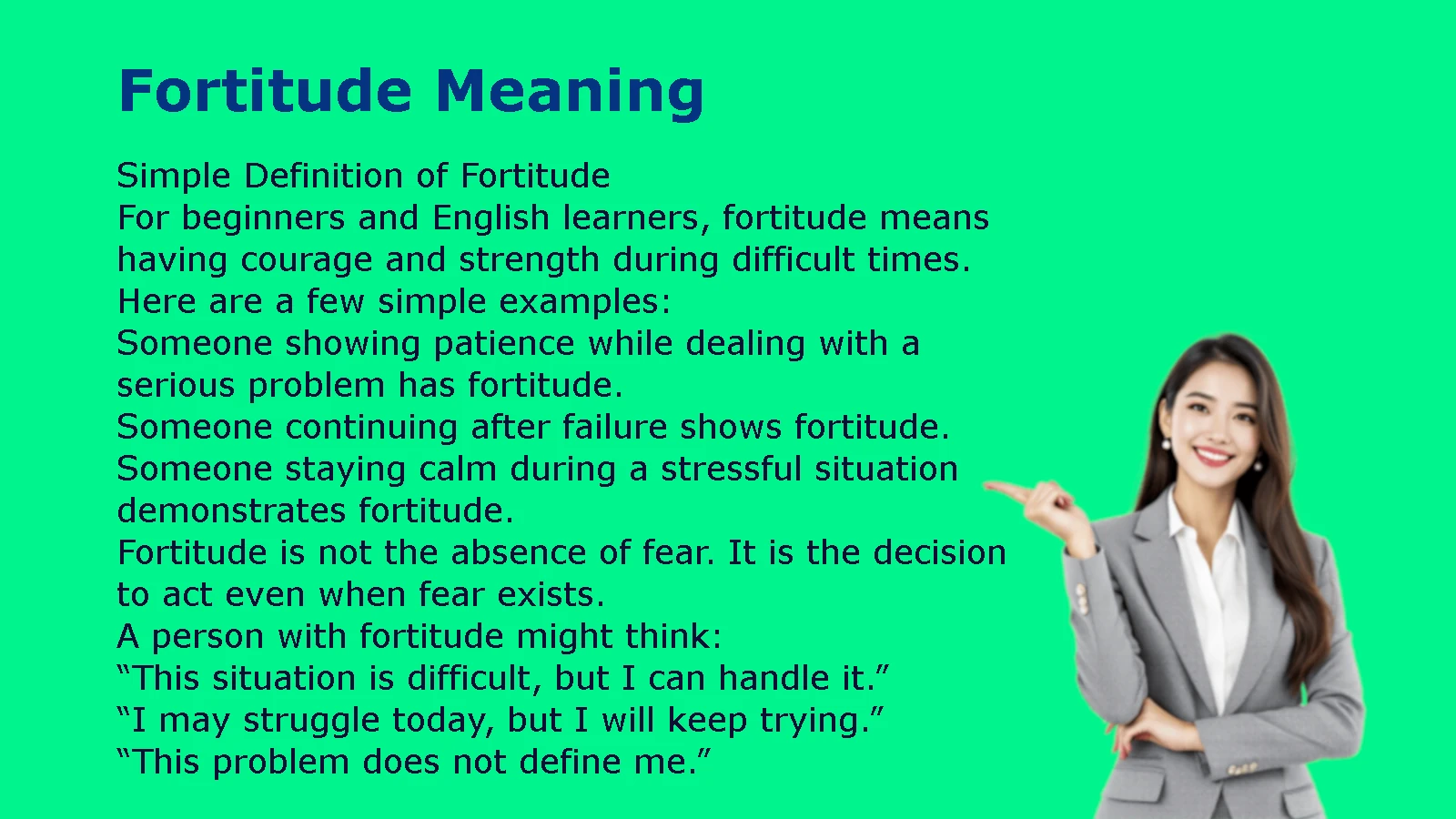
Simple Definition of Fortitude
For beginners and English learners, fortitude means having courage and strength during difficult times.
Here are a few simple examples:
- Someone showing patience while dealing with a serious problem has fortitude.
- Someone continuing after failure shows fortitude.
- Someone staying calm during a stressful situation demonstrates fortitude.
Fortitude is not the absence of fear. It is the decision to act even when fear exists.
A person with fortitude might think:
- “This situation is difficult, but I can handle it.”
- “I may struggle today, but I will keep trying.”
- “This problem does not define me.”
Fortitude Meaning in Different Contexts
The meaning of fortitude stays connected to strength and courage, but it can appear in different areas of life.
| Context | Fortitude Meaning |
| Personal life | Remaining emotionally strong during hardships |
| Education | Continuing to learn despite failure or challenges |
| Career | Handling pressure, setbacks, and uncertainty |
| Leadership | Staying calm and making decisions during crises |
| Health | Facing illness, recovery, or physical struggles with courage |
| Relationships | Managing emotional difficulties with patience |
Fortitude in Personal Challenges
Personal struggles often reveal the deepest examples of fortitude.
Someone who loses an important opportunity and chooses to improve instead of giving up demonstrates emotional strength. A person who experiences disappointment but continues pursuing their goals shows determination and courage.
For example:
A young entrepreneur launches a business that fails. Instead of seeing failure as the end, they study what went wrong, improve their approach, and try again. That ability to continue despite disappointment reflects fortitude.
Fortitude in the Workplace
Professional life often requires patience and mental strength.
Employees may face:
- Difficult projects
- Workplace pressure
- Career changes
- Unexpected failures
- Long periods of uncertainty
A worker who remains focused and productive during challenging situations shows fortitude.
Strong professionals are not people who never experience stress. They are people who manage stress effectively and continue performing their responsibilities.
Fortitude in Leadership
Great leaders often rely on fortitude because leadership involves difficult choices.
During a crisis, people look to leaders for stability. A leader with fortitude can:
- Stay calm under pressure
- Make thoughtful decisions
- Accept responsibility
- Support others during uncertainty
Without fortitude, leadership becomes reactive. With fortitude, leaders can guide others through difficult periods.
Fortitude Definition and Word Origin
The history behind the word fortitude reveals why it has always been associated with strength.
The word comes from the Latin term fortitudo, which means strength, firmness, or courage. It comes from another Latin word, fortis, meaning strong or brave.
The word eventually entered English through Old French and developed into the modern term fortitude.
The original idea behind fortitude was not simply physical strength. It represented a person’s ability to remain firm when facing challenges.
A person with fortitude had:
- A strong character
- Courage during hardship
- Control over emotions
- The ability to endure suffering
Over time, the word became strongly connected with moral strength and personal courage.
Fortitude as a Virtue
Throughout history, philosophers have considered fortitude an important human virtue.
Ancient thinkers believed that a good person needed more than intelligence or talent. They also needed the strength to act correctly during difficult situations.
Fortitude was often connected with:
- Courage
- Self control
- Responsibility
- Patience
- Moral strength
The idea was simple:
Knowing what is right is important, but having the strength to follow through during difficult moments is even more valuable.
For example, a person may know they should apologize after making a mistake. However, admitting fault requires humility and courage. That willingness to do the right thing despite discomfort reflects fortitude.
Fortitude Meaning With Examples
Understanding a word becomes easier when you see it in real situations.
Here are examples of fortitude in everyday life:
A Student Overcoming Failure
A student studies hard for an exam but receives a poor result. Instead of quitting, the student reviews mistakes, changes study habits, and prepares again.
The student demonstrates fortitude because they continue despite disappointment.
A Patient Facing Recovery
Someone recovering from an injury may experience pain, frustration, and slow progress. Continuing physical therapy and maintaining hope requires mental strength.
That persistence shows fortitude.
An Employee Handling Difficult Times
An employee faces company changes and increased responsibilities. Instead of becoming overwhelmed, they adapt, learn new skills, and continue improving.
That ability to stay strong under pressure demonstrates fortitude.
A Family Supporting Each Other
A family experiencing a difficult period chooses to remain supportive and hopeful. Their patience and emotional strength reflect fortitude.
Fortitude Example Sentences
Here are examples showing how to use fortitude correctly:
- “She showed incredible fortitude while recovering from her injury.”
- “The firefighter’s fortitude helped him remain calm during the emergency.”
- “Building a successful career requires patience, discipline, and fortitude.”
- “His fortitude allowed him to continue despite repeated failures.”
- “The community admired her fortitude during difficult times.”
Common Phrases With Fortitude
| Phrase | Meaning |
| Show fortitude | Demonstrate strength during difficulty |
| Great fortitude | A high level of courage and endurance |
| Mental fortitude | Emotional strength and resilience |
| Moral fortitude | Strength to follow principles despite pressure |
| Inner fortitude | Personal strength from within |
What Does Fortitude Mean in Simple Words?
In simple terms, fortitude means staying strong when life becomes challenging.
Think about learning a new skill. At first, mistakes feel frustrating. You might want to stop. However, continuing to practice requires patience and determination.
That small daily effort is a form of fortitude.
Fortitude appears in ordinary moments:
- Waking up and continuing after a difficult day
- Trying again after failure
- Staying patient during stressful situations
- Making the right choice even when it is uncomfortable
Fortitude does not always look dramatic. Sometimes it appears quietly through everyday choices.
A person showing fortitude may not receive attention or praise, but their strength helps them move forward.
Fortitude Synonyms and Related Words
Understanding the fortitude meaning becomes easier when you compare it with similar words. Many words describe strength and courage, but each one focuses on a slightly different quality.
Fortitude is a combination of courage, endurance, patience, and emotional strength. It describes the ability to remain firm when facing difficulty.
Here are some common fortitude synonyms and how they differ:
| Word | Meaning | How It Differs From Fortitude |
| Courage | The ability to face fear or danger | Focuses mainly on confronting fear |
| Resilience | The ability to recover after problems | Focuses on bouncing back after hardship |
| Strength | The power to handle challenges | A broader term that can include physical strength |
| Endurance | The ability to continue through difficulty | Focuses on lasting through hardship |
| Perseverance | Continuing toward a goal despite obstacles | Focuses on persistence and effort |
| Determination | A strong desire to achieve something | Focuses on commitment to a goal |
| Bravery | Acting despite fear | Often relates to immediate situations |
| Grit | Passion and persistence over a long period | Focuses on long term achievement |
Although these words overlap, fortitude stands out because it combines strength of character with the ability to endure difficult experiences.
For example:
- A firefighter entering a burning building shows courage.
- A person rebuilding their life after losing everything shows fortitude.
- An athlete practicing every day despite setbacks shows perseverance.
Fortitude vs Courage: What Is the Difference?
Many people use fortitude and courage as if they mean the same thing. While they are closely connected, they are not identical.
Courage focuses on facing fear.
Courage usually appears in moments when someone encounters danger, fear, or uncertainty.
Examples:
- Speaking in front of a large audience
- Defending someone who is being treated unfairly
- Trying something new despite fear
A courageous person acts even when they feel afraid.
Fortitude focuses on enduring hardship.
Fortitude goes beyond a single brave moment. It involves staying strong over time.
Examples:
- Recovering after a major failure
- Living through a difficult period
- Continuing a difficult journey without losing hope
A simple comparison:
| Courage | Fortitude |
| Facing fear | Enduring hardship |
| Often appears in a specific moment | Develops over time |
| Requires bravery | Requires patience and strength |
| “I will face this.” | “I will keep going through this.” |
A person may need courage to start a difficult journey, but they need fortitude to continue when the journey becomes exhausting.
Fortitude vs Resilience: Understanding the Difference
Fortitude and resilience are often confused because both involve handling challenges.
However, they describe different parts of overcoming difficulty.
Resilience means recovering after hardship.
A resilient person can experience failure, disappointment, or loss and eventually return stronger.
For example:
Someone loses their job, feels disappointed, then searches for new opportunities and rebuilds their career.
That is resilience.
Fortitude means remaining strong during hardship.
Fortitude focuses on the strength shown while facing the challenge.
For example:
A person who continues supporting their family during financial struggles demonstrates fortitude.
The difference:
| Fortitude | Resilience |
| Strength during hardship | Recovery after hardship |
| Focuses on endurance | Focuses on bouncing back |
| Helps people continue | Helps people rebuild |
Many people develop resilience because they first show fortitude. The strength needed to survive difficult moments often becomes the foundation for recovery.
Fortitude vs Strength: How Are They Different?
The word strength has a broad meaning. It can describe physical ability, emotional control, intelligence, or personal character.
For example:
- A weightlifter has physical strength.
- A calm person under pressure has emotional strength.
- A determined person has mental strength.
However, fortitude specifically refers to inner strength during difficult circumstances.
A person lifting a heavy object shows strength.
A person staying hopeful during a serious life challenge shows fortitude.
Fortitude is a type of strength that comes from character rather than muscles.
Fortitude vs Perseverance: Which One Is Stronger?
Perseverance and fortitude both involve continuing despite obstacles.
However, perseverance usually focuses on reaching a goal.
For example:
- An athlete training for years to win a competition shows perseverance.
- A person continuing through emotional pain after a difficult experience shows fortitude.
The difference:
| Perseverance | Fortitude |
| Goal focused | Challenge focused |
| Continuing effort | Remaining emotionally strong |
| Often connected with achievement | Often connected with adversity |
Someone can have perseverance while working toward success. Someone shows fortitude when they remain strong during suffering or uncertainty.
How to Use Fortitude in a Sentence
Using fortitude correctly helps you understand its meaning better.
The word is usually used as a noun. It describes a quality someone possesses or demonstrates.
Common Sentence Structures With Fortitude
Show fortitude
Meaning: To demonstrate courage and strength.
Example:
“The nurses showed remarkable fortitude while caring for patients during the crisis.”
Demonstrate fortitude
Meaning: To display inner strength through actions.
Example:
“She demonstrated great fortitude when rebuilding her life after the setback.”
Have fortitude
Meaning: To possess emotional strength.
Example:
“Successful leaders need the fortitude to make difficult decisions.”
With fortitude
Meaning: To face something with courage and strength.
Example:
“He accepted the challenge with fortitude and determination.”
Examples of Fortitude in Different Situations
Fortitude in School
Students experience many challenges:
- Difficult subjects
- Exam pressure
- Academic failure
- Fear of making mistakes
A student who keeps learning after receiving a poor grade shows fortitude.
For example:
A student struggles with mathematics throughout the year. Instead of deciding they are “bad at math,” they ask for help, practice daily, and improve.
The final improvement comes from fortitude.
Fortitude in Career Growth
Career success rarely happens without obstacles.
Professionals often experience:
- Rejection
- Failed projects
- Workplace stress
- Career changes
Someone with fortitude does not allow one setback to define their future.
For example:
An employee applies for several positions and receives multiple rejections. Instead of giving up, they improve their skills and continue applying.
That persistence reflects fortitude.
Fortitude in Personal Relationships
Relationships require emotional strength.
People often need fortitude when they:
- Forgive others
- Communicate during conflict
- Support loved ones through difficult periods
- Accept uncomfortable truths
Healthy relationships are not built because problems never happen. They grow because people have the strength to handle problems together.
Characteristics of Someone With Fortitude
People with strong fortitude often share certain qualities. These characteristics help them remain steady during difficult situations.
Emotional Control
People with fortitude understand their emotions without allowing emotions to control every decision.
This does not mean they ignore feelings.
Instead, they recognize emotions like fear, anger, or sadness and choose thoughtful actions.
For example:
A manager receives criticism about a project. Instead of reacting immediately, they listen, reflect, and make improvements.
That response requires emotional control.
Patience
Many challenges cannot be solved quickly.
Fortitude requires patience because growth often happens slowly.
A person recovering from an injury, learning a skill, or rebuilding after failure must accept that progress takes time.
Patience helps people continue when results do not appear immediately.
Self Discipline
Motivation changes from day to day. Discipline helps people continue even when motivation disappears.
Someone with fortitude:
- Keeps commitments
- Follows through on responsibilities
- Continues working toward improvement
Discipline turns good intentions into consistent actions.
Confidence
Fortitude grows when people believe they can handle challenges.
Confidence does not mean believing everything will be easy.
Instead, it means trusting yourself enough to face difficulties.
A confident person may say:
“This situation is hard, but I have handled difficult things before.”
Mental Resilience
Strong people are not those who never experience problems.
They are people who know how to respond when problems appear.
Mental resilience helps people:
- Adapt to change
- Learn from mistakes
- Maintain hope
- Recover emotionally
Why Is Fortitude Important?
Fortitude plays an important role in personal growth, relationships, leadership, and success.
Without fortitude, challenges can easily feel overwhelming. With fortitude, difficult situations become opportunities to learn and improve.
Fortitude Helps People Handle Adversity
Challenges are unavoidable.
Everyone experiences moments of uncertainty:
- Losing an opportunity
- Facing rejection
- Experiencing failure
- Managing unexpected changes
Fortitude provides the mental strength needed to continue.
It does not remove problems. Instead, it changes how people respond to them.
A person without fortitude may think:
“This problem is impossible.”
A person with fortitude may think:
“This problem is difficult, but I can find a way forward.”
Fortitude Builds Confidence
Every challenge overcome becomes proof of personal strength.
When people successfully handle difficult situations, they develop greater confidence.
For example:
Someone who once feared public speaking practices regularly and eventually gives a successful presentation.
That experience creates confidence because they learn:
“I can handle things that once scared me.”
Fortitude grows through action.
Fortitude Improves Decision Making
Stress can affect judgment.
People who lack emotional strength may make quick decisions based on fear or frustration.
Fortitude allows people to:
- Stay calm
- Consider options carefully
- Think long term
- Avoid unnecessary reactions
This quality is especially valuable for leaders, parents, and professionals.
Fortitude Supports Long Term Success
Many achievements require years of effort.
Successful people often experience:
- Failures
- Delays
- Mistakes
- Criticism
Fortitude helps them continue when progress feels slow.
A successful career, strong relationship, or personal achievement rarely comes from one perfect moment. It usually develops through many small acts of persistence.
How to Develop Fortitude in Daily Life
Fortitude is not something only a few people are born with. While some individuals may naturally handle pressure better than others, fortitude can be developed through practice, experience, and intentional choices.
Just like physical strength grows when you exercise your muscles, mental strength grows when you challenge and train your mind.
Developing fortitude does not mean searching for hardship. It means learning how to respond better when challenges naturally appear.
Here are practical ways to build stronger fortitude.
Accept That Challenges Are Part of Life
One of the first steps toward developing fortitude is accepting that difficulties are unavoidable.
Many people waste energy asking:
- “Why is this happening to me?”
- “Why can’t everything be easier?”
- “Why do problems keep appearing?”
These questions are understandable, but they often keep people focused on the problem instead of the solution.
A person with fortitude understands that challenges are part of growth.
A difficult situation can become:
- A lesson in patience
- A chance to develop new skills
- An opportunity to discover personal strength
For example, an athlete does not become stronger by avoiding difficult workouts. The challenge itself creates improvement.
The same idea applies to emotional strength.
Practice Self Discipline
Self discipline is one of the foundations of fortitude.
When life becomes difficult, motivation often disappears. Discipline helps people continue even when they do not feel inspired.
Small daily habits can strengthen mental toughness.
Examples include:
- Completing tasks even when they feel uncomfortable
- Maintaining healthy routines
- Keeping promises to yourself
- Practicing skills consistently
Consider a writer who wants to finish a book. Some days writing feels exciting. Other days it feels exhausting.
The writer who continues despite difficult days develops fortitude.
Small acts of discipline create stronger character over time.
Learn From Failure Instead of Fear
Failure often feels painful, but it can become one of the greatest teachers.
People with fortitude do not view failure as proof that they cannot succeed. They see it as information.
After a setback, they ask:
- What went wrong?
- What can I improve?
- What lesson can I take from this experience?
For example:
A business owner launches a product that fails. Instead of closing the business immediately, they study customer feedback, improve the product, and try again.
The failure becomes a stepping stone instead of a stopping point.
Build Emotional Awareness
Fortitude requires understanding your emotions.
Strong people still experience:
- Fear
- Frustration
- Sadness
- Doubt
- Stress
The difference is that they do not allow those emotions to completely control their actions.
Emotional awareness helps you recognize:
- What you are feeling
- Why you are feeling it
- How you can respond effectively
For example:
A person receives criticism at work. Their first reaction might be anger or disappointment. However, emotional awareness allows them to pause, understand the feedback, and decide how to improve.
That pause creates strength.
Focus on What You Can Control
Many difficult situations become overwhelming because people focus on things outside their control.
Fortitude grows when you separate:
Things You Can Control
- Your effort
- Your attitude
- Your choices
- Your preparation
- Your response
Things You Cannot Control
- Other people’s opinions
- Past mistakes
- Unexpected events
- Every possible outcome
A person with fortitude spends energy improving what they can influence rather than worrying endlessly about what they cannot change.
Develop a Growth Mindset
A growth mindset means believing that abilities can improve through effort and learning.
People with a fixed mindset may think:
- “I am not good at this.”
- “I always fail.”
- “I cannot change.”
A person with a growth mindset thinks:
- “I can improve with practice.”
- “This mistake teaches me something.”
- “This challenge can make me stronger.”
This mindset supports fortitude because it encourages persistence.
Surround Yourself With Strong Influences
The people around you can affect your mindset.
Positive and resilient people often encourage growth.
Spending time with people who demonstrate:
- Patience
- Responsibility
- Optimism
- Determination
can help strengthen your own approach to challenges.
For example:
A person training for a marathon often improves faster when surrounded by other committed runners. The same principle applies to emotional and mental strength.
Practice Gratitude During Difficult Times
Gratitude does not remove problems, but it helps create balance.
During challenging periods, focusing only on difficulties can make problems feel larger.
Gratitude helps people notice:
- Support from others
- Small victories
- Positive experiences
- Progress over time
Someone recovering from a setback may still struggle, but appreciating small improvements can provide motivation to continue.
Fortitude in Literature, History, and Real Life
Throughout history, many people have demonstrated remarkable fortitude. Their stories show how inner strength can influence individuals, communities, and entire societies.
Fortitude in Famous Stories
Many fictional characters represent fortitude because they continue despite difficult circumstances.
Frodo Baggins in The Lord of the Rings
Frodo faces an overwhelming mission that brings fear, exhaustion, and danger.
He does not succeed because the journey is easy. He succeeds because he continues despite the burden he carries.
His story represents:
- Endurance
- Responsibility
- Courage during hardship
Harry Potter in the Harry Potter Series
Harry repeatedly faces danger, loss, and uncertainty.
His strength comes from his willingness to continue fighting for what he believes is right.
His character demonstrates:
- Courage
- Loyalty
- Emotional strength
Historical Examples of Fortitude
Real people throughout history have shown extraordinary fortitude during difficult circumstances.
Nelson Mandela
Nelson Mandela spent 27 years imprisoned before becoming South Africa’s president.
His ability to maintain hope, patience, and commitment during decades of hardship represents a powerful example of fortitude.
His life demonstrates that inner strength can survive even extreme challenges.
Helen Keller
Helen Keller became blind and deaf as a young child.
Despite these challenges, she learned communication, became an author, and advocated for people with disabilities.
Her life shows that limitations do not have to define a person’s future.
Abraham Lincoln
Abraham Lincoln faced repeated failures before becoming president.
He experienced:
- Business failures
- Political defeats
- Personal struggles
However, he continued pursuing his goals.
His story reflects perseverance and fortitude.
Common Questions About Fortitude
Is Fortitude the Same as Courage?
No. Fortitude and courage are related, but they are not exactly the same.
Courage usually refers to facing fear in a specific situation.
Fortitude refers to maintaining strength through ongoing difficulty.
Example:
- Jumping into dangerous conditions to save someone shows courage.
- Continuing to rebuild your life after a major loss shows fortitude.
Is Fortitude a Personality Trait?
Fortitude can be considered both a personal quality and a skill.
Some people naturally remain calm under pressure, but anyone can strengthen fortitude through experience and practice.
It develops through:
- Facing challenges
- Learning from mistakes
- Building discipline
- Improving emotional control
Fortitude grows over time.
What Is the Opposite of Fortitude?
The opposite of fortitude includes qualities such as:
| Opposite Quality | Meaning |
| Cowardice | Avoiding challenges because of fear |
| Weakness | Lack of inner strength |
| Giving up | Stopping when difficulties appear |
| Hopelessness | Losing belief that improvement is possible |
| Avoidance | Refusing to face problems |
Everyone experiences moments of weakness. However, developing fortitude helps people recover and respond more effectively.
How Do You Show Fortitude?
People show fortitude through their actions.
Examples include:
- Continuing after failure
- Staying calm during pressure
- Facing uncomfortable situations
- Supporting others during difficult times
- Making difficult but responsible choices
- Remaining patient during slow progress
Fortitude often appears in quiet moments.
It may look like:
- Studying one more hour after struggling with a subject
- Trying again after rejection
- Staying hopeful during uncertainty
- Choosing kindness during conflict
Small actions can reveal great strength.
Why Fortitude Matters in Modern Life
Modern life brings unique challenges.
People often deal with:
- Rapid changes
- Career uncertainty
- Information overload
- Financial pressure
- Personal expectations
Fortitude helps people navigate these challenges without becoming overwhelmed.
In a world where circumstances can change quickly, the ability to adapt and remain strong is extremely valuable.
Fortitude vs Weakness: A Simple Comparison
| Fortitude | Weakness |
| Faces problems directly | Avoids challenges |
| Learns from mistakes | Blames circumstances |
| Controls reactions | Reacts impulsively |
| Continues despite difficulty | Gives up easily |
| Searches for solutions | Focuses only on problems |
Fortitude does not mean someone never struggles.
It means they refuse to let struggles control their future.
Final Thoughts: The True Fortitude Meaning
The fortitude meaning goes far beyond simply being brave. Fortitude represents the inner strength that helps people face challenges with courage, patience, and determination.
A person with fortitude may experience fear, disappointment, or uncertainty, but they continue moving forward.
It is the strength to:
- Keep trying after failure
- Stay calm during pressure
- Accept challenges as opportunities for growth
- Make difficult choices with confidence
- Remain hopeful during difficult times
Fortitude is built through everyday actions. It develops when people choose patience over frustration, effort over excuses, and growth over giving up.
Life will always bring challenges, but fortitude helps people meet those challenges with a stronger mind and a steadier heart.