
Have you ever seen the word “concurrent” in a sentence and wondered exactly what it means? While Concurrent Meaning may sound technical at first, the word simply describes things that happen at the same time or overlap in time.
Concurrent is an adjective used to describe events, actions, or situations that occur simultaneously or during the same period. It is common in everyday English as well as in business, technology, law, education, and other professional contexts.
Examples:
- The two meetings were concurrent, so I had to choose one.
- She held two concurrent positions at the company.
The confusion is understandable. People often search for what does concurrent mean, concurrent meaning in English, concurrent meaning in a sentence, or concurrent meaning in law because the word can have slightly different uses depending on the context. And here’s the interesting part: concurrent does not always mean that two things begin and end at exactly the same moment. They can simply overlap for a period of time.
In this guide, you’ll learn the complete Concurrent Meaning, its definition, pronunciation, part of speech, synonyms, antonyms, correct usage, and examples in sentences. You’ll also discover how concurrent is used in different contexts and the difference between concurrent, simultaneous, consecutive, and concurrent vs. sequential.
Concurrent Meaning in Simple Words
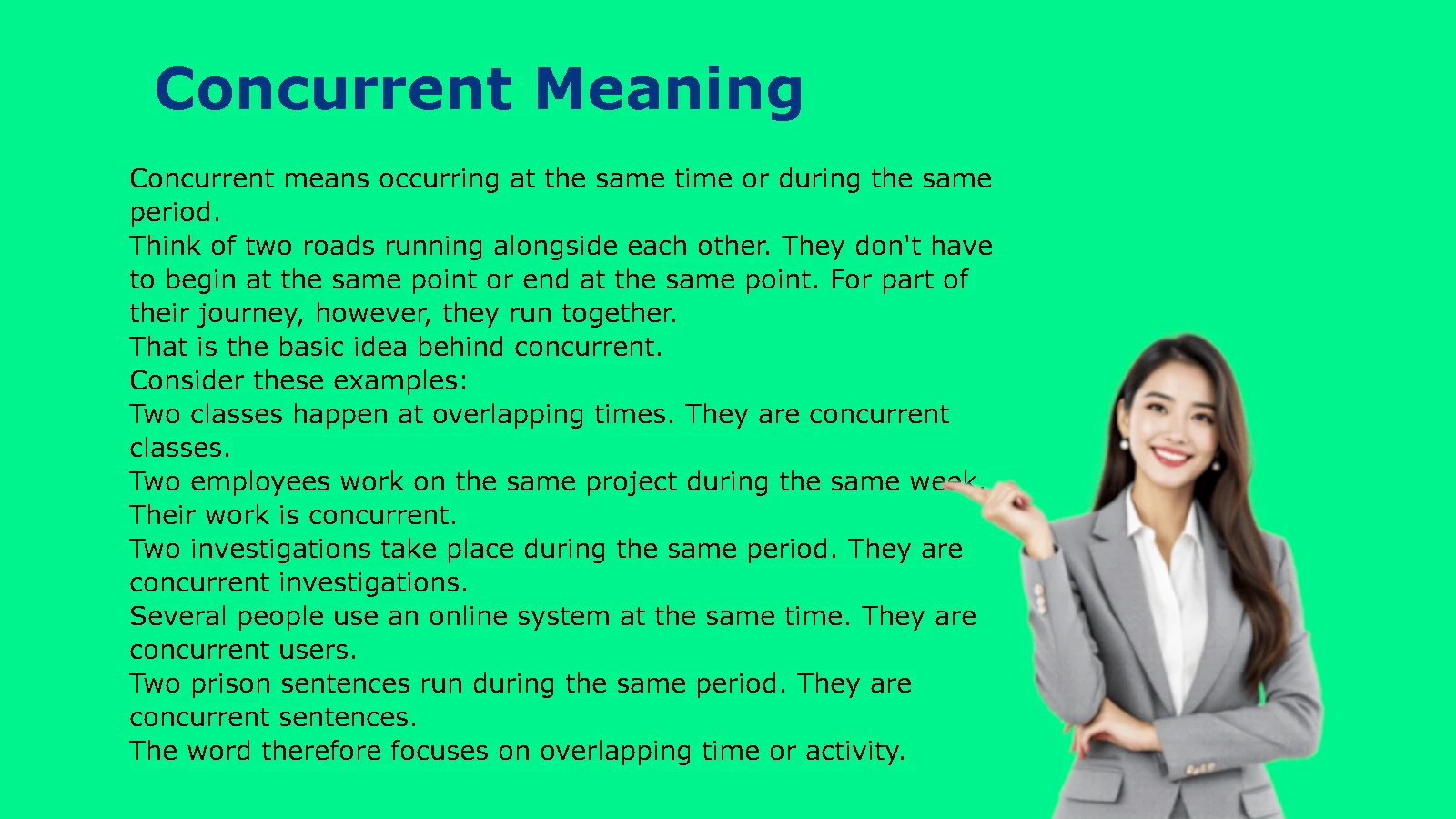
Concurrent means occurring at the same time or during the same period.
Think of two roads running alongside each other. They don’t have to begin at the same point or end at the same point. For part of their journey, however, they run together.
That is the basic idea behind concurrent.
Consider these examples:
- Two classes happen at overlapping times. They are concurrent classes.
- Two employees work on the same project during the same week. Their work is concurrent.
- Two investigations take place during the same period. They are concurrent investigations.
- Several people use an online system at the same time. They are concurrent users.
- Two prison sentences run during the same period. They are concurrent sentences.
The word therefore focuses on overlapping time or activity.
What Does Concurrent Mean?
The most useful definition is:
Concurrent: happening, existing, operating, or continuing at the same time or during an overlapping period.
Here’s a quick reference:
| Word | Meaning |
| Concurrent | Happening or existing at the same time |
| Concurrently | Happening at the same time |
| Concurrency | The state or condition of things happening together |
| Consecutive | Following one after another |
| Simultaneous | Happening at exactly the same time |
The distinction between concurrent and simultaneous matters because the words overlap but don’t always communicate precisely the same idea.
Concurrent Definition and Part of Speech
Concurrent is primarily an adjective. You use it to describe a person, event, activity, process, condition, sentence, or other noun that exists or occurs at the same time as something else.
For example:
- concurrent events
- concurrent activities
- concurrent projects
- concurrent sessions
- concurrent processes
- concurrent users
- concurrent sentences
- concurrent conditions
In each case, concurrent describes a relationship in time.
Concurrent as an Adjective
Here are several natural examples:
The company launched two concurrent marketing campaigns.
Several concurrent sessions were available at the conference.
The researchers conducted concurrent studies.
The application supports thousands of concurrent users.
The adjective usually appears directly before the noun. You can also use concurrent with when you want to identify the other activity.
For example:
The training program ran concurrently with the regular classes.
Cambridge’s Business English Dictionary also uses the construction “concurrent with” when describing conditions or activities that occur at the same time.
Concurrent Pronunciation
In American English, concurrent is pronounced approximately:
/kənˈkɝː.ənt/
The stress falls on the second syllable:
con-CUR-rent
The first part sounds relatively light, while the middle syllable receives the main emphasis.
The related adverb concurrently follows the same basic pronunciation pattern:
con-CUR-rent-ly
Cambridge lists both American and British pronunciations for concurrent and concurrently.
Concurrent Etymology and Word Origin
The history of concurrent helps explain its meaning.
The word comes through Old French and ultimately from the Latin concurrere, which meant “to run together.” The Latin verb combines elements associated with “together” and “run.” Over time, the idea of things “running together” developed into the figurative sense of things happening or operating together.
That original image is surprisingly useful.
Imagine two streams flowing alongside each other. They don’t need to occupy the exact same point at every second. They simply move together for a period.
Likewise, two concurrent activities overlap in time.
The English word dates back to the late 14th century. Historical uses developed around ideas such as acting together, contributing to the same result, and happening at the same time.
How to Use Concurrent in a Sentence
The easiest way to understand a word is to see it working in real sentences.
Concurrent for Events
Use concurrent when multiple events take place during the same period.
The university held several concurrent events during orientation week.
This doesn’t necessarily mean every event began at 9:00 a.m. and ended at 11:00 a.m. It means their schedules overlapped.
Another example:
The city hosted two concurrent festivals downtown.
The festivals may have different schedules. As long as they take place during the same period, concurrent can describe them.
Concurrent for Activities
You can also use the word for actions or responsibilities that happen together.
She managed three concurrent projects.
This sentence tells you that the projects were active during the same period. It doesn’t tell you that she worked on all three at precisely 2:00 p.m.
That distinction makes concurrent especially useful in professional writing.
Concurrent for Conditions
The word can describe circumstances that exist at the same time.
The business faced several concurrent challenges.
Here, the challenges didn’t necessarily begin together. The point is that they existed together and affected the business during the same period.
Concurrent for Processes
In technical contexts, concurrent often describes processes that overlap.
The software handles multiple concurrent processes.
This use becomes particularly important in computing, where concurrency describes how multiple tasks can make progress during overlapping periods.
Concurrent Examples
The following examples show how the meaning changes slightly depending on the situation:
| Example sentence | What concurrent means |
| The school offered concurrent classes. | The classes took place during overlapping periods. |
| She worked on two concurrent projects. | Both projects were active at the same time. |
| The company faced concurrent problems. | Several problems existed together. |
| The conference offered concurrent sessions. | Multiple sessions were scheduled during overlapping periods. |
| The system supports concurrent users. | Multiple users can use the system during the same period. |
| The court imposed concurrent sentences. | The sentences run during the same period. |
| The researchers conducted concurrent studies. | The studies took place during the same period. |
| The two campaigns ran concurrently. | Both campaigns operated at the same time. |
Notice something important: concurrent doesn’t automatically mean identical timing.
If Project A runs from January through June and Project B runs from March through September, the projects are concurrent from March through June.
That overlap is enough.
Concurrent Meaning in Different Contexts
The word appears in many fields because overlapping activities are common in almost every part of life.
Concurrent Meaning in Everyday English
In everyday English, concurrent simply describes things that happen at the same time or during overlapping periods.
For example:
The two concerts were concurrent, so we had to choose one.
Or:
The renovation and landscaping work were concurrent.
In casual conversation, however, people often choose the simpler phrase “at the same time.”
Instead of:
We had several concurrent activities.
You might naturally say:
We had several activities happening at the same time.
Both sentences work. The first sounds more formal and compact.
Concurrent Meaning in Business
Business writing frequently uses concurrent because companies often manage multiple activities at once.
You might encounter:
- concurrent projects
- concurrent negotiations
- concurrent campaigns
- concurrent deadlines
- concurrent contracts
- concurrent operations
- concurrent users
- concurrent sessions
For example:
The marketing department ran two concurrent campaigns.
The sentence tells you that both campaigns were active during the same period.
Business English also uses concurrent conditions. Cambridge gives the example of payment and delivery as conditions that must occur together.
This meaning is more precise than simply saying two things are related. The emphasis falls on their timing.
Concurrent Meaning in Law
Concurrent has a particularly important meaning in legal contexts.
A concurrent sentence is a sentence that runs at the same time as another sentence rather than one after another.
Suppose a court imposes two 10 year sentences and orders them to run concurrently. The sentences overlap instead of adding 20 years of sequential time in the simple sense.
By contrast, consecutive sentences run one after another.
Cambridge gives examples of people serving concurrent sentences and contrasts the concept with sentences that run consecutively.
However, legal sentencing rules can vary by jurisdiction and by the specific court order. You shouldn’t assume that every pair of sentences automatically runs concurrently.
The key vocabulary distinction is:
| Legal term | Basic meaning |
| Concurrent sentences | Sentences run during the same period |
| Consecutive sentences | Sentences run one after another |
This is one of the clearest real world examples of why concurrent and consecutive should not be confused.
Concurrent Meaning in Computing
Technology gives concurrent a more specialized meaning.
In computing, concurrency refers to multiple tasks making progress during overlapping periods. A concurrent system may manage several tasks even when the hardware doesn’t execute every task at precisely the same instant.
For example, an application might:
- receive a user’s request
- process another request
- wait for a database response
- handle a third request
These activities can overlap.
That’s why you may see phrases such as:
- concurrent processing
- concurrent execution
- concurrent programming
- concurrent requests
- concurrent users
- concurrent connections
- concurrent tasks
Cambridge’s Business English Dictionary specifically uses concurrent users for people using a computer system at the same time.
Concurrent vs. Parallel in Computing
This distinction deserves attention.
Concurrency concerns multiple tasks that overlap in progress. Parallelism focuses on tasks actually executing at the same time, typically through multiple processing resources.
A simple analogy helps.
Imagine one chef preparing three dishes. The chef might chop vegetables for one dish, put something in the oven, then work on another dish while the first cooks.
That’s concurrent work.
Now imagine three chefs preparing the three dishes at the same moment.
That’s closer to parallel work.
In real computing systems, the two concepts can work together. A system can manage concurrent tasks and execute some of them in parallel.
Concurrent Meaning in Education
Education also uses the word in several practical ways.
You might hear about:
- concurrent courses
- concurrent enrollment
- concurrent classes
- concurrent programs
If two courses run during the same academic period, you can describe them as concurrent courses.
Some educational programs use concurrent enrollment as a formal term for students enrolled in more than one educational program or institution at the same time. The exact meaning depends on the institution and program rules.
Concurrent Meaning in Science
Scientific writing often uses concurrent to describe observations, conditions, forces, or processes that occur together.
For example:
The researchers observed several concurrent changes in temperature and pressure.
In physics, a concurrent force can refer to forces whose lines of action meet at a common point. Cambridge’s American Dictionary also lists this specialized physics use.
That is a good reminder that context matters. A technical definition may add precision that the everyday definition doesn’t capture.
Concurrent vs. Simultaneous
Concurrent and simultaneous are close synonyms, but they aren’t perfect substitutes.
What Is the Difference Between Concurrent and Simultaneous?
Concurrent emphasizes overlapping periods.
Simultaneous more strongly emphasizes the same moment.
Consider these examples:
The two projects were concurrent.
This tells you that the projects overlapped.
The two alarms sounded simultaneously.
This strongly suggests that both alarms sounded at the same moment.
The difference becomes clearer with a timeline:
Concurrent
Project A: |———————-|
Project B: |———————-|
Overlapping period
Simultaneous
Event A: X
Event B: X
Same moment
Cambridge lists simultaneous and coincident among the synonyms associated with concurrent.
Still, context determines which word sounds most precise.
When Should You Use Concurrent Instead of Simultaneous?
Choose concurrent when the overlap itself matters.
For example:
The company ran two concurrent investigations.
Choose simultaneous when you want to stress that things occurred at exactly the same moment.
Both alarms went off simultaneously.
In short:
Concurrent = overlapping in time.
Simultaneous = occurring at the same moment.
Concurrent vs. Consecutive
This is one of the most important word comparisons.
Concurrent means things happen during the same period.
Consecutive means things follow one after another.
Consider a work schedule.
Concurrent
Task A: |—————-|
Task B: |—————-|
The tasks overlap.
Consecutive
Task A: |—————-|
Task B: |—————-|
The second task follows the first.
A simple example makes the distinction even clearer:
I worked on two concurrent projects.
Both projects were active during overlapping periods.
I completed two consecutive projects.
One project followed the other.
The same distinction appears in law, where concurrent sentences run together while consecutive sentences run one after another.
Concurrent vs. Coinciding
Coinciding also refers to things occurring at the same time.
For example:
The conference coincided with the annual trade show.
This means the two events happened during the same period.
Concurrent tends to describe the overlapping timing directly:
The conference and trade show were concurrent.
Coincide can also carry a sense of two events happening together unexpectedly or lining up with one another.
Cambridge lists coincident as a formal synonym of concurrent.
The words overlap heavily, so your choice often depends on sentence structure and tone.
Concurrent vs. Coexisting
The difference between concurrent and coexisting is subtle but useful.
Concurrent emphasizes time.
Coexisting emphasizes existence together.
Compare:
The two investigations were concurrent.
The investigations happened during the same period.
The two theories coexisted.
The theories existed at the same time, perhaps within the same field of thought.
You can therefore think of the distinction this way:
- Concurrent: together in time
- Coexisting: existing together
The two ideas can overlap, but they aren’t interchangeable in every sentence.
Synonyms for Concurrent
Several words can replace concurrent, although each carries its own shade of meaning.
Common Synonyms
- simultaneous
- coincident
- coinciding
- overlapping
- contemporaneous
- coexisting
- parallel
- occurring together
- happening at the same time
- running together
Which Synonym Works Best?
| Synonym | Best use |
| Simultaneous | Events happening at the same moment |
| Coincident | Things occurring at the same time |
| Coinciding | Events that happen during the same period |
| Overlapping | Periods or activities that partially intersect |
| Contemporaneous | People, events, or things existing in the same period |
| Parallel | Activities or processes progressing alongside each other |
| Coexisting | Things existing together |
| At the same time | Simple, conversational writing |
Don’t treat a synonym list as a word swapping machine. The most accurate choice depends on what you want the sentence to emphasize.
Antonyms of Concurrent
The most useful opposites include:
- consecutive
- successive
- sequential
- separate
- later
- subsequent
The strongest direct contrast in many contexts is consecutive.
For example:
The sentences run concurrently.
versus:
The sentences run consecutively.
Likewise:
The tasks were concurrent.
versus:
The tasks were sequential.
The second version says that one task follows another according to an order.
Common Phrases With Concurrent
You’ll encounter concurrent in several established expressions.
Concurrent Events
Events that occur during overlapping periods.
The city hosted several concurrent events.
Concurrent Sessions
Sessions scheduled at overlapping times, especially at conferences or training programs.
The conference offered four concurrent sessions.
Concurrent Projects
Projects that remain active during the same period.
The team is managing three concurrent projects.
Concurrent Processes
Processes that overlap in their execution or progress.
The application manages multiple concurrent processes.
Concurrent Users
Users accessing a system during the same period.
The platform can support thousands of concurrent users.
Concurrent Sentences
Legal sentences that run during the same period.
The judge ordered the sentences to run concurrently.
Concurrent Jurisdiction
A legal situation in which more than one court or authority may have jurisdiction over a matter. The legal details depend on the applicable jurisdiction.
The term has a long history in legal English. Etymonline dates the legal use of concurrent jurisdiction to the 18th century.
Concurrent Enrollment
Enrollment in more than one educational program, course, or institution at the same time, depending on the specific educational system.
Concurrent Execution
In computing, execution of multiple tasks in an overlapping period.
Common Mistakes With Concurrent
The word looks straightforward, but a few mistakes appear repeatedly.
Mistake: Assuming Concurrent Means Exactly Simultaneous
This is probably the most important mistake.
Two activities can be concurrent even when their start and end times differ.
For example:
Project A: January to June
Project B: March to August
The projects overlap from March through June. Therefore, they can be described as concurrent.
They aren’t necessarily simultaneous in the strict sense.
Mistake: Confusing Concurrent With Consecutive
Remember:
Concurrent = together.
Consecutive = one after another.
A quick memory trick is to picture two lanes of traffic. Concurrent activities move alongside each other. Consecutive activities take turns.
Mistake: Confusing Concurrent With Contemporary
These words look similar, but they aren’t identical.
Concurrent means happening or existing at the same time.
Contemporary generally means belonging to the same period, especially when discussing people, art, culture, literature, or history.
For example:
Shakespeare and Cervantes were contemporary writers.
That doesn’t mean they were physically doing something at the same moment. It means they lived and worked during overlapping historical periods.
Mistake: Assuming Concurrent and Parallel Always Mean the Same Thing
In ordinary language, parallel can describe activities happening alongside each other.
In technical contexts, however, concurrency and parallelism have more precise meanings.
A concurrent system can manage multiple tasks whose progress overlaps. Parallel execution means multiple tasks actually execute at the same time using separate resources.
Context matters.
Concurrent vs. Concurrently
The difference is grammatical.
Concurrent is an adjective.
Concurrently is an adverb.
Compare:
The projects are concurrent.
The teams worked concurrently.
The first sentence uses concurrent to describe the projects.
The second uses concurrently to describe how the teams worked.
Cambridge defines concurrently as an adverb meaning “at the same time.”
Examples of Concurrently
The two programs ran concurrently.
She managed both assignments concurrently.
The company launched the products concurrently.
Several investigations were conducted concurrently.
When you want to describe how an action happens, concurrently is usually the correct form.
Word Forms Related to Concurrent
The word belongs to a small family of related terms.
| Word | Part of speech | Meaning |
| Concurrent | Adjective | Happening or existing at the same time |
| Concurrently | Adverb | At the same time |
| Concurrency | Noun | The state or concept of things occurring together |
| Concur | Verb | To agree; also, in some contexts, to happen at the same time |
| Concurrence | Noun | Agreement or the occurrence of things at the same time |
One word deserves special attention: concur.
In modern English, concur most commonly means to agree or have the same opinion. Cambridge also records a less common sense in which events concur when they happen at the same time.
For example:
I concur with your assessment.
Here, concur means agree.
But:
Several circumstances concurred to produce the result.
Here, the word can express the idea of circumstances coming together.
What Does Concurrency Mean?
Concurrency is the noun form related to the idea of things occurring together.
In general English, it can refer to the simultaneous or overlapping occurrence of events.
Cambridge also lists concurrency as a noun meaning a situation in which things or events happen or exist at the same time.
In computing, however, concurrency becomes a major technical concept involving the management and progress of multiple tasks.
Is Concurrent a Formal Word?
Yes. Concurrent is a standard English word, but it often sounds more formal than “at the same time.”
Compare:
Formal:
The organization conducted several concurrent investigations.
More conversational:
The organization conducted several investigations at the same time.
Both communicate the basic idea.
The choice depends on your audience.
Use concurrent when you want a concise and precise term, especially in:
- Academic writing
- Business writing
- Legal writing
- Technical documentation
- Research papers
- Formal reports
For casual conversation, at the same time may sound more natural.
That’s not because concurrent is overly complicated. It simply belongs to a more formal register.
How to Remember the Meaning of Concurrent
A simple mental image can make the word stick.
Think of two trains traveling along tracks that run beside each other.
They don’t necessarily leave the station at the same time. They don’t necessarily reach the end at the same time. During part of the journey, however, they travel alongside each other.
That’s concurrent.
You can also remember the Latin origin. The word ultimately comes from concurrere, meaning “to run together.”
So when you see concurrent, think:
“Running together in time.”
Case Study: Understanding Concurrent Projects
Imagine a marketing team has three projects:
| Project | Start | End |
| Website redesign | January | April |
| Email campaign | February | May |
| Product launch | March | July |
All three projects are concurrent during March and April.
They don’t share exactly the same schedule. Their timelines overlap.
This example shows why concurrent is more useful than simply saying “simultaneous.”
The word captures the idea of overlapping activity, not necessarily identical start and finish times.
Now imagine the same team finishes the website redesign before beginning the email campaign.
That arrangement is consecutive, not concurrent.
Case Study: Concurrent vs. Consecutive Sentences
Legal language provides another clear example.
Suppose a court imposes two sentences and orders them to run concurrently. The sentences operate during the same period.
If the court instead orders them to run consecutively, one sentence follows the other.
A simplified timeline looks like this:
Concurrent sentences
Sentence A: |———————-|
Sentence B: |———————-|
Consecutive sentences
Sentence A: |———————-|
Sentence B: |———————-|
The vocabulary tells you how the sentences relate in time.
Actual sentencing consequences depend on the court’s order and applicable law, so the terms shouldn’t be used to make assumptions about a particular case.
Case Study: Concurrent Users in Technology
Imagine an online store has 5,000 people browsing products during a busy sale.
Those users are concurrent users because they’re accessing the system during the same period.
The phrase doesn’t necessarily mean that every user sends a request at the exact same millisecond. Instead, it describes the system’s ability to deal with many users whose activity overlaps.
That distinction matters when discussing software capacity.
A website might process one user’s request while another user’s request waits for a database response. The system can still manage both activities concurrently.
This is why concurrency has become such an important concept in modern computing.
Quick Guide: When Should You Use Concurrent?
Use concurrent when:
- Two or more things happen during overlapping periods.
- Multiple projects are active at the same time.
- Several events occur during the same period.
- Different processes make progress during overlapping periods.
- Legal sentences run during the same period.
- Multiple users access a system during the same period.
- You want a concise formal alternative to “happening at the same time.”
Be careful when:
- You mean that events occur at exactly the same instant. Simultaneous may be more precise.
- You mean that events happen one after another. Use consecutive or sequential.
- You mean that people or things belong to the same historical period. Contemporary may be more appropriate.
- You’re discussing technical computing concepts. Distinguish concurrency from parallelism.
Frequently Asked Questions About Concurrent Meaning
What does concurrent mean in simple terms?
Concurrent means happening or existing at the same time or during the same period. Two concurrent activities overlap in time.
What is an example of concurrent?
“The company worked on two concurrent projects.”
This means both projects were active during the same period.
Does concurrent mean at the same time?
Yes, but with an important nuance. Concurrent can describe things that happen during overlapping periods. They don’t necessarily need to begin and end at exactly the same moment.
What is the opposite of concurrent?
The most useful opposite depends on context. Consecutive, successive, and sequential can contrast with concurrent when activities happen one after another.
What is another word for concurrent?
Common alternatives include simultaneous, coincident, coinciding, overlapping, and contemporaneous. However, these words don’t work as perfect substitutes in every sentence.
What is the difference between concurrent and simultaneous?
Concurrent emphasizes overlapping time periods. Simultaneous more strongly emphasizes events happening at the same moment.
What does concurrent mean in law?
In law, concurrent sentences generally run during the same period. They contrast with consecutive sentences, which run one after another. The exact legal effect depends on the applicable law and court order.
What does concurrent mean in computing?
In computing, concurrent describes tasks whose progress overlaps. Multiple tasks can be managed during the same period even when they aren’t all executing at the exact same instant.
Is concurrent a positive or negative word?
Neither. Concurrent is neutral. It simply describes a timing or relationship between events, activities, conditions, or processes.
What is the noun form of concurrent?
The main noun is concurrency. It refers to the state or concept of things happening or existing together. Concurrence is another related noun with meanings that include agreement and simultaneous occurrence.
What does concurrently mean?
Concurrently means at the same time or during an overlapping period.
For example:
“The teams worked concurrently.”
The teams worked during the same period.
Concurrent Meaning at a Glance
| Feature | Answer |
| Word | Concurrent |
| Part of speech | Adjective |
| Concurrent meaning | Happening or existing at the same time or during the same period |
| Simple synonym | At the same time |
| Common synonym | Simultaneous |
| Important opposite | Consecutive |
| Adverb | Concurrently |
| Noun | Concurrency |
| Related noun | Concurrence |
| Common fields | Business, law, computing, education, science |
| Core idea | Overlap in time |
Final Takeaway on Concurrent Meaning
The concurrent meaning is straightforward once you focus on the idea of overlap.
When two or more things are concurrent, they happen or exist during the same period. They don’t necessarily begin or end together. That’s the key distinction.
Remember these three words together:
- Concurrent: happening during the same period
- Simultaneous: happening at the same moment
- Consecutive: happening one after another
So if two projects overlap, they’re concurrent. If two alarms sound at exactly the same moment, they’re simultaneous. If one task follows another, they’re consecutive.
The word also takes on useful specialized meanings in law, business, science, and computing. Once you understand its central idea of things “running together” in time, those uses become much easier to recognize and apply.
In one sentence: Concurrent means happening or existing at the same time or during an overlapping period.