
What Is the Compile Meaning?
Compile means to collect, gather, or arrange information, data, or materials into a single organized document or list. In computing, it also means converting source code into machine-readable code so a computer can execute it.
Examples:
- She compiled a report using data from several departments.
- The programmer compiled the code before running the application.
The challenge is that many people aren’t sure what compile means, how to use compile in a sentence, or when it’s the right word to choose instead of similar terms like collect, gather, or assemble. But here’s the good news: once you understand its core meaning, using it correctly becomes surprisingly simple.
In this guide, you’ll discover the Compile Meaning, compile definition, how to pronounce compile, compile examples, and compile in a sentence. You’ll also learn the difference between compile and related words, explore its use in computer programming, and pick up practical tips to use it confidently in both writing and conversation.
What Does Compile Mean?
The word compile is a verb. Its primary meaning is to gather information, materials, or data from different sources and arrange them into a single organized work.
Unlike simply collecting something, compiling also involves sorting, editing, or organizing the material so it becomes useful.
Simple Definition
Compile means to collect information, documents, facts, or materials from various sources and organize them into one complete work.
In computing, compile means to convert source code written by a programmer into machine-readable code that a computer can execute.
Quick Definition Table
| Word | Meaning |
| Compile | To collect and organize information into one complete work. In programming, to convert source code into executable machine code. |
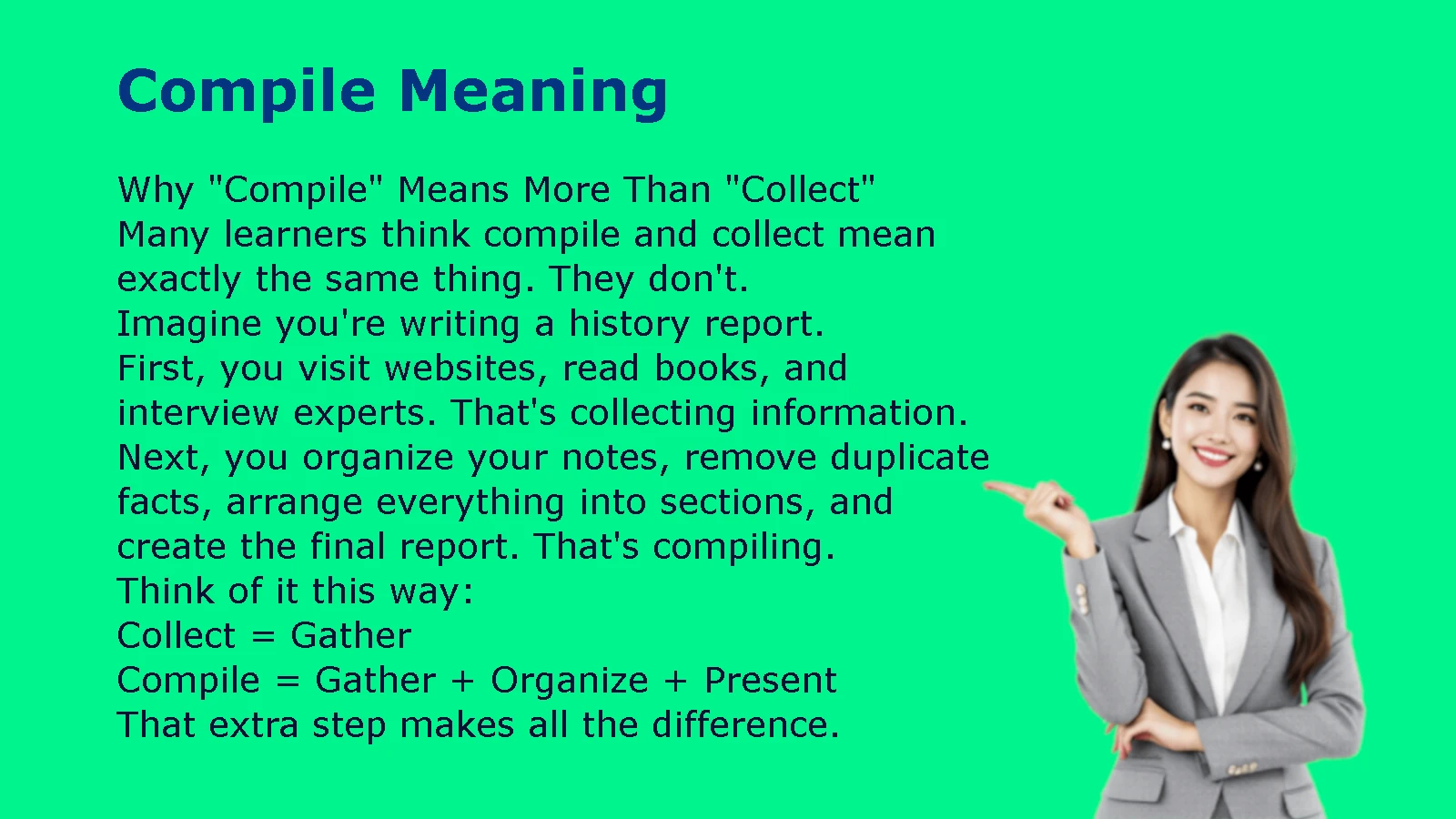
Why “Compile” Means More Than “Collect”
Many learners think compile and collect mean exactly the same thing. They don’t.
Imagine you’re writing a history report.
First, you visit websites, read books, and interview experts. That’s collecting information.
Next, you organize your notes, remove duplicate facts, arrange everything into sections, and create the final report. That’s compiling.
Think of it this way:
- Collect = Gather
- Compile = Gather + Organize + Present
That extra step makes all the difference.
How to Pronounce Compile
Correct pronunciation helps you sound more confident in conversations, presentations, and professional settings.
American English
/kəmˈpaɪl/
Sounds like:
kuhm-PILE
The second syllable receives the strongest stress.
British English
The pronunciation is almost identical:
/kəmˈpaɪl/
Syllable Breakdown
Com • pile
- First syllable: com
- Second syllable: pile
Pronunciation Tip
Think of the word pile because it rhymes with the second half of compile.
Say it slowly:
kuhm + pile
Then speed it up naturally.
Part of Speech
Compile functions as a verb.
Verb Forms
| Form | Example |
| Base Verb | compile |
| Third-Person Singular | compiles |
| Present Participle | compiling |
| Past Tense | compiled |
| Past Participle | compiled |
Examples
- I compile weekly sales reports.
- She compiles customer feedback every month.
- They are compiling research data.
- We compiled the final document yesterday.
- The information has been compiled successfully.
Origin and Etymology of Compile
Understanding where a word comes from often makes its modern meaning easier to remember.
The word compile entered English through Old French and ultimately comes from the Latin verb compilare.
Originally, the Latin word carried the idea of gathering together, although in some historical contexts it also referred to taking or collecting things from different places.
Over time, English speakers began using compile to describe gathering written materials, documents, facts, and information into a single organized work.
Today, the word appears in many fields, including:
- Education
- Journalism
- Publishing
- Business
- Government
- Scientific research
- Software development
Its central idea has remained surprisingly consistent: bringing many pieces together into one organized whole.
Different Meanings of Compile
Although the core meaning stays the same, the word changes slightly depending on the context.
Let’s explore the most common uses.
Compile Meaning in Everyday English
In everyday conversations, compile usually refers to organizing information from several sources.
People compile:
- Shopping lists
- Recipe collections
- Music playlists
- Address books
- Travel guides
- Family histories
- Event schedules
The emphasis isn’t simply on gathering items. Instead, the goal is to organize everything into a useful format.
Everyday Examples
- I compiled a list of the best restaurants in town.
- She compiled recipes from her grandmother’s notebooks.
- They compiled customer reviews before launching the product.
- We compiled everyone’s vacation photos into one album.
- He compiled newspaper articles about the local election.
Notice that each example involves collecting and organizing.
Common Situations Where People Compile Information
| Situation | What Gets Compiled |
| Planning a trip | Hotel options, flights, attractions |
| Buying a house | Property listings and prices |
| Wedding planning | Guest lists and budgets |
| Job hunting | Company research and applications |
| Writing a book | Notes, interviews, references |
| Personal finance | Expenses and income records |
Everyday Scenario
Imagine you’re organizing a family reunion.
You don’t simply collect phone numbers.
You organize:
- Contact information
- Meal preferences
- Travel schedules
- Seating arrangements
- Hotel reservations
By the end, you’ve compiled a complete event plan.
Compile Meaning in Academic Writing
Students, teachers, and researchers use compile almost every day.
Research often involves gathering information from many reliable sources before organizing it into a paper or report.
For example, a student writing about climate change may:
- Read journal articles
- Examine government reports
- Analyze survey data
- Compare scientific studies
After reviewing everything, the student compiles the information into one research paper.
Academic Examples
- The researchers compiled data from twenty hospitals.
- She compiled references for her dissertation.
- Students compiled evidence from several historical documents.
- The professor compiled reading materials for the course.
- Scientists compiled years of weather records.
What Students Commonly Compile
| Academic Task | Compiled Material |
| Research paper | Sources and evidence |
| Thesis | Academic references |
| Literature review | Published studies |
| Group project | Team findings |
| Science report | Experimental results |
| Survey analysis | Participant responses |
Why Compilation Matters in Research
Academic work depends on accuracy.
Researchers don’t rely on a single source. Instead, they compile evidence from multiple trusted references to build stronger conclusions.
That process improves:
- Accuracy
- Credibility
- Balance
- Completeness
Without careful compilation, research may become incomplete or biased.
“Strong research isn’t built on one source. It’s built on carefully compiled evidence from many reliable sources.”
Compile Meaning in Business
Businesses constantly compile information to make better decisions.
Managers, accountants, marketers, and analysts all rely on organized data.
Instead of looking at hundreds of separate documents, they compile everything into one report that’s easy to understand.
Examples
- The finance department compiled quarterly earnings.
- Human resources compiled employee records.
- Marketing teams compiled customer feedback.
- Analysts compiled market research.
- Sales managers compiled monthly performance reports.
Business Documents That Are Commonly Compiled
| Department | Compiled Information |
| Finance | Budgets and expenses |
| Human Resources | Employee records |
| Marketing | Survey responses |
| Sales | Revenue reports |
| Operations | Performance metrics |
| Customer Support | Complaint summaries |
Real-World Example
Suppose a company receives 15,000 customer reviews in one month.
Reading each review individually would take days.
Instead, analysts compile the comments into categories such as:
- Product quality
- Shipping
- Customer service
- Pricing
- Website experience
The final report gives executives a clear overview instead of thousands of scattered opinions.
Compile Meaning in Computer Programming
In software development, compile has a much more technical meaning.
Here, compiling doesn’t involve reports or research.
Instead, it refers to converting human-readable source code into machine-readable instructions that a computer can execute.
What Is Compilation?
Programmers write software using programming languages such as:
- C
- C++
- Rust
- Go
- Swift
- Java (compiled into bytecode before execution)
Computers cannot directly understand these programming languages.
Instead, they understand only machine language, which consists of binary instructions.
A compiler translates the programmer’s source code into machine code or another executable format.
Without compilation, many programs simply won’t run.
Simple Compilation Process
Source Code
│
▼
Compiler
│
▼
Machine Code
│
▼
Executable Program
Step-by-Step Compilation
- A programmer writes source code.
- The compiler checks for syntax errors.
- The compiler analyzes the code structure.
- It converts the code into machine-readable instructions.
- The operating system runs the finished program.
Example
Suppose a programmer writes:
printf(“Hello, World!”);
The computer cannot execute this text directly.
The compiler translates it into machine instructions that the processor understands.
Only then does the program display:
Hello, World!
Why Compiling Is Important
Compilation provides several important benefits.
- Detects coding errors before execution.
- Optimizes programs for better performance.
- Converts code into executable files.
- Improves efficiency.
- Helps software run faster than many interpreted programs.
Compiled vs. Interpreted Languages
Although both approaches execute code, they work differently.
| Compiled Languages | Interpreted Languages |
| Converted before running | Executed line by line |
| Usually faster | Usually easier to test quickly |
| Produces executable files | Often requires an interpreter |
| Examples: C, C++, Rust, Go | Examples: Python, JavaScript, Ruby |
Some modern languages combine both approaches. For example, Java first compiles source code into bytecode, which the Java Virtual Machine (JVM) then executes.
Understanding this distinction helps explain why the word compile has become one of the most important terms in software development.
Examples of Compile in Sentences
Seeing a word in context is one of the fastest ways to understand it. The examples below show how compile works in everyday conversations, academic writing, business communication, and programming.
Everyday Life Examples
- I compiled a grocery list before going to the store.
- She compiled all her favorite recipes into one notebook.
- We compiled our vacation photos into a digital album.
- He compiled a playlist for the road trip.
- The neighborhood committee compiled a list of local volunteers.
School and Education Examples
- The teacher compiled students’ grades into a spreadsheet.
- Emma compiled research from several history books.
- We compiled notes before the final exam.
- The librarian compiled a reading list for the science club.
- The students compiled interview responses for their project.
Business Examples
- The marketing team compiled customer feedback after the product launch.
- Our accountant compiled the annual financial report.
- The manager compiled sales figures from every regional office.
- Human resources compiled employee training records.
- The company compiled market data before expanding overseas.
Journalism and Media Examples
- The reporter compiled eyewitness accounts for the news article.
- Editors compiled the week’s top stories into a special edition.
- The magazine compiled expert opinions from several interviews.
Research Examples
- Scientists compiled climate data collected over three decades.
- Researchers compiled patient information from multiple hospitals.
- The study compiled survey responses from more than 5,000 participants.
Programming Examples
- The compiler compiled the source code without errors.
- The application failed because the code didn’t compile.
- After fixing the syntax error, the program compiled successfully.
- Developers compiled the software before releasing the update.
Common Collocations with Compile
A collocation is a pair or group of words that naturally appear together. Learning common collocations helps your English sound more fluent and natural.
| Collocation | Example Sentence |
| Compile data | Researchers compiled data from multiple studies. |
| Compile information | She compiled information from trusted sources. |
| Compile a report | The manager compiled a monthly report. |
| Compile statistics | Officials compiled crime statistics. |
| Compile evidence | Detectives compiled evidence from the scene. |
| Compile a list | I compiled a list of potential clients. |
| Compile records | The office compiled historical records. |
| Compile research | Students compiled research before writing essays. |
| Compile findings | Scientists compiled their findings into a journal article. |
| Compile results | The software compiled test results automatically. |
| Compile code | The IDE compiled the project successfully. |
| Compile documentation | Developers compiled technical documentation for users. |
Tips for Using These Collocations
Notice a pattern. The object after compile usually refers to something that can be organized into one complete collection.
Common objects include:
- Data
- Reports
- Lists
- Notes
- Evidence
- Records
- Statistics
- References
- Research
- Code
If you’re simply gathering physical objects without organizing them, collect may be the better word.
Synonyms of Compile
No synonym matches compile in every situation. The best choice depends on what you’re talking about.
Common Synonyms
| Synonym | Best Used When | Difference |
| Collect | Gathering items | Doesn’t always imply organization. |
| Gather | Bringing things together | More general than compile. |
| Assemble | Putting parts together | Often used for physical objects. |
| Organize | Arranging information | Focuses on structure rather than collection. |
| Consolidate | Combining several things into one | Often used in business or finance. |
| Aggregate | Combining data | Common in statistics and analytics. |
| Catalog | Creating an organized record | Often used for libraries or inventories. |
| Arrange | Putting information in order | Emphasizes sequence or layout. |
| Prepare | Creating reports or documents | Broader than compile. |
| Summarize | Reducing information | Different because it shortens content. |
Understanding the Differences
Although these words overlap, each carries a slightly different meaning.
Compile vs. Collect
You collect information first.
Then you compile it into an organized document.
Example
- I collected articles about renewable energy.
- I compiled those articles into a research report.
Compile vs. Gather
Gather simply means bringing things together.
Compile goes one step further by organizing everything.
Think of gathering ingredients before cooking. Gathering alone doesn’t produce a meal. You still need to prepare everything. Compiling works the same way.
Compile vs. Organize
You can organize information that you already have.
Compiling usually includes both collecting and organizing.
Compile vs. Assemble
Assemble often refers to physical objects.
Examples include:
- Assemble furniture
- Assemble a machine
- Assemble a bicycle
Compile usually deals with information, documents, records, or code.
Compile vs. Consolidate
Businesses often consolidate departments or financial accounts.
Researchers compile information.
The words sometimes overlap, but consolidate emphasizes combining existing groups into one.
Antonyms of Compile
Antonyms express the opposite idea.
Since compile means bringing information together in an organized way, its opposites involve separating, scattering, or breaking apart.
| Antonym | Meaning |
| Scatter | Spread things randomly |
| Disperse | Send items in different directions |
| Separate | Divide into parts |
| Divide | Split into sections |
| Dismantle | Take apart |
| Disorganize | Remove order or structure |
| Fragment | Break into smaller pieces |
| Distribute | Share among different places |
| Discard | Throw away information or materials |
Example Comparisons
Instead of compiling research into one report, someone might scatter the documents across several folders.
Instead of compiling employee records, a poorly managed office might keep information divided between multiple systems.
Compile vs. Similar Words
Many English learners confuse compile with similar verbs. Understanding the differences makes your writing more precise.
Compile vs. Collect
| Compile | Collect |
| Includes organization | Focuses on gathering |
| Creates one finished work | May stop after gathering |
| Often used for reports and research | Used in everyday situations |
Example
- We collected customer reviews.
- We compiled those reviews into a presentation.
Compile vs. Compose
This pair causes frequent confusion.
Compose means to create something original.
Examples include:
- Compose music
- Compose a poem
- Compose an email
Compile, on the other hand, means organizing material that already exists.
Comparison
| Compile | Compose |
| Organizes existing information | Creates new content |
| Research reports | Songs |
| Databases | Poems |
| Statistics | Essays |
Compile vs. Assemble
Although both involve putting things together, the objects differ.
| Compile | Assemble |
| Information | Physical parts |
| Reports | Furniture |
| Data | Machines |
| Research | Equipment |
Compile vs. Gather
These words share similar meanings, but they aren’t identical.
Imagine picking apples.
Gathering apples means placing them into one basket.
Compiling apples would involve sorting them by size, quality, and variety before creating an inventory.
The organization step changes everything.
Is Compile Formal or Informal?
Compile works best in formal and professional English.
You’ll often see it in:
- Academic writing
- Government reports
- Scientific journals
- Business communication
- Technical manuals
- Software documentation
Examples
Formal:
- The committee compiled its findings into a final report.
Less Formal:
- We put all the information together.
Both are correct.
The first sounds more professional.
When “Collect” Sounds Better
In casual conversations, collect often feels more natural.
Instead of saying:
I compiled seashells during vacation.
Most native speakers would say:
I collected seashells during vacation.
Why?
Because you’re gathering physical objects rather than organizing information.
When Should You Use Compile?
Use compile whenever you combine information from multiple sources into one organized result.
Common Situations
- Writing a research paper
- Creating a company report
- Preparing tax records
- Building a customer database
- Producing an employee handbook
- Creating a recipe book
- Organizing survey responses
- Writing historical timelines
- Preparing legal documents
- Developing software
Quick Decision Guide
| Situation | Use Compile? |
| Making a report | ✅ Yes |
| Organizing research | ✅ Yes |
| Creating a spreadsheet | ✅ Yes |
| Writing a bibliography | ✅ Yes |
| Converting source code | ✅ Yes |
| Picking flowers | ❌ No |
| Collecting coins | ❌ Usually no |
| Buying groceries | ❌ Usually no |
Grammar Patterns for Compile
Learning common grammar structures makes the word easier to use correctly.
Compile + Noun
This is the most common pattern.
Examples:
- compile data
- compile evidence
- compile records
- compile statistics
- compile notes
Compile + Object + From
Use this pattern when mentioning the source of the information.
Examples
- She compiled information from government reports.
- We compiled customer feedback from online surveys.
- Researchers compiled data from hundreds of experiments.
Compile + Into
Use into when explaining the final result.
Examples
- They compiled the articles into a book.
- She compiled the notes into a study guide.
- Editors compiled interviews into a documentary.
Compile + Together
Although less common, this pattern appears in everyday English.
Example
- We compiled everything together before the meeting.
Many editors prefer:
We compiled everything before the meeting.
The shorter version sounds smoother.
Common Mistakes When Using Compile
Even advanced English speakers sometimes misuse this verb.
Understanding these mistakes helps you avoid awkward sentences.
Mistake: Using Compile Instead of Collect
❌ I compiled seashells on the beach.
✅ I collected seashells on the beach.
Reason:
You’re gathering physical objects, not organizing information.
Mistake: Using Compile Without Organization
❌ She compiled several books from the library.
Better:
✅ She collected several books from the library.
Or:
✅ She compiled information from several books.
Mistake: Confusing Compile with Compose
❌ Beethoven compiled a symphony.
✅ Beethoven composed a symphony.
Reason:
Music is created, not compiled.
Mistake: Confusing Programming and Everyday Meanings
Some beginners think compiling always relates to software.
That’s incorrect.
You can compile:
- Research
- Reports
- Statistics
- Historical records
- Survey responses
- Business documents
Programming is simply one specialized use of the word.
Quick Checklist Before Using “Compile”
Ask yourself these questions:
- Am I combining information from multiple sources?
- Am I organizing that information into one complete work?
- Would “collect” leave the job unfinished?
- Is the result a report, database, document, or completed collection?
If you answered yes, compile is probably the right word.
“Compilation isn’t just about gathering information. It’s about transforming scattered pieces into something useful, organized, and complete.”
Idioms and Expressions Related to Compile
Unlike words such as break, run, or hand, the verb compile does not appear in many English idioms. It’s a precise word that writers, researchers, business professionals, and programmers use in literal contexts rather than figurative expressions.
Even so, you’ll often hear expressions that convey a similar idea.
Common Expressions with Similar Meanings
| Expression | Meaning | Example |
| Put together | Collect and organize | She put together a training manual for new employees. |
| Pull together | Gather information from different places | We pulled together the project files before the meeting. |
| Bring together | Combine people or information | The report brings together years of scientific research. |
| Gather information | Collect facts or details | Detectives gathered information from several witnesses. |
| Build a database | Create an organized collection of data | The company built a customer database over five years. |
| Create a record | Produce an official document | The office created a record of every transaction. |
Although these expressions are common in everyday speech, compile often sounds more precise in formal writing.
Example Comparison
Informal
We put together a report after the meeting.
Formal
We compiled a report after the meeting.
Both sentences are correct. The second is more appropriate for academic, professional, and technical writing.
Real-World Uses of Compile
The word compile appears in many industries because organizing information is part of almost every profession.
Education
Teachers and students compile:
- Reading lists
- Lesson plans
- Exam results
- Research notes
- Bibliographies
Healthcare
Hospitals compile:
- Patient records
- Treatment histories
- Clinical research
- Medical statistics
Journalism
Reporters compile:
- Interviews
- Witness statements
- Historical facts
- News archives
Business
Companies compile:
- Sales reports
- Customer feedback
- Financial statements
- Inventory records
- Employee performance reviews
Government
Government agencies compile:
- Census data
- Economic reports
- Crime statistics
- Population records
- Employment figures
Software Development
Developers compile:
- Source code
- Software libraries
- Applications
- System updates
No matter the field, the goal stays the same: turn scattered information into an organized, useful resource.
Mini Case Studies
Case Study: A University Research Project
A graduate student is writing a thesis on renewable energy.
Instead of relying on one article, the student:
- Reads 60 research papers.
- Reviews government reports.
- Analyzes survey responses.
- Examines industry statistics.
After gathering everything, the student organizes the material into chapters with proper citations.
The student has compiled research into a complete academic thesis.
Case Study: A Small Business Sales Report
A retail business operates five stores.
At the end of each month, every store submits:
- Revenue numbers
- Customer feedback
- Product returns
- Inventory updates
The finance team combines the information into one report for company leaders.
They have compiled the monthly sales report.
Case Study: A Software Release
A software developer writes thousands of lines of C++ code.
Before users can run the program, the developer uses a compiler to translate the source code into machine code.
Once the process finishes successfully, the application is ready for testing.
The code has been compiled.
Compile in Everyday Conversation
Although compile is common in formal settings, native English speakers also use it in daily conversations.
Examples include:
- “I’ll compile everyone’s suggestions before Friday.”
- “Can you compile a list of restaurants?”
- “She compiled all the family recipes into one cookbook.”
- “We’ve compiled everything you asked for.”
- “Our travel agent compiled several vacation packages.”
Notice how the word always suggests more than simply gathering information. Someone has taken the time to organize it into a useful format.
Frequently Asked Questions About Compile Meaning
What does compile mean?
Compile means to collect information, documents, data, or materials from different sources and organize them into one complete work. In computer programming, it means converting source code into machine-readable code that a computer can execute.
Does compile always mean “collect”?
No.
Collecting is only one part of compiling.
When you compile something, you also arrange, organize, edit, or combine it into a finished product.
For example:
- You collect research articles.
- You compile those articles into a literature review.
Is compile a verb?
Yes.
Compile is a regular verb.
Its forms are:
| Verb Form | Example |
| Compile | I compile reports every week. |
| Compiles | She compiles customer data. |
| Compiling | They are compiling research. |
| Compiled | We compiled the report yesterday. |
What is a compilation?
A compilation is the finished work that results from compiling.
Examples include:
- A compilation album featuring songs from different artists
- A compilation of historical documents
- A compilation of recipes
- A compilation of research studies
In other words, compile is the action, while compilation is the result.
What is a compiler?
A compiler is a software program that translates source code into machine code or another executable format.
Compilers help computers understand programming languages such as:
- C
- C++
- Rust
- Go
Without a compiler, many programming languages cannot produce executable programs.
Can you compile data?
Yes.
In fact, compile data is one of the most common collocations in English.
Examples include:
- Scientists compile data from experiments.
- Businesses compile customer data.
- Governments compile census data.
- Researchers compile statistical data.
Can someone compile a book?
Yes.
An editor may compile a book by collecting articles, essays, poems, interviews, or historical documents from different sources and arranging them into one publication.
Anthologies and collections often result from this process.
What is the difference between compile and compose?
Although the words sometimes appear in similar contexts, they describe different actions.
| Compile | Compose |
| Organizes existing material | Creates original material |
| Compile research | Compose music |
| Compile reports | Compose a poem |
| Compile statistics | Compose an email |
If you’re creating something new from your own ideas, compose is usually the better choice.
If you’re organizing existing information, use compile.
Can compile refer to physical objects?
Usually, no.
Most native speakers use collect for physical items.
For example:
- Collect stamps
- Collect coins
- Collect shells
However, if you organize those items into a catalog or database, you could say you compiled a catalog of your stamp collection.
Quick Summary
Here’s a quick overview of everything covered in this guide.
| Topic | Summary |
| Meaning | To collect and organize information into one complete work |
| Part of Speech | Verb |
| Pronunciation | /kəmˈpaɪl/ (kuhm-PILE) |
| Past Tense | Compiled |
| Present Participle | Compiling |
| Common Uses | Reports, research, statistics, records, programming |
| Programming Meaning | Convert source code into machine code |
| Common Synonyms | Collect, gather, organize, assemble, consolidate |
| Common Opposites | Scatter, disperse, divide, separate |
| Formality | Mostly formal and professional |
Related Words
Learning related words helps expand your vocabulary and makes it easier to recognize the word in different contexts.
| Word | Meaning |
| Compilation | A collection created by compiling |
| Compiler | Software that converts source code into executable code |
| Compiled | Past tense and past participle of compile |
| Compiling | Present participle of compile |
| Compilation album | A music album containing songs from various recordings |
| Source code | Human-readable programming instructions |
| Machine code | Instructions a computer processor executes directly |
| Executable | A program that can run on a computer |
| Aggregate | Combine data into a whole |
| Consolidate | Merge several parts into one |
| Organize | Arrange information logically |
Key Takeaways
Before you leave, remember these essential points:
- Compile means collecting and organizing information into one complete work.
- The word is widely used in education, research, business, journalism, publishing, and software development.
- Compile is more specific than collect because it includes arranging and structuring the material.
- In programming, compiling converts source code into a format a computer can execute.
- Common phrases include compile data, compile research, compile a report, compile evidence, and compile code.
- The noun form is compilation, while compiler refers to the software that performs compilation.
Final Thoughts on Compile Meaning
The compile meaning goes beyond simply gathering information. At its core, the word describes the process of transforming scattered facts, documents, records, or code into something organized and useful. That idea explains why compile appears in so many fields, from classrooms and research labs to corporate offices and software development teams.
Understanding this distinction helps you choose the right word for the right situation. If you’re only gathering information, collect may be enough. If you’re arranging that information into a report, database, book, or program, compile is the more accurate choice.
As your vocabulary grows, recognizing these subtle differences will make your writing clearer, more precise, and more professional. The next time you hear someone talk about compiling data, compiling research, or compiling code, you’ll know they’re doing much more than gathering information—they’re creating an organized result that others can use with confidence.