
Have you ever seen something that seemed completely out of place and wondered why it felt so strange? That is where Incongruous Meaning comes into play. The word incongruous describes something that does not fit, match, or agree with its surroundings, situation, or other things around it.
Incongruous means not in harmony or agreement with something else. It is often used when a person, object, idea, behavior, or situation seems unsuitable or unexpected in a particular context.
Examples:
- His casual clothes looked incongruous at the formal dinner.
- The cheerful music seemed incongruous with the sad scene.
The confusion is understandable. People often search for what does incongruous mean, incongruous meaning in a sentence, incongruous definition, or incongruous meaning in context because the word can describe different kinds of mismatches. It might refer to something that looks out of place, sounds inappropriate, or simply does not fit with the surrounding circumstances.
In this guide, you’ll learn the complete Incongruous Meaning, its definition, pronunciation, synonyms, antonyms, and correct usage. You’ll also discover how to use incongruous in a sentence, understand its meaning in different contexts, and see clear examples that make this somewhat tricky word easy to understand.
Incongruous Meaning in Simple Words
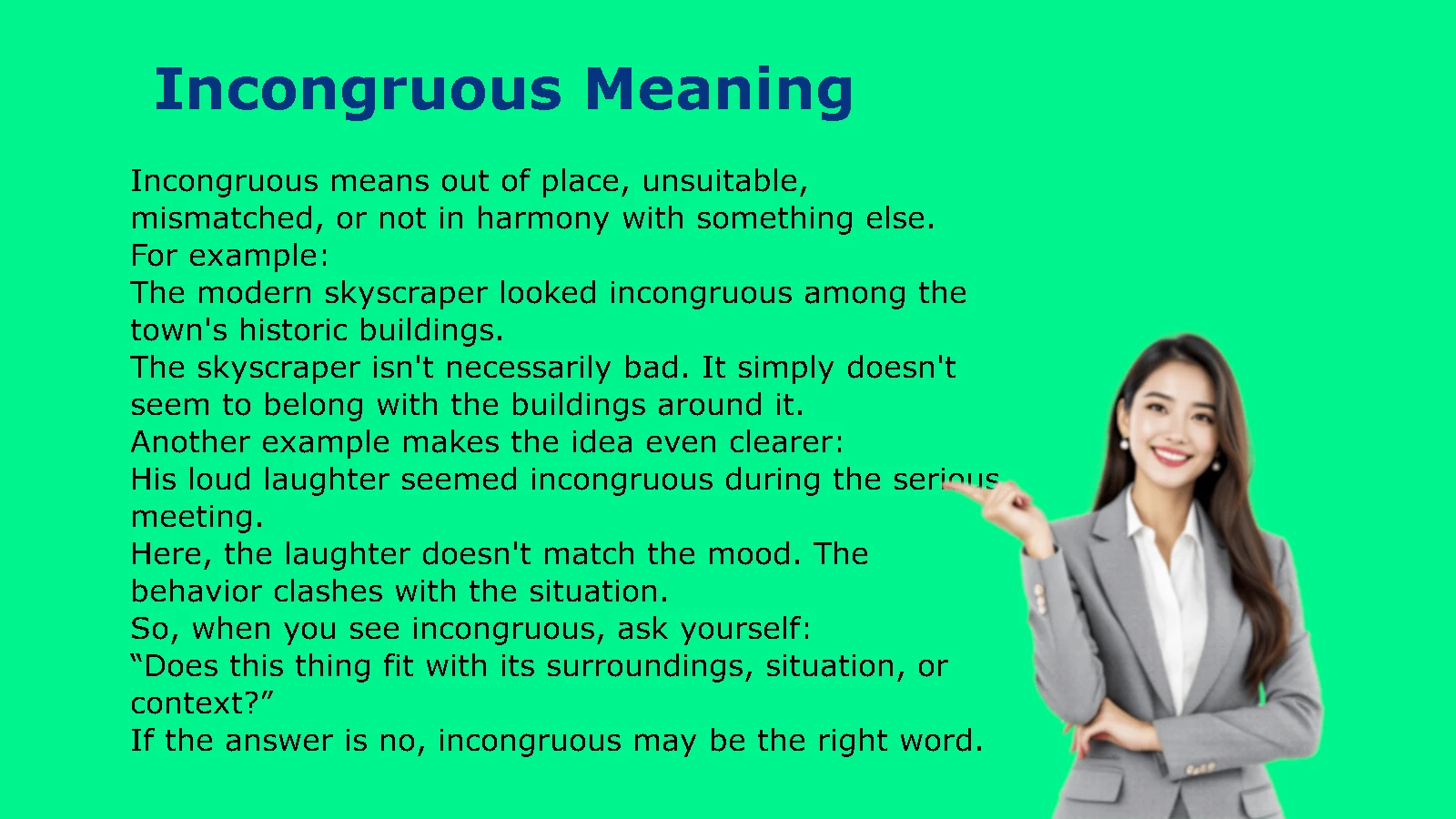
Incongruous means out of place, unsuitable, mismatched, or not in harmony with something else.
For example:
The modern skyscraper looked incongruous among the town’s historic buildings.
The skyscraper isn’t necessarily bad. It simply doesn’t seem to belong with the buildings around it.
Another example makes the idea even clearer:
His loud laughter seemed incongruous during the serious meeting.
Here, the laughter doesn’t match the mood. The behavior clashes with the situation.
So, when you see incongruous, ask yourself:
“Does this thing fit with its surroundings, situation, or context?”
If the answer is no, incongruous may be the right word.
Quick Definition of Incongruous
| Feature | Meaning |
| Word | Incongruous |
| Part of speech | Adjective |
| Simple meaning | Out of place or unsuitable |
| Pronunciation | in-KAHNG-groo-us |
| Noun form | Incongruity |
| Adverb form | Incongruously |
| Common pattern | Incongruous with |
| Opposite idea | Congruous, harmonious, suitable, fitting |
Cambridge classifies incongruous as an adjective and gives the US pronunciation as /ɪnˈkɑːŋ.ɡru.əs/.
What Does Incongruous Mean?
The word has a few closely related meanings, but they all revolve around the same central idea: a lack of fit or agreement.
Merriam Webster gives several senses, including not harmonious, incompatible, disagreeing, internally inconsistent, and unsuitable.
That means incongruous can describe more than something that simply looks odd.
Incongruous Can Mean “Out of Place”
This is probably the easiest sense to understand.
A bright red sofa looked incongruous in the otherwise minimalist white room.
The sofa doesn’t necessarily have anything wrong with it. Its color and style simply clash with the room.
Incongruous Can Mean “Unsuitable”
Something can also be incongruous because it doesn’t suit a particular situation.
His casual jokes seemed incongruous during the formal ceremony.
The problem isn’t the jokes themselves. The problem is their lack of fit with the occasion.
Incongruous Can Mean “Not Harmonious”
The word can describe elements that don’t work well together.
The painting combines several incongruous colors.
The colors may create a visual clash rather than a balanced combination.
Incongruous Can Mean “Inconsistent”
The word can also describe something that doesn’t agree with another idea, action, principle, or fact.
Her behavior was incongruous with her stated commitment to honesty.
Her actions and her stated values don’t match.
This broader sense explains why incongruous appears in discussions about behavior, literature, design, politics, art, architecture, and ideas.
Incongruous Pronunciation
The American pronunciation of incongruous is:
in-KAHNG-groo-us
Its US phonetic pronunciation is:
/ɪnˈkɑːŋ.ɡru.əs/
The stress falls on the second syllable.
Break it into parts:
in + KAHNG + groo + us
The word can look intimidating when you first encounter it. Once you hear it, however, the pronunciation becomes much easier.
Is Incongruous an Adjective?
Yes. Incongruous is an adjective.
It modifies a noun by describing something that doesn’t fit, agree, or harmonize with something else.
For example:
- an incongruous outfit
- an incongruous building
- an incongruous remark
- an incongruous combination
- an incongruous relationship
- an incongruous image
- an incongruous response
You can also use it after linking verbs such as seem, look, appear, and be.
The old house looked incongruous beside the new shopping center.
His response seemed incongruous with the evidence.
Oxford lists verbs such as be, look, and seem among common collocations with incongruous.
How to Use Incongruous in a Sentence
The most useful sentence pattern is incongruous with.
Incongruous With
Use incongruous with when you want to show that one thing doesn’t fit or agree with another.
The modern design was incongruous with the historic building.
His angry reaction seemed incongruous with his normally calm personality.
The bright decorations were incongruous with the solemn atmosphere.
This construction works especially well when you’re comparing two things.
Incongruous in
You can also use incongruous with in when you describe something that looks out of place within a particular setting.
The computer looked incongruous in the old library.
She felt incongruous in such a traditional environment.
Seem Incongruous
Seem incongruous is useful when the mismatch isn’t absolute but appears strange to the observer.
It may seem incongruous to see a modern art installation in such an old church.
Look Incongruous
Use look incongruous when the mismatch is primarily visual.
The neon sign looked incongruous against the historic brick wall.
An Incongruous Combination
This phrase works when two or more things don’t naturally seem to belong together.
The restaurant served an incongruous combination of traditional dishes and futuristic desserts.
The combination may be unusual without necessarily being wrong.
Incongruous Examples
The best way to understand this word is to see it in different contexts.
| Situation | Example | Why it is incongruous |
| Clothing | He wore a tuxedo to a beach barbecue. | The formal clothing doesn’t fit the casual setting. |
| Architecture | A glass tower stood among centuries old cottages. | The modern design clashes with the historic surroundings. |
| Behavior | She laughed during the serious announcement. | Her reaction doesn’t match the mood. |
| Colors | Bright orange walls filled an otherwise muted room. | The color clashes with the room’s design. |
| Language | The formal speech suddenly included a silly joke. | The joke doesn’t fit the tone. |
| Music | A cheerful pop song played during a solemn ceremony. | The mood of the music conflicts with the event. |
| Ideas | His actions contradicted his stated principles. | His behavior doesn’t agree with his beliefs. |
| Objects | A vending machine stood inside the antique museum gallery. | Its modern appearance feels out of place. |
| Characters | A strict teacher behaved like a carefree comedian. | The behavior conflicts with expectations. |
| Design | A medieval style castle had a futuristic neon entrance. | The styles create a noticeable mismatch. |
Notice an important detail: incongruous doesn’t always mean completely wrong.
Something can be perfectly functional yet still be incongruous.
A bright yellow chair might work perfectly well as a chair. Put it in a room filled with dark Victorian furniture, though, and its appearance may suddenly seem incongruous.
Incongruous Examples in Everyday Situations
You don’t need to read a literary novel to encounter this word. Everyday life produces plenty of incongruous situations.
Clothing
His formal suit looked incongruous at the casual backyard party.
The suit is appropriate for a wedding or business event. At a relaxed backyard gathering, however, it stands out.
Architecture
The futuristic building looked incongruous beside the old stone houses.
The contrast between architectural styles creates the mismatch.
Behavior
Her cheerful attitude seemed incongruous after the disappointing news.
The word describes the gap between the situation and her reaction.
Conversation
His sarcastic comment felt incongruous during the serious discussion.
The comment clashes with the tone of the conversation.
Interior Design
The plastic garden chair looked incongruous in the elegant dining room.
Again, the chair isn’t inherently wrong. Its surroundings make it seem out of place.
A Simple Way to Understand Incongruous
Think about a puzzle.
Most puzzle pieces fit together because their shapes and positions correspond. An incongruous piece would look strange if you forced it into the wrong section.
Language works in much the same way.
The surrounding context creates an expectation. When something doesn’t match that expectation, it can seem incongruous.
For example:
Formal setting + formal clothing = congruous
Formal setting + beachwear = incongruous
The same object can therefore be congruous in one context and incongruous in another.
A swimsuit at the beach is normal.
A swimsuit at a business conference is incongruous.
The object hasn’t changed. The context has.
Incongruous vs. Inappropriate
These words overlap, but they aren’t interchangeable in every sentence.
Inappropriate generally means unsuitable for a particular purpose, person, or situation.
Incongruous emphasizes a noticeable mismatch between something and its surroundings or context.
Compare these examples:
His comment was inappropriate during the meeting.
This tells you that the comment wasn’t suitable.
His comment was incongruous with the serious tone of the meeting.
This highlights the contrast between the comment and the tone.
The distinction is subtle but useful.
| Word | Main focus | Example |
| Inappropriate | Not suitable | His joke was inappropriate for the ceremony. |
| Incongruous | Doesn’t fit the surrounding context | His joke seemed incongruous with the solemn mood. |
Oxford treats inappropriate as a synonym for incongruous in its definition, which shows how closely the words overlap.
Incongruous vs. Inconsistent
These words can also overlap, especially when you’re describing behavior, ideas, or statements.
Inconsistent means that things don’t agree with each other or don’t follow a consistent pattern.
Incongruous often focuses more strongly on a mismatch between something and its context.
For example:
His two statements were inconsistent.
The statements contradict each other.
His cheerful response seemed incongruous with the seriousness of the situation.
The response clashes with its context.
Quick Comparison
| Incongruous | Inconsistent |
| Emphasizes a mismatch | Emphasizes a lack of consistency |
| Often involves context | Often involves disagreement between facts, statements, or actions |
| Can describe appearance | Commonly describes ideas, statements, behavior, or results |
| “The outfit looked incongruous.” | “Her answers were inconsistent.” |
Incongruous vs. Incongruent
The two words look almost identical, which makes confusion understandable.
Incongruous usually describes something that appears strange, unsuitable, mismatched, or out of place.
Incongruent also means not corresponding or not agreeing. It appears frequently in technical, academic, psychological, mathematical, and scientific contexts.
For general English writing, incongruous is often the better choice when you want to describe something that seems out of place.
Consider:
The modern sculpture looked incongruous in the historic square.
This sounds natural.
In a technical discussion, however, incongruent may be more appropriate because the word can describe things that don’t correspond or align.
The two words share the same basic idea of a lack of agreement, but their usage differs by context.
Incongruous Synonyms
There isn’t one perfect synonym for incongruous because the exact meaning depends on what kind of mismatch you’re describing.
Merriam Webster’s thesaurus includes terms such as inappropriate, unsuitable, improper, irrelevant, inconsistent, out of place, awkward, and inapposite.
Synonyms for “Out of Place”
- out of place
- misplaced
- unsuitable
- unfitting
- awkward
- inappropriate
- inapt
Example:
The modern sculpture looked out of place in the traditional garden.
Synonyms for “Not Harmonious”
- discordant
- mismatched
- incompatible
- clashing
- inharmonious
- conflicting
Example:
The two colors looked discordant together.
Synonyms for “Inconsistent”
- contradictory
- conflicting
- inconsistent
- incompatible
- discrepant
Example:
His explanation was inconsistent with the available evidence.
Best Synonym Depending on Context
| If you mean… | Consider… |
| Not suitable | Inappropriate |
| Doesn’t belong | Out of place |
| Doesn’t match | Mismatched |
| Doesn’t agree | Inconsistent |
| Doesn’t harmonize | Discordant |
| Doesn’t fit | Unsuitable |
| Conflicts with something | Contradictory |
| Doesn’t correspond | Incompatible |
Choosing the right synonym matters because incongruous can carry a visual, social, emotional, or logical sense of mismatch.
Antonyms of Incongruous
The opposite of incongruous is congruous, although everyday English often favors words such as appropriate, suitable, harmonious, and fitting.
Cambridge defines congruous as being the same as or in agreement with other facts or principles.
Useful antonyms include:
- congruous
- appropriate
- suitable
- harmonious
- compatible
- consistent
- fitting
- corresponding
- matching
- coherent
Incongruous vs. Congruous
| Incongruous | Congruous |
| Doesn’t fit | Fits |
| Not harmonious | Harmonious |
| Unsuitable | Suitable |
| Mismatched | Matching |
| Conflicting | In agreement |
| Out of place | In keeping with its surroundings |
For example:
The bright neon sign was incongruous with the historic building.
But:
The traditional wooden sign was congruous with the historic building.
The contrast between the two sentences makes the meaning easy to remember.
Incongruity: The Noun Form
The noun form of incongruous is incongruity.
Incongruity means the state or quality of being incongruous.
For example:
The incongruity between the building’s traditional exterior and its futuristic interior was striking.
You can use incongruity when you want to talk about the mismatch itself rather than describe something as mismatched.
Oxford lists incongruity as a noun and gives both singular and plural forms: incongruity and incongruities.
Incongruous vs. Incongruity
- Incongruous = adjective
- Incongruity = noun
Compare:
The modern furniture looked incongruous in the old house.
The incongruity between the furniture and the house was obvious.
Incongruously: The Adverb Form
The adverb form is incongruously.
It means in a strange or unsuitable way.
The decorations were incongruously bright for such a solemn room.
He was incongruously dressed for the occasion.
Oxford defines incongruously as doing something in a strange way that isn’t suitable for the situation.
The word is useful when you want to describe how something happens rather than simply describe the thing itself.
Incongruousness: Another Noun Form
Incongruousness is also a noun form.
It refers to the quality or condition of being incongruous. Merriam Webster lists incongruousness as a noun alongside incongruously.
However, incongruity is usually the more useful noun for general writing.
For example:
The incongruity of the situation was immediately obvious.
This generally sounds more natural than:
The incongruousness of the situation was immediately obvious.
Both can work, but incongruity is the stronger everyday choice.
Incongruous in Literature and Writing
Writers often use incongruous to highlight contrast.
Imagine a dark story in which a character suddenly makes a cheerful joke. The joke may feel incongruous because it clashes with the mood.
This technique can serve several purposes:
- Create humor
- Emphasize tension
- Surprise the reader
- Highlight character differences
- Draw attention to contradictions
- Make a scene memorable
- Show a conflict between appearance and reality
An incongruous detail can work like a bright spot on a dark canvas. Because it doesn’t blend in, you notice it immediately.
Example of Literary Contrast
Consider this sentence:
The cheerful balloons looked incongruous against the abandoned house.
The balloons create a sharp contrast with the setting. That contrast can make the scene feel eerie rather than cheerful.
The word therefore does more than mean “strange.” It helps explain why something feels strange.
Incongruous in Art and Design
Designers often think about whether individual elements fit within a larger visual system.
An element can become incongruous when its:
- Color clashes with surrounding colors
- Size conflicts with nearby objects
- Style differs sharply from the overall design
- Shape disrupts visual balance
- Material feels unrelated to the setting
For example:
The ultra modern lamp looked incongruous in the room’s traditional design.
However, an incongruous element isn’t automatically a design mistake.
Artists sometimes create contrast deliberately.
A bright red chair in an otherwise neutral room can be incongruous while also becoming the room’s focal point.
That’s an important distinction:
Incongruous describes the relationship between elements. It doesn’t automatically judge whether the result is good or bad.
Is Incongruous a Negative Word?
Not necessarily.
The word often carries a mildly negative or critical tone because it points out that something doesn’t fit. Yet context determines the emotional effect.
Neutral Use
The modern artwork looked incongruous beside the ancient sculptures.
This simply describes a contrast.
Negative Use
His rude comment was incongruous with the respectful tone of the discussion.
Here, the word highlights inappropriate behavior.
Humorous Use
The tiny dog looked incongruous beside the enormous security guards.
The mismatch may be amusing rather than critical.
Creative Use
The bright yellow door was incongruous against the gray stone facade.
The writer may simply be drawing attention to an unusual design choice.
So, incongruous is best understood as descriptive rather than automatically insulting.
Common Collocations With Incongruous
Learning common word combinations can make your writing sound more natural.
Some useful collocations include:
- incongruous with
- seem incongruous
- look incongruous
- appear incongruous
- completely incongruous
- totally incongruous
- utterly incongruous
- incongruous behavior
- incongruous appearance
- incongruous combination
- incongruous elements
- incongruous sight
- incongruous statement
- incongruous relationship
- incongruous mixture
Here are a few natural examples:
The bright colors seemed incongruous with the quiet setting.
His behavior appeared completely incongruous with his usual personality.
The restaurant was an incongruous mixture of old and new design.
The scene presented an incongruous combination of luxury and decay.
These patterns are especially useful in formal and descriptive writing.
The Origin of Incongruous
The history of the word explains its meaning surprisingly well.
Oxford traces incongruous to early 17th century English and ultimately to the Latin incongruus. The Latin word combines in-, meaning “not,” with congruus, meaning “agreeing” or “suitable.”
The related Latin verb congruere carried the idea of coming together or agreeing.
That history connects directly to the modern meaning.
Think of the basic progression:
congruere → come together / agree
congruous → fitting / agreeing
incongruous → not fitting / not agreeing
Merriam Webster gives 1582 as the first known use of incongruous in English and likewise connects the word to Late Latin incongruus.
The etymology therefore provides a useful memory trick: if something doesn’t come together properly, it may be incongruous.
How to Remember the Meaning of Incongruous
A simple memory trick is:
Incongruous = doesn’t fit.
Picture a formal black suit at a beach picnic.
The suit itself isn’t wrong.
The beach isn’t wrong.
The problem is the mismatch between the two.
That is the heart of incongruous.
You can also connect it with the opposite word congruous:
- Congruous = fits or agrees
- Incongruous = doesn’t fit or agree
Once you remember that contrast, the word becomes much easier to recognize.
Common Mistakes With Incongruous
Because incongruous is relatively formal, learners sometimes use it where a simpler word would sound more natural.
Mistake: Using It for Anything Merely Unusual
Not everything unusual is incongruous.
She has an unusual collection of stamps.
This doesn’t necessarily mean the collection is incongruous.
To use incongruous, there should usually be some mismatch, conflict, or lack of fit.
Mistake: Assuming It Always Means “Wrong”
An incongruous element can be intentional.
The designer added an incongruous red chair to create contrast.
The chair may be deliberately out of harmony with the rest of the room.
Mistake: Confusing It With “Inconvenient”
The words look somewhat similar, but their meanings differ.
Incongruous means mismatched or unsuitable.
Inconvenient means causing difficulty or trouble.
The bright painting was incongruous with the room.
The late appointment was inconvenient.
Mistake: Using “Incongruous” Without a Context
The word becomes clearest when the reader knows what doesn’t fit with what.
Instead of:
The outfit was incongruous.
Consider:
The formal outfit was incongruous with the relaxed beach setting.
The second sentence gives the reader the missing relationship.
Incongruous Meaning in Different Contexts
The word changes slightly depending on the subject.
| Context | Meaning of incongruous |
| Clothing | Doesn’t suit the occasion |
| Architecture | Doesn’t match the surrounding style |
| Behavior | Doesn’t fit the expected mood or personality |
| Speech | Doesn’t fit the tone or situation |
| Art | Doesn’t harmonize with other visual elements |
| Ideas | Don’t agree with each other |
| Actions | Conflict with beliefs or principles |
| Writing | Doesn’t fit the narrative, tone, or context |
| Design | Creates a noticeable mismatch |
| Relationships | People or qualities seem unexpectedly mismatched |
This flexibility makes incongruous a useful word when “out of place” feels too basic or when you need to describe a more specific kind of mismatch.
A Short Case Study: Why Context Matters
Imagine a bright red umbrella.
At a rainy street corner, it looks completely normal.
At a wedding with a strict black and white dress code, the same umbrella might look unusual.
Inside a children’s playroom, it might fit perfectly.
Nothing about the umbrella changed.
The context changed.
This illustrates an important feature of incongruous: the word often describes a relationship between an object and its environment, rather than an inherent quality of the object.
That is why context matters so much when using the word.
When Should You Use Incongruous?
Use incongruous when you want to point out a noticeable lack of fit between two things.
It works especially well when:
- Something looks strange in its surroundings.
- Behavior doesn’t match the situation.
- A statement conflicts with another statement or principle.
- Colors or styles clash.
- Two ideas don’t seem to belong together.
- An action conflicts with someone’s expected character.
- A detail disrupts the tone of a scene.
- A combination feels unusual because its parts don’t naturally match.
If you’re writing casually, out of place may sound simpler.
If you’re writing an essay, review, analysis, or descriptive passage, incongruous can give you greater precision.
Frequently Asked Questions About Incongruous
What does incongruous mean in simple words?
Incongruous means out of place, unsuitable, or not matching the surrounding situation or context.
For example, a formal tuxedo at a casual beach party could look incongruous.
What is an example of incongruous?
The futuristic car looked incongruous on the narrow street lined with historic houses.
The car doesn’t fit the visual character of its surroundings.
Is incongruous positive or negative?
It can be either neutral or negative depending on context. The word mainly describes a mismatch. Writers can use that mismatch for criticism, humor, surprise, or simple observation.
What is a synonym for incongruous?
Common synonyms include inappropriate, unsuitable, mismatched, discordant, inconsistent, incompatible, awkward, and out of place.
The best synonym depends on the context.
What is the opposite of incongruous?
The direct opposite is congruous. Other useful opposites include appropriate, suitable, harmonious, compatible, consistent, and fitting.
What is the noun form of incongruous?
The main noun form is incongruity.
The incongruity between the two designs was obvious.
What is the adverb form of incongruous?
The adverb is incongruously.
He was incongruously dressed for the formal event.
Is incongruous a formal word?
Yes. Cambridge’s Learner’s Dictionary labels incongruous as formal.
It appears naturally in academic, literary, professional, and descriptive writing. In casual conversation, simpler alternatives such as out of place, odd, or not fitting may sound more natural.
Does incongruous mean weird?
Sometimes, but weird is broader.
Weird simply means strange or unusual. Incongruous usually suggests that something is strange because it doesn’t fit its context.
That difference is important.
The house was weird.
This only tells you that the house seemed strange.
The modern house looked incongruous among the surrounding medieval buildings.
This tells you why it seemed strange.
Quick Reference: Incongruous Meaning
| Category | Answer |
| Word | Incongruous |
| Meaning | Out of place, unsuitable, mismatched, or not harmonious |
| Part of speech | Adjective |
| US pronunciation | /ɪnˈkɑːŋ.ɡru.əs/ |
| Simple pronunciation | in-KAHNG-groo-us |
| Noun | Incongruity |
| Adverb | Incongruously |
| Common construction | Incongruous with |
| Synonyms | Inappropriate, unsuitable, mismatched, discordant, inconsistent |
| Antonyms | Congruous, appropriate, suitable, harmonious, compatible |
| Word origin | Latin incongruus |
| First known English use | 1582, according to Merriam Webster |
The major dictionary sources agree on the central idea: incongruous describes something that doesn’t fit, harmonize, or agree with its context.
Final Takeaway on Incongruous Meaning
The easiest way to remember incongruous meaning is simple:
Something is incongruous when it doesn’t fit with what surrounds it or with the situation in which it appears.
A tuxedo at a beach picnic is incongruous. A modern skyscraper among historic cottages can look incongruous. A cheerful joke during a solemn event may sound incongruous. A person’s actions can also be incongruous with their stated beliefs.
The key isn’t simply that something is unusual. The key is the mismatch.
Once that distinction becomes clear, incongruous becomes much easier to use. When you need a precise word for something that clashes with its setting, behavior, tone, appearance, or context, incongruous is often exactly the word you need.