
Have you ever described someone as laconic because they gave a very short answer and wondered exactly what the word meant? While Laconic Meaning may seem straightforward, this unusual adjective has a deeper connection to brevity, directness, and the way someone communicates.
Laconic means using very few words to express something, often in a way that is brief, direct, and sometimes humorously blunt. A laconic person may answer questions with only a few words instead of giving a long explanation.
Examples:
- His laconic reply was simply, “No.”
- She gave a laconic response and returned to work.
The confusion is understandable. People often search for what does laconic mean, laconic meaning in English, laconic meaning in a sentence, or laconic meaning in conversation because the word can describe both a person’s speaking style and a particular response or statement. And here’s the kicker: being laconic doesn’t necessarily mean being rude. Sometimes, saying less can communicate more.
In this guide, you’ll learn the complete Laconic Meaning, its definition, pronunciation, origin, correct usage, and examples in sentences. You’ll also discover the difference between laconic, concise, terse, and brief, along with synonyms, antonyms, and practical examples to help you understand exactly when to use this word.
What Does “Laconic” Mean?
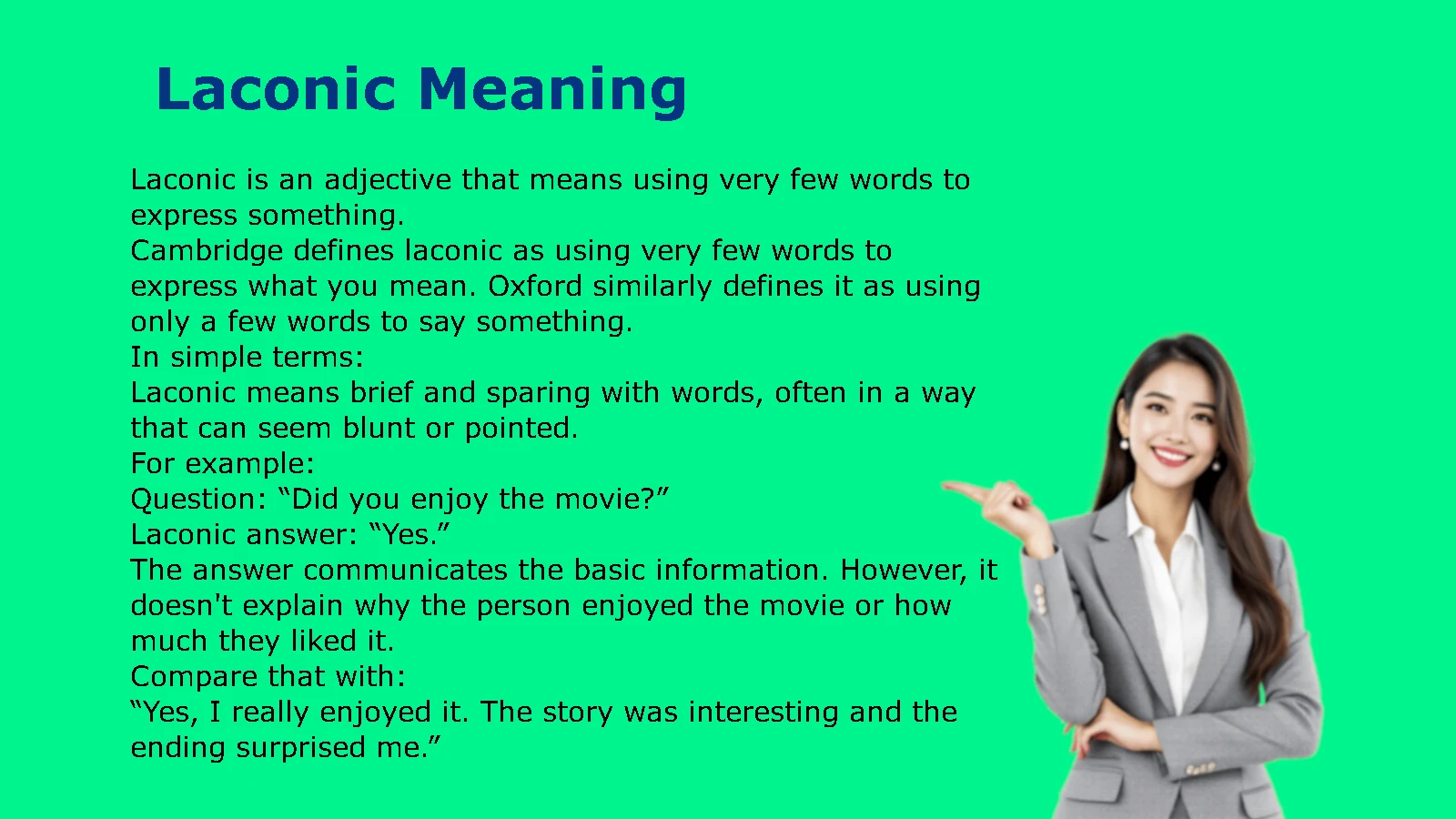
Laconic is an adjective that means using very few words to express something.
Cambridge defines laconic as using very few words to express what you mean. Oxford similarly defines it as using only a few words to say something.
In simple terms:
Laconic means brief and sparing with words, often in a way that can seem blunt or pointed.
For example:
- Question: “Did you enjoy the movie?”
- Laconic answer: “Yes.”
The answer communicates the basic information. However, it doesn’t explain why the person enjoyed the movie or how much they liked it.
Compare that with:
“Yes, I really enjoyed it. The story was interesting and the ending surprised me.”
The second response gives considerably more information. The first one is laconic because the speaker uses only the words needed to answer.
Merriam-Webster adds an important nuance: laconic can mean concise to the point of seeming rude or mysterious.
That distinction matters. Someone who gives short answers isn’t necessarily rude. Their communication style may simply be economical.
Laconic Meaning in Simple Words
If you want an easy definition to remember, use this:
Laconic = using few words to say something.
A useful memory trick is:
Few words + clear meaning = laconic.
For example:
- “Probably.”
- “Not yet.”
- “I agree.”
- “We’ll see.”
- “Maybe tomorrow.”
These responses can all be laconic when the context makes them unusually brief.
Laconic Definition and Part of Speech
Laconic functions as an adjective.
It describes a person, response, comment, writing style, remark, or another form of expression.
| Word | Part of Speech | Meaning |
| Laconic | Adjective | Using very few words |
| Laconically | Adverb | In a way that uses very few words |
| Laconical | Adjective | An archaic form of laconic |
Oxford lists examples such as “a laconic comment,” while Cambridge provides examples including “a laconic reply.”
You might see laconic used with:
- laconic answer
- laconic reply
- laconic response
- laconic comment
- laconic remark
- laconic style
- laconic humor
- laconic wit
- laconic prose
- laconic speaker
- laconic tone
- laconic manner
What Does “Laconically” Mean?
Laconically is the adverbial form of laconic. It means in a way that uses very few words.
For example:
“Maybe,” she replied laconically.
This means she gave a very short response.
Another example:
He laconically dismissed the suggestion.
The sentence suggests that he dismissed it with very few words.
How Do You Pronounce “Laconic”?
The American pronunciation is generally:
luh-KAH-nik
The phonetic pronunciation is:
/ləˈkɑː.nɪk/
Cambridge gives the US pronunciation as /ləˈkɑː.nɪk/, while Oxford lists the American pronunciation alongside the British form.
Break it into three parts:
luh + KAH + nik
The stress falls on the middle syllable:
luh-KAH-nik
Don’t pronounce it as LAY-con-ick. The first syllable has a relaxed sound, similar to the beginning of about.
What Is the Origin of “Laconic”?
The history of laconic is one of the most interesting things about the word.
The term comes from Laconia, a region in the southeastern part of ancient Greece. Sparta was located in Laconia, and the Spartans became famous for their brief and pointed style of speech.
Oxford traces the word through Latin Laconicus to Greek Lakōnikos, meaning something associated with Laconia or its people. The English word eventually developed its modern sense because of the Spartans’ reputation for terse speech.
Merriam-Webster gives the first known use of laconic in its modern English history as 1589.
Why Were Spartans Associated With Brief Speech?
Ancient Sparta developed a cultural reputation for discipline, restraint, and directness. Their reputation for short answers became part of the larger Greek image of Spartan character.
One famous anecdote illustrates the idea perfectly.
According to the traditional story, Philip II of Macedon warned the Spartans that if he entered Laconia, he would destroy Sparta. The reported Spartan response was simply:
“If.”
The force of the reply comes from its extreme brevity. The Spartans did not respond with a long argument. They reduced the challenge to a single conditional word.
This story captures the basic idea behind the modern word: say less, but make every word count.
Historical anecdotes about Spartan speech come from ancient and later traditions, so they shouldn’t be treated as verbatim transcripts of every historical event. Still, the association between Sparta and terse speech is firmly reflected in the etymology of laconic.
What Is a Laconic Person?
A laconic person tends to communicate with few words.
That doesn’t necessarily mean the person is shy. It doesn’t automatically mean they’re angry. And it doesn’t mean they have nothing interesting to say.
Instead, the focus is on how little they say.
Imagine two coworkers discussing a project.
Coworker A:
“I think we should probably move the meeting to Thursday because the client won’t be available tomorrow.”
Coworker B:
“Thursday works.”
Coworker B’s response is laconic. It communicates agreement without adding extra explanation.
A laconic person may:
- Give short answers.
- Avoid unnecessary explanations.
- Prefer direct statements.
- Use one or two sentences instead of several paragraphs.
- Let other people do most of the talking.
- Communicate meaning through carefully chosen words.
However, laconic doesn’t mean silent.
A person can talk regularly and still have a laconic style. The important feature is the economy of their expression.
Laconic Examples in Everyday Conversation
The easiest way to understand laconic meaning is to see the word in context.
Laconic Replies
Consider these short responses:
- “Yes.”
- “No.”
- “Perhaps.”
- “Possibly.”
- “Not yet.”
- “I agree.”
- “We’ll see.”
- “Probably.”
- “Fine.”
- “Understood.”
Each response is brief. Whether it is actually laconic depends on the situation.
For example, replying “Yes” to a simple yes-or-no question isn’t necessarily noteworthy. But if someone asks for a detailed opinion and the person answers only “Yes,” the response becomes distinctly laconic.
Laconic Responses to Questions
Question: “Did you finish the report?”
Laconic response: “Almost.”
The speaker provides the essential information but doesn’t elaborate.
A more detailed response might be:
“Almost. I finished the introduction and results section, but I still need to check the references.”
The second response gives context. The first keeps everything tightly compressed.
Laconic Comments
A person might respond to a long explanation with:
“Interesting.”
Or:
“Fair enough.”
Or:
“Noted.”
These responses don’t necessarily communicate hostility. Their meaning depends heavily on tone, facial expression, relationship, and context.
A cheerful “Fair enough” can sound accepting. A cold “Fine” can sound dismissive.
That’s why laconic describes the form of communication more reliably than it describes the speaker’s feelings.
Examples of “Laconic” in a Sentence
Here are natural examples showing how to use the word correctly:
- His laconic reply ended the conversation.
- She gave a laconic answer when the reporter asked about the decision.
- The detective was known for his laconic style.
- His laconic comments revealed very little about his opinion.
- The manager offered a laconic response and returned to work.
- Her emails are usually brief and laconic.
- He gave a laconic explanation for his sudden departure.
- The author’s laconic prose leaves plenty of room for interpretation.
- His laconic manner made him difficult to read.
- The coach gave one laconic instruction: “Stay focused.”
- She has a laconic sense of humor that often catches people off guard.
- The witness gave a remarkably laconic account of the incident.
- His laconic response suggested that he didn’t want to discuss the matter.
- The character’s laconic dialogue makes him seem confident and reserved.
- Her laconic writing style avoids unnecessary explanation.
Notice that the word can describe both people and their expressions.
Laconic vs. Concise
Laconic and concise overlap, but they aren’t perfect synonyms.
Concise generally means expressing something clearly and efficiently without unnecessary words. It often carries a positive or neutral tone.
Laconic puts more emphasis on extreme brevity. In some contexts, it can suggest that the speaker sounds blunt, detached, mysterious, or even slightly rude. Merriam-Webster specifically distinguishes laconic from related words by noting this possible effect.
| Word | Core Meaning | Typical Tone |
| Concise | Brief and clear | Usually positive or neutral |
| Laconic | Very brief in expression | Neutral, blunt, dry, or mysterious |
| Terse | Brief and pointed | Can sound sharp |
| Curt | Brief and abrupt | Often negative |
| Succinct | Expressed clearly in few words | Usually positive |
Consider these examples:
Concise:
“The report summarizes the three main causes of the problem.”
Laconic:
“Three causes. That’s all.”
The first focuses on efficient communication. The second emphasizes extreme brevity.
So, if you want to praise someone’s writing for being short and effective, concise may be the better choice.
If you want to highlight an unusually spare or restrained style, laconic is more precise.
Laconic vs. Terse
Terse is one of the closest synonyms of laconic.
Both words describe communication that uses few words. Yet terse often carries a stronger suggestion of sharpness or abruptness.
Compare:
“She gave a laconic answer.”
This tells you that the answer was very brief.
“She gave a terse answer.”
This can suggest that the answer was brief and possibly unfriendly or impatient.
Merriam-Webster explains the distinction by saying that terse implies pointed conciseness, while laconic can imply brevity that seems rude, indifferent, or mysterious.
In everyday writing, the two words often overlap. Context decides which one sounds more accurate.
Laconic vs. Curt
Curt means brief and abrupt, often in a way that seems rude.
That’s an important distinction.
A laconic response:
“Maybe.”
A curt response:
“Whatever.”
The first could simply reflect a person’s restrained communication style. The second may communicate irritation or dismissal.
Here’s another comparison:
| Situation | Better Word |
| Someone naturally gives short answers | Laconic |
| Someone gives an abrupt answer because they’re annoyed | Curt |
| Someone communicates clearly without unnecessary words | Concise |
| Someone gives a pointed, very brief answer | Terse |
A laconic person isn’t necessarily being unpleasant. A curt person often is.
Laconic vs. Taciturn
Taciturn describes someone who tends to say very little.
That sounds almost identical to laconic, but the focus differs.
Laconic usually describes the person’s expression or communication style.
Taciturn more strongly describes the person’s general tendency to avoid talking.
For example:
“His answer was laconic.”
This focuses on the answer.
“He is taciturn.”
This focuses on the person’s character or usual behavior.
The distinction becomes clearer in a simple table:
| Word | Main Focus | Example |
| Laconic | Brief expression | “She gave a laconic reply.” |
| Taciturn | A person who rarely speaks | “He is a taciturn man.” |
| Curt | Brief and potentially rude | “She gave him a curt response.” |
| Concise | Brief and efficient | “The explanation was concise.” |
| Terse | Brief and pointed | “He gave a terse answer.” |
The American Heritage Dictionary similarly distinguishes laconic from reticent and taciturn, noting that laconic emphasizes terseness or conciseness in expression.
Synonyms for Laconic
Several English words overlap with laconic, but each carries a slightly different shade of meaning.
Close Synonyms
- Concise — brief and clear
- Brief — short in length or duration
- Terse — brief and pointed
- Succinct — expressed clearly in very few words
- Pithy — brief but full of meaning
- Compact — condensed into a small amount of space
- Crisp — brief and clear, often with a polished quality
Merriam-Webster’s thesaurus includes words such as concise, brief, terse, succinct, pithy, curt, compact, crisp, and abrupt among related terms.
Why These Synonyms Aren’t Interchangeable
Consider pithy.
A pithy statement isn’t merely short. It usually contains a useful or memorable insight.
For example:
“Actions speak louder than words.”
That’s short, but it also expresses a broader idea.
Now consider curt:
“No. Next question.”
It’s short and abrupt.
Finally, consider succinct:
“The study found that sleep improves memory.”
It’s brief while still providing a complete idea.
These distinctions help you choose the right word instead of treating every synonym as identical.
Antonyms of Laconic
The opposite of a laconic communication style involves using many words or providing extensive explanation.
Common antonyms include:
- Verbose
- Wordy
- Talkative
- Loquacious
- Long winded
- Expansive
| Antonym | Meaning |
| Verbose | Uses more words than necessary |
| Wordy | Contains too many words |
| Talkative | Talks frequently or at length |
| Loquacious | Very talkative |
| Long winded | Takes a long time to express an idea |
| Expansive | Covers a subject in considerable detail |
For example:
Laconic: “The plan failed.”
Verbose: “Unfortunately, after considering everything that happened throughout the process, it became clear that the plan had ultimately failed for several reasons.”
The second sentence isn’t automatically bad. Sometimes detailed explanation is exactly what the reader needs. The difference is that the first communicates the idea with extreme economy.
Common Collocations With “Laconic”
Certain word combinations sound particularly natural in English.
Common phrases include:
- laconic answer
- laconic reply
- laconic response
- laconic remark
- laconic comment
- laconic style
- laconic manner
- laconic prose
- laconic speaker
- laconic tone
- laconic humor
- laconic wit
Cambridge examples include laconic wit, while Oxford gives laconic comment and Cambridge’s American Dictionary includes laconic reply.
Among these, laconic reply, laconic response, and laconic style are especially useful for everyday writing.
How to Use “Laconic” Correctly
The safest way to use laconic is to connect it with a form of communication.
For example:
He gave a laconic response.
Her laconic writing style impressed the editor.
The character is known for his laconic humor.
She offered a laconic explanation.
The word becomes less precise if you use it simply to mean quiet.
Don’t Confuse Laconic With Quiet
A quiet person may simply make little noise.
A laconic person uses few words.
For example:
“Maria is quiet during meetings.”
This tells you that Maria doesn’t speak much.
“Maria gives laconic answers during meetings.”
This tells you something more specific about how she communicates when she does speak.
The second sentence is much closer to the actual meaning of laconic.
Don’t Confuse Laconic With Shy
A shy person may avoid speaking because they feel nervous or uncomfortable.
A laconic person may be completely confident and still prefer short answers.
Someone could be both shy and laconic. However, the two words describe different characteristics.
Is “Laconic” Positive or Negative?
Laconic is generally neutral, but its connotation changes with context.
Sometimes brevity is a strength.
“The author’s laconic prose makes every sentence count.”
Here, laconic sounds complimentary. The writer has achieved a powerful effect with few words.
In another situation, the same word may sound critical:
“His laconic response made the customer feel ignored.”
Now the short response creates a negative impression.
A Laconic Style Can Be:
- Confident
- Efficient
- Dry
- Humorous
- Mysterious
- Reserved
- Blunt
- Cold
- Dismissive
The surrounding context determines which interpretation makes sense.
This is why you shouldn’t automatically translate laconic as rude. Rudeness is one possible effect, not the basic definition.
Laconic Meaning in Writing
Writers sometimes use a laconic style intentionally.
Instead of explaining every thought, a writer may give readers a few carefully chosen words and allow them to infer the rest.
For example:
“He opened the letter. Read it. Burned it.”
Those sentences are extremely economical.
The writer doesn’t explain the character’s feelings. The reader has to interpret the actions.
That technique can create:
- Suspense
- Emotional restraint
- Mystery
- Tension
- Humor
- A sense of confidence
- A distinctive character voice
A laconic style can therefore say more through what it leaves unsaid.
Laconic Dialogue in Fiction
A fictional character who constantly responds with short sentences may appear:
- Tough
- Serious
- Secretive
- Emotionally controlled
- Sarcastic
- Confident
- Uninterested
Imagine this exchange:
“Are you coming?”
“No.”
“Why?”
“Busy.”
The character doesn’t explain further.
That dialogue immediately creates an impression. The reader may start asking questions: Is the character annoyed? Is there a secret? Does the character simply dislike conversation?
The brevity becomes part of the character’s personality.
A Practical Case Study: Concise vs. Laconic Communication
Imagine a manager asks an employee whether a project will be completed by Friday.
Concise answer
“Yes. I’ll finish the final review Thursday morning.”
This answer is brief but informative.
Laconic answer
“Yes.”
This is much shorter. It provides the required answer but no supporting information.
Terse answer
“Obviously.”
Now the answer carries a sharper edge. It may imply irritation.
Curt answer
“I said yes.”
This sounds abrupt and potentially hostile.
Taciturn behavior
The employee generally avoids conversation throughout the meeting and answers questions only when necessary.
These examples demonstrate why vocabulary matters. All four situations involve limited speech, but the words describe different aspects of communication.
Laconic Humor and Wit
Laconic humor relies on understatement and short responses.
Instead of building toward a long joke, the speaker may deliver a dry observation in only a few words.
For example:
Friend: “How was the three hour meeting?”
Response: “Educational.”
The humor comes from the gap between the short answer and the implied meaning.
The speaker may actually mean that the meeting was painfully long or unproductive.
This style works because the listener fills in the missing information.
Cambridge specifically includes laconic wit among its examples of the word’s use.
Laconic Meaning in Formal and Academic Writing
You can use laconic in formal writing when you want to describe a restrained communication style.
For example:
“The author uses a laconic writing style throughout the novel.”
“The witness gave a laconic account of the event.”
“His laconic response revealed little about his position.”
However, don’t use laconic when you simply mean short and clear.
If you are praising a report for communicating information efficiently, concise is often the better word:
“The report provides a concise summary of the findings.”
If you want to emphasize its unusually sparse style:
“The report uses a laconic style that leaves several details unexplained.”
The second sentence carries a different implication.
Laconic vs. Concise vs. Terse vs. Curt vs. Taciturn
When these words start blending together, this quick reference can help:
| Word | What It Emphasizes | Example |
| Laconic | Very few words, sometimes with a blunt or mysterious effect | “His laconic reply raised more questions.” |
| Concise | Clear communication without unnecessary words | “Her explanation was concise.” |
| Terse | Brief, pointed expression | “He gave a terse response.” |
| Curt | Brief and abrupt, often unfriendly | “She was curt with the caller.” |
| Taciturn | A person who rarely talks | “He is naturally taciturn.” |
| Succinct | Extremely clear and brief | “The summary was succinct.” |
| Pithy | Brief but rich in meaning | “She offered a pithy observation.” |
| Verbose | Uses too many words | “The explanation was verbose.” |
The key difference is simple:
Concise describes efficient brevity. Laconic describes restrained brevity. Curt describes abrupt brevity. Taciturn describes a tendency to speak little.
Common Mistakes With “Laconic”
Even though laconic has a straightforward definition, several mistakes appear regularly.
Mistake: Treating “laconic” as a synonym for “silent”
Silence means saying nothing.
Laconic communication means saying very little.
Someone can be laconic while speaking several times during a conversation.
Mistake: Assuming “laconic” always means rude
A laconic answer can sound rude, but the word doesn’t automatically imply bad manners.
Tone and context matter.
Mistake: Using “laconic” when “concise” is better
If you mean that an explanation is short, clear, and efficient, concise may be more appropriate.
Mistake: Confusing “laconic” with “taciturn”
A laconic statement is brief.
A taciturn person tends not to talk much.
Those meanings overlap, but they aren’t identical.
How to Remember the Meaning of Laconic
The easiest memory trick connects the word to Sparta.
Think:
Sparta → few words → laconic
The Spartans’ traditional reputation for brief, pointed speech gave the word its modern association with terse communication.
You can also remember this short phrase:
Laconic = less said.
When someone communicates with only the words necessary to make a point, their style may be laconic.
Frequently Asked Questions About Laconic Meaning
What does laconic mean in simple terms?
Laconic means using very few words to express an idea. It can describe a brief response, comment, writing style, or a person known for speaking sparingly.
Is laconic a positive or negative word?
Laconic is usually neutral. However, it can sound positive when it praises efficient or powerful expression. It can sound negative when the short communication seems cold, rude, or dismissive.
Does laconic mean rude?
No. Laconic doesn’t inherently mean rude. A laconic response is simply very brief. Depending on the situation and tone, that brevity may seem rude or may seem confident and efficient.
What is a synonym for laconic?
Common synonyms include concise, terse, brief, succinct, pithy, and compact. Words such as curt and brusque can also overlap with laconic, but they usually add a stronger sense of abruptness.
What is the opposite of laconic?
Common opposites include verbose, wordy, loquacious, talkative, and long winded.
What does a laconic person do?
A laconic person tends to use few words when speaking or writing. They may give short answers and avoid unnecessary explanation.
Is laconic the same as concise?
Not quite. Concise usually emphasizes clarity and efficiency. Laconic emphasizes extreme brevity and can sometimes suggest bluntness, indifference, or mystery.
Is laconic the same as terse?
They’re very close. Both describe brief expression. Terse often suggests pointed or sharp brevity, while laconic can emphasize a restrained style that leaves more unsaid.
Is laconic the same as taciturn?
No. Laconic focuses on brief expression. Taciturn describes someone who generally doesn’t talk much.
Where does the word laconic come from?
Laconic comes from Laconia, the ancient Greek region associated with Sparta. Oxford traces it through Latin Laconicus to Greek Lakōnikos. The word developed its modern sense because Spartans were traditionally known for terse speech.
What is the pronunciation of laconic?
In American English, laconic is pronounced approximately luh-KAH-nik, with the stress on the middle syllable. Cambridge gives the US pronunciation as /ləˈkɑː.nɪk/.
Final Takeaway: Laconic Meaning
The simplest definition of laconic is using very few words to express something.
Yet the word carries more nuance than simply saying “brief.” A laconic response can be dry, pointed, mysterious, restrained, blunt, or even unintentionally rude, depending on the situation.
The word’s history makes its meaning easier to remember. Laconic traces back to Laconia and ancient Sparta, whose inhabitants developed a famous reputation for saying much with very little.
Keep these distinctions in mind:
- Laconic = very brief in expression.
- Concise = brief and clear.
- Terse = brief and pointed.
- Curt = brief and potentially rude.
- Taciturn = inclined to speak very little.
- Pithy = brief but rich in meaning.
- Verbose = using more words than necessary.
A good way to remember the word is simple:
Laconic means few words, with plenty left unsaid.
When you encounter a one word answer, a sharply compressed comment, or a writing style that leaves readers to fill in the gaps, laconic may be exactly the word you’re looking for.