
Have you ever come across the word “snifies” and wondered what it means? While Snifies Meaning may look confusing at first, the word is generally understood as a form of “sniffy,” depending on the context and intended spelling.
Snifies can be associated with sniffing, smelling, or acting in a somewhat snobbish or displeased way, depending on how the word is being used. Because it is uncommon, its meaning can change based on the sentence, conversation, or source where you encounter it.
Examples:
- The dog snifies around the room, looking for a familiar scent.
- He gave a snifies look when he heard the suggestion.
The confusion is understandable. People may search for what does snifies mean, snifies definition, snifies meaning in text, or what does snifies mean in a sentence because the word is uncommon and can be confused with similar words such as sniffs, sniffy, or sniffles.
In this guide, you’ll learn the complete Snifies Meaning, its definition, pronunciation, possible origins, correct usage, and examples in sentences. You’ll also discover how snifies differs from similar words and how to understand it correctly based on context.
What Does Snifies Mean?
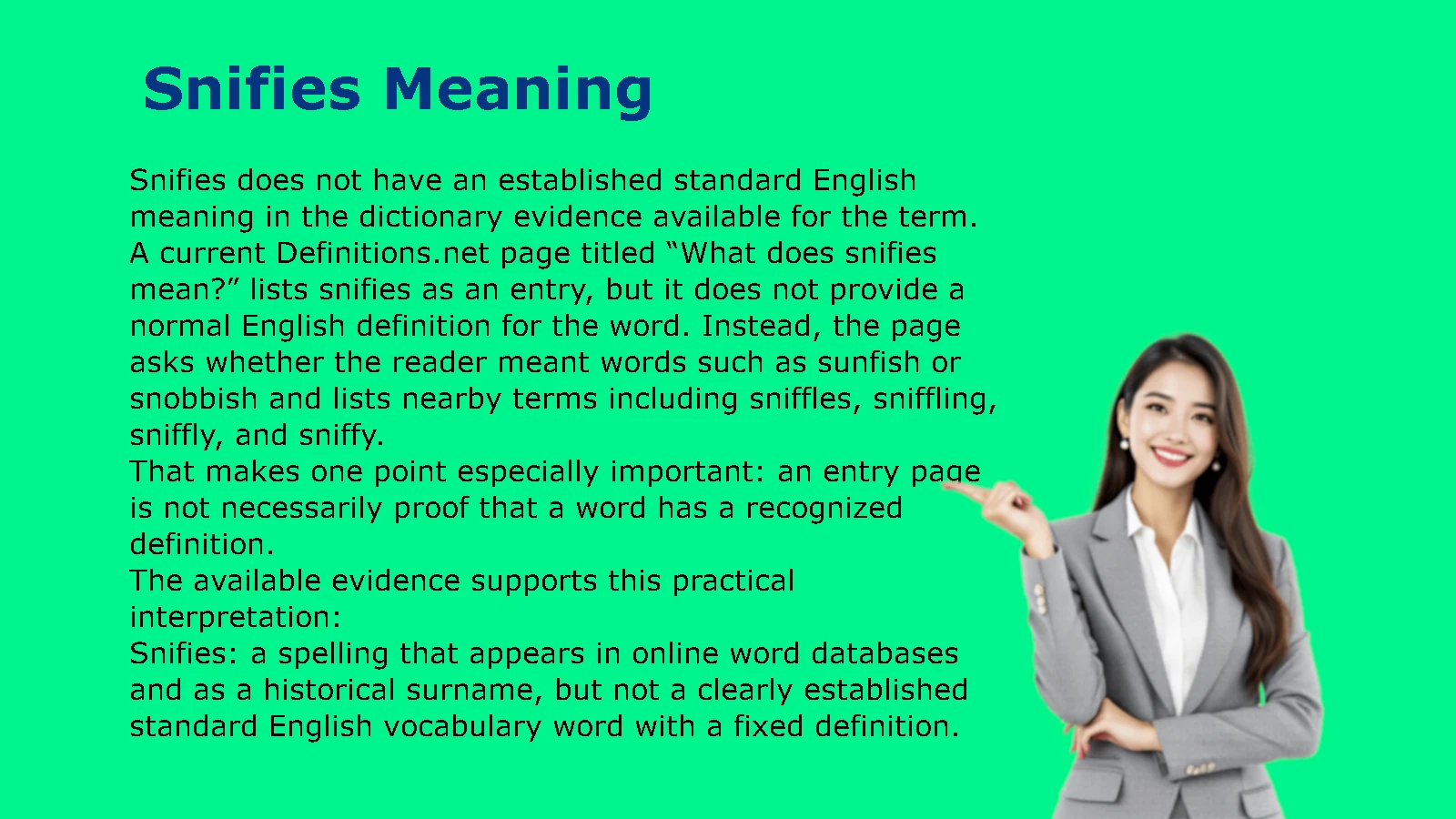
Snifies does not have an established standard English meaning in the dictionary evidence available for the term.
A current Definitions.net page titled “What does snifies mean?” lists snifies as an entry, but it does not provide a normal English definition for the word. Instead, the page asks whether the reader meant words such as sunfish or snobbish and lists nearby terms including sniffles, sniffling, sniffly, and sniffy.
That makes one point especially important: an entry page is not necessarily proof that a word has a recognized definition.
The available evidence supports this practical interpretation:
Snifies: a spelling that appears in online word databases and as a historical surname, but not a clearly established standard English vocabulary word with a fixed definition.
This is different from saying that nobody has ever used the spelling. The spelling clearly exists in several records. What isn’t established is a conventional English vocabulary meaning.
Quick answer
| Question | Answer |
| What does snifies mean? | No standard English definition is clearly established. |
| Is snifies a common English word? | No. |
| Is Snifies a surname? | Yes. Historical US records document it as a surname. |
| Does snifies mean sniffles? | Not according to the available dictionary evidence. |
| Could it be a typo? | Yes, depending on the sentence where it appears. |
| Does capitalization matter? | Yes. “Snifies” may indicate a name rather than ordinary vocabulary. |
Is “Snifies” a Real Word?
The answer requires a little nuance.
Snifies is a real spelling, but that doesn’t necessarily mean it functions as a standard English word.
English contains thousands of words that appear in specialized databases, historical documents, names, dialects, trademarks, usernames, and other sources without becoming part of everyday standard vocabulary. A search engine can also return a spelling because it appears somewhere online. That evidence alone isn’t enough to establish a dictionary meaning.
For example, Snifies appears in historical surname records. Ancestry’s surname database reports 29 records connected with the name, including census and voter records.
That makes the spelling real in a documentary sense.
However, a reader asking for snifies meaning is usually looking for something different: a definition such as “snifies means ___.” The available evidence doesn’t support filling that blank with a definite standard English meaning.
Word versus name
A useful way to understand the issue is to separate vocabulary from names.
A vocabulary word has a recognized meaning that speakers can generally use in sentences.
For example:
- sniff means to take air in through the nose.
- sniffle means to sniff repeatedly.
- sniffy can mean showing a haughty or disdainful attitude.
By contrast, a surname identifies people or families. It doesn’t need to have an everyday dictionary definition.
So Snifies can be documented as a name without being a standard English vocabulary word.
Snifies as a Surname
One of the clearest documented uses of Snifies is as a family name.
Ancestry’s historical surname information lists Snifies and reports 29 records, including 22 census and voter records and seven family tree records.
The historical concentration is particularly interesting.
According to the same database, the Snifies surname was found in the United States in 1880. The records show 11 Snifies families living in South Carolina, representing all of the recorded Snifies families in the United States in that dataset for that year.
Snifies surname facts
| Fact | Historical record |
| Surname | Snifies |
| US records listed by Ancestry | 29 |
| Census and voter records | 22 |
| Family tree records | 7 |
| US appearance reported | 1880 |
| Families recorded in 1880 | 11 |
| State with recorded concentration in 1880 | South Carolina |
These figures describe the records available in Ancestry’s database. They shouldn’t be interpreted as a complete count of every person who has ever carried the surname.
Does the surname have a known meaning?
The available Ancestry entry documents the surname but doesn’t establish a definitive etymology for Snifies. It lists similar surnames such as Sniffen, Snipes, Scifres, Silfies, Nieves, Nies, Spies, Sires, Sides, and Snider.
Similar spelling does not prove common ancestry, though.
That is an important rule in surname research. Two names can look alike because of spelling changes, transcription errors, regional pronunciation, or coincidence. Without reliable genealogical or historical evidence, assigning a specific origin to Snifies would be speculation.
Snifies vs. Sniffles
The most likely source of confusion is sniffles.
The two spellings look similar:
- snifies
- sniffles
But they aren’t interchangeable.
Sniffles is a recognized English word. Merriam Webster defines sniffle as a verb meaning “to sniff repeatedly” and uses the plural noun sniffles for a head cold marked by nasal discharge or for the act or sound of sniffling.
So if someone writes:
“I have the sniffles.”
the meaning is clear. The person probably has a mild cold or is experiencing repeated nasal sniffing.
If someone writes:
“I have the snifies.”
the intended meaning isn’t clear from standard English vocabulary alone.
Why the confusion happens
The confusion is understandable because English has several closely related forms built around sniff.
| Word | Meaning |
| sniff | To take air in through the nose, often to smell something |
| sniffle | To sniff repeatedly |
| sniffles | Repeated sniffing or a mild cold with nasal symptoms |
| sniffling | The act of repeatedly sniffing |
| sniffy | Haughty, disdainful, or expressing superiority |
| snifies | No clearly established standard English definition |
Cambridge Dictionary defines sniff as taking air in through the nose to smell something. It also recognizes another use involving taking air in quickly through the nose, often to prevent nasal liquid from running.
Merriam Webster traces sniffle to sniff and records its first known use as a verb in 1632. The noun sense dates to around 1825.
That established history is very different from the evidence available for snifies.
Snifies vs. Sniffling
Sniffling is another word that can cause confusion.
Sniffling is the present participle of sniffle. Cambridge identifies sniffing as the present participle of sniff, while Merriam Webster gives sniffling as the form associated with sniffle.
For example:
“The child kept sniffling because of the cold.”
Here, sniffling describes repeated sniffing.
By comparison, there is no equivalent standard definition that can safely be assigned to snifies.
This is why replacing an unfamiliar word with a familiar nearby word can be risky. The spelling may look close, but the intended word could depend entirely on the original sentence.
Snifies vs. Sniffy
Sniffy is another genuine English word that resembles snifies.
Merriam Webster defines sniffy as an adjective meaning haughty or disdainful. The dictionary gives examples of someone being “sniffy” about people who don’t meet their standards.
For example:
“She sounded sniffy about the restaurant.”
Here, sniffy doesn’t necessarily mean someone is physically sniffing. Instead, it describes an attitude of superiority or disdain.
That second meaning can surprise readers because the word looks like it should relate only to the nose.
The key difference
Sniffy has an established dictionary meaning. Snifies does not have the same level of standard English recognition.
Don’t assume that adding or changing a few letters creates a valid grammatical form.
Could “Snifies” Be a Misspelling?
Yes. Snifies could be a misspelling, especially if it appears in informal writing.
However, there isn’t enough evidence to say that every occurrence of snifies is a misspelling. Some occurrences may refer to the surname Snifies, while others could represent an unusual, local, informal, or context specific usage.
The safest approach is to inspect the sentence.
Possible intended words
If you encounter snifies, check whether the writer may have intended:
- sniffles
- sniffle
- sniffling
- sniffy
- sniff
- another word entirely
- the surname Snifies
For example, suppose a message says:
“He has snifies after being outside all morning.”
The surrounding context suggests a possible reference to sniffles, especially if the sentence discusses a runny nose or cold symptoms.
Now imagine:
“The Snifies family moved to South Carolina.”
Here, Snifies is clearly functioning as a proper name.
The sentence changes everything.
How to Understand “Snifies” in a Sentence
When a word doesn’t have a clear dictionary definition, context becomes the best clue.
Start by examining how the word functions grammatically.
Check whether it is capitalized
Capitalization can provide an immediate clue.
Snifies with a capital S may be a surname or another proper name.
For example:
“The Snifies family appears in the historical record.”
That sentence treats Snifies as a name.
On the other hand:
“She snifies whenever she gets a cold.”
would make the word look like a verb.
That doesn’t make the verb valid standard English. It simply shows how the writer is using it.
Look at the surrounding words
The words around snifies often reveal the intended meaning.
If the sentence contains words such as:
- cold
- nose
- sneeze
- tissue
- runny
- allergy
- sick
then the writer may have intended a word related to sniffles or sniffling.
If the sentence contains:
- family
- surname
- ancestor
- census
- South Carolina
- genealogy
then Snifies is more likely to be a name.
Check the grammatical role
Ask whether the term acts like a:
- noun
- verb
- adjective
- surname
- username
- brand or title
This simple test can eliminate several possibilities.
A standard English word normally fits recognizable grammatical patterns. Snifies, however, doesn’t have an established standard form that allows readers to confidently determine its grammatical role without context.
A Practical Example of Context Analysis
Consider three sentences.
Example: Possible misspelling
“I woke up with snifies after sleeping in the cold.”
The sentence sounds as though the writer may have intended sniffles.
Merriam Webster recognizes the sniffles as an informal expression for a mild cold that causes frequent sniffling.
Example: Historical surname
“The Snifies family appears in the 1880 census.”
Here, Snifies works as a surname. Historical records support that use. Ancestry reports Snifies families in South Carolina in the 1880 US census data.
Example: Unclear informal usage
“He snifies when he talks.”
This sentence doesn’t provide enough evidence to establish what snifies means. A reader shouldn’t automatically replace it with sniffles unless the context supports that interpretation.
The lesson is simple: don’t turn an uncertain spelling into a confident definition.
What Does Snifies Mean in Texting?
If you encountered snifies in a text message, there is no universally recognized texting meaning that can be assigned to it.
Informal online communication often contains:
- typos
- autocorrect mistakes
- shortened forms
- invented words
- usernames
- inside jokes
- playful spellings
Because of that, a nonstandard word can make sense to the people involved even when a dictionary doesn’t recognize it.
For example, friends might invent a word and use it repeatedly within a private conversation. That doesn’t automatically give the word a standard English definition.
What should you do if someone texts “snifies”?
Look at the surrounding message.
When necessary, the simplest solution is to ask:
“What do you mean by snifies?”
That’s better than confidently guessing.
Is Snifies the Same as Sniffles?
No. Snifies and sniffles should not be treated as the same word.
Sniffles has a documented English meaning. Merriam Webster defines the noun sniffles as a head cold marked by nasal discharge and also as the act or sound of sniffling.
Snifies, by contrast, lacks a comparable standard English definition in the dictionary evidence reviewed.
The difference can be summarized like this:
| Term | Standard English meaning? | Typical use |
| snifies | Not clearly established | Unclear, surname, possible misspelling |
| sniffles | Yes | Mild cold or repeated sniffing |
| sniffle | Yes | Repeatedly sniff |
| sniffling | Yes | Repeated sniffing |
| sniffy | Yes | Haughty or disdainful |
| sniff | Yes | Smell or breathe sharply through the nose |
What Does Sniff Mean?
Understanding sniff helps explain why several of these words look alike.
Cambridge Dictionary defines sniff as taking air in through the nose to smell something. It also recognizes the use of sniff for quickly drawing air through the nose, such as when someone has a runny nose.
For example:
“The dog sniffed the box.”
The dog is using its nose to investigate a smell.
Another example:
“She kept sniffing because she had a cold.”
Here, sniffing refers to repeatedly drawing air through the nose.
The word can also have a figurative sense. Cambridge notes that sniff can describe speaking in a way that shows a low opinion of something.
That meaning connects naturally with sniffy, which can describe a haughty or disdainful attitude.
The Word Family Around Sniff
The sniff family contains several legitimate English forms.
| Word | Part of speech | Basic meaning |
| sniff | Verb/noun | Take air through the nose; a quick nasal breath |
| sniffle | Verb/noun | Sniff repeatedly; an act of sniffling |
| sniffles | Plural noun | Repeated sniffing or a mild cold |
| sniffling | Verb form | Repeatedly sniffing |
| sniffy | Adjective | Haughty or disdainful |
| sniffily | Adverb | In a sniffy or disdainful manner |
| snifies | Unestablished | No clear standard English definition |
Merriam Webster also recognizes sniffily, meaning in a sniffy or disdainful manner.
This shows why spelling can become confusing. English often creates related words by adding endings such as -le, -ing, -y, and -ly. But not every spelling that resembles an established word becomes a valid standard form.
What Does “The Sniffles” Mean?
The sniffles is a recognized informal expression.
Merriam Webster defines it as a slight or mild cold that causes a person to sniffle a lot.
For example:
“I think I’m coming down with the sniffles.”
This usually suggests a relatively mild illness with symptoms such as a runny or stuffy nose and frequent sniffing.
The expression is common enough to appear in modern news and lifestyle writing. Merriam Webster’s entry includes recent usage examples from publications such as TIME, Vulture, Architectural Digest, and PEOPLE.
That gives sniffles a strong documented usage history, unlike the uncertain vocabulary status of snifies.
Snifies Meaning: What the Evidence Actually Shows
A useful way to evaluate unusual words is to separate evidence from assumption.
Here is what the available sources establish:
- Definitions.net has a page for “snifies,” but it does not provide a conventional definition.
- The page lists nearby terms such as sniffles, sniffling, sniffly, and sniffy.
- Snifies appears as a surname in Ancestry’s historical records.
- Ancestry reports 29 Snifies records in its database.
- Ancestry’s records place 11 Snifies families in South Carolina in 1880.
- Merriam Webster recognizes sniffle and sniffles as established English forms.
- Merriam Webster recognizes sniffy as an adjective meaning haughty or disdainful.
- Cambridge recognizes sniff as both a verb and noun.
What the evidence doesn’t establish is an authoritative definition saying:
“Snifies means ______.”
That missing definition is significant.
Search Interest for “Snifies”
There is also a useful SEO clue behind the popularity of the query.
An Exploding Topics analysis of Definitions.net’s traffic reported “snifies” with an estimated monthly search volume of 74,000, a keyword difficulty of 30, and a ranking position of 6 for Definitions.net at the time of that report. The same report listed 121 search results for the query.
These figures describe search and SEO estimates, not the number of people who use snifies as a normal English word.
That distinction is crucial.
A high search volume can mean that people are repeatedly looking for an explanation of an unusual term. It doesn’t prove that the term has a well established meaning.
In fact, unusual dictionary queries can attract substantial search interest precisely because people don’t know what the word means.
What the search data tells us
| Metric | Reported figure |
| Keyword | snifies |
| Estimated monthly volume | 74K |
| Reported keyword difficulty | 30 |
| Reported ranking for Definitions.net | 6 |
| Reported search results | 121 |
These are third party SEO estimates and should be treated as estimates rather than official Google search counts.
For someone researching snifies meaning, the search demand is therefore real even though the lexical evidence remains limited.
Case Study: Why “Snifies” Can Be Misleading
Imagine someone encounters the sentence:
“The child has snifies after catching a cold.”
They search for snifies meaning and find a page with the spelling listed as an entry.
It would be tempting to conclude that snifies is simply another word for sniffles.
But the evidence doesn’t justify that conclusion.
A better investigation would compare the unfamiliar term with established sources:
Step 1: Search snifies.
The result shows an online entry but no clear conventional definition.
Step 2: Search sniffles.
A major dictionary provides a clear definition involving a mild cold or repeated sniffling.
Step 3: Compare the context.
The sentence mentions a cold, which makes sniffles a plausible intended word.
Step 4: Avoid overstating the conclusion.
The correct conclusion is that sniffles may be what the writer intended, not that snifies officially means sniffles.
That small distinction separates careful language research from guesswork.
Common Questions About Snifies
What is the definition of snifies?
Snifies does not have a clearly established standard English definition in the dictionary evidence reviewed. It appears as an entry on Definitions.net without a conventional definition and also appears as a surname in historical records.
Is snifies an English word?
It is safer to describe snifies as an attested spelling rather than a standard English vocabulary word. The spelling appears in online databases and historical surname records, but a reliable standard English definition has not been established by the sources reviewed.
Is Snifies a surname?
Yes. Ancestry documents Snifies as a surname and reports historical US records for the name. Its database includes 29 records and identifies South Carolina as the location of the recorded Snifies families in 1880.
Does snifies mean sniffles?
There is no reliable evidence that snifies is a standard synonym for sniffles. Sniffles is a recognized English word, while snifies lacks a comparable established definition.
What does snifies mean in texting?
There is no universal texting definition for snifies. It may be a typo, an invented expression, a name, or a context specific spelling. The surrounding message is necessary to determine the intended meaning.
Is snifies a misspelling of sniffles?
It could be, particularly when the context involves a cold, runny nose, or repeated sniffing. However, it shouldn’t automatically be treated as a misspelling because Snifies also exists as a documented surname.
What does sniffles mean?
Sniffles can refer to repeated sniffling or a mild cold that causes frequent sniffing. Merriam Webster recognizes both senses.
What does sniffy mean?
Sniffy means haughty, disdainful, or superior in attitude. It can describe someone who reacts dismissively toward something they consider beneath their standards.
What does sniff mean?
Sniff means to take air in through the nose, especially to smell something. It can also describe taking a quick nasal breath or speaking in a disdainful way.
Final Answer: Snifies Meaning
The clearest answer to “snifies meaning” is this:
Snifies does not have a clearly established standard English dictionary definition.
The spelling does appear online, including on a Definitions.net entry that provides no conventional definition. More importantly, Snifies is documented as a surname in historical US records. Ancestry reports 29 records for the surname and identifies 11 Snifies families living in South Carolina in 1880.
If snifies appears in an ordinary sentence about illness or the nose, it may be a misspelling of sniffles, sniffle, or sniffling. Those are established English forms with documented definitions.
The important point is not to force a definition where the evidence doesn’t support one.
Snifies is a documented spelling and surname, but it shouldn’t be presented as a standard English word with a fixed meaning unless a specific context provides evidence for that usage.