
Have you ever met someone who seems cheerful, friendly, and full of good humor? That person might be described as jovial. While Jovial Meaning may sound a little formal, this word has a warm and positive meaning that is easy to understand once you see it in context.
Jovial means cheerful, happy, friendly, and full of good humor. It is often used to describe a person’s mood, personality, or behavior when they are joyful and enjoy making others feel comfortable.
Examples:
- He was in a jovial mood at the party.
- Her jovial personality made everyone feel welcome.
The confusion is understandable. People often search for what does jovial mean, jovial meaning in English, jovial meaning in a sentence, or jovial meaning in simple words because the word isn’t as common in everyday conversation as words like happy or cheerful. And here’s the fun part: calling someone jovial suggests more than simply being happy. It often paints a picture of someone who is lively, friendly, and naturally good humored.
In this guide, you’ll learn the complete Jovial Meaning, its definition, pronunciation, synonyms, antonyms, correct usage, and examples in sentences. You’ll also discover how to use jovial in everyday English and how it differs from words such as cheerful, joyful, merry, and happy.
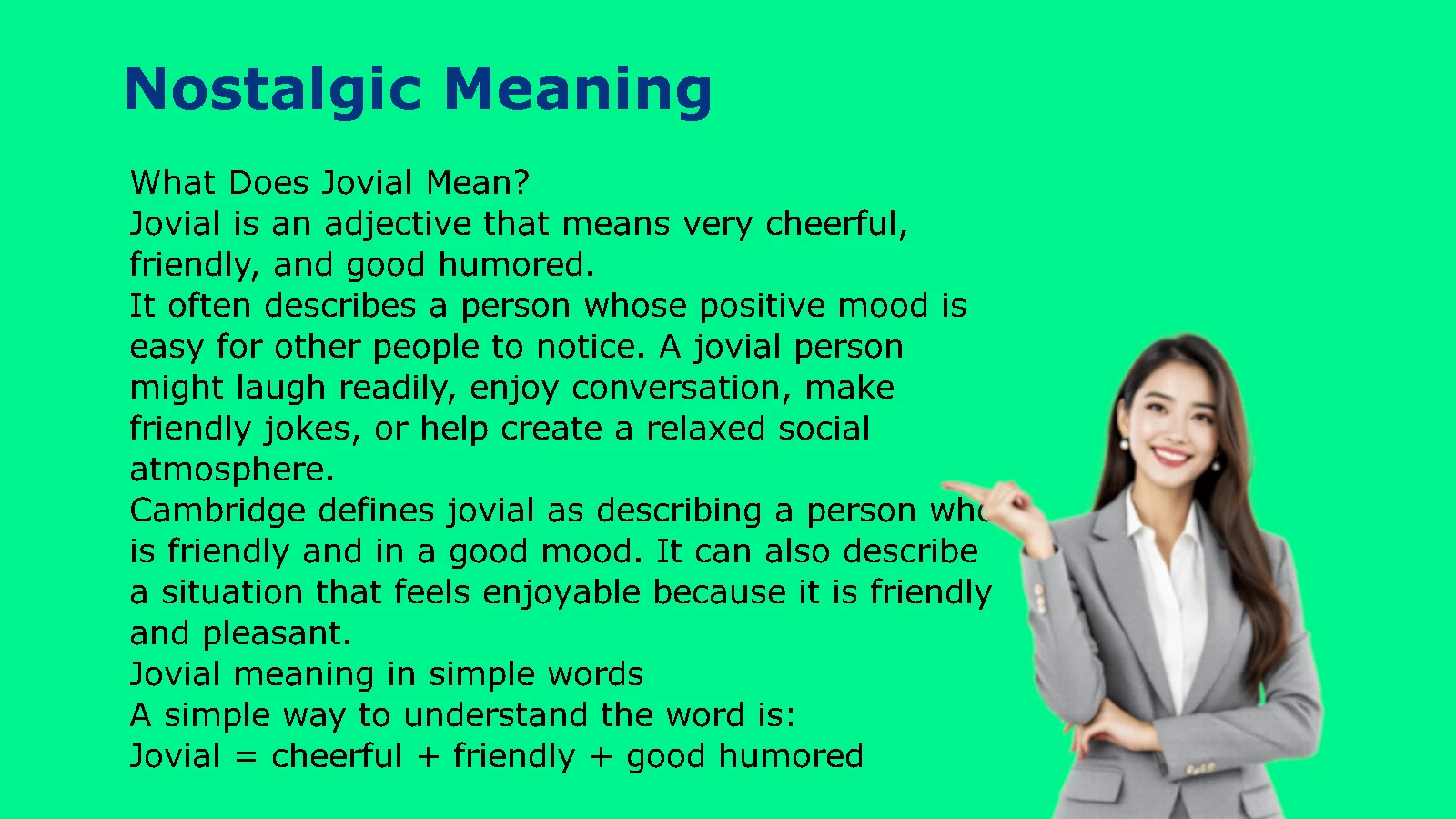
What Does Jovial Mean?
Jovial is an adjective that means very cheerful, friendly, and good humored.
It often describes a person whose positive mood is easy for other people to notice. A jovial person might laugh readily, enjoy conversation, make friendly jokes, or help create a relaxed social atmosphere.
Cambridge defines jovial as describing a person who is friendly and in a good mood. It can also describe a situation that feels enjoyable because it is friendly and pleasant.
Jovial meaning in simple words
A simple way to understand the word is:
Jovial = cheerful + friendly + good humored
Think of a family gathering where one relative tells funny stories, greets everyone warmly, and keeps the conversation moving. That person might be described as jovial.
The word usually carries a stronger social feeling than simply saying someone is happy.
Someone can be happy while sitting quietly and reading a book. Someone who is jovial tends to express that good mood through friendly interaction, laughter, warmth, or lively conversation.
Quick definition
| Word | Meaning |
| Jovial | Very cheerful, friendly, and good humored |
| Part of speech | Adjective |
| Pronunciation | JOH-vee-ul |
| US IPA | /ˈdʒoʊ.vi.əl/ |
| Noun form | Joviality |
| Adverb | Jovially |
| Common synonyms | Jolly, cheerful, merry, genial, convivial |
Oxford lists jovial as an adjective meaning “very cheerful and friendly” and gives common combinations such as jovial mood and jovial personality.
Jovial Definition and Meaning
The most useful definition of jovial centers on good humor and friendly cheerfulness.
Merriam Webster defines it as being characterized by good humored cheerfulness and conviviality. It also lists jolly as a synonym.
That definition contains a few ideas worth unpacking.
Cheerful
A jovial person usually has a noticeably positive mood.
They aren’t merely having a neutral or pleasant day. Their attitude tends to show energy, warmth, or enthusiasm.
Example:
“She gave the team a jovial greeting when she arrived.”
Friendly
Jovial behavior often involves other people.
A jovial person may enjoy chatting, laughing, joking, welcoming guests, or making others feel comfortable.
Example:
“The jovial waiter made the restaurant feel welcoming.”
Good humored
Someone who is jovial usually has a lighthearted attitude.
They may joke around, laugh easily, or respond to everyday situations with warmth rather than irritation.
Example:
“Despite the long wait, he remained jovial.”
Convivial
Convivial refers to a friendly, lively atmosphere or an enjoyment of social company.
This explains why jovial works so naturally with words such as mood, gathering, evening, host, personality, and atmosphere.
What Does Jovial Mean in a Sentence?
The meaning becomes much easier to understand when you see the word in context.
Consider these examples:
- He is a jovial man who enjoys meeting new people.
- Everyone was in a jovial mood after the celebration.
- The dinner had a jovial atmosphere.
- She gave her guests a jovial welcome.
- His jovial personality made the meeting less tense.
- The group shared a jovial conversation over coffee.
- Our teacher remained jovial even after a hectic morning.
- The normally serious manager seemed unusually jovial today.
Notice the pattern. In each sentence, jovial points toward visible good humor and positive social energy.
How Do You Pronounce Jovial?
In American English, jovial is pronounced:
JOH-vee-ul
The US pronunciation is /ˈdʒoʊ.vi.əl/. Cambridge breaks the sound into the equivalent of j as in “jump,” oh as in “nose,” v as in “very,” followed by the sounds in “happy,” “above,” and “look.”
Pronunciation breakdown
JOH + vee + uhl
The stress falls on the first syllable:
JOH-vee-ul
Example
“He has a JOH-vee-ul personality.”
Don’t pronounce it like joy-vial. The first part sounds like JOH, not the full word joy.
Jovial as an Adjective
Jovial is an adjective. It describes a person, mood, behavior, atmosphere, or situation.
You can place it directly before a noun:
- a jovial person
- a jovial host
- a jovial mood
- a jovial personality
- a jovial atmosphere
- a jovial smile
- a jovial conversation
- a jovial gathering
You can also use it after a linking verb:
- “He was jovial.”
- “She seemed jovial.”
- “They remained jovial.”
- “The crowd became jovial after the announcement.”
This makes jovial flexible enough for everyday descriptions as well as polished writing.
Examples of Jovial in a Sentence
The best way to understand jovial meaning is to see how the word changes slightly with context.
Jovial describing a person
“My grandfather was a jovial man who loved telling stories.”
The sentence suggests more than happiness. It paints a picture of someone warm, sociable, and good humored.
Jovial describing a mood
“The entire office was in a jovial mood after the project ended.”
Here, jovial describes the collective emotional atmosphere.
Jovial describing a personality
“Her jovial personality helped new employees feel comfortable.”
The word suggests that her cheerful nature affects the people around her.
Jovial describing an atmosphere
“The café had a jovial atmosphere on Saturday afternoon.”
The setting itself feels friendly, lively, and pleasant.
Jovial describing a conversation
“Their jovial conversation continued long after dinner ended.”
The conversation wasn’t merely informative. It was warm, relaxed, and cheerful.
Jovial describing a welcome
“The guests received a jovial welcome from their hosts.”
The welcome felt genuinely warm and cheerful.
Common Words Used With Jovial
Certain nouns naturally pair with jovial. These combinations can help you use the word more accurately.
| Phrase | What it describes |
| Jovial mood | A cheerful emotional state |
| Jovial personality | A naturally cheerful and friendly character |
| Jovial person | Someone who is notably cheerful and good humored |
| Jovial host | A warm, cheerful person welcoming guests |
| Jovial atmosphere | A friendly and lively setting |
| Jovial smile | A cheerful, good humored expression |
| Jovial conversation | Friendly and cheerful talk |
| Jovial gathering | A lively and pleasant social event |
| Jovial manner | A cheerful way of behaving |
| Jovial welcome | A warm and cheerful reception |
Oxford specifically identifies mood and personality among nouns commonly used with jovial.
When Should You Use the Word Jovial?
Jovial works best when you want to describe more than basic happiness.
Use it when someone displays a combination of:
- Cheerfulness
- Friendliness
- Good humor
- Sociability
- Warmth
- Lively energy
- Lightheartedness
For example, imagine two people.
Person A: Smiles quietly while reading a book.
Person B: Greets everyone, laughs easily, tells jokes, and keeps the conversation lively.
You could call both people happy, but jovial fits Person B more naturally.
That’s the useful distinction.
A practical test
Ask yourself:
Does this person or situation feel cheerful, friendly, and socially warm?
If the answer is yes, jovial may be an excellent choice.
Jovial vs. Happy
These words overlap, but they’re not identical.
Happy is broad. It can describe almost any positive emotional state.
Jovial is more specific. It usually suggests cheerful behavior combined with friendliness or good humor.
Compare:
“She was happy about the promotion.”
This tells you how she felt.
“She was jovial after receiving the promotion.”
This suggests that her happiness showed through her lively, friendly behavior.
Happy focuses on the emotion.
Jovial often focuses on the cheerful manner in which that emotion appears.
Jovial vs. Cheerful
Cheerful is one of the closest everyday alternatives to jovial.
Both words describe positive moods. However, cheerful is broader and often less expressive.
| Word | Main idea |
| Cheerful | Happy, positive, and pleasant |
| Jovial | Very cheerful, friendly, and good humored |
For example:
“She has a cheerful personality.”
This means she tends to be positive and pleasant.
“She has a jovial personality.”
This gives a stronger impression of warmth, humor, and lively social energy.
Jovial vs. Jolly
Jolly and jovial are close synonyms. Merriam Webster lists jolly among the direct synonyms of jovial.
Still, they have slightly different flavors.
Jolly often suggests lively high spirits, laughter, joking, or playful behavior.
Jovial often emphasizes friendly good humor and social warmth.
Compare:
“The jolly children ran around the yard.”
The focus is on lively happiness.
“The jovial host welcomed everyone into his home.”
The focus is on warmth and good fellowship.
In many everyday sentences, you could replace one with the other without creating a major change in meaning.
Jovial vs. Merry
Merry often has a festive or celebratory feeling.
Think of:
- a merry celebration
- merry laughter
- a merry group
- a merry evening
Jovial, meanwhile, emphasizes good humor and friendliness.
Merriam Webster notes that merry suggests cheerful and uninhibited enjoyment of festivity, while jovial suggests conviviality and good fellowship.
So:
Merry → festive happiness
Jovial → friendly good humor
Jovial vs. Joyful
The difference between jovial and joyful is subtle but useful.
Joyful means full of joy.
Jovial means cheerful and good humored, often with a social quality.
For example:
“She felt joyful when she saw her family.”
The emphasis is on deep happiness.
“She was jovial during the family dinner.”
The emphasis is on her cheerful, friendly behavior.
A person can feel joyful internally. A jovial person tends to show cheerful energy outwardly.
Jovial vs. Genial
Genial describes someone who is warm, friendly, and pleasant.
Jovial adds a stronger sense of cheerfulness and good humor.
Consider these examples:
“The genial manager greeted every customer.”
The manager is warm and pleasant.
“The jovial manager joked with every customer.”
The manager is not only pleasant. He is cheerful and good humored.
This small distinction can make your writing more precise.
Synonyms for Jovial
Several words can replace jovial, depending on the exact meaning you want.
Common synonyms
- Cheerful
- Jolly
- Merry
- Genial
- Friendly
- Convivial
- Joyful
- Mirthful
- Lighthearted
- Good humored
- Lively
- Upbeat
- Cheery
- Festive
Merriam Webster’s thesaurus includes words such as jolly, merry, festive, cheerful, lively, mirthful, joyful, playful, lighthearted, and upbeat among related terms.
However, synonyms aren’t interchangeable in every sentence.
Best synonym by context
| If you mean… | Try… |
| Generally happy and positive | Cheerful |
| Lively and good natured | Jolly |
| Festive and celebratory | Merry |
| Warm and pleasant | Genial |
| Social and enjoyable | Convivial |
| Full of joy | Joyful |
| Light and carefree | Lighthearted |
| Full of laughter or humor | Mirthful |
Choosing the right synonym is like choosing the right lens on a camera. Several lenses can capture the same scene, but each one highlights something different.
Antonyms of Jovial
The opposite of jovial depends on which part of the meaning you want to contrast.
Common antonyms include:
- Gloomy
- Sullen
- Grumpy
- Somber
- Unhappy
- Miserable
- Surly
- Morose
- Grouchy
- Solemn
For example:
Jovial: “He greeted everyone with a broad smile and a joke.”
Sullen: “He barely spoke and avoided eye contact.”
The contrast isn’t simply happiness versus sadness. It can also involve social openness versus withdrawal and good humor versus irritability.
Is Jovial a Positive Word?
Yes. Jovial is normally a positive word.
Calling someone jovial usually suggests that the person is:
- Cheerful
- Friendly
- Good natured
- Pleasant to be around
- Warm
- Sociable
- Full of good humor
For example:
“Everyone enjoys working with Maria because she has such a jovial personality.”
That’s clearly complimentary.
However, context matters. A writer might use jovial ironically or describe someone as outwardly jovial when the surrounding situation suggests something more complicated. The word itself still carries a positive core meaning.
Is Jovial Formal or Informal?
Jovial is neither highly formal nor strongly informal. It is a standard English adjective that can appear in conversation, fiction, journalism, essays, and professional writing.
That said, it can sound more descriptive or polished than simple words such as happy or friendly.
Compare:
“He was happy and friendly.”
“He was jovial.”
The second sentence is shorter, but it packs several related ideas into one word.
You might use jovial when you want your writing to feel vivid without becoming overly elaborate.
Joviality: The Noun Form of Jovial
The noun form is joviality.
Joviality means the quality or state of being jovial.
Example:
“His joviality made the long journey more enjoyable.”
Another example:
“The restaurant was filled with laughter and joviality.”
Oxford lists joviality as the noun form, while Merriam Webster also recognizes it as a related word.
Jovial vs. joviality
- Jovial → adjective
- Joviality → noun
Example:
“She has a jovial personality.”
“Her joviality lifted everyone’s spirits.”
Jovially: The Adverb Form
Jovially is the adverb form.
It means in a cheerful and friendly way.
Examples:
“He laughed jovially.”
“She greeted the visitors jovially.”
“The two friends chatted jovially while preparing dinner.”
Here, jovially tells you how someone performed an action.
Word family
| Word | Part of speech | Meaning |
| Jovial | Adjective | Cheerful and friendly |
| Joviality | Noun | Cheerful friendliness or good humor |
| Jovially | Adverb | In a cheerful, friendly way |
The Origin of the Word Jovial
The history of jovial is more unusual than its everyday meaning suggests.
The word ultimately comes from Jove, another name for Jupiter, the chief Roman god. Its linguistic path runs through Late Latin jovialis, meaning “of Jupiter” or “of Jove.” English adopted jovial in the late 16th century. Merriam Webster gives 1592 as its first known use in English.
Oxford likewise traces the word to French and Late Latin jovialis, connected with Jupiter and the supposed influence of the planet on people born under it.
How Jupiter became connected with happiness
The connection came through astrology.
In historical astrology, Jupiter was associated with favorable qualities. People believed that someone born under Jupiter’s influence could possess a cheerful or fortunate temperament.
That idea eventually produced the sense of jovial that we recognize today.
The path looks roughly like this:
Jupiter / Jove → jovialis (“of Jupiter”) → astrological influence → cheerful temperament → modern “jovial”
Merriam Webster explains that English speakers initially used the word in an astrological sense before applying it more broadly to people with a cheerful, good natured character.
Jovial and Jovian are not the same
This history creates an easy point of confusion.
Jovial means cheerful and good humored.
Jovian means relating to Jupiter.
So:
“He has a jovial personality.”
means he is cheerful.
But:
“Jovian planets include Jupiter, Saturn, Uranus, and Neptune.”
uses Jovian in an astronomical sense.
Don’t swap these words simply because both trace back to Jupiter.
A Real World Example of Jovial
Imagine a restaurant celebrating its anniversary.
The owner welcomes customers at the door. He remembers regulars by name, laughs with the kitchen staff, tells harmless jokes, and keeps chatting with guests even though the restaurant is busy.
A description such as:
“The owner maintained a jovial manner throughout the celebration.”
works well because the behavior combines friendliness, humor, warmth, and social energy.
Now imagine the same owner quietly smiling at a table while eating dinner.
You might call him content, happy, or relaxed.
Jovial would be possible, but it would be less precise unless his behavior showed the lively friendliness associated with the word.
That distinction matters.
How to Use Jovial in Everyday Writing
If you want to use jovial naturally, focus on situations where cheerfulness is visible.
In personal descriptions
“My uncle is a jovial person who can start a conversation with anyone.”
In workplace writing
“Her jovial attitude helped create a relaxed team environment.”
In storytelling
“The jovial innkeeper welcomed the travelers with a smile.”
In descriptive writing
“Laughter filled the jovial room as friends exchanged stories.”
In casual conversation
“He was in a pretty jovial mood today.”
The word works particularly well when you want to create a quick picture of someone’s personality.
Common Mistakes With Jovial
Mistaking jovial for simply happy
Not every happy person is necessarily jovial.
Happy describes a broad emotional state. Jovial usually suggests a more expressive, good humored, and socially warm form of cheerfulness.
Using jovial for serious situations
Calling a funeral, emergency, or tense negotiation jovial would normally clash with the context unless the word is deliberately ironic.
The word carries a strong positive emotional tone.
Confusing jovial with Jovian
Remember:
- Jovial = cheerful and good humored
- Jovian = related to Jupiter
They share an origin but have different modern meanings.
Assuming jovial always means funny
A jovial person may joke and laugh, but jovial doesn’t specifically mean funny.
Someone can be jovial without telling jokes. A warm smile, friendly conversation, and cheerful manner can create the same effect.
Jovial in Different Contexts
The meaning stays consistent, but the emphasis changes slightly depending on what jovial describes.
| Context | Example | What jovial emphasizes |
| Person | “He is jovial.” | Cheerful personality |
| Mood | “She was in a jovial mood.” | Positive emotional state |
| Personality | “His jovial personality stood out.” | Consistent good humor |
| Atmosphere | “The atmosphere was jovial.” | Friendly social energy |
| Conversation | “They had a jovial conversation.” | Warm, cheerful interaction |
| Gathering | “It was a jovial gathering.” | Lively friendliness |
| Welcome | “We received a jovial welcome.” | Cheerful hospitality |
| Manner | “He spoke in a jovial manner.” | Friendly, good humored behavior |
Jovial Meaning: A Quick Comparison
The easiest way to remember the word is to compare it with nearby terms.
| Word | Basic meaning | Key difference |
| Jovial | Cheerful and friendly | Strong good humor and social warmth |
| Happy | Feeling pleasure or satisfaction | Much broader |
| Cheerful | Positive and upbeat | More general |
| Jolly | Lively and cheerful | Often more playful |
| Merry | Cheerful and festive | Often connected with celebration |
| Joyful | Full of joy | Strong focus on happiness |
| Genial | Warm and friendly | More focused on pleasant manner |
| Convivial | Sociable and enjoyable | Strong focus on social interaction |
| Mirthful | Full of laughter or amusement | Stronger focus on amusement |
| Gloomy | Dark or unhappy in mood | A clear contrast |
Merriam Webster makes a particularly useful distinction among merry, blithe, jocund, jovial, and jolly: jovial emphasizes conviviality and good fellowship, while jolly more strongly suggests laughter, banter, and joking.
Frequently Asked Questions About Jovial Meaning
What does jovial mean?
Jovial means very cheerful, friendly, and good humored. It often describes someone whose positive mood shows through warm interaction, laughter, or lively conversation.
What is a simple synonym for jovial?
Cheerful is one of the simplest synonyms. Jolly and merry are also close, although each has a slightly different shade of meaning.
Is jovial a positive word?
Yes. Jovial normally has a positive meaning and describes someone or something cheerful, pleasant, and good natured.
Can jovial describe a person?
Yes. In fact, describing a person as jovial is one of the most common uses.
“He is a jovial man who enjoys meeting new people.”
Can jovial describe a mood?
Yes.
“Everyone was in a jovial mood after the celebration.”
Oxford specifically gives jovial mood as a common example.
What is the opposite of jovial?
Common opposites include gloomy, sullen, morose, grumpy, somber, and unhappy.
The best choice depends on the exact opposite you want to express.
What is the difference between jovial and cheerful?
Cheerful is broader. Jovial usually adds a stronger sense of friendliness, good humor, and lively social interaction.
What is the difference between jovial and jolly?
Both mean cheerful and good humored. Jolly often suggests lively joking or high spirits, while jovial more strongly suggests warm social friendliness and good fellowship.
What is the noun form of jovial?
The noun is joviality.
“Her joviality made everyone feel welcome.”
What is the adverb form of jovial?
The adverb is jovially.
“He laughed jovially.”
How do you pronounce jovial?
In US English, jovial is pronounced JOH-vee-ul, with the IPA pronunciation /ˈdʒoʊ.vi.əl/.
What is the origin of jovial?
Jovial comes through French from Late Latin jovialis, meaning “of Jupiter” or “of Jove.” Historical astrology associated Jupiter with favorable and cheerful qualities, which helped produce the modern meaning.
Is jovial the same as funny?
No. Funny means causing amusement or laughter. Jovial describes a person’s or situation’s cheerful, friendly, good humored character.
A jovial person might be funny, but being funny isn’t required.
Final Takeaway: Jovial Meaning
The clearest definition of jovial is:
Jovial means very cheerful, friendly, and good humored.
The word usually describes a person who brings warmth and positive energy into social situations. It can also describe a mood, personality, atmosphere, conversation, gathering, welcome, or manner.
If happy is the broad idea, jovial adds color to the picture. It suggests someone who isn’t merely feeling good but is expressing that good humor in a warm, lively, and friendly way.
Remember it this way:
Jovial = cheerful + friendly + good humored.
That combination is what gives the word its distinctive meaning.