
What Is the Contradict Meaning?
Contradict means to say or prove that something is false, incorrect, or inconsistent. It can also mean expressing the opposite of what someone else has said or presenting information that conflicts with another statement.
Examples:
- His actions contradict his words.
- The new evidence contradicts the witness’s statement.
The confusion often arises because contradict can describe disagreeing with someone, saying the opposite of a statement, or proving that something is false. But here’s the kicker: using it incorrectly can change the meaning of your sentence and weaken your communication.
In this guide, you’ll learn the meaning of contradict, its definition, pronunciation, part of speech, synonyms, antonyms, and how to use contradict in a sentence. You’ll also discover common examples, everyday uses, and simple memory tips to help you use the word confidently in both speaking and writing.
What Does Contradict Mean?
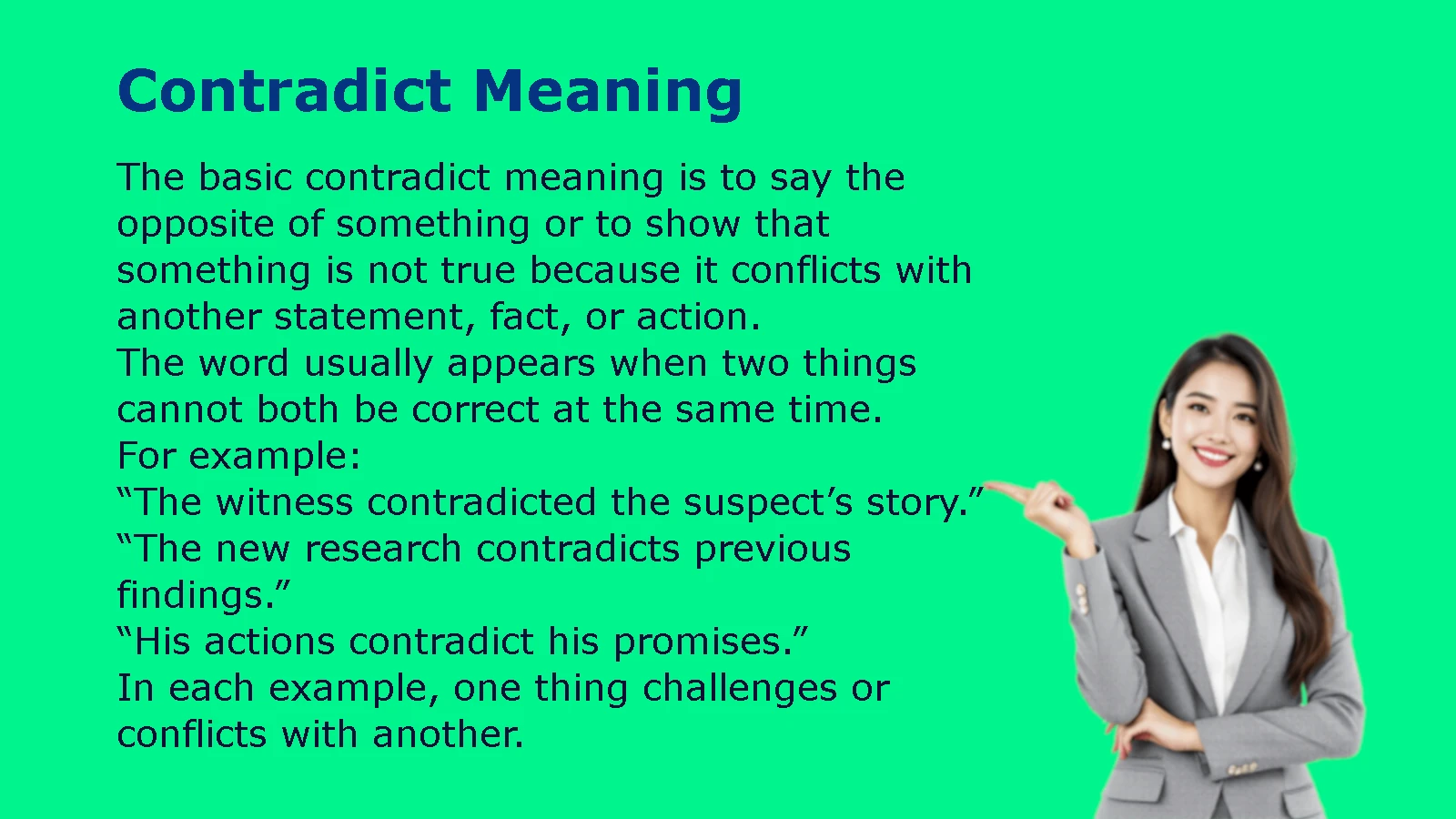
The basic contradict meaning is to say the opposite of something or to show that something is not true because it conflicts with another statement, fact, or action.
The word usually appears when two things cannot both be correct at the same time.
For example:
- “The witness contradicted the suspect’s story.”
- “The new research contradicts previous findings.”
- “His actions contradict his promises.”
In each example, one thing challenges or conflicts with another.
The word contradict comes from Latin roots:
- Contra means “against” or “opposite.”
- Dicere means “to say.”
Together, the original idea means “to speak against.”
Today, the word has expanded beyond speech. It can describe conflicts between:
- Statements
- Evidence
- Beliefs
- Actions
- Rules
- Results
- Information
Contradict Meaning in Simple Words
If you want the easiest explanation:
To contradict means to say or do something that is the opposite of what was said or expected.
Imagine two puzzle pieces that do not fit together. A contradiction works the same way. Two ideas cannot connect because they clash.
Simple examples:
| Situation | Contradiction |
| Someone says they are saving money but buys expensive items every day | Their actions contradict their words |
| A report says sales increased, but another report says sales dropped | The reports contradict each other |
| A person says “I was home all night,” but security footage shows them outside | The evidence contradicts the claim |
Contradictions appear when there is a clear difference between what is claimed and what is shown.
Contradict Definition and Meaning in English
The verb contradict has two main meanings.
To Say the Opposite of Someone or Something
The first meaning involves directly opposing a statement.
Examples:
- “She contradicted her manager during the meeting.”
- “The student contradicted the teacher’s explanation.”
- “I’m not trying to contradict you, but the facts suggest something different.”
In these cases, one person challenges another person’s words.
However, contradicting someone does not always mean being rude or argumentative. Sometimes it simply means providing different information.
For example:
“I thought the meeting started at 3 p.m.”
“Actually, it starts at 4 p.m.”
The second speaker contradicts the first statement by correcting the information.
To Conflict With Facts, Evidence, or Reality
The second meaning involves situations rather than people.
Something contradicts another thing when the two cannot logically exist together.
Examples:
- “The evidence contradicts his explanation.”
- “The results contradict the original prediction.”
- “Her behavior contradicts her public image.”
Here, nobody necessarily speaks. The conflict happens between information or actions.
How to Pronounce Contradict
The pronunciation of contradict changes slightly depending on how it is used.
As a verb:
Contradict
Pronunciation: con-truh-DIKT
Phonetic spelling:
/ˌkɒn.trəˈdɪkt/
The stress falls on the second part:
- con-truh-DIKT
Example:
“The facts contradict his statement.”
Word Forms of Contradict
The word contradict has several related forms that appear frequently in English.
| Word Form | Meaning | Example |
| Contradict | To oppose or conflict with something | “The report contradicts the claim.” |
| Contradicts | Third person form | “This evidence contradicts the theory.” |
| Contradicted | Past tense | “She contradicted herself yesterday.” |
| Contradicting | Continuing action | “He is contradicting the information provided earlier.” |
| Contradiction | A conflict between ideas | “There is a contradiction in the statement.” |
| Contradictory | Showing disagreement or conflict | “The witness gave contradictory answers.” |
Understanding these forms helps you recognize the word in different contexts.
For example:
- Contradict → action
- Contradiction → the conflict itself
- Contradictory → describes something that conflicts
Contradict Examples in Sentences
The best way to understand the meaning of contradict is to see how people use it naturally.
Everyday Conversation Examples
Contradictions happen often in normal conversations.
Example 1:
“You said you were too busy to go out, but you posted pictures from a party.”
Your actions contradict your earlier statement.
Example 2:
“Mike said he never watches television, but he talks about new shows every week.”
His behavior contradicts his claim.
Example 3:
“I’m not contradicting you. I’m only sharing another perspective.”
This sentence shows that contradiction can happen politely.
Workplace Examples of Contradict
In professional settings, contradictions often involve reports, instructions, or decisions.
Example:
“The sales report contradicts the information shared during the meeting.”
This means the report and the meeting information do not match.
Other examples:
- “The employee’s explanation contradicted the company records.”
- “The two departments provided contradictory instructions.”
- “The data contradicts the original business forecast.”
Clear communication matters at work because conflicting information can create confusion.
Academic Examples of Contradict
Researchers often use the word contradict when discussing studies and theories.
Examples:
- “The new study contradicts earlier research.”
- “These findings contradict the traditional explanation.”
- “The argument contradicts established evidence.”
In academic writing, contradict does not always mean someone made a mistake. New evidence can challenge old ideas and lead to better understanding.
Example:
For many years, scientists have updated theories when new discoveries provided stronger evidence. A new study may contradict an older explanation because researchers have gained more accurate information.
Contradict Meaning in Literature and Writing
Writers often use contradictions to create deeper stories and stronger characters.
A character who says one thing but does another can become more interesting because real people often have conflicting emotions and behaviors.
For example:
A character might say:
“I don’t care about anyone.”
But throughout the story, they repeatedly help others.
This contradiction reveals hidden feelings and creates character development.
Authors use contradictions to:
- Create tension
- Show inner conflict
- Build suspense
- Reveal personality traits
- Make stories more realistic
A contradiction can make a reader stop and think:
“Why does this person behave this way?”
That curiosity keeps people engaged.
Contradict vs Disagree: Understanding the Difference
Many people confuse contradict with disagree, but they have different meanings.
| Contradict | Disagree |
| Means saying something opposite or showing inconsistency | Means having a different opinion |
| Often involves facts or statements | Usually involves personal views |
| Suggests one idea challenges another | Does not mean someone is wrong |
| Can involve evidence | Often involves preferences |
Examples:
Disagree:
“I disagree with your opinion about the movie.”
This means two people have different views.
Contradict:
“Your statement contradicts the information in the report.”
This means one statement conflicts with available information.
A person can disagree without contradicting.
For example:
“I think pizza is better than burgers.”
Someone else says:
“I prefer burgers.”
They disagree, but neither person contradicts the other because both opinions can be true.
However:
“The store is closed.”
and
“The store is open right now.”
These statements contradict because they cannot both be true at the same time.
Contradict vs Contradiction vs Contradictory
The words contradict, contradiction, and contradictory share the same root, but they play different roles in a sentence. Understanding the difference makes your writing more accurate and natural.
Contradict (Verb)
Contradict is an action word. It describes the act of opposing, challenging, or showing that something is incorrect.
Examples:
- “The witness contradicted the suspect’s statement.”
- “New evidence contradicts the original theory.”
- “Her actions contradict her promises.”
In each sentence, something actively conflicts with another idea.
Think of contradict as something that happens.
Someone or something contradicts something else.
Contradiction (Noun)
Contradiction is the name of the conflict itself. It describes a situation where two ideas, statements, or facts cannot both be true.
Examples:
- “There is a contradiction between his words and actions.”
- “The report contains several contradictions.”
- “Her explanation created a contradiction in the investigation.”
A contradiction is the problem or disagreement that exists.
Simple comparison:
| Word | Type | Meaning | Example |
| Contradict | Verb | To oppose something | “The facts contradict his claim.” |
| Contradiction | Noun | A conflict between ideas | “The claim contains a contradiction.” |
| Contradictory | Adjective | Describes conflicting things | “The statements are contradictory.” |
Contradictory (Adjective)
Contradictory describes something that contains opposing ideas or information.
Examples:
- “The witness gave contradictory answers.”
- “The instructions were contradictory.”
- “The two reports contain contradictory information.”
When something is contradictory, it creates confusion because the parts do not agree.
Everyday example:
Imagine a weather app says:
- “Sunny all day.”
- “Heavy rain expected this afternoon.”
Those predictions are contradictory because they suggest very different conditions.
Synonyms for Contradict
Several words have similar meanings to contradict, but each one has a slightly different use. Choosing the right synonym helps you communicate your exact meaning.
| Synonym | Meaning | Example |
| Oppose | To resist or disagree with an idea | “Many citizens opposed the new rule.” |
| Dispute | To question whether something is true | “The lawyer disputed the accusation.” |
| Deny | To say something is not true | “He denied the allegations.” |
| Challenge | To question or test an idea | “The study challenges previous beliefs.” |
| Refute | To prove something wrong with evidence | “The research refuted the old assumption.” |
| Reject | To refuse to accept something | “The committee rejected the proposal.” |
| Counter | To respond with an opposing argument | “She countered his argument with new facts.” |
Contradict vs Refute
People often confuse contradict and refute.
They are related, but they are not identical.
Contradict:
Means something conflicts with another statement.
Example:
“The new information contradicts the earlier report.”
This does not always prove the earlier report was false. It only shows a conflict.
Refute:
Means proving something wrong through evidence.
Example:
“The scientist refuted the false claim with research data.”
Refuting requires stronger evidence.
Contradict vs Deny
These words also have different meanings.
Deny:
Means refusing to accept or admit something.
Example:
“The athlete denied using illegal substances.”
Contradict:
Means providing information that conflicts with something else.
Example:
“The test results contradicted the athlete’s statement.”
A person can deny something, but evidence can contradict that denial.
Antonyms of Contradict
Antonyms are words with opposite meanings. The opposite of contradict involves agreement, support, or confirmation.
| Antonym | Meaning | Example |
| Agree | To have the same opinion | “I agree with your suggestion.” |
| Confirm | To prove something is true | “The results confirmed the prediction.” |
| Support | To strengthen an idea | “The evidence supports the theory.” |
| Match | To be consistent with something | “The records match the original information.” |
| Accept | To recognize something as valid | “She accepted the explanation.” |
| Verify | To check and prove accuracy | “The team verified the data.” |
Common Phrases Using Contradict
The word contradict appears in many common expressions. Learning these phrases helps you understand natural English usage.
Contradict Yourself
Meaning:
To say something that conflicts with something you said earlier.
Examples:
- “You’re contradicting yourself. Earlier, you said you liked the plan.”
- “The politician contradicted himself during the interview.”
People often use this phrase when someone’s statements do not match.
Contradict the Evidence
Meaning:
To conflict with facts or proof.
Examples:
- “The suspect’s story contradicts the evidence.”
- “The explanation contradicts the available data.”
This phrase appears frequently in legal, scientific, and investigative writing.
Directly Contradict
Meaning:
To strongly oppose or clearly conflict with something.
Examples:
- “The new findings directly contradict previous research.”
- “His actions directly contradict his public statements.”
The word “directly” emphasizes that the conflict is obvious.
Contradict a Statement
Meaning:
To say something that disagrees with or challenges a specific claim.
Examples:
- “The employee contradicted the manager’s statement.”
- “The witness contradicted the official report.”
Real World Examples of Contradictions
Contradictions appear everywhere. They are not limited to arguments between people.
Example: Business Reports
Imagine a company receives two reports:
Report A:
“Customer satisfaction increased by 20%.”
Report B:
“Customer complaints reached an all-time high.”
These statements may contradict each other because they describe very different situations.
A business analyst would need to investigate:
- Were different customers measured?
- Did the reports use different time periods?
- Was one report inaccurate?
Contradictions often reveal areas that need closer examination.
Example: Legal Cases
In law, contradictions can affect how people evaluate evidence.
For example:
A witness says:
“I saw the person leave the building at 9 p.m.”
Security footage shows:
The person left at 10 p.m.
The evidence contradicts the witness’s statement.
This does not automatically prove someone lied. Memory can be imperfect. However, the contradiction becomes an important part of the investigation.
Example: Science and Research
Science changes when new evidence challenges old explanations.
A new discovery may contradict an earlier theory because researchers have better tools, more information, or improved methods.
For example:
- An old explanation may fit available evidence.
- New technology reveals additional details.
- Scientists update their understanding.
A contradiction in science often leads to progress.
Why Understanding Contradictions Matters
Recognizing contradictions helps you become a better communicator and thinker.
It Improves Critical Thinking
When you notice contradictions, you can ask better questions:
- Do these facts match?
- Which source is more reliable?
- Is there missing information?
- Can both statements be true?
This skill helps in school, work, and daily decisions.
It Prevents Misunderstandings
Conflicting information can create confusion.
For example:
A manager tells employees:
“Submit the project by Friday.”
Later, another message says:
“The project is due Monday.”
The instructions contradict each other.
Identifying the contradiction helps solve the problem quickly.
It Makes Writing Stronger
Good writers use contradictions to:
- Create interesting characters
- Explain complex ideas
- Show different perspectives
- Build stronger arguments
A well-written argument often acknowledges opposing views before explaining why one position is stronger.
Common Mistakes When Using Contradict
Although contradict meaning seems simple, many learners misuse the word.
Here are common mistakes and how to fix them.
Mistake: Using Contradict When You Mean Disagree
Incorrect:
“I contradict your opinion about the movie.”
Better:
“I disagree with your opinion about the movie.”
Why?
An opinion can be different without being contradictory.
Mistake: Confusing Contradict With Contradiction
Incorrect:
“His answer was a contradict.”
Correct:
“His answer was a contradiction.”
Why?
- Contradict = verb
- Contradiction = noun
Mistake: Using Contradict Without an Object
Incorrect:
“She contradicted.”
Correct:
“She contradicted the report.”
The reader usually needs to know what was challenged.
Mistake: Thinking Contradict Always Means Lie
A contradiction does not automatically mean someone is dishonest.
People can contradict themselves because of:
- Memory mistakes
- New information
- Misunderstandings
- Changing opinions
- Different perspectives
A contradiction shows inconsistency. It does not always prove bad intentions.
Contradict Meaning in Different Contexts
The meaning of contradict stays the same across different fields, but people use it in unique ways depending on the situation. Understanding these contexts helps you recognize how the word works in real conversations, professional settings, and academic discussions.
Contradict Meaning in Communication
In everyday communication, people use contradict when someone challenges another person’s words, opinions, or statements.
A contradiction can happen during a casual conversation, a debate, or even a simple correction.
Examples:
“I thought the store closed at 8 p.m.”
“Actually, it closes at 9 p.m.”
The second statement contradicts the first because both cannot be correct at the same time.
However, contradiction does not always mean conflict or anger. Sometimes it simply helps people find the correct information.
Healthy contradictions can:
- Correct mistakes
- Add new information
- Improve understanding
- Encourage better discussions
For example, a friend might say:
“This restaurant has always been closed on Sundays.”
You reply:
“I think it recently changed its hours. I visited there last Sunday.”
You are not starting an argument. You are providing information that contradicts the original statement.
Contradict Meaning in Business and Workplace Communication
In professional environments, contradictions often appear in:
- Reports
- Emails
- Meetings
- Instructions
- Company policies
- Financial documents
Businesses rely on accurate information. When different sources contradict each other, it can lead to poor decisions.
Example:
A marketing team reports:
“Website traffic increased by 30% this month.”
A sales team reports:
“Customer inquiries dropped significantly.”
These two pieces of information may contradict each other.
A company might investigate:
- Did website visitors come from the wrong audience?
- Did the website receive traffic but fail to generate leads?
- Were different measurement methods used?
The contradiction does not necessarily mean someone made an error. It may reveal a deeper issue.
Example: Workplace Instructions
Imagine an employee receives two messages:
Email from Manager:
“Complete the project by Thursday.”
Updated calendar notice:
“Project deadline: Monday.”
These instructions contradict each other.
The employee should ask for clarification instead of guessing.
Contradict Meaning in Science and Research
Scientists frequently use the word contradict when discussing discoveries, theories, and evidence.
Scientific knowledge changes because researchers continue testing ideas and collecting information.
A new discovery may contradict an older explanation because:
- Scientists found better evidence.
- Technology improved.
- Previous assumptions were incomplete.
- New experiments produced different results.
Example:
A researcher might write:
“The results contradict previous studies that suggested the opposite effect.”
This does not mean earlier researchers were careless. Science develops through testing, questioning, and improving explanations.
Contradict Meaning in Law
The legal world uses contradict frequently because cases depend on reliable evidence and consistent statements.
Lawyers, judges, and investigators examine contradictions carefully.
Common legal contradictions include:
- A witness giving different accounts of an event
- Evidence that conflicts with testimony
- Records that do not match statements
- Timeline problems
Example:
A person says:
“I was not near the location that evening.”
However, security footage shows them nearby.
The evidence contradicts the statement.
A contradiction may influence how people evaluate credibility, but it does not automatically determine the final outcome.
Contradict Meaning in Literature and Storytelling
Writers often use contradictions as a powerful storytelling tool.
A character’s conflicting thoughts and actions can make a story feel realistic.
Real people are complicated. They sometimes say one thing while feeling or doing another.
Example:
A character says:
“I don’t need anyone’s help.”
Later, they accept support from a friend.
This contradiction reveals something deeper about the character. Maybe they want independence but still value relationships.
How Writers Use Contradictions
Authors use contradictions to:
- Create emotional tension
- Reveal hidden motivations
- Develop characters
- Make readers question events
- Add complexity to a story
A story without conflict can feel flat. Contradictions create movement and curiosity.
Contradict Meaning in Grammar and Sentence Structure
Understanding how to use contradict grammatically helps you write correctly.
The word is usually followed by the thing being challenged.
Common structure:
Subject + contradict + object
Examples:
- “The evidence contradicts the statement.”
- “She contradicted his explanation.”
- “The results contradict earlier findings.”
Using Contradict With Different Subjects
People:
“The witness contradicted the lawyer.”
Meaning:
The witness said something different from the lawyer.
Facts:
“The evidence contradicts the claim.”
Meaning:
The facts do not support the claim.
Actions:
“His behavior contradicts his values.”
Meaning:
His actions do not match what he believes or says.
Quick Answer: What Does Contradict Mean?
Contradict means to say the opposite of something, disagree with a statement, or show that something conflicts with facts or information.
Short examples:
- “Her statement contradicts the evidence.”
- “He contradicted himself during the conversation.”
- “The new report contradicts the old data.”
The word can describe conflicts between people, ideas, facts, or actions.
Frequently Asked Questions About Contradict Meaning
What does contradict mean in simple terms?
Contradict means to say or show the opposite of something else.
For example:
“You said you liked the movie, but you told others you hated it.”
Those statements contradict each other.
Is contradict a negative word?
No. Contradict is a neutral word.
The meaning depends on the situation.
It can describe:
- A helpful correction
- A disagreement
- Conflicting evidence
- A mistake
- A discovery
For example:
Positive use:
“The new research contradicts an outdated belief.”
This contradiction helps improve knowledge.
Negative use:
“His story contradicts the available evidence.”
This suggests a problem with the information.
What is the noun form of contradict?
The noun form is contradiction.
Examples:
- “The argument contains a contradiction.”
- “There is a contradiction between the two statements.”
The adjective form is contradictory.
Example:
- “The reports provide contradictory information.”
Can two facts contradict each other?
Yes, but usually one of the following is true:
- One fact may be incorrect.
- The information may come from different situations.
- The facts may be incomplete.
- The definitions may differ.
Example:
Statement A:
“The company made a profit this year.”
Statement B:
“The company lost money this quarter.”
These statements might seem contradictory, but they can both be true if they refer to different time periods.
What is the difference between contradict and argue?
Contradict means something conflicts with another statement.
Argue means someone presents reasons or opinions.
Examples:
Contradict:
“The report contradicts his explanation.”
Argue:
“They argued about the best solution.”
A person can contradict someone without arguing.
What is the opposite of contradict?
Common opposites include:
- Agree
- Support
- Confirm
- Match
- Verify
- Accept
Example:
Contradict:
“The evidence contradicts the claim.”
Opposite:
“The evidence confirms the claim.”
How to Remember the Meaning of Contradict
A simple memory trick can make the word easier to remember.
Think:
Contra = against
Dict = speak
So:
Contradict = speak against
Whenever someone speaks against an idea or something conflicts with another thing, a contradiction exists.
Final Thoughts on Contradict Meaning
Understanding the contradict meaning gives you a stronger command of English. The word appears in daily conversations, news reports, academic writing, business discussions, and legal situations.
At its core, contradict means to oppose, challenge, or conflict with something else. It can describe a person disagreeing with a statement, evidence challenging a claim, or actions failing to match words.
Remember these key points:
- Contradict is a verb that describes an action.
- Contradiction is the conflict itself.
- Contradictory describes things that do not match.
- Contradicting something does not always mean someone is wrong or dishonest.
- Contradictions often help people discover better information.
Whether you are improving your vocabulary, writing an essay, preparing a report, or simply communicating more clearly, knowing how to use contradict correctly helps you express ideas with accuracy and confidence.
A good communicator does not avoid contradictions. Instead, they recognize them, understand them, and use them to find the truth behind different viewpoints.