
Have you ever heard a claim and wanted to know whether there was evidence to prove it was true? That’s where the Corroborate Meaning becomes useful. While corroborate may sound like a formal or complicated word, it simply refers to supporting a statement, story, or claim with additional evidence or information.
Corroborate is a verb that means to confirm or support something by providing evidence or information that shows it is true or accurate. It is often used when one piece of evidence strengthens or verifies another.
Examples:
- The witness’s statement corroborated his story.
- The documents corroborate her claim.
The confusion is understandable. People often search for what does corroborate mean, corroborate meaning in a sentence, corroborate meaning in text, or how to use corroborate because the word is more common in formal writing, news reports, legal discussions, and academic contexts. And here’s the kicker: corroborate doesn’t mean simply saying that something is true. It means providing supporting evidence that helps confirm it.
In this guide, you’ll learn the complete Corroborate Meaning, its definition, pronunciation, correct usage, and examples in sentences. You’ll also discover common synonyms for corroborate, how to use it in different contexts, and the difference between corroborate, confirm, verify, and other related words.
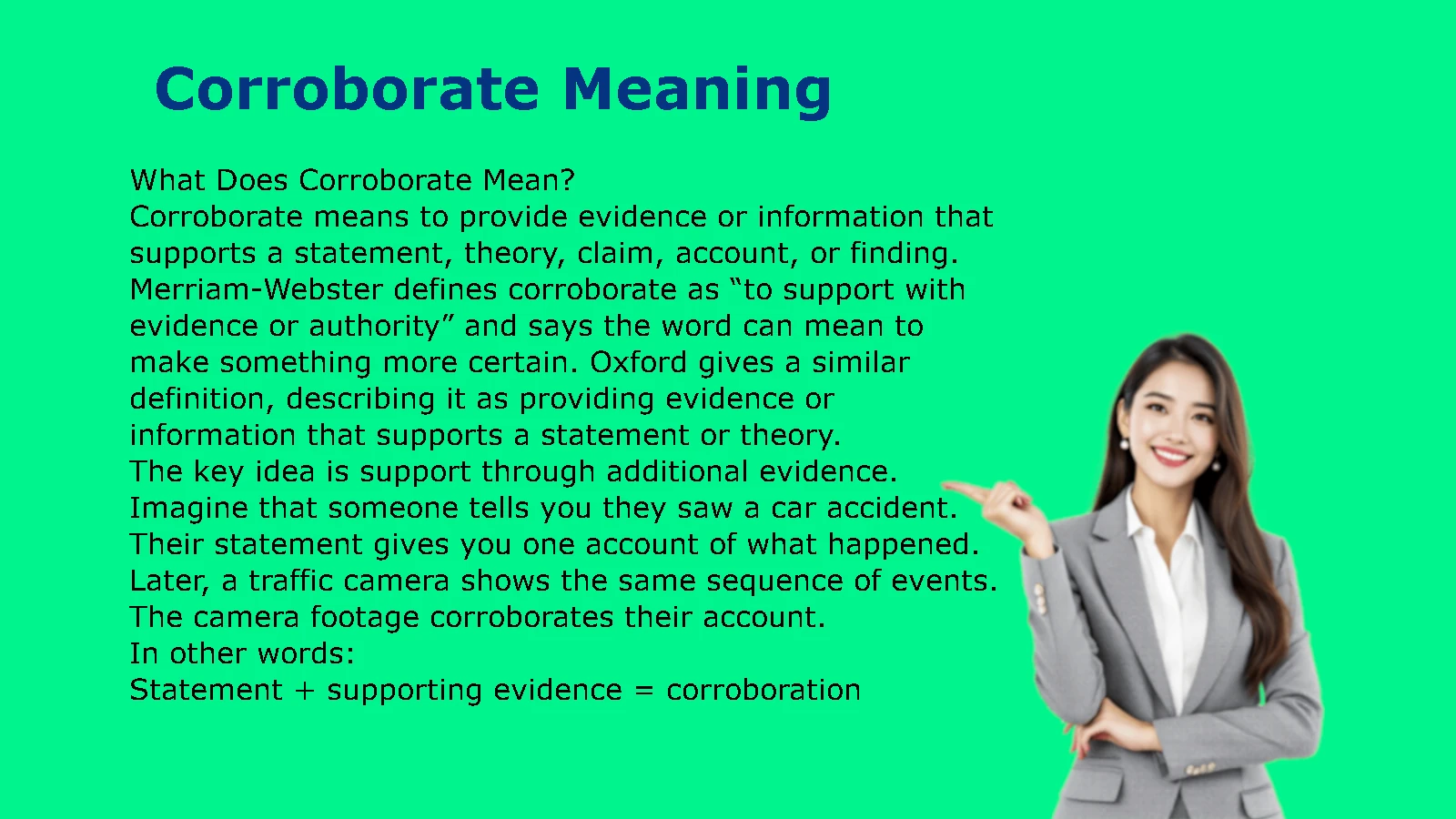
What Does Corroborate Mean?
Corroborate means to provide evidence or information that supports a statement, theory, claim, account, or finding.
Merriam-Webster defines corroborate as “to support with evidence or authority” and says the word can mean to make something more certain. Oxford gives a similar definition, describing it as providing evidence or information that supports a statement or theory.
The key idea is support through additional evidence.
Imagine that someone tells you they saw a car accident. Their statement gives you one account of what happened. Later, a traffic camera shows the same sequence of events. The camera footage corroborates their account.
In other words:
Statement + supporting evidence = corroboration
Here are a few quick examples:
- The documents corroborated her claim.
- Two witnesses corroborated his account.
- New research corroborates the earlier findings.
- The photographs corroborated the report.
- Her emails corroborated what she told investigators.
Corroborate in Simple Terms
The easiest way to remember the corroborate meaning is:
Corroborate = support something with additional evidence.
You can think of it as backing something up.
Suppose your friend says, “I finished the project yesterday.”
You don’t have to believe or disbelieve the statement immediately. Then you see the completed file with a timestamp from yesterday. The file doesn’t simply repeat your friend’s words. It gives you independent information that supports them.
That is the basic idea behind corroborate.
Corroborate Definition
Here is the meaning at a glance:
| Word | Definition | Part of speech | Tone |
| Corroborate | To support a statement, claim, theory, or account with evidence | Verb | Formal |
| Corroboration | Supporting evidence or the act of corroborating | Noun | Formal |
| Corroborated | Supported by additional evidence | Verb form/adjective use | Formal |
| Corroborating | Providing support or evidence | Verb form/adjective use | Formal |
| Corroborative | Providing corroboration | Adjective | Formal |
The word is generally considered formal. Cambridge labels it a formal verb, while Oxford also marks it as formal.
That doesn’t mean you can’t use it in ordinary conversation. You can. However, words such as back up, support, and confirm often sound more natural in casual speech.
What Does Corroborate Mean in Everyday English?
In everyday English, corroborate usually means:
- Back up a story
- Support a claim
- Provide evidence
- Confirm an account
- Strengthen an explanation
For example:
The receipt corroborated her claim that she bought the laptop that morning.
In casual conversation, you might say:
The receipt backed up her story.
Both sentences communicate a similar idea. The first simply has a more formal tone.
Corroborate Pronunciation
In American English, corroborate is pronounced approximately:
kuh-ROB-uh-rate
The stress falls on the ROB syllable.
Merriam-Webster gives the pronunciation as kə-ˈrä-bə-ˌrāt, while the Oxford American Dictionary gives /kəˈrɑbəˌreɪt/.
Break it into parts:
kuh + ROB + uh + rate
Don’t pronounce it like corroboration. The noun has a different ending:
- corroborate → kuh-ROB-uh-rate
- corroboration → kuh-ROB-uh-RAY-shun
What Part of Speech Is Corroborate?
Corroborate is a verb.
It commonly works as a transitive verb, meaning it can take a direct object.
For example:
The evidence corroborated his statement.
Here:
- The evidence = subject
- corroborated = verb
- his statement = object
The usual pattern is:
Subject + corroborate + claim/account/story/theory/etc.
Examples include:
- The witness corroborated the account.
- The study corroborated the theory.
- The records corroborated the allegation.
- The video corroborated her statement.
Oxford lists corroborate with nouns such as finding, report, and testimony and gives corroborating evidence as a common expression.
How to Use Corroborate in a Sentence
The easiest way to use corroborate correctly is to identify the thing being supported.
You can corroborate:
- a claim
- a story
- an account
- a statement
- a theory
- a report
- a finding
- an allegation
- testimony
- evidence
- information
Present Tense
Use corroborate when the subject is I, you, we, or they.
Several sources corroborate the report.
Use corroborates with he, she, or it.
The new evidence corroborates the original findings.
Past Tense
The past form is corroborated.
The photographs corroborated the witness’s account.
This is especially common when discussing investigations or events that have already happened.
-ing Form
The present participle is corroborating.
Investigators found corroborating evidence.
You can also use it as part of a continuous verb phrase:
The new data are corroborating the earlier results.
Passive Construction
Although active voice usually sounds clearer, corroborate frequently appears in passive constructions when the evidence matters more than the source.
His account was corroborated by two independent witnesses.
Oxford specifically notes that corroborate is often used in the passive.
Examples of Corroborate in a Sentence
Seeing the word in different situations makes its meaning much easier to grasp.
Everyday Examples
- The receipt corroborated her explanation.
- His text messages corroborated what he told us.
- The photographs corroborated her description of the damage.
- A second guest corroborated his account of the conversation.
- The timestamp corroborated the employee’s explanation.
Academic Examples
- The latest study corroborates the earlier research.
- The experiment corroborated the researchers’ original hypothesis.
- Independent findings corroborated the team’s results.
- The data corroborate the theory proposed by the researchers.
- Several studies have corroborated these findings.
Cambridge uses a similar academic context, giving an example in which recent research supports a theory.
Legal and Investigative Examples
- The witness’s testimony corroborated the victim’s account.
- Video footage corroborated the witness’s statement.
- Investigators found documents that corroborated the allegation.
- Two independent witnesses corroborated her version of events.
- The records corroborated the timeline presented during the investigation.
Workplace Examples
- The emails corroborated the employee’s account of the meeting.
- The sales records corroborated the manager’s report.
- The audit data corroborated the figures in the original report.
- The customer records corroborated his explanation.
- The project files corroborated the team’s timeline.
Corroborate vs. Confirm
Corroborate and confirm are close in meaning, but they aren’t always interchangeable.
Confirm generally means to establish that something is true, accurate, or correct. Corroborate focuses more specifically on supporting something with additional evidence or information.
Merriam-Webster explains that confirm can imply removing doubt through an authoritative statement or indisputable fact, while corroborate suggests strengthening something that is already partly established.
Compare these sentences:
The doctor confirmed the diagnosis.
This says the doctor established or verified that the diagnosis was correct.
The test results corroborated the doctor’s diagnosis.
Here, the test results provide additional support for the diagnosis.
Quick Comparison
| Word | Main idea |
| Confirm | Establish that something is true or correct |
| Corroborate | Strengthen something with supporting evidence |
| Verify | Check something against facts |
| Substantiate | Provide evidence that supports a claim |
| Validate | Establish that something is valid |
A useful shortcut is:
Confirm = establish
Corroborate = strengthen with evidence
Corroborate vs. Verify
These words can overlap, but they describe different actions.
To verify something means to check whether it is accurate or corresponds to known facts.
To corroborate something means to provide additional evidence that supports it.
For example:
The editor verified the author’s sources.
The editor checked whether the sources were accurate or legitimate.
Now compare:
The new study corroborated the author’s conclusion.
The new study provided additional evidence supporting the conclusion.
Merriam-Webster distinguishes verify by emphasizing correspondence between actual facts or details and those proposed or suspected.
A Simple Way to Remember the Difference
Think of a detective checking a person’s statement.
If the detective verifies the address, they check whether the address is actually correct.
If another independent witness gives an account that supports the person’s story, that witness corroborates the story.
One is primarily about checking. The other is about supporting.
Corroborate vs. Substantiate
Substantiate is another close synonym.
To substantiate a claim means to provide evidence that supports it. To corroborate a claim also means to support it with additional evidence.
The difference is subtle.
Merriam-Webster says substantiate implies offering evidence that sustains a contention, whereas corroborate suggests strengthening something that is already partly established.
Compare:
The company couldn’t substantiate the allegation.
The company couldn’t provide enough evidence to support the allegation.
The witness corroborated the employee’s allegation.
The witness provided additional information that supported what the employee had already said.
In many contexts, either word may work. The choice depends on what you want to emphasize.
Corroborate vs. Validate
Validate can mean establishing that something is valid through authoritative confirmation or factual proof.
For example:
The researchers validated the testing method.
This suggests that they established the method’s validity.
Now consider:
The new experiment corroborated the earlier findings.
The new experiment produced evidence that supported the earlier findings.
The distinction matters because validate often concerns validity, legitimacy, or correctness, while corroborate focuses on supporting an existing statement, account, or finding.
Merriam-Webster includes validate among the related verbs but distinguishes it from corroborate in this way.
Synonyms for Corroborate
The best synonym depends on the context.
| Synonym | Meaning | Example |
| Confirm | Establish that something is true | The report confirmed the figures. |
| Verify | Check something against facts | We verified the information. |
| Substantiate | Support a claim with evidence | The records substantiated the allegation. |
| Validate | Establish validity or correctness | The experiment validated the method. |
| Support | Give evidence or backing | The data support the conclusion. |
| Back up | Support something informally | The photos backed up her story. |
| Reinforce | Make an idea or argument stronger | The results reinforced the theory. |
Don’t assume that every synonym works in every sentence. Words that appear similar in a dictionary can carry different shades of meaning.
For example, back up sounds natural in casual speech:
The photos back up his story.
In formal writing, this may be better:
The photographs corroborate his account.
Word Forms of Corroborate
Understanding related forms helps you recognize the word in different types of writing.
Corroborate
Corroborate is the verb.
The new evidence may corroborate her claim.
Corroborated
Corroborated is the past tense and past participle.
The witness’s story was corroborated by video footage.
Corroborating
Corroborating is the present participle and can also work as an adjective.
Investigators discovered corroborating evidence.
Corroboration
Corroboration is the noun form.
The claim lacked independent corroboration.
Cambridge defines corroboration as the supporting evidence or information associated with a claim or account.
Corroborative
Corroborative is an adjective meaning that something provides corroboration.
The investigators found corroborative evidence.
This form is less common in everyday English than corroborating.
What Does Corroboration Mean?
Corroboration means supporting evidence or the act of supporting something with evidence.
If corroborate is the action, corroboration is the noun.
Compare:
The documents corroborated her account.
and:
The documents provided corroboration for her account.
The meaning is nearly the same.
You might encounter corroboration in formal writing, journalism, academic research, and legal contexts.
Examples include:
- The allegation lacked independent corroboration.
- The prosecution presented additional corroboration.
- Researchers found corroboration for the original results.
- The witness provided corroboration of his account.
What Does Corroborating Mean?
Corroborating means providing evidence or information that supports something.
It often appears directly before a noun.
Common combinations include:
- corroborating evidence
- corroborating testimony
- corroborating information
- corroborating documents
- corroborating witnesses
- corroborating records
- corroborating details
For example:
The investigators found corroborating evidence in the company’s records.
Here, corroborating tells you what the evidence does. It supports another piece of information.
Common Collocations With Corroborate
Certain words naturally appear with corroborate. Learning these combinations can make your writing sound more fluent.
Corroborate a Story
The photographs corroborated his story.
Corroborate a Claim
The data corroborated the company’s claim.
Corroborate an Account
Another witness corroborated her account of the incident.
Corroborate a Statement
The documents corroborated his statement.
Corroborate a Theory
The latest research corroborates the theory.
Corroborate Findings
The second experiment corroborated the original findings.
Corroborate Testimony
The recording corroborated the witness’s testimony.
Corroborate a Report
Independent sources corroborated the report.
These combinations reflect a central feature of the word: something already exists, and additional evidence strengthens it.
Common Mistakes With Corroborate
The word isn’t difficult, but a few mistakes can trip people up.
Mistake: Treating Corroborate as Exactly the Same as Prove
Corroborate does not automatically mean prove beyond doubt.
Evidence can support a claim without making the claim absolutely certain.
For example:
The photographs corroborated the witness’s account.
This tells you that the photographs supported the account. It doesn’t necessarily mean the photographs establish every detail beyond question.
That distinction matters in careful writing.
Mistake: Using Corroborate When You Mean Verify
If you are checking whether information is accurate, verify may be the better word.
We verified the customer’s address.
You aren’t necessarily supporting someone else’s statement. You’re checking a factual detail.
Mistake: Assuming Corroboration Requires Two People
Corroboration doesn’t require another person.
A document, photograph, recording, database, experiment, physical object, or other source of information can corroborate a statement.
For example:
The security footage corroborated the employee’s account.
The footage is not a person, yet it provides supporting evidence.
Mistake: Using Every Synonym Interchangeably
Confirm, verify, substantiate, validate, and corroborate overlap, but they aren’t identical.
Choosing the right one can make your sentence more precise.
Is Corroborate a Formal Word?
Yes. Corroborate is generally a formal word.
Cambridge and Oxford both label it as formal.
That makes it especially useful in:
- Academic writing
- Research papers
- News reports
- Legal writing
- Investigative reports
- Business reports
- Professional correspondence
It can still appear in conversation, especially when discussing evidence or investigations.
Compare the tone:
Casual:
The video backs up her story.
Neutral:
The video supports her story.
Formal:
The video corroborates her account.
All three work. The difference is mainly tone and precision.
Corroborate in Legal and Formal Writing
The word appears frequently in legal and investigative contexts because these fields often deal with claims that require supporting evidence.
You may see phrases such as:
- corroborating evidence
- corroborating testimony
- corroborating witness
- corroborating statement
- independent corroboration
- corroborated account
Consider this example:
A witness gives investigators an account of an event. Later, investigators find video footage that matches the witness’s description.
The footage can corroborate the witness’s account.
The important point is that corroboration is about the relationship between pieces of information. One source provides a claim or account. Another source lends support to it.
That idea also explains why the word works so well in research.
Corroborate in Academic Writing
Researchers often compare new findings with earlier research.
Suppose one study reports a particular result. A later study uses a different dataset or method and reaches a similar conclusion.
You could write:
The later study corroborated the findings of the original research.
The second study adds support to the first.
This doesn’t necessarily mean the first study was proven perfect. Instead, the new evidence makes its findings more credible or better supported.
That nuance makes corroborate especially useful in scientific and academic writing.
A Simple Case Study: Corroborating a Story
Consider a fictional workplace situation.
Maya tells her manager that a software problem prevented her from submitting a report on time. At first, the manager only has Maya’s explanation.
Later, the IT department checks its system logs. The logs show that the reporting system experienced an outage during the exact period Maya mentioned.
The IT records corroborate Maya’s explanation.
Notice what happened:
| Information | Role |
| Maya’s explanation | Original account |
| IT system logs | Additional evidence |
| Matching timestamps | Connection between the two |
| Result | Maya’s account is corroborated |
The system logs don’t simply repeat Maya’s words. They provide independent supporting information.
That’s corroboration in action.
How to Remember the Meaning of Corroborate
A useful mental image is a bridge.
Imagine that one piece of information is standing on one side of a river. It may be credible, but it doesn’t have much support yet.
Then another reliable piece of evidence connects to it.
That additional evidence acts like another support beam.
The first claim becomes stronger.
So remember:
Corroborate = strengthen a claim with supporting evidence.
The word’s history makes this memory trick especially fitting. Merriam-Webster traces corroborate to Latin corroborare, related to strength and ultimately to robur, meaning strength or oak. Merriam-Webster records the first known English use of corroborate as 1529.
Corroborate Sentence Practice
Test your understanding with these examples.
Fill in the Blank
Choose the form of corroborate that fits each sentence.
- The photographs ______ the witness’s account.
- New research ______ the original findings.
- The documents provided ______ for his claim.
- Two witnesses ______ her version of events.
- Investigators discovered ______ evidence.
Answers
- corroborated
- corroborates
- corroboration
- corroborated
- corroborating
Choose the Best Word
Consider this sentence:
The editor ______ the author’s statistics against the original research.
The best choice is verified.
Why? The editor is checking the statistics against the original research.
Now consider:
The new study ______ the author’s conclusion.
Here, corroborated is a strong choice because the new study provides additional support for the conclusion.
This small distinction can dramatically improve word choice in formal writing.
Corroborate vs. Confirm vs. Verify vs. Substantiate
When these four words compete for the same sentence, the following table can help.
| Word | Core idea | Typical question |
| Corroborate | Add supporting evidence | “What else supports this?” |
| Confirm | Establish truth or correctness | “Is this true?” |
| Verify | Check against facts | “Does this match the facts?” |
| Substantiate | Provide evidence for a claim | “What evidence supports this claim?” |
There is some overlap. Real language rarely behaves like four perfectly separated boxes.
Still, these distinctions give you a reliable starting point.
Is Corroborate Positive or Negative?
Corroborate is neutral.
The word itself doesn’t mean that a claim is good, bad, true, false, helpful, or harmful.
It describes the act of supporting information with additional evidence.
For example:
The evidence corroborated the accusation.
The word doesn’t tell you whether the accusation was morally good or bad. It only explains that the evidence supported it.
Likewise:
The research corroborated the positive results.
Again, corroborated describes the relationship between the new evidence and the existing information.
Can You Corroborate a Person?
Usually, you corroborate what a person says, rather than simply saying that you corroborated the person.
Natural:
The witness corroborated her account.
Also natural:
The second witness corroborated what she said.
Less natural:
The second witness corroborated her.
The object of corroborate is generally the statement, account, claim, theory, finding, or information being supported.
Can Evidence Corroborate Evidence?
Yes, depending on the context.
You may encounter phrases such as:
The new evidence corroborated the earlier evidence.
However, writers often choose a more specific noun when possible:
The new evidence corroborated the witness’s testimony.
Specific wording usually gives the reader a clearer picture of what is being supported.
Why Is Corroborate Useful?
Some words are technically correct but don’t add much precision. Corroborate is different.
It captures a specific relationship between information:
Something has already been said, found, proposed, or reported. Then another source provides support for it.
That makes the word valuable when you need to distinguish between:
- discovering a fact
- checking a fact
- proving a claim
- supporting a claim
- confirming information
- strengthening an existing account
For example, saying:
The second study corroborated the first study’s findings.
tells the reader more than simply saying:
The second study agreed with the first study.
The first sentence emphasizes evidence-based support.
Frequently Asked Questions About Corroborate
What does corroborate mean in simple words?
Corroborate means to support something with additional evidence or information.
A witness can corroborate a story. A photograph can corroborate a statement. A study can corroborate a theory.
What is an example of corroborate?
The security footage corroborated the witness’s story.
The footage provided evidence that supported what the witness said.
What is another word for corroborate?
Common alternatives include confirm, support, verify, substantiate, validate, reinforce, and back up. However, these words don’t have exactly the same meaning or tone.
Does corroborate mean prove?
Not necessarily.
Corroborate means to support or strengthen something with evidence. Supporting evidence can make a claim more certain without proving every aspect of it conclusively.
What is the noun form of corroborate?
The main noun form is corroboration.
The allegation lacked independent corroboration.
What is the adjective form of corroborate?
Corroborative is an adjective meaning that something provides corroboration.
Corroborating can also function adjectivally:
The investigators found corroborating evidence.
Is corroborate a formal word?
Yes. Major learner and general dictionaries label corroborate as formal.
It works especially well in academic, professional, legal, journalistic, and investigative writing.
What does corroborating evidence mean?
Corroborating evidence is evidence that supports an existing statement, account, claim, theory, or finding.
For example:
The photographs served as corroborating evidence for the witness’s account.
What does corroborate mean in research?
In research, corroborate means that new evidence or findings support earlier findings, a theory, or a conclusion.
For example:
The second experiment corroborated the original findings.
Can a study corroborate a theory?
Yes.
Recent research corroborates the theory.
This means the research provides evidence that supports the theory.
Final Takeaway: Corroborate Meaning
The clearest way to understand corroborate is to focus on one idea:
To corroborate something means to support it with additional evidence or information.
The word is formal but useful, especially when you need to describe evidence carefully.
Keep these distinctions in mind:
- Corroborate = support with additional evidence
- Confirm = establish as true or correct
- Verify = check against facts
- Substantiate = provide evidence that supports a claim
- Validate = establish validity or correctness
- Corroboration = supporting evidence or the act of corroborating
If you remember only one thing, remember this: corroboration makes an existing claim stronger by giving you more evidence to support it.