
Have you ever come across the word Defer Meaning and wondered what it actually means? You’re not alone. Many English learners and native speakers confuse defer because it has more than one meaning depending on the context. It can mean to postpone something or to respectfully accept someone else’s opinion or decision, making it easy to misunderstand.
Defer means to postpone or delay something until a later time or to yield respectfully to another person’s opinion, judgment, or authority. The correct meaning depends on the context in which the word is used.
Examples:
- The committee decided to defer the meeting until next week.
- I defer to my doctor’s advice on this matter.
The confusion often starts when people search for defer definition, defer pronunciation, defer examples, or how to use defer in a sentence but find explanations that are too technical. And here’s the kicker: using defer incorrectly can completely change the meaning of your sentence.
In this guide, you’ll learn the Defer Meaning in plain English, explore the defer definition, discover the correct defer pronunciation, and understand how to use defer in a sentence with real-life examples. You’ll also learn the difference between defer, delay, postpone, and adjourn, along with common phrases and synonyms to help you use the word naturally.
What Does Defer Mean?
The defer meaning depends on the sentence. English dictionaries recognize two primary definitions, and both appear frequently in spoken and written English.
| Meaning | Simple Explanation | Example |
| To postpone | Move something to a later time | We deferred the meeting until Monday. |
| To yield to someone’s judgment | Respect another person’s opinion or expertise | I defer to the doctor’s advice. |
Both meanings share one common idea: waiting instead of acting immediately. The difference lies in what you’re waiting for.
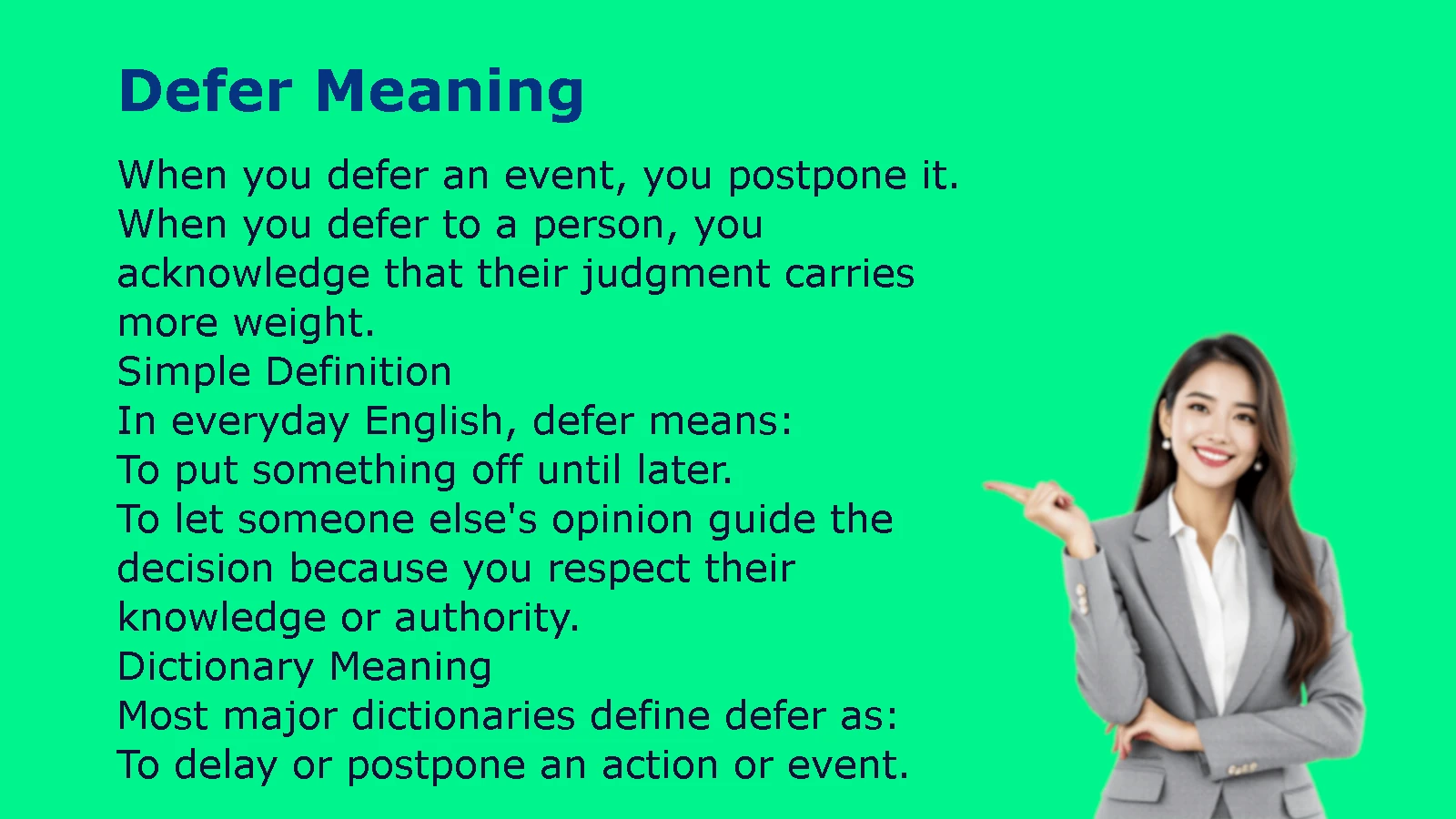
- When you defer an event, you postpone it.
- When you defer to a person, you acknowledge that their judgment carries more weight.
Simple Definition
In everyday English, defer means:
- To put something off until later.
- To let someone else’s opinion guide the decision because you respect their knowledge or authority.
Dictionary Meaning
Most major dictionaries define defer as:
- To delay or postpone an action or event.
- To submit respectfully to another person’s opinion, wishes, or authority.
Both definitions have remained consistent for centuries and still appear in modern English.
Part of Speech
| Feature | Information |
| Word | Defer |
| Part of Speech | Verb |
| Regular or Irregular | Regular verb |
| Present Participle | Deferring |
| Past Tense | Deferred |
| Past Participle | Deferred |
Origin of the Word
The word defer comes from the Latin verb deferre, which means to carry away, bring down, or submit. Over time, English adopted the word and developed its modern meanings of postponing something or showing respect for another person’s judgment.
Understanding its origin makes the two meanings easier to remember.
- Carry something forward → postpone it.
- Carry respect toward someone → defer to them.
How to Pronounce Defer
Many English learners know the word after reading it, but they’re unsure how to pronounce it correctly.
Pronunciation
US English
/dɪˈfɝː/
UK English
/dɪˈfɜː/
The emphasis falls on the second syllable.
de-FER
Not:
- DEE-fer
- DEF-er
Syllable Breakdown
de + fer
The first syllable sounds short.
The second syllable receives the stress.
Pronunciation Tip
Imagine saying:
“I prefer to defer.”
Both words share a similar rhythm because the stress falls on the second syllable.
Common Pronunciation Mistakes
| Incorrect | Correct |
| DEE-fer | de-FER |
| DEF-er | de-FER |
| de-fair | de-FER |
Practicing the word aloud in complete sentences helps you remember the correct stress naturally.
For example:
- We decided to defer the meeting.
- I defer to your experience.
How to Use Defer in a Sentence
One reason people struggle with the defer meaning is that they only learn one definition. In reality, native speakers use both meanings regularly.
The easiest way to master the word is to learn it in context.
Defer Meaning as “Postpone”
This is the most common meaning.
When you defer something, you intentionally move it to a later time.
You aren’t canceling it. You’re simply delaying it.
Common Situations
People often defer:
- meetings
- interviews
- payments
- college admission
- taxes
- maintenance
- decisions
- vacations
- legal hearings
- projects
Everyday Examples
- We deferred the meeting until next Tuesday.
- The company deferred construction because of bad weather.
- She deferred her vacation until summer.
- They deferred the final decision after reviewing new evidence.
- The university deferred his admission for one semester.
Notice that every sentence involves moving something into the future rather than eliminating it.
Workplace Example
Imagine a management team discussing a new product launch.
The marketing department still needs customer research.
Instead of making a rushed decision, the CEO says:
“Let’s defer the launch until we receive the survey results.”
The launch still happens.
It simply happens later.
Academic Example
Many universities allow students to defer admission.
Suppose a student receives acceptance for the fall semester but wants to travel or complete military service before starting college.
Instead of applying again next year, the student requests a deferral.
The university reserves the student’s place for a future semester.
Financial Example
Banks and lenders sometimes allow borrowers to defer payments during financial hardship.
Instead of making payments immediately, borrowers postpone them according to the loan agreement.
The debt doesn’t disappear.
The payment schedule changes.
Legal Example
Courts occasionally defer hearings when:
- new evidence appears
- attorneys need more preparation time
- witnesses are unavailable
- settlement discussions continue
Again, the hearing isn’t canceled.
It’s postponed.
Defer Meaning as “Yield to Someone’s Opinion or Authority”
The second definition surprises many learners because it has nothing to do with time.
Here, defer means to respect another person’s judgment because they have more experience, authority, or expertise.
Think of it as saying:
“I’ll trust your decision.”
Common Situations
People defer to:
- doctors
- judges
- teachers
- parents
- experts
- scientists
- experienced coworkers
- coaches
- financial advisors
- attorneys
Everyday Examples
- I defer to your experience.
- The committee deferred to the legal team’s recommendation.
- Parents often defer to medical professionals when making health decisions.
- The board deferred to the CEO’s judgment.
- She deferred to the architect on design choices.
Notice something important.
The phrase is almost always:
defer to someone
That small word to matters.
Professional Example
During a software project, developers disagree about cybersecurity.
One engineer has twenty years of security experience.
The team says:
“We’ll defer to Maria because she specializes in cybersecurity.”
Nobody delays anything.
Instead, they accept Maria’s expertise.
Healthcare Example
Imagine a patient researching treatments online.
After reading several articles, they still ask their physician for advice.
The patient says:
“I’ll defer to your medical judgment.”
This doesn’t mean the patient postpones treatment.
It means they trust the doctor’s professional opinion.
Understanding Both Meanings Together
Although the definitions seem unrelated, there’s a simple way to remember them.
| Situation | Meaning |
| You defer something | You postpone it. |
| You defer to someone | You respect their judgment. |
Here’s another easy comparison.
| Sentence | Meaning |
| We deferred the meeting. | We postponed the meeting. |
| We deferred to the manager. | We accepted the manager’s judgment. |
| The bank deferred payment. | The payment moved to a later date. |
| The students deferred to the professor. | The students trusted the professor’s expertise. |
Memory Trick
Think of these two simple rules:
- Defer something = Delay it.
- Defer to someone = Respect them.
That single distinction helps you understand almost every use of defer you’ll encounter in books, news articles, business meetings, and everyday conversations.
Defer Meaning in Everyday English: Real-Life Examples
Learning a definition is helpful. Seeing defer in real situations makes the word much easier to remember.
Native English speakers use defer in business, education, healthcare, law, finance, and everyday conversations. Once you understand the context, choosing the correct meaning becomes almost automatic.
Everyday Conversations
These examples sound natural in daily speech.
- Let’s defer that conversation until everyone is here.
- Can we defer the trip until next month?
- I’ll defer to your choice since you’ve been there before.
- They decided to defer buying a new car this year.
- We should defer judgment until we know all the facts.
Notice how the first, second, and fourth examples mean postpone, while the third and fifth examples mean respect another opinion.
At School or College
Students and teachers frequently use defer in academic settings.
Examples include:
- The university deferred her admission until the spring semester.
- The professor deferred the exam because of severe weather.
- The committee deferred its final recommendation.
- Most students deferred to the instructor’s explanation.
Many colleges also offer admission deferrals for students who want to take a gap year before beginning classes.
In the Workplace
Business English uses defer regularly because organizations often postpone decisions or rely on experienced professionals.
Examples:
- Management deferred the product launch.
- The board deferred its vote until next quarter.
- We deferred payment until the client approved the invoice.
- The junior analyst deferred to the finance director during the meeting.
- Everyone deferred to the legal department before signing the contract.
In professional writing, defer often sounds more formal than put off.
Healthcare
Doctors and hospitals also use this verb frequently.
Examples include:
- The surgeon deferred the operation because the patient developed a fever.
- The family deferred to the doctor’s recommendation.
- The hospital deferred elective procedures during the emergency.
Healthcare professionals often encourage patients to ask questions. Even so, many patients still defer to medical expertise after discussing their options.
Legal Settings
Legal documents often include the word defer because courts regularly postpone proceedings.
Examples:
- The judge deferred sentencing.
- The court deferred the hearing until additional evidence became available.
- The jury deferred to the judge’s legal instructions.
Legal English tends to favor defer because it clearly communicates an intentional delay instead of an indefinite one.
Customer Service
Businesses sometimes defer requests when they need additional information.
For example:
“We’re deferring your request until we receive the required documents.”
Or:
“We’ll defer to our technical specialists before providing a final answer.”
Common Phrases With Defer
Certain word combinations appear repeatedly in books, newspapers, and professional communication. Learning these collocations helps you sound more natural.
| Phrase | Meaning | Example |
| Defer a decision | Delay making a choice | We deferred the decision until Monday. |
| Defer payment | Pay later | The bank deferred payments for six months. |
| Defer taxes | Postpone paying taxes legally | Retirement accounts may defer taxes. |
| Defer judgment | Wait before forming an opinion | Let’s defer judgment until we know more. |
| Defer action | Delay taking action | Leaders deferred action during negotiations. |
| Defer maintenance | Postpone repairs | Deferred maintenance increased repair costs. |
| Defer admission | Delay starting school | She deferred admission for one year. |
| Defer enrollment | Begin studies later | The student deferred enrollment. |
| Defer implementation | Delay putting a plan into effect | Officials deferred implementation of the policy. |
| Defer to someone | Respect another person’s judgment | I defer to your expertise. |
These phrases appear frequently because they describe common situations in business, education, government, and personal life.
Defer vs. Similar Words
Many English learners confuse defer with other words that seem similar.
Although these words overlap in some situations, they don’t always mean the same thing.
Understanding the differences helps you choose the most natural word every time.
Defer vs. Delay
These two words often describe moving something to a later time.
However, they aren’t always interchangeable.
| Defer | Delay |
| Usually intentional | Can be intentional or accidental |
| Often used in formal situations | Common in everyday speech |
| Suggests a planned postponement | Can describe unexpected interruptions |
Examples:
- The committee deferred the vote.
- Heavy traffic delayed the meeting.
The first sentence describes a conscious decision.
The second describes an unexpected problem.
Defer vs. Postpone
These verbs are very close in meaning.
In many situations, you can use either one.
| Defer | Postpone |
| More formal | More common in everyday conversation |
| Frequently used in business, law, and education | Used almost everywhere |
| Also means respect someone’s judgment | Never carries that meaning |
Examples:
- We deferred the meeting.
- We postponed the meeting.
Both are correct.
However, only one sentence works here:
- I defer to your experience. ✅
- I postpone to your experience. ❌
Defer vs. Suspend
People also confuse these words because each involves stopping something.
The difference lies in whether the interruption has a planned restart.
| Defer | Suspend |
| Move to a future date | Temporarily stop |
| Focuses on timing | Focuses on interruption |
Examples:
- The university deferred enrollment.
- The school suspended classes because of flooding.
Defer vs. Differ
These words look similar but have completely different meanings.
| Defer | Differ |
| Postpone or respect someone’s opinion | Be different |
| Verb | Verb |
Examples:
- We deferred the project.
- Our opinions differ.
Memory Trick
- Defer = Delay or Respect
- Differ = Different
One extra r changes the entire meaning.
Defer vs. Refer
Another commonly confused pair is defer and refer.
| Defer | Refer |
| Delay or yield | Direct someone elsewhere |
| Concerns timing or respect | Concerns guidance or recommendation |
Examples:
- The board deferred the decision.
- The doctor referred the patient to a specialist.
A referral sends someone somewhere.
A deferral postpones something or acknowledges another person’s authority.
Is Defer Formal or Informal?
The word defer generally sounds more formal than alternatives like put off or wait.
That doesn’t mean it’s difficult.
Instead, it’s appropriate in situations where precision matters.
Formal Usage
You’ll often see defer in:
- business reports
- legal documents
- academic writing
- government announcements
- financial policies
- medical communication
Examples:
- The committee deferred consideration.
- Officials deferred implementation.
- The board deferred approval.
Everyday Usage
Native speakers also use defer, although they often choose simpler alternatives.
Instead of saying:
We deferred our vacation.
Someone might say:
We pushed our vacation back.
Or:
We put our vacation off.
All three communicate the same idea.
Business English
Business professionals prefer defer because it sounds precise and neutral.
Examples include:
- defer payment
- defer costs
- defer revenue
- defer expenses
- defer negotiations
- defer approval
These phrases appear regularly in corporate reports and financial statements.
Academic Writing
Researchers frequently use defer when acknowledging another expert’s work.
For example:
“We defer to previous research on this topic.”
This wording respectfully recognizes earlier findings without dismissing them.
Legal English
Lawyers and judges often use defer because legal decisions require precise language.
Examples include:
- defer sentencing
- defer prosecution
- defer enforcement
- defer consideration
Synonyms of Defer
The best synonym depends on which meaning of defer you’re using.
Synonyms When Defer Means “Postpone”
| Synonym | Best Used When |
| Postpone | Everyday situations |
| Delay | General use |
| Put off | Informal conversation |
| Reschedule | Meetings or appointments |
| Adjourn | Meetings or court proceedings |
| Shelve | Pause a project indefinitely |
| Table* | Legislative discussions (meaning varies by region) |
Examples
- We postponed the conference.
- We delayed construction.
- We rescheduled the interview.
- The judge adjourned the hearing.
Synonyms When Defer Means “Respect Someone’s Judgment”
These words express the second meaning of defer.
| Synonym | Meaning |
| Yield | Give way |
| Submit | Accept authority |
| Comply | Follow instructions |
| Respect | Value another opinion |
| Accept | Agree with |
| Trust | Rely on someone’s expertise |
| Follow | Act according to advice |
Examples:
- I yield to your experience.
- We trust the engineer’s recommendation.
- They respected the judge’s ruling.
Although these words overlap, defer to carries a stronger sense of respectful acknowledgment of another person’s knowledge or authority.
Antonyms of Defer
Antonyms also depend on context.
When Defer Means “Postpone”
Opposites include:
- proceed
- continue
- advance
- accelerate
- implement
- complete
- finalize
Example:
- Instead of deferring the launch, the company proceeded as planned.
When Defer Means “Yield”
Opposite ideas include:
- reject
- challenge
- question
- oppose
- overrule
- disagree
- insist
Example:
- Rather than defer to the consultant, management challenged the recommendation.
Grammar and Word Forms of Defer
Learning every grammatical form makes the word much easier to recognize in books, articles, and conversations.
| Word Form | Part of Speech | Example |
| defer | Verb | We defer the meeting. |
| defers | Verb | She defers to experts. |
| deferred | Past tense verb | They deferred payment. |
| deferring | Present participle | We’re deferring the decision. |
| deferral | Noun | The application received a deferral. |
| deferment | Noun | Student loan deferment reduced financial pressure. |
Deferral vs. Deferment
Both nouns are correct.
However, their usage differs slightly.
| Deferral | Deferment |
| More common in education and business | Often used in finance and military contexts |
| Admission deferral | Student loan deferment |
| Payment deferral | Military deferment |
Today, both words appear in standard English, although certain industries strongly prefer one over the other.
Common Collocations With Defer
Native speakers naturally pair defer with certain nouns and phrases.
Learning these combinations improves both writing and speaking.
Business
- defer payment
- defer revenue
- defer expenses
- defer implementation
- defer negotiations
- defer approval
Education
- defer admission
- defer enrollment
- defer graduation
- defer exams
Legal
- defer sentencing
- defer prosecution
- defer judgment
- defer enforcement
Everyday English
- defer a decision
- defer responsibility
- defer consideration
- defer action
- defer plans
- defer to authority
- defer to experience
- defer to experts
Idioms and Expressions Related to Defer
Although defer isn’t part of many traditional English idioms, it appears in several common expressions. You’ll hear these phrases in workplaces, classrooms, courtrooms, and everyday conversations.
Understanding these expressions helps you recognize the defer meaning instantly.
Defer to Someone’s Judgment
This expression means to trust another person’s opinion because they have more knowledge or experience.
Examples
- I defer to your judgment because you’ve handled similar projects before.
- The team deferred to the architect’s judgment on the building design.
- Parents often defer to a pediatrician when making medical decisions.
Defer to Authority
This phrase means to respect or follow someone in a position of authority.
Examples include:
- Employees defer to company leadership.
- Soldiers defer to their commanding officers.
- Students often defer to their teachers during classroom discussions.
Defer to the Experts
You’ll often hear this expression in healthcare, engineering, science, and finance.
Example
Rather than guessing, we decided to defer to the experts before making a final decision.
The phrase emphasizes the value of professional knowledge.
Reserve Judgment
Although reserve judgment doesn’t contain the word defer, it expresses a similar idea.
It means to avoid forming an opinion until more information becomes available.
Example
The jury reserved judgment until all witnesses had testified.
Put Something on Hold
This informal phrase works much like defer when talking about postponing plans.
Examples
- We put the renovation on hold.
- She put her career plans on hold for a year.
Compared with defer, this expression sounds more conversational.
Kick the Can Down the Road
This informal idiom means to postpone solving a problem instead of addressing it now.
Unlike defer, which is often neutral, this phrase usually suggests avoiding responsibility.
Example
The committee kicked the can down the road instead of making a difficult decision.
Common Mistakes When Using Defer
Many English learners understand the basic definition but still misuse the word in writing or conversation.
Avoid these common errors to sound more natural.
Confusing Defer With Differ
This is probably the most common mistake.
❌ Our opinions defer.
✅ Our opinions differ.
Remember:
- Defer = postpone or respect someone’s judgment.
- Differ = be different.
Using the Wrong Preposition
When talking about respecting another person’s opinion, always use to.
❌ I defer your opinion.
✅ I defer to your opinion.
The preposition is essential.
Using Defer Instead of Delay
Sometimes delay sounds more natural.
Compare these sentences:
- Heavy snow delayed the flight. ✅
- Heavy snow deferred the flight. ❌
Bad weather doesn’t intentionally postpone a flight.
It causes a delay.
Forgetting the Double “R”
When adding -ed or -ing, double the final r.
Correct forms include:
- deferred
- deferring
Incorrect forms include:
- defered
- defering
Assuming Defer Always Means Postpone
Many learners overlook the second meaning.
Consider these examples.
Sentence A
The company deferred the meeting.
Meaning:
The meeting happens later.
Sentence B
The company deferred to the consultant.
Meaning:
The company accepted the consultant’s advice.
The context changes everything.
Quick Summary Table
| Situation | Meaning of Defer | Example |
| Meeting | Postpone | We deferred the meeting until Friday. |
| Payment | Pay later | The bank deferred loan payments. |
| Admission | Start later | She deferred admission for one semester. |
| Expert | Respect expertise | We deferred to the engineer. |
| Doctor | Trust professional advice | The family deferred to the physician. |
| Judge | Accept authority | The attorneys deferred to the court’s ruling. |
Case Study: Two Meanings of Defer in One Workplace
Imagine a technology company preparing to launch new software.
During the final review meeting, engineers discover an unexpected security issue.
The project manager announces:
“We’ll defer the product launch until our security team finishes testing.”
Here, defer means postpone.
Later that afternoon, the cybersecurity specialist recommends changing the encryption system.
Although several team members disagree, everyone recognizes the specialist’s expertise.
The CEO responds:
“We’ll defer to our security expert on this decision.”
Now the word carries a completely different meaning.
Instead of postponing anything, the team chooses to respect the expert’s judgment.
This example shows why context matters more than memorizing a single definition.
Quote
“Good judgment comes from experience, and wise people know when to defer to greater expertise.”
This idea captures the second meaning of defer perfectly. Respecting another person’s knowledge isn’t weakness. It’s often the smartest decision you can make.
Frequently Asked Questions About Defer Meaning
What does defer mean in simple words?
In simple English, defer means either to postpone something until later or to respect another person’s opinion or expertise.
Does defer mean delay?
Sometimes.
When talking about events, meetings, or decisions, defer and delay can have similar meanings.
However, defer usually suggests an intentional postponement, while delay can happen unexpectedly.
What does “defer to someone” mean?
Defer to someone means to accept or respect another person’s judgment because they have more experience, authority, or knowledge.
Example
I defer to the lawyer’s advice.
Is defer a formal word?
Yes.
Defer sounds more formal than put off, although native speakers use it regularly in business, education, law, healthcare, and professional communication.
What is the difference between defer and postpone?
Both words can mean to move something to a later time.
The key difference is that defer also has a second meaning: to yield to another person’s opinion.
Postpone only refers to delaying an event or action.
What is the noun form of defer?
The two common noun forms are:
- Deferral
- Deferment
Both are correct, although certain industries prefer one over the other.
Examples include:
- admission deferral
- payment deferral
- military deferment
- student loan deferment
What is the opposite of defer?
The opposite depends on the meaning.
If defer means postpone, antonyms include:
- proceed
- continue
- implement
- finalize
If defer means yield to someone’s judgment, antonyms include:
- oppose
- reject
- challenge
- overrule
How do you pronounce defer?
In American English, defer is pronounced:
/dɪˈfɝː/
The stress falls on the second syllable.
Say it like:
de-FER
Is defer always followed by “to”?
No.
Use defer to when referring to a person or authority.
Examples:
- defer to the doctor
- defer to the committee
- defer to your judgment
When referring to an action or event, don’t use to.
Examples:
- defer the meeting
- defer payment
- defer the decision
Can defer have a positive meaning?
Yes.
Many people associate defer with delay, but the word often carries a positive meaning when it shows respect for someone else’s expertise or authority.
For example:
We deferred to the experienced engineer because she understood the problem better than anyone else.
In this context, deferring reflects good judgment rather than hesitation.
Final Thoughts on Defer Meaning
Understanding the defer meaning is easier once you remember its two core definitions.
First, defer can mean to postpone something until a later time. You’ll often see this usage with meetings, payments, admissions, projects, court hearings, and business decisions.
Second, defer can mean to respectfully accept another person’s judgment or expertise. This meaning appears most often in professional, academic, legal, and healthcare settings, where experience and authority guide important decisions.
A simple memory trick can help:
- Defer something = Postpone it.
- Defer to someone = Respect their judgment.
Once you recognize that distinction, you’ll understand nearly every use of defer in conversations, books, news articles, contracts, and professional communication.
Whether you’re improving your vocabulary, preparing for an English exam, or writing more confidently at work, mastering defer will make your English clearer and more precise.
Key Takeaways
| Topic | Key Point |
| Primary Meaning | Defer means to postpone or to respect another person’s judgment. |
| Part of Speech | Verb |
| Pronunciation | de-FER (/dɪˈfɝː/) |
| Common Phrase | Defer to someone means to trust their expertise. |
| Formal Usage | Frequently used in business, law, education, finance, and healthcare. |
| Common Synonyms | Postpone, delay, reschedule, yield, submit, trust. |
| Common Antonyms | Proceed, continue, implement, oppose, challenge. |
| Memory Tip | Defer something = Delay it. Defer to someone = Respect them. |
By learning the word through real examples, comparisons, and common expressions, you’ll not only understand the defer meaning but also know exactly when and how to use it with confidence.