
Have you ever wanted to describe the act of treating something as completely worthless, but found that ordinary words just didn’t cut it? Floccinaucinihilipilification Meaning refers to the act of considering something worthless, insignificant, or of no value. It is one of the longest words in the English language and is often used to describe a dismissive judgment about the value of something.
Floccinaucinihilipilification is a noun that means the act or habit of estimating something as worthless or unimportant. Although the word looks intimidating at first glance, its meaning is surprisingly simple. It can describe anything from dismissing an idea as useless to viewing an object as having little or no value.
Examples:
- His floccinaucinihilipilification of the proposal annoyed the entire team.
- The critic’s review was an example of floccinaucinihilipilification rather than fair analysis.
The confusion is understandable. People often search for what does floccinaucinihilipilification mean, floccinaucinihilipilification definition, floccinaucinihilipilification meaning in English, or how to use floccinaucinihilipilification in a sentence because the word’s extraordinary length makes its meaning difficult to guess. And here’s the kicker: despite its complicated appearance, the word essentially expresses the idea of treating something as worthless.
In this guide, you’ll learn the complete Floccinaucinihilipilification Meaning, its definition, pronunciation, origin, correct usage, and examples in sentences. You’ll also discover its synonyms, antonyms, grammatical use, and why this unusual word became famous for being exceptionally long.
Floccinaucinihilipilification Meaning
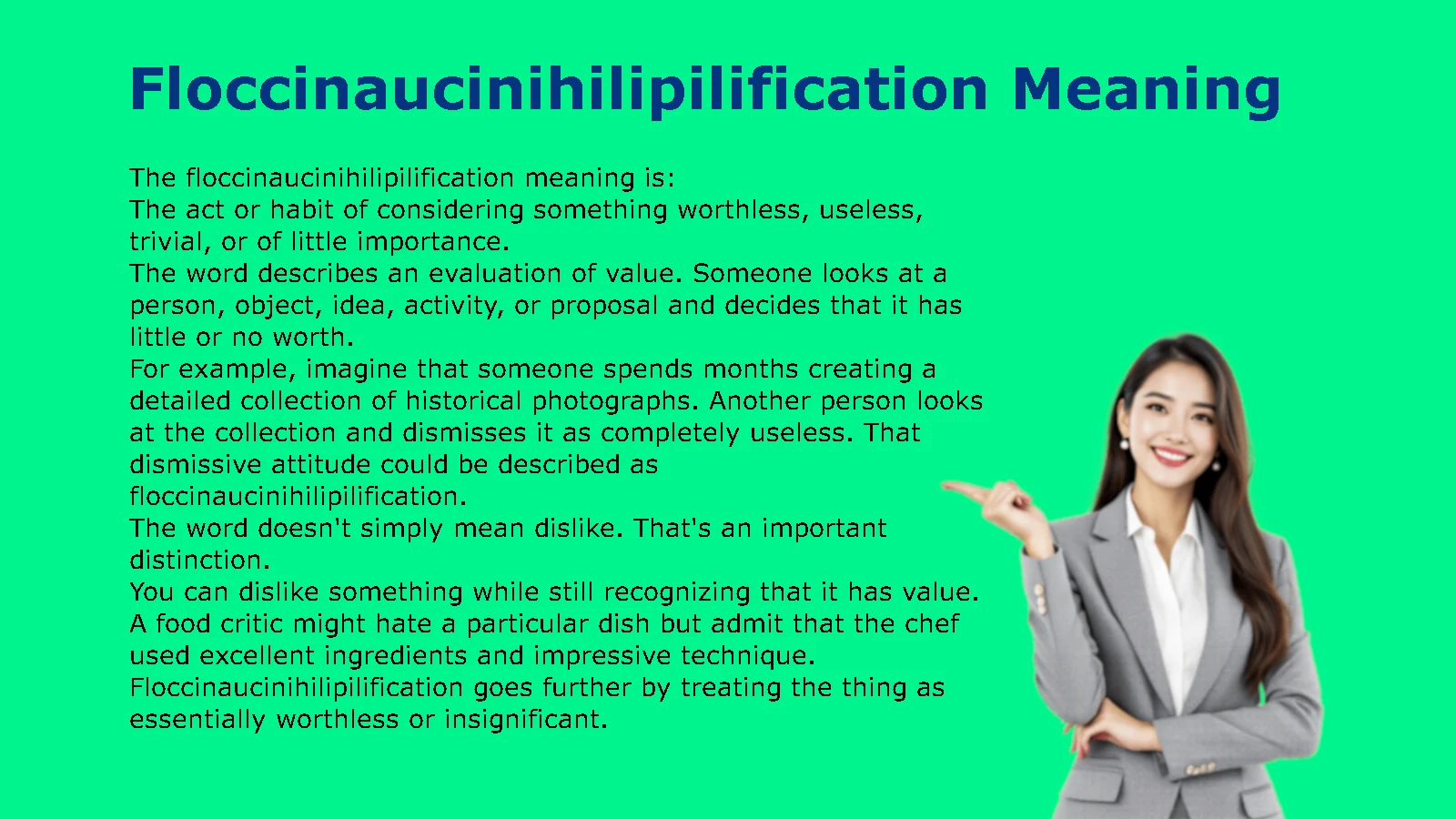
The floccinaucinihilipilification meaning is:
The act or habit of considering something worthless, useless, trivial, or of little importance.
The word describes an evaluation of value. Someone looks at a person, object, idea, activity, or proposal and decides that it has little or no worth.
For example, imagine that someone spends months creating a detailed collection of historical photographs. Another person looks at the collection and dismisses it as completely useless. That dismissive attitude could be described as floccinaucinihilipilification.
The word doesn’t simply mean dislike. That’s an important distinction.
You can dislike something while still recognizing that it has value. A food critic might hate a particular dish but admit that the chef used excellent ingredients and impressive technique. Floccinaucinihilipilification goes further by treating the thing as essentially worthless or insignificant.
Simple definition
If you need the meaning in the simplest possible terms:
Floccinaucinihilipilification = treating something as worthless or unimportant.
Cambridge lists the word as a noun and notes that it mainly serves as an example of a very long word. Dictionary.com similarly defines it as the estimation of something as valueless.
Floccinaucinihilipilification definition at a glance
| Feature | Detail |
| Word | Floccinaucinihilipilification |
| Part of speech | Noun |
| Meaning | The act of considering something worthless or unimportant |
| Number of letters | 29 |
| Origin | Latin based |
| First attested | 1741 |
| Modern use | Rare and often humorous |
| Common context | Discussions of long or unusual English words |
What Does Floccinaucinihilipilification Mean in Simple English?
In everyday English, you probably wouldn’t need this enormous word.
Instead, you could say:
- treating something as worthless
- dismissing something
- considering something useless
- seeing something as unimportant
- placing little value on something
- regarding something as trivial
Think of it this way: value goes down, and dismissal goes up.
If a manager says, “This proposal has absolutely no value,” the manager is expressing a form of floccinaucinihilipilification. If someone simply says, “I don’t like this proposal,” that doesn’t necessarily qualify. The second statement expresses personal preference rather than a judgment that the proposal has no worth.
This distinction makes the word more useful than its intimidating appearance suggests.
Floccinaucinihilipilification Pronunciation
The floccinaucinihilipilification pronunciation can look far more difficult than it actually is.
Cambridge gives the US pronunciation as:
/ˌflɑːk.sɪ.nɔː.sɪ.nɪ.hɪl.ɪ.pɪl.ɪ.fɪˈkeɪ.ʃən/
A practical way to approach it is to divide the word into smaller sound groups:
floc-si-nau-si-ni-hil-i-pil-i-fi-ca-tion
You don’t have to attack all 29 letters at once. Break the word into sections and let each section flow into the next.
How to pronounce floccinaucinihilipilification
A rough US English guide is:
flok-sih-naw-sih-nih-hil-ih-pil-ih-fih-KAY-shun
The final -fication sounds familiar because English contains many words ending in -fication, such as classification and identification.
The middle of the word creates most of the difficulty. Practice it in chunks rather than trying to memorize the entire sound pattern in one breath.
Cambridge pronunciation guide for floccinaucinihilipilification
How to Spell Floccinaucinihilipilification
The correct spelling is:
F-L-O-C-C-I-N-A-U-C-I-N-I-H-I-L-I-P-I-L-I-F-I-C-A-T-I-O-N
That gives the word 29 letters.
Because the word contains several unusual sequences, it’s easy to lose a letter while typing it. Breaking the spelling into historical components makes it easier to understand:
flocci + nauci + nihili + pili + fication
These components reflect the word’s Latin based construction. Dictionary.com traces the word to the Latin forms floccī, naucī, nihilī, and pilī, followed by -fication.
A useful spelling strategy
Instead of staring at all 29 letters, remember these chunks:
- flocci
- nauci
- nihili
- pili
- fication
Put them together:
flocci + nauci + nihili + pili + fication
→ floccinaucinihilipilification
That approach also reveals something interesting about the word: its length comes from combining several pieces rather than inventing one giant root.
Floccinaucinihilipilification Etymology and Origin
The floccinaucinihilipilification etymology is one of the most fascinating parts of the word.
The word combines four Latin forms:
- flocci
- nauci
- nihili
- pili
These forms relate to things regarded as having little value, a low price, or no value. The word then adds the Latin derived suffix -fication, meaning an act or process of making or causing something.
So although floccinaucinihilipilification looks like an enormous modern English invention, its construction has deep roots in the Latin language.
What do the parts of floccinaucinihilipilification mean?
| Part | Latin source | General association |
| flocci | floccus | Something of little value |
| nauci | naucum | A trifle or something insignificant |
| nihili | nihilum | Nothing |
| pili | pilus | A hair or something of negligible value |
| -fication | Latin derived suffix | Making, causing, or producing |
These pieces shouldn’t be treated as five independent modern English words. Together, they create a deliberately elaborate expression for regarding something as worthless.
The construction also reflects an older educational tradition. The four Latin forms appeared together in a rule associated with the Eton Latin Grammar. According to Etymonline, the resulting English word was a jocular formation that would have made sense within the educated Latin culture of 18th century Britain.
When Was Floccinaucinihilipilification First Used?
The word is attested to 1741.
Etymonline traces the earliest known occurrence to a letter written by William Shenstone in 1741. That letter was published later, in 1769.
The historical form appeared with hyphens:
flocci-nauci-nihili-pili-fication
That spelling makes the construction much easier to see.
Shenstone used the word in connection with the poet William Somervile and described his attitude toward money. The quotation is particularly useful because it demonstrates that the word originally had a meaning close to estimating something as worthless rather than merely describing something that happens to have little monetary value.
The history also explains why the word feels so deliberately constructed. It wasn’t an ordinary household word that gradually evolved through everyday speech. It grew from a learned and playful combination of Latin expressions.
Is Floccinaucinihilipilification a Real Word?
Yes.
Major English dictionaries record floccinaucinihilipilification as a noun. Cambridge defines it as the act of considering something not important or useful, while Dictionary.com describes it as the estimation of something as valueless.
However, being a real word doesn’t mean it’s common.
This is a rare word. Dictionary.com specifically labels it rare and notes that it is encountered mainly as an example of one of the longest words in English.
That distinction matters.
English contains thousands of legitimate words that most speakers rarely use. A word can be grammatically valid and dictionary recognized while remaining almost absent from everyday conversation.
Floccinaucinihilipilification falls firmly into that category.
How Many Letters Are in Floccinaucinihilipilification?
Floccinaucinihilipilification has 29 letters.
That length is one of the main reasons people encounter it in articles, vocabulary lists, quizzes, and discussions about unusually long English words.
The word’s 29 letters also make it a useful example of sesquipedalian vocabulary, meaning unusually long words or an inclination toward using them.
Yet its length isn’t merely a gimmick. The spelling reflects its construction from multiple Latin elements.
Here’s the breakdown:
flocci — 6 letters
nauci — 5 letters
nihili — 6 letters
pili — 4 letters
fication — 8 letters
Total: 29 letters
The pieces fit together without spaces:
flocci + nauci + nihili + pili + fication = floccinaucinihilipilification
Is Floccinaucinihilipilification the Longest Word in English?
This question needs a little qualification.
Floccinaucinihilipilification is frequently described as one of the longest nontechnical English words. Cambridge even gives it as an example of a very long word.
However, saying it is simply the longest word in English would be misleading.
English has much longer technical and scientific terms. For example, pneumonoultramicroscopicsilicovolcanoconiosis contains 45 letters and refers to a lung disease associated with inhaling very fine silica dust.
Another famous long word is supercalifragilisticexpialidocious, which contains 34 letters. It became widely known through Mary Poppins and functions as a playful expression rather than a technical term.
Long word comparison
| Word | Letters | Meaning or role |
| Floccinaucinihilipilification | 29 | Treating something as worthless |
| Antidisestablishmentarianism | 28 | Opposition to disestablishmentarianism |
| Supercalifragilisticexpialidocious | 34 | Playful expression of approval or something extraordinary |
| Pneumonoultramicroscopicsilicovolcanoconiosis | 45 | An obscure term for a lung condition associated with silica dust |
So floccinaucinihilipilification earns its reputation because it is unusually long and has a genuine, specific meaning.
Dictionary.com’s guide to long English words
Floccinaucinihilipilification in a Sentence
Understanding the definition is one thing. Seeing the word work in a sentence makes it much easier to grasp.
Floccinaucinihilipilification example sentences
The critic’s floccinaucinihilipilification of the young artist’s work seemed unfair.
Here, the critic treated the artist’s work as worthless.
His floccinaucinihilipilification of the proposal ignored the months of research behind it.
In this example, the person dismissed the proposal as having little or no value.
The committee’s floccinaucinihilipilification of the old records surprised the historians.
The committee regarded the historical records as unimportant.
Calling the entire project useless was an extreme form of floccinaucinihilipilification.
This sentence uses the word to describe a particularly strong act of dismissal.
Her floccinaucinihilipilification of traditional crafts overlooked their cultural value.
The person treated traditional crafts as though they had no meaningful worth.
A simple everyday translation
Consider this sentence:
“He treated my idea as completely worthless.”
A more formal version could be:
“His response amounted to floccinaucinihilipilification of my idea.”
The second sentence sounds much more formal and unusual. In normal conversation, the first version would almost always be clearer.
That’s part of the charm of the word.
How Is Floccinaucinihilipilification Used?
Although the word has a clear definition, everyday speakers rarely use it.
You are much more likely to see floccinaucinihilipilification in:
- vocabulary discussions
- articles about long words
- literary writing
- humorous essays
- political commentary
- language quizzes
- discussions of unusual English words
- writing that deliberately uses elaborate vocabulary
Dictionary.com notes that the word is very rarely used and often appears specifically in discussions of long English words.
This creates an interesting situation: the word’s unusual length is almost as famous as its meaning.
In fact, Dictionary.com notes that it is sometimes used in a self referential way. In other words, writers may use this extremely long word while discussing long words themselves.
That’s a linguistic joke with a neat little twist.
Floccinaucinihilipilification in Public Use
The word hasn’t remained trapped inside dictionaries.
It has appeared in public speech and journalism, including political contexts. One particularly notable example came in 2012, when British Conservative politician Jacob Rees Mogg used floccinaucinihilipilification in the House of Commons. Dictionary.com cites BBC reporting that the 29 letter word became the longest word recorded in Hansard at that time.
The example illustrates something important about the word’s modern role.
It can communicate the intended idea, but it also attracts attention because of its sheer size. Using it publicly can therefore do two jobs at once:
- Express the idea of treating something as worthless.
- Highlight the speaker’s unusual vocabulary.
That second function explains why the word often appears in humorous or attention grabbing contexts.
A modern example of renewed interest
The word also attracted significant attention in 2018, when Indian politician and author Shashi Tharoor used it while describing a book as an “exercise in floccinaucinihilipilification.” Dictionary.com reported that searches for the word jumped sharply after the remark.
The episode shows how obscure vocabulary can suddenly become widely searched when a public figure uses it.
Floccinaucinihilipilification Synonyms
There isn’t one perfect everyday replacement for floccinaucinihilipilification in every context.
The best synonym depends on what you want to emphasize.
Close synonyms
- dismissal
- devaluation
- disregard
- belittling
- disparagement
- trivialization
- depreciation
- contempt
Simpler phrases
- treating something as worthless
- considering something useless
- seeing something as unimportant
- placing little value on something
- dismissing something
- regarding something as trivial
- treating something as insignificant
Synonym comparison
| Word | Meaning | How it differs |
| Floccinaucinihilipilification | Treating something as worthless | Very rare and unusually specific |
| Dismissal | Rejecting or disregarding something | Broader and much more common |
| Disregard | Paying little or no attention | Focuses more on attention |
| Devaluation | Reducing perceived value | Often focuses on worth or status |
| Disparagement | Speaking of something as inferior | Often involves negative criticism |
| Trivialization | Treating something as less important than it is | Focuses on importance |
| Belittling | Making someone or something seem less important | Often involves a person or their achievements |
So if clarity matters more than linguistic novelty, dismissal or devaluation will usually work better.
Floccinaucinihilipilification vs. Disregard
These words overlap, but they aren’t identical.
Disregard means failing to give something proper attention or consideration.
Floccinaucinihilipilification emphasizes judging something as having little or no value.
For example:
Disregard:
“She disregarded the warning.”
This means she failed to pay attention to it.
Floccinaucinihilipilification:
“She dismissed the warning as worthless.”
Here, the focus falls on the perceived lack of value.
The difference may seem small, but it becomes important when choosing a precise word.
Floccinaucinihilipilification vs. Devaluation
Devaluation is another close comparison.
To devalue something means to reduce its perceived or assigned worth. The word can apply to money, property, ideas, achievements, or people.
Floccinaucinihilipilification has a more dismissive flavor. It describes the act or habit of regarding something as essentially insignificant or worthless.
For example:
- Devaluation: The market caused a devaluation of the currency.
- Floccinaucinihilipilification: The review amounted to floccinaucinihilipilification of the author’s entire body of work.
The first concerns a reduction in value. The second emphasizes treating something as having little or no value.
Floccinaucinihilipilification vs. Nihilism
The similarity between nihilism and floccinaucinihilipilification can cause confusion because the latter contains nihili, a Latin element related to “nothing.”
However, the two words don’t mean the same thing.
Nihilism generally refers to philosophical positions involving the rejection or denial of certain forms of meaning, value, knowledge, or existence.
Floccinaucinihilipilification is much narrower. It describes treating something as worthless or unimportant.
You can therefore practice floccinaucinihilipilification without being a nihilist.
For example, someone might consider one particular painting worthless while still believing that art, beauty, and culture have tremendous value.
Why Is Floccinaucinihilipilification So Long?
The word’s enormous length becomes less mysterious once you take it apart.
Rather than growing from one massive root, it combines multiple Latin elements that convey related ideas of low or nonexistent value.
The structure looks roughly like this:
flocci + nauci + nihili + pili + -fication
↓
floccinaucinihilipilification
The first four pieces come from Latin forms associated with triviality, low value, or nothing. The final -fication element turns the construction into a noun describing an act or process.
This kind of construction was possible because educated English speakers in earlier periods were comfortable borrowing Latin vocabulary and grammatical material.
The result is almost comically precise: instead of simply saying “treating something as worthless,” the word builds an elaborate 29 letter expression around that idea.
That’s why it remains such a memorable vocabulary curiosity.
Is Floccinaucinihilipilification Used in Everyday Conversation?
Rarely.
If someone says, “That’s floccinaucinihilipilification,” in a casual conversation, the listener may need to stop and decode the word before understanding the point.
Most speakers would simply say:
- “That’s dismissive.”
- “You’re treating it as worthless.”
- “You’re saying it has no value.”
- “You’re dismissing the whole idea.”
- “You’re making it seem unimportant.”
Those alternatives communicate faster.
However, the unusual word can make sense when the word itself is part of the conversation. For example, a writer discussing unusual vocabulary might deliberately choose floccinaucinihilipilification because its length and history are relevant.
In that setting, the strange word isn’t a burden. It’s the subject.
Floccinaucinihilipilification and Sesquipedalian Words
Floccinaucinihilipilification is often grouped with other extremely long words.
The term sesquipedalian refers to something characterized by long words. It can also describe a person who tends to use them.
That makes floccinaucinihilipilification an excellent example of the phenomenon.
Other famous long words include:
- antidisestablishmentarianism
- supercalifragilisticexpialidocious
- pneumonoultramicroscopicsilicovolcanoconiosis
- honorificabilitudinitatibus
Their histories and meanings differ considerably.
Antidisestablishmentarianism, for instance, has a political meaning connected with opposition to removing the established status of the Anglican Church in England. Supercalifragilisticexpialidocious is a playful expression popularized by Mary Poppins.
Floccinaucinihilipilification stands apart because its definition is surprisingly useful: the act of treating something as worthless.
Related Form: Floccinaucinihilipilificate
A related and even rarer form is floccinaucinihilipilificate.
It functions as a verb associated with treating or regarding something as worthless.
The verb is far less familiar than the noun, so it shouldn’t be treated as ordinary everyday vocabulary. The noun floccinaucinihilipilification remains the form most readers encounter.
The relationship is straightforward:
floccinaucinihilipilificate → verb
floccinaucinihilipilification → noun
This pattern resembles the relationship between other verbs and nouns ending in -ification, although the overall word remains highly unusual.
What Makes Floccinaucinihilipilification Interesting?
The word has several features that make it memorable.
It has a precise meaning
Despite its absurd appearance, the word isn’t meaningless. It describes a specific attitude toward value.
It has a documented history
Its earliest known attestation reaches back to 1741, making its history much older than its modern reputation might suggest.
It has an unusual construction
The word combines four Latin forms associated with little or no value with -fication.
It has 29 letters
That makes it long enough to attract attention without being a technical scientific term.
It has appeared in public discourse
Politicians, journalists, and writers have used it, giving the word occasional bursts of modern visibility.
It is almost self advertising
When you see a word this long, you naturally want to know what it means. Its size practically begs for attention.
A Quick Case Study: Why Public Figures Use the Word
The use of floccinaucinihilipilification by public figures illustrates how vocabulary can function rhetorically.
Suppose a politician wants to accuse an opponent of treating an important issue as worthless. The speaker could say:
“You have dismissed this issue.”
That’s clear and direct.
Or the speaker could choose:
“Your response represents floccinaucinihilipilification of the issue.”
The second statement sounds markedly more formal and theatrical.
The unusual word draws attention to the sentence itself. That can be useful when a speaker wants a memorable phrase rather than merely a clear one.
The 2012 House of Commons example involving Jacob Rees Mogg demonstrates exactly why the word attracts attention in public speech. Its 29 letters became part of the story surrounding its use.
This doesn’t make the word better than dismissal. It simply gives it a different rhetorical effect.
Common Mistakes About Floccinaucinihilipilification
Mistake: Assuming it means “nothing”
The word contains the Latin element nihili, which relates to nothing. However, the entire word means the act of considering something worthless, not simply “nothing.”
Mistake: Calling it the longest word in English without qualification
It is a famous 29 letter nontechnical word, but English contains longer technical and specialized terms.
Mistake: Using it as a synonym for dislike
Disliking something doesn’t necessarily mean considering it worthless.
Mistake: Assuming it is commonly used
The word is rare. Dictionaries specifically highlight its unusual status.
Mistake: Thinking its length makes it meaningless
The construction is unusual, but the word has a documented etymology and a clear dictionary definition.
How to Remember the Meaning of Floccinaucinihilipilification
A simple memory trick can help.
Think:
“Four ways of saying something has little value, turned into one enormous word.”
The Latin components all point toward ideas such as triviality, low value, or nothing. Then -fication turns the construction into an expression for an act or process.
You can also connect the word with the phrase:
“Treating something as worthless.”
Whenever you see floccinaucinihilipilification, think:
worthless → dismissive → little value
That chain gets you to the meaning much faster than trying to memorize all 29 letters at once.
Floccinaucinihilipilification Facts
Here are the key facts in one place:
- Floccinaucinihilipilification is a noun.
- It means the act of considering something worthless or unimportant.
- It contains 29 letters.
- It has a Latin based origin.
- Its four principal Latin components are flocci, nauci, nihili, and pili.
- The word is attested to 1741.
- The 1741 occurrence comes from a letter by William Shenstone that was published in 1769.
- It is considered a rare word.
- Dictionaries frequently mention it in connection with unusually long English words.
- It has appeared in political and public discourse.
- Jacob Rees Mogg used it in the House of Commons in 2012.
- Shashi Tharoor’s use of the word in 2018 generated a large increase in searches for it.
- It isn’t simply another word for nihilism.
- It isn’t necessarily a synonym for dislike.
- It is one of the best known examples of an unusually long nontechnical English word.
Frequently Asked Questions About Floccinaucinihilipilification
What does floccinaucinihilipilification mean?
Floccinaucinihilipilification means the act or habit of considering something worthless, useless, or unimportant.
What is the floccinaucinihilipilification definition?
The floccinaucinihilipilification definition is essentially the estimation of something as valueless. Cambridge describes it as considering something not at all important or useful.
How many letters does floccinaucinihilipilification have?
It has 29 letters.
How do you pronounce floccinaucinihilipilification?
The US pronunciation given by Cambridge is:
/ˌflɑːk.sɪ.nɔː.sɪ.nɪ.hɪl.ɪ.pɪl.ɪ.fɪˈkeɪ.ʃən/
A rough pronunciation guide is:
flok-sih-naw-sih-nih-hil-ih-pil-ih-fih-KAY-shun
Is floccinaucinihilipilification a noun?
Yes. Dictionaries classify it as a noun.
What is a synonym for floccinaucinihilipilification?
Depending on context, possible alternatives include dismissal, disregard, devaluation, belittling, disparagement, and trivialization.
The simplest replacement is usually treating something as worthless.
Is floccinaucinihilipilification a negative word?
Generally, yes. It describes a dismissive assessment in which something receives little or no value.
Where did floccinaucinihilipilification come from?
It developed from a combination of four Latin forms, flocci, nauci, nihili, and pili, with -fication. Its earliest attested use dates to 1741 in a letter by William Shenstone.
Is floccinaucinihilipilification the longest English word?
It is one of the longest well known nontechnical English words at 29 letters. However, longer technical and specialized terms exist.
Can floccinaucinihilipilification be used in a sentence?
Yes.
“The reviewer’s floccinaucinihilipilification of the author’s work ignored its historical importance.”
Here, the word means that the reviewer treated the work as though it had little or no value.
Is floccinaucinihilipilification commonly used?
No. It is rare and is frequently encountered because of its length rather than because people use it in everyday conversation.
Final Takeaway: Floccinaucinihilipilification Meaning
The easiest way to remember the floccinaucinihilipilification meaning is this:
It means treating something as worthless, useless, or unimportant.
The word contains 29 letters, comes from a playful combination of Latin elements, and has a documented history reaching back to 1741. Its four central Latin components all relate to ideas of little or no value, while -fication helps form the noun describing the act or process.
Although floccinaucinihilipilification rarely appears in ordinary conversation, it remains a fascinating English word because its meaning, history, construction, and extraordinary length all come together in one linguistic curiosity.
When you encounter it, don’t let the 29 letters scare you.
Floccinaucinihilipilification simply means treating something as worthless.