
Have you ever looked at an old photo, heard a familiar song, or remembered a childhood moment and suddenly felt a wave of emotion? That feeling is often described as nostalgic, but what exactly does Nostalgic Meaning involve? The word can describe a warm, sentimental feeling connected to memories of the past.
Nostalgic means feeling sentimental or emotional when thinking about happy, meaningful, or familiar moments from the past. You might feel nostalgic when remembering your childhood, old friends, family traditions, favorite places, or special experiences.
Examples:
- I felt nostalgic when I found my old school photos.
- That song makes me nostalgic for my childhood.
The confusion is understandable. People often search for what does nostalgic mean, nostalgic meaning in text, nostalgic meaning in a sentence, or what does it mean to feel nostalgic because the word describes more than simply remembering something. It usually involves an emotional connection to the past, often mixed with happiness, longing, or a touch of sadness.
In this guide, you’ll learn the complete Nostalgic Meaning, its definition, pronunciation, correct usage, and examples in sentences. You’ll also discover what it means to feel nostalgic, how nostalgic is used in texting and social media, and the difference between nostalgic, sentimental, and reminiscent.
What Does Nostalgic Mean?
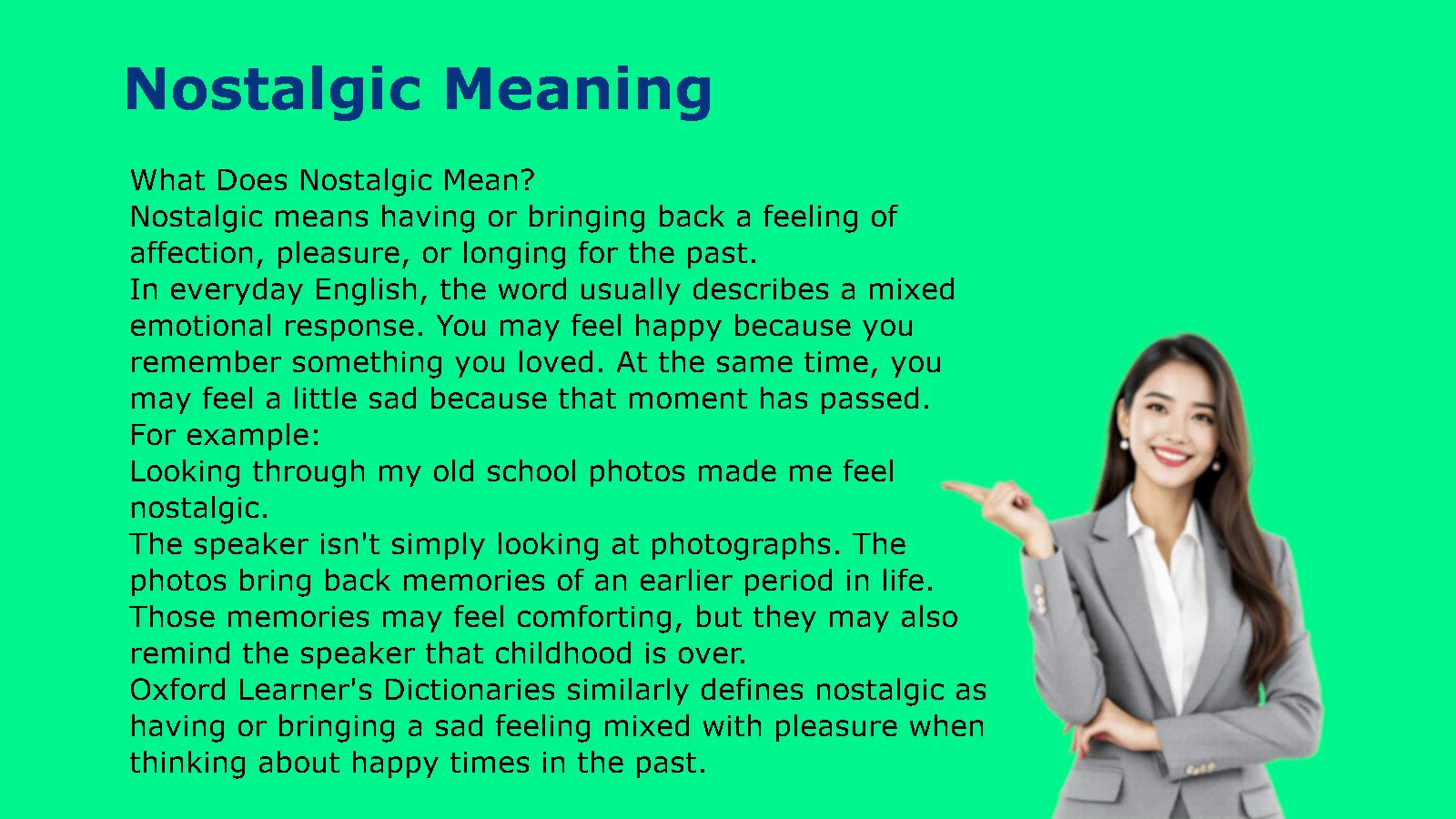
Nostalgic means having or bringing back a feeling of affection, pleasure, or longing for the past.
In everyday English, the word usually describes a mixed emotional response. You may feel happy because you remember something you loved. At the same time, you may feel a little sad because that moment has passed.
For example:
Looking through my old school photos made me feel nostalgic.
The speaker isn’t simply looking at photographs. The photos bring back memories of an earlier period in life. Those memories may feel comforting, but they may also remind the speaker that childhood is over.
Oxford Learner’s Dictionaries similarly defines nostalgic as having or bringing a sad feeling mixed with pleasure when thinking about happy times in the past.
Nostalgic Meaning in Simple English
If you want the shortest possible explanation:
Nostalgic means remembering the past with warm feelings, often mixed with a little sadness or longing.
Here are a few easy examples:
- I feel nostalgic when I hear that song.
- She became nostalgic while looking at her childhood photos.
- That old restaurant has a nostalgic atmosphere.
- He felt nostalgic for his college days.
- The movie has a nostalgic feel.
The important idea is the past. Without that connection, nostalgic usually isn’t the right word.
Nostalgic Definition and Meaning
The word nostalgic works as an adjective. It describes a person, feeling, memory, object, place, experience, or style associated with the past.
Consider these examples:
| Example | What “nostalgic” describes |
| She felt nostalgic. | A person’s emotional state |
| He has nostalgic memories of childhood. | Memories |
| The song sounds nostalgic. | A song’s ability to evoke the past |
| We visited a nostalgic old diner. | A place’s connection with an earlier period |
| The movie takes a nostalgic look at the 1980s. | The movie’s treatment of the past |
| That smell makes me nostalgic. | An experience that triggers memories |
So, nostalgic doesn’t always mean that the object itself is old.
A new movie, restaurant, advertisement, or piece of music can feel nostalgic if it reminds you of an earlier period.
That’s an important distinction.
What Does It Mean to Feel Nostalgic?
To feel nostalgic means that something from the past has stirred an emotional response.
Imagine opening a box in your closet and finding your old school notebook. You recognize the handwriting. You remember your classmates, the classroom, the teacher, and the conversations you had after school.
For a moment, the past feels close.
That’s nostalgia.
The feeling might include:
- Happiness
- Affection
- Longing
- Sentimentality
- Comfort
- Bittersweet sadness
- Fond memories
- A desire to revisit an earlier time
The emotion doesn’t have to be overwhelmingly sad. In fact, nostalgia often feels pleasant. Cambridge describes nostalgia as a feeling that combines pleasure with slight sadness when thinking about past experiences.
Why Nostalgia Can Feel Both Happy and Sad
Nostalgia has an unusual emotional shape.
You might smile when you remember your childhood birthday parties. Yet you also know you’ll never experience that exact childhood moment again. The memory feels good, but its distance from the present creates a small ache.
That combination explains why nostalgic often sounds warmer and more emotional than simply saying old or past.
Compare these sentences:
- I found an old photograph.
- I found a nostalgic photograph.
The first sentence gives you a fact about the photograph’s age or history.
The second suggests that the photograph evokes meaningful memories or an earlier period.
One describes age. The other describes emotion.
Nostalgic Pronunciation
In American English, nostalgic is commonly pronounced:
/nɑːˈstæl.dʒɪk/
An easy pronunciation guide is:
nah-STAL-jik
The stress falls on the second syllable.
The word has three main sound parts:
nos + tal + jik
The related noun nostalgia is pronounced differently at the end:
nah-STAL-juh
Cambridge gives the US pronunciation of nostalgic as /nɑːˈstæl.dʒɪk/.
What Part of Speech Is Nostalgic?
Nostalgic is an adjective.
It describes a noun or a person’s emotional state.
For example:
- a nostalgic memory
- a nostalgic song
- a nostalgic movie
- a nostalgic feeling
- a nostalgic atmosphere
- a nostalgic person
- a nostalgic look at the past
You can also use it after linking verbs:
- I feel nostalgic.
- She became nostalgic.
- He was nostalgic about his childhood.
The related forms are useful to know:
| Word | Part of speech | Example |
| nostalgia | Noun | The song filled me with nostalgia. |
| nostalgic | Adjective | The song made me nostalgic. |
| nostalgically | Adverb | She looked nostalgically at her old photographs. |
Oxford lists nostalgia, nostalgic, and nostalgically as related forms.
Nostalgic vs. Nostalgia
The difference between nostalgic and nostalgia is simple once you identify their parts of speech.
Nostalgia is the feeling.
Nostalgic describes the person, thing, memory, or experience connected to that feeling.
| Nostalgia | Nostalgic |
| Noun | Adjective |
| Names the feeling | Describes the feeling or something that evokes it |
| I felt nostalgia. | I felt nostalgic. |
| The song brought back nostalgia. | The song was nostalgic. |
| She has nostalgia for childhood. | She is nostalgic for childhood. |
For example:
Correct: I feel nostalgic when I visit my old neighborhood.
Correct: Visiting my old neighborhood fills me with nostalgia.
Both sentences communicate essentially the same emotional idea. The grammar changes because one uses the adjective nostalgic while the other uses the noun nostalgia.
How to Use “Nostalgic” in a Sentence
Several sentence patterns occur naturally with nostalgic.
Feel Nostalgic
This is one of the most common structures.
I feel nostalgic whenever I hear that song.
She felt nostalgic while looking through her old yearbooks.
We became nostalgic when we started talking about college.
The pattern is:
feel + nostalgic + when/while + memory or situation
Nostalgic About Something
You can use nostalgic about when talking about a past subject or period.
He felt nostalgic about his childhood.
She became nostalgic about her school days.
They were nostalgic about the neighborhood where they grew up.
Cambridge provides examples of nostalgic about the past and similar constructions.
Nostalgic for Something
Nostalgic for is also common, especially when the sentence emphasizes longing for a particular place, period, or experience.
She felt nostalgic for her hometown.
He was nostalgic for his college years.
They became nostalgic for the simpler days of their childhood.
Oxford gives the example “I feel quite nostalgic for the place where I grew up.”
Make Someone Nostalgic
Something can make a person nostalgic.
That old commercial makes me nostalgic.
The smell of fresh bread makes her nostalgic for home.
Seeing my childhood toys made me nostalgic.
This construction is particularly useful because it shows that an object, sound, smell, place, or event can trigger the feeling.
Nostalgic Examples in Everyday English
Here are practical examples you might actually hear or use.
Childhood
- I felt nostalgic when I found my old toys.
- Those cartoons make me nostalgic for childhood.
- Looking at my childhood photos always makes me nostalgic.
- She has a nostalgic attachment to her old school.
School and College
- Our reunion made everyone nostalgic.
- He felt nostalgic for his college days.
- That old school building gives me a nostalgic feeling.
- The yearbook brought back a lot of nostalgic memories.
Music
- That song makes me nostalgic for the 1990s.
- I get nostalgic whenever I hear that band’s old songs.
- The soundtrack has a nostalgic quality.
- Hearing that melody brought back nostalgic memories.
Movies and Television
- The movie takes a nostalgic look at childhood.
- That television show makes me nostalgic for the early 2000s.
- The director used nostalgic references to an earlier era.
- The old opening theme still feels nostalgic.
Places
- This neighborhood makes me nostalgic.
- The old house has a nostalgic charm.
- She felt nostalgic when she returned to her hometown.
- The restaurant has a nostalgic 1950s atmosphere.
Food and Smells
- The smell of homemade cookies made me nostalgic.
- That family recipe brings back nostalgic memories.
- One bite of the dessert made him nostalgic for his childhood.
Smells can be especially powerful because they can become closely associated with specific memories. That’s why an ordinary scent can sometimes transport you mentally to another place and time.
Things That Can Make You Feel Nostalgic
Nostalgia doesn’t require a dramatic event. Sometimes a tiny detail opens the door.
Common triggers include:
- Childhood photographs
- Old songs
- Family recipes
- School uniforms
- Childhood toys
- Former homes
- Old video games
- Favorite books
- Movie soundtracks
- Familiar smells
- Old television shows
- Handwritten letters
- Family traditions
- Childhood neighborhoods
- Holiday decorations
- Old photographs
- Former classmates
- Places from vacations
- Vintage advertisements
- Objects associated with a particular period
The trigger matters because the object itself isn’t necessarily the emotion. It evokes the emotion.
An old game console sitting on a shelf is simply an object. For someone who spent every weekend playing it with a sibling, however, it can become a powerful nostalgic reminder.
Case Study: How an Ordinary Song Can Become Nostalgic
Consider someone who hears a song they listened to during high school.
At first, they hear only the music. Then the memory unfolds.
They remember the friends they spent time with, the car they drove, the places they visited, and the plans they had. The song has become connected to a whole period of life.
Now imagine the person saying:
“This song makes me nostalgic.”
They aren’t saying the song itself is sad.
They’re saying the song brings back memories of the past, along with the emotions attached to those memories.
That’s the heart of the nostalgic meaning.
Nostalgic vs. Sentimental
Nostalgic and sentimental overlap, but they aren’t identical.
Sentimental describes strong or tender feelings connected to a person, object, relationship, or experience.
Nostalgic specifically points toward the past.
Compare these examples:
She kept the necklace for sentimental reasons.
The necklace may remind her of someone she loves.
She felt nostalgic when she found the necklace she wore in high school.
Here, the necklace connects her to an earlier period of her life.
A sentimental feeling doesn’t have to involve the past. A nostalgic feeling does.
Quick Comparison
| Word | Main idea |
| Nostalgic | Emotional connection to the past |
| Sentimental | Strong emotional attachment |
| Wistful | Gentle longing or sadness |
| Reminiscent | Reminding you of something |
| Homesick | Missing home while away |
So, while these words can overlap, they aren’t interchangeable in every sentence.
Nostalgic vs. Wistful
Wistful usually suggests gentle sadness, longing, or a quiet desire for something unavailable.
Nostalgic focuses more specifically on the past.
For example:
She felt nostalgic when she visited her childhood home.
The feeling comes from memories of the past.
He gave a wistful smile as he watched the train leave.
The sentence emphasizes longing or sadness. It doesn’t necessarily involve a past memory.
You can combine the words when both meanings apply:
She felt nostalgic and wistful while looking through her old photographs.
That sentence suggests both fond memories and gentle longing.
Nostalgic vs. Homesick
Homesick has a narrower meaning than nostalgic.
When you’re homesick, you miss your home while you’re away from it.
When you’re nostalgic, you can miss almost any meaningful part of the past.
For example:
- I felt homesick while studying abroad.
- I felt nostalgic when I visited my old school.
- She felt nostalgic for her childhood.
- He felt homesick for his hometown.
The words sometimes overlap because a hometown can represent both home and the past.
However, nostalgia doesn’t require physical separation from home.
You can sit in your childhood bedroom and feel nostalgic. You aren’t necessarily homesick because you’re already home.
Nostalgic vs. Old-Fashioned
These words are easy to confuse because both can describe things associated with earlier periods.
However, they focus on different ideas.
Old-fashioned describes a style, idea, method, or object that belongs to an earlier period or seems outdated.
Nostalgic describes the emotional response that something from the past creates.
For example:
The restaurant has an old-fashioned design.
This describes its style.
The restaurant has a nostalgic atmosphere.
This suggests that the atmosphere reminds people of an earlier time.
An old-fashioned object can be nostalgic, but it doesn’t have to be.
Can Something New Be Nostalgic?
Absolutely.
This is one of the most interesting uses of the word.
A newly designed product can have a nostalgic style if it intentionally resembles something from the past.
For example:
- A new movie can use a retro visual style.
- A new restaurant can recreate the look of an old diner.
- A new song can imitate the sound of an earlier decade.
- A new video game can use graphics inspired by older games.
- A new advertisement can recreate the style of an earlier era.
The item itself doesn’t need to be old.
What matters is the connection it creates with the past.
Cambridge’s examples include expressions such as a nostalgic look at a particular period, showing that the word can describe how something presents or evokes the past.
Is Nostalgic Always About Happy Memories?
No.
Nostalgia usually involves memories that have some positive emotional value, but those memories can also carry sadness.
Suppose someone remembers a close friend from school. The memory may make them smile because they had wonderful times together. It may also make them sad because they no longer see each other.
That’s still nostalgia.
The emotional mixture is important. Oxford describes nostalgia as sadness mixed with pleasure when remembering happy times in the past.
So nostalgic doesn’t simply mean happy.
A better way to think about it is:
nostalgic = fondly connected to the past, often with a bittersweet emotional edge
The History and Origin of Nostalgic
The history of nostalgic becomes clearer when you look at nostalgia.
The word nostalgia originally had a more painful meaning than it does today. Oxford traces the word to the late 18th century in the sense of acute homesickness and connects it with Greek elements meaning return home and pain.
Over time, its meaning shifted.
Today, nostalgia usually refers to a sentimental or bittersweet longing for the past rather than simply an illness or intense homesickness.
That historical change explains something interesting about the modern word: the idea of longing has remained, but the object of that longing expanded.
You can now feel nostalgia for:
- A childhood
- A former home
- A relationship
- A decade
- A school
- A vacation
- A cultural era
- A family tradition
- A favorite form of entertainment
The word evolved, but its emotional core remained connected to longing.
Common Nostalgic Synonyms
There isn’t one perfect synonym for nostalgic because each related word highlights a slightly different part of the meaning.
Wistful
Wistful emphasizes gentle longing or sadness.
He gave a wistful smile when he remembered his childhood.
Sentimental
Sentimental emphasizes emotional attachment.
She kept the letter for sentimental reasons.
Reminiscent
Reminiscent means something reminds you of another thing, often something from the past.
The music is reminiscent of old jazz recordings.
Reflective
Reflective describes thoughtful consideration of the past or one’s experiences.
He became reflective while looking through his old journals.
Longing
Longing describes a strong desire for something.
She felt a longing for the life she once knew.
These words overlap with nostalgic, but each one paints a slightly different picture.
Common Phrases With Nostalgic
Learning common word combinations can make your English sound more natural.
Feel Nostalgic
I feel nostalgic whenever I visit my hometown.
Get Nostalgic
We got nostalgic while talking about our school days.
This is especially common in casual conversation.
Become Nostalgic
She became nostalgic after finding her old diary.
Make Someone Nostalgic
That song makes me nostalgic.
Nostalgic Memories
He shared some nostalgic memories from his childhood.
Nostalgic Feeling
The old photographs gave her a nostalgic feeling.
Nostalgic Look
The documentary takes a nostalgic look at the decade.
Nostalgic for
They felt nostalgic for their college years.
Nostalgic About
She was nostalgic about her childhood.
These patterns are more useful than simply memorizing a dictionary definition because they show how nostalgic actually works in sentences.
Common Mistakes With “Nostalgic”
A few mistakes appear repeatedly when people learn this word.
Mistake: Treating Nostalgic and Nostalgia as the Same
They aren’t.
Nostalgia is a noun.
Nostalgic is an adjective.
Correct:
The movie filled me with nostalgia.
Correct:
The movie made me nostalgic.
Incorrect usage can make the sentence sound awkward even when the intended meaning is clear.
Mistake: Assuming Nostalgic Means Old
An old object isn’t automatically nostalgic.
A rusty chair might simply be old.
A rusty chair from your grandparents’ house might be nostalgic because it brings back meaningful memories.
Mistake: Assuming Nostalgic Always Means Sad
Nostalgia can involve sadness, but it also commonly includes pleasure and affection.
That’s why someone can say:
“I feel nostalgic, but it’s a nice feeling.”
There’s no contradiction.
Mistake: Using Nostalgic Without a Past Connection
If something has no connection to an earlier time, nostalgic may not fit.
For example, a brand-new object isn’t necessarily nostalgic simply because you like it.
There should be some link to the past, whether personal, cultural, historical, or stylistic.
Nostalgic Meaning in Everyday Conversation
In casual English, people often use nostalgic in short sentences.
You might hear:
- This makes me nostalgic.
- I’m feeling nostalgic today.
- That takes me back.
- This song is so nostalgic.
- I get nostalgic whenever I see that.
- That brings back so many memories.
- I’m nostalgic for those days.
- This place feels nostalgic.
Notice how naturally the word fits into everyday conversation.
The phrase “That makes me nostalgic” is especially useful because it clearly identifies something as the trigger for the emotional response.
A Quick Comparison of Related Words
| Word | Definition | Example |
| Nostalgic | Connected emotionally to the past | That song makes me nostalgic. |
| Nostalgia | A feeling of pleasure mixed with sadness about the past | The song filled me with nostalgia. |
| Sentimental | Showing strong emotional attachment | She kept the gift for sentimental reasons. |
| Wistful | Showing gentle longing or sadness | He gave a wistful smile. |
| Homesick | Missing home while away | She felt homesick after moving abroad. |
| Reminiscent | Reminding someone of something | The smell was reminiscent of childhood. |
| Old-fashioned | Characteristic of an earlier style or period | The room has an old-fashioned design. |
The easiest distinction to remember is this:
Nostalgic points backward emotionally.
Nostalgic Meaning: Key Facts at a Glance
| Fact | Answer |
| Word | Nostalgic |
| Part of speech | Adjective |
| Related noun | Nostalgia |
| Main meaning | Having or evoking feelings connected with the past |
| Typical emotion | Pleasure mixed with some sadness or longing |
| US pronunciation | /nɑːˈstæl.dʒɪk/ |
| Common patterns | Feel nostalgic, nostalgic for, nostalgic about, make someone nostalgic |
| Main focus | Memories, experiences, places, people, or periods from the past |
| Can new things be nostalgic? | Yes, if they evoke an earlier period |
| Is it always negative? | No |
| Is it the same as old-fashioned? | No |
Frequently Asked Questions About Nostalgic Meaning
What is the simple meaning of nostalgic?
Nostalgic means having warm, fond, or bittersweet feelings about the past. It can describe someone who remembers the past fondly or something that brings those memories back.
Does nostalgic mean happy or sad?
It can mean both. Nostalgia often combines pleasure from remembering good times with slight sadness because those times are gone or have changed. Cambridge and Oxford both describe this mixed emotional quality.
What is an example of nostalgic?
I felt nostalgic when I found my old childhood toys.
The toys remind the speaker of an earlier period and create an emotional response.
Is nostalgic a positive word?
Usually, nostalgic has a warm or affectionate tone, but it isn’t automatically positive or negative. Context matters.
She looked back nostalgically on her childhood.
This sounds warm.
The politician offered a nostalgic view of an era that had serious problems.
Here, nostalgic can suggest that the past is being remembered too fondly.
What is the difference between nostalgic and nostalgia?
Nostalgia is the feeling.
Nostalgic describes someone or something connected with that feeling.
I feel nostalgia.
I feel nostalgic.
Both are grammatically correct, but they use different parts of speech.
What is another word for nostalgic?
Depending on the context, possible alternatives include wistful, sentimental, reminiscent, reflective, and longing.
However, these aren’t exact synonyms. Each word emphasizes a different part of the meaning.
Can a person be nostalgic?
Yes.
He became nostalgic while talking about his childhood.
A person can feel nostalgic about a particular period, place, person, or experience.
Can a place be nostalgic?
Yes. A place can be described as nostalgic when it evokes memories of an earlier period.
The old theater has a nostalgic atmosphere.
The building doesn’t literally experience emotion. Instead, it creates or evokes a feeling of nostalgia in people.
Can you feel nostalgic for someone?
Yes.
She felt nostalgic for her old friends.
This construction works when the person represents an important part of the past.
Can you be nostalgic for something you never experienced?
Yes, in some contexts.
A person can describe a style, movie, song, or cultural image as nostalgic even if they didn’t personally live through the period it represents. Here, nostalgic can describe the way something evokes an imagined or culturally familiar past rather than a direct personal memory.
What is the opposite of nostalgic?
There isn’t one perfect opposite in every situation.
Depending on the context, possible contrasts include:
- Forward-looking
- Future-focused
- Present-focused
- Modern
- Unconcerned with the past
The best opposite depends on what you mean by nostalgic in the original sentence.
Final Takeaway: Nostalgic Meaning Explained
The nostalgic meaning centers on an emotional connection with the past.
When you feel nostalgic, you look back on a person, place, experience, period, or memory with affection or longing. The feeling can be wonderfully warm, yet it may carry a small trace of sadness because the past cannot simply be replayed.
The word is an adjective:
I feel nostalgic when I hear that song.
Its related noun is nostalgia:
That song fills me with nostalgia.
Remember the core distinction:
Nostalgic describes the feeling or something that evokes it. Nostalgia names the feeling itself.
Once that difference clicks, the word becomes much easier to use. Whether it’s an old photograph, a childhood recipe, a familiar song, or a place you haven’t visited in years, nostalgic gives you a precise way to describe that strange little moment when the past suddenly feels close again.