
Have you ever heard someone make a joke at the perfect moment and wondered if they were being facetious? While Facetious Meaning may sound confusing at first, this word describes a particular kind of humor that often depends on tone, context, and the speaker’s intention.
Facetious means treating a serious subject in a joking, playful, or deliberately unserious way. Someone who is being facetious may say something they don’t literally mean, often to make a joke or add humor to a conversation.
Examples:
- I was being facetious when I said I’d never make another mistake.
- His facetious comment made everyone laugh.
The confusion is understandable. People often search for what does facetious mean, facetious meaning in text, facetious meaning in chat, or what does it mean when someone is being facetious because the word can describe humor that isn’t always easy to recognize. And here’s the kicker: a facetious comment can sound completely serious if you miss the speaker’s tone.
In this guide, you’ll learn the complete Facetious Meaning, its definition, pronunciation, correct usage, and examples in sentences. You’ll also discover facetious meaning in texting, how to use the word correctly, and the difference between facetious, sarcastic, humorous, and other related words.
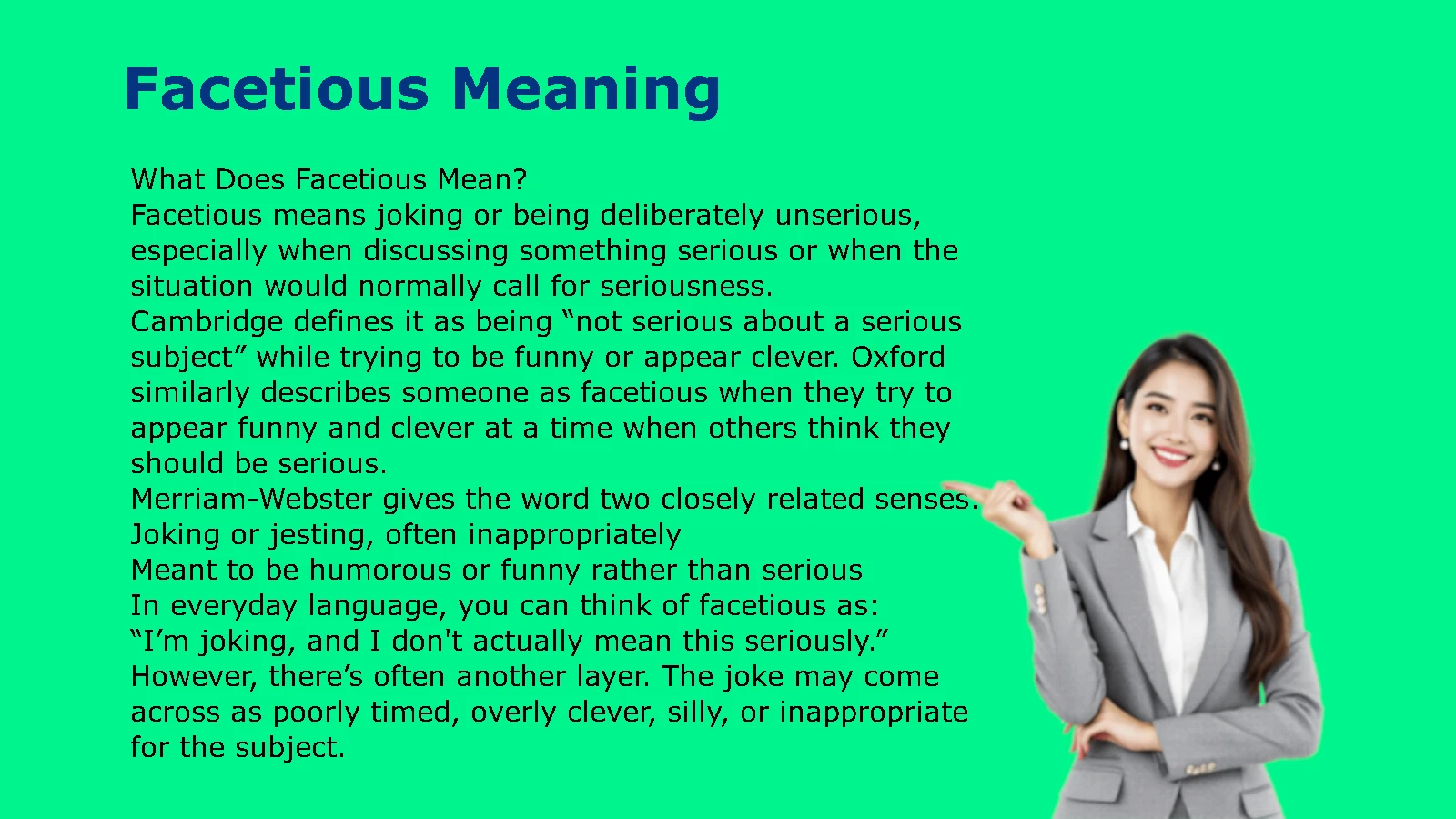
What Does Facetious Mean?
Facetious means joking or being deliberately unserious, especially when discussing something serious or when the situation would normally call for seriousness.
Cambridge defines it as being “not serious about a serious subject” while trying to be funny or appear clever. Oxford similarly describes someone as facetious when they try to appear funny and clever at a time when others think they should be serious.
Merriam-Webster gives the word two closely related senses:
- Joking or jesting, often inappropriately
- Meant to be humorous or funny rather than serious
In everyday language, you can think of facetious as:
“I’m joking, and I don’t actually mean this seriously.”
However, there’s often another layer. The joke may come across as poorly timed, overly clever, silly, or inappropriate for the subject.
A simple example
Imagine someone asks:
“How are we going to pay for all these repairs?”
Someone replies:
“We could always find a suitcase full of money on the sidewalk.”
That answer isn’t a serious financial suggestion. The speaker knows it isn’t realistic. If the person says it to make light of the situation, the comment can be described as facetious.
Facetious Meaning in Simple Words
The easiest way to understand facetious is to focus on intent and context.
Someone who makes a facetious statement usually doesn’t mean exactly what they say. Instead, they use humor, exaggeration, absurdity, or playful cleverness.
Consider these two statements:
| Statement | Likely meaning |
| “The meeting starts at 9 a.m.” | Serious and literal |
| “Great, another 9 a.m. meeting. My favorite way to start the day.” | Potentially facetious |
| “We can solve the entire problem in two minutes.” | Potentially facetious if clearly exaggerated |
| “Please send me the report by Friday.” | Serious and literal |
The important factor isn’t simply whether someone makes you laugh.
A facetious statement usually creates a gap between what the speaker says and what the speaker actually intends.
That’s why context matters so much.
If a friend says, “I absolutely love waiting in traffic,” while sitting in a bumper-to-bumper jam, you can probably recognize the joke. The speaker almost certainly doesn’t mean that traffic is their favorite pastime.
Facetious Pronunciation
The US pronunciation of facetious is:
fuh-SEE-shus
Its IPA pronunciation is:
/fəˈsiːʃəs/
Cambridge and Oxford both give essentially the same pronunciation.
How to pronounce facetious
Break it into three easy parts:
fuh + SEE + shus
The strongest stress falls on the middle syllable:
fuh-SEE-shus
Don’t pronounce it as “fa-SET-ee-us.” The ending sounds like “shus.”
Is facetious a difficult word to pronounce?
Not once you hear it broken down.
Try saying:
fuh → SEE → shus
Then combine the sounds:
fuh-SEE-shus
Merriam-Webster also gives the pronunciation fə-ˈsē-shəs.
Is Facetious an Adjective?
Yes. Facetious is an adjective.
That means it describes a person, comment, remark, tone, response, question, suggestion, or another noun.
Common combinations include:
- facetious remark
- facetious comment
- facetious response
- facetious question
- facetious suggestion
- facetious tone
- facetious answer
- facetious attitude
Examples
- “He made a facetious remark about the company’s new rules.”
- “Her facetious response made everyone laugh.”
- “I thought your question was facetious.”
- “He used a facetious tone during the discussion.”
- “That was a facetious suggestion, not a serious proposal.”
The related forms are also useful:
| Word | Part of speech | Meaning |
| facetious | Adjective | Joking or not serious |
| facetiously | Adverb | In a facetious manner |
| facetiousness | Noun | The quality or state of being facetious |
Merriam-Webster identifies facetiously and facetiousness as the related adverb and noun forms.
Facetious Examples in a Sentence
The best way to understand the word is to see it in realistic situations.
Everyday examples
- “I was being facetious when I said I’d quit my job and become a professional napper.”
- “She made a facetious comment about needing a vacation after the vacation.”
- “He wasn’t offering real advice; he was being facetious.”
- “His facetious answer wasn’t what the manager expected.”
- “Don’t take that comment seriously. She’s being facetious.”
- “The suggestion that we solve the problem with magic was clearly facetious.”
- “He gave a facetious response when asked how he finished the project so quickly.”
- “Her facetious remark lightened an otherwise tense conversation.”
Workplace example
Suppose your team has a huge deadline.
Your manager asks:
“Do you think we can finish everything by tomorrow?”
You answer:
“Absolutely. I’ll just stop sleeping.”
That answer is facetious if you don’t literally plan to stay awake all night. You’re using exaggeration to joke about the workload.
Classroom example
A teacher asks:
“Why didn’t you complete the assignment?”
A student says:
“I was waiting for inspiration to strike.”
If the student didn’t actually expect inspiration to solve the problem, the response could be facetious.
Serious conversation example
Someone asks:
“How should we respond to this emergency?”
Another person replies:
“Let’s ignore it and hope it disappears.”
If the speaker clearly doesn’t mean that literally, the suggestion may be facetious. However, because the subject is serious, the joke could also be seen as inappropriate or insensitive.
That’s an important part of the word’s meaning.
What Does “I’m Being Facetious” Mean?
“I’m being facetious” means:
“I’m joking. I don’t mean what I just said literally or seriously.”
People often use the phrase when they worry that someone might misunderstand a joke.
For example:
“We could solve the budget problem by printing more money. I’m being facetious.”
The second sentence tells the listener that the first wasn’t a genuine proposal.
You may also hear:
- “I’m just being facetious.”
- “I was being facetious.”
- “Sorry, I was being facetious.”
- “Don’t take me seriously. I’m being facetious.”
- “I’m not being facetious.”
Why do people say it?
Humor doesn’t always survive without context.
A joke that sounds obvious in person can look completely serious in a text message. Saying “I’m being facetious” removes some of that ambiguity.
Think of it as putting a small sign next to the joke that says:
“This isn’t meant literally.”
Facetious vs. Sarcastic
Facetious and sarcastic overlap, but they aren’t exact synonyms.
A facetious comment focuses on being joking or unserious, especially in a context where seriousness may be expected.
Sarcasm often has a sharper edge. A sarcastic speaker may say something that appears positive or literal while intending the opposite, frequently to mock, criticize, or express irritation.
Merriam-Webster explains that facetious can mean joking or jesting inappropriately, while sarcastic tends to carry a more caustic or biting quality that may be intended to hurt.
Facetious vs. sarcastic comparison
| Feature | Facetious | Sarcastic |
| Main idea | Deliberately unserious or joking | Often expresses meaning through irony or mockery |
| Typical tone | Playful, silly, clever, or inappropriate | Cutting, mocking, ironic, or biting |
| Requires the opposite meaning? | No | Often |
| Can be harmless? | Yes | Yes, but it can also be hurtful |
| Main emphasis | Lack of seriousness | Mockery or ironic criticism |
Example of facetious
“Sure, I’ll just build a new office before lunch.”
The speaker is joking about an unrealistic task.
Example of sarcasm
Someone arrives two hours late.
You say:
“Nice of you to show up on time.”
You don’t literally mean they arrived on time. You’re criticizing their lateness through sarcasm.
Can something be both facetious and sarcastic?
Yes.
A remark can be sarcastic while also being facetious. The categories can overlap.
For example:
“Fantastic. Another six-hour meeting. Exactly what my weekend needed.”
That could be sarcastic because the speaker means the opposite of the words. It could also be facetious because the speaker is deliberately making an unserious comment about a serious inconvenience.
Facetious vs. Humorous
Humorous is much broader than facetious.
Something humorous is simply funny or amusing. The word doesn’t necessarily suggest that the humor is inappropriate or poorly timed.
Facetious, on the other hand, often carries a stronger implication that someone is deliberately being unserious.
Merriam-Webster explains that humorous applies broadly to things that produce laughter, while facetious can imply a questionable or ill timed attempt at humor.
Compare these sentences
“She told a humorous story about her childhood.”
This sounds positive and neutral.
“She made a facetious comment about the serious situation.”
Now the humor itself is part of the issue.
So, while facetious remarks can be humorous, not every humorous remark is facetious.
Facetious vs. Flippant
Flippant is one of the closest words to facetious when the speaker treats a serious subject too lightly.
Oxford specifically lists flippant as a synonym for facetious in its definition.
However, the emphasis can differ.
- Facetious focuses on joking or trying to be funny.
- Flippant focuses more strongly on a lack of proper seriousness or respect.
Example
“He made a facetious suggestion that we solve the problem with a time machine.”
The emphasis is on the joke.
“His flippant response upset the people who were dealing with the crisis.”
The emphasis is on his failure to treat the crisis seriously.
This distinction matters when choosing the right word.
Facetious vs. Witty
Witty describes clever and often quick humor.
Facetious describes deliberate joking or unseriousness and can suggest that the humor isn’t appropriate.
Merriam-Webster says witty emphasizes cleverness and quickness of mind. By contrast, facetious can suggest a questionable or ill timed attempt at humor.
Compare the two
“She gave a witty answer.”
This is usually a compliment. You’re praising her cleverness.
“She gave a facetious answer.”
This simply tells us that her answer wasn’t serious. Depending on context, it might also suggest criticism.
That’s why calling someone witty often sounds positive, while calling their comment facetious can sound more neutral or mildly critical.
Facetious Synonyms
Several words overlap with facetious, but each carries its own shade of meaning.
Merriam-Webster lists related terms including witty, humorous, clever, funny, jocular, joking, playful, amusing, flippant, teasing, jocose, and jesting.
Useful synonyms for facetious
- Joking — not serious; intended as a joke
- Humorous — funny or amusing
- Witty — clever and amusing
- Jocular — fond of joking
- Jocose — playful or joking
- Playful — lighthearted rather than serious
- Flippant — treating something serious too casually
- Teasing — playfully making fun of someone
- Jesting — speaking or acting in a joking way
Which synonym should you choose?
| If you mean… | Consider… |
| Clever humor | Witty |
| General humor | Humorous |
| Casual joking | Joking |
| Frequent joking | Jocular |
| Playful joking | Jocose |
| Serious subject treated too lightly | Flippant or facetious |
| Light teasing | Teasing |
Don’t treat synonyms as interchangeable puzzle pieces. A word can fit grammatically while still changing the meaning.
Facetious Antonyms
The best opposite of facetious depends on what you want to contrast.
Useful antonyms include:
- Serious
- Sincere
- Earnest
- Genuine
- Solemn
- Literal
- Straightforward
Examples
“She gave a facetious answer.”
Opposite:
“She gave a serious answer.”
Or:
“He wasn’t being facetious. He was completely sincere.”
The most direct antonym in everyday conversation is usually serious.
How to Use “Facetious” Correctly
The word fits naturally into several common sentence patterns.
Facetious + noun
This is probably the most straightforward structure.
- “a facetious remark”
- “a facetious comment”
- “a facetious response”
- “a facetious suggestion”
Example:
“He made a facetious suggestion during the meeting.”
Be + facetious
This structure describes a person’s behavior.
“She’s being facetious.”
“I was only being facetious.”
“Are you being facetious?”
Respond + facetiously
Here, facetiously describes how someone responded.
“He responded facetiously to the question.”
“She facetiously suggested that everyone take the day off.”
Cambridge defines facetiously as doing something in a way that isn’t serious while trying to be funny or clever about a serious subject.
When shouldn’t you use facetious?
Don’t automatically use facetious whenever something is funny.
If someone tells a genuinely funny story, humorous may be more accurate.
If someone makes a clever joke, witty may fit better.
Choose facetious when the key idea is deliberate unseriousness, especially around a subject that normally deserves seriousness.
Facetiously Meaning and Examples
Facetiously is the adverb form of facetious.
It means in a joking or deliberately unserious way.
Examples
- “He facetiously suggested buying a private island.”
- “She facetiously claimed that coffee was a basic human right.”
- “I facetiously told him to call a superhero for help.”
- “The politician’s statement was delivered facetiously.”
- “She facetiously suggested replacing the entire system with a coin toss.”
The word changes the grammar but keeps the basic meaning.
Compare:
He made a facetious remark.
Here, facetious describes the noun remark.
He spoke facetiously.
Here, facetiously describes the verb spoke.
Cambridge lists facetiously as an adverb and provides examples involving deliberately unserious suggestions and comments.
Facetiousness Meaning
Facetiousness is the noun form of facetious.
It refers to the quality or state of being facetious.
For example:
“His facetiousness annoyed the committee.”
That sentence means his tendency to make unserious or joking remarks annoyed the committee.
Another example:
“The writer used facetiousness to expose the absurdity of the situation.”
The word is less common in everyday conversation than facetious, but it is useful when discussing the general quality of someone’s humor or writing style.
Word family
| Form | Word | Example |
| Adjective | facetious | “That was facetious.” |
| Adverb | facetiously | “She replied facetiously.” |
| Noun | facetiousness | “His facetiousness was obvious.” |
The History and Origin of Facetious
The history of facetious is surprisingly old.
Merriam-Webster records the first known use of the word in 1594. It entered English through Middle French facetieux, which came from facetie, meaning a joke or jesting remark. That French word traces back to Latin facetia or facetiae, associated with cleverness, wit, and jests.
Oxford likewise traces the word to the late 16th century and gives the chain:
Latin facetus → Latin facetia → French facétie → French facétieux → English facetious.
The meaning has also shifted over time.
The older meaning was more positive
According to the Online Etymology Dictionary, facetious originally meant something closer to sportive, playful, witty, or amusing. Historical usage could treat the word positively. Over time, it developed a stronger implication that someone’s desire to be funny might be intrusive or ill timed.
That history explains an important modern distinction.
Facetious doesn’t automatically mean bad humor.
Instead, modern usage often highlights the mismatch between the joke and the seriousness of the situation.
Is Facetious Always a Negative Word?
No.
Calling someone facetious isn’t automatically an insult.
Merriam-Webster explicitly notes that the word isn’t inherently insulting. However, it can suggest a questionable or poorly timed attempt at wit or humor.
Compare these:
“He was being facetious.”
This can simply mean he was joking.
“His facetious comment during the memorial was deeply inappropriate.”
Here, the context makes the criticism clear.
The difference comes from context and tone.
A useful rule
If someone says “I’m being facetious,” they’re usually clarifying their intent.
If someone says “Stop being facetious,” they’re probably criticizing the way the other person is treating the subject.
Oxford’s example captures this distinction neatly:
“Stop being facetious; this is serious.”
The second part explains exactly why the first person objects to the humor.
Common Mistakes When Using Facetious
Because facetious overlaps with several other words, it’s easy to misuse.
Mistake: Using facetious as a direct synonym for funny
Not every funny thing is facetious.
Better distinction:
- Funny → makes people laugh
- Facetious → deliberately unserious, often about something serious
Mistake: Assuming facetious always means sarcastic
It doesn’t.
A person can be facetious without saying the opposite of what they mean.
Mistake: Thinking facetious always means offensive
It doesn’t.
A harmless joke can be facetious. The word can become negative when the humor is inappropriate, annoying, or poorly timed.
Mistake: Confusing facetious with facetiously
Remember:
Facetious describes a noun or person.
Facetiously describes an action or manner.
Mistake: Using facetious when you mean witty
If you’re praising someone’s clever humor, witty may be better.
“That’s a witty answer” sounds complimentary.
“That’s a facetious answer” focuses on its lack of seriousness.
Facetious in Everyday Conversation
You can hear facetious in conversations where people deliberately exaggerate or make absurd suggestions.
Texting
Friend: “How are you going to finish all that work tonight?”
You: “Easy. I’ll simply clone myself.”
Friend: “You’re being facetious, right?”
You: “Very.”
Workplace
Manager: “Can we finish the entire project by Friday?”
Employee: “Sure. Assuming nobody needs sleep.”
The response is likely facetious because the speaker isn’t genuinely proposing that everyone stop sleeping.
Friendly conversation
Friend: “Why do you own seven coffee mugs?”
You: “Each one has a different personality.”
That playful answer can be facetious because you aren’t seriously claiming that your mugs have personalities.
Serious situation
Imagine someone asks how to fix a major problem and receives:
“Have you tried turning the entire building off and on again?”
If the speaker is joking, the remark is facetious. Whether it’s appropriate depends on the situation.
That’s the heart of the word: the humor isn’t merely funny. It interacts with the seriousness of the subject.
Case Study: Why Context Changes the Meaning
Consider this sentence:
“We can always solve the problem by throwing money at it.”
Now imagine two situations.
Situation A: Casual conversation
Friends are discussing a small household problem.
Someone makes the statement with a smile.
Here, the comment may simply be playful or facetious.
Situation B: Emergency budget meeting
A company is facing a major financial crisis.
Someone makes the same comment while the team is discussing serious budget cuts.
Now the statement may sound facetious, flippant, or even insensitive.
The words haven’t changed.
The context has.
That’s why dictionary definitions alone don’t always tell you how a word will sound in real conversation. Pragmatics, tone, timing, and shared knowledge all affect interpretation.
Facetious vs. Related Words at a Glance
| Word | Main meaning | Tone | Example |
| Facetious | Joking or deliberately unserious | Can be mildly disapproving | “He made a facetious remark.” |
| Sarcastic | Often expresses meaning through irony or mockery | Can be sharp | “Her sarcastic response was obvious.” |
| Humorous | Funny or amusing | Usually neutral or positive | “It was a humorous story.” |
| Witty | Clever and amusing | Usually positive | “She gave a witty reply.” |
| Flippant | Treating something serious too casually | Often negative | “His flippant response upset them.” |
| Jocular | Fond of joking | Usually lighthearted | “He kept a jocular tone.” |
| Jocose | Playful or joking | Usually lighter than facetious | “The article had a jocose tone.” |
| Playful | Lighthearted and fun | Usually positive | “She made a playful comment.” |
Merriam-Webster’s synonym guidance makes an especially useful distinction: witty emphasizes cleverness, humorous applies broadly to things that provoke laughter, jocular suggests a fondness for joking, and facetious can imply that the attempt at humor is dubious or ill timed.
Interesting Fact About the Word Facetious
There’s a famous vocabulary fact associated with facetious.
The word contains the five vowel letters a, e, i, o, u in order:
f a c e t i o u s
Merriam-Webster has highlighted this feature in its Word of the Day material.
However, it’s worth being precise: the claim concerns the letters appearing in alphabetical vowel order. The word doesn’t contain them as five consecutive letters.
Another related word, facetiae, comes from the same Latin family and refers to witty or humorous writings or sayings.
How to Tell If a Comment Is Facetious
When you’re unsure whether someone is being facetious, look for a few clues.
Watch for exaggeration
“I’ll finish this mountain of paperwork in thirty seconds.”
The speaker probably doesn’t mean it literally.
Look for absurd suggestions
“We should hire a dragon to guard the office.”
Unless your workplace has taken a very unusual turn, that’s probably a joke.
Consider the subject
If everyone is discussing something serious and someone suddenly makes an obviously unserious remark, facetious becomes a strong possibility.
Listen to the tone
A smile, laugh, exaggerated voice, or deliberately deadpan delivery can signal that the speaker isn’t being literal.
Check what happens next
Someone may immediately clarify:
“I’m kidding.”
“I’m just joking.”
These phrases remove much of the ambiguity.
When “Facetious” Is the Best Word
Use facetious when you want to communicate that someone is:
- Not being serious
- Making a deliberate joke
- Treating a serious subject humorously
- Using exaggerated or absurd language
- Trying to appear clever through humor
- Making a remark that may be poorly timed
- Speaking in a joking way rather than giving a literal answer
For example:
“His facetious response wasn’t intended as actual advice.”
That’s more precise than simply saying:
“His response was funny.”
The first sentence tells readers something about intent. The second tells them only about the effect or quality of the response.
Frequently Asked Questions About Facetious Meaning
What does facetious mean?
Facetious means joking or deliberately not serious, especially when someone makes light of a serious subject or uses humor when seriousness would be more appropriate.
Does facetious mean funny?
Not exactly. Facetious can describe something funny, but the word emphasizes that the speaker is being deliberately unserious. It can also suggest that the humor is poorly timed or inappropriate.
Is facetious the same as sarcastic?
No. Facetious emphasizes joking or lack of seriousness. Sarcastic often involves irony, mockery, or saying something that means the opposite of the literal words. Sarcasm can be more biting.
What does “I’m being facetious” mean?
It means “I’m joking” or “I don’t mean what I just said literally.”
Is facetious a negative word?
Not inherently. However, it can sound negative when it describes humor that seems inappropriate, annoying, disrespectful, or badly timed.
How do you pronounce facetious?
In US English, pronounce it fuh-SEE-shus: /fəˈsiːʃəs/.
What is the adjective form of facetious?
Facetious itself is the adjective.
Example:
“That was a facetious comment.”
What is the adverb form of facetious?
The adverb is facetiously.
Example:
“She facetiously suggested that we cancel the entire project.”
What is the noun form of facetious?
The noun is facetiousness.
Example:
“His facetiousness wasn’t appreciated during the meeting.”
What is a good synonym for facetious?
Depending on context, you could use joking, humorous, witty, jocular, jocose, playful, flippant, or jesting. They aren’t exact replacements in every sentence.
Is facetious a compliment?
Usually, not necessarily. Calling someone facetious can simply identify their joking behavior, but it can also suggest that their humor is inappropriate or poorly timed.
What is the opposite of facetious?
The most direct opposite is usually serious. Other possibilities include sincere, earnest, genuine, and solemn, depending on the context.
Final Takeaway: Facetious Meaning
The simplest way to remember the facetious meaning is:
Facetious describes someone who is joking or deliberately unserious, especially when the subject or situation calls for seriousness.
The word sits in an interesting space between humor, irony, cleverness, and inappropriate timing. That’s why it doesn’t mean exactly the same thing as funny, witty, sarcastic, or flippant.
If someone says, “I’m being facetious,” they usually want you to understand one thing: don’t take the statement literally or seriously.
The word dates back to the late 16th century and originally had a more positive connection with wit and amusement. Over time, its modern sense developed a stronger suggestion of humor that can be intrusive, ill timed, or inappropriate.
So, when you use facetious, think about the context, not just the joke. A witty comment can make people laugh. A sarcastic comment can sting. A humorous story can entertain. A facetious remark, meanwhile, often makes light of something that isn’t supposed to be taken lightly.
Quick reference
| Question | Answer |
| Facetious meaning | Joking or deliberately unserious, especially about a serious subject |
| Part of speech | Adjective |
| US pronunciation | fuh-SEE-shus |
| IPA | /fəˈsiːʃəs/ |
| Adverb | facetiously |
| Noun | facetiousness |
| Common synonym | Joking, humorous, witty, jocular, flippant |
| Common opposite | Serious |
| First known use | 1594 |
| Origin | Middle French facetieux, ultimately from Latin facetia/facetiae |
| Key distinction | It often highlights deliberate humor or unseriousness in a context where seriousness may be expected |