
Ever come across the word Enumerate Meaning and wondered what it actually means? You’re not alone. Many people encounter this word in books, exams, workplace documents, or everyday conversations but aren’t sure how to use it correctly.
Enumerate means to list, count, or mention items one by one in a clear and organized way. It is commonly used in writing, speeches, instructions, and formal discussions when presenting information in a specific order.
Examples:
- The teacher asked the students to enumerate the causes of climate change.
- Please enumerate the steps required to complete the application.
- The report enumerates the company’s major achievements.
The confusion often goes beyond the definition. People also search for enumerate definition, how to pronounce enumerate, enumerate meaning in English, and how to use enumerate in a sentence because the word can seem formal or unfamiliar. And here’s the kicker: understanding it can instantly improve your vocabulary and make your writing sound more precise.
In this guide, you’ll discover the Enumerate Meaning, learn the correct pronunciation of enumerate, explore its definition, synonyms, examples, and sentence usage, and understand when to use it in both formal and everyday English. You’ll also see the difference between enumerate vs list and pick up easy memory tips to remember the word with confidence.
What Does Enumerate Mean?
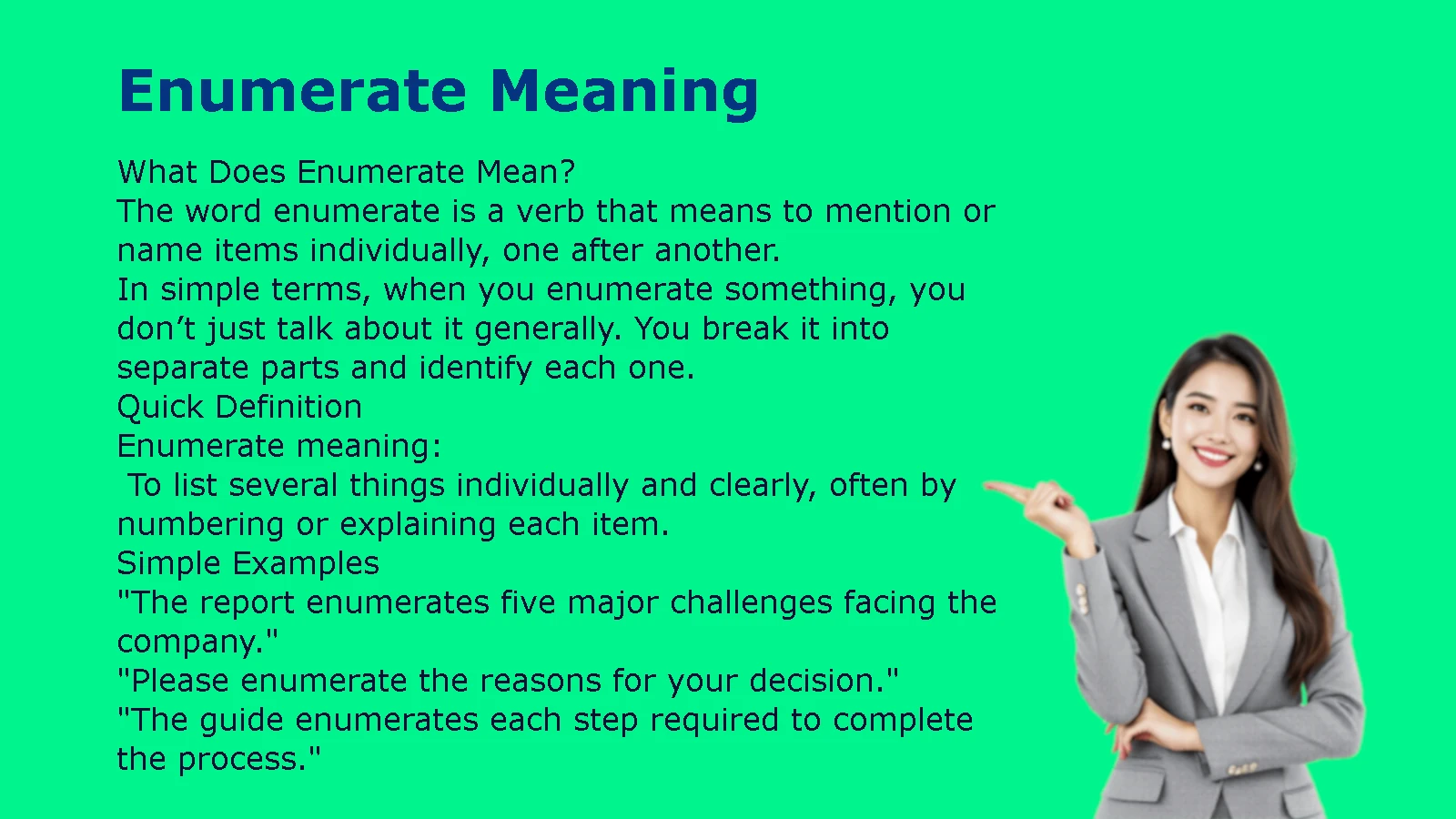
The word enumerate is a verb that means to mention or name items individually, one after another.
In simple terms, when you enumerate something, you don’t just talk about it generally. You break it into separate parts and identify each one.
Quick Definition
Enumerate meaning:
To list several things individually and clearly, often by numbering or explaining each item.
Simple Examples
- “The report enumerates five major challenges facing the company.”
- “Please enumerate the reasons for your decision.”
- “The guide enumerates each step required to complete the process.”
In each example, the speaker or writer presents separate points rather than giving a broad overview.
Think of enumeration like organizing items in a grocery list. Instead of saying:
“I bought some food.”
You enumerate by saying:
- Apples
- Bread
- Milk
- Rice
You identify each item so someone else can understand exactly what you mean.
Enumerate Definition: A Closer Look
According to standard English usage, enumerate has two closely related meanings:
| Meaning | Explanation | Example |
| To list items individually | Naming each item separately | “The article enumerates the benefits of exercise.” |
| To count or number things | Assigning numbers to items | “The researcher enumerated the samples before testing.” |
The second meaning comes from the idea of counting one by one. However, in modern English, people most often use enumerate to mean list or specify clearly.
The Origin of the Word Enumerate
Understanding a word’s origin can make its meaning easier to remember.
The word enumerate comes from the Latin word enumerare, which means to count out or to calculate one by one.
It combines two Latin parts:
| Word Part | Meaning |
| e- | out |
| numerus | number |
The connection is simple: when you enumerate something, you bring each item “out” and identify it separately.
This root also connects to other English words such as:
- Number
- Numerical
- Numerous
- Numeration
All of these words relate to counting or numbers.
Enumerate Pronunciation: How to Say It Correctly
Many people recognize the word enumerate when reading but hesitate when speaking because it looks more complicated than it sounds.
Correct Pronunciation
Enumerate: ih-NOO-muh-rate
Phonetic Spelling
/ɪˈnuːməreɪt/
Syllable Breakdown
The word has four syllables:
e • nu • mer • ate
The stress falls on the second syllable:
e-NU-mer-ate
Common Pronunciation Mistake
A common mistake is stressing the first syllable:
❌ EE-num-er-ate
✅ ih-NOO-muh-rate
The pronunciation becomes easier when you connect it with the word numerous, which shares the same root.
Enumerate Meaning in Different Contexts
The meaning of enumerate stays consistent, but its use changes depending on the situation. You’ll find it most often in formal, structured writing where accuracy matters.
Enumerate Meaning in General English
In everyday English, enumerate means explaining things individually.
However, native speakers often choose simpler words like list or name in casual conversations.
Example:
Formal:
“The speaker enumerated the reasons for changing the policy.”
Casual:
“The speaker listed the reasons for changing the policy.”
Both sentences are correct. The first one sounds more formal and organized.
Enumerate Meaning in Academic Writing
Academic writers frequently use enumerate when discussing theories, research findings, or arguments.
A professor might ask:
“Enumerate the factors that influence human behavior.”
This instruction means:
- Identify each factor.
- Present them separately.
- Explain them clearly.
Academic Example
A biology student might write:
“The study enumerates three major functions of the human respiratory system: gas exchange, oxygen delivery, and carbon dioxide removal.”
The word works well because the information has a clear structure.
Enumerate Meaning in Business Communication
Businesses use enumerate when they need precision.
For example, a company report may ask employees to:
- Enumerate project risks.
- Enumerate customer complaints.
- Enumerate possible solutions.
- Enumerate budget requirements.
Business Example
A project manager writes:
“The team must enumerate all potential risks before launching the product.”
This tells the team not to provide a general statement. They need to identify each risk separately.
Enumerate Meaning in Legal Documents
Legal writing often uses enumerate because laws and contracts require exact wording.
A contract might enumerate:
- Responsibilities
- Conditions
- Exceptions
- Rights
- Obligations
Example:
“The agreement enumerates the duties of both parties.”
This means the contract clearly states each duty instead of leaving responsibilities open to interpretation.
Enumerate Meaning in Technology and Programming
In technology, enumerate has a specialized meaning.
In programming, enumeration refers to going through a collection of items one by one.
For example, a computer program may enumerate:
- Files inside a folder
- Users in a database
- Options in a menu
- Records in a system
Programming Example
A developer might write code that:
- Finds all available files.
- Reads each file name.
- Processes each file separately.
The program is essentially enumerating the files.
Enumerate Meaning in Mathematics and Data Analysis
In mathematics, enumeration means identifying or counting elements individually.
For example, a researcher may enumerate the members of a dataset before analyzing patterns.
Instead of saying:
“There are several values in this group.”
A mathematician may enumerate them:
2, 4, 6, 8, 10
Each value receives individual attention.
When to Use the Word Enumerate
The word enumerate works best when information needs structure and precision.
Use it when you want someone to:
- Identify separate items
- Explain multiple points
- Provide a detailed breakdown
- Present information in order
- Avoid vague statements
Common Situations Where Enumerate Works Well
Writing Reports
Reports often require organized information.
Example:
“The report enumerates the company’s financial challenges.”
The reader expects a clear list of challenges.
Answering Exam Questions
Teachers often use enumerate in instructions.
Example:
“Enumerate the advantages of renewable energy.”
Students should provide numbered points.
A strong answer might include:
- Reduced greenhouse gas emissions
- Lower dependence on fossil fuels
- Long-term energy sustainability
Giving Instructions
Step-by-step guides often rely on enumeration.
Example:
A cooking guide might enumerate the preparation steps:
- Wash the vegetables.
- Chop the ingredients.
- Cook the mixture.
- Add seasoning.
Explaining Complex Ideas
Some topics contain many parts. Enumeration helps readers process information.
For example, explaining a car engine becomes easier when you enumerate its main components:
- Engine block
- Fuel system
- Cooling system
- Exhaust system
When Not to Use Enumerate
Although enumerate is a useful word, it doesn’t fit every situation. Because it sounds formal and structured, using it in casual conversations can sometimes feel unnatural.
For example, imagine asking a friend:
“Can you enumerate your weekend plans?”
The sentence is grammatically correct, but most people would simply say:
“Can you list your weekend plans?”
or:
“What are your plans for the weekend?”
The word enumerate works best when you want accuracy, organization, or a formal tone.
Avoid Enumerate When a Simpler Word Works Better
Sometimes a shorter, clearer word communicates the idea more naturally.
Compare these examples:
| Less Natural | Better Choice |
| “Please enumerate your favorite movies.” | “Please list your favorite movies.” |
| “I will enumerate my daily tasks.” | “I will list my daily tasks.” |
| “She enumerated her shopping items.” | “She listed her shopping items.” |
The goal of good writing isn’t to use impressive words. It’s to choose words that make your meaning clear.
Enumerate vs Similar Words
Many English words overlap with enumerate, but each one has a slightly different purpose. Understanding these differences helps you choose the right word.
Enumerate vs List
The words enumerate and list are very close in meaning.
Both involve presenting items individually. However, enumerate often suggests a more careful, detailed, or formal listing process.
Comparison
| Word | Meaning | Tone | Example |
| Enumerate | Identify items one by one with detail | Formal | “The report enumerates the causes of inflation.” |
| List | Write or mention items | Neutral | “The report lists the causes of inflation.” |
When to Use Each
Use enumerate when:
- You need precision.
- You are writing formally.
- Each item deserves attention.
Use list when:
- You want simple communication.
- The situation is casual.
- You don’t need extra emphasis.
Enumerate vs Count
These words connect to numbers, but they focus on different actions.
Count means determining how many items exist.
Enumerate means identifying each item individually.
Example:
Counting:
“I counted 20 books on the shelf.”
Enumeration:
“I enumerated the 20 books by recording each title.”
The first example focuses on the total number. The second focuses on the individual items.
Enumerate vs Itemize
Itemize means breaking information into separate items, usually for clarity or accounting purposes.
It often appears in financial situations.
Examples:
- “The invoice itemizes all expenses.”
- “The contractor itemized the repair costs.”
Enumerate is broader.
You can enumerate:
- Reasons
- Steps
- Benefits
- Problems
- Ideas
You usually itemize:
- Costs
- Charges
- Expenses
- Financial details
Comparison Table
| Word | Main Focus | Example |
| Enumerate | Naming individual points | “Enumerate the reasons for the decision.” |
| Itemize | Separating details into categories | “Itemize the expenses on the receipt.” |
Enumerate vs Specify
The word specify means giving exact details.
However, it does not always involve multiple items.
Example:
Specify:
“Please specify the delivery date.”
Enumerate:
“Please enumerate the delivery requirements.”
The first asks for one specific detail. The second asks for a complete list.
Enumerate vs Mention
Mention means referring to something briefly.
It does not require a complete explanation.
Example:
“The article mentions several health benefits.”
This means the article refers to them.
However:
“The article enumerates several health benefits.”
This means the article identifies each benefit separately.
Key Difference
| Word | Level of Detail |
| Mention | Brief reference |
| Enumerate | Detailed identification |
Enumerate vs Catalog
Catalog means creating an organized record of items.
It often relates to collections.
Examples:
- A museum catalogs artwork.
- A library catalogs books.
- A company catalogs products.
Enumerate focuses on naming items one by one.
Example:
Catalog:
“The museum cataloged its ancient artifacts.”
Enumerate:
“The researcher enumerated the artifacts found during excavation.”
How to Use Enumerate in a Sentence
The word enumerate follows normal verb patterns. It can appear in different tenses depending on the situation.
Present Tense
Use this form for general facts or ongoing actions.
Structure:
Subject + enumerate/enumerates + objects
Examples:
- “The article enumerates the advantages of online learning.”
- “The teacher enumerates the rules before the exam.”
- “The document enumerates employee responsibilities.”
Past Tense
The past form is enumerated.
Examples:
- “The researcher enumerated the survey results.”
- “The report enumerated several environmental concerns.”
- “The speaker enumerated the reasons behind the decision.”
Present Participle
The -ing form is enumerating.
Examples:
- “The scientist is enumerating the samples collected from the experiment.”
- “The system is enumerating available network devices.”
Future Tense
Examples:
- “The presentation will enumerate the major findings.”
- “The committee will enumerate the necessary changes.”
Common Sentence Patterns With Enumerate
The word frequently appears in these structures:
Enumerate + Noun
Examples:
- “Enumerate the benefits.”
- “Enumerate the problems.”
- “Enumerate the requirements.”
Enumerate + List of Items
Examples:
- “The report enumerates three possible solutions.”
- “The article enumerates five reasons for customer dissatisfaction.”
Enumerate + That Clause
Examples:
- “The study enumerates that several factors influence consumer behavior.”
However, this structure is less common. Writers usually prefer:
“The study enumerates several factors that influence consumer behavior.”
40+ Examples of Enumerate in Sentences
Everyday Examples
- “Can you enumerate the items you need from the store?”
- “She enumerated the reasons for changing her plans.”
- “The teacher asked students to enumerate the main ideas.”
- “He carefully enumerated each step of the process.”
- “The instructions enumerate everything needed for setup.”
Workplace Examples
- “The manager enumerated the goals for the upcoming quarter.”
- “The report enumerates customer concerns.”
- “The presentation enumerated the benefits of the new strategy.”
- “The employee enumerated the tasks completed during the week.”
- “The proposal enumerates several ways to reduce expenses.”
Academic Examples
- “The essay enumerates the causes of economic inequality.”
- “Students must enumerate the characteristics of living organisms.”
- “The textbook enumerates important historical events.”
- “The researcher enumerated the factors affecting the results.”
- “The study enumerates different approaches to solving the problem.”
Legal Examples
- “The contract enumerates the obligations of both parties.”
- “The law enumerates specific protections for consumers.”
- “The agreement enumerates conditions for termination.”
- “The document enumerates the rights of property owners.”
- “The policy enumerates acceptable workplace behaviors.”
Technical Examples
- “The software enumerates connected devices automatically.”
- “The program enumerates files stored on the server.”
- “The database enumerates available records.”
- “The system enumerates user permissions.”
- “The application enumerates possible configuration options.”
Scientific Examples
- “The scientist enumerated the species discovered in the region.”
- “The study enumerates factors affecting plant growth.”
- “The researchers enumerated cells under a microscope.”
- “The experiment enumerated different chemical reactions.”
- “The report enumerates environmental changes.”
Professional Writing Examples
- “The document enumerates the company’s core values.”
- “The article enumerates strategies for improving productivity.”
- “The guide enumerates safety procedures.”
- “The report enumerates potential risks.”
- “The presentation enumerates key performance indicators.”
Additional Examples
- “The coach enumerated the team’s weaknesses.”
- “The speaker enumerated the reasons behind the decision.”
- “The checklist enumerates every required step.”
- “The manual enumerates troubleshooting methods.”
- “The survey enumerates customer preferences.”
Common Phrases Using Enumerate
Certain phrases appear frequently in formal writing.
Enumerate the Reasons
Meaning: Explain each reason separately.
Example:
“The article enumerates the reasons why businesses adopt automation.”
Enumerate the Benefits
Meaning: Provide a detailed list of advantages.
Example:
“The presentation enumerates the benefits of remote work.”
Enumerate the Steps
Meaning: Explain a process in order.
Example:
“The guide enumerates the steps needed to install the software.”
Enumerate the Requirements
Meaning: Identify all necessary conditions.
Example:
“The application form enumerates the requirements for admission.”
Enumerate the Factors
Meaning: Identify individual influences or causes.
Example:
“The research paper enumerates the factors affecting consumer choices.”
Is Enumerate a Formal Word?
Yes, enumerate is considered a formal word.
You will see it more often in:
- Academic papers
- Legal writing
- Business documents
- Research reports
- Technical manuals
You’ll hear it less often in everyday conversations.
Formality Comparison
| Situation | Better Word |
| Academic essay | Enumerate |
| Legal contract | Enumerate |
| Business report | Enumerate |
| Casual conversation | List |
| Friendly email | List |
Common Synonyms for Enumerate
| Synonym | Meaning | Best Used In |
| List | To write or mention items one by one | Everyday writing |
| Itemize | To separate information into individual items | Bills, reports, expenses |
| Specify | To state something clearly and exactly | Instructions, requirements |
| Count | To determine the number of items | Mathematics, statistics |
| Name | To identify something by its title or label | General communication |
| Identify | To recognize and point out something | Research, analysis |
| Catalog | To organize and record items | Collections, databases |
| Detail | To explain fully | Reports, explanations |
| Outline | To summarize main points | Essays, presentations |
| Number | To assign numbers to items | Lists, instructions |
Detailed Differences Between Enumerate and Its Synonyms
Enumerate vs List
List is the closest and most common synonym for enumerate.
However, enumerate suggests a more deliberate process. It often implies that each item receives individual attention.
Example:
List:
“The website lists popular travel destinations.”
Enumerate:
“The report enumerates the factors that influence travel decisions.”
The first example simply presents information. The second suggests a structured explanation.
Enumerate vs Itemize
The word itemize focuses on separating information into individual parts.
You often see it in financial or administrative settings.
Examples:
- An accountant itemizes expenses.
- A contractor itemizes repair costs.
- A company itemizes monthly charges.
Meanwhile, you can enumerate almost anything:
- Ideas
- Problems
- Benefits
- Steps
- Reasons
Quick Comparison
| Word | Example |
| Enumerate | “Enumerate the causes of pollution.” |
| Itemize | “Itemize the costs of the renovation.” |
Enumerate vs Identify
These words sometimes overlap, but they have different goals.
Identify means recognizing or pointing something out.
Enumerate means listing multiple items individually.
Example:
- “The scientist identified a new species.”
- The scientist discovered or recognized it.
- “The scientist enumerated the species found in the area.”
- The scientist listed each species.
Enumerate vs Describe
These words are often confused.
Enumerate answers:
“What are the items?”
Describe answers:
“What are the items like?”
Example:
Enumerate:
“The article enumerates three causes of stress.”
Describe:
“The article describes how stress affects the body.”
Sometimes both actions appear together:
“The report enumerates the risks and describes their impact.”
Antonyms of Enumerate
An antonym is a word with an opposite meaning.
Since enumerate means identifying items individually, its opposite often involves ignoring details, combining information, or giving a general view.
Common Opposites of Enumerate
| Antonym | Meaning |
| Summarize | Give a shorter overview |
| Generalize | Discuss broadly without details |
| Omit | Leave something out |
| Ignore | Fail to consider something |
| Overlook | Miss important details |
| Condense | Reduce information |
| Simplify | Make less detailed |
Examples of Enumerate Antonyms
Enumerate:
“The report enumerates every safety requirement.”
Summarize:
“The report summarizes the main safety concerns.”
The first gives every detail. The second provides only the major points.
Common Mistakes When Using Enumerate
Even though enumerate has a straightforward meaning, people often misuse it.
Understanding these mistakes helps you use the word naturally.
Mistake: Using Enumerate When You Mean Count
Many people assume enumerate always means counting numbers.
However, it usually means listing individual items, not just calculating a total.
Incorrect idea:
“I enumerated the number of students in the classroom.”
Better:
“I counted the number of students in the classroom.”
or:
“I enumerated the students in the classroom by recording each name.”
Mistake: Using Enumerate in Casual Conversation
The word can sound overly formal in relaxed situations.
Example:
Too formal:
“Please enumerate your favorite foods.”
Natural:
“Please list your favorite foods.”
Formal vocabulary has its place, but everyday communication usually benefits from simplicity.
Mistake: Thinking Enumerate Requires Numbers
Many people believe enumeration always requires numbered lists.
That is not always true.
You can enumerate items without using actual numbers.
Example:
“The article enumerates the challenges faced by small businesses.”
The challenges may appear as bullet points or sentences rather than a numbered list.
Mistake: Confusing Enumeration With Explanation
Enumeration identifies items. It does not necessarily explain them.
Example:
Enumeration:
“The five causes are pollution, deforestation, waste, overpopulation, and climate change.”
Explanation:
“Pollution damages ecosystems by introducing harmful substances into the environment.”
A strong article or report often does both:
- Enumerate the points.
- Explain each point.
Tips for Remembering the Meaning of Enumerate
Learning vocabulary becomes easier when you connect words to familiar ideas.
Memory Trick: Think “Number Them Out”
The word enumerate contains a connection to number.
Remember:
“Enumerate means to bring numbers or items out one by one.”
Imagine a teacher calling students from a classroom:
- Sarah
- John
- Maria
- David
The teacher is enumerating the students.
Use the Word in Real Life
Try creating your own sentences.
Examples:
- “I will enumerate my goals for this year.”
- “The presentation enumerates the main problems.”
- “The checklist enumerates everything needed for the trip.”
The more you use a word, the more naturally it becomes part of your vocabulary.
Case Study: How Enumeration Improves Communication
Imagine two project reports.
Report A
“The project has several problems that need attention.”
This sentence gives information, but it remains vague.
Report B
“The project faces three major problems: delayed deliveries, unclear responsibilities, and limited resources.”
The second report uses enumeration. It immediately tells the reader what issues exist.
Why Report B Works Better
Enumeration:
- Creates structure.
- Reduces confusion.
- Makes information easier to remember.
- Helps readers take action.
This is why businesses, researchers, and educators frequently use enumeration.
How Enumerating Information Helps Readers
Well-organized information is easier for the human brain to process.
When you enumerate ideas, you create a mental roadmap.
Readers can:
- Scan information quickly.
- Remember important points.
- Compare different items.
- Find specific details later.
For example, a safety manual becomes much more useful when it says:
Five safety rules:
- Wear protective equipment.
- Inspect tools before use.
- Follow operating instructions.
- Report hazards immediately.
- Maintain a clean workspace.
A paragraph containing the same information would take longer to understand.
Enumeration in Different Fields
The concept of enumeration appears almost everywhere.
Education
Teachers use enumeration to organize lessons and test knowledge.
Examples:
- “Enumerate the causes of World War I.”
- “Enumerate the functions of the human heart.”
Students learn better when complex topics become separate points.
Business
Companies enumerate information to support decisions.
Examples:
- Market challenges
- Customer needs
- Project goals
- Financial risks
A business plan with clearly enumerated sections looks more organized and professional.
Science
Scientists enumerate observations and findings.
Examples:
- Species identified during research
- Experimental results
- Research variables
- Data points
Scientific work depends on accuracy, so clear enumeration matters.
Technology
Computers frequently enumerate digital information.
Examples:
- Files in a directory
- Devices connected to a network
- Database entries
- User permissions
Enumeration allows systems to handle large collections efficiently.
Frequently Asked Questions About Enumerate Meaning
What does enumerate mean in simple words?
Enumerate means to list things one by one. It involves identifying each item separately rather than discussing something generally.
Example:
“The teacher asked students to enumerate the causes of pollution.”
This means students should list each cause.
Is enumerate the same as list?
Not exactly.
Although both words involve presenting items, enumerate sounds more formal and often suggests a careful, detailed listing process.
“List” works in almost all situations, while “enumerate” is better for formal writing.
Does enumerate mean count?
Sometimes, but not always.
Historically, enumerate relates to counting. Today, it usually means identifying items individually.
Example:
- Count: “There are 50 books.”
- Enumerate: “The librarian recorded each book title.”
Is enumerate a formal word?
Yes. Enumerate is mainly used in formal writing, including:
- Academic papers
- Legal documents
- Research reports
- Business communication
In casual conversations, words like “list” or “name” often sound more natural.
What is the noun form of enumerate?
The noun form is enumeration.
Example:
“The enumeration of the survey responses helped researchers analyze the data.”
Enumeration means the act or process of listing items individually.
What is the adjective form of enumerate?
The adjective form is enumerated.
Example:
“The document contains an enumerated list of requirements.”
This means the requirements appear as separate listed items.
What is the opposite of enumerate?
Common opposites include:
- Summarize
- Generalize
- Omit
- Ignore
- Condense
These words focus on reducing details rather than identifying each item.
Key Takeaways About Enumerate Meaning
The word enumerate means to identify, name, or list items individually. It helps writers and speakers organize information clearly.
Remember these main points:
- Enumerate = list one by one.
- It is a formal verb often used in academic, business, legal, and technical writing.
- It does not simply mean “count.”
- It works best when each item deserves attention.
- List is the most common everyday alternative.
- Enumeration helps readers understand complex information faster.
Whether you’re writing a report, answering an exam question, creating instructions, or explaining a complicated idea, enumeration gives your information a clear structure. When details matter, this simple technique turns a confusing collection of ideas into an organized path your readers can follow.