
Have you ever needed to create a clear plan, develop a solution, or organize your thoughts before taking action? The word formulate describes that process. The formulate meaning is to carefully create, develop, or express something by putting ideas, information, or materials together in a structured way.
In simple words, to formulate means to think something through and create it in a clear, organized form.
For example:
- A business leader may formulate a strategy before launching a new product.
- A scientist may formulate a hypothesis before conducting an experiment.
- A student may formulate an answer after analyzing a question.
The confusion often comes from its different uses in everyday English. People frequently search for formulate meaning, formulate definition, formulate pronunciation, and how to use formulate in a sentence because the word can describe creating an idea, developing a plan, or expressing thoughts clearly. And here’s the kicker: understanding the correct meaning can instantly improve both your vocabulary and writing.
The word often suggests planning and careful thought. You usually do not “formulate” something randomly. Instead, you build it step by step, like an architect designing a building before construction begins.
The word appears frequently in academic writing, business discussions, science, medicine, government, and professional communication. Understanding its meaning helps you choose stronger vocabulary and communicate ideas more precisely.
What Does Formulate Mean?
The word formulate is a verb that means to create, develop, prepare, or express something in a specific and organized way.
According to its common English usage, formulate meaning focuses on the process of arranging thoughts, facts, or ingredients into a clear structure.
Simple Definition of Formulate
Formulate (verb): To carefully create a plan, idea, theory, explanation, or solution by combining different elements.
Breaking Down the Meaning
The word contains the idea of forming something.
When you formulate something, you usually:
- Gather information or materials.
- Think about the best approach.
- Organize different parts.
- Create a final version.
For example:
A company does not simply create a marketing plan overnight. It researches customers, studies competitors, and then formulates a strategy.
The strategy becomes the result of careful thinking.
Formulate Definition in Different Contexts
The meaning of formulate changes slightly depending on where you use it.
| Context | Meaning of Formulate | Example |
| Everyday life | Create a plan or idea | She formulated a plan for saving money. |
| Business | Develop a strategy or policy | The company formulated a new growth strategy. |
| Science | Develop a theory or hypothesis | Researchers formulated a hypothesis about climate change. |
| Medicine | Prepare a treatment or product | Scientists formulated a new vaccine formula. |
| Writing | Express thoughts clearly | He formulated his argument before writing the essay. |
| Government | Create rules or policies | Officials formulated new safety regulations. |
Although the situations differ, the central idea stays the same: carefully creating something organized.
Formulate Pronunciation and Word Type
Pronunciation
Formulate is pronounced:
FOR-myuh-late
Phonetic spelling:
/ˈfɔːr.mjə.leɪt/
The stress falls on the first syllable: FOR.
Part of Speech
Formulate is a verb.
Examples:
- Scientists formulate theories.
- The team formulated a new approach.
- Engineers are formulating a solution.
Word Origin of Formulate
The word formulate comes from the Latin word formula, meaning a small form, rule, or pattern.
Over time, the meaning expanded from creating a specific formula to creating organized ideas, plans, and systems.
Today, English speakers use formulate for both physical and abstract creations.
For example:
Physical Creation
- Formulate a medicine
- Formulate a chemical mixture
- Formulate a product recipe
Abstract Creation
- Formulate a plan
- Formulate an argument
- Formulate an opinion
How to Use “Formulate” in a Sentence
The word formulate usually appears with an object because it describes creating something.
The common structure is:
Subject + formulate + something
Examples:
- The team formulated a strategy to improve sales.
- Researchers formulated a theory based on their findings.
- She formulated a response after reviewing the report.
The object after “formulate” tells readers what you created.
Common Ways to Use Formulate
Formulate a Plan
This is one of the most common uses of the word.
To formulate a plan means to carefully create a series of steps to achieve a goal.
Example:
The project manager formulated a plan to complete the website redesign within three months.
A plan is not just an idea. It usually includes:
- Goals
- Actions
- Timelines
- Resources
- Possible challenges
Formulate an Idea
To formulate an idea means to develop a thought clearly.
Example:
After studying customer feedback, the company formulated an idea for a new service.
People often formulate ideas after:
- Researching information
- Discussing problems
- Exploring possibilities
Formulate a Strategy
Businesses, organizations, and teams often use this phrase.
To formulate a strategy means to create a long term approach for achieving a goal.
Example:
The marketing team formulated a strategy to attract younger customers.
A strategy usually answers questions like:
- What is the goal?
- Who is the target audience?
- What resources are needed?
- What steps should happen first?
Formulate a Question
Many people think questions simply appear, but strong questions often require planning.
To formulate a question means to carefully create a question that communicates exactly what you want to know.
Example:
The researcher formulated questions that helped participants explain their experiences.
A well formulated question should be:
- Clear
- Specific
- Relevant
- Easy to understand
Formulate a Hypothesis
Scientists commonly use this phrase.
A hypothesis is a possible explanation that can be tested.
Example:
The scientist formulated a hypothesis that increased sunlight would improve plant growth.
The process usually involves:
- Observing something.
- Asking why it happens.
- Creating a possible explanation.
- Testing that explanation.
Formulate Meaning With Real World Examples
Understanding the word becomes easier when you see how people use it in real situations.
Example 1: Business Planning
Imagine a company notices declining sales.
The leaders do not immediately make random changes. Instead, they:
- Analyze customer behavior.
- Review competitors.
- Identify problems.
- Create solutions.
After gathering information, they formulate a new business strategy.
The strategy represents organized thinking.
Example 2: Scientific Research
A researcher notices that a certain plant grows faster in one environment.
The researcher asks:
“Why does this happen?”
After studying previous research, the scientist formulates a hypothesis.
The hypothesis guides the experiment.
Example 3: Personal Decision Making
You might use the word in everyday situations too.
For example:
After comparing different options, I formulated a plan for my career development.
You are not simply choosing randomly. You are creating a thoughtful approach.
Formulate vs Create: What Is the Difference?
Many people confuse formulate with create because both involve making something.
However, they have different meanings.
| Word | Meaning | Example |
| Create | Make something new | She created a painting. |
| Formulate | Develop something through careful planning | She formulated a marketing plan. |
The key difference is the process.
Create focuses on producing something.
Formulate focuses on organizing ideas, information, or components to produce something.
Compare these sentences:
- The chef created a new recipe.
- The chef formulated a recipe after testing different ingredients.
The second sentence suggests a more careful development process.
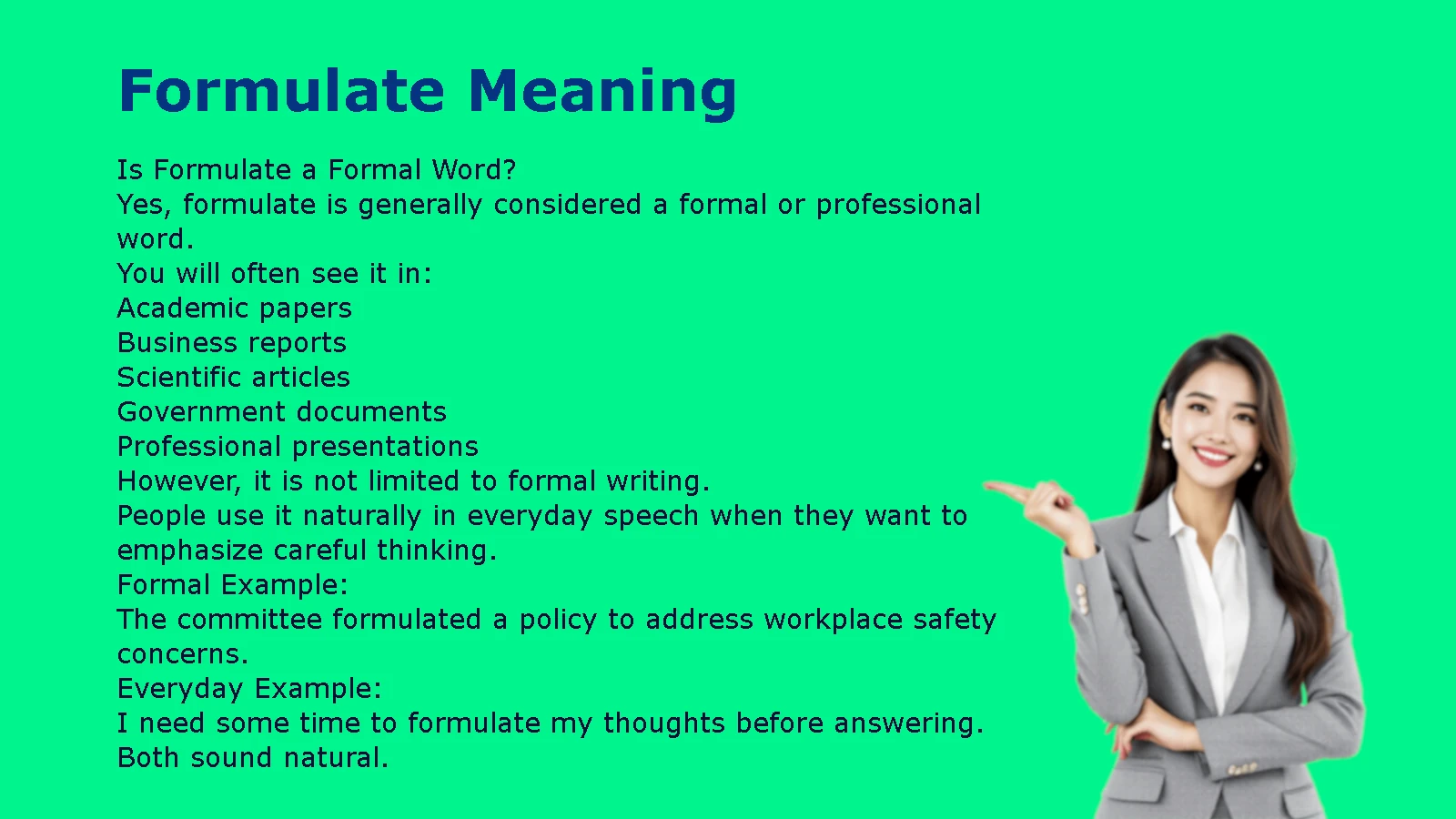
Is Formulate a Formal Word?
Yes, formulate is generally considered a formal or professional word.
You will often see it in:
- Academic papers
- Business reports
- Scientific articles
- Government documents
- Professional presentations
However, it is not limited to formal writing.
People use it naturally in everyday speech when they want to emphasize careful thinking.
Formal Example:
The committee formulated a policy to address workplace safety concerns.
Everyday Example:
I need some time to formulate my thoughts before answering.
Both sound natural.
Common Collocations With Formulate
A collocation is a group of words that commonly appear together.
Learning these combinations helps you use formulate correctly.
| Phrase | Meaning | Example |
| Formulate a plan | Create organized steps | We formulated a plan for the project. |
| Formulate a strategy | Develop an approach | The company formulated a sales strategy. |
| Formulate an idea | Develop a thought | She formulated an idea for improving efficiency. |
| Formulate a theory | Develop an explanation | Scientists formulated a new theory. |
| Formulate a response | Prepare an answer | He formulated a careful response. |
| Formulate a solution | Create a way to solve a problem | Engineers formulated a solution. |
| Formulate a policy | Create official rules | The government formulated a policy. |
| Formulate objectives | Establish clear goals | The team formulated objectives for the year. |
Using these phrases correctly can make your writing sound more polished and professional.
Formulate Synonyms: Words With Similar Meanings
Understanding synonyms helps you choose the right word for different situations. While many words share a similar meaning with formulate, they do not always communicate the same level of planning or structure.
The best synonym depends on what you are creating and how you are creating it.
Common Synonyms of Formulate
| Synonym | Meaning | Example |
| Create | Make something new | The designer created a new logo. |
| Develop | Grow or improve something over time | The team developed a new product. |
| Design | Plan the structure of something | Engineers designed a safer vehicle system. |
| Devise | Think of a clever solution | She devised a way to reduce costs. |
| Prepare | Make something ready | He prepared a detailed report. |
| Draft | Create an early version | The lawyer drafted a contract. |
| Construct | Build something carefully | Researchers constructed a new model. |
| Compose | Arrange ideas or parts into a whole | She composed a thoughtful response. |
| Establish | Set up something officially | The organization established new guidelines. |
| Frame | Organize ideas in a particular way | The writer framed the argument clearly. |
Formulate vs Develop
Both formulate and develop involve creating something, but they focus on different stages.
Develop usually means improving or growing something over time.
Formulate means creating something by organizing ideas, information, or components.
Compare:
Develop:
The company developed a new software product over two years.
This suggests the product went through growth and improvement.
Formulate:
The company formulated a strategy for launching the software product.
This focuses on creating the plan behind the launch.
A simple way to remember the difference:
- Formulate = decide and structure
- Develop = grow and improve
Formulate vs Create
The word create has a broader meaning than formulate.
You can create almost anything:
- Art
- Music
- Food
- Products
- Ideas
However, you usually formulate things that require organization or careful thought.
Examples:
Create:
The artist created a beautiful painting.
Formulate:
The researcher formulated a theory based on years of study.
A painting can come from creativity alone. A theory requires evidence, reasoning, and structure.
Formulate vs Design
The words formulate and design overlap, especially when discussing plans and strategies.
However, design focuses more on structure, appearance, or arrangement.
Formulate focuses more on developing the idea itself.
Examples:
- Architects design buildings.
- Business leaders formulate business strategies.
- Engineers design machines.
- Scientists formulate hypotheses.
Think of it this way:
Formulating creates the blueprint. Designing shapes the final product.
Formulate vs Draft
Both words involve creating something before completion.
However, draft usually means creating a first version that may need changes.
Formulate means developing a complete idea or approach.
Examples:
The manager drafted an email to employees.
The email is an early version.
The manager formulated a response to employee concerns.
The response represents carefully organized thinking.
Formulate vs Compose
Compose means putting parts together, especially in writing, music, or communication.
Formulate focuses on developing a concept or solution.
Examples:
- A writer composes a poem.
- A researcher formulates a research question.
- A musician composes a song.
- A scientist formulates a theory.
Antonyms of Formulate
Antonyms are words with opposite meanings.
Since formulate means creating something organized, its opposites often involve failing to organize, ignoring, or breaking something apart.
| Antonym | Meaning | Example |
| Ignore | Pay no attention | He ignored the problem instead of solving it. |
| Neglect | Fail to give proper care | The company neglected safety issues. |
| Abandon | Give up a plan or idea | They abandoned the project. |
| Destroy | Break something down | The storm destroyed the structure. |
| Confuse | Make unclear | The instructions confused users. |
| Disorganize | Remove structure | Poor planning disorganized the process. |
Some words are only partial opposites depending on context.
For example, improvise can contrast with formulate because improvising means acting without detailed preparation.
Example:
She formulated a detailed presentation.
versus
She improvised a presentation at the last minute.
Grammar Guide for Formulate
Learning the grammar behind formulate helps you use it correctly.
Verb Forms of Formulate
| Verb Form | Word |
| Base form | formulate |
| Third person singular | formulates |
| Present participle | formulating |
| Past tense | formulated |
| Past participle | formulated |
Examples:
Present:
Scientists formulate theories based on evidence.
Past:
The committee formulated a new policy last year.
Present continuous:
Researchers are formulating a solution to the problem.
Past perfect:
The team had formulated a plan before the meeting began.
Is Formulate a Transitive Verb?
Yes, formulate is usually a transitive verb.
A transitive verb needs an object because the action affects something.
The basic structure is:
Subject + formulate + object
Examples:
✅ Correct:
The company formulated a strategy.
❌ Incorrect:
The company formulated.
The second sentence feels incomplete because the reader needs to know what was created.
Common Grammar Mistakes With Formulate
Using Formulate Without an Object
Incorrect:
The scientists formulated.
Correct:
The scientists formulated a new theory.
The sentence needs something after the verb.
Confusing Formulate With Formula
The words look similar, but they have different meanings.
Formula
A formula is:
- A mathematical equation
- A recipe
- A fixed method
Example:
The scientist created a formula for the chemical reaction.
Formulate
A verb meaning:
- To create
- To develop
- To organize
Example:
The scientist formulated a new chemical solution.
Using Formulate When Create Sounds Better
Sometimes writers use formulate because it sounds professional. However, it can feel unnatural if the situation does not require careful planning.
Example:
Unnatural:
She formulated a birthday card.
Better:
She created a birthday card.
A birthday card does not usually require a structured development process.
How Formulate Is Used in Different Fields
The word formulate appears across many industries because professionals constantly create plans, systems, and solutions.
Formulate Meaning in Business
In business, companies frequently formulate strategies, plans, policies, and goals.
Before making important decisions, organizations analyze:
- Market conditions
- Customer behavior
- Competition
- Financial data
- Business risks
Then leaders create an organized approach.
Example:
The company formulated a five year growth strategy after analyzing market trends.
A business strategy may include:
- Revenue targets
- Marketing plans
- Expansion goals
- Customer acquisition methods
Formulate Meaning in Science
Scientists use formulate when developing explanations based on observations and evidence.
A researcher may formulate:
- A hypothesis
- A theory
- A research question
- A scientific model
Example:
Researchers formulated a hypothesis about how temperature affects plant growth.
The hypothesis does not appear randomly. Scientists build it from previous knowledge and observations.
Formulate Meaning in Medicine
Medicine uses the word in two important ways.
Creating Treatments
Scientists formulate medicines by combining specific ingredients in precise amounts.
Example:
Pharmacists formulated a medication designed to improve patient outcomes.
Developing Treatment Plans
Doctors may formulate treatment approaches based on:
- Symptoms
- Medical history
- Test results
- Patient needs
Example:
The doctor formulated a treatment plan after reviewing the patient’s condition.
Formulate Meaning in Education
Teachers and students also use the concept of formulation.
Students formulate:
- Opinions
- Arguments
- Research questions
- Answers
Teachers formulate:
- Lesson plans
- Learning objectives
- Assessment strategies
Example:
Students formulated arguments after researching different viewpoints.
Strong academic work depends on organized thinking.
Formulate Meaning in Law and Government
Government agencies and legal organizations often formulate:
- Laws
- Regulations
- Policies
- Guidelines
Example:
Lawmakers formulated new regulations to improve public safety.
The process usually involves:
- Reviewing information.
- Considering different viewpoints.
- Creating a formal document.
- Implementing the decision.
Case Study: How Organizations Formulate Solutions
Imagine a company receives complaints about slow customer service.
The company does not immediately change everything.
Instead, it follows a process:
| Step | Action |
| Identify the issue | Review customer complaints |
| Gather information | Analyze response times |
| Explore options | Consider possible improvements |
| Formulate a solution | Create a customer service strategy |
| Measure results | Track improvements |
The final solution comes from careful planning.
That is exactly what formulate describes.
Common Mistakes When Using “Formulate”
Although formulate is a useful and precise word, many people misuse it because they confuse it with similar terms. Understanding these mistakes will help you use the word naturally.
Using “Formulate” for Simple Actions
One common mistake is using formulate for things that do not require planning or organization.
For example:
❌ Incorrect:
She formulated a cup of coffee.
The word sounds unnatural because making coffee is usually a simple action.
✅ Better:
She made a cup of coffee.
However, the word can work in a scientific or production setting:
✅ Correct:
The company formulated a new coffee blend using carefully selected ingredients.
Here, the process involves testing, measuring, and combining elements.
Confusing “Formulate” With “Form”
The words formulate and form share the same root, but they are not interchangeable.
Form
Means to create, shape, or develop naturally.
Example:
Clouds formed in the sky.
Formulate
Means to deliberately create something through planning.
Example:
The researchers formulated a new explanation for the results.
The main difference is intention.
- Form can happen naturally.
- Formulate requires conscious effort.
Using “Formulate” in Casual Situations
The word is correct in casual conversations, but it can sometimes sound too formal.
Example:
I need time to formulate my thoughts.
This sounds natural because thinking carefully fits the meaning.
However:
I need to formulate what movie I want to watch tonight.
This sounds overly formal.
A more natural option would be:
I need to decide what movie I want to watch tonight.
The best vocabulary choice depends on the situation.
Adding Unnecessary Complexity
Some writers choose formulate simply because it sounds more professional. However, stronger writing does not come from using complicated words. It comes from choosing the right words.
Compare:
Less natural:
The team formulated a method for organizing the office supplies.
More natural:
The team created a system for organizing the office supplies.
“Formulate” works, but “created” feels more natural because the situation does not require a complex planning process.
Phrases and Expressions With “Formulate”
Certain phrases appear frequently with formulate. Learning them helps you recognize and use the word confidently.
Formulate a Plan
Meaning: Create a detailed approach for achieving something.
Example:
The students formulated a study plan before their final exams.
A good plan often includes:
- A clear goal
- Specific actions
- A timeline
- Available resources
Formulate a Strategy
Meaning: Develop a method for reaching a long term objective.
Example:
The company formulated a strategy to increase online sales.
Businesses use strategies for:
- Growth
- Marketing
- Customer retention
- Competition
Formulate a Response
Meaning: Prepare a thoughtful answer.
Example:
She took a moment to formulate a response before replying to the complaint.
This phrase suggests careful consideration rather than a quick reaction.
Formulate an Opinion
Meaning: Develop a personal viewpoint after thinking about information.
Example:
Readers should review different sources before formulating an opinion.
Opinions become stronger when they come from:
- Evidence
- Experience
- Reasoning
Formulate a Solution
Meaning: Create a method for solving a problem.
Example:
Engineers worked together to formulate a solution to the design problem.
Solutions often require:
- Investigation
- Creativity
- Testing
- Improvement
Frequently Asked Questions About Formulate Meaning
What Does Formulate Mean in Simple Words?
Formulate means to carefully create or develop something, especially an idea, plan, strategy, or solution.
For example:
The manager formulated a plan to improve productivity.
In simple terms, it means to think something through and put it into a clear form.
Is Formulate a Formal Word?
Yes, formulate is generally considered a formal or professional word, but people use it in everyday English too.
You will commonly find it in:
- Business documents
- Research papers
- News articles
- Academic writing
- Professional conversations
Example:
Scientists formulated a new theory.
However, in casual speech, simpler words like “make,” “create,” or “develop” may sound more natural.
What Is Another Word for Formulate?
Common alternatives include:
- Create
- Develop
- Design
- Prepare
- Draft
- Devise
- Construct
- Compose
- Establish
The best synonym depends on the situation.
For example:
- Formulate a plan → create a plan
- Formulate a theory → develop a theory
- Formulate a response → prepare a response
Can You Formulate a Question?
Yes. You can formulate a question when you carefully create a question to get specific information.
Example:
The interviewer formulated questions that revealed the candidate’s problem solving skills.
A well formulated question is:
- Clear
- Focused
- Relevant
- Easy to understand
What Is the Difference Between Formulate and Create?
The main difference is the level of planning.
| Word | Focus | Example |
| Create | Making something new | She created a painting. |
| Formulate | Developing something through careful thought | She formulated a business plan. |
Creation can happen through inspiration. Formulation usually requires structure.
What Does Formulate Mean in Science?
In science, formulate means to develop an explanation, hypothesis, model, or solution based on evidence and reasoning.
Example:
Scientists formulated a hypothesis about the effects of pollution on marine life.
The process often involves:
- Observation
- Research
- Analysis
- Testing
What Is the Noun Form of Formulate?
The noun forms related to formulate include:
Formulation
Meaning: The process or result of creating something carefully.
Example:
The formulation of the new policy took several months.
Formula
Meaning: A specific method, equation, or recipe.
Example:
The scientist created a formula for the experiment.
Key Takeaways: Understanding the Meaning of Formulate
The word formulate describes the process of creating something through careful thought, planning, and organization.
Here are the main points to remember:
- Formulate means to create or develop something in a structured way.
- It is commonly used with words like plan, strategy, idea, theory, question, response, and solution.
- The word often appears in professional, academic, and scientific settings.
- It differs from create because it emphasizes planning and organization.
- It differs from develop because it focuses on forming an idea or approach rather than improving something over time.
- It is usually a transitive verb, meaning it needs an object.
A simple way to remember the meaning:
Formulate = take separate pieces of information and shape them into a clear idea, plan, or solution.
Whether you are writing a report, preparing a presentation, solving a problem, or explaining your thoughts, knowing how to use formulate can make your communication clearer and more precise.
Final Example List: Formulate in Sentences
To reinforce the meaning, here are more examples:
- The team formulated a strategy to improve customer satisfaction.
- Scientists formulated a theory after years of research.
- She formulated a thoughtful answer during the interview.
- The government formulated new safety guidelines.
- Students formulated questions before beginning the project.
- Engineers formulated a solution to reduce energy waste.
- The company formulated a plan for future expansion.
- Researchers formulated new methods for analyzing data.
- The teacher helped students formulate stronger arguments.
- The doctor formulated a treatment approach based on the patient’s needs.
When you see the word formulate, think of careful creation. It represents the moment when scattered thoughts, facts, or materials come together and become something organized, useful, and clear.