
Have you ever come across the word Articulate Meaning and wondered what it actually means or how to use it correctly? You’re not alone. Many people search for this word because they hear it in conversations, interviews, speeches, and professional settings but aren’t always sure what it means.
Articulate means to express thoughts, ideas, or feelings clearly and effectively in speech or writing. It can also describe a person who communicates in a confident, fluent, and easy-to-understand way.
Examples:
- She gave an articulate explanation of the problem.
- He is articulate and speaks with confidence during presentations.
The confusion often comes from its different uses. People look for the articulate definition, articulate pronunciation, articulate synonym, and articulate examples to understand whether it describes a person’s speaking ability or the act of expressing ideas clearly. And here’s the kicker: using the word correctly can instantly make your vocabulary sound more polished and confident.
In this guide, you’ll discover the Articulate Meaning, learn the definition of articulate, understand how to pronounce articulate, and see articulate in a sentence with real-life examples. You’ll also explore synonyms and antonyms of articulate, its parts of speech, and practical tips for using the word naturally in everyday conversations and writing.
What Does Articulate Mean?
The word articulate has two common uses. It can function as a verb or an adjective, and each form carries a slightly different meaning.
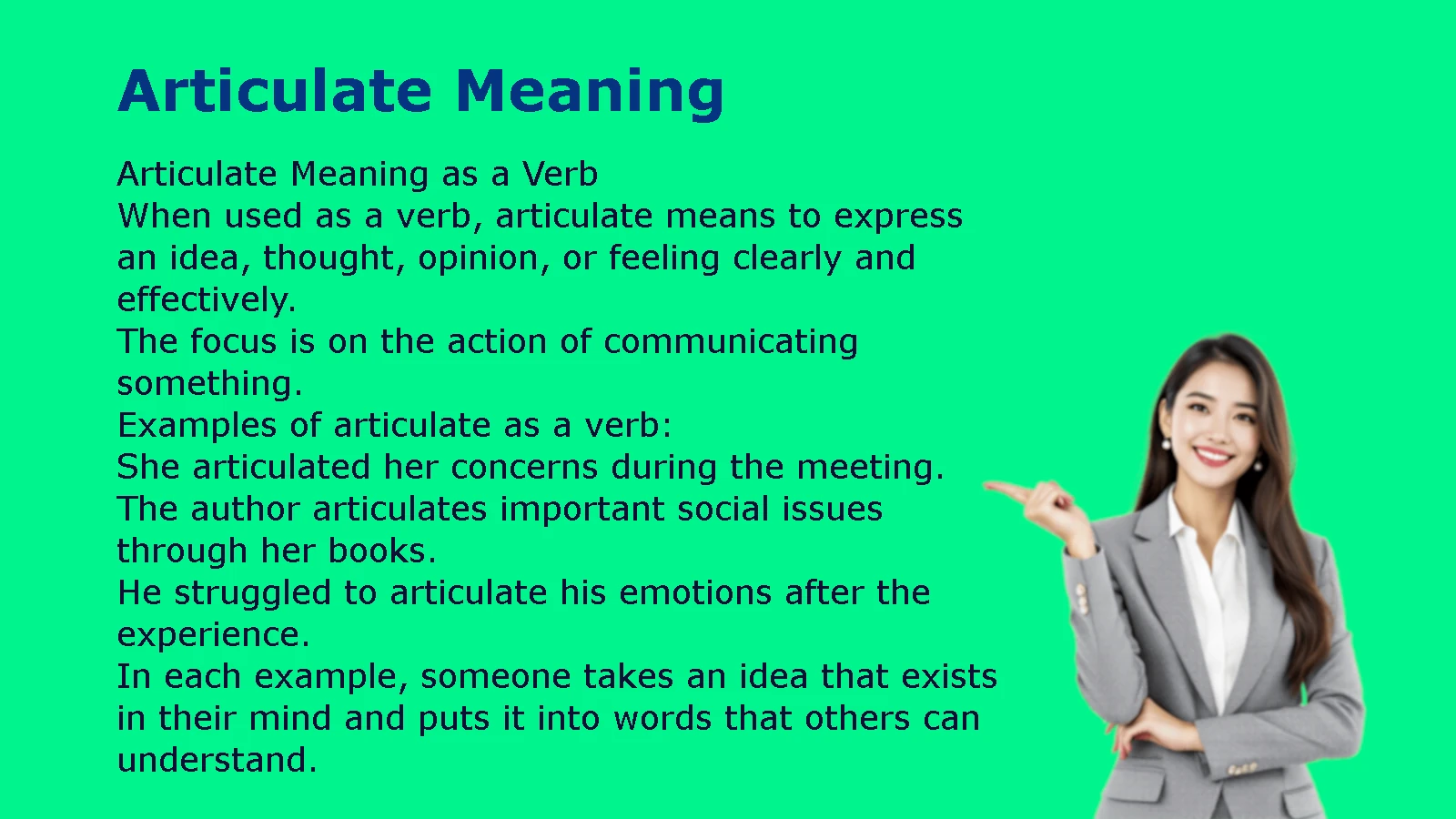
Articulate Meaning as a Verb
When used as a verb, articulate means to express an idea, thought, opinion, or feeling clearly and effectively.
The focus is on the action of communicating something.
Examples of articulate as a verb:
- She articulated her concerns during the meeting.
- The author articulates important social issues through her books.
- He struggled to articulate his emotions after the experience.
In each example, someone takes an idea that exists in their mind and puts it into words that others can understand.
Think of articulation like building a bridge. Your thoughts exist on one side, and your listener stands on the other side. Clear language creates the path that connects both sides.
Articulate Meaning as an Adjective
When articulate works as an adjective, it describes someone who communicates clearly and effectively.
An articulate person usually:
- Chooses words carefully.
- Organizes ideas logically.
- Explains concepts clearly.
- Speaks with confidence.
Examples of articulate as an adjective:
- She is an articulate speaker who explains difficult topics well.
- The candidate gave an articulate answer during the interview.
- His articulate presentation impressed the entire team.
Calling someone articulate is usually a compliment. It suggests that the person has strong communication skills.
Articulate Definition: Quick Explanation
Here is a simple breakdown of the word:
| Word Form | Definition | Example |
| Articulate (verb) | To express something clearly using words | He articulated his ideas during the discussion. |
| Articulate (adjective) | Able to communicate thoughts clearly and effectively | She is an articulate leader. |
The key idea behind both meanings is clarity.
Whether you are speaking, writing, teaching, or presenting, articulation helps people understand your message.
Articulate Meaning in Different Contexts
The meaning of articulate becomes clearer when you see how people use it in different situations.
Articulate Meaning in Communication
Communication requires more than simply talking. A person can speak for several minutes without making their message clear.
An articulate communicator does something different. They:
- Understand their main point.
- Arrange ideas in a logical order.
- Use language that fits their audience.
- Avoid unnecessary confusion.
For example, imagine two employees explaining a project problem.
The first employee says:
“Things are kind of complicated right now, and there are many issues happening.”
The second employee says:
“The project is delayed because we need more testing time and additional customer feedback before launch.”
The second explanation is more articulate because it identifies the problem and provides specific details.
Articulate Meaning in Writing
People often associate articulation with speaking, but writing can also be articulate.
An articulate writer can:
- Present ideas clearly.
- Use precise words.
- Create logical connections between points.
- Make complex topics easier to understand.
For example, a scientific article may discuss a complicated discovery. A skilled writer does not simply repeat technical information. Instead, they explain the discovery in a way that helps ordinary readers understand why it matters.
Good writing is not about showing how many difficult words you know. It is about making your message easy to follow.
Articulate Meaning in Professional Settings
Being articulate can strongly influence career success.
Employers often value people who can:
- Explain their ideas during meetings.
- Present information confidently.
- Communicate with customers.
- Lead discussions.
- Solve problems through clear conversations.
A talented employee with poor communication skills may struggle to share their ideas. Meanwhile, someone who can explain solutions clearly often gains more trust and influence.
Examples of workplace situations where articulation matters:
| Situation | Why Being Articulate Helps |
| Job interview | Helps you explain your experience and skills |
| Presentation | Allows others to understand your message |
| Team meeting | Prevents misunderstandings |
| Negotiation | Helps you express your position clearly |
| Leadership | Helps people understand goals and expectations |
Articulate Meaning in Personal Conversations
Articulation also matters outside school and work.
People use communication skills every day when they:
- Express feelings.
- Explain personal needs.
- Resolve disagreements.
- Share opinions.
For example, saying:
“You never listen to me.”
may create conflict.
A more articulate statement might be:
“I feel ignored when I share my thoughts and the conversation moves on quickly.”
The second statement communicates the same concern but explains the feeling more clearly.
Being articulate does not mean sounding formal or robotic. It means helping others understand what you truly mean.
Examples of Articulate in Sentences
Understanding examples makes the articulate meaning easier to remember.
Examples of Articulate as a Verb
Example 1:
The teacher articulated the lesson so clearly that every student understood the concept.
Meaning:
- The teacher explained the lesson in a clear way.
Example 2:
She articulated her vision for the company’s future.
Meaning:
- She expressed her ideas about the company’s direction.
Example 3:
He found it difficult to articulate his feelings.
Meaning:
- He struggled to put his emotions into words.
Example 4:
The report articulates the challenges facing small businesses.
Meaning:
- The report explains those challenges clearly.
Examples of Articulate as an Adjective
Example 1:
The speaker was articulate and answered every question confidently.
Meaning:
- The speaker communicated ideas clearly.
Example 2:
Maria is an articulate writer who explains complex topics simply.
Meaning:
- Maria writes in a clear and understandable way.
Example 3:
The lawyer presented an articulate argument in court.
Meaning:
- The lawyer presented a clear and organized argument.
What Does an Articulate Person Look Like?
An articulate person is not necessarily the loudest person in the room. In fact, some of the most articulate people speak calmly and choose their words carefully.
An articulate person usually demonstrates these qualities:
| Quality | Description |
| Clear thinking | They understand their message before expressing it |
| Good vocabulary | They choose words that fit the situation |
| Active listening | They consider what others say before responding |
| Confidence | They communicate without unnecessary hesitation |
| Organization | They present ideas in a logical sequence |
A common misconception is that articulate people are naturally gifted speakers. While some people develop communication skills early, articulation is also a skill anyone can improve through practice.
Articulate Pronunciation and Correct Usage
Knowing the articulate meaning also includes understanding how to pronounce the word correctly.
How to Pronounce Articulate
The pronunciation changes slightly depending on whether the word is a verb or an adjective.
As a verb:
Articulate
Pronunciation: ar-TIK-yuh-late
Phonetic spelling:
/ɑːrˈtɪkjəleɪt/
Example:
- “She can articulate her ideas clearly.”
As an adjective:
Articulate
Pronunciation: ar-TIK-yuh-lit
Phonetic spelling:
/ɑːrˈtɪkjələt/
Example:
- “He is an articulate speaker.”
Common Pronunciation Mistakes
Many English learners make a few common mistakes with this word.
Mistake 1: Putting Stress on the Wrong Syllable
The strongest emphasis belongs to the second syllable:
Correct:
- ar TIK yuh late
Incorrect:
- AR tik yuh late
Mistake 2: Pronouncing Every Syllable Equally
English usually uses stressed and unstressed sounds. Saying every syllable with the same force can make pronunciation sound unnatural.
Word Origin and History of Articulate
Understanding the history behind a word can make its meaning easier to remember. The word articulate has an interesting connection to the way ideas and body parts connect.
The word comes from the Latin term articulatus, which means “divided into joints” or “connected in sections.” It comes from articulus, meaning “a joint” or “a small part.”
At first, the word was closely related to physical structures. A joint connects different parts of the body and allows movement. Over time, the meaning expanded to describe how people connect ideas through language.
In other words, an articulate speaker “joins” thoughts together so others can follow them.
This connection explains why articulation involves more than simply speaking. It involves organizing separate thoughts into a clear message.
For example:
- A person with random ideas may confuse listeners.
- An articulate person connects those ideas into a logical explanation.
The history of the word reflects its modern meaning: bringing separate parts together in a clear and organized way.
Synonyms for Articulate
Finding synonyms helps you understand the full range of the articulate meaning. Although several words share similar meanings, each one carries a slightly different feeling.
The best synonym depends on the situation.
Synonyms for Articulate as a Verb
When articulate means “to express clearly,” these words can often replace it:
| Synonym | Meaning | Example |
| Express | To communicate thoughts or feelings | She expressed her opinion during the discussion. |
| Explain | To make something easier to understand | He explained the process step by step. |
| Describe | To give details about something | She described her experience clearly. |
| Communicate | To share information or ideas | The leader communicated the plan effectively. |
| Convey | To deliver a message or feeling | His speech conveyed a sense of hope. |
| Clarify | To make something less confusing | The teacher clarified the difficult concept. |
| State | To say something directly | He stated his position clearly. |
| Present | To introduce information formally | She presented her argument confidently. |
Example:
Original:
The manager articulated the company’s goals.
Similar versions:
- The manager explained the company’s goals.
- The manager communicated the company’s goals.
- The manager presented the company’s goals.
However, articulate often suggests a higher level of clarity and organization than simply “say” or “tell.”
Synonyms for Articulate as an Adjective
When describing a person who communicates well, these synonyms are useful:
| Synonym | Meaning | How It Differs From Articulate |
| Eloquent | Fluent and persuasive in speaking or writing | Focuses on beauty and emotional impact |
| Fluent | Able to speak smoothly | Focuses on flow rather than organization |
| Clear | Easy to understand | Focuses on simplicity |
| Expressive | Able to show thoughts and emotions | Focuses on emotional communication |
| Persuasive | Able to convince others | Focuses on influence |
| Well spoken | Communicates in a polished way | Focuses on speaking style |
Articulate vs Eloquent: What Is the Difference?
People often use articulate and eloquent as if they mean the same thing. While they overlap, they are not identical.
Articulate
An articulate person communicates ideas clearly and logically.
Example:
A doctor explaining a medical condition using simple language is articulate.
The focus is understanding.
Eloquent
An eloquent person communicates in a beautiful, powerful, or emotionally moving way.
Example:
A speaker delivering an inspiring graduation speech may be eloquent.
The focus is impact.
A person can be articulate without being eloquent. They may explain ideas clearly but not use dramatic or poetic language.
Articulate vs Fluent
These two words are also closely related.
Fluent
Fluent means speaking smoothly and naturally, especially in a language.
Example:
She is fluent in Spanish.
This means she can communicate comfortably in Spanish.
Articulate
Articulate means expressing ideas clearly and effectively.
Example:
She is articulate when explaining business strategies.
A person can be fluent but not articulate. Someone may speak a language smoothly but struggle to organize complex thoughts.
Articulate vs Communicate
Communication is a broad concept. Articulation is a specific type of communication.
Communicate means:
- Sharing information.
- Sending a message.
- Exchanging ideas.
Communication can happen through:
- Words.
- Gestures.
- Images.
- Writing.
- Technology.
Articulate means:
- Expressing something clearly.
- Choosing words carefully.
- Making ideas understandable.
For example:
A text message saying “Meeting changed” communicates information.
A message saying:
“Tomorrow’s meeting has moved from 10 a.m. to 2 p.m. because the client requested additional preparation time.”
is more articulate because it provides clear details.
Antonyms of Articulate
Understanding opposite words helps strengthen your vocabulary.
The main antonym of articulate is inarticulate.
An inarticulate person may struggle to:
- Explain thoughts clearly.
- Find suitable words.
- Organize ideas.
- Express emotions.
Common Antonyms of Articulate
| Antonym | Meaning | Example |
| Inarticulate | Unable to express thoughts clearly | He became inarticulate when asked about his feelings. |
| Unclear | Difficult to understand | The instructions were unclear. |
| Vague | Lacking specific details | Her answer was vague. |
| Confusing | Hard to follow | The explanation was confusing. |
| Tongue tied | Unable to speak easily | He became tongue tied during the interview. |
| Unexpressive | Not showing thoughts or feelings | His response seemed unexpressive. |
Articulate vs Inarticulate Examples
Seeing the difference in action makes the meaning clearer.
Articulate:
“I disagree with this approach because it may increase costs and delay the project timeline.”
The speaker explains the reason behind the opinion.
Inarticulate:
“I just don’t think it’s good.”
The speaker shares a feeling but does not explain the reasoning.
The difference is not intelligence. A person may have excellent ideas but struggle to express them. Articulation helps turn thoughts into understandable messages.
How to Use Articulate in a Sentence
The word articulate follows different sentence patterns depending on whether you use it as a verb or adjective.
Using Articulate as a Verb
The common structure is:
Subject + articulate + idea, thought, feeling, or message
Examples:
- She articulated her concerns before making a decision.
- The scientist articulated the importance of climate research.
- The leader articulated a clear plan for improvement.
The object after “articulate” is usually something that requires explanation.
Common combinations include:
- Articulate an idea
- Articulate a vision
- Articulate an opinion
- Articulate a goal
- Articulate feelings
- Articulate concerns
- Articulate a strategy
Using Articulate as an Adjective
The common structure is:
Subject + be + articulate
Examples:
- She is an articulate speaker.
- He was articulate during the interview.
- The student gave an articulate response.
You can also use it before a noun:
- An articulate explanation
- An articulate argument
- An articulate presentation
- An articulate response
Common Phrases With Articulate
Some common expressions include:
Articulate Your Thoughts
Meaning:
- Express your ideas clearly.
Example:
Writing notes before a meeting can help you articulate your thoughts.
Articulate Your Feelings
Meaning:
- Explain your emotions with words.
Example:
Healthy communication requires the ability to articulate your feelings.
Articulate a Vision
Meaning:
- Clearly explain a future goal or direction.
Example:
Great leaders know how to articulate a vision that inspires others.
Articulate an Argument
Meaning:
- Present reasons and evidence in a clear way.
Example:
The lawyer articulated a strong argument based on facts.
Why Being Articulate Is an Important Skill
Clear communication affects almost every area of life. Whether you are applying for a job, teaching a class, or having a personal conversation, articulation helps people understand your message.
An articulate person often builds stronger connections because others know exactly what they mean.
Benefits of Being Articulate
| Benefit | How It Helps |
| Better relationships | Reduces misunderstandings |
| Career growth | Improves presentations and teamwork |
| Stronger confidence | Makes expressing ideas easier |
| Better leadership | Helps others understand goals |
| Improved learning | Makes it easier to explain knowledge |
The Role of Articulation in Leadership
Strong leaders do not only create good ideas. They must explain those ideas so others can act on them.
Consider a company leader introducing a new strategy.
A weak explanation might sound like:
“We need to improve our process and focus more on customers.”
An articulate explanation might be:
“We will improve customer satisfaction by reducing response times, training support teams, and collecting feedback after every interaction.”
The second message gives people a clear direction.
Great leaders use articulation to transform ideas into action.
How to Become More Articulate
Becoming articulate is not a talent reserved for a few naturally gifted speakers. It is a communication skill that improves through practice, awareness, and consistent effort.
Many articulate people became effective communicators because they trained themselves to think clearly and express ideas intentionally.
The goal is not to sound overly formal or use complicated words. The goal is to make your message easy to understand.
Think of communication like cooking. Having many ingredients does not guarantee a great meal. You need the right ingredients combined in the right way. The same applies to words. A large vocabulary helps, but organization and clarity matter more.
Here are practical ways to improve your articulation skills.
Expand Your Vocabulary Naturally
A strong vocabulary gives you more options when expressing ideas. However, memorizing hundreds of difficult words will not automatically make you articulate.
The best approach is to learn useful words in context.
For example:
Instead of repeatedly saying:
“The problem is bad.”
You can learn more specific alternatives:
- The problem is serious.
- The problem is challenging.
- The problem is complex.
- The problem is urgent.
Each word communicates a slightly different meaning.
Ways to Build a Better Vocabulary
| Method | How It Helps |
| Read regularly | Introduces new words naturally |
| Keep a vocabulary journal | Helps you remember useful terms |
| Learn words through examples | Shows how people actually use them |
| Practice using new words | Turns passive knowledge into active skill |
| Study synonyms | Helps you choose precise language |
Reading high quality articles, books, and essays exposes you to different communication styles.
Organize Your Thoughts Before Speaking
Many people struggle to communicate because their thoughts feel scattered. They know what they want to say but cannot arrange the ideas clearly.
Before speaking, create a simple structure.
A useful framework is:
The Point, Reason, Example Method
Point:
State your main idea.
Example:
“I think we should change our marketing strategy.”
Reason:
Explain why.
Example:
“Our current approach attracts fewer customers than it did last year.”
Example:
Provide evidence or details.
Example:
“For example, our website traffic has increased, but sales conversions have remained the same.”
This structure helps you communicate with confidence because your message has a clear path.
Practice Explaining Complex Ideas Simply
One of the strongest signs of an articulate person is the ability to simplify complicated information.
A person who truly understands something can often explain it clearly.
For example:
A computer expert might explain artificial intelligence using technical terms. However, an articulate expert might say:
“Artificial intelligence is like a smart assistant that learns from information and improves its responses over time.”
The second explanation makes the idea easier for more people to understand.
Try This Exercise:
Choose a complicated topic and explain it in three ways:
- Explain it to a professional in that field.
- Explain it to a teenager.
- Explain it to a child.
If you can adjust your explanation for different audiences, your articulation skills are improving.
Read Aloud to Improve Communication
Reading silently helps you understand information. Reading aloud helps you develop communication skills.
When you read aloud, you practice:
- Pronunciation.
- Sentence rhythm.
- Speaking speed.
- Voice control.
- Confidence.
Even 10 minutes of reading aloud each day can improve your comfort with language.
Good materials for reading aloud include:
- News articles.
- Essays.
- Short stories.
- Speeches.
- Educational content.
Pay attention to how sentences flow. Notice where writers create pauses and emphasis.
Listen to Skilled Communicators
Strong communication skills develop faster when you study people who communicate well.
Pay attention to:
- How they begin explanations.
- How they organize information.
- How they use examples.
- How they keep audiences interested.
You can learn from:
- Teachers.
- Public speakers.
- Interviewers.
- Authors.
- Business leaders.
However, do not copy someone’s personality. Instead, study their techniques and adapt them to your own style.
Slow Down and Choose Better Words
Many communication problems happen because people rush.
Speaking faster does not make you sound smarter. In many cases, slowing down improves clarity.
An articulate speaker understands that pauses are useful.
A short pause allows you to:
- Organize your thoughts.
- Choose accurate words.
- Emphasize important points.
For example:
Instead of quickly saying:
“I think maybe we should possibly consider another option because there are some problems.”
Try:
“I think we should consider another option because the current plan creates several problems.”
The second version sounds more confident and organized.
Common Mistakes When Using the Word Articulate
Although articulate is a common word, people sometimes misunderstand how to use it.
Mistake: Thinking Articulate Means Using Fancy Words
Many people believe articulate speakers use complicated vocabulary.
That is incorrect.
Clear communication often uses simple words.
For example:
Less effective:
“The implementation of this methodology requires optimization of operational procedures.”
More articulate:
“This approach requires us to improve our daily processes.”
The second sentence is easier to understand while still communicating a professional idea.
Mistake: Using Articulate Only for Speaking
Some people think articulation applies only to conversations.
However, people can articulate ideas through:
- Writing.
- Presentations.
- Reports.
- Videos.
- Visual explanations.
A well written article can be articulate. A carefully designed presentation can also be articulate.
Mistake: Confusing Articulate With Intelligent
An articulate person communicates well, but articulation does not automatically equal intelligence.
Someone may understand a complex subject but struggle to explain it.
Another person may explain ideas beautifully but still need more knowledge about the topic.
Intelligence involves understanding. Articulation involves expressing that understanding.
The strongest communicators develop both.
Real Life Examples of Articulate Communication
Understanding the articulate meaning becomes easier when you see how the skill appears in everyday situations.
Workplace Example: Explaining a Project Delay
Imagine a team member needs to explain why a project is behind schedule.
Less articulate explanation:
“We are late because some things did not work out.”
More articulate explanation:
“The project is delayed by two weeks because we discovered technical issues during testing. The team has created a revised timeline to solve these problems and complete the launch successfully.”
The second explanation gives:
- The cause.
- The impact.
- The solution.
That is effective articulation.
Classroom Example: Explaining an Opinion
A student discussing a book might say:
Less articulate:
“I liked the character because she was good.”
More articulate:
“I liked the character because she showed resilience during difficult situations and continued helping others despite her challenges.”
The second response provides reasoning and detail.
Personal Example: Expressing Feelings
Clear emotional communication often requires articulation.
Instead of:
“You always make me upset.”
A more articulate statement could be:
“I feel frustrated when plans change without discussion because I prefer knowing what to expect.”
This approach explains the feeling without creating unnecessary conflict.
Frequently Asked Questions About Articulate Meaning
What does articulate mean in simple words?
Articulate means expressing thoughts, ideas, or feelings clearly so others can understand them.
It can describe someone who communicates well or the act of explaining something clearly.
Is articulate a positive word?
Yes. Articulate is usually a positive word.
When someone calls you articulate, they usually mean you:
- Communicate clearly.
- Explain ideas effectively.
- Speak with confidence.
- Organize your thoughts well.
What is an articulate person?
An articulate person is someone who can express ideas clearly and effectively.
They do not necessarily use advanced vocabulary. Instead, they choose words that match the situation and audience.
Can you articulate feelings?
Yes. People often use the word articulate when discussing emotions.
Examples:
- She articulated her fears before making a decision.
- He articulated his disappointment calmly.
- They learned to articulate their needs in the relationship.
Being able to express emotions clearly can improve personal relationships.
Is articulate the same as intelligent?
No.
Articulation and intelligence are connected but different.
A person may be highly intelligent but have difficulty explaining ideas. Another person may communicate beautifully but still need more knowledge about a subject.
Articulation is a communication skill.
What is the difference between articulate and eloquent?
An articulate person explains ideas clearly.
An eloquent person expresses ideas in a beautiful, powerful, or persuasive way.
For example:
- A scientist explaining research clearly is articulate.
- A speaker delivering a moving inspirational speech is eloquent.
Final Thoughts on Articulate Meaning
The word articulate represents one of the most valuable communication skills a person can develop. It means more than simply speaking. It involves organizing thoughts, choosing appropriate words, and helping others understand your message.
Whether you are writing an email, presenting an idea at work, teaching a lesson, or sharing your feelings with someone close to you, articulation makes communication stronger.
Remember, being articulate does not mean sounding complicated. It means making ideas clear.
The best communicators are not always the ones who use the biggest words. They are the ones who help others understand the message with confidence and ease.