
What Is the Constitute Meaning?
Constitute means to form, make up, establish, or create something. It is commonly used to describe what something consists of or what officially forms a whole, system, or organization.
Examples:
- Women constitute nearly half of the workforce.
- These documents constitute a legal agreement.
The confusion often comes from its many uses. People search for constitute meaning, constitute definition, how to pronounce constitute, how to use constitute in a sentence, and what does constitute mean because the word can mean to make up, to form, to establish, or to be considered as. But here’s the kicker: choosing the correct meaning can make your writing and communication much clearer.
In this guide, you’ll discover the Constitute Meaning, its definition, pronunciation, part of speech, synonyms, sentence examples, and the different ways it’s used in real-life situations. You’ll also learn how to use constitute correctly in everyday conversations, formal writing, and professional communication.
What Does Constitute Mean?
The word constitute is a verb with several closely related meanings. While the exact definition changes slightly depending on the sentence, every use revolves around the idea of forming, creating, making up, or qualifying as something.
Quick Definition
| Word | Constitute |
| Part of Speech | Verb |
| Pronunciation (US) | /ˈkɑːn.stə.tuːt/ |
| Pronunciation (UK) | /ˈkɒn.stɪ.tʃuːt/ |
| Primary Meaning | To form or make up something |
| Other Meanings | To establish, to create, to be considered as, to amount to |
Constitute Meaning in Simple Words
In everyday English, constitute often means:
- To form something
- To make up something
- To create something officially
- To be regarded as something
- To amount to or qualify as something
Think of it this way:
Small parts constitute a larger whole.
Certain actions constitute a legal offense.
The first sentence talks about forming something. The second refers to meeting the definition of something.
That flexibility makes constitute one of the most useful verbs in formal English.
Different Meanings of Constitute
Although dictionaries list several definitions, most uses fit into four practical categories.
Constitute Meaning: To Form or Make Up Something
This is the most common meaning.
Here, constitute explains that several people, objects, or ideas combine to create a larger whole.
Examples
- Fifty states constitute the United States.
- Three chapters constitute the first section of the book.
- Volunteers constitute most of the organization.
- Water constitutes a large percentage of the human body.
- Small businesses constitute an important part of the economy.
Notice the pattern:
Parts → Constitute → Whole
More Examples
| Parts | Constitute | Whole |
| Twelve months | constitute | one year |
| Seven days | constitute | one week |
| Four quarters | constitute | one whole |
| Five players | constitute | the committee |
| Multiple ingredients | constitute | the recipe |
This meaning frequently appears in education, science, economics, and journalism because it clearly describes how individual elements combine into a complete unit.
Constitute Meaning: To Be Considered As
Sometimes constitute doesn’t describe physical parts. Instead, it indicates that something qualifies as or counts as something else.
For example:
- Lying under oath constitutes perjury.
- Copying someone else’s work constitutes plagiarism.
- Entering without permission constitutes trespassing.
- Ignoring safety procedures constitutes negligence.
In these examples, constitute means:
- qualifies as
- is considered
- amounts to
This meaning appears regularly in:
- Laws
- School policies
- Company handbooks
- Government regulations
- Contracts
Example
Imagine a company policy that states:
“Sharing confidential customer information constitutes a serious violation.”
The policy isn’t saying the information forms a violation. Instead, it means the action counts as a violation.
Constitute Meaning: To Establish or Create
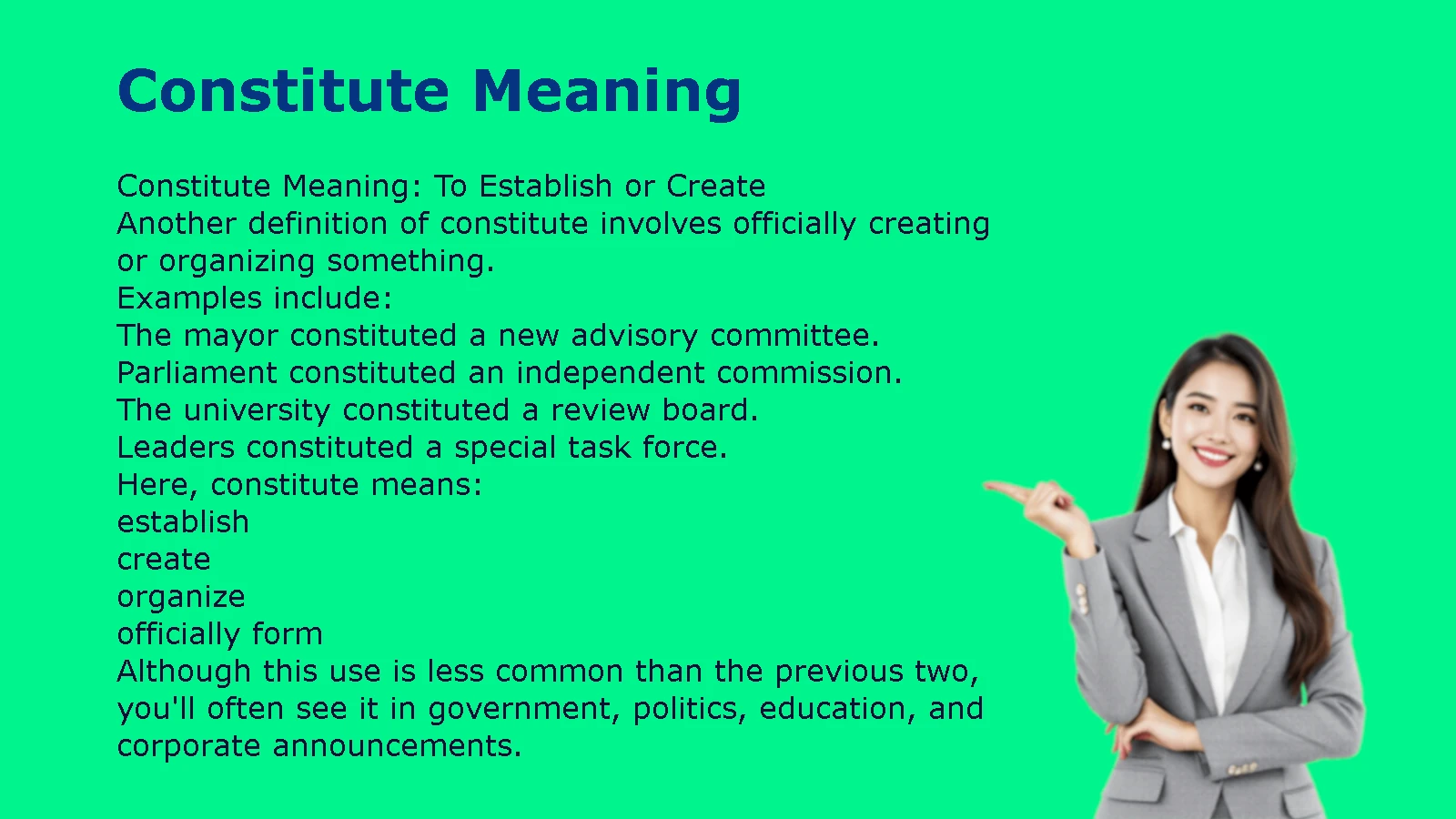
Another definition of constitute involves officially creating or organizing something.
Examples include:
- The mayor constituted a new advisory committee.
- Parliament constituted an independent commission.
- The university constituted a review board.
- Leaders constituted a special task force.
Here, constitute means:
- establish
- create
- organize
- officially form
Although this use is less common than the previous two, you’ll often see it in government, politics, education, and corporate announcements.
Constitute Meaning: To Amount To
This meaning overlaps with be considered as, yet it emphasizes that something reaches a particular standard or legal definition.
Examples:
- The evidence constitutes sufficient proof.
- These actions constitute fraud.
- The remarks constitute discrimination.
- The behavior constitutes harassment.
Many legal documents rely on this definition because it leaves little room for ambiguity.
Constitute Meaning in Everyday English
Although constitute appears more often in formal writing, you may still encounter it in newspapers, documentaries, business meetings, or classroom discussions.
Here are some everyday examples.
Health
- Vegetables constitute an important part of a healthy diet.
- Sleep constitutes one of the foundations of good health.
School
- Homework constitutes 25% of your final grade.
- Attendance constitutes part of the course requirements.
Business
- Online sales constitute nearly half of the company’s revenue.
- Customer satisfaction constitutes one of our primary goals.
Sports
- Speed and endurance constitute the athlete’s biggest strengths.
- Teamwork constitutes the foundation of every successful championship team.
How to Use “Constitute” in a Sentence
One reason English learners struggle with constitute is its sentence structure.
Fortunately, the grammar is simple.
Basic Pattern
Subject + constitute(s) + object
Examples:
- Five regions constitute the country.
- These documents constitute strong evidence.
- Trust constitutes the basis of friendship.
- Healthy habits constitute long-term success.
- Exercise constitutes an effective way to improve mental health.
Singular vs. Plural
Like most verbs, constitute changes depending on the subject.
| Subject | Correct Form |
| The evidence | constitutes |
| One document | constitutes |
| Several documents | constitute |
| Five members | constitute |
| Water | constitutes |
Examples:
✅ Water constitutes nearly 60% of the human body.
✅ Three rivers constitute the natural border.
Common Grammar Patterns
Constitute + Noun
Examples:
- The agreement constitutes a legal contract.
- This behavior constitutes misconduct.
- The payment constitutes full settlement.
- The report constitutes official documentation.
Constitute + Percentage
Examples:
- Women constitute 48% of the workforce.
- Renewable energy constitutes 35% of electricity production.
- Exports constitute a significant share of national income.
This structure commonly appears in statistics and research reports.
Constitute + Part Of
Examples:
- Reading constitutes part of daily learning.
- These expenses constitute part of the overall budget.
- Community service constitutes part of graduation requirements.
Constitute + Majority
Examples:
- Independent voters constitute the majority.
- Young professionals constitute most of the customer base.
- Local businesses constitute the largest employment sector.
Real-Life Examples of Constitute
Understanding definitions is helpful. Seeing the word in real situations makes it much easier to remember.
Business Example
A technology company reports:
“Subscription services constitute 72% of annual revenue.”
This means subscription income makes up most of the company’s earnings.
Education Example
A university handbook states:
“Final examinations constitute 40% of the overall grade.”
The final exam contributes 40% toward a student’s total score.
Workplace Example
An employee handbook says:
“Repeated unexcused absences constitute misconduct.”
In other words, those absences are considered misconduct under company rules.
Healthcare Example
Doctors often explain:
“Regular exercise and balanced nutrition constitute the foundation of good health.”
Neither habit works alone. Together, they form a healthy lifestyle.
Government Example
A city council announces:
“Five members constitute the review committee.”
Those five people officially make up the committee.
Example Sentences Using Constitute
The best way to master constitute is by seeing it in different contexts.
Everyday Examples
- Fresh fruit constitutes an important part of breakfast.
- These five rules constitute the club’s code of conduct.
- Good communication constitutes healthy relationships.
- Honesty constitutes one of the company’s core values.
- Daily practice constitutes the fastest path to improvement.
- Reading widely constitutes an excellent learning habit.
- Small improvements constitute long-term progress.
- Trust constitutes the heart of every lasting friendship.
- Experience constitutes a valuable teacher.
- Patience constitutes an essential leadership skill.
Academic Examples
- The findings constitute strong evidence for the theory.
- These documents constitute primary historical sources.
- Laboratory work constitutes 30% of the course grade.
- The survey results constitute valuable research data.
- Critical thinking constitutes an important learning objective.
- This chapter constitutes the main argument of the book.
- The references constitute an extensive bibliography.
- Independent study constitutes part of the curriculum.
- Statistical analysis constitutes the final stage of the project.
- The experiment constitutes a controlled scientific investigation.
Business Examples
- Customer feedback constitutes an important source of innovation.
- These policies constitute the company’s operating standards.
- Product quality constitutes our competitive advantage.
- Employee training constitutes a long-term investment.
- Market research constitutes the first phase of development.
- Digital services constitute the fastest-growing division.
- The agreement constitutes a binding contract.
- Ethical leadership constitutes the company’s culture.
- Customer loyalty constitutes one of our greatest assets.
- Strong partnerships constitute lasting business success.
Legal Examples
- Forging signatures constitutes fraud.
- Unauthorized access constitutes a criminal offense.
- False advertising constitutes deceptive business practice.
- Failure to comply constitutes a contract violation.
- Threatening witnesses constitutes obstruction of justice.
- Identity theft constitutes a serious crime.
- Copyright infringement constitutes a legal violation.
- Discrimination constitutes unlawful conduct under many employment laws.
- Destroying evidence constitutes obstruction in many legal systems.
- Harassment constitutes unacceptable workplace behavior.
Workplace Examples
- Respect constitutes a core workplace value.
- Professional behavior constitutes part of every employee’s responsibilities.
- Accurate reporting constitutes effective management.
- Clear communication constitutes successful teamwork.
- Meeting deadlines constitutes reliable performance.
- Ethical decisions constitute responsible leadership.
- Collaboration constitutes the team’s greatest strength.
- Positive feedback constitutes valuable recognition.
- Innovation constitutes one of the company’s strategic priorities.
- Accountability constitutes effective leadership.
Common Phrases With Constitute
Native English speakers often pair constitute with specific nouns. These combinations, known as collocations, appear frequently in newspapers, legal documents, academic writing, business communication, and government reports.
Learning these phrases helps you sound more natural and understand formal English more easily.
| Phrase | Meaning | Example |
| Constitute evidence | To serve as proof | The emails constitute evidence of the agreement. |
| Constitute a violation | To break a rule or law | Parking here constitutes a violation of city regulations. |
| Constitute a crime | To qualify as a criminal act | Identity theft constitutes a serious crime. |
| Constitute a threat | To pose danger | The damaged bridge constitutes a public safety threat. |
| Constitute grounds for | To justify an action | Repeated misconduct constitutes grounds for dismissal. |
| Constitute the majority | To make up more than half | Women constitute the majority of the workforce. |
| Constitute part of | To form one section | Taxes constitute part of the total price. |
| Constitute an offense | To qualify as wrongdoing | The comments constitute an offense under the policy. |
| Constitute a breach | To violate an agreement | Missing the deadline may constitute a breach of contract. |
| Constitute sufficient proof | To provide enough evidence | The report constitutes sufficient proof for approval. |
Example in Context
Imagine a workplace investigation.
An employee shares confidential customer information without permission. The company handbook states that this action constitutes a breach of confidentiality. That wording clearly indicates the action meets the definition of a policy violation.
Is Constitute Formal or Informal?
One of the most common questions learners ask is whether constitute sounds too formal.
The answer depends on where you use it.
Usage by Context
| Context | Common? | Better Alternative |
| Everyday conversation | Sometimes | make up, form |
| Academic writing | Yes | constitute |
| Business writing | Yes | constitute |
| Government writing | Very common | constitute |
| Legal documents | Extremely common | constitute |
| Scientific writing | Very common | constitute |
Everyday Conversation
Most people don’t casually say:
“These cookies constitute my breakfast.”
Instead, they’ll usually say:
“These cookies make up my breakfast.”
Both sentences are correct. The second simply sounds more natural in casual speech.
Formal Writing
In professional settings, constitute often sounds more precise than simpler alternatives.
Examples:
- These findings constitute compelling evidence.
- The agreement constitutes a legally binding contract.
- Employee safety constitutes our highest priority.
Synonyms of Constitute
Several English verbs share similar meanings with constitute, yet each one works best in different situations.
Choosing the right synonym improves clarity and helps your writing sound more natural.
| Synonym | Meaning | Best Used For | Example |
| Form | Create or shape | General writing | Exercise forms healthy habits. |
| Make up | Compose a whole | Everyday English | Students make up the class. |
| Compose | Form something | Formal writing | Five movements compose the symphony. |
| Establish | Create officially | Organizations | The city established a committee. |
| Create | Bring into existence | General situations | The company created a new department. |
| Represent | Stand for | Statistics | Women represent half the workforce. |
| Amount to | Be considered as | Legal or figurative | The behavior amounts to negligence. |
| Equal | Have the same value | Math | Four quarters equal one dollar. |
| Build | Construct | Physical objects | Workers built the bridge. |
| Generate | Produce | Energy or results | Solar panels generate electricity. |
Synonym Comparison
Constitute vs. Form
Constitute usually emphasizes what something is made of or what qualifies as something.
Form often emphasizes creating or shaping something.
Examples:
- These chapters constitute the book.
- These chapters form the book.
Both are correct, though constitute sounds more formal.
Constitute vs. Make Up
This is the closest everyday synonym.
Compare these sentences:
- Twelve months constitute one year.
- Twelve months make up one year.
The meanings are identical.
However, make up sounds friendlier in conversation.
Constitute vs. Create
These words aren’t always interchangeable.
Compare:
- Parliament constituted a commission.
- Parliament created a commission.
Both work.
Now consider:
- These actions constitute fraud.
- These actions create fraud.
The second sentence changes the meaning completely.
Constitute means qualify as.
Create means cause something to exist.
Constitute vs. Make Up
Many learners wonder if these expressions mean exactly the same thing.
Most of the time, they do.
The difference lies mainly in tone.
| Constitute | Make Up |
| Formal | Informal |
| Common in legal writing | Common in conversation |
| Common in research papers | Common in daily speech |
| Frequently used in reports | Frequently used in spoken English |
Examples
Formal:
- Renewable resources constitute nearly 40% of total energy production.
Informal:
- Renewable resources make up nearly 40% of total energy production.
Both communicate the same information.
Which One Should You Choose?
Use constitute when writing:
- Research papers
- Business reports
- Contracts
- Government documents
- Academic essays
Choose make up for:
- Emails
- Conversations
- Blogs
- Social media
- Everyday writing
Constitute vs. Compose
Although these verbs appear similar, they differ in sentence structure.
Constitute
The parts come first.
Example:
- Five musicians constitute the band.
Compose
The parts usually come first as well.
Example:
- Five musicians compose the band.
However, compose often appears in the passive voice.
Example:
- The band is composed of five musicians.
Notice something important.
People sometimes mistakenly write:
❌ The band is constituted of five musicians.
That construction isn’t standard English.
Instead, write:
- The band consists of five musicians.
- The band is composed of five musicians.
Quick Comparison
| Constitute | Compose |
| Five players constitute the team. | Five players compose the team. |
| Formal | Slightly more literary |
| Common in legal writing | Common in music and literature |
Constitute vs. Form
These verbs overlap considerably.
Constitute
Highlights the relationship between parts and the whole.
Example:
- Volunteers constitute the organization’s largest workforce.
Form
Focuses on creating or arranging something.
Example:
- Volunteers formed a rescue team.
Notice the subtle difference.
The first sentence explains what the workforce consists of.
The second describes an action that created the team.
Constitute vs. Establish
Many dictionaries list establish as one meaning of constitute, yet the words aren’t identical.
Establish
Means:
- create
- found
- set up
Example:
- The university established a scholarship program.
Constitute
Can also mean officially create, though this usage appears mainly in formal contexts.
Example:
- The university constituted an ethics committee.
In modern English, establish is much more common.
Common Grammar Patterns With Constitute
Understanding these patterns helps you write naturally.
Constitute + Noun
Examples
- This agreement constitutes a contract.
- The report constitutes official evidence.
- The incident constitutes misconduct.
- These statements constitute an admission.
Constitute + Percentage
This structure appears frequently in reports and statistics.
Examples
- Manufacturing constitutes 18% of the local economy.
- Tourism constitutes nearly one-third of annual income.
- Women constitute over half of the company’s leadership team.
Constitute + Majority
Examples
- Local residents constitute the majority of volunteers.
- Independent voters constitute the largest political group.
- Small businesses constitute most employers in the region.
Constitute + Part of
Examples
- Customer service constitutes part of the training program.
- Research constitutes part of every graduate degree.
- Maintenance costs constitute part of the annual budget.
Constitute + Grounds for
Examples
- Plagiarism constitutes grounds for disciplinary action.
- Serious misconduct constitutes grounds for termination.
- Failure to pay taxes may constitute grounds for legal action.
Constitute + Evidence
Examples
- The fingerprints constitute strong evidence.
- These photographs constitute valuable historical evidence.
- Financial records constitute documentary evidence.
Common Mistakes People Make
Even advanced English learners misuse constitute from time to time.
Understanding these mistakes makes your writing much stronger.
Mistake: Using Constitutes Of
This is one of the most common errors.
❌ The team constitutes of five members.
Correct versions:
- The team consists of five members.
- Five members constitute the team.
Remember this simple rule:
Constitute never takes “of.”
Mistake: Confusing Constitute With Consist Of
Although the meanings are related, the sentence structure changes.
| Constitute | Consist Of |
| Parts → Whole | Whole → Parts |
| Five players constitute the team. | The team consists of five players. |
| Four wheels constitute a car. | A car consists of four wheels. |
| Three branches constitute the organization. | The organization consists of three branches. |
Easy Trick to Remember
Think of constitute as looking upward.
The smaller pieces point toward the bigger picture.
Think of consist of as looking downward.
The whole points back to its individual parts.
Case Study: Why Word Choice Matters
A company updates its employee handbook.
Version One
Breaking customer privacy rules is against company policy.
Version Two
Breaking customer privacy rules constitutes a serious violation of company policy.
The second version leaves less room for interpretation.
That’s why lawyers, compliance officers, and policy writers often choose constitute. It defines an action more precisely and gives the statement greater authority.
Expert Insight
“Precision is one of the hallmarks of effective writing. Choosing the exact verb often eliminates confusion before it begins.”
That idea explains why professional writers continue to use constitute. It communicates a specific relationship between actions, parts, and legal or logical definitions in a way that simpler verbs sometimes cannot.
Common Collocations With Constitute
A collocation is a natural combination of words that native speakers use together. Learning common collocations helps you write more fluently and understand professional English more easily.
Below are some of the most frequent collocations with constitute.
| Collocation | Meaning | Example |
| Constitute evidence | Serve as proof | The witness statements constitute strong evidence. |
| Constitute a crime | Qualify as a criminal act | Identity theft constitutes a serious crime. |
| Constitute a violation | Break a rule or law | Smoking inside the building constitutes a violation of company policy. |
| Constitute a breach | Break an agreement | Missing the payment deadline may constitute a breach of contract. |
| Constitute a threat | Pose danger | The unstable structure constitutes a safety threat. |
| Constitute grounds for | Justify an action | Fraud constitutes grounds for dismissal. |
| Constitute a majority | Make up more than half | Women constitute the majority of the workforce. |
| Constitute part of | Form one section | Taxes constitute part of the total cost. |
| Constitute an offense | Be considered wrongdoing | The remarks constitute an offense under the organization’s code of conduct. |
| Constitute an essential element | Form a necessary part | Trust constitutes an essential element of healthy relationships. |
Why Collocations Matter
Imagine you’re writing a business report. Instead of saying:
These facts are proof.
You can write:
These facts constitute evidence.
The second sentence sounds more precise and professional without becoming difficult to understand.
Words Commonly Confused With Constitute
Several English verbs share similar meanings with constitute, yet they aren’t interchangeable in every situation.
The table below highlights the differences.
| Word | Meaning | Example |
| Constitute | Form or qualify as | Three sections constitute the report. |
| Consist of | Be made up of | The report consists of three sections. |
| Compose | Form a whole | Three sections compose the report. |
| Form | Create or shape | The volunteers formed a committee. |
| Establish | Set up officially | The city established a task force. |
| Create | Bring into existence | The company created a new department. |
| Represent | Stand for or symbolize | Blue represents trust. |
| Mean | Express or signify | Red lights mean stop. |
Quick Comparison
Constitute
- The parts make up the whole.
- Often used in formal writing.
- Can also mean qualify as.
Consist of
- The whole contains the parts.
- Always followed by of.
Compose
- Similar to constitute, though slightly more literary.
- Common in music, literature, and formal writing.
Form
- Usually emphasizes creating or shaping something.
Establish
- Focuses on officially creating an organization, rule, or institution.
Etymology of Constitute
Understanding a word’s history often makes its meaning easier to remember.
The word constitute comes from the Latin verb constituere, which means:
- to set up
- to establish
- to arrange
- to appoint
- to place together
It combines two Latin elements:
- con- meaning together
- statuere meaning to set or place
Over time, the word entered Middle English through Old French and gradually developed its modern meanings.
Although English has changed significantly over the centuries, the core idea has remained remarkably consistent.
Something is brought together, established, or recognized as something else.
Pronunciation Guide
Correct pronunciation helps you sound more confident when speaking English.
| Accent | Pronunciation |
| American English | /ˈkɑːn.stə.tuːt/ |
| British English | /ˈkɒn.stɪ.tʃuːt/ |
Syllable Breakdown
Con • sti • tute
The primary stress falls on the first syllable.
Pronunciation Tips
- Say CON clearly.
- Keep the middle syllable short.
- End with toot in American English.
- In British English, the ending sounds closer to tyoot.
Tips for Using Constitute Naturally
Knowing the definition is helpful. Using the word confidently is even better.
Here are a few practical tips.
Think About Direction
Ask yourself one question:
Are the smaller parts creating the whole?
If the answer is yes, constitute may be the right choice.
Example:
- Five chapters constitute the book.
If you’re describing the whole instead, use consist of.
Example:
- The book consists of five chapters.
Use It in Formal Writing
You’ll often see constitute in:
- Academic essays
- Research papers
- Business reports
- Government publications
- Contracts
- Policies
- News articles
In casual conversation, simpler alternatives usually sound more natural.
Avoid Overusing It
Although constitute is precise, repeating it too often can make your writing feel stiff.
Instead, vary your vocabulary with words like:
- form
- make up
- establish
- create
- represent
- amount to
Using the right synonym keeps your writing smooth and engaging.
Quick Quiz
Test your understanding with these short questions.
Choose the Correct Answer
Which sentence uses “constitute” correctly?
A. The team constitutes of ten players.
B. Ten players constitute the team.
C. The team constitute ten players.
Answer: B
Which sentence is correct?
A. These actions constitute fraud.
B. These actions consist fraud.
C. These actions compose of fraud.
Answer: A
Complete the sentence.
Three branches __________ the organization.
A. constitute
B. consists of
C. constitutes of
Answer: A
Choose the correct sentence.
A. One year constitutes twelve months.
B. Twelve months constitute one year.
C. Twelve months consists one year.
Answer: B
Which sentence sounds most natural in casual conversation?
A. Friends constitute my support system.
B. Friends make up my support system.
Answer: Both are correct, though B sounds more natural in everyday speech.
Frequently Asked Questions About Constitute Meaning
What does constitute mean?
Constitute is a verb that means to form, make up, establish, create, or be considered as something. Its exact meaning depends on the context.
Does constitute mean make up?
Yes. In many sentences, constitute and make up have the same meaning.
Example:
- Five departments constitute the company.
- Five departments make up the company.
The first sentence sounds more formal.
Is constitute a formal word?
Yes. It appears most often in academic, legal, scientific, business, and government writing. Native speakers usually choose simpler alternatives in everyday conversation.
Can constitute mean establish?
Yes, though this meaning is less common today.
Example:
- The governor constituted a review committee.
Here, constituted means officially established.
What is another word for constitute?
Depending on the context, you can use:
- form
- make up
- compose
- establish
- create
- represent
- amount to
Each synonym fits slightly different situations.
What is the difference between constitute and consist of?
The direction of the sentence changes.
- Five members constitute the committee.
- The committee consists of five members.
The first starts with the parts.
The second starts with the whole.
How is constitute used in legal writing?
Lawyers often use constitute to show that an action meets the legal definition of an offense, violation, or breach.
Examples include:
- The conduct constitutes negligence.
- The evidence constitutes probable cause.
- The statement constitutes defamation.
- The actions constitute a breach of contract.
Its precision makes it especially useful in laws, regulations, and contracts.
Can a person constitute something?
Yes. A person or a group of people can constitute an organization, committee, jury, board, or other collective body.
Examples:
- Seven judges constitute the panel.
- Volunteers constitute the rescue team.
- Teachers constitute the largest employee group in the district.
Key Takeaways
- Constitute is a verb that means to form, make up, establish, or qualify as something.
- It appears most often in legal, academic, business, scientific, and government writing.
- The word commonly describes how individual parts create a whole or how an action meets the definition of something, such as a crime, violation, or breach.
- A simple grammar rule makes it easier to remember: the parts constitute the whole, while the whole consists of the parts.
- Common collocations include constitute evidence, constitute a violation, constitute a threat, constitute grounds for, and constitute a majority.
- In everyday conversation, phrases like make up or form often sound more natural. In formal writing, constitute provides greater precision.
Conclusion
Understanding the constitute meaning gives you more than just another vocabulary word. It helps you recognize how English expresses relationships between parts and wholes, explains legal and academic concepts with precision, and communicates ideas clearly in professional writing.
Although constitute may seem formal at first, its core idea is simple. It describes something that forms, makes up, establishes, or qualifies as something else. Once you remember that the parts constitute the whole, you’ll avoid one of the most common grammar mistakes involving consist of.
The next time you encounter a sentence like “These actions constitute a violation” or “Five members constitute the committee,” you’ll understand exactly what it means and why that specific verb was chosen. With regular practice and attention to common sentence patterns, you’ll use constitute naturally and confidently in both your writing and your conversations.