
Ever come across the word Coerce Meaning and wondered what it actually means? You’re not alone. Many people search for coerce meaning, coerce definition, and coerce pronunciation because the word often appears in legal documents, news articles, workplaces, and everyday conversations.
Coerce means to force, pressure, or intimidate someone into doing something against their will. It is commonly used when a person is influenced through threats, manipulation, or other forms of pressure rather than by choice.
Examples:
- She refused to be coerced into signing the agreement.
- No one should coerce another person into making a decision.
In this guide, you’ll learn the Coerce Meaning, its definition, pronunciation, and correct usage in simple English. You’ll also discover how to use coerce in a sentence, explore its synonyms and antonyms, understand the difference between coerce vs force, and see practical examples that make the word easy to remember.
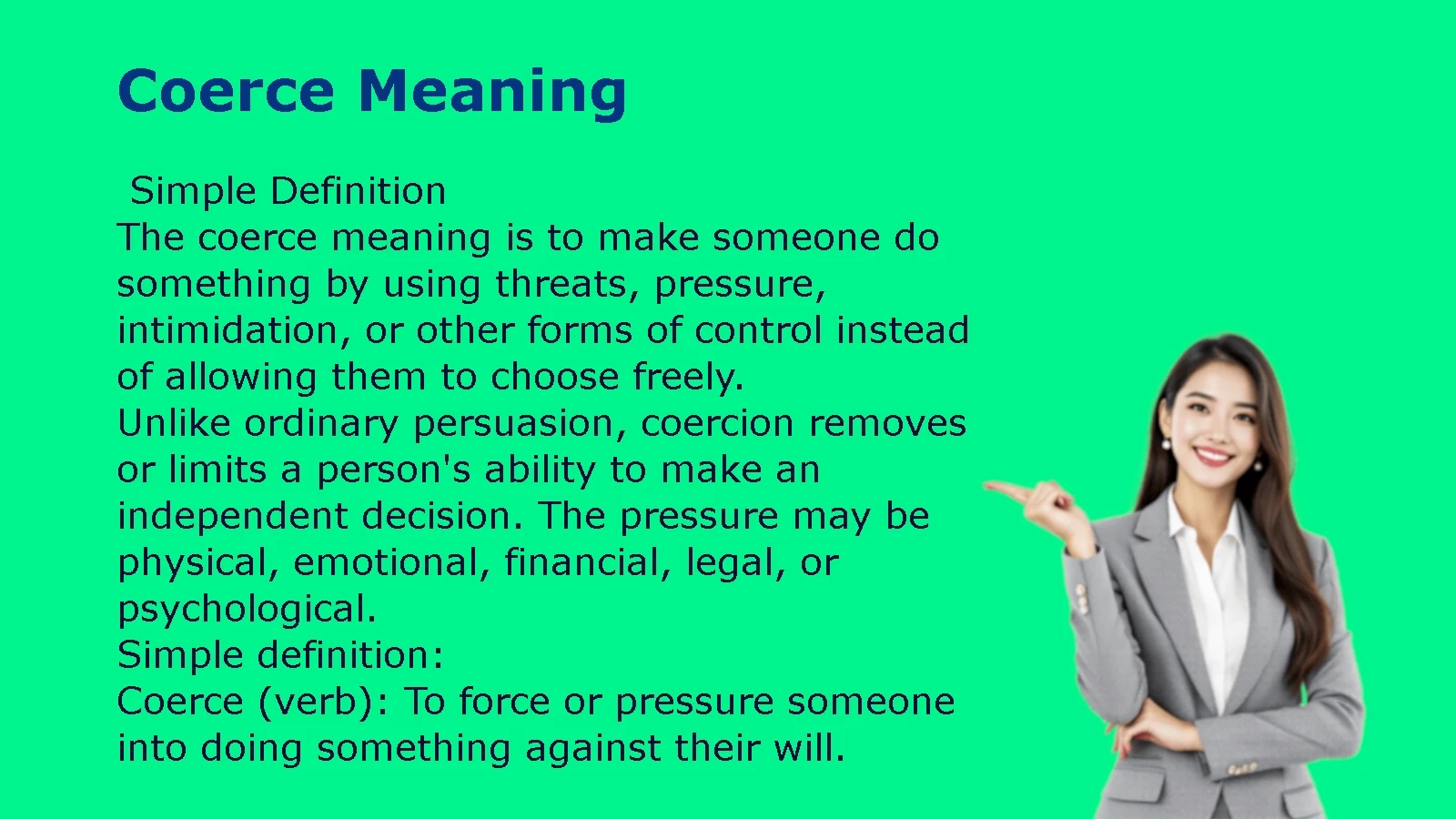
Coerce Meaning
Simple Definition
The coerce meaning is to make someone do something by using threats, pressure, intimidation, or other forms of control instead of allowing them to choose freely.
Unlike ordinary persuasion, coercion removes or limits a person’s ability to make an independent decision. The pressure may be physical, emotional, financial, legal, or psychological.
Simple definition:
Coerce (verb): To force or pressure someone into doing something against their will.
The action doesn’t always involve violence. Sometimes subtle threats or emotional pressure can be just as coercive.
For example:
- A criminal threatens a witness to stay silent.
- An employer threatens to fire an employee unless they agree to unfair demands.
- Someone pressures another person through fear rather than reason.
In each example, the person’s freedom to choose has been undermined.
Dictionary Definition
Most major dictionaries define coerce using similar language.
Common definitions include:
- To compel someone through force or intimidation.
- To persuade someone by using threats.
- To make someone act unwillingly through pressure.
- To obtain something by coercion.
Although the wording differs slightly, every definition emphasizes one essential idea:
The person does not act entirely by choice.
What Does “Coerce” Mean in Plain English?
Imagine someone tells you:
“Sign this paper, or you’ll lose your job.”
Technically, you still have a choice.
Realistically, the threat makes the decision extremely difficult.
That’s coercion.
Now compare it with another situation:
“I think signing this agreement would really benefit you.”
This second statement is persuasion. You’re encouraged but not threatened.
A simple way to remember the difference is:
| Word | Meaning |
| Persuade | Convince someone using reasons |
| Encourage | Give support or confidence |
| Coerce | Pressure someone through threats or intimidation |
| Force | Make someone act through direct power or physical control |
Whenever someone loses meaningful freedom to decide, the word coerce often becomes appropriate.
How to Pronounce Coerce
Many English learners hesitate when pronouncing this word because it doesn’t look the way it sounds.
Pronunciation
IPA:
/koʊˈɜːrs/
Phonetic Spelling
koh-URSS
The second syllable receives the strongest emphasis.
Syllable Breakdown
Co • erce
Two syllables:
- Co
- Erce
Common Pronunciation Mistakes
Many people incorrectly pronounce it like:
- “Core-see”
- “Cow-erce”
- “Co-air-ce”
The correct pronunciation sounds closer to:
koh-URSS
Listening to native speakers and repeating the word several times can help you develop natural pronunciation.
Origin and Etymology of Coerce
The history of the word helps explain why it still carries such a powerful meaning today.
The English word coerce comes from the Latin verb coercēre, meaning:
- To restrain
- To control
- To confine
- To keep within limits
Over time, the word passed through medieval legal and scholarly language before entering English in the late sixteenth century.
Unlike many English words whose meanings changed dramatically over time, coerce has remained remarkably consistent. It has always referred to controlling someone’s actions through authority, force, or pressure.
Timeline
| Period | Development |
| Ancient Latin | Coercēre meant restrain or control |
| Medieval Europe | Used mainly in legal and academic writing |
| Late 1500s | Entered English vocabulary |
| Modern English | Means forcing or pressuring someone against their will |
Its legal roots explain why the word frequently appears in court decisions, contracts, government policies, and discussions about personal rights.
Is Coerce Positive, Negative, or Neutral?
The answer is simple.
Coerce almost always has a negative meaning.
Why?
Because coercion removes genuine freedom.
Healthy communication respects another person’s ability to decide. Coercion replaces that freedom with fear, pressure, or intimidation.
Common negative situations include:
- Domestic abuse
- Workplace intimidation
- Political oppression
- Criminal threats
- Blackmail
- Emotional manipulation
- Forced confessions
Because of these associations, calling someone’s behavior coercive is usually a serious criticism.
When Might the Word Appear?
You may encounter coerce in:
- News reports
- Court cases
- Police investigations
- Human rights discussions
- Psychology articles
- Workplace policies
- Academic writing
You rarely hear it in casual conversation unless someone wants to emphasize unfair pressure.
Quote
“Consent loses its meaning when fear replaces free choice.”
This idea captures why coercion matters in law, ethics, and human relationships.
Examples of Coerce in Sentences
Learning through examples makes vocabulary much easier to remember.
Everyday Examples
- He tried to coerce his friend into lending him money.
- Nobody should coerce you into making an important decision.
- She refused to let anyone coerce her into changing her opinion.
- They attempted to coerce customers through misleading threats.
Workplace Examples
- The manager allegedly coerced employees into working unpaid overtime.
- No employer should coerce workers into signing contracts without enough time to review them.
- Human resources investigated claims that supervisors had coerced staff members.
School Examples
- Older students tried to coerce younger classmates into cheating.
- Teachers should encourage learning instead of trying to coerce participation through humiliation.
- The principal warned students against coercing others during elections.
Family Examples
- Parents should guide children rather than coerce them through fear.
- Emotional threats can coerce family members into making decisions they later regret.
- Healthy families discuss problems instead of using coercion.
Legal Examples
- Prosecutors argued the suspect had coerced the witness.
- Evidence suggested the confession had been coerced.
- Courts often examine whether consent was freely given or obtained through coercion.
Political Examples
- International organizations condemned attempts to coerce voters.
- Economic sanctions sometimes raise debates about political coercion.
- Critics claimed officials used threats to coerce public support.
Coerce Meaning in Law
Legal professionals use the word coerce with great care because it can determine whether agreements, confessions, or consent are legally valid.
In legal contexts, coercion generally refers to forcing someone to act through unlawful threats, intimidation, or improper pressure.
The exact definition varies by jurisdiction. However, the central principle remains the same:
A decision made under coercion may not reflect genuine consent.
This principle affects several areas of law.
Contracts
A contract should result from voluntary agreement.
If one party signs because another threatens violence, financial harm, or unlawful consequences, a court may find that the agreement was not entered into freely.
Criminal Law
Investigators must ensure confessions are voluntary.
If officers or others obtain statements through threats or unlawful pressure, courts may question whether those confessions are reliable or admissible.
Employment Law
Employees have rights against unlawful coercion.
Examples include:
- Threatening termination to obtain illegal agreements
- Retaliating against workers for exercising legal rights
- Pressuring employees to ignore workplace safety rules
Human Rights
International human rights standards emphasize that:
- Consent must be voluntary.
- Torture and coercion violate fundamental rights.
- Governments should protect people from coercive practices.
Mini Case Study
Imagine a landlord tells a tenant:
“Sign this new lease today or I’ll illegally lock you out tonight.”
Although the tenant signs the document, the decision wasn’t freely made.
A court could examine whether the agreement resulted from coercion rather than genuine consent.
The critical issue isn’t whether the tenant physically signed the contract. It’s whether they had a real opportunity to refuse.
Coerce Meaning in Psychology
Psychologists study coercion because it plays an important role in human behavior, relationships, and decision-making.
Unlike physical force, psychological coercion often works by influencing emotions rather than using direct violence.
Common methods include:
- Fear
- Guilt
- Shame
- Isolation
- Financial dependence
- Repeated threats
- Emotional blackmail
Over time, these tactics can make people feel they have no realistic choice.
For that reason, mental health professionals often distinguish between healthy influence and coercive control.
Healthy influence includes:
- Respectful advice
- Honest discussion
- Mutual compromise
- Open communication
Coercive influence includes:
- Constant intimidation
- Threats of punishment
- Manipulation
- Isolation from family or friends
- Controlling finances
- Monitoring someone’s actions
Researchers studying abusive relationships frequently describe coercive control as a repeated pattern of behavior rather than a single event.
The goal isn’t simply to win an argument. Instead, it’s to dominate another person’s choices over time.
Difference Between Coerce and Similar Words
Many English words involve influence or pressure, yet they aren’t interchangeable. Understanding these differences helps you choose the right word in every situation.
Coerce vs. Force
Both words involve making someone do something, but force usually suggests direct physical power or an unavoidable action. Coerce, on the other hand, often relies on threats, intimidation, or psychological pressure.
| Coerce | Force |
| Uses threats, fear, or pressure | Often involves physical strength or direct power |
| Can be emotional or psychological | Commonly physical, though not always |
| Focuses on undermining free choice | Focuses on making an action happen |
Examples:
- The scammer tried to coerce the victim into sharing personal information.
- The storm forced the town to evacuate.
Coerce vs. Compel
Both words mean causing someone to act, but compel is more neutral. A person can be compelled by law, evidence, duty, or strong moral reasons without any improper pressure.
| Coerce | Compel |
| Usually negative | Can be neutral or positive |
| Involves intimidation or threats | May result from obligation, logic, or necessity |
| Suggests unwilling compliance | Doesn’t always imply wrongdoing |
Examples:
- They coerced the witness into changing the story.
- The overwhelming evidence compelled the jury to reach its verdict.
Coerce vs. Persuade
Persuasion respects a person’s freedom to choose, while coercion undermines it.
| Coerce | Persuade |
| Uses fear or pressure | Uses reasons and evidence |
| Limits free choice | Encourages voluntary agreement |
| Has a negative tone | Usually has a neutral or positive tone |
Examples:
- She tried to persuade her friend to apply for the scholarship by explaining its benefits.
- The fraudster attempted to coerce the victim by threatening to reveal private information.
Coerce vs. Manipulate
At first glance, coerce and manipulate may seem interchangeable because both involve influencing another person. However, they are not the same.
Manipulation usually works through deception, guilt, or subtle emotional tactics. Coercion goes a step further by using threats, intimidation, or pressure that removes genuine freedom of choice.
| Coerce | Manipulate |
| Uses threats or intimidation | Uses deception or emotional influence |
| Often obvious | Often subtle |
| Removes meaningful choice | Influences decisions without direct threats |
| Usually considered more serious | Can range from mild to severe |
Examples
- The gang coerced the shop owner into paying protection money.
- The salesperson manipulated customers by hiding important details.
Quick Tip:
Someone can manipulate you without coercing you. However, repeated manipulation can eventually become coercive if it creates fear or dependency.
Coerce vs. Pressure
People often use pressure and coerce interchangeably, but there is an important difference.
Pressure isn’t always harmful. A deadline at work creates pressure. A coach may pressure athletes to improve. Parents may pressure children to study harder.
Coercion begins when pressure becomes unfair, threatening, or controlling.
| Pressure | Coerce |
| Can be positive or negative | Almost always negative |
| Doesn’t always remove choice | Reduces or removes free choice |
| May motivate | Forces compliance through threats |
Examples
- My manager pressured me to finish the report today.
- My manager tried to coerce me into falsifying company records.
Synonyms of Coerce
No synonym matches coerce perfectly. Each carries a slightly different meaning, which makes choosing the right word important.
| Synonym | Meaning | Best Used When |
| Compel | Cause someone to act | Formal or legal writing |
| Force | Make someone do something | Physical or direct action |
| Pressure | Apply influence | General situations |
| Threaten | Use fear of harm | Direct intimidation |
| Intimidate | Frighten someone | Fear-based situations |
| Constrain | Restrict freedom | Legal or academic contexts |
| Oblige | Require someone to act | Formal obligations |
| Strong-arm | Force aggressively | Informal speech |
| Bully | Dominate through fear | School or workplace settings |
| Corner | Leave no reasonable option | Informal discussions |
Choosing the Right Synonym
Use intimidate when fear is the primary tactic.
Use pressure when influence exists but may not amount to coercion.
Example Sentences
- The judge compelled the witness to testify.
- The robber forced the cashier to open the safe.
- The supervisor pressured employees to meet unrealistic deadlines.
- The gang intimidated local business owners.
- The suspect allegedly coerced victims into transferring money.
Notice how each sentence creates a different level of seriousness.
Antonyms of Coerce
Antonyms describe actions that respect another person’s freedom instead of limiting it.
| Antonym | Meaning |
| Encourage | Give confidence or support |
| Persuade | Convince through reasons |
| Inspire | Motivate positively |
| Empower | Give authority or confidence |
| Support | Help someone succeed |
| Advise | Offer guidance |
| Recommend | Suggest without pressure |
| Request | Politely ask |
Understanding the Differences
Encourage builds confidence.
Persuade uses facts and logic.
Empower gives people greater control.
Request leaves the final decision entirely with the other person.
These words share one important feature:
They respect free choice.
Common Collocations With Coerce
Native English speakers often use coerce with certain nouns and phrases. Learning these combinations makes your writing sound more natural.
| Collocation | Meaning |
| Coerce someone into signing | Pressure someone to sign a document |
| Coerce a confession | Obtain a confession through threats |
| Coerce a witness | Pressure a witness to change testimony |
| Coerce employees | Force workers through intimidation |
| Coerce voters | Influence voting through threats |
| Coerce compliance | Force obedience |
| Coerce participation | Pressure someone to join an activity |
| Coerce cooperation | Obtain cooperation unwillingly |
Examples
- Police denied allegations that officers had coerced a confession.
- The company was accused of coercing employees into accepting unfair contracts.
- Officials promised they would never coerce voters.
Learning collocations helps you recognize how the word naturally appears in newspapers, legal documents, and academic writing.
Common Mistakes When Using Coerce
Even advanced English speakers misuse coerce from time to time.
Here are the most common errors.
Mistake: Using Coerce Instead of Persuade
❌ She coerced me by explaining the benefits.
✅ She persuaded me by explaining the benefits.
Explaining isn’t coercion.
Mistake: Assuming All Pressure Is Coercion
Deadlines, expectations, and constructive criticism aren’t automatically coercive.
Coercion involves improper pressure that limits meaningful choice.
Mistake: Using It for Voluntary Decisions
❌ I was coerced into taking a vacation.
Unless someone threatened you, this sentence is incorrect.
Better:
I decided to take a vacation.
Mistake: Ignoring Context
Calling ordinary disagreements “coercion” exaggerates the situation.
Choose the word only when threats, intimidation, or significant pressure are involved.
Mistake: Incorrect Grammar
The most common pattern is:
Coerce someone into doing something
Examples:
- They tried to coerce him into signing.
- Nobody should coerce you into lying.
- Criminals attempted to coerce victims into paying.
Is Coerce a Verb, Noun, or Adjective?
The word appears in several grammatical forms.
| Part of Speech | Word | Meaning |
| Verb | Coerce | To pressure someone into acting |
| Noun | Coercion | The act of coercing |
| Adjective | Coercive | Using force or threats |
| Adverb | Coercively | In a coercive manner |
Examples
Verb
The suspect tried to coerce the witness.
Noun
The court found evidence of coercion.
Adjective
The organization condemned coercive tactics.
Adverb
He acted coercively throughout the negotiations.
Understanding all four forms helps improve both your writing and vocabulary.
Common Phrases and Expressions Using Coerce
Many phrases containing coerce appear in journalism, law, politics, and psychology.
Coerce Into Silence
Someone is threatened so they won’t speak.
Example
The whistleblower claimed executives tried to coerce employees into silence.
Coerce Into Compliance
Someone obeys because refusing feels dangerous.
Example
The group allegedly used fear to coerce compliance.
Coerce Someone to Confess
Authorities or criminals pressure someone into admitting guilt.
Example
Defense attorneys argued investigators had coerced the confession.
Economic Coercion
Pressure applied through financial means rather than physical force.
Examples include:
- Trade restrictions
- Financial sanctions
- Blocking business opportunities
Political Coercion
Governments, political groups, or officials attempt to influence behavior through threats or abuse of authority.
Coercive Tactics
Actions designed to remove someone’s ability to choose freely.
Examples include:
- Threats
- Blackmail
- Harassment
- Intimidation
- Financial control
Coercive Control
One of the most important modern expressions.
It refers to a continuing pattern of controlling behavior, especially in abusive relationships.
Instead of one dramatic event, coercive control often develops gradually through:
- Isolation
- Monitoring
- Threats
- Financial dependence
- Emotional abuse
Many countries now recognize coercive control as a serious issue because it can severely affect a person’s independence and well-being.
When Should You Use the Word Coerce?
Use coerce when someone acts because of fear, threats, intimidation, or overwhelming pressure rather than genuine willingness.
Appropriate Situations
- Legal discussions
- Court cases
- News reports
- Academic writing
- Workplace investigations
- Human rights reports
- Psychology articles
Everyday Conversation
Although coerce is a formal word, it’s still useful in daily speech.
For example:
- Nobody should coerce you into making a life-changing decision.
- Friends shouldn’t coerce each other into risky behavior.
When Not to Use Coerce
Choose a different word if someone simply:
- Gives advice
- Shares an opinion
- Makes a recommendation
- Offers encouragement
- Explains the benefits
For example:
Instead of saying:
My teacher coerced me to read more books.
Say:
My teacher encouraged me to read more books.
The second sentence accurately reflects voluntary influence.
Mini Case Study: Workplace Ethics
Imagine an employee discovers that a company has been altering financial records.
The manager says:
“Sign these reports exactly as they are or you’ll lose your job.”
Although the employee technically has a choice, the threat creates intense pressure. Many people would describe this as coercion because the decision no longer reflects genuine free will.
Now consider a different scenario:
The manager says:
“Please review the reports carefully. If you notice anything that concerns you, let’s discuss it together.”
Here, the employee remains free to agree, disagree, or ask questions. This is professional communication, not coercion.
The contrast highlights the core difference: coercion replaces choice with fear, while ethical leadership encourages informed decisions.
Quick Facts About Coerce
| Feature | Information |
| Part of Speech | Verb |
| Pronunciation | koh-URSS |
| IPA | /koʊˈɜːrs/ |
| Tone | Negative |
| Origin | Latin coercēre (“to restrain” or “control”) |
| Noun Form | Coercion |
| Adjective Form | Coercive |
| Adverb Form | Coercively |
| Opposites | Encourage, persuade, empower |
| Common Contexts | Law, psychology, politics, business, education, human rights |
| Typical Pattern | Coerce someone into doing something |
Quote
“Real agreement comes from freedom. Coercion replaces choice with fear.”
This simple idea explains why the word coerce carries such a strong negative meaning across legal systems, workplaces, schools, and personal relationships.
FAQs About Coerce Meaning
What Is the Meaning of Coerce?
The coerce meaning is to force, pressure, or intimidate someone into doing something against their will. Instead of making a free choice, the person acts because of threats, fear, manipulation, or other forms of undue pressure.
For example:
- A scammer threatens to expose someone’s private information unless they send money.
- An employer pressures an employee to sign an unfair contract by threatening termination.
In both situations, the person’s freedom to choose has been compromised.
Is Coerce Always Negative?
Yes. In modern English, coerce almost always has a negative connotation.
The word suggests that someone used improper pressure rather than honest communication or mutual agreement. Because of this, you’ll often see it in discussions about:
- Criminal law
- Human rights
- Domestic abuse
- Workplace misconduct
- Political intimidation
- Psychological manipulation
If someone simply offers advice or makes a convincing argument, words like persuade, encourage, or convince are more accurate.
What’s the Difference Between Coerce and Persuade?
This is one of the most common questions because the two words both involve influencing another person.
The difference lies in how the influence happens.
| Coerce | Persuade |
| Uses threats or intimidation | Uses logic, facts, or encouragement |
| Removes meaningful choice | Respects free choice |
| Negative meaning | Neutral or positive meaning |
| Creates fear | Builds understanding |
Example
Persuade
My friend persuaded me to join the hiking club by explaining how much fun it would be.
Coerce
The gang coerced the shop owner into paying money by making violent threats.
One relies on reason. The other relies on fear.
Can Someone Be Coerced Without Physical Force?
Absolutely.
Many people mistakenly believe coercion always involves physical violence. In reality, psychological and emotional pressure can also amount to coercion.
Examples include:
- Threatening to reveal private information
- Emotional blackmail
- Financial control
- Threatening to fire an employee unfairly
- Threatening legal action without justification
- Isolating someone from friends or family
- Repeated intimidation
In many cases, emotional coercion causes lasting harm even though no physical force was used.
What Is Coercion in Law?
In legal contexts, coercion refers to forcing someone to act through unlawful threats, intimidation, or improper pressure.
Courts often examine whether a person’s decision was truly voluntary.
Coercion may affect issues such as:
- Contract validity
- Witness testimony
- Criminal confessions
- Employment disputes
- Consent in various legal matters
If a court determines that a decision resulted from coercion rather than genuine consent, that decision may carry legal consequences depending on the applicable laws and the facts of the case.
What Is Coercive Behavior?
Coercive behavior refers to repeated actions that control another person’s choices through fear or intimidation.
It often develops gradually instead of appearing all at once.
Examples include:
- Monitoring someone’s movements
- Controlling access to money
- Threatening punishment
- Constant intimidation
- Isolating someone from loved ones
- Using guilt to maintain control
- Making repeated threats
Healthy relationships encourage discussion and respect. Coercive behavior seeks control.
Is Coerce a Formal Word?
Yes.
Coerce is generally considered a formal English word. You’ll frequently encounter it in:
- News reports
- Court documents
- Government publications
- Academic articles
- Business policies
- Psychology research
While people do use it in conversation, everyday speech often favors simpler alternatives such as:
- Force
- Pressure
- Threaten
However, when precision matters, coerce is often the best choice because it specifically describes pressure that undermines free choice.
What Is the Noun Form of Coerce?
The noun form is coercion.
It refers to the act or practice of coercing someone.
Examples
- The investigation uncovered evidence of coercion.
- The company denied allegations of employee coercion.
- Witnesses reported repeated acts of coercion during the negotiations.
Related word forms include:
| Word Form | Example |
| Coerce | They tried to coerce the witness. |
| Coercion | The court investigated coercion. |
| Coercive | The organization condemned coercive tactics. |
| Coercively | He acted coercively throughout the meeting. |
Can a Contract Signed Under Coercion Be Challenged?
In many legal systems, yes.
If someone signs a contract because of unlawful threats or improper pressure, a court may examine whether genuine consent existed.
Whether a contract can ultimately be challenged depends on factors such as:
- The facts of the case
- The evidence available
- The applicable laws in that jurisdiction
Because contract law differs from one place to another, anyone facing a real legal dispute should seek advice from a qualified legal professional.
How Do You Use Coerce in a Sentence?
Here are several natural examples.
Everyday English
- Nobody should coerce you into making an important decision.
Workplace
- The investigation found no evidence that managers had coerced employees.
Legal
- Prosecutors alleged the suspect coerced the witness.
Politics
- International observers condemned attempts to coerce voters.
Family
- Parents should guide children instead of trying to coerce them through fear.
The more you read these examples, the easier it becomes to recognize the word in everyday situations.
Common Contexts Where You’ll See the Word Coerce
Although coerce appears in many situations, some contexts use it far more often than others.
| Context | Typical Example |
| Law | Coerced confession, coerced consent |
| Business | Coercing employees, coercive contracts |
| Politics | Coercing voters, political coercion |
| Psychology | Coercive control, emotional coercion |
| Education | Coercing students through threats |
| Family Relationships | Financial or emotional coercion |
| Human Rights | Freedom from coercion and intimidation |
Recognizing these common contexts helps you understand why the word frequently appears in newspapers, legal discussions, and academic writing.
Key Takeaways
If you only remember a few points about the coerce meaning, make them these:
- Coerce means forcing or pressuring someone to act against their will.
- The pressure may be physical, emotional, psychological, financial, or legal.
- The word almost always carries a negative meaning.
- Coercion differs from persuasion because it limits genuine freedom of choice.
- The noun form is coercion, while the adjective is coercive.
- You’ll most often encounter the word in discussions about law, psychology, business, politics, and human rights.
- Using coerce correctly makes your writing more precise, especially when describing situations involving intimidation or undue pressure.
Quick Comparison Cheat Sheet
| Word | Meaning | Tone |
| Coerce | Force someone through threats or intimidation | Negative |
| Force | Make someone act through direct power | Usually Negative |
| Compel | Cause someone to act because of necessity or obligation | Neutral |
| Persuade | Convince with reasons or evidence | Positive/Neutral |
| Encourage | Support or motivate | Positive |
| Manipulate | Influence through deception or emotional tactics | Negative |
| Pressure | Apply influence that may or may not be improper | Neutral to Negative |
This table offers a quick way to choose the most accurate word for different situations.
Final Thoughts on Coerce Meaning
The coerce meaning extends far beyond a simple dictionary definition. It describes situations where a person’s freedom to choose is weakened or removed through threats, intimidation, or overwhelming pressure. Whether the setting involves a courtroom, a workplace, a political campaign, or a personal relationship, the central idea remains the same: true consent cannot exist when fear replaces free choice.
Understanding the difference between coerce, force, persuade, and manipulate helps you communicate with greater precision. While people often use these words interchangeably, each carries a distinct meaning and fits different situations. Choosing the right one not only improves your vocabulary but also makes your writing clearer and more accurate.
The next time you encounter the word coerce in a news report, legal document, or everyday conversation, you’ll recognize that it refers to more than influence. It points to pressure that undermines voluntary decision-making. That distinction is what gives the word its significance and explains why it plays such an important role in discussions about consent, ethics, justice, and personal freedom.