
What Is the Withstand Meaning?
Withstand means to resist, endure, or remain strong against pressure, force, damage, or difficult conditions without giving way. It is commonly used to describe people, objects, or structures that can handle challenges or stress.
Examples:
- This bridge can withstand strong winds and heavy traffic.
- She was able to withstand the pressure during the interview.
In this guide, you’ll discover the Withstand Meaning, withstand definition, how to use withstand, withstand pronunciation, and withstand in a sentence with clear, real-life examples. You’ll also learn synonyms of withstand, when to use withstand, and the difference between withstand and similar words like endure, resist, and tolerate.
What Does Withstand Mean?
The meaning of withstand is to resist, remain strong against, or survive something difficult without being damaged or defeated.
Unlike many verbs that simply describe an action, withstand emphasizes strength and resilience. It suggests that someone or something continues to function even when facing force, pressure, danger, or hardship.
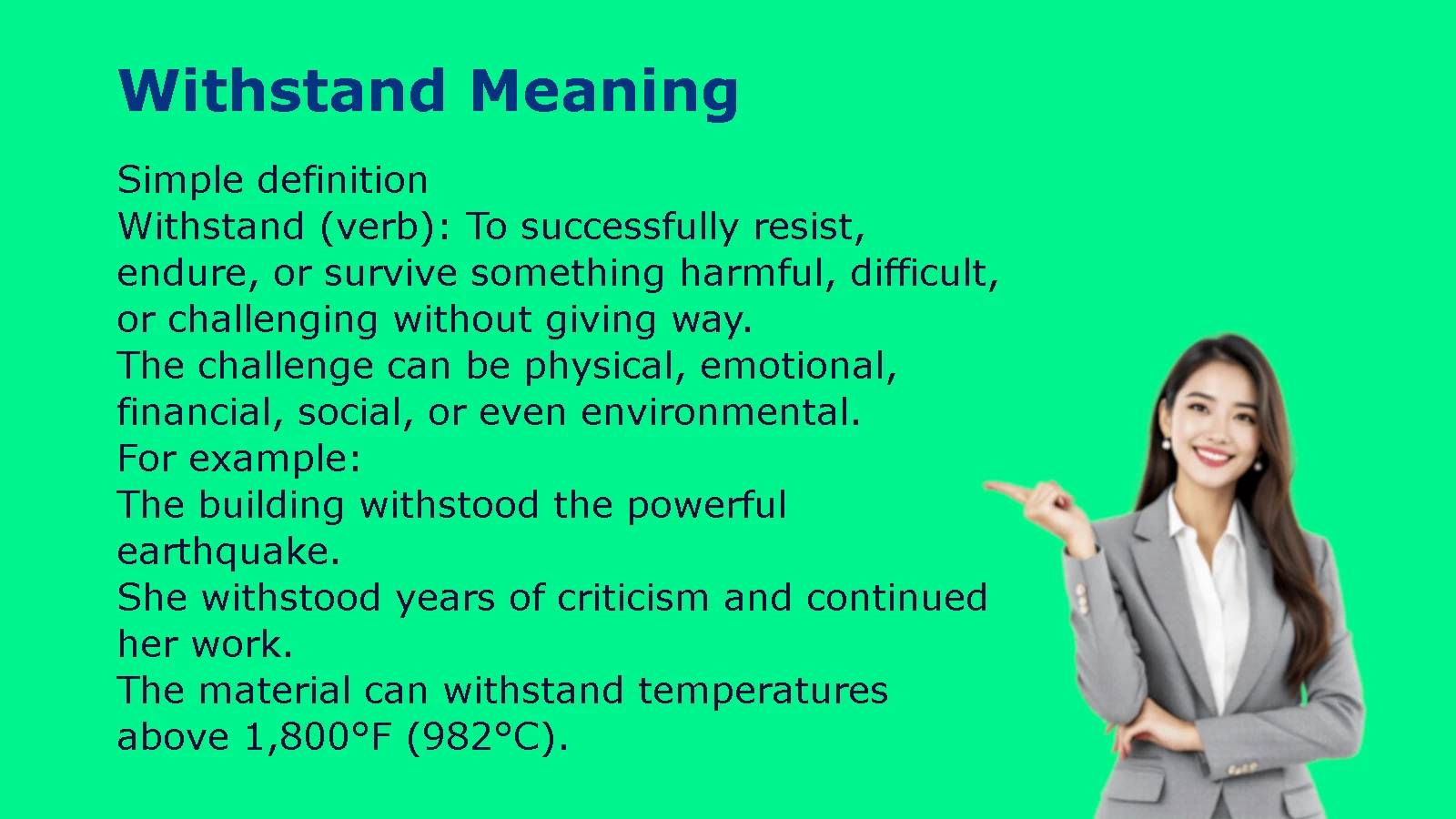
Simple definition
Withstand (verb): To successfully resist, endure, or survive something harmful, difficult, or challenging without giving way.
The challenge can be physical, emotional, financial, social, or even environmental.
For example:
- The building withstood the powerful earthquake.
- She withstood years of criticism and continued her work.
- The material can withstand temperatures above 1,800°F (982°C).
Each sentence highlights the same idea: remaining intact despite outside pressure.
Withstand Meaning in Everyday English
In everyday speech, withstand often means to hold up against something difficult.
People use it when talking about:
- Extreme weather
- Emotional stress
- Physical pressure
- Public criticism
- Legal examination
- Financial hardship
- Disease
- Wear and tear
For example:
“This backpack can withstand heavy rain.”
Here, the backpack doesn’t merely encounter rain. It continues working without significant damage.
Another example:
“He withstood enormous pressure during the championship.”
The player didn’t avoid pressure. Instead, he remained focused despite it.
Literal vs. Figurative Meaning
One reason withstand appears in so many contexts is that it has both literal and figurative uses.
| Literal Meaning | Figurative Meaning |
| Surviving physical force | Remaining emotionally strong |
| Resisting damage | Resisting temptation |
| Enduring harsh weather | Handling criticism |
| Tolerating high temperatures | Coping with stress |
| Remaining structurally sound | Staying confident under pressure |
Literal examples
- The bridge withstood hurricane-force winds.
- Steel can withstand tremendous pressure.
- The helmet withstood the impact.
Figurative examples
- She withstood years of public criticism.
- The company withstood the economic downturn.
- He withstood intense political pressure.
Notice that both meanings share the same central idea: remaining strong despite adversity.
Withstand Pronunciation
Although withstand is common in English, some learners hesitate when pronouncing it because of the consonant cluster in the middle.
US pronunciation
/wɪðˈstænd/
UK pronunciation
/wɪðˈstænd/
The pronunciation is nearly identical in American and British English.
Syllable breakdown
with • stand
Stress falls on the second syllable.
Pronunciation tips
- Say with first.
- Pause very briefly.
- Add stand naturally.
- Keep the “th” sound soft.
Many native speakers pronounce it smoothly as one connected word rather than emphasizing each part separately.
Part of Speech
Withstand is a verb.
More specifically, it is a transitive verb, which means it usually requires a direct object.
For example:
✔ The walls withstood the storm.
Here, the storm is the object.
Likewise:
✔ She withstood criticism.
Again, the sentence tells us what she resisted.
Without an object, the sentence often feels incomplete.
Incorrect:
The bridge withstood.
Correct:
The bridge withstood the flood.
Verb Forms of Withstand
Like understand, withstand is an irregular verb. Its past forms don’t follow the usual -ed pattern.
| Verb Form | Word |
| Base Form | withstand |
| Third-Person Singular | withstands |
| Present Participle | withstanding |
| Past Tense | withstood |
| Past Participle | withstood |
Examples
Present
- This material withstands moisture.
Present Continuous
- Engineers are withstanding difficult working conditions.
Past
- The bridge withstood the earthquake.
Present Perfect
- The equipment has withstood years of heavy use.
Future
- The structure will withstand strong winds.
Is “Withstood” Correct?
Yes.
Withstood is the correct past tense and past participle of withstand.
Examples:
- The ship withstood enormous waves.
- She has withstood countless obstacles.
- The old castle withstood centuries of conflict.
Is “Withstanded” a Word?
No.
Withstanded is not a correct English word.
Since withstand is irregular, you must use withstood instead.
Incorrect:
- The wall withstanded the impact.
Correct:
- The wall withstood the impact.
This mistake is common among English learners because many regular verbs simply add -ed.
Origin and Etymology of Withstand
The word withstand has existed in English for well over a thousand years.
It comes from Old English:
- wið meaning against
- standan meaning to stand
Combined, the original sense was “to stand against.”
That basic idea remains unchanged today.
During the Middle English period, the spelling gradually evolved while the meaning stayed remarkably consistent. Writers continued using withstand to describe resisting attacks, pressure, hardship, and danger.
As English developed, the word expanded beyond physical resistance. It also began describing emotional resilience, moral strength, legal scrutiny, scientific testing, and financial stability.
Today, withstand appears across many fields, including:
- Engineering
- Architecture
- Construction
- Medicine
- Law
- Military science
- Environmental science
- Manufacturing
- Finance
Its long history explains why the word still carries a strong sense of durability and endurance.
When to Use “Withstand”
You should use withstand whenever you want to express that someone or something successfully resists a difficult force, condition, or challenge.
Although the idea sounds simple, the situations where it applies are surprisingly broad.
Using Withstand for Physical Forces
One of the most common uses involves physical strength.
Examples include:
- Buildings
- Vehicles
- Machines
- Protective equipment
- Bridges
- Roads
- Materials
Examples
- The suspension bridge can withstand winds exceeding 150 mph.
- This waterproof jacket withstands heavy rainfall.
- Reinforced concrete withstands enormous compressive forces.
- Safety helmets are designed to withstand repeated impacts.
In engineering, withstand often refers to materials passing standardized strength tests before they enter public use.
Using Withstand for Weather
Weather provides countless opportunities to use withstand naturally.
Examples:
- Hurricanes
- Tornadoes
- Floods
- Heat waves
- Freezing temperatures
- Snowstorms
- Sandstorms
Example sentences:
- The lighthouse withstood decades of coastal storms.
- Desert plants withstand months without rainfall.
- Modern windows withstand strong wind pressure much better than older designs.
Using Withstand for Emotional Challenges
People don’t only withstand physical forces. They also withstand emotional struggles.
Examples include:
- Stress
- Fear
- Anxiety
- Criticism
- Grief
- Loneliness
- Pressure
Example sentences:
- She withstood years of rejection before becoming successful.
- The athlete withstood enormous pressure during the final match.
- They withstood public criticism without changing their decision.
Here, withstand emphasizes emotional resilience rather than physical durability.
Using Withstand in Professional Settings
Professionals across many industries regularly use this verb.
Examples include:
- Financial reports
- Scientific research
- Construction specifications
- Product testing
- Legal writing
- Medical literature
Typical examples:
- The company withstood the recession by reducing unnecessary expenses.
- Laboratory testing showed the material could withstand prolonged exposure to chemicals.
- The contract withstood legal scrutiny.
Notice how the word often appears in formal writing because it communicates precision and durability in a single verb.
Examples of Withstand in Sentences
Seeing withstand in context makes its meaning much easier to understand.
Everyday Examples
- My hiking boots can withstand muddy trails and rocky paths.
- This phone case withstands accidental drops surprisingly well.
- She withstood hours of travel without complaining.
- The old fence couldn’t withstand the strong winds.
- Their friendship has withstood many disagreements.
Academic Examples
- Researchers tested whether the alloy could withstand prolonged exposure to saltwater.
- The experiment measured how different materials withstand thermal expansion.
- Students learned why certain ecosystems withstand climate changes better than others.
Business Examples
- The company withstood a challenging market by diversifying its products.
- Small businesses that maintain healthy cash reserves often withstand economic downturns more effectively.
- Strong customer loyalty helped the brand withstand increased competition.
Engineering Examples
- Engineers designed the foundation to withstand seismic activity.
- Aircraft components must withstand rapid temperature changes during flight.
- Offshore platforms withstand constant wave impact and corrosive seawater.
Literary Examples
Writers often use withstand to describe characters who remain strong despite hardship. The word can also describe places or objects that survive the passage of time.
Examples:
- The ancient castle withstood centuries of warfare.
- Despite countless setbacks, the hero withstood every challenge.
- Their love withstood distance, doubt, and uncertainty.
- The old oak tree withstood generations of storms.
- The kingdom withstood repeated invasions before finally achieving peace.
These examples show how withstand creates a strong image of resilience, whether the subject is a person, place, or object.
Common Collocations with Withstand
A collocation is a pair or group of words that naturally appear together. Learning common collocations helps your English sound more fluent because native speakers use these combinations regularly.
Below are some of the most common collocations with withstand.
| Collocation | Meaning | Example Sentence |
| withstand pressure | Resist force or stress | The pipe can withstand high pressure. |
| withstand heat | Resist high temperatures | Ceramic tiles withstand intense heat. |
| withstand stress | Remain strong under strain | The steel beam withstands constant stress. |
| withstand force | Resist physical impact | The barrier withstood enormous force. |
| withstand impact | Survive collisions | Safety glass withstands heavy impact. |
| withstand damage | Resist harm | Protective coatings withstand damage better. |
| withstand corrosion | Resist rust or chemical damage | Stainless steel withstands corrosion. |
| withstand wear and tear | Stay durable after repeated use | Leather boots withstand years of wear and tear. |
| withstand criticism | Remain unaffected by negative opinions | The scientist withstood criticism from peers. |
| withstand scrutiny | Pass careful examination | The evidence withstood legal scrutiny. |
| withstand temptation | Resist doing something undesirable | He withstood the temptation to quit. |
| withstand attack | Resist military or physical assault | The fortress withstood the attack. |
| withstand harsh conditions | Continue functioning in difficult environments | The equipment withstands harsh conditions. |
| withstand extreme temperatures | Operate in severe climates | Spacecraft materials withstand extreme temperatures. |
| withstand change | Adapt without failing | Strong organizations withstand rapid change. |
Using these natural combinations makes your writing clearer and more idiomatic.
Examples Using Common Collocations
Consider how each collocation changes slightly depending on the context.
Withstand pressure
- Diamonds withstand enormous pressure beneath the Earth’s surface.
- She withstood intense pressure during the interview.
Withstand heat
- Cast iron cookware withstands high cooking temperatures.
- Fire-resistant glass withstands direct flames much longer than ordinary glass.
criticism
- The proposal withstood criticism because it relied on solid evidence.
- Successful leaders often withstand public criticism without losing focus.
scrutiny
- Every financial record must withstand independent scrutiny.
- Scientific discoveries should withstand peer review before gaining acceptance.
temptation
- He withstood the temptation to respond angrily.
- Investors sometimes struggle to withstand emotional temptation during market swings.
Synonyms of Withstand
Many English words share a similar meaning with withstand, but each has its own nuance. Choosing the right synonym depends on what you’re describing.
Common Synonyms
- Resist
- Endure
- Bear
- Tolerate
- Survive
- Weather
- Brave
- Hold out
- Stand up to
- Sustain (in limited contexts)
Although these words overlap, they aren’t always interchangeable.
Synonym Comparison Table
| Word | Best Used For | How It Differs from Withstand |
| Resist | Opposing force | Focuses on opposition rather than survival. |
| Endure | Lasting through hardship | Emphasizes duration and patience. |
| Tolerate | Accepting unpleasant conditions | Suggests acceptance rather than strength. |
| Survive | Staying alive or continuing | Focuses on the outcome instead of resistance. |
| Weather | Successfully getting through difficulties | Often describes long-term challenges. |
| Bear | Carrying emotional or physical burden | More common for emotions or responsibility. |
| Stand up to | Informal resistance | Casual alternative to withstand. |
| Brave | Facing danger courageously | Highlights courage instead of durability. |
Understanding these differences helps you choose the most accurate word.
When “Resist” Works Better
Sometimes resist sounds more natural.
Examples:
- Resist temptation.
- Resist arrest.
- Resist infection.
- Resist change.
While withstand temptation is also correct, resist temptation appears more frequently in everyday English.
When “Endure” Fits Better
Use endure when the focus is on continuing through hardship over time.
Examples:
- She endured years of poverty.
- Patients endured painful treatment.
- They endured long winters.
By contrast:
- The bridge withstood the earthquake.
The bridge wasn’t simply present during the earthquake. It successfully resisted damage.
Antonyms of Withstand
The opposite of withstand is giving way under pressure rather than remaining strong.
Common antonyms include:
- Yield
- Surrender
- Succumb
- Collapse
- Fail
- Break
- Give in
- Cave in
Antonym Comparison
| Antonym | Meaning |
| Yield | Stop resisting |
| Succumb | Fail because of pressure or illness |
| Collapse | Fall apart physically or emotionally |
| Give in | Stop resisting voluntarily |
| Cave in | Collapse under pressure |
| Surrender | Accept defeat |
Examples:
- The dam withstood the flood.
- The old wall collapsed during the flood.
Withstand vs. Resist
These words are closely related, yet they aren’t identical.
Withstand
Means to remain strong despite pressure.
Examples:
- The bridge withstood hurricane-force winds.
- She withstood years of criticism.
The emphasis falls on surviving or remaining undamaged.
Resist
Means to oppose or fight against something.
Examples:
- Resist temptation.
- Resist infection.
- Resist arrest.
The emphasis falls on opposition.
Comparison Table
| Withstand | Resist |
| Focuses on surviving | Focuses on opposing |
| Often used for objects and structures | Often used for actions or decisions |
| Suggests remaining intact | Suggests pushing back |
| Common in engineering | Common in everyday speech |
Which One Should You Choose?
Choose withstand when you want to emphasize strength and durability.
Choose resist when you want to emphasize active opposition.
Examples:
✔ The steel beams withstood the explosion.
✔ She resisted peer pressure.
Although both involve resistance, each highlights a different aspect of the situation.
Withstand vs. Endure
These verbs often appear together, but they communicate different ideas.
Withstand
- Focuses on resisting damage.
- Usually describes strength.
Examples:
- The roof withstood heavy snowfall.
- Protective gear withstands impact.
Endure
- Focuses on continuing despite suffering.
- Usually describes people or experiences.
Examples:
- They endured years of hardship.
- He endured severe pain.
Side-by-Side Comparison
| Withstand | Endure |
| Resist outside force | Continue through hardship |
| Common for objects | Common for people |
| Highlights durability | Highlights patience |
| Damage is avoided | Suffering may continue |
Withstand vs. Tolerate
Many learners confuse these verbs because both involve difficult situations.
However, they describe different responses.
Withstand
Means remaining strong despite pressure.
Example:
- This material withstands high temperatures.
Tolerate
Means allowing or accepting something unpleasant.
Example:
- I can’t tolerate loud music.
Nothing is resisting physical force in the second example. Instead, someone accepts—or refuses to accept—a condition.
Comparison Table
| Withstand | Tolerate |
| Resist successfully | Accept or allow |
| Shows durability | Shows acceptance |
| Often physical | Often emotional or personal |
| Frequently technical | Frequently conversational |
Common Phrases Using Withstand
Several fixed expressions use withstand. Native speakers recognize these phrases immediately.
Withstand the Test of Time
Meaning:
Something remains useful, valuable, attractive, or relevant over many years.
Examples:
- Shakespeare’s plays have withstood the test of time.
- Quality craftsmanship usually withstands the test of time.
Withstand Scrutiny
Meaning:
To remain valid after close examination.
Examples:
- The research withstood scientific scrutiny.
- The contract withstood legal scrutiny.
Withstand Pressure
Meaning:
Remain calm or effective under stress.
Examples:
- Elite athletes withstand tremendous pressure.
- Emergency responders withstand pressure every day.
Withstand Criticism
Meaning:
Continue confidently despite negative opinions.
Examples:
- The artist withstood harsh criticism.
- Strong leaders withstand criticism and keep improving.
Withstand Temptation
Meaning:
Successfully avoid doing something you shouldn’t do.
Examples:
- She withstood the temptation to check her phone.
- He withstood temptation and stayed focused.
Withstand the Elements
Meaning:
Survive natural weather conditions.
Examples:
- Outdoor furniture should withstand the elements.
- Stone monuments have withstood the elements for centuries.
Withstand an Attack
Meaning:
Remain functional or standing after being attacked.
Examples:
- The fortress withstood repeated attacks.
- Cybersecurity systems must withstand sophisticated attacks.
Idioms and Expressions Related to Strength and Endurance
Although they don’t always contain the word withstand, these expressions communicate similar ideas.
| Expression | Meaning |
| Hold your ground | Refuse to retreat |
| Stand firm | Stay committed despite pressure |
| Weather the storm | Survive a difficult period |
| Keep your footing | Stay balanced or stable |
| Stay the course | Continue despite obstacles |
| Stand tall | Remain confident during adversity |
Examples
- She held her ground during the debate.
- The company weathered the storm after the recession.
- He stood firm despite intense opposition.
These idioms often appear in speeches, journalism, literature, and business writing.
Grammar Rules for Withstand
Using withstand correctly becomes much easier once you understand a few grammar rules.
Withstand Is a Transitive Verb
It almost always needs a direct object.
Correct:
- The wall withstood the explosion.
- She withstood criticism.
Incorrect:
- The wall withstood.
The sentence leaves readers wondering, “Withstood what?”
Can “Withstand” Be Followed by “Against”?
Usually, no.
Incorrect:
- The building withstood against the storm.
Correct:
- The building withstood the storm.
Because withstand already means stand against, adding against creates unnecessary repetition.
Can Withstand Be Used in the Passive Voice?
Yes, although the active voice sounds more natural in most cases.
Active:
- The structure withstood the earthquake.
Passive:
- The earthquake was withstood by the structure.
The passive version is grammatically correct, yet it feels awkward because the active sentence is clearer and more direct.
Can People and Objects Both Withstand Something?
Absolutely.
People:
- She withstood years of pressure.
- They withstood enormous emotional stress.
Objects:
- The bridge withstood the earthquake.
- The protective coating withstands corrosion.
This flexibility is one reason withstand appears so often across everyday conversation, technical writing, engineering, science, journalism, and literature.
Common Mistakes When Using “Withstand”
Even advanced English speakers occasionally misuse withstand because it’s an irregular verb and has a specific grammatical pattern. Fortunately, most mistakes are easy to avoid once you know what to watch for.
Using “Withstanded” Instead of “Withstood”
This is the most common mistake.
❌ Incorrect:
- The building withstanded the earthquake.
✅ Correct:
- The building withstood the earthquake.
Remember that withstand follows an irregular pattern similar to understand → understood.
| Base Form | Past Tense | Past Participle |
| withstand | withstood | withstood |
Adding “Against” After Withstand
Many learners write withstand against, but this is incorrect because withstand already includes the idea of standing against something.
❌ Incorrect
- The wall withstood against the explosion.
✅ Correct
- The wall withstood the explosion.
Using Withstand Without an Object
Because withstand is a transitive verb, it usually needs an object.
❌ Incorrect
- The material can withstand.
✅ Correct
- The material can withstand high temperatures.
Confusing Withstand with Stand
Although the words look similar, they have different meanings.
| Word | Meaning |
| stand | To be upright or rise to your feet |
| withstand | To resist or survive pressure or damage |
Examples:
- She stood near the entrance.
- The bridge withstood the flood.
Using the Wrong Subject
Not everything can logically withstand something.
Less natural:
- Happiness withstood the book.
Natural:
- The waterproof cover withstood heavy rain.
- She withstood intense criticism.
Always make sure the subject is capable of resisting or surviving the challenge.
Withstand Meaning in Different Contexts
One reason withstand remains such an important English verb is its flexibility. It appears in many industries and academic fields, each with a slightly different emphasis.
Withstand in Engineering
Engineers use withstand to describe how well a material, structure, or machine resists physical forces without failing.
Examples include:
- Load-bearing capacity
- Wind resistance
- Earthquake resistance
- Heat resistance
- Pressure resistance
- Fatigue resistance
Example:
A steel beam must withstand thousands of pounds of structural load throughout its service life.
Engineering standards often include withstand tests to verify that products perform safely under expected conditions.
Withstand in Construction
Construction professionals frequently discuss whether buildings can withstand natural disasters and everyday wear.
Examples:
- Buildings withstand earthquakes.
- Roofs withstand hurricane-force winds.
- Foundations withstand soil movement.
- Windows withstand impact from flying debris.
Modern building codes often require structures in disaster-prone areas to meet strict performance standards.
Case Study: Hurricane-Resistant Homes
Homes built with reinforced concrete walls, impact-resistant windows, and hurricane straps are better equipped to withstand powerful storms than homes built under older construction standards. These features help reduce structural damage during extreme weather events, though no building is completely immune to severe natural disasters.
Withstand in the Military
Military writing often uses withstand when describing defensive capability.
Examples:
- Troops withstood enemy attacks.
- Defensive positions withstood heavy shelling.
- Vehicles withstand explosive blasts.
- Equipment withstands harsh battlefield conditions.
Here, the word emphasizes resilience rather than offensive action.
Withstand in Biology
In biology, withstand often describes how living organisms survive environmental stress.
Examples:
- Some bacteria withstand extreme temperatures.
- Certain desert plants withstand long droughts.
- Polar animals withstand freezing conditions through specialized adaptations.
The emphasis is on survival through natural adaptations rather than human design.
Withstand in Medicine
Medical professionals use withstand when discussing the body’s ability to cope with disease, treatment, or physical stress.
Examples:
- Patients may withstand surgery well.
- Healthy immune systems withstand infections more effectively.
- Some medications help patients withstand aggressive treatments.
Doctors typically use the word carefully because individual outcomes vary from person to person.
Withstand in Technology
Technology companies often advertise how well products withstand everyday use.
Examples include:
- Smartphones withstand accidental drops.
- Laptops withstand vibration during travel.
- Industrial computers withstand dust and moisture.
- Servers withstand continuous operation.
Durability testing has become a major selling point for consumer electronics.
Withstand in Environmental Science
Environmental researchers use withstand to study how ecosystems respond to changing conditions.
Examples:
- Coral reefs struggle to withstand rising ocean temperatures.
- Forests withstand seasonal droughts differently depending on species diversity.
- Wetlands help coastlines withstand storm surges.
These discussions help scientists understand long-term environmental resilience.
Withstand in Finance and Economics
Businesses and economists frequently describe companies and markets using withstand.
Examples:
- The company withstood the recession.
- Small businesses withstood supply chain disruptions.
- Banks must withstand financial shocks through adequate capital reserves.
- Investors hope diversified portfolios can withstand market volatility.
In these contexts, withstand means remaining stable despite economic challenges.
Case Study: Business Resilience During Economic Uncertainty
Many businesses strengthened online sales, diversified suppliers, and improved cash-flow management during periods of economic disruption. Companies that adapted quickly often proved better able to withstand sudden market changes than those relying on a single revenue source.
How Withstand Appears in Literature and Everyday Writing
The word withstand appears across many forms of writing because it communicates strength, persistence, and endurance in a single verb.
In Fiction
Novelists use withstand to describe both physical survival and emotional resilience.
Example:
The old lighthouse had withstood countless storms, just as its keeper had withstood years of loneliness.
The parallel between the lighthouse and its keeper adds emotional depth while reinforcing the idea of endurance.
In Journalism
News organizations commonly use withstand when reporting on:
- Severe weather
- Economic trends
- Court decisions
- Political pressure
- Infrastructure
- Public health
Example:
Local officials confirmed that the bridge withstood the flooding without major structural damage.
The verb conveys that the bridge remained functional despite a significant challenge.
In Academic Writing
Researchers often use withstand in studies involving testing, analysis, or evaluation.
Examples:
- Materials withstand repeated stress cycles.
- Data withstand statistical analysis.
- The hypothesis withstood peer review.
The word suggests that the subject remained valid or reliable after careful examination.
In Technical Manuals
Instruction manuals frequently describe the limits of equipment using withstand.
Examples:
- This cable can withstand temperatures up to 194°F (90°C).
- The enclosure withstands exposure to dust and water under specified test conditions.
- Safety gloves withstand moderate chemical exposure.
These statements help users understand the intended operating conditions of a product.
In Marketing and Advertising
Brands often highlight durability by using withstand.
Examples include:
- Built to withstand everyday wear.
- Designed to withstand harsh environments.
- Engineered to withstand years of heavy use.
These phrases reassure customers that a product is durable and dependable.
Frequently Asked Questions About Withstand Meaning
What does withstand mean?
Withstand means to resist, survive, or remain undamaged despite pressure, force, hardship, or difficult conditions.
Is withstand a verb?
Yes. Withstand is an irregular transitive verb, meaning it usually takes a direct object.
Example:
- The barrier withstood the impact.
What is the past tense of withstand?
The correct past tense is withstood.
Example:
- The bridge withstood the earthquake.
Is “withstanded” correct?
No. Withstanded is incorrect.
Always use withstood.
What is another word for withstand?
Depending on the context, common synonyms include:
- Resist
- Endure
- Survive
- Bear
- Weather
- Stand up to
- Hold out
Each carries a slightly different meaning, so choose the one that best fits your sentence.
What is the opposite of withstand?
Common antonyms include:
- Yield
- Collapse
- Succumb
- Fail
- Surrender
- Give in
- Cave in
Can people withstand something?
Yes.
Examples:
- She withstood years of criticism.
- They withstood enormous emotional pressure.
Can objects withstand something?
Absolutely.
Examples:
- Steel withstands extreme heat.
- Concrete withstands heavy loads.
- Protective helmets withstand repeated impacts.
What does “withstand the test of time” mean?
The phrase means something remains valuable, effective, attractive, or relevant for many years despite changing trends or conditions.
Examples include classic books, historic buildings, timeless fashion, and durable products.
Is withstand formal or informal?
Withstand is considered neutral to moderately formal.
You’ll find it in:
- Everyday conversation
- Newspapers
- Academic writing
- Engineering documents
- Business reports
- Legal writing
Because it’s widely understood, it’s appropriate in both professional and general contexts.
What’s the difference between withstand and resist?
Both involve opposition, but withstand focuses on remaining strong or undamaged, while resist emphasizes actively opposing something.
Example:
- The bridge withstood the flood.
- She resisted the temptation to leave early.
Quick Reference Table
| Topic | Answer |
| Meaning | To resist, endure, or survive without giving way |
| Pronunciation (US) | /wɪðˈstænd/ |
| Part of Speech | Verb |
| Verb Type | Transitive, irregular |
| Base Form | withstand |
| Past Tense | withstood |
| Past Participle | withstood |
| Present Participle | withstanding |
| Third-Person Singular | withstands |
| Common Synonyms | Resist, endure, survive, weather, bear |
| Common Antonyms | Yield, collapse, succumb, surrender |
| Common Collocations | Withstand pressure, withstand heat, withstand scrutiny, withstand criticism, withstand wear and tear |
| Example Sentence | The reinforced bridge withstood the powerful earthquake without major damage. |
Quote About Resilience
“Strength is not measured by never facing challenges but by continuing to stand firm when challenges arrive.”
This idea captures the essence of withstand. Whether you’re describing a durable material, a determined person, or a successful organization, the word always points to resilience in the face of difficulty.
Key Takeaways About Withstand Meaning
The withstand meaning centers on one powerful idea: remaining strong despite pressure, force, or adversity. Whether the challenge is physical, emotional, financial, or environmental, withstand describes the ability to resist damage or defeat and continue functioning effectively.
To use the word accurately, remember these essential points:
- Withstand means to resist, endure, or survive something difficult without giving way.
- It is an irregular transitive verb, so its correct past tense and past participle are withstood, not withstanded.
- The verb usually takes a direct object, such as pressure, heat, criticism, or an earthquake.
- Common collocations include withstand pressure, withstand scrutiny, withstand wear and tear, and withstand the test of time.
- Although withstand, resist, endure, and tolerate share similarities, each emphasizes a different aspect of dealing with challenges.
- The word appears across many fields, including engineering, construction, medicine, finance, environmental science, journalism, and literature.
Learning withstand is about more than memorizing a definition. It’s about recognizing a concept that appears throughout English: the ability to remain steady when circumstances become difficult. Once you understand that core idea, you’ll find it much easier to recognize and use withstand naturally in conversation, writing, and professional communication.