
What Is the Framework Meaning?
A framework is a structured system, set of guidelines, or basic structure used to organize ideas, solve problems, or support development. It is commonly used in business, education, software development, and research.
Examples:
- The company adopted a new framework for project management.
- This coding framework helps developers build applications faster.
Understanding Framework Meaning helps you use the word correctly in professional communication, academic writing, and everyday English.
In this guide, you’ll discover the Framework Meaning, its definition, pronunciation, examples, and how to use framework in a sentence. You’ll also learn the different meanings of framework, framework synonyms, and how the word is commonly used in professional, academic, and everyday English.
What Does Framework Mean?
The framework meaning is straightforward at its core. A framework is an organized structure that supports or shapes something else. Sometimes that structure is physical, like the steel beams that support a skyscraper. Other times it’s abstract, such as a business strategy or a software development platform.
Unlike random collections of ideas, frameworks provide order. They establish relationships between different parts so everything works together toward a common goal.
For example:
- A building framework supports walls and roofs.
- A software framework provides reusable code for developers.
- A legal framework organizes laws and regulations.
- A research framework helps scholars structure their studies.
Although these examples belong to different industries, they all share one essential characteristic: they provide structure.
Dictionary Definition of Framework
Most major English dictionaries define framework in similar ways:
- A basic structure that supports or surrounds something.
- A system of rules, ideas, or beliefs used to organize or guide activities.
- An underlying structure that holds components together.
These definitions cover both literal and figurative meanings.
Framework Meaning in Plain English
Imagine building a house.
Before painters choose colors or furniture fills the rooms, workers construct the wooden or steel frame. Without that frame, nothing else has a stable place.
The same principle applies elsewhere.
A business creates policies before expanding. A teacher designs lesson plans before teaching. A programmer establishes a software framework before adding application features.
In every case, the framework comes first because everything else depends on it.
Framework at a Glance
| Feature | Details |
| Word | Framework |
| Pronunciation | /ˈfreɪmˌwɝːk/ |
| Part of Speech | Noun |
| Meaning | A structure or organized system that supports or guides something |
| Common Contexts | Software, business, education, law, research, construction, government |
| Related Words | Structure, system, model, architecture, foundation |
| Opposites | Chaos, disorder, randomness |
Why Understanding Framework Meaning Matters
Many people assume “framework” is simply another word for structure. While they’re closely related, framework usually suggests something more organized and purposeful.
Knowing the correct meaning helps you:
- Understand technical documents.
- Follow business discussions.
- Read academic research confidently.
- Learn programming concepts faster.
- Interpret government policies correctly.
For students, professionals, and everyday readers, recognizing how the word changes across different contexts prevents confusion.
“A good framework doesn’t limit creativity—it gives creativity a place to grow.”
This idea explains why frameworks appear in nearly every profession.
Framework Meaning in Different Contexts
One reason people search for framework meaning is that the word changes slightly depending on where it’s used. The underlying concept remains the same, but each field applies it differently.
Let’s explore the most common uses.
Framework Meaning in Technology
Technology has made the word “framework” especially popular over the past two decades.
Developers rarely build modern applications from scratch. Instead, they rely on software frameworks that provide reusable components, security features, routing systems, and development tools.
What Is a Software Framework?
A software framework is a collection of reusable code, libraries, and standards that developers use to build applications more efficiently.
Rather than solving the same problems repeatedly, programmers start with an established framework.
Think of it like assembling furniture.
You could cut every piece of wood yourself, or you could buy a kit that already contains the essential components. The kit saves time while ensuring everything fits together properly.
Software frameworks serve a similar purpose.
Benefits of Software Frameworks
- Reduce development time
- Improve code organization
- Increase security
- Encourage consistent coding standards
- Simplify maintenance
- Support teamwork
- Minimize repetitive coding
Popular Software Frameworks
Several frameworks dominate modern software development.
| Framework | Primary Language | Common Use |
| React | JavaScript | User interfaces |
| Angular | TypeScript | Enterprise web applications |
| Django | Python | Web development |
| Laravel | PHP | Dynamic websites |
| Spring Boot | Java | Enterprise applications |
| Ruby on Rails | Ruby | Rapid web development |
| ASP.NET Core | C# | Cross-platform web apps |
Each framework solves different problems, yet all provide developers with an organized starting point.
Real-World Example
Suppose two developers need to create an online shopping website.
Developer A writes every authentication system, security feature, and routing mechanism from scratch.
B uses Django or Laravel.
B usually finishes sooner because the framework already handles many common tasks.
Framework vs Programming Language
These terms often confuse beginners.
| Programming Language | Framework |
| Defines syntax | Provides structure |
| Examples: Python, Java, PHP | Examples: Django, Spring Boot, Laravel |
| Used to write code | Built using programming languages |
| Can exist independently | Depends on a programming language |
A framework doesn’t replace a programming language.
Instead, it builds upon one.
Framework Meaning in Business
Businesses rely on frameworks to organize decisions, improve efficiency, and solve complex problems.
Instead of making every decision from scratch, organizations use established models that guide planning and execution.
Business Framework Definition
A business framework is a structured approach that helps companies analyze situations, make decisions, and achieve strategic objectives.
These frameworks reduce uncertainty by providing consistent methods for evaluating problems.
Common Business Frameworks
Businesses use many established frameworks.
SWOT Analysis
Evaluates:
- Strengths
- Weaknesses
- Opportunities
- Threats
Companies use SWOT before launching products or entering new markets.
Porter’s Five Forces
This framework examines industry competition through five factors:
- Competitive rivalry
- Supplier power
- Buyer power
- Threat of substitutes
- Threat of new entrants
It helps businesses understand market dynamics.
Balanced Scorecard
Organizations monitor performance using four perspectives:
- Financial
- Customer
- Internal processes
- Learning and growth
This framework ensures companies don’t focus only on profits.
Case Study: Starbucks
When Starbucks expands internationally, it doesn’t simply open new stores randomly.
Instead, the company follows structured decision-making frameworks that consider:
- Customer demand
- Local competition
- Supply chain logistics
- Real estate availability
- Brand positioning
This systematic approach reduces risk while improving long-term success.
Framework Meaning in Education
Education depends heavily on frameworks because learning becomes more effective when it’s organized.
Teachers rarely create lessons without following curriculum guidelines or educational standards.
Educational Framework Definition
An educational framework outlines the goals, teaching methods, assessment strategies, and learning outcomes for students.
These frameworks help maintain consistency across classrooms.
Examples
Educational frameworks often include:
- Curriculum standards
- Learning objectives
- Assessment methods
- Classroom expectations
- Skill progression
For instance, elementary mathematics frameworks typically introduce addition before multiplication because each concept builds upon earlier knowledge.
Why Teachers Use Frameworks
Frameworks help educators:
- Plan lessons efficiently.
- Track student progress.
- Maintain consistency.
- Align instruction with academic standards.
- Measure learning outcomes objectively.
Without a framework, classrooms could become inconsistent and confusing.
Framework Meaning in Research
Researchers frequently use the word framework, especially in academic writing.
If you’ve written a thesis or dissertation, you’ve probably encountered conceptual frameworks and theoretical frameworks.
Although they’re related, they aren’t identical.
Conceptual Framework
A conceptual framework explains how researchers believe different variables relate to one another.
It creates a visual or logical roadmap for the study.
For example, someone researching remote work productivity might connect:
- Employee flexibility
- Job satisfaction
- Communication quality
- Productivity
These relationships form the conceptual framework.
Theoretical Framework
A theoretical framework builds on existing theories developed by previous researchers.
Instead of creating new relationships, it explains research using established academic knowledge.
For example:
A psychology study on motivation may rely on Self-Determination Theory as its theoretical framework.
Analytical Framework
Analytical frameworks provide structured methods for examining evidence.
Researchers often use them to:
- Interpret qualitative interviews
- Analyze survey responses
- Compare historical events
- Evaluate public policies
Why Research Frameworks Matter
Research frameworks help scholars:
- Define variables clearly.
- Reduce bias.
- Organize data collection.
- Improve study reliability.
- Explain findings logically.
Without a framework, research often lacks direction.
Framework Meaning in Construction and Engineering
The word framework originally referred to physical structures long before it became popular in business or technology.
Builders still use the term every day.
What Is a Structural Framework?
A structural framework is the load-bearing skeleton of a building or other structure.
It distributes weight safely while supporting walls, roofs, floors, and other components.
Common Materials
Construction frameworks commonly use:
- Steel
- Reinforced concrete
- Timber
- Aluminum
Material selection depends on factors such as building size, environmental conditions, and engineering requirements.
Real-World Example
Imagine constructing a bridge.
Before workers install pavement or safety barriers, engineers build the steel framework.
That framework carries the bridge’s weight and withstands wind, traffic, and environmental forces.
Without it, the bridge couldn’t function safely.
Why Structural Frameworks Matter
Structural frameworks provide:
- Stability
- Strength
- Safety
- Load distribution
- Long-term durability
Engineers carefully calculate every beam and connection because even minor design errors can affect the entire structure.
Framework Meaning in Government and Law
Governments use frameworks to organize laws, regulations, and public policies.
Rather than creating isolated rules, lawmakers establish broader systems that guide future decisions.
Legal Framework
A legal framework consists of the laws, regulations, constitutional principles, and judicial processes that govern a society or organization.
Examples include:
- Constitutional law
- Criminal law
- Civil law
- Administrative regulations
Together, they create an organized legal system rather than disconnected rules.
Regulatory Framework
A regulatory framework establishes how governments oversee industries.
These frameworks often cover:
- Banking
- Healthcare
- Aviation
- Telecommunications
- Environmental protection
- Food safety
Businesses operating in regulated industries must follow these standards to remain compliant.
Policy Framework
Policy frameworks guide public institutions when creating or implementing programs.
For example, a national climate policy framework may define:
- Environmental goals
- Emission targets
- Funding priorities
- Reporting requirements
- Enforcement mechanisms
Instead of dictating every action, the framework provides consistent guidance for future decisions.
Case Study: Data Privacy
Many countries have introduced comprehensive data privacy frameworks to protect personal information.
Although specific rules vary by jurisdiction, these frameworks generally address:
- User consent
- Data collection
- Information security
- Breach reporting
- Consumer rights
Organizations that process personal data build their internal policies around these broader legal frameworks.
Framework Meaning in Project Management
Projects rarely succeed through improvisation alone. Whether a team is launching a mobile app or constructing a hospital, everyone needs a repeatable way to plan, execute, and measure progress. That’s where project management frameworks come in.
A project management framework is a structured approach that defines how work should move from start to finish. It establishes roles, processes, communication methods, and performance measurements so teams can work efficiently.
Unlike a single checklist, a framework creates a repeatable system that organizations can apply to multiple projects.
Why Project Management Frameworks Matter
Organizations use frameworks because they help teams:
- Define clear project goals.
- Assign responsibilities.
- Manage budgets effectively.
- Reduce project risks.
- Improve collaboration.
- Track progress consistently.
- Deliver projects on time.
Without a framework, projects often suffer from unclear expectations, missed deadlines, and unnecessary costs.
Popular Project Management Frameworks
| Framework | Best For | Key Characteristics |
| Agile | Software and evolving projects | Iterative development, customer feedback, flexibility |
| Scrum | Agile teams | Short work cycles (sprints), defined team roles |
| Kanban | Workflow management | Visual task boards, continuous delivery |
| PRINCE2 | Large organizations | Process-driven, documentation-focused |
| PMBOK Framework | General project management | Best practices and standardized processes |
Agile Framework
Agile focuses on continuous improvement rather than rigid planning.
Instead of waiting months before releasing a finished product, Agile teams deliver small improvements regularly. They gather customer feedback after each iteration and adjust future work accordingly.
Example:
A software company developing a fitness app might release:
- Basic login system
- Workout tracking
- Nutrition planner
- Social features
Each feature arrives in stages rather than all at once.
Scrum Framework
Scrum builds on Agile principles.
It organizes work into short development cycles called sprints, which typically last one to four weeks.
Each Scrum team usually includes:
- Product Owner
- Scrum Master
- Development Team
Daily meetings keep everyone aligned while sprint reviews evaluate completed work.
Kanban Framework
Kanban emphasizes visual workflow management.
Tasks move across columns such as:
To Do
↓
In Progress
↓
Testing
↓
Completed
This simple visualization helps teams identify bottlenecks before they become serious problems.
Framework Meaning in Writing and Communication
Professional writers rarely begin with a blank page. Before drafting articles, reports, or presentations, they often create a framework that organizes their ideas logically.
A writing framework acts as a blueprint for communication.
Instead of focusing on individual sentences first, writers establish the overall structure before filling in the details.
Common Writing Frameworks
Examples include:
- Essay outlines
- Report structures
- Presentation templates
- Blog post outlines
- Research paper formats
- Proposal templates
These frameworks improve clarity while making information easier to follow.
Example
Without a framework:
- Ideas appear randomly.
- Important details get overlooked.
- Readers struggle to follow the discussion.
With a framework:
- Information flows naturally.
- Arguments build logically.
- Readers understand the main points more easily.
Framework Meaning in Simple Words
If someone asked for the simplest possible explanation, here’s an easy answer.
A framework is the basic structure that helps something work properly.
Think about assembling a bicycle.
Before you install the wheels, handlebars, or seat, you need the frame.
Everything else connects to it.
The same idea applies to businesses, schools, governments, software, and research.
Everyday Examples
Imagine these situations:
- A recipe provides the framework for cooking dinner.
- Classroom rules create the framework for learning.
- Traffic laws establish the framework for safe driving.
- A company’s handbook forms the framework for employee behavior.
- Building plans provide the framework for construction.
Although these examples involve different activities, they all organize people and processes.
An Everyday Analogy
Imagine organizing a family vacation.
Without any planning:
- Nobody books hotels.
- Flights overlap.
- Activities conflict.
- Budgets become unclear.
Now imagine creating a travel plan first.
You decide:
- Where to go.
- When to travel.
- How much to spend.
- Which attractions to visit.
That travel plan becomes your framework.
It doesn’t guarantee a perfect vacation, but it gives everyone a shared direction.
Examples of Framework in Sentences
Seeing a word in context often makes its meaning much clearer.
Everyday Conversation
- We created a framework for dividing household chores fairly.
- The community developed a framework for neighborhood safety.
- This schedule provides a framework for our weekly meetings.
Technology
- React is a popular framework for building user interfaces.
- The development team selected Django because its framework speeds up web development.
- The company migrated to a modern software framework.
Business
- Leadership introduced a new framework for evaluating employee performance.
- The marketing framework improved campaign consistency.
- Our strategic framework helped prioritize investments.
Education
- The school adopted a literacy framework for elementary students.
- Teachers followed the curriculum framework throughout the semester.
- The learning framework emphasized critical thinking.
Construction
- Steel workers completed the framework before installing exterior walls.
- Engineers inspected the bridge’s structural framework.
- The framework supports the building during construction.
Government
- Parliament approved a regulatory framework for digital payments.
- The environmental framework establishes national conservation goals.
- Officials revised the legal framework governing consumer protection.
Academic Writing
- The researcher explained the conceptual framework before discussing the methodology.
- Every hypothesis fit within the theoretical framework.
- The analytical framework guided data interpretation.
Common Types of Frameworks
Although the word has one core meaning, many specialized frameworks exist across industries.
Understanding these variations helps you recognize how professionals use the term.
Conceptual Framework
A conceptual framework explains relationships among ideas or variables.
Researchers often design conceptual frameworks before collecting data.
Key Characteristics
- Organizes concepts visually.
- Shows cause-and-effect relationships.
- Guides research questions.
- Supports hypothesis development.
Example
Education
↓
Skills Development
↓
Employment Opportunities
↓
Income Growth
This simple diagram illustrates how concepts connect within a conceptual framework.
Theoretical Framework
A theoretical framework relies on established academic theories.
Rather than creating new ideas, researchers apply existing theories to explain their studies.
Examples
- Social Learning Theory
- Maslow’s Hierarchy of Needs
- Diffusion of Innovation Theory
- Cognitive Development Theory
Researchers use these theories to interpret observations consistently.
Software Framework
Software frameworks simplify application development by providing reusable tools and standardized architecture.
They commonly include:
- Authentication systems
- Database connectivity
- Security tools
- Routing
- Testing utilities
Developers spend more time solving unique problems instead of rebuilding common features.
Organizational Framework
Large organizations need clear structures for decision-making.
Organizational frameworks define:
- Leadership responsibilities
- Department relationships
- Reporting structures
- Performance expectations
- Governance procedures
These frameworks improve accountability while reducing confusion.
Strategic Framework
Businesses use strategic frameworks when making long-term decisions.
A strategic framework often includes:
- Vision
- Mission
- Core objectives
- Performance indicators
- Action plans
It ensures every department works toward common organizational goals.
Regulatory Framework
Regulatory frameworks establish rules for industries that affect public safety or economic stability.
Examples include:
- Banking regulations
- Aviation standards
- Healthcare compliance
- Environmental protection
- Food safety regulations
Governments update these frameworks as technology and society evolve.
Structural Framework
Structural frameworks physically support buildings and infrastructure.
Common examples include:
- Steel skyscrapers
- Wooden homes
- Suspension bridges
- Stadium roofs
Every component depends on the framework for stability.
Educational Framework
Educational frameworks organize teaching and learning.
They define:
- Learning objectives
- Assessment methods
- Curriculum progression
- Instructional strategies
Schools use these frameworks to maintain educational consistency.
Analytical Framework
Analytical frameworks help professionals evaluate information objectively.
They’re widely used in:
- Market research
- Public policy
- Finance
- Data science
- Risk management
Rather than relying on intuition alone, analysts follow structured evaluation methods.
Decision-Making Framework
Decision-making frameworks reduce uncertainty when choosing among alternatives.
A typical framework includes:
- Define the problem.
- Gather information.
- Identify possible solutions.
- Compare risks and benefits.
- Select the best option.
- Monitor results.
Businesses frequently rely on these frameworks when making high-impact decisions.
Framework vs Similar Words
Many words resemble framework, but they aren’t interchangeable.
Understanding the differences helps you choose the most accurate term.
Comparison Table
| Term | Definition | Primary Purpose | Flexibility | Example |
| Framework | Structured system that guides work | Organization and support | High | Agile framework |
| Structure | Arrangement of parts | Stability | Medium | Building structure |
| System | Interconnected components working together | Operation | Medium | Operating system |
| Model | Simplified representation | Explanation or prediction | High | Business model |
| Architecture | Overall design of components | Technical planning | Medium | Software architecture |
| Methodology | Collection of methods | Completing tasks | Medium | Research methodology |
| Process | Series of steps | Task completion | Lower | Hiring process |
Framework vs Structure
A structure focuses on how parts are arranged.
A framework focuses on providing guidance and support.
Every framework has a structure, but not every structure serves as a framework.
Framework vs System
A system performs work.
A framework provides the foundation that allows systems or processes to operate consistently.
For example:
- Windows is an operating system.
- .NET is a software framework.
Framework vs Model
Models explain or represent reality.
Frameworks organize activities.
Economists build models to predict markets.
Businesses use frameworks to make decisions.
Framework vs Architecture
Architecture describes design.
Frameworks provide reusable implementation structures.
Software architects design systems.
Developers implement them using frameworks.
Framework vs Methodology
This comparison causes frequent confusion.
A methodology explains how work should happen.
A framework provides the environment within which that work occurs.
Think of it this way:
- Framework = the house.
- Methodology = the instructions for living inside it.
Framework vs Process
Processes describe specific sequences of actions.
Frameworks may include multiple processes.
For example, an HR framework could contain hiring, onboarding, training, and performance review processes.
Synonyms of Framework
Although no synonym matches every context, several words convey similar ideas.
| Synonym | Best Used When |
| Structure | Physical or organizational arrangement |
| System | Connected components working together |
| Foundation | Supporting base |
| Model | Conceptual representation |
| Architecture | Technical design |
| Blueprint | Planning stage |
| Outline | Organizing written ideas |
| Skeleton | Basic physical or conceptual form |
| Platform | Technology environments |
| Arrangement | Organized placement |
| Organization | Coordinated structure |
When Synonyms Don’t Work
For example, calling React a structure sounds unnatural.
Calling it a software framework is the accepted industry term.
Likewise, a building blueprint isn’t the same as the building’s framework.
Choosing the right synonym depends on context.
Antonyms of Framework
Opposites highlight what a framework prevents.
Common antonyms include:
| Antonym | Why It’s Opposite |
| Chaos | No organization |
| Disorder | Lack of structure |
| Confusion | Unclear relationships |
| Randomness | No planned arrangement |
| Disorganization | Poor coordination |
Imagine trying to manage a company without policies, procedures, or leadership.
The result would resemble chaos rather than a framework.
Origin and Etymology of Framework
The word framework combines two older English words:
- Frame
- Work
Originally, frame referred to a physical structure or supporting skeleton.
By the Middle English period, builders commonly used the word when discussing timber construction.
As language evolved, people began applying the same concept metaphorically.
Instead of describing only buildings, framework came to represent any organized structure that supports ideas, systems, or activities.
Today, the word appears in virtually every professional discipline because its underlying concept remains universally useful.
How to Pronounce Framework
IPA Pronunciation
/ˈfreɪmˌwɝːk/
Simple Phonetic Spelling
FRAYM-work
Pronunciation Tips
- Stress the first syllable.
- Keep “frame” clear and distinct.
- Avoid shortening the second syllable too much.
Common Mistakes
Some learners incorrectly emphasize the second syllable or merge the word into a single indistinct sound.
Native speakers typically pronounce it as two clearly connected parts:
FRAME + work
Common Collocations With Framework
Certain words naturally appear alongside framework in English. These combinations, known as collocations, are common in professional writing, news articles, academic papers, and everyday conversations.
Learning them will help you use the word naturally.
| Collocation | Meaning | Example Sentence |
| Legal framework | The system of laws governing an area | The country updated its legal framework for online privacy. |
| Regulatory framework | Rules established by authorities | Financial institutions must follow the regulatory framework. |
| Policy framework | Guidelines for developing policies | The agency released a new policy framework for renewable energy. |
| Strategic framework | A plan that guides long-term decisions | The company introduced a strategic framework for global growth. |
| Conceptual framework | Structure that connects ideas | The researcher explained the conceptual framework before presenting the results. |
| Theoretical framework | Existing theories supporting research | Every hypothesis aligned with the theoretical framework. |
| Software framework | Reusable platform for software development | React remains one of the most popular software frameworks. |
| Security framework | Standards for protecting systems | The organization adopted a stronger cybersecurity framework. |
| Governance framework | Rules for decision-making and oversight | A governance framework improves accountability. |
| Operational framework | Structure for daily operations | Managers developed an operational framework to improve efficiency. |
| National framework | Country-wide system or plan | The education ministry announced a national curriculum framework. |
| Framework agreement | Broad agreement establishing future terms | Both companies signed a framework agreement before negotiations continued. |
| Framework document | Document outlining a structure | The committee published a framework document for public review. |
| Framework analysis | Method for analyzing information | Researchers used framework analysis to examine interview responses. |
| Framework design | Planning the structure of a system | Engineers completed the framework design before development began. |
These collocations appear frequently because they describe structured systems across many industries.
Common Phrases Using Framework
English speakers also use several phrases built around the word framework.
Understanding these expressions makes reading professional documents much easier.
Within the Framework Of
Meaning: Operating according to established rules or guidelines.
Example:
“The negotiations continued within the framework of international law.”
Develop a Framework
Meaning: Create an organized system before beginning work.
Example:
“Our team developed a framework for evaluating customer feedback.”
Build a Framework
Meaning: Construct either a physical or conceptual structure.
Example:
“The engineers built the steel framework before installing the exterior walls.”
Create a Framework
Meaning: Design a structured plan or system.
Example:
“The school created a framework for digital learning.”
Establish a Framework
Meaning: Formally introduce a structured system.
Example:
“The government established a framework for artificial intelligence governance.”
Operate Within a Framework
Meaning: Follow established procedures or rules.
Example:
“Healthcare providers operate within strict regulatory frameworks.”
Framework for Success
Meaning: A structure designed to increase the chances of achieving goals.
Example:
“Clear communication provides a framework for long-term success.”
Mistakes People Make With “Framework”
Because framework has several meanings, it’s easy to misuse the word. Here are the most common mistakes and how to avoid them.
Confusing a Framework With a Methodology
A framework provides the overall structure, while a methodology explains the methods or techniques used to complete work.
Incorrect:
“We’ll use Agile as our methodology framework.”
Better:
“We’ll use the Agile framework along with appropriate development methodologies.”
Using Framework When “System” Is More Accurate
Not every organized collection of components is a framework.
For example, an operating system manages hardware and software resources. Although it has a framework internally, the operating system itself is a system.
Choosing the correct term improves clarity.
Assuming Every Software Library Is a Framework
This is one of the most common misconceptions among beginner programmers.
Software Library
- Provides reusable functions.
- Developers decide when to call them.
Software Framework
- Controls the application’s overall structure.
- Calls your code at predefined points.
This principle is often summarized as “Don’t call us. We’ll call you.” It describes how frameworks control the application’s flow rather than waiting for developers to invoke individual components.
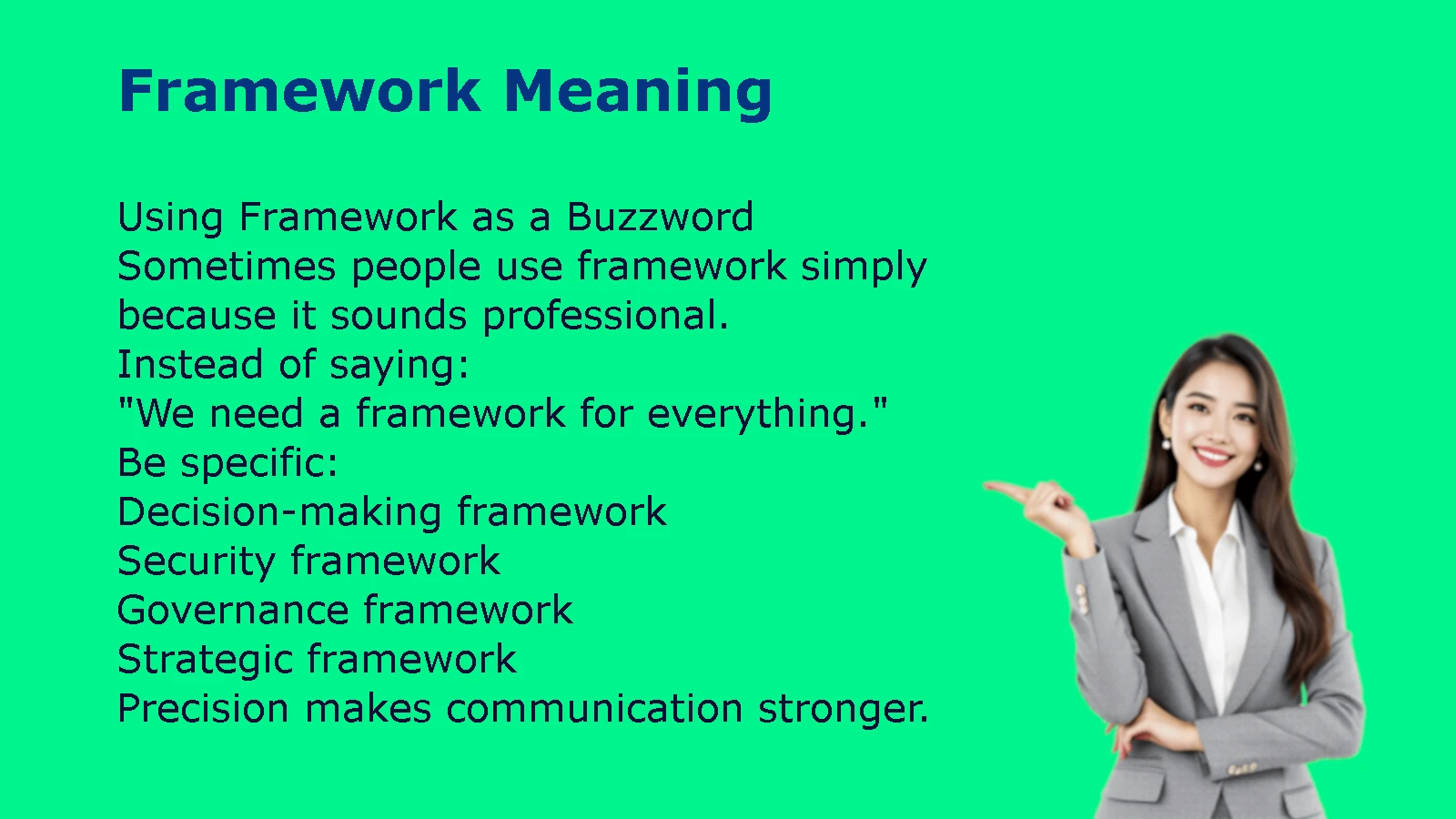
Using Framework as a Buzzword
Sometimes people use framework simply because it sounds professional.
Instead of saying:
“We need a framework for everything.”
Be specific:
- Decision-making framework
- Security framework
- Governance framework
- Strategic framework
Precision makes communication stronger.
Confusing Conceptual and Theoretical Frameworks
Students often mix these terms.
Here’s the difference:
| Conceptual Framework | Theoretical Framework |
| Developed by the researcher | Based on existing theories |
| Shows relationships between concepts | Explains research through established theories |
| Often unique to the study | Draws from previous scholarly work |
Understanding this distinction can significantly improve academic writing.
Real-World Examples of Frameworks
Looking at real organizations makes the framework meaning even clearer.
Software Development
Modern web applications commonly use frameworks such as:
- React
- Angular
- Vue
- Django
- Laravel
- Spring Boot
- ASP.NET Core
These frameworks provide routing, security, authentication, and reusable components that reduce development time.
Business Strategy
Businesses frequently rely on strategic frameworks, including:
- SWOT Analysis
- Porter’s Five Forces
- Balanced Scorecard
- PESTLE Analysis
- Business Model Canvas
Rather than making decisions based on instinct alone, leaders use these frameworks to evaluate opportunities and risks systematically.
Healthcare
Healthcare organizations use clinical frameworks to:
- Improve patient safety.
- Standardize treatments.
- Reduce medical errors.
- Monitor quality of care.
- Support evidence-based decision-making.
These frameworks help ensure consistent care across hospitals and clinics.
Cybersecurity
Security professionals depend on cybersecurity frameworks to identify, manage, and reduce digital risks.
Common frameworks cover areas such as:
- Risk assessment
- Access control
- Incident response
- Continuous monitoring
- Recovery planning
By following a structured framework, organizations can improve their overall security posture and respond more effectively to emerging threats.
Framework Meaning Across Different Industries
Although every profession applies the term differently, the underlying purpose stays remarkably consistent.
| Industry | Meaning of Framework |
| Software Development | Reusable development platform |
| Construction | Physical supporting structure |
| Education | Organized teaching system |
| Research | Structure guiding academic studies |
| Government | Collection of laws and policies |
| Business | Decision-making model |
| Healthcare | Clinical guidance system |
| Engineering | Structural support design |
| Finance | Regulatory and compliance structure |
| Marketing | Strategic planning process |
Notice the recurring theme.
Every definition centers on providing structure, consistency, and guidance.
How to Choose the Right Meaning of Framework
When you encounter the word framework, look at the surrounding context.
Ask yourself these questions:
- Is the discussion about software?
- Is it describing a building?
- Is it related to research?
- Is someone talking about laws or regulations?
- Does it involve planning or decision-making?
The surrounding topic almost always reveals the intended meaning.
Quick Reference Guide
| Context | Meaning |
| Programming | Software platform |
| Research | Organizational structure for a study |
| Construction | Physical supporting frame |
| Business | Strategic decision-making model |
| Education | Curriculum and learning structure |
| Government | Legal or regulatory system |
Frequently Asked Questions About Framework Meaning
What is the simplest definition of framework?
A framework is a structured system or supporting structure that helps organize, guide, or build something. It can be physical, such as the frame of a building, or abstract, such as a business strategy or software platform.
What does framework mean in software?
In software development, a framework is a collection of reusable tools, libraries, and conventions that provides developers with a foundation for building applications efficiently.
What is a conceptual framework?
A conceptual framework illustrates the relationships between ideas or variables in a study. Researchers create it to organize their thinking and guide data collection and analysis.
What is a theoretical framework?
A theoretical framework is based on established theories and explains a study using existing academic knowledge. It supports research by connecting it to proven concepts.
What is the difference between a framework and a model?
A framework organizes ideas or activities, while a model represents or explains how something works. A framework provides structure. A model simplifies reality for understanding or prediction.
Is a framework the same as a structure?
Not exactly.
A structure refers to the arrangement of parts, while a framework provides organized support or guidance. Every framework has a structure, but not every structure functions as a framework.
What is the difference between a framework and a methodology?
A framework establishes the overall structure, whereas a methodology explains the methods used to accomplish tasks within that structure.
Why are frameworks important?
Frameworks provide consistency, improve organization, reduce unnecessary work, and help people solve problems using proven approaches.
Can a framework be both physical and abstract?
Yes.
A building’s steel frame is a physical framework, while a software framework or legal framework is an abstract system that organizes activities.
What are some examples of frameworks?
Examples include:
- React
- Django
- Laravel
- SWOT Analysis
- Balanced Scorecard
- Curriculum frameworks
- Regulatory frameworks
- Governance frameworks
- Conceptual frameworks
Each serves a different purpose, but all provide organized guidance.
How do you use “framework” in a sentence?
Here are a few examples:
- “The architect designed the framework before construction began.”
- “Our team selected a software framework to speed up development.”
- “The researcher explained the conceptual framework in the introduction.”
- “The company created a strategic framework for international expansion.”
Key Takeaways About Framework Meaning
The word framework appears in countless industries because the concept is universal. Whether you’re looking at a skyscraper, a research paper, a business strategy, or a web application, the framework provides the underlying structure that supports everything else.
Here are the main points to remember:
- Framework meaning refers to a structure or organized system that supports, guides, or organizes something.
- A framework may be physical, such as the frame of a building, or conceptual, such as a research or business framework.
- Software frameworks provide reusable code and standardized architecture, allowing developers to build applications faster and more consistently.
- Businesses, governments, educators, engineers, healthcare professionals, and researchers all rely on frameworks to improve organization and decision-making.
- Although the exact definition varies by context, every framework shares one purpose: providing a dependable foundation for future work.
- Understanding the surrounding context helps you interpret the correct meaning and distinguish a framework from related terms like system, structure, model, or methodology.
“Strong results rarely happen by accident. Behind nearly every successful project, organization, or innovation is a well-designed framework that provides direction, consistency, and room for growth.”
By understanding framework meaning, you’ll recognize why the term appears so often in technology, business, education, law, construction, and countless other fields. Once you grasp its core idea—a structured foundation that supports something larger—you can confidently interpret and use the word in virtually any context.