
Have you ever seen the word “clicking” in a message, conversation, or social media post and wondered what it really means? While Clicking Meaning may seem simple, this word can have different meanings depending on the context, tone, and situation in which it is used.
Clicking is the present participle of “click,” and it can describe making a short, sharp sound, pressing a button on a computer or phone, or developing a strong connection with someone. Its meaning depends on how the word is being used.
Examples:
- I keep clicking the wrong button.
- We started clicking as soon as we met.
The confusion is understandable. People often search for what does clicking mean, clicking meaning in text, clicking meaning in chat, or what does it mean when someone says we are clicking because the word can describe an action, a sound, or even a personal connection. And here’s the interesting part: when someone says “We really clicked,” they’re usually talking about getting along naturally.
In this guide, you’ll learn the complete Clicking Meaning, its definition, pronunciation, correct usage, and examples in sentences. You’ll also discover clicking meaning in texting, clicking meaning on social media, its different meanings in everyday conversation, and how to understand clicking based on context.
What Does Clicking Mean?
Clicking is the present participle of the verb click. It can describe an action happening at the moment of speaking, an activity in progress, or an idea that has developed from the verb click.
The word has several established meanings in English.
| Context | Meaning of clicking | Example |
| Sound | Making a short, sharp sound | “I hear something clicking.” |
| Computers | Pressing a mouse or interface button | “She is clicking the icon.” |
| Understanding | Becoming clear or understandable | “The idea is finally clicking.” |
| Relationships | Connecting naturally with someone | “They are clicking already.” |
| Performance | Working or functioning smoothly | “The offense is clicking tonight.” |
The key is context. You usually don’t need a special rule to identify the meaning. The words around clicking do the heavy lifting.
For example, “clicking the button” clearly refers to computer use. “Clicking with someone” refers to a relationship or connection. “Clicking noise” refers to sound.
Merriam Webster lists click as a verb meaning, among other things, to make a click, select something through a computer interface, fit together, function smoothly, and succeed.
Clicking Meaning in Different Contexts
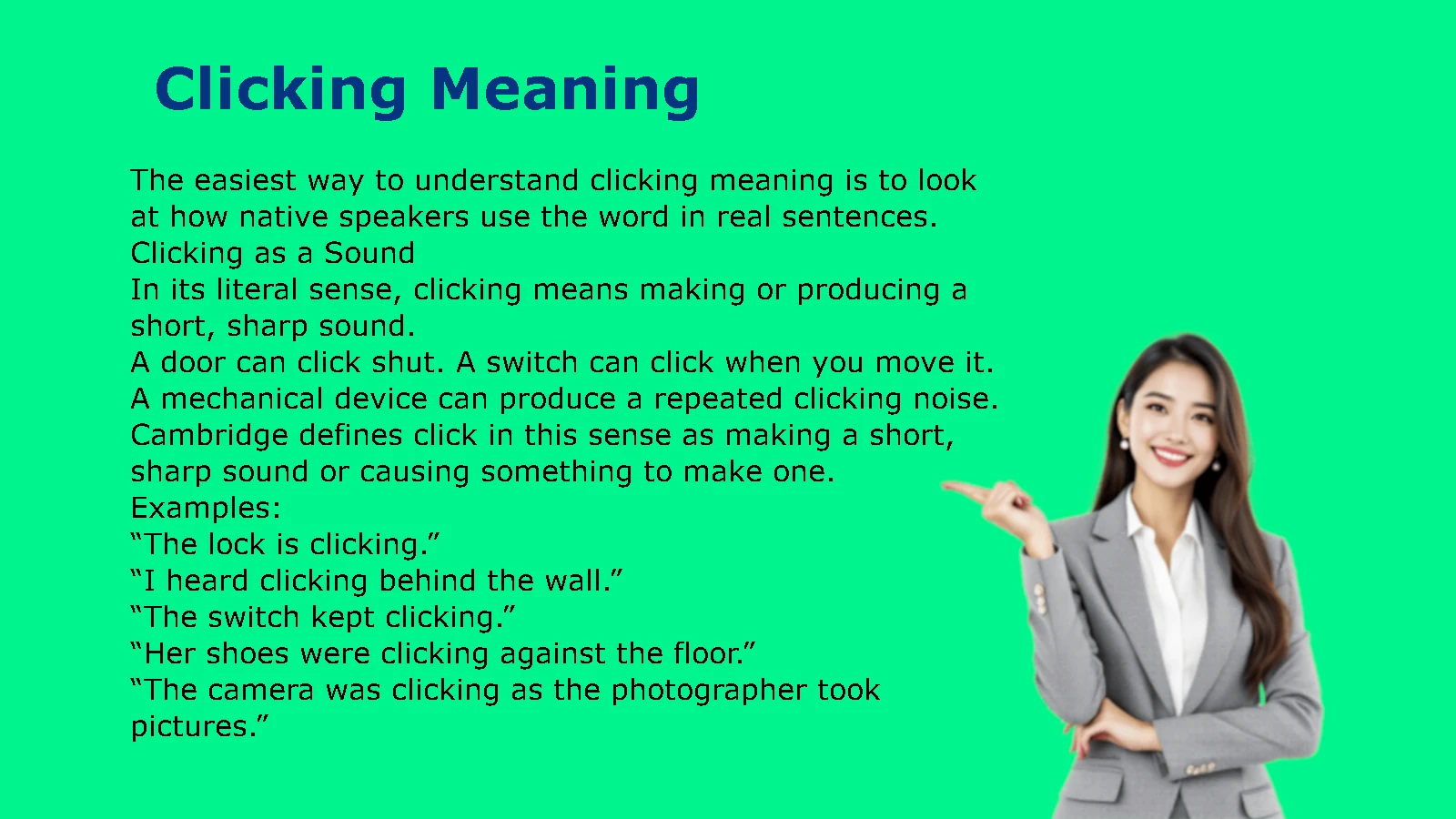
The easiest way to understand clicking meaning is to look at how native speakers use the word in real sentences.
Clicking as a Sound
In its literal sense, clicking means making or producing a short, sharp sound.
A door can click shut. A switch can click when you move it. A mechanical device can produce a repeated clicking noise.
Cambridge defines click in this sense as making a short, sharp sound or causing something to make one.
Examples:
- “The lock is clicking.”
- “I heard clicking behind the wall.”
- “The switch kept clicking.”
- “Her shoes were clicking against the floor.”
- “The camera was clicking as the photographer took pictures.”
Here, clicking has nothing to do with computers or relationships. It describes a sound.
The noun click can also refer to the sound itself. Merriam Webster defines it as “a slight sharp noise.”
Clicking on a Computer
Technology gave clicking one of its most familiar modern meanings.
When you click something on a computer, you press a mouse button or another control to perform an operation. Cambridge describes this as carrying out a computer operation by pressing a button on a mouse or keyboard.
You might click:
- A link
- A button
- An icon
- A menu
- A checkbox
- A file
- A tab
- A text field
- A notification
Examples:
“Click the blue button to continue.”
“She is clicking through the menu.”
“Try clicking the link again.”
“I accidentally clicked the wrong icon.”
The expression click on is also common.
For example:
“Click on the image to enlarge it.”
In everyday computer instructions, click and click on can both appear. The exact construction varies by context and dialect, but the basic action remains the same: you use a mouse or similar control to select or activate something.
Clicking With Someone
One of the most interesting figurative meanings appears in the phrase clicking with someone.
If two people click, they naturally like, understand, or connect with each other. Cambridge describes click with someone as liking and understanding someone, particularly when meeting for the first time, or working well together.
So if someone says:
“We really clicked.”
they usually mean:
“We connected naturally and felt comfortable with each other.”
It doesn’t automatically mean romantic attraction.
Two coworkers can click. Two friends can click. A teacher and student can click. Two people on a first date can click.
Examples:
- “We clicked as soon as we met.”
- “She really clicked with her new coworkers.”
- “They didn’t click at first.”
- “I clicked with my roommate almost immediately.”
- “The two actors clicked on screen.”
The phrase often suggests that the connection felt easy rather than forced.
That’s an important distinction. You can get along with someone without feeling that you click with them. Getting along may simply mean you have a pleasant relationship. Clicking suggests a stronger sense of natural compatibility.
What Does “Clicking With Someone” Mean?
Clicking with someone means having a natural connection with that person.
You may share a similar sense of humor, communicate easily, understand each other’s personalities, or simply feel comfortable together. The connection can happen quickly, although the phrase doesn’t require an instant friendship.
Cambridge’s examples include people who click when they first meet, as well as people or messages that become successful with an audience.
Does “Clicking” Mean Romantic Chemistry?
Not necessarily.
Romantic chemistry can be one form of clicking, but the phrase itself is broader.
| Situation | “We clicked” can mean |
| First date | We felt natural chemistry |
| New friendship | We connected easily |
| Workplace | We communicated and worked well together |
| School | We understood each other easily |
| Team project | We worked together naturally |
For example:
“I clicked with my new manager.”
This doesn’t imply romance. It means the two people understood each other or worked well together.
Likewise:
“The new teacher really clicks with her students.”
That describes a successful interpersonal connection.
What Does “It Finally Clicked” Mean?
When someone says “it finally clicked,” they mean that something suddenly became clear or understandable.
This is a figurative use of click. Cambridge gives examples where something suddenly becomes understood, while Merriam Webster also lists the sense of fitting together or functioning successfully.
Imagine trying to solve a puzzle for twenty minutes. You understand every individual piece, but you can’t see the whole picture. Then suddenly, one detail changes everything.
It clicks.
You might say:
- “It finally clicked.”
- “The math problem finally clicked.”
- “Then everything clicked.”
- “I couldn’t understand it before, but now it’s clicking.”
- “Her explanation made the whole thing click.”
Why Do People Say “Click”?
The metaphor makes intuitive sense. Separate pieces can click together physically. English extends that physical idea to thoughts and relationships.
When an idea “clicks,” the pieces seem to fit.
That gives the expression a useful emotional difference from simply saying “I understood.”
Compare:
“I understood the explanation.”
This states a fact.
“The explanation finally clicked.”
This emphasizes the moment of realization.
The second sentence often feels more vivid because it suggests a sudden mental connection.
What Does “Everything Is Clicking” Mean?
“Everything is clicking” usually means that things are working smoothly, falling into place, or progressing successfully.
Merriam Webster lists function smoothly and succeed among the meanings of click.
For example:
“The team is clicking this season.”
This means the players are working together effectively.
Or:
“Everything is clicking at work right now.”
That suggests the different parts of the job are working well together.
You might hear this expression in:
- Sports
- Business
- Music
- Entertainment
- Team projects
- Creative work
- Everyday conversation
Examples of “Everything Is Clicking”
Sports:
“The offense is clicking tonight.”
The players are coordinating effectively and producing good results.
Work:
“Once we hired another designer, the project started clicking.”
The workflow became smoother.
Creative work:
“The characters are finally clicking.”
The writer may mean that the characters now feel natural together or that the story is coming together.
The expression therefore combines two ideas: coordination and success.
Clicking Into Place Meaning
The phrase “click into place” describes something becoming clear, fitting together, or making sense.
Cambridge specifically recognizes click into place as an expression used when everything becomes clear or fits together.
Examples:
- “Once I learned the final detail, everything clicked into place.”
- “The clues slowly clicked into place.”
- “After she explained the timeline, the story clicked into place.”
- “The pieces of the plan are finally clicking into place.”
This phrase is especially useful when several separate facts suddenly form one understandable picture.
“Click” vs. “Click Into Place”
There is a small difference.
“It clicked” focuses on understanding or realization.
“It clicked into place” emphasizes how separate pieces fit together.
For example:
“I finally understood the problem.”
could become:
“The problem finally clicked.”
But if several facts connect:
“All the clues clicked into place.”
The second version paints a clearer picture of different pieces forming one whole.
Clicking Meaning When Something Works Well
English also uses click to describe successful performance.
Merriam Webster includes “to function smoothly” and “succeed” among its intransitive meanings of click.
That is why you may hear:
- “The team is clicking.”
- “The business is clicking.”
- “The show is clicking with audiences.”
- “The system is finally clicking.”
- “The offense is clicking.”
This usage is related to clicking with someone, but the meaning isn’t exactly the same.
When people click with each other, they connect.
When a team or project is clicking, its parts work together effectively.
Cambridge also uses click with for situations where something works well with an audience.
Clicking With Someone vs. Getting Along
These expressions overlap, but they aren’t identical.
| Expression | Main idea | Example |
| Click with someone | Natural connection or compatibility | “We clicked immediately.” |
| Get along with someone | Have a friendly or workable relationship | “We get along well.” |
| Hit it off | Connect quickly and enthusiastically | “They hit it off at dinner.” |
| Bond with someone | Develop a meaningful connection | “They bonded over music.” |
| Connect with someone | Establish understanding or rapport | “I connected with her right away.” |
Clicking often has a sense of effortless compatibility.
For instance, two coworkers might get along because they’re polite and professional. If they click, their communication may feel especially natural.
That’s why someone might say:
“She’s nice, but we don’t really click.”
The speaker isn’t necessarily criticizing the other person. They’re saying the natural connection isn’t there.
Clicking vs. Clicked vs. Click
Understanding the grammar makes the clicking meaning much easier to recognize.
| Word | Grammatical role | Example |
| Click | Base form | “Click the button.” |
| Clicks | Present tense, third person | “He clicks the link.” |
| Clicked | Past tense/past participle | “She clicked the icon.” |
| Clicking | Present participle/gerund | “She is clicking the icon.” |
Cambridge identifies clicking directly as the present participle of click.
Clicking as a Present Participle
In:
“She is clicking the button.”
clicking forms part of the present progressive verb phrase is clicking.
The action is presented as ongoing.
Clicking as a Gerund
In:
“Clicking the link opened the page.”
clicking functions as a noun-like form.
The activity itself is the subject of the sentence.
This distinction matters when you’re studying English grammar, but everyday readers usually understand the meaning from context without thinking about the grammatical label.
Common Phrases With Clicking
Several expressions use clicking or the related verb click in established ways.
“Clicking on Something”
This means selecting something on a computer or digital interface.
“Click on the file to open it.”
“Clicking a Button”
This means pressing a button with a mouse or similar control.
“Clicking the button will submit the form.”
“Clicking With Someone”
This means connecting naturally with another person.
“I really clicked with my new coworker.”
“It Finally Clicked”
This means something finally became clear.
“After three examples, it finally clicked.”
“Everything Is Clicking”
This means things are working smoothly or successfully.
“The team is clicking now.”
“Clicking Into Place”
This means separate pieces are becoming clear or fitting together.
“The final clue made everything click into place.”
These phrases cover the major everyday uses without forcing unrelated slang meanings onto the word.
Clicking Meaning in Texting and Casual Conversation
In texting, clicking doesn’t suddenly acquire one completely separate definition. Instead, people usually use the same established meanings in shorter, more informal sentences.
For example:
“We clicked lol.”
This usually means the people connected easily.
“Omg it finally clicked.”
This means the person suddenly understood something.
“Everything’s clicking now.”
This means a situation is starting to make sense or work smoothly.
The surrounding words matter more than the communication platform.
A text message, social media post, conversation, or email can all use clicking in essentially the same ways.
Is “Clicking” Slang?
Clicking can appear in informal speech, but that doesn’t make every use slang.
The interpersonal sense of click with someone is explicitly marked informal by Cambridge.
The computer meaning, however, is standard vocabulary.
Likewise, describing a sound as clicking is ordinary English.
So it’s better to identify the specific usage rather than label the entire word as slang.
Case Study: How Context Changes the Clicking Meaning
Consider the following five sentences:
“I hear clicking.”
This describes a sound.
“I’m clicking the link.”
This describes computer activity.
“The lesson is clicking now.”
This suggests the lesson is becoming understandable.
“I’m clicking with my new classmates.”
This describes social connection.
“The team is clicking.”
This describes smooth coordination or successful performance.
Notice what happened. The word itself barely changed. The context changed the meaning.
That’s one of the most useful lessons for English learners: don’t translate a word in isolation when it has several established senses. Look at the words surrounding it.
Real Usage Facts About the Word “Click”
The word click has a long history in English.
Merriam Webster gives the first known use of the verb click as the 15th century and the noun as 1611. Its etymology is described as probably imitative, meaning the word may have developed in connection with the sound it represents.
That history helps explain the word’s later meanings.
The physical sense comes naturally from a sharp sound. From there, English developed figurative meanings involving things fitting together, connecting, and working successfully.
The modern computer sense developed from the physical act of pressing a control that produces a click.
So the meanings aren’t as random as they first appear.
They share a common idea:
Something happens with a distinct, successful connection.
A mechanism clicks into position. A mouse clicks a button. An idea clicks in your mind. Two people click socially. A team clicks as a unit.
That underlying image gives the word remarkable flexibility.
Examples of Clicking in Sentences
Clicking Meaning: Sound
- “The clock is clicking loudly.”
- “I heard a clicking noise from the engine.”
- “The door was clicking as the wind moved it.”
- “Her heels were clicking across the floor.”
- “The switch started clicking.”
Clicking Meaning: Technology
- “I’m clicking the link now.”
- “Try clicking the icon.”
- “She was clicking through the settings.”
- “Clicking the image opens a larger version.”
- “He accidentally clicked the wrong button.”
Understanding
- “The concept is finally clicking.”
- “After another example, it clicked.”
- “Everything clicked once she explained the timeline.”
- “The answer suddenly clicked.”
- “It took me a while, but now it’s clicking.”
Relationships
- “We clicked immediately.”
- “She clicked with everyone at the party.”
- “They clicked the first time they met.”
- “I don’t think we really clicked.”
- “The two coworkers seem to click.”
Clicking Meaning: Successful Performance
- “The team is clicking.”
- “The offense is clicking tonight.”
- “The new system is finally clicking.”
- “The project started clicking after we changed the workflow.”
- “The show clicked with its audience.”
What Is the Difference Between “Clicking” and “Connecting”?
Clicking and connecting can mean similar things when you talk about people, but clicking often sounds more immediate and natural.
Compare:
“I connected with her.”
This can describe a meaningful emotional or intellectual connection.
“I clicked with her.”
This often suggests that the interaction felt easy and natural.
Neither expression guarantees a deep relationship.
Someone can click with you during a first conversation without becoming your lifelong friend. Likewise, you can gradually build a strong connection with someone even if you don’t click immediately.
What Is the Difference Between “Clicking” and “Hitting It Off”?
Hitting it off and clicking are close in meaning when discussing people.
“We clicked.”
“We hit it off.”
Both can mean that two people connected well.
However, hit it off often emphasizes a successful first meeting or quick start to a relationship. Click can describe both an immediate connection and an ongoing sense of compatibility.
For example:
“We clicked when we met and have been friends ever since.”
The phrase works naturally even after the first meeting has passed.
What Does “Not Clicking” Mean?
Not clicking means that something isn’t connecting, making sense, or working smoothly.
The intended meaning depends on context.
With People
“We aren’t clicking.”
This means the people don’t feel naturally compatible or connected.
With Ideas
“This chapter isn’t clicking for me.”
This means the person doesn’t understand it yet.
With Performance
“The team isn’t clicking.”
This means the players aren’t coordinating effectively.
With Technology
“I’m clicking the button, but nothing happens.”
Here, clicking has the literal computer meaning. The problem isn’t social or intellectual. The button simply isn’t responding.
A Quick Guide to the Clicking Meaning
When you see clicking, ask what comes immediately before or after it.
| If you see… | The likely meaning is… |
| Clicking noise | A sound |
| Clicking the button | Computer interaction |
| Clicking with someone | Personal connection |
| Clicking for me | Becoming understandable or working well |
| Everything is clicking | Things are working smoothly |
| Clicking into place | Pieces are fitting together or becoming clear |
This simple method can help English learners understand the word without memorizing a long list of definitions.
Frequently Asked Questions About Clicking Meaning
What does clicking mean in English?
Clicking is the present participle of click. Depending on context, it can mean making a short sound, using a computer control, connecting with someone, suddenly understanding something, or working successfully.
What does clicking with someone mean?
Clicking with someone means liking, understanding, or connecting naturally with that person. It can describe friendships, work relationships, dating, or other social situations. Cambridge classifies this usage as informal.
What does “it finally clicked” mean?
“It finally clicked” means that something suddenly became clear or understandable.
Example:
“I struggled with the formula all morning, but then it finally clicked.”
What does “everything is clicking” mean?
It means that things are working smoothly, fitting together, or progressing successfully.
Example:
“The team is playing with confidence, and everything is clicking.”
Merriam Webster includes function smoothly and succeed among the meanings of click.
What does clicking mean on a computer?
On a computer, clicking means pressing a mouse button or another interface control to select or activate something. Cambridge lists this as one of the standard meanings of click.
Is clicking the same as understanding?
Not always.
When clicking describes an idea, it can mean becoming understood or suddenly becoming clear.
“The explanation finally clicked.”
But clicking can also describe a sound, computer action, relationship, or successful performance.
Does clicking with someone mean you like them?
Usually, yes, in the sense that you like or understand each other and interact naturally. However, it doesn’t necessarily mean romantic attraction.
What does “click into place” mean?
Click into place means that separate facts, ideas, or pieces suddenly fit together or become clear.
“Once I saw the missing detail, everything clicked into place.”
Is clicking a verb?
Clicking is the present participle of the verb click. It can appear in progressive verb forms such as “is clicking”, and it can also function as a gerund in sentences such as “Clicking the link opened the page.”
What is another word for clicking with someone?
Depending on the situation, alternatives include:
- Connecting
- Bonding
- Getting along
- Hitting it off
- Relating
- Feeling comfortable with someone
The best choice depends on the exact meaning. Clicking usually carries the idea of a natural or easy connection.
Final Takeaway: Clicking Meaning Explained Simply
The clicking meaning isn’t limited to one definition. It changes according to context.
At its most literal, clicking describes a short, sharp sound. In technology, it describes pressing a mouse or interface button. In conversation, clicking with someone means developing a natural connection. When an idea clicks, it suddenly becomes clear. When a team or project is clicking, its parts are working smoothly together.
The easiest way to remember the word is to think about things coming together.
A button clicks.
An idea clicks.
People click.
A plan clicks into place.