
Have you ever wondered about the Weaved Meaning and whether weaved is actually a correct word? You’re not alone. Many people confuse weaved vs woven, wonder when to use weaved, or aren’t sure if it’s an accepted past tense of weave.
The confusion comes from the fact that weaved and woven are both used in English, but in different contexts. Here’s the good news: once you understand the difference, choosing the correct word becomes much easier.
In this guide, you’ll discover the weaved meaning, learn the weaved definition, understand weaved vs woven, explore when to use weaved, see weaved examples, learn how to pronounce weaved, and find weaved in a sentence so you can use the word confidently in everyday writing.
What Is the Weaved Meaning?
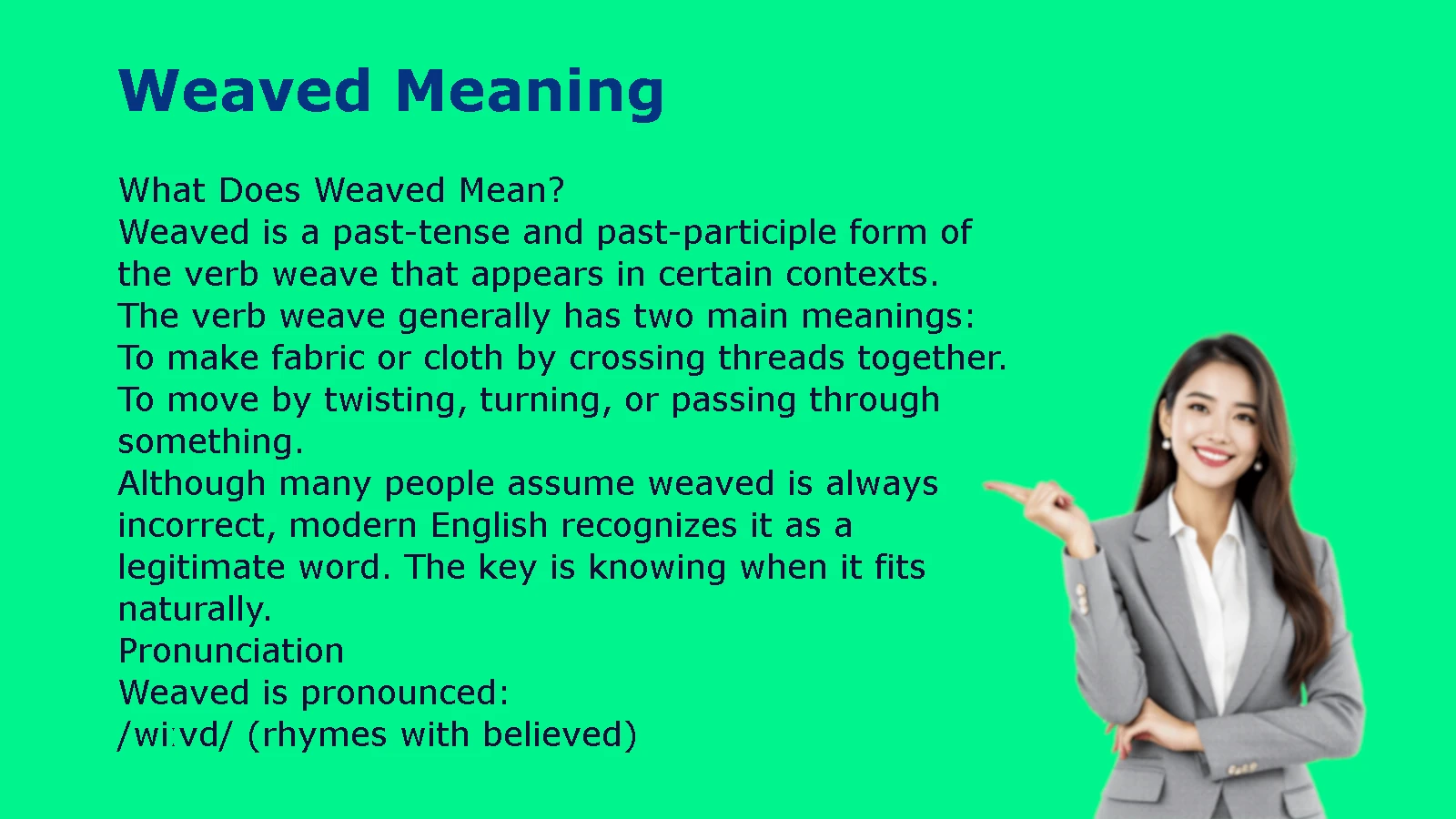
Weaved is the past tense of weave in certain contexts, especially when describing movement through obstacles, traffic, or crowds. However, woven is the more common past participle of weave when referring to fabric, baskets, or anything created by weaving.
Examples
- The cyclist weaved through traffic.
- The basket was woven by hand.
Pronunciation
Weaved is pronounced:
/wiːvd/ (rhymes with believed)
Part of Speech
| Word | Part of Speech |
| Weaved | Verb (past tense or past participle in some contexts) |
Simple Definition
Weaved means:
- Moved in a winding or zigzag path
- Passed between objects by changing direction repeatedly
- Interlaced or combined things together in certain specialized contexts
Example Sentences
- The cyclist weaved through heavy traffic.
- She weaved around the construction barriers.
- The skier weaved between the trees.
Notice that these examples describe movement, not creating fabric.
Is Weaved a Real Word?
Yes. Weaved is absolutely a real word.
One reason people question it is because weave is traditionally an irregular verb. English irregular verbs don’t always follow the simple -ed pattern.
For example:
| Base Verb | Past Tense | Past Participle |
| Write | Wrote | Written |
| Drive | Drove | Driven |
| Break | Broke | Broken |
| Weave | Wove | Woven |
Since wove and woven are the traditional forms, many people assume weaved must be wrong. That’s only partly true.
Today, major dictionaries recognize weaved, particularly when referring to movement or in certain technical fields. However, wove remains the preferred choice for traditional weaving.
Why the Confusion Exists
English has changed over hundreds of years. Many irregular verbs gradually become regular in everyday speech.
For example:
- Dreamed and dreamt
- Learned and learnt
- Burned and burnt
Both versions exist, although one may be more common depending on region and style.
Something similar has happened with weaved.
Weaved vs. Wove: What’s the Difference?
This is where most confusion begins.
Although both words come from the same verb, they aren’t always interchangeable.
| Feature | Weaved | Wove |
| Traditional past tense | Rare | Yes |
| Movement through objects | Commonly used | Also accepted |
| Making cloth or fabric | Usually avoided | Preferred |
| Formal writing | Less common | Preferred |
| Everyday speech | Fairly common | Very common |
The easiest way to remember the difference is to think about what is happening.
Use wove when someone creates something by interlacing materials.
Examples:
- She wove a beautiful basket.
- My grandmother wove blankets by hand.
- They wove colorful rugs for the market.
These sentences describe the traditional act of weaving.
Use weaved when describing movement.
Examples:
- The motorcycle weaved through traffic.
- The runner weaved between defenders.
- The boat weaved around floating rocks.
While some editors still prefer wove even for movement, weaved has become common enough that many dictionaries accept it in these situations.
Why Does English Have Both Weaved and Wove?
English didn’t become one fixed language overnight. It developed through centuries of influence from Germanic languages, French, Latin, and many others.
Some verbs kept their irregular forms.
Others gradually adopted regular endings.
The verb weave sits somewhere in the middle.
Traditional grammar favors:
- weave
- wove
- woven
Modern everyday English sometimes uses:
- weave
- weaved
- weaved
This change reflects how people naturally speak rather than a sudden rule change.
Understanding the Verb “Weave”
Before deciding between weaved and wove, it helps to understand what the verb itself means.
The verb has two primary meanings.
To Interlace Threads
This is the original meaning.
A person crosses threads over and under one another to create cloth, baskets, rugs, or other woven materials.
Examples include:
- weaving silk
- weaving cotton
- weaving baskets
- weaving carpets
Example:
The artisan wove a traditional blanket using natural wool.
To Move in a Curving Path
Over time, English speakers began using weave metaphorically.
Instead of threads crossing each other, a person or object moves back and forth through obstacles.
Imagine a snake moving across the ground.
Or a football player dodging defenders.
That repeated side-to-side movement inspired the second meaning.
Example:
The driver weaved through stalled traffic.
When to Use Weaved
Although wove remains the standard past tense in many grammar books, weaved appears frequently when discussing movement.
Let’s look at the most common situations.
Weaved Through Traffic
One of the most common phrases is:
weaved through traffic
It describes changing direction repeatedly to avoid vehicles.
Examples
- The taxi weaved through downtown traffic to reach the airport.
- The cyclist weaved between slow-moving cars.
- The ambulance weaved carefully around stopped vehicles.
Why It Works
The focus isn’t on creating fabric.
Instead, it’s about moving in a winding pattern.
Weaved Through a Crowd
People also use weaved when someone moves through a group of people.
Examples
- She weaved through the concert crowd.
- Tourists weaved between market stalls.
- The waiter weaved through busy tables carrying drinks.
The movement changes direction several times, making weaved feel natural.
Weaved Around Obstacles
Another common use involves avoiding objects.
Examples include:
- trees
- rocks
- cones
- furniture
- barriers
Example Sentences
- The skier weaved around the trees.
- The robot weaved between obstacles during testing.
- The child weaved around puddles after the rain.
Weaved In and Out
You’ll often hear the phrase:
weaved in and out
It describes continuous side-to-side movement.
Examples:
- The puppy weaved in and out of people’s legs.
- The race car weaved in and out of traffic.
- The kayak weaved in and out of narrow channels.
This expression appears frequently in news articles, sports reporting, and everyday conversation.
Weaved Through Defensive Players
Sports commentators often describe athletes this way.
Examples:
- The running back weaved through defenders.
- The soccer player weaved past three opponents.
- The basketball guard weaved into the paint before scoring.
The image is vivid because the athlete changes direction rapidly.
Weaved Along Mountain Roads
Roads rarely travel in straight lines.
That’s why travel writers often use weaved.
Examples:
- The highway weaved through the mountains.
- Our hiking trail weaved along the riverbank.
- The narrow road weaved through the forest.
Common Expressions Using Weaved
Many English expressions naturally pair with weaved.
| Expression | Meaning |
| Weaved through traffic | Moved between vehicles |
| Weaved through the crowd | Moved between people |
| Weaved around obstacles | Avoided objects while moving |
| Weaved in and out | Changed direction repeatedly |
| Weaved past defenders | Moved around opponents |
| Weaved along the road | Followed a winding route |
These expressions appear regularly in newspapers, sports coverage, novels, and spoken English.
When to Use Wove
If weaved usually describes movement, wove remains the standard choice when talking about the traditional act of weaving materials together.
In formal writing, academic work, and most dictionaries, wove is the preferred past tense of weave when someone creates fabric, baskets, rugs, or other woven items.
Wove Fabric
This is the most common use of wove.
It refers to making cloth by interlacing threads over and under each other.
Examples
- The factory wove thousands of yards of cotton every week.
- She wove colorful scarves from soft wool.
- Skilled workers wove silk into elegant fabrics.
In each example, the subject creates a physical textile rather than moving through space.
Wove a Basket
Basket weaving is one of the oldest crafts in the world. Since the action involves intertwining natural materials, wove is the correct past-tense form.
Examples
- The artisan wove a basket from willow branches.
- My grandfather wove fishing baskets by hand.
- They wove decorative baskets for the local market.
This usage has remained consistent in English for centuries.
Wove a Rug or Carpet
Textiles such as rugs, carpets, and tapestries also use wove.
Examples
- The family wove rugs using traditional techniques.
- Craftspeople wove intricate patterns into the carpet.
- The workshop wove custom tapestries for museums.
Because these examples describe producing woven goods, wove is the standard choice.
Wove a Story or Narrative
English often uses weave figuratively to describe combining ideas, details, or themes into a story.
Although no physical threads exist, the image of interlacing elements still applies.
Examples
- The novelist wove history and fiction into one compelling tale.
- She wove humor into her speech.
- The documentary wove interviews, photographs, and archival footage together.
This figurative meaning is well established in both formal and creative writing.
Quick Reference Table
| Situation | Preferred Form |
| Making cloth | Wove |
| Weaving baskets | Wove |
| Creating rugs or carpets | Wove |
| Combining ideas into a story | Wove |
| Moving through traffic | Weaved (commonly accepted) or Wove (preferred by some editors) |
| Moving around obstacles | Weaved (commonly accepted) |
The key takeaway is simple: wove remains the standard past tense for traditional weaving, while weaved has become common when describing movement in modern English.
Why Do People Say “Weaved” Instead of “Wove”?
If wove is the traditional past tense of weave, why do so many people say weaved?
The answer lies in how English naturally evolves. Languages change as people speak them, and common usage often influences grammar over time. In everyday conversation, many speakers instinctively add -ed to verbs because that’s the standard pattern for most English verbs.
For example:
- Walk → Walked
- Jump → Jumped
- Paint → Painted
- Weave → Weaved (by analogy)
Although weave is an irregular verb, the regular form weaved feels more intuitive to many speakers.
The Influence of Regular Verbs
English contains hundreds of regular verbs but far fewer irregular ones. Because of this, people often apply the regular -ed ending to verbs they don’t use frequently.
This process is called regularization, and it has shaped English for centuries.
Examples
| Traditional Form | Regular Alternative |
| Dreamt | Dreamed |
| Burnt | Burned |
| Learnt | Learned |
| Spoilt | Spoiled |
In some cases, both versions became acceptable. With weave, the traditional forms wove and woven remain standard, but weaved has gained acceptance in certain contexts.
Everyday Speech
Most people don’t stop to think about verb conjugation while talking. They choose the form that sounds natural.
That’s why you’ll often hear sentences such as:
- The car weaved through traffic.
- She weaved around pedestrians.
- The runner weaved between defenders.
These expressions appear frequently in conversation, journalism, and sports commentary.
Regional Preferences
American English and British English generally agree that wove is the standard past tense. However, spoken language varies by region, and weaved appears more often in informal speech than in carefully edited writing.
Specialized Industries
Some industries also use weaved as the preferred form.
For example:
- Hair extensions
- Wire mesh manufacturing
- Fence construction
- Textile machinery
In technical writing, weaved may describe specific manufacturing processes or product types.
Is “Weaved” Grammatically Correct?
Yes, weaved is grammatically correct—but context matters.
Many people assume grammar works in black and white. In reality, English contains many words that are acceptable in some situations but not others.
Short Answer
- Yes, weaved is a real English word.
- Wove remains the preferred past tense for traditional weaving.
- Weaved commonly appears when describing movement and in technical fields.
Formal Writing
If you’re writing:
- academic papers
- business reports
- books
- professional articles
using wove for the past tense and woven for the past participle is usually the safest choice.
Example:
She wove a beautiful tapestry.
This version follows standard grammar conventions.
Informal Writing
In blogs, news stories, sports reporting, and everyday conversation, weaved often sounds perfectly natural.
Example:
The motorcycle weaved through heavy traffic.
Many readers won’t question this usage because it reflects common speech.
Should You Avoid Weaved?
Not necessarily.
Instead, ask yourself one question:
What does the sentence describe?
If you’re describing movement, weaved is widely understood and increasingly accepted.
If you’re describing creating woven materials, choose wove.
Examples of “Weaved” in Sentences
Seeing a word in context is the easiest way to remember how it works.
Driving
- The driver weaved through rush-hour traffic.
- A motorcycle weaved between slow-moving cars.
- The taxi weaved around construction zones.
Sports
- The striker weaved past four defenders before scoring.
- The skier weaved between the gates.
- The cyclist weaved around fallen riders.
Running
- She weaved through the crowded sidewalk.
- The marathon runner weaved around slower participants.
- The child weaved between playground equipment.
Nature
- The river weaved through the valley.
- The hiking trail weaved around ancient trees.
- The snake weaved across the sand.
Everyday Conversation
- He weaved through the grocery store looking for his family.
- We weaved between tables to reach the exit.
- The dog weaved through everyone’s legs.
Examples of “Wove” in Sentences
Now compare those with examples that require wove.
Textile Production
- She wove a silk scarf.
- They wove cotton into durable fabric.
- The workers wove blankets by hand.
Basket Making
- The craftsperson wove a basket from reeds.
- He wove decorative baskets for local festivals.
- They wove storage baskets from bamboo.
Storytelling
- The author wove mystery into every chapter.
- She wove personal experiences into the speech.
- The filmmaker wove interviews throughout the documentary.
Literature
- The poet wove vivid imagery into every verse.
- The novelist wove several storylines together.
- The historian wove facts and eyewitness accounts into one narrative.
Common Mistakes People Make
Even experienced writers occasionally mix up weaved, wove, and woven.
Here are the mistakes to avoid.
Using “Weaved” for Traditional Weaving
❌ She weaved a sweater.
✅ She wove a sweater.
The action involves creating fabric, so wove is correct.
Confusing the Past Tense With the Past Participle
Many learners write:
❌ The basket was wove yesterday.
Correct version:
✅ The basket was woven yesterday.
Remember:
| Form | Example |
| Base | Weave |
| Past Tense | Wove |
| Past Participle | Woven |
Assuming “Weaved” Is Always Wrong
This misconception is surprisingly common.
Sentence:
The cyclist weaved through traffic.
This is acceptable in modern English and appears frequently in newspapers and everyday writing.
Mixing Literal and Figurative Meanings
Incorrect:
She weaved a beautiful blanket.
Correct:
She wove a beautiful blanket.
However:
She weaved through the crowd.
Context changes everything.
Weaved, Wove, or Woven?
The easiest way to avoid mistakes is to know the role each word plays.
| Word | Grammar Role | Example |
| Weave | Base verb | They weave baskets every summer. |
| Wove | Standard past tense | She wove a blanket yesterday. |
| Woven | Standard past participle | The blanket was woven by hand. |
| Weaved | Accepted in certain contexts | The cyclist weaved through traffic. |
A Simple Trick to Remember
Think of these questions:
Did someone create fabric?
Use wove.
Was something already created?
Use woven.
Did someone move in a zigzag path?
Weaved is commonly accepted, although some editors still prefer wove.
Synonyms of “Weaved”
The best synonym depends on the meaning of weave.
For Movement
| Synonym | Best Used For |
| Zigzagged | Sharp side-to-side movement |
| Threaded | Moving carefully through narrow spaces |
| Wound | Following a curving route |
| Twisted | Turning repeatedly |
| Curved | Gentle bends |
| Maneuvered | Controlled movement |
| Navigated | Finding a route |
| Dodged | Avoiding obstacles |
Examples
Instead of:
The car weaved through traffic.
You could write:
- The car threaded through traffic.
- The car maneuvered through traffic.
- The car zigzagged through traffic.
Each creates a slightly different image.
For Textile Weaving
When discussing fabrics or baskets, these words fit better.
- Interlaced
- Intertwined
- Braided
- Entwined
- Knitted (only when knitting is actually meant)
- Bound together
Example:
The artisan interlaced colorful fibers into a decorative basket.
Related Grammar Terms
Understanding a few grammar concepts makes weaved, wove, and woven much easier to remember.
Irregular Verbs
Irregular verbs don’t simply add -ed.
Examples include:
| Base | Past | Past Participle |
| Go | Went | Gone |
| Speak | Spoke | Spoken |
| Break | Broke | Broken |
| Write | Wrote | Written |
| Weave | Wove | Woven |
Regular Verbs
Regular verbs follow a predictable pattern.
Examples:
- Walk → Walked
- Watch → Watched
- Open → Opened
- Clean → Cleaned
Because English contains many regular verbs, people sometimes mistakenly form weaved instead of wove.
Past Tense
The past tense describes a completed action.
Example:
She wove a basket yesterday.
Past Participle
The past participle works with helping verbs like has, have, had, was, and were.
Example:
The basket was woven by hand.
Quick Comparison Chart
| Context | Correct Choice |
| Traditional weaving | Wove |
| Making fabric | Wove |
| Basket weaving | Wove |
| Rugs and carpets | Wove |
| Storytelling | Wove |
| Through traffic | Weaved (commonly accepted) |
| Around obstacles | Weaved (commonly accepted) |
| Past participle | Woven |
Frequently Asked Questions
Is “weaved” correct English?
Yes. Weaved is a real English word and is considered acceptable in certain contexts, particularly when describing movement or in some technical fields. However, wove remains the standard past tense for traditional weaving.
Is “wove” or “weaved” more common?
Wove is more common in dictionaries, grammar guides, and formal writing. Weaved appears frequently in spoken English, journalism, and descriptions of movement.
Can you say “weaved through traffic”?
Yes. Many native English speakers say “weaved through traffic.” Although some editors still prefer “wove through traffic,” both forms are widely understood.
Is “weaved” used in American English?
Yes. American English includes weaved, especially in news reports, sports writing, and everyday conversation. Formal publications still tend to favor wove when discussing traditional weaving.
Is “weaved” acceptable in formal writing?
It depends on the context. For weaving fabric, baskets, or rugs, use wove. For movement, check your organization’s style guide because some editors accept weaved, while others prefer wove.
What is the past participle of “weave”?
The standard past participle is woven.
Examples:
- The blanket was woven by hand.
- The fabric has been woven carefully.
Why do people confuse “weaved” and “wove”?
The confusion happens because English has many regular verbs ending in -ed. Since weave is irregular, many speakers naturally assume its past tense should be weaved, even though wove has long been the traditional form.
Weaved Meaning in Real-Life Contexts
Learning grammar rules is helpful, but seeing how native speakers use a word makes the lesson stick. Below are common situations where weaved, wove, and woven naturally appear.
Everyday Conversation
When people describe movement, weaved often sounds natural in casual speech.
Examples:
- She weaved through the busy airport to reach her gate.
- The child weaved between shopping carts.
- We weaved around puddles after the storm.
These examples focus on changing direction while moving.
Literature and Creative Writing
Authors usually prefer wove when describing the act of combining ideas, themes, or emotions.
Examples:
- The novelist wove suspense into every chapter.
- She wove family history throughout the memoir.
- The speaker wove humor into an emotional speech.
In these cases, wove creates the image of carefully joining different elements into a complete work.
Sports Commentary
Sports broadcasters frequently describe quick, agile movement with weaved.
Examples:
- The running back weaved through the defense for a touchdown.
- The winger weaved past two defenders before crossing the ball.
- The skier weaved through the slalom course without missing a gate.
Because the focus is movement, many commentators naturally choose weaved.
Business and Professional Writing
Professional documents usually favor the traditional forms.
Examples:
- The artisan wove high-quality textiles using traditional methods.
- The report wove customer feedback into its recommendations.
- The presentation wove research findings into a compelling narrative.
Mini Quiz: Test Your Understanding
Choose the correct word.
1. The craftsperson ______ a beautiful basket.
- Weaved
- Wove ✅
- Woven
2. The motorcycle ______ through heavy traffic.
- Weaved ✅
- Wove (also accepted by some editors)
- Woven
3. The blanket was ______ by hand.
- Weaved
- Wove
- Woven ✅
4. The author ______ several storylines together.
- Weaved
- Wove ✅
- Woven
5. The runner ______ between defenders.
- Weaved ✅
- Wove (also acceptable in some style guides)
- Woven
Memory Trick to Never Confuse Them Again
A simple way to remember the correct form is to connect each word with its purpose.
| Word | Think of… |
| Weave | The action happening now |
| Wove | Someone made something by weaving |
| Woven | The finished result |
| Weaved | Someone moved in a winding path |
Easy Formula
- Made cloth? → Wove
- Already completed? → Woven
- Moved around obstacles? → Weaved (commonly accepted)
This shortcut works for nearly every situation you’ll encounter.
Final Thoughts on Weaved Meaning
The debate over weaved versus wove continues because English isn’t a perfectly fixed language. Usage changes over time, and both dictionaries and style guides recognize that common speech often influences accepted grammar.
The safest approach is to match the word to its context. Use wove when referring to traditional weaving, woven as the past participle, and weaved when describing movement if it suits your audience or style guide.
Instead of memorizing a single rule, focus on the meaning of the sentence. Once you understand that distinction, choosing the correct form becomes much easier.
Quick Summary
| Form | Best Use | Example |
| Weave | Base verb | They weave baskets every year. |
| Wove | Standard past tense | She wove a rug. |
| Woven | Standard past participle | The rug was woven by hand. |
| Weaved | Movement and some technical contexts | The cyclist weaved through traffic. |