
What Is the Stipulate Meaning?
Stipulate means to state or demand a specific condition, requirement, or term that must be followed as part of an agreement, contract, rule, or arrangement. It is commonly used in legal, business, and formal English.
Examples:
- The contract stipulates that payment must be made within 30 days.
- The landlord stipulated that pets were not allowed in the apartment.
Understanding the stipulate meaning helps you use the word correctly in contracts, professional communication, academic writing, and everyday English.
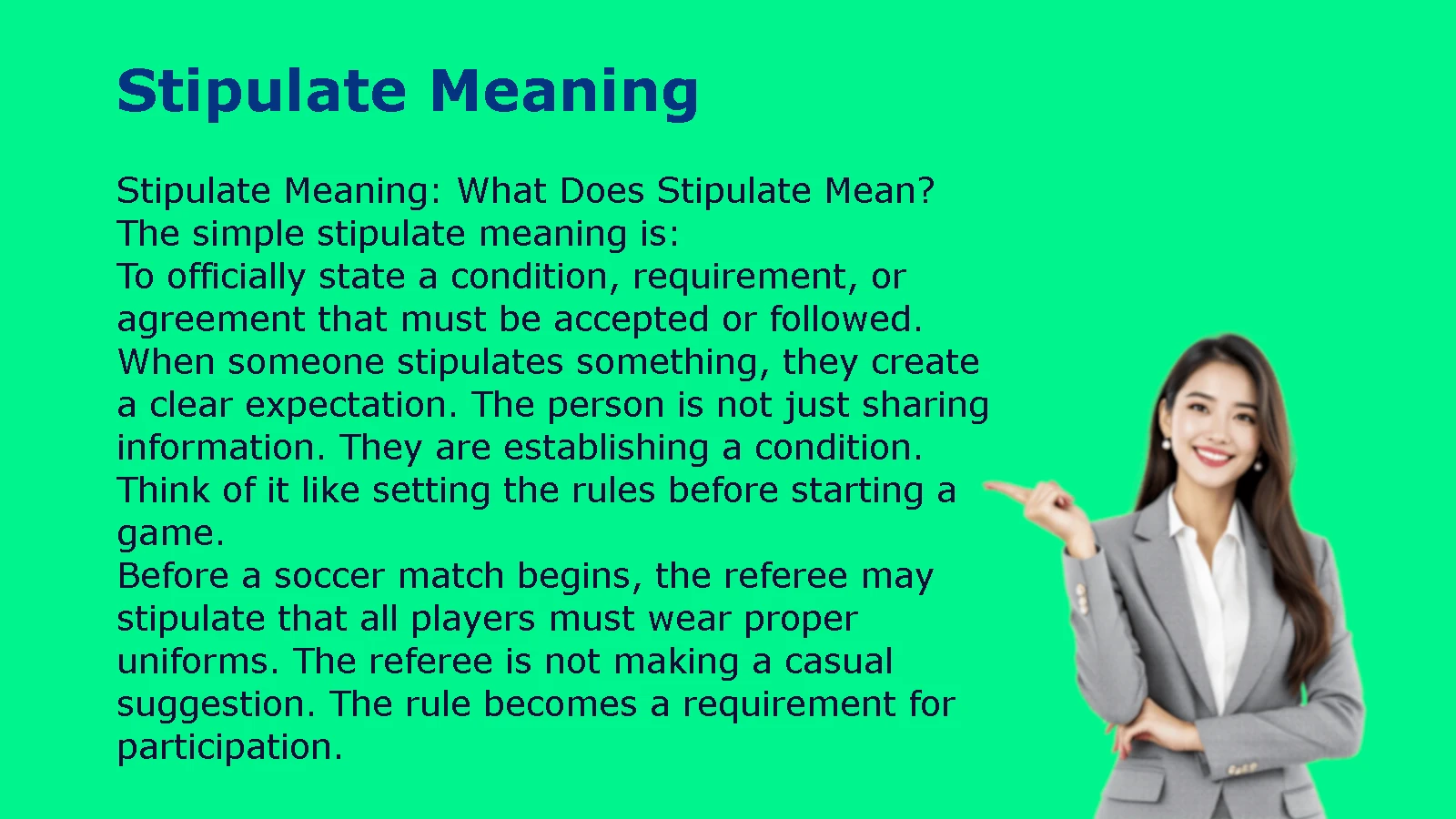
Stipulate Meaning: What Does Stipulate Mean?
The simple stipulate meaning is:
To officially state a condition, requirement, or agreement that must be accepted or followed.
When someone stipulates something, they create a clear expectation. The person is not just sharing information. They are establishing a condition.
Think of it like setting the rules before starting a game.
Before a soccer match begins, the referee may stipulate that all players must wear proper uniforms. The referee is not making a casual suggestion. The rule becomes a requirement for participation.
Simple Definition of Stipulate
| Word | Meaning |
| Stipulate | To set a specific condition or requirement |
| Stipulation | A condition or agreement that has been established |
| Stipulated | Something that was clearly required or agreed upon |
Simple Examples of Stipulate
- The school stipulated that students must submit their projects by Friday.
- The contract stipulates that payment must be completed within 30 days.
- The company stipulated several conditions before approving the partnership.
In each example, someone creates a rule or requirement.
Stipulate Definition in Different Contexts
The meaning of stipulate stays mostly the same, but its use changes depending on the situation.
Stipulate Meaning in General English
In everyday English, stipulate means to set a condition or requirement.
Although the word sounds formal, people use it whenever they describe rules or expectations.
Examples:
- “The coach stipulated that every player must attend practice.”
- “The event organizers stipulated that guests should register in advance.”
- “The recipe stipulates that the dough must rest for one hour.”
In these examples, the word shows that something is required before another action happens.
Stipulate Meaning in Legal Contexts
The legal meaning of stipulate is especially important.
In law, to stipulate means that two or more parties formally agree on a fact, condition, or term. Lawyers often use stipulations to save time and avoid unnecessary arguments.
For example, during a court case, both sides may agree that a document is authentic. Instead of proving it again in court, they create a legal stipulation.
Legal Examples:
- The two parties stipulated that the contract was valid.
- The lawyers stipulated the facts before the trial began.
- The settlement agreement stipulated payment terms.
A legal stipulation can help:
- Reduce disagreements
- Speed up court proceedings
- Clarify responsibilities
- Prevent confusion
Example Scenario:
Imagine two companies have a disagreement over a contract. Before going to court, both companies agree on certain facts:
- The contract was signed on January 15.
- Both companies received copies.
- The payment deadline was March 1.
These agreed facts become stipulations. The court does not need to spend time proving them.
Stipulate Word Origin and History
The word stipulate has a long history connected to formal agreements.
It comes from the Latin word “stipulari,” which means “to demand a formal promise or agreement.”
The word entered English through legal language and gradually expanded into business and everyday formal communication.
For centuries, agreements depended heavily on spoken promises and clearly defined conditions. Words like stipulate developed because people needed precise language to describe official commitments.
Today, the word still keeps that formal feeling.
You are more likely to see stipulate in:
- Contracts
- Court documents
- Government policies
- Business agreements
- Academic writing
You probably would not hear someone say:
“I stipulate that we should watch a movie tonight.”
That sounds too formal.
Instead, someone would say:
“I suggest we watch a movie tonight.”
The situation determines whether stipulate fits naturally.
How to Use Stipulate in a Sentence
Using stipulate correctly depends on understanding that it usually introduces a condition.
The common sentence pattern is:
Person or organization + stipulates + condition
Examples:
- The contract stipulates that employees must protect customer information.
- The teacher stipulated that homework must be completed before class.
- The agreement stipulates that both parties share responsibility.
The word often appears with “that” because it introduces the condition being established.
Examples of Stipulate in Everyday Sentences
Here are practical examples:
| Sentence | Meaning |
| The landlord stipulated that rent must be paid on time. | Paying rent is a required condition. |
| The school stipulated that uniforms are mandatory. | Uniforms are part of the rules. |
| The website stipulates that users must create an account before purchasing. | Creating an account is required. |
Examples of Stipulate in Business Writing
Businesses frequently use stipulate because agreements need clear terms.
Examples:
- The partnership agreement stipulates that both companies must approve major decisions.
- The employee contract stipulates confidentiality requirements.
- The insurance policy stipulates coverage limits.
In professional writing, stipulate creates clarity because it shows that a requirement is official.
Examples of Stipulate in Academic Writing
Researchers and educators also use the word.
Examples:
- The research guidelines stipulate ethical treatment of participants.
- The study stipulates specific conditions for data collection.
- The assignment instructions stipulate formatting requirements.
Academic writing uses precise words because small differences in meaning matter.
Stipulate Synonyms and Similar Words
Understanding stipulate meaning becomes easier when you compare it with similar words. Many English words describe rules, conditions, or statements, but they do not always work in the same situations.
A good writer chooses words based on the exact idea they want to express. While stipulate suggests a formal condition or requirement, other words may simply describe information, requests, or instructions.
Here are some common alternatives:
| Word | Meaning | How It Differs From Stipulate |
| Specify | To give exact details | Focuses on information, not necessarily a condition |
| Require | To demand something necessary | Stronger focus on necessity |
| State | To express information clearly | Does not usually involve a rule |
| Demand | To insist on something | Sounds more forceful |
| Establish | To create a rule or standard | Focuses on creating something official |
| Dictate | To impose instructions | Can sound controlling |
| Set | To create a limit or condition | More casual than stipulate |
Stipulate vs Require
Many people think stipulate and require mean exactly the same thing. They are close, but there is a small difference.
Require focuses on something that must happen.
Stipulate focuses on the condition that someone officially sets.
Examples:
Require:
“The company requires employees to wear identification badges.”
This simply means wearing a badge is necessary.
Stipulate:
“The employment contract stipulates that employees must wear identification badges.”
This shows that the requirement appears as an official term in an agreement.
A simple way to remember the difference:
- Require = Something is necessary
- Stipulate = Someone officially sets that requirement
Stipulate vs Specify: What Is the Difference?
The difference between stipulate and specify causes confusion because both words involve clarity.
However, they serve different purposes.
Specify means to provide exact details.
Stipulate means to establish a condition.
Comparison Table
| Stipulate | Specify |
| Creates a condition or requirement | Provides details or information |
| Often appears in agreements | Often appears in instructions |
| Has a formal tone | Can be formal or casual |
| Usually involves expectations | Usually involves explanation |
Examples:
Stipulate:
“The contract stipulates that the buyer must pay within 60 days.”
The contract creates a condition.
Specify:
“The contract specifies the payment amount as $5,000.”
The contract provides a detail.
Both words may appear in the same document, but they do different jobs.
Stipulate Meaning in Different Contexts
The word stipulate appears in many areas because agreements and rules exist everywhere.
Understanding the context helps you recognize why the word is being used.
Stipulate Meaning in Business
Businesses use stipulations to protect everyone involved in an agreement.
A business contract may stipulate:
- Payment deadlines
- Responsibilities
- Confidentiality rules
- Product standards
- Delivery requirements
- Quality expectations
For example:
“The supplier agreement stipulates that all products must meet safety standards.”
This means meeting safety standards is not optional. It is part of the agreement.
Why Businesses Use Stipulations
Clear conditions help companies:
- Avoid misunderstandings
- Define responsibilities
- Reduce conflicts
- Create accountability
- Protect their interests
A vague agreement can create problems later. A detailed agreement works like a roadmap because everyone knows what they agreed to.
Stipulate Meaning in Law
Law is where stipulate appears most often.
Legal professionals use the word because courts depend on clear agreements.
A legal stipulation may involve:
- Facts both sides accept
- Terms of a settlement
- Evidence agreements
- Procedural decisions
For example:
“The parties stipulated that the witness was present at the meeting.”
This means both sides agree on that fact.
The court can then focus on issues that still require discussion.
Stipulate Meaning in Rules and Regulations
Organizations often stipulate requirements to create fair systems.
Examples include:
- Schools
- Sports organizations
- Government agencies
- Professional associations
Examples:
School:
“The school handbook stipulates that students must complete community service hours before graduation.”
Sports:
“The league stipulates that players must follow safety regulations.”
Organizations:
“The membership agreement stipulates that fees must be paid annually.”
These rules create predictable expectations.
Is Stipulate a Positive or Negative Word?
The word stipulate is neutral.
It does not automatically mean something good or bad. The meaning depends on the condition being established.
A reasonable stipulation can create fairness.
An unreasonable stipulation can create frustration.
Positive Example:
“The company stipulates that all workers must receive proper safety training.”
This condition protects employees.
Negative Example:
“The landlord stipulated several unfair restrictions in the agreement.”
Here, the conditions may feel unreasonable.
The word itself simply describes the act of setting conditions.
What Is the Noun Form of Stipulate?
The noun form of stipulate is stipulation.
A stipulation means a condition, requirement, or agreement that has been established.
Stipulation Examples:
- “The contract includes a stipulation about payment deadlines.”
- “One stipulation of the agreement was complete confidentiality.”
- “The job offer came with several stipulations.”
A stipulation becomes part of the expectations between people or organizations.
Types of Stipulations
Different situations create different types of stipulations.
| Type of Stipulation | Example |
| Contract stipulation | A buyer must complete payment before delivery |
| Legal stipulation | Both sides agree on certain facts |
| Employment stipulation | Workers must follow company policies |
| Academic stipulation | Students must meet assignment requirements |
| Event stipulation | Guests must register before attending |
Common Mistakes When Using Stipulate
Although stipulate meaning seems simple, many people use the word incorrectly.
Here are the most common mistakes.
Mistake: Using Stipulate When You Mean Mention
Incorrect:
“The article stipulates the history of the organization.”
This sentence sounds incorrect because the article is not creating a condition.
Better:
“The article explains the history of the organization.”
Use stipulate when someone sets a requirement, not when someone provides information.
Mistake: Using Stipulate for Casual Requests
Because stipulate sounds formal, it can sound strange in everyday conversations.
Unnatural:
“I stipulate that you bring dessert tonight.”
Better:
“I’d like you to bring dessert tonight.”
Or:
“I request that you bring dessert tonight.”
The word fits better when there is an official expectation.
Mistake: Confusing Stipulate With Assume
These words have completely different meanings.
Stipulate:
- A condition is clearly stated.
- Someone creates an expectation.
Assume:
- Someone accepts something without proof.
Examples:
“The contract stipulates that payment is due on Monday.”
A written condition exists.
“I assumed payment was due on Monday.”
A person simply believed it.
Real World Case Studies Using Stipulate
Case Study: Employment Agreement
Imagine a software company hires a new developer.
The employment contract stipulates:
- The employee must protect confidential information.
- The employee must follow security policies.
- The employee must complete required training.
These conditions protect both sides.
The employee understands expectations, and the company has clear guidelines.
Case Study: Rental Agreement
A landlord and tenant sign a lease.
The agreement stipulates:
- Monthly rent amount
- Payment date
- Maintenance responsibilities
- Rules about property use
Because these terms are written clearly, both parties know their responsibilities.
Without stipulations, disagreements become more likely.
How to Remember the Meaning of Stipulate
A simple memory trick:
Stipulate = Set the terms
Both words begin with the idea of establishing something.
Think:
“Before starting a deal, people stipulate the rules.”
When you remember that stipulate involves setting conditions, you can use it correctly.
Quick Reference: Stipulate Meaning Summary
| Question | Answer |
| What does stipulate mean? | To set a condition, rule, or requirement |
| Is stipulate formal? | Yes, it is commonly used in legal and professional writing |
| What is the noun form? | Stipulation |
| What is a synonym? | Specify, require, establish |
| What is the opposite? | Allow, permit, leave open |
| Where is it commonly used? | Contracts, law, business, policies |
Opposite of Stipulate: Understanding the Opposite Meaning
To understand the stipulate meaning more clearly, it helps to look at words that express the opposite idea.
Since stipulate means to set a condition, requirement, or rule, its opposites usually involve allowing freedom, removing restrictions, or leaving something undecided.
There is no single perfect opposite for every situation. The best antonym depends on the context.
Common Opposites of Stipulate
| Opposite Word | Meaning | Example |
| Allow | To give permission without setting restrictions | The manager allowed employees to choose their schedules. |
| Permit | To officially give approval | The rules permit members to bring guests. |
| Leave open | To avoid deciding a condition | The agreement leaves open the payment schedule. |
| Suggest | To offer an idea rather than require it | The teacher suggested reading extra material. |
| Optionalize | To make something optional | The company made additional training optional. |
Example Comparison:
Stipulate:
“The agreement stipulates that customers must provide identification.”
A condition exists.
Allow:
“The agreement allows customers to choose different payment methods.”
Freedom is provided.
The difference comes down to control. Stipulate creates boundaries, while its opposites usually remove them.
Frequently Asked Questions About Stipulate Meaning
What Does Stipulate Mean in Simple Words?
Stipulate means to clearly set a rule, condition, or requirement that someone agrees to follow.
For example:
“The contract stipulates that payment must be made before delivery.”
This means the contract creates a condition: payment must happen first.
What Is an Example of Stipulate?
Here are some examples:
- The school stipulated that students must wear uniforms.
- The contract stipulates that the company must complete the project by June.
- The contest rules stipulate that participants must be at least 18 years old.
Each example includes a requirement or condition.
Is Stipulate a Formal Word?
Yes. Stipulate is considered a formal word.
You will often find it in:
- Legal documents
- Business contracts
- Government policies
- Academic writing
- Professional agreements
In casual conversations, people usually choose simpler words such as:
- Require
- Ask
- Set
- Demand
- Agree
For example:
Formal:
“The agreement stipulates that all payments must be received by Friday.”
Casual:
“The agreement says payments are due by Friday.”
Both sentences communicate a similar idea, but the first sounds more official.
What Is the Difference Between Stipulate and Specify?
The difference is small but important.
Stipulate means to establish a condition.
Specify means to give exact details.
Example:
“The contract stipulates that payment must be made within 30 days.”
The contract creates a requirement.
A contract can both stipulate conditions and specify details.
Can You Use Stipulate in Everyday Conversation?
Yes, but it may sound more formal than normal conversation requires.
For example:
“I stipulate that we eat pizza tonight.”
This is grammatically correct, but it sounds humorous or overly serious.
A natural version would be:
“I insist that we eat pizza tonight.”
Or:
“I’d like us to eat pizza tonight.”
The word works best when discussing official rules, agreements, or requirements.
What Is the Difference Between Stipulate and Demand?
These words are related, but their tone differs.
Demand focuses on force or authority.
Stipulate focuses on establishing a condition.
Compare:
“The customer demanded a refund.”
This suggests strong pressure.
“The contract stipulates refund conditions.”
This simply describes an official requirement.
A stipulation does not always involve conflict. It can simply create clarity.
Is Stipulate Used Only in Legal Writing?
No.
Although lawyers use stipulate frequently, the word appears in many areas.
Examples:
Business:
“The agreement stipulates delivery within seven business days.”
Education:
“The assignment instructions stipulate a minimum word count.”
Science:
“The experiment stipulates controlled environmental conditions.”
Organizations:
“The membership rules stipulate annual renewal.”
The common idea is always the same: a condition has been clearly established.
How to Improve Your Vocabulary With Stipulate
Learning words like stipulate improves your ability to write with precision.
Instead of writing:
“The company said employees need training.”
You can write:
“The company stipulated that employees must complete training.”
The second sentence communicates a stronger idea. It shows that training is an official requirement, not just a casual statement.
When to Use Stipulate
Use stipulate when:
- A rule is officially established.
- A contract contains a condition.
- Two parties agree on terms.
- Someone sets requirements before an action happens.
- You are writing formally.
When Not to Use Stipulate
Avoid it when:
- You are simply sharing information.
- You are making a casual suggestion.
- You are describing an opinion.
- You are talking about assumptions.
Common Sentence Patterns With Stipulate
Learning sentence patterns makes using new vocabulary easier.
Pattern: Stipulate That
This is the most common structure.
Examples:
- The contract stipulates that the buyer must complete payment.
- The policy stipulates that employees must report incidents immediately.
- The rules stipulate that players cannot use outside equipment.
Pattern: Stipulate a Condition
Examples:
- The agreement stipulates a condition for renewal.
- The company stipulated several conditions before accepting the proposal.
Pattern: Be Stipulated By
This passive structure appears in formal writing.
Examples:
- The requirements were stipulated by the organization.
- The terms were stipulated by both parties.
However, active voice usually sounds clearer:
Better:
“The organization stipulated the requirements.”
Instead of:
“The requirements were stipulated by the organization.”
Stipulate Meaning: Examples From Different Situations
Example in a Job Offer
A company offers someone a position.
The offer stipulates:
- The employee must complete background checks.
- The employee must follow company policies.
- The employee must maintain confidentiality.
These conditions protect the organization and explain expectations.
Example in a Contract
A construction contract may stipulate:
- The completion deadline.
- The payment schedule.
- The quality standards.
- The responsibilities of each party.
Clear stipulations reduce confusion because everyone understands the agreement.
Example in Personal Agreements
Although less common, people can also use stipulations in personal situations.
Example:
“The parents stipulated that their children must finish homework before playing video games.”
This creates a condition.
The same idea applies whether the agreement is legal or informal.
Stipulate Meaning: Quick FAQ Schema
What does stipulate mean?
Stipulate means to officially state a condition, requirement, or rule that must be followed.
What is a simple example of stipulate?
“The contract stipulates that payment must be completed within 30 days.”
What is another word for stipulate?
Common synonyms include require, specify, establish, state, and demand.
What does stipulation mean?
A stipulation is a condition, requirement, or agreement that has been formally established.
Is stipulate the same as specify?
No. Stipulate creates a condition, while specify provides exact details.
Where is stipulate commonly used?
It is commonly used in legal documents, contracts, business agreements, policies, and academic writing.
Final Thoughts: Understanding the Meaning of Stipulate
The word stipulate carries a simple but powerful idea: setting clear conditions that guide what happens next.
When someone stipulates something, they are not merely sharing information. They are creating a requirement, agreement, or expectation.
The most important points to remember are:
- Stipulate means to clearly set a condition or requirement.
- It is commonly used in contracts, law, business, and formal writing.
- It is different from specify, which focuses on details rather than conditions.
- The noun form is stipulation, meaning an established condition or agreement.
- It works best when describing official rules or expectations.
A quick memory trick:
Stipulate = Set the terms.
Whenever you see the word in a document, ask yourself:
“What condition or rule is being established?”
That question will help you understand the meaning immediately.