
Thinking on your feet means reacting quickly and making good decisions without having much time to prepare. The idiom is often used to describe someone who stays calm and solves problems effectively in unexpected situations.
Examples:
- She was thinking on her feet during the interview.
- A good manager must be able to think on their feet in a crisis.
The phrase is widely used in workplaces, interviews, and everyday conversations, but its meaning isn’t always obvious to non-native speakers or even native English learners. And here’s the kicker: understanding this expression can help you communicate more naturally and recognize it whenever it appears in real-life conversations.
In this guide, you’ll learn the thinking on your feet meaning, discover the definition of thinking on your feet, explore its origin, pronunciation, and examples in a sentence, and see similar idioms you can use in different situations. You’ll also learn when to use this expression and how it differs from other phrases that describe quick thinking.
Thinking on Your Feet Meaning
What Does Thinking on Your Feet Mean?
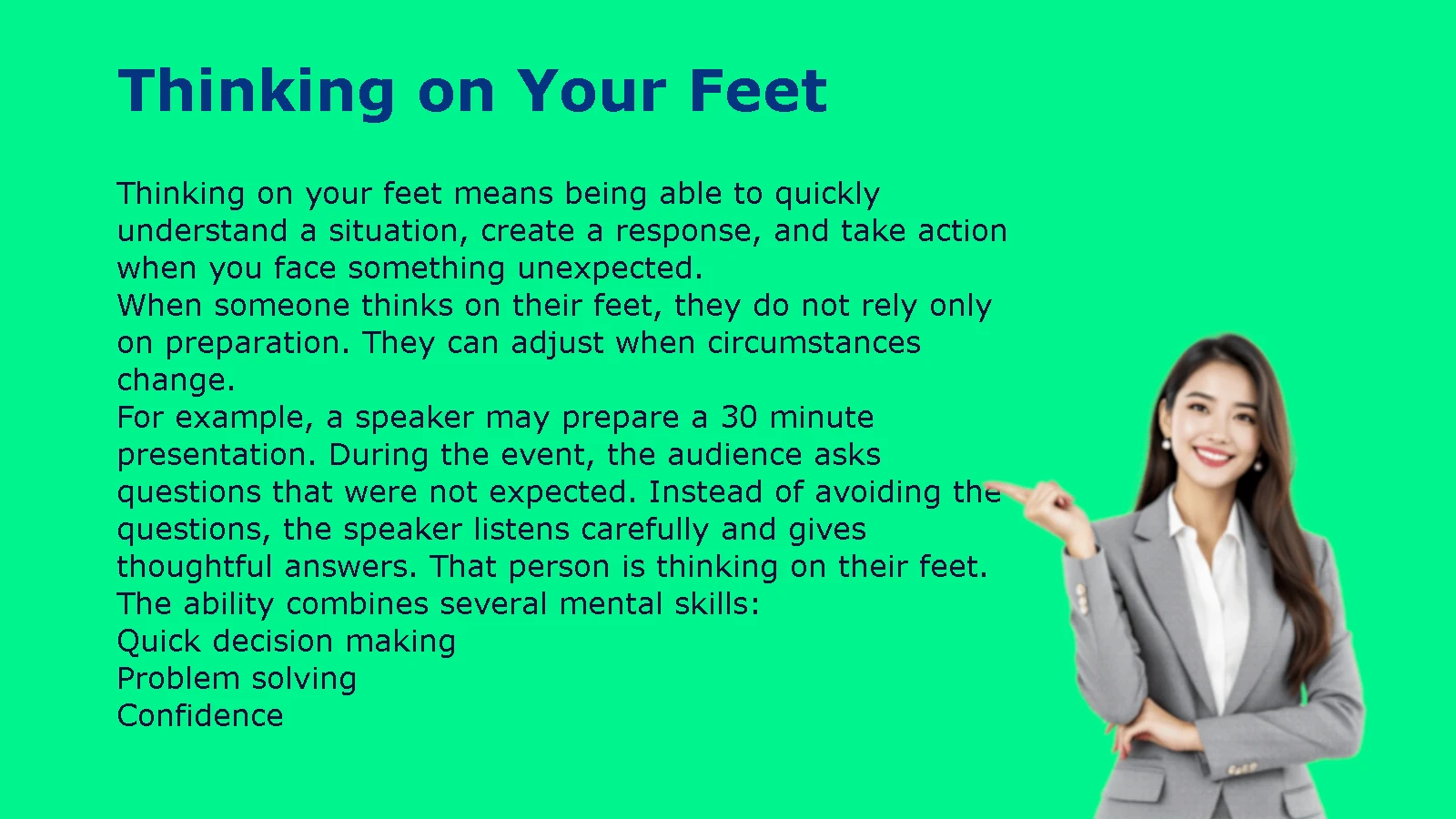
Thinking on your feet means being able to quickly understand a situation, create a response, and take action when you face something unexpected.
When someone thinks on their feet, they do not rely only on preparation. They can adjust when circumstances change.
For example, a speaker may prepare a 30 minute presentation. During the event, the audience asks questions that were not expected. Instead of avoiding the questions, the speaker listens carefully and gives thoughtful answers. That person is thinking on their feet.
The ability combines several mental skills:
- Quick decision making
- Problem solving
- Confidence
- Awareness
- Creativity
- Emotional control
A person who thinks on their feet does not always have the perfect answer immediately. Instead, they know how to stay calm and find a useful solution.
Simple Definition of Thinking on Your Feet
| Phrase | Meaning |
| Thinking on your feet | Responding quickly and effectively to unexpected situations |
| Quick thinking | Making decisions rapidly |
| Adaptability | Adjusting when conditions change |
| Improvisation | Creating a solution without preparation |
Breaking Down the Phrase “Thinking on Your Feet”
The phrase has a simple but interesting meaning when you look at each part.
“Thinking”
This refers to using your mind to analyze information, solve problems, and make decisions.
“On Your Feet”
This suggests action and movement. When you are “on your feet,” you are active and ready rather than sitting back and waiting.
Together, the phrase creates the image of someone who can think while dealing with a situation in real time.
It is similar to a basketball player reacting instantly when the game changes. They cannot stop the match and create a new plan. They must read the situation and act.
Thinking on Your Feet Meaning in Different Situations
The meaning of thinking on your feet changes slightly depending on where you use the skill. However, the main idea remains the same: adapting quickly when something unexpected happens.
Thinking on Your Feet in the Workplace
Work environments often require quick decisions because problems rarely arrive at convenient times.
Employees who think on their feet can:
- Handle unexpected customer complaints
- Adjust when deadlines change
- Answer difficult questions during meetings
- Solve technical issues
- Make decisions during emergencies
Workplace Example
A project manager discovers that a supplier cannot deliver important materials on time.
A person who struggles with pressure may panic or blame someone else.
A person who thinks on their feet might:
- Identify the problem.
- Contact alternative suppliers.
- Adjust the timeline.
- Communicate the solution clearly to the team.
The difference is not that one person faces fewer problems. The difference is how they respond.
Thinking on Your Feet During Conversations
Communication often requires quick thinking.
You may need this skill when:
- Someone asks you an unexpected question.
- You need to explain a complicated idea.
- A conversation becomes uncomfortable.
- You need to solve a misunderstanding.
For example, imagine a friend asks why you made a certain decision. You did not prepare an answer, but you calmly explain your reasoning. That is a simple example of thinking on your feet.
Good conversational thinkers usually:
- Listen carefully before responding.
- Avoid rushing.
- Consider the other person’s perspective.
- Choose words carefully.
Thinking on Your Feet in Public Speaking
Public speakers often depend on this ability because live situations rarely go perfectly.
Unexpected problems include:
- Forgetting a point
- Losing technology access
- Receiving challenging questions
- Running out of time
A confident speaker knows how to recover.
For example, if a microphone stops working, an experienced speaker might continue by speaking louder while someone fixes the equipment. They do not allow a small problem to control the entire presentation.
Origin and History of the Phrase “Thinking on Your Feet”
Where Did the Expression Come From?
The exact origin of the phrase is difficult to identify, but it comes from the idea of being physically active and ready to respond.
Historically, people often connected standing with action and readiness. Someone standing could react immediately, while someone sitting appeared more prepared for reflection or planning.
Over time, English speakers began using the phrase metaphorically. Instead of describing physical movement, it described mental flexibility.
The phrase became associated with people who could:
- Respond quickly
- Handle pressure
- Adjust plans
- Make decisions without preparation
How the Meaning Developed Over Time
The phrase has become especially common in modern workplaces, education, business, and communication.
Today, employers often value people who can think on their feet because many professional situations involve uncertainty.
A person may have years of experience and still face situations they have never encountered before. In those moments, adaptability becomes just as important as knowledge.
Real Life Examples of Thinking on Your Feet
Everyday Examples of Thinking on Your Feet
Small daily situations often test your ability to adapt.
| Situation | Thinking on Your Feet Response |
| You take the wrong route while traveling | Find another route using a map or landmarks |
| Your recipe fails while cooking | Adjust ingredients and create a new version |
| Your internet stops during a meeting | Use mobile data or another device |
| Someone asks a difficult question | Take a moment and give a thoughtful answer |
| Your plans suddenly change | Create a new plan instead of giving up |
These examples show that quick thinking is not only for professionals. Everyone uses it.
Professional Examples of Thinking on Your Feet
Case Study: A Teacher Adapting a Lesson
A teacher plans a science activity for students. However, the classroom equipment does not work.
Instead of canceling the lesson, the teacher creates a discussion activity using everyday examples.
The result?
Students still learn the concept.
The teacher successfully thinks on their feet by adjusting the approach while keeping the goal the same.
Case Study: A Business Owner Solving a Customer Problem
A small business receives a large order but discovers that one product is temporarily unavailable.
The owner contacts the customer, offers alternatives, and provides a revised delivery plan.
Instead of focusing only on the problem, the owner focuses on solutions.
That ability protects customer trust.
Why Thinking on Your Feet Is an Important Skill
It Helps You Handle Uncertainty
Life rarely follows a perfect plan. Unexpected situations appear in workplaces, relationships, education, and everyday activities.
A person who can think on their feet does not depend entirely on having everything planned beforehand. Instead, they know how to adjust when circumstances change.
For example, an entrepreneur may launch a product expecting strong customer demand. However, customers may respond differently than expected. A flexible business owner studies the feedback, changes the strategy, and improves the product.
The ability to adapt does not remove challenges. It helps you face them with a clearer mind.
People who think on their feet often handle uncertainty better because they focus on:
- What can be done now?
- What information is available?
- What solution creates the best outcome?
- What action should happen next?
It Improves Decision Making
Quick thinking and good decision making often work together.
Many people assume that thinking fast means making careless choices. However, effective quick thinkers do something different. They quickly identify the most important information and use it to make a practical decision.
A strong decision making process looks like this:
| Step | Action |
| Identify | Understand what is happening |
| Analyze | Consider possible solutions |
| Decide | Choose the most effective option |
| Act | Put the solution into practice |
| Adjust | Change the approach if needed |
For example, an emergency room doctor does not have unlimited time to consider every possibility. They quickly evaluate symptoms, prioritize risks, and choose the safest treatment approach.
The goal is not simply speed. The goal is smart speed.
It Builds Confidence
Confidence often grows from experience.
When you successfully handle unexpected situations, your brain learns that you can manage challenges. Over time, you become less afraid of situations you cannot predict.
Think of it like learning to ride a bicycle.
At first, every small movement feels difficult. You focus on every detail. After enough practice, your body responds naturally.
Thinking on your feet works the same way. Experience creates mental flexibility.
People who develop this skill often feel more comfortable with:
- Unexpected questions
- Difficult conversations
- New responsibilities
- Sudden changes
- High pressure situations
It Strengthens Communication Skills
Good communication requires more than knowing what to say. It requires knowing how to respond.
Someone with strong quick thinking skills can:
- Explain ideas clearly.
- Adjust their message for different audiences.
- Handle disagreements calmly.
- Answer questions effectively.
For example, a manager speaking with employees may notice confusion during a meeting. Instead of repeating the same explanation, they change their approach and use a simpler example.
That small adjustment shows awareness and communication ability.
Skills That Help You Think on Your Feet
Thinking on your feet is not a talent that only certain people have. It is a skill that improves with practice.
Several abilities work together to create effective quick thinking.
Active Listening: The Foundation of Quick Thinking
Many people respond too quickly because they are already preparing their answer before understanding the situation.
Active listening creates better responses.
When you listen carefully, you collect important information before making a decision.
Good active listening involves:
- Paying full attention.
- Avoiding unnecessary interruptions.
- Asking useful questions.
- Understanding the main concern.
Example
A customer complains about a service.
A weak response:
“We cannot do anything about that.”
A stronger response:
“I understand the problem. Let me look at what happened and find the best solution.”
The second response works because the person listened before reacting.
Critical Thinking: Making Better Quick Decisions
Critical thinking helps you separate useful information from distractions.
When you think critically, you ask:
- What is the real problem?
- What facts do I know?
- What assumptions am I making?
- What solution makes the most sense?
This prevents emotional reactions and improves your responses.
For example, if a project fails, a critical thinker does not immediately blame team members. They examine what caused the issue and look for improvements.
Emotional Control: Staying Calm Under Pressure
Strong emotions can make thinking difficult.
Fear, anger, or stress can narrow your attention and prevent you from seeing possible solutions.
People who think on their feet learn how to manage their emotions.
This does not mean they never feel nervous. It means they know how to continue despite pressure.
Helpful techniques include:
- Taking a short pause before answering.
- Breathing slowly.
- Focusing on facts instead of emotions.
- Avoiding impulsive reactions.
A calm mind can solve problems faster than a stressed one.
Creativity: Finding Solutions Others Miss
Sometimes unexpected situations require unusual solutions.
Creativity helps you look beyond obvious answers.
For example:
A restaurant runs out of a popular menu item during a busy evening.
A manager who thinks creatively might:
- Recommend a similar dish.
- Create a temporary special.
- Offer a customized alternative.
Creative thinking turns problems into opportunities.
Confidence: Trusting Your Judgment
Confidence plays an important role in quick decision making.
A person may have the knowledge needed to solve a problem but hesitate because they doubt themselves.
Confidence allows you to:
- Share ideas.
- Make decisions.
- Handle questions.
- Recover from mistakes.
However, confidence should work with humility. Good quick thinkers stay open to new information.
How to Improve Your Ability to Think on Your Feet
Practice Responding to Unexpected Situations
Like any skill, quick thinking improves through repetition.
You can practice by putting yourself in situations that require flexible thinking.
Try these exercises:
- Answer random questions out loud.
- Explain complicated topics in simple words.
- Participate in discussions.
- Practice interview questions.
- Debate different viewpoints.
For example, choose a random topic and explain your opinion for two minutes without preparation.
This trains your brain to organize thoughts quickly.
Expand Your Knowledge
Your brain needs information to create solutions.
The more knowledge you have, the more connections your mind can make.
Reading, learning, and exploring different subjects help you develop mental flexibility.
Useful areas to study include:
- Communication
- Psychology
- Business
- Technology
- History
- Problem solving
A person with broad knowledge often finds solutions faster because they can draw from more experiences.
Use the Pause, Process, Respond Method
Many people think thinking on your feet means answering instantly. That is not always true.
A short pause can improve your response.
Use this simple method:
Unexpected Situation
↓
Pause Briefly
↓
Understand the Problem
↓
Consider Options
↓
Choose the Best Response
↓
Take Action
A two second pause can prevent a poor decision.
Ask Clarifying Questions
When you do not understand a situation, asking questions helps you respond better.
Examples:
- “Can you explain what happened?”
- “What result are you hoping for?”
- “Which part is causing the biggest problem?”
Clarifying questions give your brain more useful information.
Learn From Past Experiences
Every challenge teaches something.
After handling a difficult situation, review what happened.
Ask yourself:
- What worked well?
- What could I improve?
- What would I do differently next time?
Over time, these lessons build your ability to react faster.
People Who Need to Think on Their Feet
Leaders and Managers
Leadership requires constant adjustment.
Managers often face:
- Employee concerns.
- Changing business goals.
- Customer problems.
- Unexpected risks.
A strong leader does not panic when plans change. They guide others toward solutions.
Teachers
Teachers rarely experience a completely predictable day.
Students may struggle with a lesson, technology may fail, or classroom situations may change.
A flexible teacher adapts while keeping the learning goal clear.
Healthcare Workers
Healthcare professionals frequently make decisions in changing situations.
They must:
- Evaluate information quickly.
- Prioritize important issues.
- Communicate clearly.
Their ability to think on their feet can directly affect patient care.
Entrepreneurs
Business owners often operate without perfect information.
They must react to:
- Market changes.
- Customer feedback.
- Competition.
- Financial challenges.
Entrepreneurs who adapt quickly often survive difficult periods better.
Thinking on Your Feet vs Similar Skills
Although several skills sound similar, they have different meanings.
| Skill | Meaning | Main Difference |
| Thinking on your feet | Responding quickly to unexpected situations | Focuses on immediate action |
| Problem solving | Finding answers to challenges | Often allows more planning time |
| Critical thinking | Evaluating information logically | Focuses on analysis |
| Creativity | Producing new ideas | Focuses on originality |
| Improvisation | Creating without preparation | Often involves performance or spontaneous action |
For example, a person may use problem solving to create a long term business strategy. They may use thinking on their feet when they need to handle a sudden customer complaint.
Common Mistakes People Make When Trying to Think Quickly
Reacting Without Thinking
Speed does not always equal effectiveness.
Some people respond immediately without understanding the situation.
This can lead to:
- Wrong decisions.
- Miscommunication.
- Unnecessary conflict.
A thoughtful pause often creates a better answer.
Overthinking
While rushing can cause problems, thinking too much can also slow you down.
Overthinking happens when you:
- Analyze every possible outcome.
- Fear making mistakes.
- Delay simple decisions.
Effective quick thinkers know when they have enough information to act.
Losing Confidence
Fear can prevent people from sharing ideas or making decisions.
Many people avoid speaking because they worry about being wrong.
However, mistakes are part of learning.
The goal is not perfection. The goal is improvement.
Ignoring the Situation
Some people focus so much on their own response that they forget to observe what is happening.
Good quick thinkers pay attention to:
- Body language.
- Context.
- Important details.
- Other people’s reactions.
Awareness creates better decisions.
Frequently Asked Questions About Thinking on Your Feet
Is thinking on your feet a skill?
Yes. Thinking on your feet is a skill that anyone can develop.
Some people naturally respond faster, but practice, experience, and confidence can improve this ability.
Is thinking on your feet the same as being intelligent?
Not exactly.
Intelligence involves understanding, learning, and reasoning. Thinking on your feet focuses more on applying those abilities during unexpected situations.
A person can be highly intelligent but struggle under pressure. Another person may quickly adapt because they have strong practical experience.
How can I become better at thinking on my feet?
You can improve by:
- Practicing quick response exercises.
- Improving communication skills.
- Staying calm under pressure.
- Learning from past experiences.
- Expanding your knowledge.
What are other ways to say thinking on your feet?
Common alternatives include:
- Thinking quickly
- Responding quickly
- Acting fast
- Thinking under pressure
- Being adaptable
- Making decisions on the spot
- Handling situations smoothly
- Improvising effectively
Final Thoughts on Thinking on Your Feet Meaning
The true thinking on your feet meaning goes beyond giving fast answers. It describes the ability to stay calm, understand situations, and create effective solutions when life does not follow your plan.
Unexpected moments happen every day. A meeting changes direction. A customer asks a difficult question. A problem appears without warning.
People who develop quick thinking skills do not avoid these moments. They handle them with confidence.
The good news is that thinking on your feet is not something you are simply born with. You can build it through practice, curiosity, experience, and a willingness to adapt.
When you learn to respond instead of react, challenges become opportunities to show creativity, confidence, and problem solving ability. That is what makes quick thinking such a valuable skill in both personal and professional life.