
What Is the Sneaked Meaning?
Sneaked is the traditional past tense and past participle of sneak. It means to move quietly or secretly to avoid being noticed. While snuck is also widely accepted, especially in American English, sneaked remains the preferred form in formal writing.
Examples:
- She sneaked out of the house without making a sound.
- He sneaked a quick look at the answers.
Understanding the sneaked meaning helps you choose the correct form, avoid common grammar mistakes, and use sneaked and snuck confidently in everyday English.
The confusion comes from the fact that both sneaked and snuck are accepted past tense forms of sneak, but they’re not always used in the same situations. And here’s the kicker: choosing the wrong form can make your writing sound less natural depending on your audience or writing style.
In this guide, you’ll discover the Sneaked Meaning, learn the definition of sneaked, explore the past tense of sneak, and see sneaked in a sentence with real-life examples. You’ll also find out how to pronounce sneaked, understand the difference between sneaked vs snuck, and learn when each word is the better choice.
By the end, you’ll know exactly what sneaked means, how to use it correctly, and how to avoid one of the most common verb confusions in English.
What Does “Sneaked” Mean?
The word sneaked is the past tense and past participle form of the verb sneak. It describes an action where someone moves or does something quietly, secretly, or carefully so other people do not notice.
In simple terms, when someone sneaked, they tried to stay hidden or avoid attention.
Basic Definition of Sneaked
Sneaked means:
To have moved somewhere quietly or secretly, or to have done something without being noticed.
For example:
- “The cat sneaked into the kitchen looking for food.”
- “He sneaked a look at the answers before turning in his test.”
- “They sneaked away before the party ended.”
The meaning changes slightly depending on the situation. Sometimes it describes harmless behavior, like quietly entering a room. Other times, it can suggest something dishonest, such as secretly taking something.
Sneaked Meaning at a Glance
| Word | Meaning | Example |
| Sneaked | Moved or acted secretly to avoid attention | She sneaked into the room quietly. |
| Sneak | To move or act secretly | The child tried to sneak past his parents. |
| Sneaking | The act of moving secretly | He was sneaking around the house. |
| Sneaked away | Left quietly without being noticed | They sneaked away after dinner. |
The key idea behind sneaked is secrecy. The person, animal, or object is usually trying to avoid being seen, heard, or discovered.
Sneaked Meaning in Simple Words
If you want an easy way to remember the meaning, think of sneaked as:
“Went somewhere quietly without attracting attention.”
Imagine a child walking past a sleeping dog. The child takes slow steps, avoids making noise, and carefully reaches the kitchen. The child sneaked into the kitchen.
Another example is a person leaving a boring meeting early. Instead of standing up and announcing, “I’m leaving now,” they quietly walk out. They sneaked away.
The action does not always involve something wrong. Someone can sneak for many reasons:
- To avoid disturbing others
- To surprise someone
- To stay hidden
- To escape attention
- To keep something secret
Is “Sneaked” a Real Word?
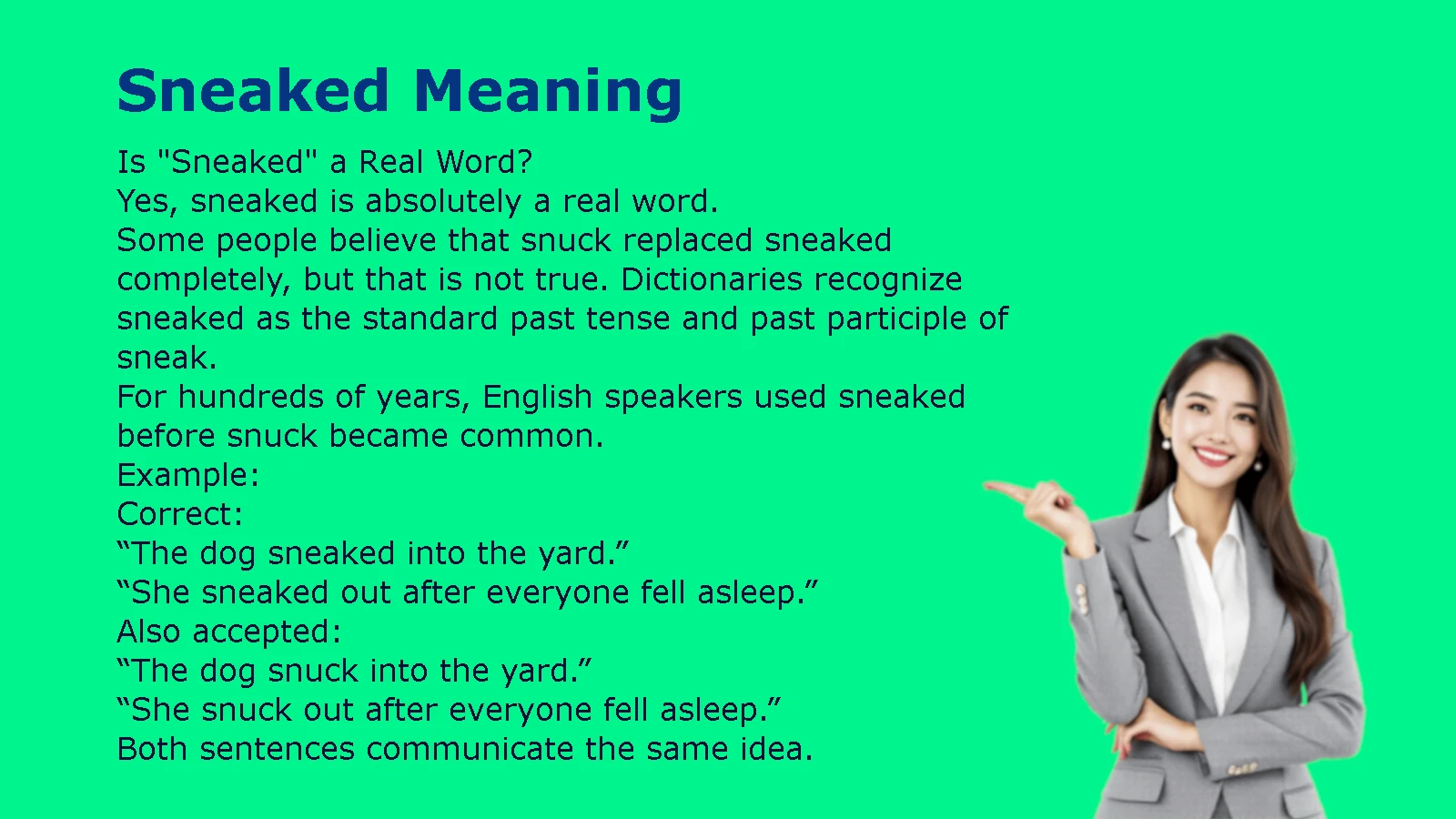
Yes, sneaked is absolutely a real word.
Some people believe that snuck replaced sneaked completely, but that is not true. Dictionaries recognize sneaked as the standard past tense and past participle of sneak.
For hundreds of years, English speakers used sneaked before snuck became common.
Example:
Correct:
- “The dog sneaked into the yard.”
- “She sneaked out after everyone fell asleep.”
Also accepted:
- “The dog snuck into the yard.”
- “She snuck out after everyone fell asleep.”
Both sentences communicate the same idea.
Why Do People Question “Sneaked”?
The confusion happens because many English verbs have irregular past forms:
| Present Verb | Past Form |
| Go | Went |
| Take | Took |
| Run | Ran |
| Sing | Sang |
| Sneak | Sneaked / Snuck |
Because English has many irregular verbs, some speakers assume that sneak should follow the same pattern. This helped snuck become common.
However, unlike verbs such as go or take, the verb sneak traditionally followed the regular -ed pattern.
Sneaked Pronunciation
The pronunciation of sneaked is simple.
Sneaked Pronunciation:
/sniːkt/
It sounds like:
“sneekt”
The ending sounds like the word “ticked” without the “i” sound.
Break It Down:
- Sneak → “sneek”
- Sneaked → “sneekt”
Examples:
- “He sneaked away.”
Pronounced: He sneekt away. - “She sneaked into the room.”
Pronounced: She sneekt into the room.
Common Pronunciation Mistake
Some speakers incorrectly pronounce sneaked as “sneak-ed” with two separate syllables.
Incorrect:
❌ sneak-ed
Correct:
✅ sneekt
The -ed ending creates a single sound because the word ends with the “k” sound.
Sneaked Meaning in Different Contexts
The meaning of sneaked can shift depending on how you use it. The word often describes quiet movement, but it can also describe secret actions or hidden behavior.
Understanding these different contexts makes your writing and conversations more natural.
Sneaked Meaning When Moving Quietly
The most common meaning of sneaked involves physical movement.
Someone sneaked when they moved carefully and quietly to avoid being noticed.
Examples:
- “The thief sneaked through the back door.”
- “The children sneaked downstairs to watch TV.”
- “The fox sneaked across the field.”
In these examples, the person or animal tries to remain unnoticed.
Think of a spy in a movie walking through a dark hallway. Every step is careful. Every sound matters. That character is sneaking.
Sneaked Meaning When Doing Something Secretly
Sometimes sneaked does not describe movement. It describes a secret action.
Examples:
- “He sneaked a cookie before dinner.”
- “She sneaked a quick look at her phone during class.”
- “They sneaked extra snacks into the movie theater.”
Here, the person is not necessarily walking quietly. Instead, they are doing something without permission or without others knowing.
Sneaked Meaning When Entering Somewhere Without Being Seen
People often use sneaked when someone enters a place quietly.
Examples:
- “The puppy sneaked into the bedroom.”
- “He sneaked into the office before everyone arrived.”
- “The children sneaked into the kitchen for a midnight snack.”
This usage often appears in storytelling because it creates a sense of mystery or surprise.
Sneaked Meaning When Leaving Quietly
Another common use is sneaked away or sneaked out.
This means someone left without making an announcement.
Examples:
- “I sneaked out of the party early.”
- “The students sneaked away after the bell rang.”
- “She sneaked out before anyone noticed.”
People often sneak away because they do not want attention.
For example, someone might leave a crowded event early because they feel tired. They are not doing anything wrong. They simply want a quiet exit.
Sneaked vs. Snuck: What’s the Difference?
The biggest question people ask is:
Should you say sneaked or snuck?
The answer depends on your audience, style, and preference.
Both words are forms of the verb sneak. The main difference is that sneaked is the traditional regular past tense, while snuck developed later as an irregular alternative.
Sneaked vs. Snuck Comparison Table
| Feature | Sneaked | Snuck |
| Verb type | Regular past tense | Irregular past tense |
| Original usage | Older and traditional form | Later informal development |
| Formal writing | Often preferred | Accepted but less formal in some contexts |
| Everyday speech | Common | Very common, especially in US English |
| Meaning | Same as snuck | Same as sneaked |
Examples:
Using sneaked:
“The child sneaked into the room quietly.”
Using snuck:
“The child snuck into the room quietly.”
Both sentences mean the child entered secretly.
Is Sneaked or Snuck More Correct?
Neither word is completely wrong.
However, sneaked is often considered the safer choice when writing formally.
Use sneaked in:
- Academic writing
- Professional documents
- Formal articles
- Business communication
Example:
“The researcher noted that the participant sneaked into the restricted area.”
Use snuck in:
- Casual conversations
- Informal writing
- Dialogue
- Personal stories
Example:
“My brother snuck into the kitchen and ate the leftovers.”
Why Did “Snuck” Become Popular?
English speakers often create new patterns naturally. Over time, some regular verbs develop irregular forms because they sound similar to other common words.
The word snuck likely became popular because English already has many short irregular verbs:
- Stick → stuck
- Strike → struck
- Dig → dug
- Spin → spun
Because of these patterns, speakers began using:
Sneak → Snuck
instead of:
Sneak → Sneaked
Today, snuck is widely accepted, especially in American English.
How to Use “Sneaked” Correctly
Using sneaked correctly becomes easy once you understand that it works like most regular past tense verbs. You usually add it after a subject to show that someone or something performed a secret or quiet action in the past.
The basic structure looks like this:
Subject + sneaked + place/action/object
Examples:
- “The cat sneaked into the room.”
- “She sneaked away before the meeting ended.”
- “He sneaked a glance at the message.”
The word often works with small connecting words called prepositions. These words help explain where someone moved or what they secretly did.
Common Sentence Patterns With Sneaked
Sneaked + Place
Use this pattern when someone quietly enters or moves through an area.
Formula:
Person/Animal + sneaked + into/through/past + place
Examples:
- The puppy sneaked into the garden.
- The child sneaked through the hallway.
- The fox sneaked past the fence.
This pattern focuses on movement.
Sneaked + Away
The phrase sneaked away means someone left quietly without drawing attention.
Examples:
- “She sneaked away after the conversation became awkward.”
- “The students sneaked away before the teacher noticed.”
- “The actor sneaked away from the crowd after the event.”
This phrase often appears when someone wants to avoid being stopped or questioned.
Sneaked + Out
The phrase sneaked out means leaving secretly.
Examples:
- “He sneaked out of the house after midnight.”
- “They sneaked out of the restaurant before paying attention to the time.”
- “I sneaked out early because I had another appointment.”
Sneaked + Into
The phrase sneaked into means entering somewhere quietly or secretly.
Examples:
- “The dog sneaked into the bedroom.”
- “She sneaked into the classroom after the bell rang.”
- “The children sneaked into the kitchen for dessert.”
Sneaked + Object
Sometimes sneaked describes secretly doing something rather than moving.
Examples:
- “He sneaked a cookie from the jar.”
- “She sneaked a picture of the sunset.”
- “The student sneaked a quick look at the notes.”
Here, sneaked means “did something secretly.”
Examples of “Sneaked” in Sentences
The best way to understand a word is to see how people actually use it. Here are examples from different situations.
Everyday Examples
- The puppy sneaked into the living room while everyone was asleep.
- I sneaked a snack before dinner because I was hungry.
- She sneaked out of the room without saying goodbye.
- The kids sneaked downstairs to watch a movie.
- He sneaked a peek at the surprise gift.
School Examples
Students and teachers often use sneaked when talking about quiet actions.
Examples:
- The student sneaked a look at the clock during the exam.
- The children sneaked extra pencils into their backpacks.
- Someone sneaked into the classroom before the teacher arrived.
- The students sneaked away after finishing their project.
- The boy sneaked a comic book into his textbook.
Workplace Examples
In professional situations, sneaked often describes actions done privately or without attention.
Examples:
- The employee sneaked a quick break between meetings.
- She sneaked into the conference room before the presentation started.
- He sneaked a glance at the report before the discussion.
- The manager sneaked away after completing the final interview.
- They sneaked a few updates into the presentation.
Family Examples
Family conversations often use sneaked in playful situations.
Examples:
- My brother sneaked into the kitchen looking for cookies.
- The children sneaked downstairs on Christmas morning.
- The dog sneaked onto the couch when nobody was watching.
- She sneaked a surprise gift into the closet.
- Dad sneaked away before the kids woke up.
Storytelling Examples
Writers often use sneaked to create suspense.
Examples:
- The detective sneaked through the dark hallway.
- The thief sneaked past the guards.
- The explorer sneaked into the hidden cave.
- The warrior sneaked behind the enemy camp.
- The spy sneaked out before sunrise.
The word creates a feeling of caution and secrecy. It helps readers imagine every quiet step.
Common Phrases Using “Sneaked”
The word sneaked appears in many common phrases. These expressions make conversations sound more natural.
| Phrase | Meaning | Example |
| Sneaked away | Left quietly | She sneaked away before the party ended. |
| Sneaked out | Left secretly | He sneaked out after everyone went to sleep. |
| Sneaked in | Entered quietly | The cat sneaked in through the open door. |
| Sneaked into | Entered a place secretly | They sneaked into the theater. |
| Sneaked past | Passed something without being noticed | The mouse sneaked past the cat. |
| Sneaked up on | Approached quietly from behind | The child sneaked up on his father. |
| Sneaked back | Returned quietly | She sneaked back into the house. |
| Sneaked through | Moved quietly through an area | The hikers sneaked through the forest. |
Common Collocations With Sneaked
Collocations are words that naturally appear together. Learning them helps you sound more fluent.
Sneaked Into
Meaning: Entered a place quietly.
Examples:
- The puppy sneaked into the bedroom.
- He sneaked into the building before the doors closed.
Sneaked Out Of
Meaning: Left somewhere secretly.
Examples:
- She sneaked out of the meeting early.
- The teenager sneaked out of the house after midnight.
Sneaked Past
Meaning: Passed someone or something without being noticed.
Examples:
- The cat sneaked past the sleeping dog.
- The children sneaked past their parents.
Sneaked Away
Meaning: Left quietly.
Examples:
- The guests sneaked away before the speech ended.
- He sneaked away to avoid a long conversation.
Sneaked Up On
Meaning: Approached someone quietly and unexpectedly.
Examples:
- The child sneaked up on his sister.
- The photographer sneaked up on the bird to capture a picture.
Synonyms of Sneaked
Although sneaked has a specific meaning, several words can express similar ideas. However, each synonym has a slightly different feeling.
| Synonym | Meaning | Example |
| Crept | Moved slowly and quietly | The cat crept across the floor. |
| Slipped | Moved quietly or quickly | She slipped out of the room. |
| Tiptoed | Walked quietly on toes | He tiptoed past the sleeping baby. |
| Slinked | Moved secretly or shyly | The dog slinked away after making a mess. |
| Stole | Moved secretly or took something | He stole away before anyone noticed. |
| Crouched | Moved while staying low | The hunter crouched behind the bushes. |
| Skulked | Hid while moving secretly | The animal skulked in the shadows. |
Difference Between Sneaked and Similar Words
Sneaked vs. Crept
Both words describe quiet movement.
However:
- Sneaked focuses on avoiding attention.
- Crept focuses more on slow movement.
Example:
- “The thief sneaked into the house.”
(The thief wanted to avoid being noticed.) - “The baby crept across the floor.”
(The baby moved slowly.)
Sneaked vs. Tiptoed
Tiptoed specifically means walking quietly on the front part of your feet.
Example:
- “She tiptoed past the sleeping dog.”
Sneaked has a broader meaning and does not require a specific movement.
Example:
- “She sneaked past the sleeping dog.”
Antonyms of Sneaked
Antonyms are words with opposite meanings.
Since sneaked involves secrecy and quiet movement, its opposites involve openness, confidence, or visibility.
| Antonym | Meaning | Example |
| Announced | Made something known openly | She announced her arrival. |
| Revealed | Showed something hidden | He revealed the secret. |
| Appeared | Became visible | The actor appeared on stage. |
| Entered openly | Came in without hiding | They entered openly through the front door. |
| Marched | Walked confidently | The soldiers marched forward. |
| Declared | Stated clearly | She declared her intentions. |
Examples:
- Instead of sneaking into a room, someone might announce their arrival.
- Instead of sneaking away, someone might say goodbye openly.
Grammar Rules for “Sneaked”
Understanding the grammar behind sneaked helps you avoid mistakes.
The verb forms are:
| Verb Form | Word |
| Base form | Sneak |
| Past tense | Sneaked |
| Past participle | Sneaked |
| Present participle | Sneaking |
| Third person singular | Sneaks |
Examples:
Present Tense
- “The cat sneaks into the garden.”
Past Tense
- “The cat sneaked into the garden.”
Present Continuous
- “The cat is sneaking into the garden.”
Past Perfect
- “The cat had sneaked into the garden before we noticed.”
Sneaked in Different Tenses
Simple Past
Use sneaked for a completed action in the past.
Example:
- “He sneaked out last night.”
Present Perfect
Use has/have sneaked when the action happened before now.
Examples:
- “She has sneaked into the room before.”
- “They have sneaked away several times.”
Past Perfect
Use had sneaked when one past action happened before another.
Example:
- “The dog had sneaked outside before anyone opened the door.”
Common Mistakes When Using Sneaked
Even though sneaked seems simple, people often make a few mistakes.
Mistake: Thinking Sneaked Is Incorrect
Incorrect idea:
❌ “Sneaked is not a real word.”
Correct:
✅ “Sneaked is the traditional past tense of sneak.”
Mistake: Using Sneak Instead of Sneaked for Past Actions
Incorrect:
❌ “Yesterday, she sneak into the room.”
Correct:
✅ “Yesterday, she sneaked into the room.”
Mistake: Confusing Sneaked With Stole
The words can overlap, but they are not identical.
- Sneaked means moved secretly.
- Stole means took something without permission.
Example:
- “He sneaked into the office.”
(He entered quietly.) - “He stole money from the office.”
(He took something illegally.)
Mistake: Using Wrong Prepositions
Incorrect:
❌ “She sneaked on the room.”
Correct:
✅ “She sneaked into the room.”
Common prepositions include:
- Into
- Out of
- Away
- Past
- Through
- Around
The Origin and History of “Sneaked”
The word sneaked comes from the verb sneak, which has been part of the English language for several centuries. Understanding its history explains why both sneaked and snuck exist today.
The verb sneak originally appeared in English around the 16th century. It described moving in a quiet, secretive, or underhanded way. Over time, the word expanded beyond physical movement and began describing secret actions as well.
For example:
- A person could sneak through a doorway.
- Someone could sneak a piece of food.
- A child could sneak a look at a gift.
The original past tense followed the regular English pattern:
Sneak → Sneaked
Later, speakers began creating the alternative form:
Sneak → Snuck
This change happened because English speakers often reshape words to match familiar patterns. Similar changes have happened with other verbs throughout history.
How “Snuck” Developed
English contains many irregular verbs:
- Stick → Stuck
- Strike → Struck
- Hang → Hung
- Dig → Dug
Because sneak sounds similar to some of these verbs, people began using snuck naturally in speech.
Although snuck was once considered informal, it became widely accepted over time. Today, many dictionaries recognize both forms.
The difference is not about meaning. Both words describe the same action.
Example:
- “The child sneaked into the kitchen.”
- “The child snuck into the kitchen.”
Both mean the child entered quietly and secretly.
Sneaked in Formal and Informal Writing
Choosing between sneaked and snuck often depends on your audience.
The word sneaked usually feels slightly more traditional and formal. It works well in professional writing, academic work, and edited publications.
The word snuck feels more conversational. It often appears in everyday speech, fiction, movies, and casual writing.
When to Use Sneaked
Use sneaked when you want a more traditional style.
Examples:
- Academic articles
- Reports
- Formal essays
- Professional communication
Example:
“The researcher observed that the participant sneaked into the restricted area.”
The sentence sounds neutral and professional.
When to Use Snuck
Use snuck when writing natural dialogue or casual content.
Example:
“My little brother snuck into my room and borrowed my headphones.”
This sounds like everyday conversation.
Real-Life Examples: Sneaked vs. Snuck
Imagine three different situations.
Situation One: A Formal Report
A security report might say:
“The individual sneaked into the building after closing hours.”
The traditional form fits the serious tone.
Situation Two: A Conversation Between Friends
A friend might say:
“You won’t believe it, but I snuck into the concert area.”
The casual form sounds natural.
Situation Three: A Storybook
An author might choose either:
“The fox sneaked through the forest.”
or:
“The fox snuck through the forest.”
Both work. The choice depends on the writer’s style.
Tips to Remember the Meaning of Sneaked
Learning vocabulary becomes easier when you connect words with images and situations.
Here are some simple ways to remember sneaked.
Think of Quiet Footsteps
Imagine someone walking across a wooden floor while trying not to make a sound.
Step.
Pause.
Step.
Pause.
That person sneaked across the room.
Connect It With a Secret Mission
Think about a detective entering a building carefully.
The detective:
- Moves quietly
- Avoids attention
- Watches surroundings
- Takes careful steps
The detective sneaked inside.
Remember the Main Idea
The easiest memory trick:
Sneaked = moved secretly or acted without being noticed.
Whenever you imagine someone trying to stay hidden, the word sneaked likely fits.
Frequently Asked Questions About Sneaked Meaning
Is “sneaked” grammatically correct?
Yes, sneaked is grammatically correct. It is the traditional past tense and past participle form of the verb sneak.
Example:
- “She sneaked out of the room.”
Is sneaked or snuck more formal?
Sneaked is generally considered more formal because it follows the traditional regular verb pattern.
However, snuck is also accepted in modern English and appears frequently in casual writing and speech.
Is snuck wrong?
No, snuck is not wrong.
It developed as an alternative past tense form of sneak and is now widely used, especially in American English.
Example:
- “He snuck into the kitchen.”
This sentence is correct.
What is the past tense of sneak?
The traditional past tense is:
Sneaked
Example:
- “The cat sneaked across the room.”
However, snuck is also accepted.
What is the past participle of sneak?
The traditional past participle is:
Sneaked
Examples:
- “She has sneaked away before.”
- “They had sneaked into the building.”
The alternative form snuck is also commonly used:
- “She has snuck away before.”
Does sneaked always mean something bad?
No. The word does not always describe negative behavior.
Someone can sneak for harmless reasons.
Examples:
Positive or neutral uses:
- “The child sneaked downstairs to surprise his parents.”
- “The photographer sneaked closer to capture a beautiful bird.”
- “She sneaked a gift into the room.”
Negative uses:
- “The thief sneaked into the house.”
- “Someone sneaked money from the drawer.”
The context determines whether the action feels playful, secretive, or dishonest.
Can animals sneak?
Yes. People often use sneaked to describe animals moving quietly.
Examples:
- “The cat sneaked toward the mouse.”
- “The fox sneaked through the grass.”
- “The rabbit sneaked away from the noise.”
Animals often move quietly because they are hunting, hiding, or avoiding danger.
What are common phrases with sneaked?
Some common phrases include:
- Sneaked away
- Sneaked out
- Sneaked into
- Sneaked past
- Sneaked through
- Sneaked up on
- Sneaked a look
- Sneaked a peek
Examples:
- “She sneaked a peek at the surprise.”
- “The dog sneaked past the gate.”
Key Takeaways About Sneaked Meaning
The word sneaked has a simple but useful meaning. It describes moving or acting quietly, secretly, or carefully to avoid attention.
Here are the main points to remember:
- Sneaked is a correct English word.
- It is the traditional past tense and past participle of sneak.
- Sneaked meaning focuses on secrecy, quiet movement, or hidden actions.
- The word can describe people, animals, and actions.
- Sneaked and snuck have the same meaning.
- Sneaked often works better in formal writing.
- Snuck is common in casual American English.
- Context decides whether sneaked sounds playful, neutral, or negative.
Conclusion: Understanding the Meaning of Sneaked
The meaning of sneaked is easy to understand once you connect it with the idea of moving quietly or doing something secretly. Whether someone quietly enters a room, leaves a party without notice, or takes a quick look at something, the word describes an action done with care and little attention.
Although many people wonder about sneaked vs. snuck, both forms are accepted in modern English. The difference mostly comes down to style and preference. If you are writing something formal, sneaked remains a reliable choice. If you are having a casual conversation, snuck may sound more natural.
Language changes over time, and words often develop new forms while keeping their original meaning. Sneaked is a great example of how English grows while still holding onto its roots.
So the next time you see someone quietly walking away, entering without being noticed, or secretly doing something, you’ll know exactly what word describes the action:
They sneaked.