
A braggart is someone who boasts excessively or constantly tries to make others notice how great they are. The word usually has a negative meaning because it suggests that a person talks about themselves too much and may want to impress others.
Examples:
- He is such a braggart that he talks about his achievements in every conversation.
- Nobody enjoyed working with the braggart because she constantly praised herself.
The confusion is understandable. People often search for what does braggart mean, braggart meaning in English, braggart meaning in a sentence, or braggart synonym because the word can describe more than simple confidence. A confident person can speak proudly about their abilities, while a braggart usually goes too far with self praise.
In this guide, you’ll learn the complete Braggart Meaning, its definition, pronunciation, synonyms, antonyms, correct usage, and examples in sentences. You’ll also discover the difference between a braggart, a boaster, and a confident person, along with simple examples to help you understand exactly when and how to use this word.
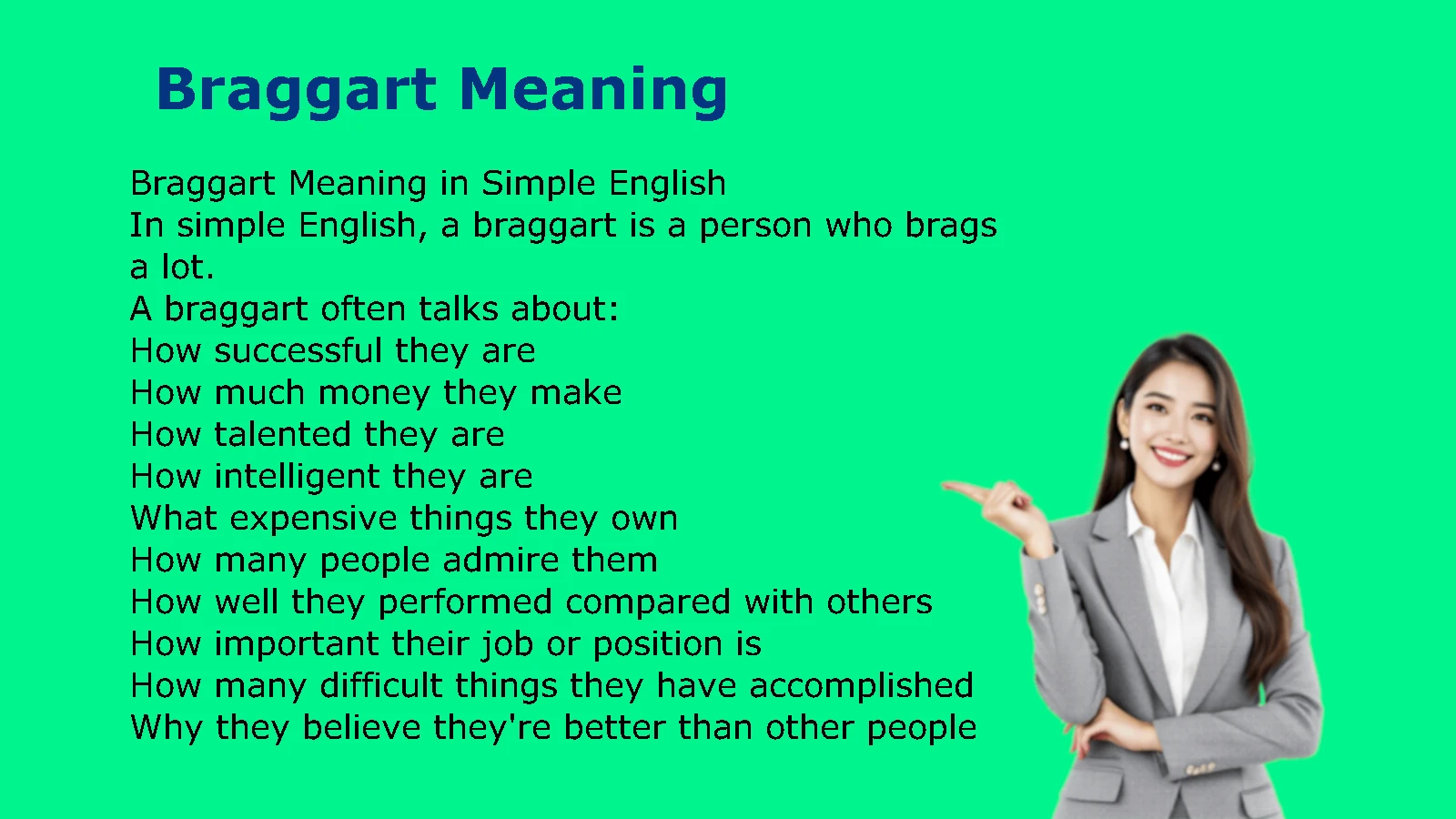
Braggart Meaning in Simple English
In simple English, a braggart is a person who brags a lot.
A braggart often talks about:
- How successful they are
- How much money they make
- How talented they are
- How intelligent they are
- What expensive things they own
- How many people admire them
- How well they performed compared with others
- How important their job or position is
- How many difficult things they have accomplished
- Why they believe they’re better than other people
The key idea is excessive self praise.
Someone might mention winning an award once because it is relevant to the conversation. That doesn’t automatically make the person a braggart. The word becomes more appropriate when someone repeatedly talks about their accomplishments or uses them to impress others.
Braggart Meaning in One Sentence
A braggart is someone who talks too proudly or too often about their achievements, abilities, possessions, or importance.
Merriam Webster defines the noun as a “loud arrogant boaster,” while Oxford gives the simpler definition of “a person who brags.”
Braggart Definition
Braggart is primarily a noun.
It refers to a person who boasts or brags, especially in a way that seems excessive, arrogant, or annoying.
Merriam Webster also records braggart as an adjective meaning boastful.
Braggart Definition at a Glance
| Feature | Details |
| Word | Braggart |
| Part of speech | Noun; also adjective |
| Simple definition | A person who brags excessively |
| Typical tone | Negative or disapproving |
| Plural form | Braggarts |
| Main idea | Excessive pride expressed through boasting |
| Related verb | Brag |
| Related noun | Bragger |
| Common synonyms | Boaster, show off, blowhard, swaggerer |
| Opposites | Humble person, modest person |
The word often describes more than simple pride. It suggests a pattern of boastful behavior that other people may find irritating, arrogant, or tiresome.
What Does Braggart Mean?
So, what does braggart mean in everyday conversation?
Imagine a coworker who mentions their promotion during a relevant discussion. That’s normal. Now imagine that the same coworker brings up the promotion during lunch, talks about it in unrelated meetings, compares their salary with everyone else’s, and repeatedly reminds people that they are the most valuable employee in the company.
That person could reasonably be described as a braggart.
The difference lies in the behavior surrounding the achievement.
A Simple Example
Consider these two statements:
Person A:
“I worked hard on the project and I’m really proud that our team won the award.”
Person B:
“I won the award because I’m clearly the smartest person here. Nobody else could have done what I did.”
Person A expresses pride.
Person B sounds boastful.
If Person B repeatedly behaves this way, calling them a braggart would make sense.
Braggart Pronunciation
The US pronunciation of braggart is:
/ˈbræɡ.ɚt/
An easy way to remember it is:
BRAG ert
The stress falls on the first syllable: BRAG.
Cambridge gives the US pronunciation as /ˈbræɡ.ɚt/ and the UK pronunciation as /ˈbræɡ.ət/.
How to Say Braggart
Break the word into two parts:
brag + ert
The first part sounds like brag, the familiar verb meaning to talk too proudly about yourself or your achievements.
The second part has a relaxed sound, similar to the ending in words such as “teacher” or “mother” in many American accents.
Is Braggart a Positive or Negative Word?
Braggart is usually negative.
Calling someone a braggart normally means that you disapprove of the way they talk about themselves.
Cambridge specifically labels the word “old-fashioned” and “disapproving.” Oxford also marks it as old-fashioned.
That doesn’t mean the word is always harsh. Friends might use it jokingly.
For example:
“Look at you, Mr. Braggart. You finally won one game!”
Here, the speaker may be teasing rather than seriously insulting the person.
However, in a serious conversation, calling someone a braggart can sound quite critical.
Why Does “Braggart” Sound Negative?
The word focuses on how someone presents their achievements, not simply on whether they have achieved something.
A person can be highly successful without being a braggart.
In fact, someone might accomplish extraordinary things while rarely mentioning them. Another person might accomplish something fairly ordinary and talk about it constantly.
The word targets the boasting behavior, not the achievement itself.
What Does a Braggart Do?
A braggart usually makes themselves the center of attention through repeated self praise.
Common behaviors include:
- Constantly talking about personal achievements
- Mentioning expensive possessions
- Exaggerating abilities
- Comparing themselves with others
- Seeking admiration
- Taking excessive credit
- Turning unrelated conversations toward themselves
- Repeatedly discussing money or status
- Claiming to be better than other people
- Trying to impress an audience
- Talking about successes without giving others credit
- Making ordinary accomplishments sound extraordinary
Not every person who does one of these things is automatically a braggart. Context and repetition matter.
Example
Suppose someone says:
“I got an A on the exam.”
That’s simply information.
If they say:
“I got an A because I’m the only person in this class who actually understands the material.”
That sounds more boastful.
If they say similar things after every test, assignment, competition, and class discussion, the description braggart becomes much more fitting.
Braggart Examples in Sentences
Seeing the word in context makes its meaning much easier to understand.
Everyday Examples
- The braggart spent the entire dinner talking about his new sports car.
- Everyone became tired of listening to the braggart describe his achievements.
- He sounded like a braggart whenever he talked about his wealth.
- The team respected her talent, but nobody liked her braggart attitude.
- That braggart never misses an opportunity to mention his promotion.
- The young athlete was confident, not a braggart.
- His friends jokingly called him a braggart after he won the competition.
- The braggart claimed he could beat every player in the tournament.
- She disliked being around people who constantly behaved like braggarts.
- The boastful braggart eventually lost the audience’s attention.
Workplace Example
“Mark became known as a braggart because he constantly reminded everyone that he had received the highest sales numbers.”
The sentence doesn’t necessarily say that Mark’s sales were poor. In fact, he may have been an excellent salesperson. The criticism concerns his constant boasting.
School Example
“The student sounded like a braggart when he told everyone that nobody in the class could match his grades.”
Again, the problem isn’t necessarily that he earned high grades. It’s the way he uses those grades to elevate himself above everyone else.
Social Media Example
“Her constant posts about her wealth made some followers see her as a braggart.”
Social media can make this behavior especially noticeable because people can repeatedly display achievements, purchases, vacations, awards, or status to a large audience.
Braggart Synonyms
Several words have meanings close to braggart, but they aren’t perfect substitutes in every situation.
Merriam Webster’s thesaurus includes terms such as bragger, boaster, swaggerer, blowhard, braggadocio, self promoter, self advertiser, and vaunter among related words.
| Synonym | Meaning | Typical nuance |
| Bragger | Someone who brags | Direct and common |
| Boaster | Someone who boasts | Similar to braggart |
| Show off | Someone who tries to attract attention | Can involve actions or possessions |
| Blowhard | A person who talks loudly and boastfully | Informal and strongly negative |
| Swaggerer | Someone who behaves with excessive confidence | Focuses on attitude and manner |
| Bighead | Someone who thinks too highly of themselves | Informal |
| Self promoter | Someone who actively advertises their abilities or achievements | Can be neutral or negative |
| Braggadocio | Boastful behavior or swagger | More literary or formal |
| Vaunter | Someone who boasts | Uncommon and formal |
Braggart vs. Bragger
Braggart and bragger are extremely close.
A bragger is simply someone who brags.
A braggart generally carries a stronger sense of excessive or arrogant boasting.
For example:
“He is a bragger who likes to talk about his achievements.”
This sounds straightforward.
“He is an arrogant braggart who never stops talking about himself.”
This sounds much more critical.
Merriam Webster lists bragger as one of the synonyms of braggart.
Braggart vs. Boaster
A boaster is someone who boasts.
A braggart is also someone who boasts, but the word often emphasizes the person’s excessive or irritating behavior.
Compare:
“He was a boaster who liked to discuss his achievements.”
with:
“He was an unbearable braggart who turned every conversation into a speech about himself.”
Both work. The second carries a sharper judgment.
Braggart vs. Show Off
A show off tries to attract attention by displaying skills, possessions, appearance, achievements, or behavior.
A braggart specifically emphasizes boastful talk or self praise.
For example, someone who performs difficult tricks simply to impress people might be a show off.
Someone who constantly tells everyone how talented they are might be a braggart.
A person can certainly be both.
Braggart vs. Confident Person
This distinction matters because confidence isn’t the same as arrogance.
A confident person can recognize their strengths without constantly demanding attention for them.
A braggart tends to turn those strengths into repeated opportunities for self promotion.
| Confident person | Braggart |
| Knows their strengths | Constantly announces their strengths |
| Can accept praise | Often seeks praise |
| Gives credit to others | May take excessive credit |
| Doesn’t need to dominate every conversation | Often redirects conversations toward themselves |
| Can admit mistakes | May avoid admitting weaknesses |
| Talks about achievements when relevant | Brings achievements into unrelated conversations |
| Respects other people’s accomplishments | May compete with other people’s accomplishments |
| Usually feels secure enough to listen | May constantly seek attention |
The Key Difference
The easiest way to remember the distinction is this:
Confidence says, “I know I can do this.”
Bragging says, “I need you to know how great I am.”
That’s not a perfect psychological rule, but it captures the everyday difference between the terms.
Braggart vs. Arrogant
The words braggart and arrogant overlap, but they don’t mean exactly the same thing.
Arrogant describes an attitude of superiority. An arrogant person may believe they are better, smarter, more important, or more deserving than others.
A braggart, on the other hand, is specifically associated with boasting.
Someone can be arrogant without talking much.
Someone can also brag without genuinely believing they are superior.
Example
A quiet executive who treats employees as inferior may be arrogant.
A loud employee who constantly talks about their accomplishments may be a braggart.
Someone who does both could be described as an arrogant braggart.
Braggart as a Noun and Adjective
The most common use of braggart is as a noun.
Braggart as a Noun
“He is a braggart.”
Here, braggart identifies the person.
Other examples include:
- She is a talented athlete, not a braggart.
- The braggart dominated the conversation.
- Nobody believed the braggart’s exaggerated stories.
- His friends eventually grew tired of the braggart.
Braggart as an Adjective
Merriam Webster also records braggart as an adjective meaning boastful.
For example:
“His braggart behavior annoyed his coworkers.”
Here, braggart describes the behavior.
The adjective form appears less frequently in ordinary modern conversation than related words such as boastful, arrogant, or bragging.
Common Characteristics of a Braggart
The word describes behavior rather than a medical condition or formal personality diagnosis.
Someone who acts like a braggart may display several recognizable patterns.
Excessive Self Praise
The person frequently talks about how talented, intelligent, successful, or impressive they are.
Constant Need for Recognition
They may feel compelled to tell others about their achievements even when nobody asked.
Exaggeration
A braggart may stretch a small achievement into something that sounds much more impressive.
Competition
Instead of celebrating someone else’s success, they may immediately try to top the story.
For example:
“You ran five miles? I ran ten.”
Status Display
Some braggarts focus heavily on money, job titles, cars, houses, clothing, vacations, awards, or social connections.
Taking Credit
A braggart may emphasize their own contribution while minimizing the efforts of everyone else.
Attention Seeking
The underlying conversational pattern is often simple: look at me.
Again, these traits don’t prove anything about a person’s psychology. They simply explain why the word braggart fits certain everyday situations.
Real Life Situations Where “Braggart” Fits
The word becomes much easier to understand when you see how it works across different settings.
At Work
Imagine an employee who repeatedly says:
“The company would fall apart without me.”
If that employee makes similar claims every week and constantly reminds coworkers about their achievements, braggart may describe the behavior.
However, someone who discusses their accomplishments during a performance review isn’t necessarily bragging. The context makes the difference.
At School
A student might proudly say:
“I studied hard and got the highest grade.”
That’s reasonable.
But if the student regularly tells classmates that everyone else is less intelligent, the word braggart becomes more appropriate.
Among Friends
Friendship often exposes bragging because people spend enough time together to notice repeated patterns.
A friend who occasionally talks about a great vacation isn’t necessarily a braggart.
A friend who turns every conversation into a competition about travel, money, relationships, possessions, or achievements might earn that label.
Online
Social media creates a special environment for self presentation.
People naturally share good news online. Posting about a promotion, graduation, new car, or vacation doesn’t automatically make someone a braggart.
The term becomes more fitting when the person’s communication repeatedly focuses on superiority, status, or self praise.
A Practical Case Study: Proud or Braggart?
Consider two fictional coworkers, Alex and Jordan.
Alex recently completed a difficult project. During a team meeting, Alex says:
“I’m really happy with how the project turned out. Everyone worked hard.”
Jordan also completed a successful project. During the meeting, Jordan says:
“Nobody else here could have handled that project. I solved problems that the rest of the team couldn’t even understand.”
Later that week, Jordan brings up the project again during lunch. A few days later, Jordan mentions it during another meeting. When another coworker receives praise, Jordan responds by talking about the project again.
What Does the Comparison Show?
| Behavior | Alex | Jordan |
| Expresses pride | Yes | Yes |
| Mentions achievement | Yes | Yes |
| Gives credit to others | Yes | No |
| Compares themselves with coworkers | No | Yes |
| Repeats the achievement excessively | No | Yes |
| Attempts to appear superior | No | Yes |
| Could be described as a braggart | Unlikely | More likely |
The lesson is simple: having something to be proud of doesn’t make someone a braggart. Constantly using achievements to elevate yourself can.
How to Use “Braggart” Correctly
The word generally works naturally with articles such as a and the.
With “a”
“He is a braggart.”
“She sounded like a braggart during the interview.”
With “the”
“The braggart refused to stop talking about his success.”
In the Plural
The plural of braggart is braggarts.
“The two braggarts competed to see who had accomplished more.”
Merriam Webster’s Scrabble dictionary also lists braggarts as the plural form.
Useful Collocations
Some combinations sound especially natural:
- an arrogant braggart
- a boastful braggart
- an insufferable braggart
- a loud braggart
- a pompous braggart
- a shameless braggart
- a self important braggart
- a constant braggart
These combinations emphasize the person’s attitude or behavior.
Opposite of Braggart
The most direct opposites of braggart include:
- Humble person
- Modest person
- Self effacing person
- Unassuming person
- Quiet achiever
A humble person doesn’t necessarily hide their accomplishments. Instead, they generally don’t need to use those accomplishments to establish superiority over others.
Braggart vs. Humble Person
Consider two athletes after winning a competition.
The braggart says:
“I proved that I’m better than everyone else.”
The humble athlete says:
“I’m proud of the result. My teammates and coaches helped me get here.”
Both won.
Only one turns the victory into a statement of superiority.
Braggart Word Origin and History
The history of braggart goes back several centuries.
Merriam Webster records the first known use of braggart around 1577. The word comes partly from brag and partly from the Middle French bragard, meaning excessively proud.
Etymonline dates the word to the 1570s and traces it to French bragard, associated with braguer, meaning “to flaunt” or “brag.” It also notes that English brag influenced the word’s development.
Oxford similarly traces braggart to the late 16th century and gives the French connection through bragard and braguer.
Braggart Timeline
| Period | Development |
| Late 14th century | English brag appears with meanings connected to boasting and pride |
| 16th century | French bragard contributes to the development of braggart |
| 1570s | Braggart appears in English as a noun meaning a boaster |
| Early 17th century | The adjective use develops with the meaning “vain” or “boastful” |
| Modern English | The word remains recognizable but is commonly labeled old-fashioned by major learner dictionaries |
Etymonline records an adjective use meaning “vain, boastful” from the 1610s.
Braggart and the Word “Brag”
The relationship between braggart and brag is easy to see in modern English.
To brag means to talk proudly about your own achievements, abilities, or possessions.
A braggart is the person who does that.
For example:
Brag: “I got the highest score in the class.”
Braggart: “He’s always telling everyone that he got the highest score in the class.”
Merriam Webster traces brag back to Middle English and records its first known English use in the 14th century.
This connection makes the word easier to remember:
brag → bragger → braggart
The forms aren’t completely interchangeable, but they revolve around the same central idea of boastful self praise.
Is “Braggart” Still Used Today?
Yes, but it has an old-fashioned flavor.
Cambridge labels braggart as old-fashioned and disapproving, while Oxford also marks it as old-fashioned.
That doesn’t mean modern speakers won’t understand it. They generally will.
However, in casual American English, people may more often use expressions such as:
- bragger
- show off
- boaster
- blowhard
- bighead
- arrogant person
- someone who loves to brag
The choice depends on the tone.
If you want a slightly literary or traditional word, braggart works well. If you want everyday conversational language, show off or bragger may sound more natural.
Braggart in Literature and Formal Writing
Although the word can sound old-fashioned in everyday speech, braggart remains useful in literature, commentary, and descriptive writing.
Writers often use it because the word immediately creates a particular character image: someone loud, proud, self impressed, and eager to prove their superiority.
Cambridge’s examples include literary uses involving characters described as confident, boastful, pompous, or troublesome.
The word can therefore do more than simply say that someone brags. It can help establish a character’s personality.
Why Writers Choose “Braggart”
Compare these sentences:
“He was a man who bragged frequently.”
and:
“He was an insufferable braggart.”
The second sentence is shorter and more vivid.
It immediately suggests a person whose boastful behavior has become part of their identity.
Common Mistakes With Braggart
Understanding the word also means knowing what not to assume.
Mistake: Thinking Every Proud Person Is a Braggart
Being proud isn’t automatically boastful.
Someone can celebrate an accomplishment without constantly seeking admiration.
Mistake: Treating Braggart and Arrogant as Exact Synonyms
They overlap, but they focus on different things.
Arrogant describes superiority or an inflated sense of importance.
Braggart focuses on boasting.
Mistake: Assuming One Boast Makes Someone a Braggart
Context matters.
Someone might excitedly share good news once. That doesn’t necessarily make them a braggart.
The word generally suggests a habit or recognizable pattern of boastful behavior.
Mistake: Using Braggart as a Neutral Compliment
In most contexts, braggart isn’t praise.
If someone says, “You’re such a braggart,” they usually aren’t complimenting your confidence.
They may be criticizing you or teasing you.
Braggart vs. Humblebrag
A humblebrag is a different but related idea.
A humblebrag happens when someone disguises a boast as a complaint, modest statement, or supposedly embarrassing situation.
For example:
“It’s so exhausting when everyone asks how I managed to win another award.”
The speaker appears to complain, but the statement still draws attention to the achievement.
Someone who frequently humblebrags could also be described as boastful. However, braggart is a broader term because the person doesn’t have to disguise the boasting.
Braggart vs. Blowhard
Blowhard is one of the closest informal alternatives to braggart.
A blowhard is generally a person who talks loudly, confidently, or arrogantly, often without having as much substance as they claim.
Cambridge lists blowhard as a synonym of braggart and labels it informal and disapproving.
Compare:
“He’s a braggart who constantly talks about his achievements.”
“He’s a blowhard who talks as though he knows everything.”
The first focuses strongly on boasting.
The second can suggest loud, empty, or overconfident talk more broadly.
Braggart vs. Braggadocio
These words look and sound related because they are.
Braggart usually refers to a person.
“He is a braggart.”
Braggadocio generally refers to boastful behavior, speech, or swagger. It can also describe a person displaying that behavior.
“His speech was full of braggadocio.”
Merriam Webster lists braggadocio among related words for braggart.
For everyday English, braggart is much easier and more direct.
Useful Braggart Synonyms by Tone
Choosing the right synonym depends on how strong you want the criticism to sound.
Mild
- Boaster
- Bragger
- Self promoter
Informal
- Show off
- Bighead
- Blowhard
Stronger or More Critical
- Braggart
- Swaggerer
- Arrogant person
- Pompous person
More Literary
- Braggadocio
- Vaunter
- Gascon
Merriam Webster’s thesaurus includes several of these related terms and also lists adjectives such as boastful, cocky, conceited, bombastic, arrogant, vainglorious, and bigheaded.
How to Tell If “Braggart” Is the Right Word
Before using the word, ask three simple questions:
- Is the person talking about themselves or their achievements?
- Are they doing it excessively or boastfully?
- Does the behavior seem arrogant, attention seeking, or annoying?
If the answer to all three is yes, braggart is probably a good fit.
If the person is simply confident, proud, or sharing relevant information, another word may be better.
Quick Comparison of Related Words
| Word | Core meaning | Tone |
| Braggart | Person who boasts excessively | Negative |
| Bragger | Person who brags | Neutral to negative |
| Boaster | Person who boasts | Negative |
| Show off | Person who seeks attention by displaying something | Informal |
| Blowhard | Loud, boastful, overconfident person | Strongly negative |
| Swaggerer | Person displaying excessive confidence | Negative |
| Self promoter | Person who promotes their abilities | Neutral to negative |
| Arrogant person | Person who believes they are superior | Negative |
| Humble person | Person who avoids excessive self praise | Positive |
| Braggadocio | Boastful behavior or swagger | Negative/literary |
Frequently Asked Questions About Braggart Meaning
What does braggart mean?
Braggart means a person who boasts excessively about themselves, their achievements, abilities, possessions, or status. The word usually has a negative or disapproving tone.
Is braggart an insult?
Usually, yes. Calling someone a braggart generally criticizes their boastful behavior. However, friends can also use the word playfully or teasingly.
What is a braggart person?
A braggart person is someone who repeatedly talks proudly about themselves in a way that can seem excessive, arrogant, or attention seeking.
What is another word for braggart?
Common alternatives include bragger, boaster, show off, blowhard, swaggerer, and self promoter. The best choice depends on the exact context.
What is the opposite of braggart?
Possible opposites include humble person, modest person, unassuming person, and self effacing person.
What is the plural of braggart?
The plural is braggarts.
Example:
“The two braggarts spent the evening competing over who had achieved more.”
Is braggart the same as arrogant?
No. The meanings overlap, but braggart specifically focuses on boasting. Arrogant describes an attitude of superiority.
Is braggart still used today?
Yes. People still understand and use the word, although major dictionaries such as Cambridge and Oxford label it old-fashioned.
Can braggart be an adjective?
Yes. Merriam Webster records braggart as both a noun and an adjective. The adjective means boastful.
What is the difference between a braggart and a show off?
A braggart mainly boasts through words. A show off seeks attention by displaying skills, possessions, appearance, achievements, or behavior. One person can be both.
What is the difference between a braggart and a confident person?
A confident person can recognize their abilities without needing constant admiration. A braggart repeatedly emphasizes their achievements or superiority to impress others.
Braggart Meaning: Quick Reference
| Question | Answer |
| What does braggart mean? | A person who boasts excessively |
| Is it positive or negative? | Usually negative |
| What is the pronunciation? | US: /ˈbræɡ.ɚt/ |
| What is the plural? | Braggarts |
| What part of speech is it? | Primarily a noun; also an adjective |
| What is a simple synonym? | Bragger or boaster |
| What is an informal synonym? | Show off or blowhard |
| What is the opposite? | Humble or modest person |
| Is it still used? | Yes, although it has an old-fashioned tone |
| When did it first appear? | Around the 1570s |
| Where does it come from? | French bragard, related to braguer |
Final Takeaway on Braggart Meaning
The braggart meaning is straightforward: a braggart is a person who boasts excessively about themselves, their accomplishments, abilities, possessions, or status.
The most important distinction is between healthy pride and repeated self praise. Someone can celebrate a promotion, win a competition, discuss an achievement, or feel proud of their work without becoming a braggart. The word usually applies when boasting becomes excessive, repetitive, arrogant, or attention seeking.
Remember the simplest definition:
A braggart is someone who brags a lot.
The word has been part of English for centuries, with Merriam Webster recording its first known use around 1577. Its connection to boasting remains just as clear today.