
Semantics is the study of meaning in language, including the meanings of words, phrases, and sentences. It plays an important role in communication, linguistics, and interpretation. Semantics meaning refers to how language conveys meaning and how people understand words and expressions in different contexts.
The confusion is understandable. Many people mix up semantics, definition, and context, making it difficult to know when the term actually applies. But here’s the kicker: understanding semantics meaning can improve your communication, strengthen your writing, and help you avoid misunderstandings in both everyday conversations and professional settings.
In this guide, you’ll learn the Semantics Meaning, explore the semantics definition, discover how to use semantics in a sentence, and understand the difference between semantics, syntax, and pragmatics. You’ll also find real-life examples, common uses, and answers to questions like “What does semantics mean?” and “How is semantics used in English?”
By the end, you’ll have a clear understanding of semantics meaning and know exactly how to recognize and use the term with confidence.
What Does Semantics Meaning Refer To?
Semantics is the branch of linguistics that studies meaning in language. It focuses on how words, phrases, sentences, and larger pieces of text communicate ideas.
In simple terms, semantics answers questions like:
- What does this word mean?
- Why does this sentence have more than one meaning?
- How do people understand language even when different words express the same idea?
- Why can the same word mean different things in different situations?
Rather than examining pronunciation or grammar alone, semantics looks at the meaning behind language.
Simple Definition: Semantics is the study of how language conveys meaning.
Academic Definition
In linguistics, semantics examines the relationship between linguistic expressions and what they represent. Researchers study how meanings are organized, interpreted, and connected within a language.
Unlike vocabulary lists that simply define words, semantics explains why those definitions work and how context can influence interpretation.
The Origin of the Word “Semantics”
The word semantics comes from the Greek word sēmantikos, meaning significant or meaningful. It is derived from the verb sēmainein, which means to signify or to indicate.
French linguist Michel Bréal introduced the modern linguistic study of semantics in the late nineteenth century. Because of his pioneering work, many scholars refer to him as the father of modern semantics.
Over time, semantics expanded beyond linguistics. Today it plays an important role in:
- Philosophy
- Psychology
- Computer science
- Artificial intelligence
- Data science
- Communication studies
- Cognitive science
As technology advanced, semantic analysis became a key component of search engines, language models, and voice recognition systems.
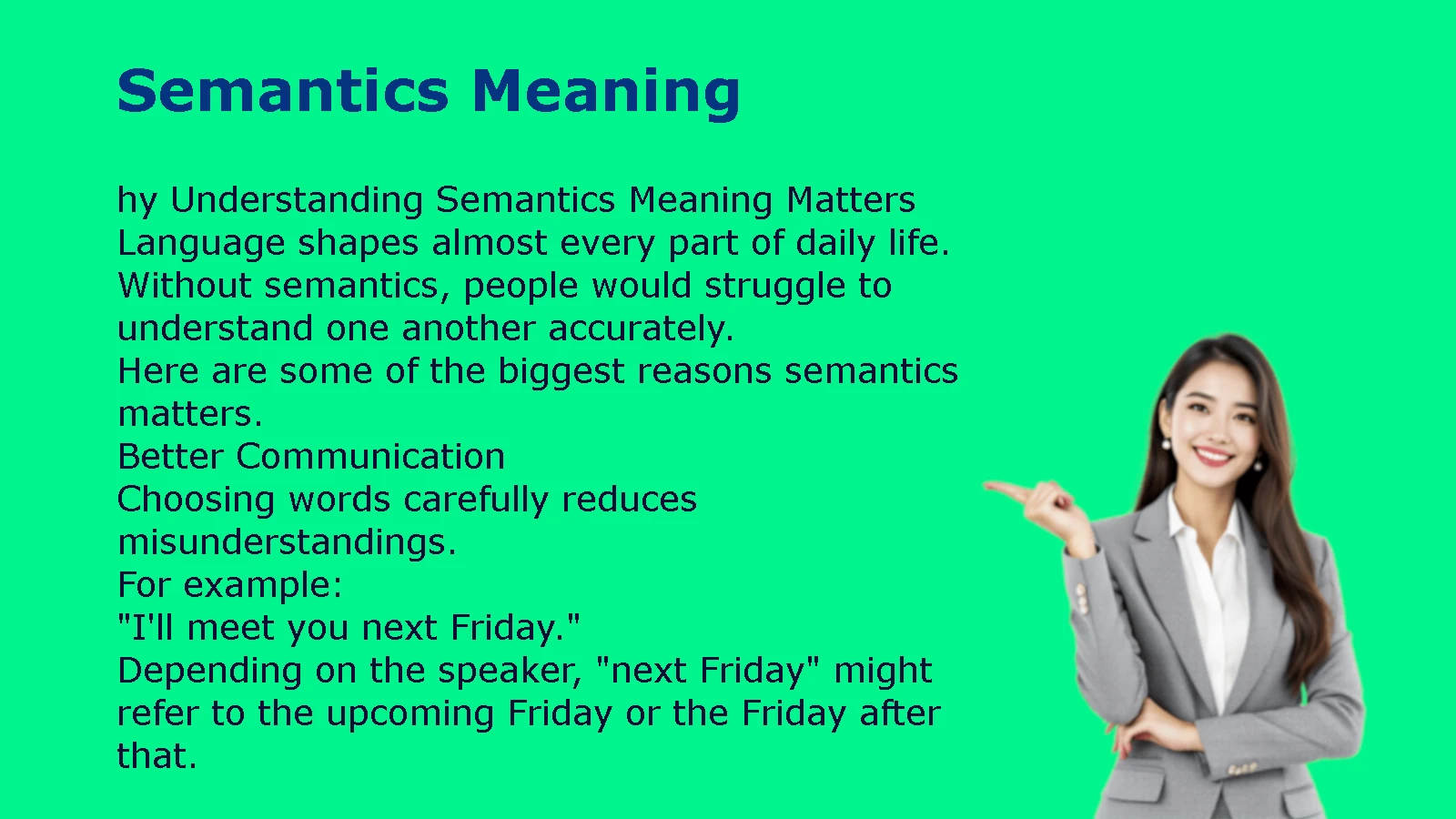
Why Understanding Semantics Meaning Matters
Language shapes almost every part of daily life. Without semantics, people would struggle to understand one another accurately.
Here are some of the biggest reasons semantics matters.
Better Communication
Choosing words carefully reduces misunderstandings.
For example:
- “I’ll meet you next Friday.”
Depending on the speaker, “next Friday” might refer to the upcoming Friday or the Friday after that.
Semantics helps explain why this confusion happens.
Improved Reading Comprehension
Readers constantly interpret meanings beyond individual words.
Consider this sentence:
“The bank was crowded.”
Without additional context, bank could mean:
- A financial institution
- The side of a river
Semantics helps readers determine the intended meaning.
More Effective Writing
Strong writers understand that every word carries meaning.
Instead of writing:
The movie was nice.
A writer who understands semantics may choose:
- Fascinating
- Inspiring
- Emotional
- Suspenseful
- Thought provoking
Each adjective communicates a different experience.
Easier Language Learning
Students learning English often struggle with words that have multiple meanings.
For example:
| Word | Meaning 1 | Meaning 2 |
| Light | Not heavy | Illumination |
| Ring | Jewelry | Telephone call |
| Watch | Timepiece | Observe |
| Bat | Flying mammal | Sports equipment |
Semantics teaches learners how context identifies the correct meaning.
Better Translation
Literal translation often creates awkward or incorrect sentences.
Professional translators rely on semantics to preserve intended meaning instead of translating word by word.
For example:
English:
It’s raining cats and dogs.
Literal translation into another language would make little sense.
A semantic translation would instead communicate:
It’s raining very heavily.
Powering Modern Technology
Many digital tools depend on semantics every day.
These include:
- Search engines
- Voice assistants
- AI chatbots
- Recommendation systems
- Machine translation
- Grammar checkers
Without semantic understanding, these systems would struggle to interpret user intent.
How Semantics Works
Semantics is more than dictionary definitions. It examines how language elements interact to create meaning.
Several factors influence interpretation.
Words Carry Meaning
Every word represents a concept.
For example:
- Apple
- Freedom
- Democracy
- Justice
- Ocean
Each word triggers mental associations.
Some meanings are concrete.
Others are abstract.
Sentences Create Relationships
Words become more meaningful when combined.
Compare these examples.
Sentence A:
The dog chased the cat.
Sentence B:
The cat chased the dog.
Both sentences contain identical words.
However, changing the word order completely changes the meaning.
This shows that semantics depends on relationships between words.
Context Changes Meaning
Context often determines interpretation.
Consider the word:
Cold
Example one:
The weather is cold.
Example two:
She gave me a cold look.
The first refers to temperature.
The second describes emotion.
Although the same word appears in both sentences, semantics changes according to context.
Shared Knowledge Shapes Interpretation
People rely on background knowledge to understand meaning.
Suppose someone says:
The White House announced new policies.
Listeners understand this usually refers to the United States government, not the physical building.
This shared cultural knowledge plays a major role in semantic interpretation.
Intent Also Influences Meaning
Sometimes speakers imply more than they literally say.
Imagine a teacher telling students:
The exam starts in five minutes.
The literal meaning provides information.
The intended meaning may also encourage students to stop talking and prepare.
Semantics helps explain both levels of interpretation.
Types of Semantics Meaning
Linguists divide semantics into several branches because meaning exists at different language levels.
Each branch studies a unique aspect of meaning.
Lexical Semantics Meaning
Lexical semantics focuses on the meanings of individual words and how words relate to one another.
Researchers study questions such as:
- Why do some words have several meanings?
- How are synonyms connected?
- Why do some words belong to larger categories?
Examples include:
- Happy → Joyful
- Dog → Animal
- Car → Vehicle
Lexical semantics forms the foundation of dictionaries and thesauruses.
Sentence Semantics Meaning
Sentence semantics examines how words combine to create complete meanings.
Grammar alone cannot explain sentence meaning.
For example:
Every student solved one problem.
This sentence can have more than one interpretation depending on context.
Sentence semantics studies these possibilities.
Formal Semantics Meaning
Formal semantics uses logic and mathematics to analyze language.
Instead of relying only on intuition, linguists create logical models that describe how meaning works.
This branch is especially important in:
- Linguistics
- Philosophy
- Artificial intelligence
- Programming language theory
Example:
“If A implies B, and A is true, then B must also be true.”
Formal semantics represents this relationship using symbolic logic.
Conceptual Semantics Meaning
Conceptual semantics studies how language connects with human thought.
It asks questions like:
- How does the brain organize meaning?
- Why do similar experiences produce similar concepts?
- How are mental images connected to words?
For instance, when someone hears the word bird, they may instantly imagine:
- Wings
- Feathers
- Flying
- Nest
- Singing
Those connected concepts help create meaning.
Cognitive Semantics Meaning
Cognitive semantics explores how experience influences language.
People understand words through everyday experiences rather than isolated definitions.
For example, many people associate:
Time with money
This explains expressions such as:
- Spend time
- Save time
- Waste time
- Invest time
Although time is not literally money, people understand these expressions because of conceptual metaphors.
Computational Semantics Meaning
Computational semantics helps computers understand human language.
This field combines linguistics with computer science.
Applications include:
- Search engines
- Chatbots
- Virtual assistants
- Text summarization
- Question-answering systems
- Automatic translation
- Spam detection
- Sentiment analysis
When you search for:
Best restaurants near me
Modern search engines analyze your intent instead of matching only exact keywords.
That is computational semantics in action.
Comparing the Main Types of Semantics
| Type | Focus | Example |
| Lexical Semantics | Meaning of individual words | Bright can describe light or intelligence |
| Sentence Semantics | Meaning of complete sentences | Word order changes interpretation |
| Formal Semantics | Logical meaning | Mathematical representation of language |
| Conceptual Semantics | Mental concepts | Bird evokes feathers, wings, and flight |
| Cognitive Semantics | Human experience | Time is money |
| Computational Semantics | Machine understanding | AI interpreting search queries |
Case Study: How One Word Can Change Everything
Imagine a customer sends this message:
“The product is light.”
Without context, the meaning remains unclear.
Possible interpretations include:
- The product weighs very little.
- The color is light.
- The brightness is high.
- The flavor is mild.
A customer service representative asks follow-up questions to identify the intended meaning.
An AI assistant analyzes nearby words and previous messages to predict the correct interpretation.
A human reader relies on experience and context.
Although each uses a different process, all depend on semantics to understand the same sentence.
“Words don’t carry meaning by themselves. People create meaning through language, context, and shared understanding.”
The next section explores lexical semantics, sentence semantics, semantic relationships, and the key differences between semantics, pragmatics, syntax, and semiotics, along with practical examples you encounter every day.
Lexical Semantics Meaning: How Words Create Meaning
Lexical semantics meaning focuses on how individual words carry meaning and how words connect with one another inside a language. While a dictionary gives you a definition, lexical semantics explores the deeper relationships behind those definitions.
For example, the word bright can describe:
- A strong source of light
- An intelligent person
- A vivid color
The meaning changes depending on how the word appears in a sentence.
Lexical semantics helps explain why languages contain words with multiple meanings and why some words feel similar while others feel completely opposite.
Types of Lexical Semantics Meaning
Several important concepts fall under lexical semantics.
Synonyms: Words With Similar Meanings
Synonyms are words that have the same or nearly the same meaning.
Examples:
| Word | Synonym |
| Happy | Joyful |
| Large | Big |
| Begin | Start |
| Smart | Intelligent |
| Beautiful | Attractive |
However, synonyms are rarely perfect replacements.
For example:
- Childish and childlike both relate to children.
- Childish usually suggests immature behavior.
- Childlike often suggests innocence or wonder.
The words share a connection, but their meanings create different impressions.
Antonyms: Words With Opposite Meanings
Antonyms are words with contrasting meanings.
Examples:
| Word | Antonym |
| Hot | Cold |
| Fast | Slow |
| Open | Closed |
| Rich | Poor |
| Success | Failure |
Antonyms help people understand concepts through contrast.
For example:
You understand happiness partly because you recognize sadness.
Meaning often becomes clearer when you compare one idea with another.
Homonyms: Words With Different Meanings
Homonyms are words that look or sound the same but have different meanings.
Examples:
| Word | Meaning One | Meaning Two |
| Bat | Flying animal | Sports equipment |
| Bank | Financial institution | River edge |
| Match | Contest | Object used to create fire |
| Ring | Jewelry | Circular shape or sound |
Homonyms create challenges for language learners because context determines the intended meaning.
Example:
I deposited money at the bank.
Here, bank means a financial institution.
We sat beside the river bank.
Now, bank refers to land near water.
Homophones: Words That Sound the Same
Homophones have the same pronunciation but different spellings and meanings.
Examples:
| Word | Meaning |
| Two | Number |
| Too | Also |
| To | Direction or purpose |
| Their | Belonging to them |
| There | A location |
| They’re | They are |
Homophones explain why spelling errors happen so often in English.
A writer may know the meaning but choose the wrong word because the sounds are identical.
Polysemy: One Word With Multiple Related Meanings
Polysemy occurs when one word has several connected meanings.
Example:
The word head can mean:
- A body part
- A leader
- The top part of something
Examples:
She hurt her head.
He is the head of the company.
The head of the table is reserved.
These meanings connect because they share the idea of a top or controlling position.
Hyponymy and Hypernymy: Category Relationships
Words often exist in category systems.
A hypernym is a broad category.
A hyponym is a specific example within that category.
Example:
| Hypernym | Hyponyms |
| Animal | Dog, Cat, Horse |
| Fruit | Apple, Banana, Orange |
| Vehicle | Car, Truck, Motorcycle |
The relationship works like a family tree.
A dog is an animal, but not every animal is a dog.
Meronymy: Part and Whole Relationships
Meronymy describes how parts connect to a larger whole.
Examples:
| Part | Whole |
| Wheel | Car |
| Finger | Hand |
| Page | Book |
| Keyboard | Computer |
Understanding these relationships helps organize information in the human brain and in computer systems.
Sentence Semantics Meaning: How Sentences Communicate Ideas
While lexical semantics studies individual words, sentence semantics meaning examines how words combine to create complete messages.
A sentence is not simply a collection of words. The relationship between those words creates meaning.
Consider:
The boy chased the dog.
and:
The dog chased the boy.
The same words appear in both sentences, but the meaning changes because the structure changes.
Sentence semantics examines:
- Word order
- Relationships between ideas
- Logical meaning
- Possible interpretations
Literal Meaning and Implied Meaning
Sentences often have a direct meaning and an additional implied meaning.
Example:
“The room is cold.”
Literal meaning:
- The temperature is low.
Possible implied meanings:
- Close the window.
- Turn on the heater.
- Bring a blanket.
Humans naturally interpret more than the exact words spoken.
Semantic Ambiguity in Sentences
A sentence becomes ambiguous when it allows multiple interpretations.
Example:
I saw the man with the telescope.
This could mean:
- I used a telescope to see the man.
- I saw a man who had a telescope.
The words remain the same, but the meaning changes.
Sentence semantics helps identify and explain these differences.
Semantics vs Pragmatics: Understanding the Difference
Many people confuse semantics and pragmatics because both study meaning.
However, they focus on different areas.
| Semantics | Pragmatics |
| Studies literal meaning | Studies intended meaning |
| Focuses on words and sentences | Focuses on context and situations |
| More stable meaning | Changes based on circumstances |
| Examines language itself | Examines language use |
Example:
Someone says:
“It’s getting late.”
Semantic meaning:
The time is becoming late.
Pragmatic meaning:
The person may want to leave.
The sentence itself provides information, but the situation reveals the speaker’s intention.
Why Semantics and Pragmatics Work Together
Imagine a friend says:
“Your phone battery is almost dead.”
The semantic meaning tells you:
- The battery has very little power remaining.
The pragmatic meaning may suggest:
- Charge your phone.
- Stop using it.
- Bring a charger.
Good communication requires understanding both.
Semantics vs Syntax: Meaning vs Structure
Syntax studies how words are arranged to create grammatically correct sentences.
Semantics studies what those sentences mean.
A sentence can have correct syntax but confusing semantics.
Example:
Colorless green ideas sleep furiously.
This sentence follows English grammar rules.
However, the meaning seems unusual because the ideas do not logically connect.
Syntax asks:
Is the sentence structured correctly?
Semantics asks:
Does the sentence communicate meaningful information?
Key Differences Between Syntax and Semantics
| Syntax | Semantics |
| Studies sentence structure | Studies meaning |
| Focuses on grammar rules | Focuses on interpretation |
| Examines word arrangement | Examines ideas expressed |
| Example: Correct word order | Example: Correct understanding |
Both work together.
Without syntax, sentences may become difficult to understand.
Without semantics, perfectly structured sentences may communicate nothing useful.
Semantics vs Semiotics: Language Meaning vs Signs
Semiotics is the study of signs and symbols.
While semantics mainly focuses on language meaning, semiotics studies how all types of signs communicate information.
Examples of signs:
- Traffic lights
- Logos
- Emojis
- Road symbols
- Body language
A red traffic light does not contain words, yet people understand its meaning.
This makes semiotics broader than semantics.
Examples of Semantics in Everyday Life
Semantics appears everywhere, often without people noticing.
Everyday Conversations
A simple sentence can carry different meanings.
Example:
“That’s interesting.”
Depending on tone and context, it might mean:
- I genuinely like this idea.
- I disagree but want to stay polite.
- I need more information.
The words remain the same, but meaning changes.
Social Media
Online communication creates many semantic challenges.
A short message like:
“Great job.”
Could express:
- Genuine praise
- Sarcasm
- Humor
Without facial expressions or voice tone, readers rely heavily on context.
Advertising
Companies carefully choose words because meanings influence emotions.
Compare:
Affordable
vs.
Cheap
Both relate to price.
However:
- Affordable suggests good value.
- Cheap may suggest poor quality.
Advertisers use semantic choices to shape customer perception.
Legal Documents
Legal language depends heavily on precise semantics.
A single word can change the interpretation of a contract.
For example:
- Shall
- May
- Must
Each word carries a different level of obligation.
Lawyers carefully analyze meaning to avoid confusion.
Education
Teachers use semantics to help students understand complex ideas.
For example:
Instead of simply defining photosynthesis, a teacher connects it to everyday concepts:
Plants use sunlight like a person uses energy from food.
The comparison creates a stronger mental connection.
Healthcare Communication
Clear semantics can prevent serious mistakes.
Doctors must explain medical information in ways patients understand.
For example:
Instead of saying:
“You have hypertension.”
A doctor may explain:
“Your blood pressure is higher than the healthy range.”
The second explanation creates clearer meaning for many people.
Semantic Relationships: How Words Connect
Language is not a random collection of words. Words form networks of meaning.
These connections help people understand unfamiliar terms.
| Relationship | Meaning | Example |
| Synonym | Similar meanings | Begin and start |
| Antonym | Opposite meanings | Hot and cold |
| Hypernym | General category | Animal |
| Hyponym | Specific category | Dog |
| Meronym | Part of something | Wheel and car |
| Polysemy | Related meanings | Head of body and organization |
These relationships also help search engines understand topics.
For example, if someone searches:
Best running shoes
A search engine understands related concepts such as:
- Sneakers
- Athletic footwear
- Sports shoes
- Training shoes
This understanding comes from semantic relationships.
Case Study: Semantic Search and Modern Google Results
Traditional search engines matched exact words.
If someone searched:
How can I fix a flat tire?
Older systems mainly looked for pages containing those exact words.
Modern search engines analyze meaning.
They understand that related searches include:
- Repair a punctured tire
- Change a car tire
- Fix tire damage
- Replace a tire tube
The search engine focuses on user intent rather than only matching keywords.
This shift represents the power of semantics in technology.
How Semantics Improves Human and Machine Communication
Semantics creates a bridge between ideas and understanding.
For humans, it improves:
- Conversations
- Writing
- Reading
- Learning
- Translation
For machines, it improves:
- Search accuracy
- AI responses
- Voice recognition
- Data organization
As language continues to evolve, semantic understanding becomes increasingly important.
Semantic Meaning: Ambiguity, Applications, Importance, and Key Takeaways
Language looks simple on the surface. People speak, write, read, and understand messages every day without thinking about the complex systems working behind the scenes.
However, meaning is rarely straightforward. A single word can have several interpretations. A sentence can communicate more than the words directly state. A machine can recognize grammar but still misunderstand the message if it fails to understand meaning.
This is where semantic meaning becomes essential.
From human conversations to artificial intelligence, semantics helps explain how meaning develops, changes, and influences communication. In this section, we’ll explore semantic ambiguity, real world applications, semantics in linguistics and computer science, common misconceptions, and practical ways to improve your understanding of meaning.
Common Types of Semantic Ambiguity
Semantic ambiguity occurs when a word, phrase, or sentence allows more than one possible interpretation.
Ambiguity does not always create problems. Sometimes it adds humor, creativity, or depth to language. However, unclear meaning can also cause confusion.
Lexical Ambiguity
Lexical ambiguity happens when a single word has multiple meanings.
Example:
I went to the bank.
The word bank creates uncertainty.
It could mean:
- A financial institution
- The edge of a river
The listener needs context to understand the intended meaning.
More examples:
| Word | Possible Meanings |
| Spring | A season, a jump, a water source |
| Bark | Tree covering, sound made by a dog |
| Crane | A bird, a lifting machine |
| Scale | Measurement tool, fish covering, size comparison |
Lexical ambiguity is common because many English words developed multiple meanings over time.
Structural Ambiguity
Structural ambiguity happens when the arrangement of words creates multiple meanings.
Example:
The chicken is ready to eat.
This sentence may mean:
- The chicken is cooked and ready for people to eat.
- The chicken itself is prepared to eat something.
The individual words are clear, but the sentence structure creates uncertainty.
Referential Ambiguity
Referential ambiguity occurs when it is unclear what a word refers to.
Example:
Sarah told Emily that she won the award.
Who won the award?
- Sarah?
- Emily?
The word she does not provide enough information.
Writers avoid this type of ambiguity by adding clearer details.
Instead of:
She won the award.
A clearer sentence:
Sarah told Emily that Sarah won the award.
Why Semantic Ambiguity Matters
Understanding ambiguity helps people:
- Write clearer messages
- Avoid misunderstandings
- Improve translation accuracy
- Create better AI systems
- Interpret literature and media
Great communication is not only about choosing words. It is about choosing words that create the intended meaning.
Real World Applications of Semantics Meaning
Semantics is not limited to academic linguistics. It affects many areas of modern life.
Semantics in Search Engines
Search engines use semantics to understand what users actually want.
In the past, search systems focused mainly on matching exact keywords.
For example:
A search for:
How to repair a bicycle chain
might only look for pages containing those exact words.
Modern search systems understand related concepts:
- Fix a broken bike chain
- Bicycle chain repair guide
- Replace damaged chain links
The system recognizes that these phrases share the same meaning.
This approach is called semantic search.
Semantic search helps users find better answers because it focuses on intent rather than simple word matching.
Semantics in Artificial Intelligence
Artificial intelligence depends heavily on semantic understanding.
An AI system needs to understand:
- What words mean
- How words relate
- What the user intends
- How context changes meaning
For example:
User:
Can you help me find a light laptop?
A basic system might think:
- Light = brightness
A semantic system understands:
- Light = low weight
This difference shows why meaning matters.
Semantics in Natural Language Processing
Natural Language Processing (NLP) combines computer science and linguistics to help machines understand human language.
NLP uses semantics for tasks such as:
- Text classification
- Sentiment analysis
- Translation
- Question answering
- Chatbots
- Voice recognition
For example:
A sentiment analysis tool examines:
This movie was surprisingly amazing.
The system must understand that amazing expresses positive emotion.
Semantics in Voice Assistants
Voice assistants such as smart speakers depend on semantic analysis.
When someone says:
Play relaxing music for dinner.
The assistant must understand:
- “Play” means start audio
- “Relaxing music” describes a category
- “For dinner” provides context
Without semantics, voice assistants would only recognize sounds rather than understand requests.
Semantics in Machine Translation
Translation requires more than replacing words from one language with another.
Languages often organize meaning differently.
For example:
English:
I am feeling blue.
A word by word translation may create confusion.
The semantic meaning is:
I feel sad.
Translation systems must understand the idea behind the sentence, not only the individual words.
Semantics in Knowledge Graphs
Modern search systems use knowledge graphs to connect information.
A knowledge graph organizes relationships between:
- People
- Places
- Events
- Objects
- Concepts
Example:
A search for:
Albert Einstein
may connect:
- Scientist
- Theory of relativity
- Physics
- Nobel Prize
- Germany
These connections help machines understand relationships between concepts.
Semantics in Linguistics
In linguistics, semantics is one of the major fields that explains how humans create meaning.
Language study often includes several connected areas:
| Field | Studies |
| Phonetics | Physical sounds |
| Phonology | Sound patterns |
| Morphology | Word formation |
| Syntax | Sentence structure |
| Semantics | Meaning |
| Pragmatics | Meaning in context |
Semantics works alongside these fields.
A word must have:
- A sound pattern
- A structure
- A meaning
All parts work together to create communication.
Semantics in Computer Science
Computer science uses semantics to explain how systems interpret information.
Programming Language Semantics
Programming languages also have semantics.
In programming, semantics explains what a piece of code does.
For example:
Two programs may look different but produce the same result.
The semantics focuses on the behavior and meaning of the instructions.
Programmers use semantic analysis to:
- Find errors
- Improve software reliability
- Design programming languages
Semantic Web
The Semantic Web aims to make internet information easier for machines to understand.
Traditional web pages mainly provide information for humans.
The Semantic Web adds structured meaning so computers can understand relationships between data.
Examples include:
- Product information
- Medical records
- Research databases
- Online libraries
Semantic Data Modeling
Businesses use semantic models to organize information.
For example, a company may connect:
- Customers
- Products
- Orders
- Locations
Instead of storing isolated data, semantic models show relationships.
This helps organizations make better decisions.
Common Misconceptions About Semantics
Many people misunderstand what semantics actually means.
Let’s clear up some common myths.
“Semantics Is Just Arguing About Words”
People often say:
“That’s just semantics.”
They usually mean someone is focusing too much on small wording differences.
However, semantics is a serious academic field.
Meaning affects:
- Law
- Science
- Technology
- Education
- Communication
A small wording change can sometimes create a completely different interpretation.
“Every Word Has Only One Meaning”
Many people assume words have fixed meanings.
In reality, language changes constantly.
Words gain new meanings through:
- Culture
- Technology
- Social trends
- Human creativity
Example:
The word mouse once mainly referred to an animal.
Today, it also refers to a computer device.
“Context Does Not Matter”
Context plays a major role in meaning.
The sentence:
That’s cold.
Could describe:
- Temperature
- Someone’s behavior
- An unfriendly response
The surrounding situation determines interpretation.
How to Improve Your Understanding of Semantics
Anyone can improve their understanding of meaning by practicing how language works.
Read Different Types of Content
Exposure to different writing styles improves semantic awareness.
Read:
- News articles
- Fiction
- Academic writing
- Conversations
- Advertisements
Each type uses language differently.
Study Word Relationships
Learn how words connect.
Pay attention to:
- Synonyms
- Antonyms
- Categories
- Multiple meanings
For example:
Instead of learning only:
Happy = feeling good
Explore related words:
- Cheerful
- Delighted
- Excited
- Content
- Joyful
Each word creates a slightly different meaning.
Pay Attention to Context
Never study words completely alone.
Compare:
She broke the glass.
and:
She broke the news.
The word broke appears in both sentences but creates different meanings.
Context reveals the intended idea.
Practice Identifying Ambiguity
Look at sentences and ask:
- Could this have another meaning?
- What information determines the meaning?
- Would another reader interpret it differently?
This skill improves writing and communication.
Use Reliable Language Resources
Helpful resources include:
- Dictionaries
- Thesauruses
- Language databases
- Academic articles
- Corpus tools
These resources show how words actually appear in real communication.
Frequently Asked Questions About Semantics Meaning
What is semantics meaning in simple words?
Semantics meaning refers to the study of how words, phrases, and sentences create meaning. It explains how people understand language and interpret messages.
What is an example of semantics?
The word bright provides a simple example.
It can mean:
- Full of light
- Intelligent
- Strong in color
The context determines the intended meaning.
What are the main types of semantics?
The major types include:
- Lexical semantics
- Sentence semantics
- Formal semantics
- Conceptual semantics
- Cognitive semantics
- Computational semantics
Each type studies a different aspect of meaning.
What is the difference between semantics and pragmatics?
Semantics studies the direct meaning of words and sentences.
Pragmatics studies how context changes meaning.
Example:
“Can you open the window?”
Semantically, it asks about ability.
Pragmatically, it usually means a request.
Why is semantics important?
Semantics improves communication by helping people understand:
- Word meanings
- Sentence interpretation
- Context
- Intent
It also helps technology understand human language.
How is semantics used in AI?
AI uses semantics to understand user requests, analyze text, translate languages, and generate meaningful responses.
Without semantics, AI systems would struggle with human communication.
Can one word have multiple meanings?
Yes.
Many English words have multiple meanings.
Examples:
- Bank
- Bat
- Light
- Head
- Match
Context determines which meaning applies.
Key Takeaways About Semantics Meaning
Semantics is the study of meaning in language. It explains how people understand words, sentences, and ideas.
The most important points include:
- Semantics focuses on meaning, not just words.
- Context plays a major role in interpretation.
- Words can have multiple meanings depending on usage.
- Lexical and sentence semantics explain different levels of meaning.
- Semantics works with syntax and pragmatics to create communication.
- Modern technology relies heavily on semantic understanding.
- AI, search engines, and translation tools use semantics to interpret human language.
Language is more than a collection of sounds and symbols. It is a system of shared meaning that connects people, ideas, and information.
By understanding semantics meaning, you gain a clearer view of how communication works and why the right words can completely change how a message is understood.