
Have you ever come across the word “scrutinize” and wondered what it really means? While SCRUTINIZE Meaning may sound formal or difficult at first, it simply refers to looking at something very carefully to find details, problems, or mistakes. The exact meaning can depend on the sentence, context, and situation in which it is used.
Scrutinize is a verb that means to examine or inspect something closely and carefully. When you scrutinize something, you do more than take a quick look. You pay close attention to its details so you can understand, evaluate, or judge it properly.
Examples:
- The manager scrutinized the report for errors.
- She scrutinized the contract before signing it.
The confusion is understandable. People often search for what does scrutinize mean, scrutinize meaning in English, scrutinize meaning in a sentence, or how to use scrutinize correctly because the word often appears in formal writing, news articles, academic texts, and professional conversations. And here’s the kicker: scrutinize doesn’t simply mean to look at something. It suggests a careful and detailed examination.
In this guide, you’ll learn the complete SCRUTINIZE Meaning, its definition, pronunciation, synonyms, correct usage, and examples in sentences. You’ll also discover how to use scrutinize in everyday and formal situations, along with the difference between scrutinize, inspect, examine, and other similar words.
What Does “Scrutinize” Mean?
Scrutinize is a verb that means to examine something or someone very carefully and closely in order to discover information or understand the details.
Cambridge Dictionary defines scrutinize as examining something very carefully to discover information. It also identifies the word as a transitive verb, meaning it normally takes a direct object.
In simple English, to scrutinize something means to look at it closely and pay careful attention to its details.
Think of the difference between looking at a map and scrutinizing one.
When you simply look at a map, you might find the general location of a city. When you scrutinize it, you may trace every road, compare distances, inspect symbols, and search for the best route.
Scrutinize Definition in Simple Words
Here are several easy ways to understand the word:
- Examine very carefully
- Study closely
- Inspect every important detail
- Look at something with great attention
- Investigate something closely
- Check something thoroughly
The central idea is careful examination.
A Quick Definition
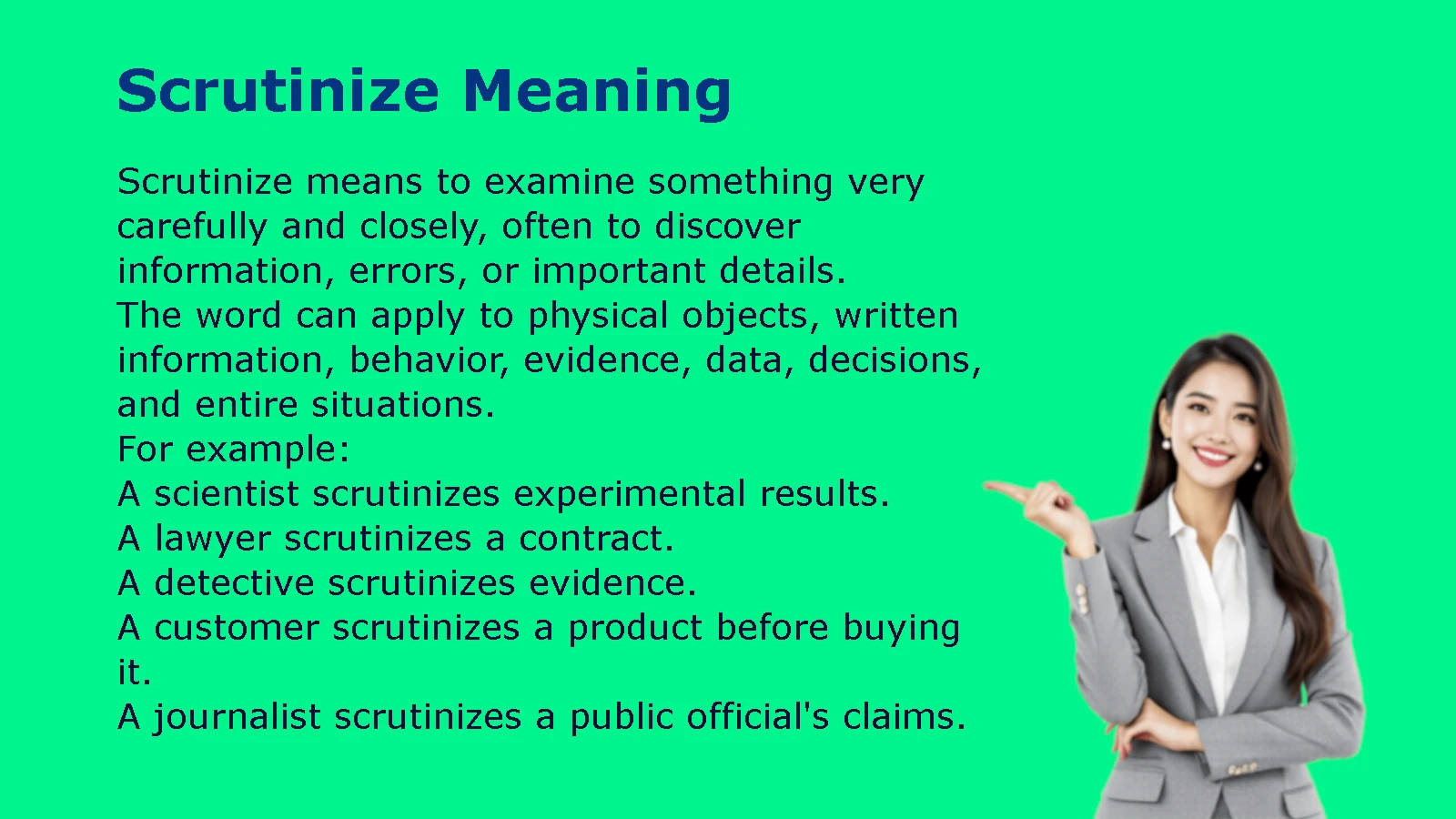
Scrutinize means to examine something very carefully and closely, often to discover information, errors, or important details.
The word can apply to physical objects, written information, behavior, evidence, data, decisions, and entire situations.
For example:
- A scientist scrutinizes experimental results.
- A lawyer scrutinizes a contract.
- A detective scrutinizes evidence.
- A customer scrutinizes a product before buying it.
- A journalist scrutinizes a public official’s claims.
What Does Scrutinize Mean in Simple English?
If scrutinize sounds too formal, replace it mentally with “look at very carefully.”
For instance:
“She scrutinized the document before signing it.”
Simply put:
“She looked over the document very carefully before signing it.”
The difference is intensity. Looked over can suggest a fairly quick review, while scrutinized suggests closer attention to details.
You might use look at when someone asks you to check a picture.
You might use scrutinize when you’re searching that picture for a tiny clue.
That extra level of attention is what gives scrutinize its distinctive meaning.
Scrutinize Pronunciation
The American English pronunciation of scrutinize is approximately:
SKROO-tuh-nize
Its IPA pronunciation is:
/ˈskruː.t̬ə.naɪz/
Cambridge lists the American pronunciation as /ˈskruː.t̬ə.naɪz/ and the British pronunciation as /ˈskruː.tɪ.naɪz/.
The stress falls on the first syllable:
SCRU-ti-nize
The final part sounds like “eyes.”
Is It “Scrutinize” or “Scrutinise”?
Both spellings are correct.
| Spelling | Common usage |
| scrutinize | American English |
| scrutinise | British English |
Cambridge identifies scrutinise as the usual British spelling.
So if you’re writing for an American audience, scrutinize is the standard spelling.
Is Scrutinize a Verb or a Noun?
Scrutinize is a verb.
It describes the action of examining something carefully.
For example:
The committee scrutinized the proposal.
The related noun is scrutiny.
The proposal came under scrutiny.
There is also the less common noun scrutinization, which refers to the act or process of scrutinizing something. However, scrutiny is far more natural and common in ordinary English.
Related Forms of Scrutinize
| Word | Part of speech | Example |
| scrutinize | Verb | They scrutinize every application. |
| scrutinizes | Verb | She scrutinizes every detail. |
| scrutinized | Verb | The report was scrutinized carefully. |
| scrutinizing | Verb/participle | He is scrutinizing the evidence. |
| scrutiny | Noun | The decision came under scrutiny. |
| scrutinizer | Noun | The reviewer was a careful scrutinizer. |
Knowing these forms makes it easier to recognize the word when you encounter it in different sentences.
Examples of Scrutinize in Everyday Life
You don’t need to work in a laboratory or courtroom to scrutinize something. People scrutinize things every day, often without realizing they’re using the concept.
Checking a Receipt
Suppose you buy several items at a store. Before leaving, you check the receipt carefully to make sure you weren’t charged twice.
You could say:
I scrutinized the receipt to make sure every charge was correct.
The word works because you’re examining the details rather than merely glancing at the receipt.
Examining a Product
Imagine you’re buying an expensive watch. You look at the face, inspect the materials, check the markings, and compare the details with the manufacturer’s information.
You might say:
He scrutinized the watch before purchasing it.
Reading a Contract
Contracts often contain details that are easy to miss.
Someone might read the entire document carefully before agreeing to it:
She scrutinized the contract before signing it.
This is a particularly natural use of the word because contracts often require careful attention to conditions and exceptions.
Looking at a Photograph
Imagine you’re trying to identify something in an old photograph.
You zoom in and inspect the background, clothing, faces, and objects.
The detective scrutinized the photograph for clues.
The sentence conveys more than simply looked at. It tells the reader that the detective examined the photograph with a specific purpose.
Scrutinize Examples in the Workplace
The word scrutinize appears frequently in professional and business writing because workplaces often involve documents, decisions, financial information, and evidence.
Financial Records
The accountant scrutinized the company’s financial records before preparing the report.
The accountant isn’t merely reading the records. They’re checking the details carefully.
A Business Proposal
The investors scrutinized the proposal before deciding whether to fund the project.
Here, scrutinized suggests detailed evaluation.
Job Applications
The hiring team scrutinized each application before selecting candidates for interviews.
This means the team examined the applications carefully.
A Performance Report
The manager scrutinized the quarterly report to identify unusual changes in sales.
The purpose of the scrutiny matters. The manager isn’t just reading numbers. They’re searching for information that might explain something.
Scrutinize Examples in Academic and Scientific Contexts
Academic writing often uses scrutinize when researchers examine evidence, methods, findings, or assumptions.
For example:
Researchers scrutinized the study’s data before drawing a conclusion.
Another example:
The scientists scrutinized the experimental results for inconsistencies.
In this context, scrutiny helps separate a casual observation from a careful investigation.
Researchers might scrutinize:
- Experimental data
- Research methods
- Statistical results
- Historical evidence
- Previous studies
- Survey responses
- Scientific claims
- The assumptions behind an argument
The word fits particularly well when the examination is detailed and deliberate.
How to Use “Scrutinize” in a Sentence
The most common grammatical pattern is:
scrutinize + object
For example:
She scrutinized the report.
Here:
- She = subject
- scrutinized = verb
- the report = direct object
Because scrutinize is normally transitive, it typically acts on something.
Common Sentence Patterns
Subject + scrutinize + object
The lawyer scrutinized the contract.
Subject + scrutinized + object + for + purpose
The lawyer scrutinized the contract for hidden clauses.
Subject + scrutinize + object + closely/carefully
The committee scrutinized the evidence carefully.
Subject + be + scrutinizing + object
The investigators are scrutinizing the evidence.
These structures work in both everyday and formal writing.
What Can You Scrutinize?
Almost anything that contains information or details can become the object of scrutiny.
Documents
- Contracts
- Reports
- Applications
- Records
- Letters
- Financial statements
- Research papers
Information
- Claims
- Evidence
- Statistics
- Data
- Arguments
- Statements
- Predictions
People and Behavior
- Facial expressions
- Actions
- Statements
- Behavior
- Body language
Objects and Places
- Products
- Photographs
- Machines
- Buildings
- Maps
- Artwork
Decisions and Situations
- Policies
- Proposals
- Plans
- Decisions
- Strategies
- Events
This flexibility explains why scrutinize appears in business, journalism, science, law, politics, education, and everyday conversation.
Scrutinize vs. Examine
Scrutinize and examine are close synonyms, but they aren’t always identical.
Examine is the broader word. It means to look at or study something carefully, often to understand it or form an opinion.
Scrutinize usually suggests a more intense or detailed examination.
Consider these examples:
The doctor examined the patient.
This sounds completely natural because medical examination is a standard process.
Now compare:
The doctor scrutinized the patient’s medical records.
This suggests that the doctor examined the records particularly closely, perhaps looking for an overlooked detail.
Key Difference
| Word | Meaning | Typical emphasis |
| Examine | Study or inspect carefully | General careful examination |
| Scrutinize | Examine extremely closely | Details, clues, errors, or information |
You can think of examine as opening the book and reading it.
Scrutinize is reading it with a magnifying glass.
That’s not a strict rule, but it’s a useful way to remember the difference.
Scrutinize vs. Inspect
These two words overlap, but they often appear in different situations.
Inspect commonly means to examine something systematically, especially to check its condition, quality, safety, or compliance with a standard.
For example:
The mechanic inspected the car before returning it to the customer.
That suggests a practical check.
By contrast:
The mechanic scrutinized the repair records for inconsistencies.
Here, the emphasis falls on close attention to information and details.
Simple Comparison
| Word | Typical focus |
| Inspect | Condition, quality, safety, compliance |
| Scrutinize | Details, information, clues, inconsistencies |
The words can overlap, but the context determines which one sounds more natural.
Scrutinize vs. Analyze
These words are sometimes treated as interchangeable, but there’s an important distinction.
Scrutinize emphasizes close examination.
Analyze emphasizes breaking something down to understand its components, structure, relationships, or meaning.
For example:
The researcher scrutinized the data.
The researcher examined it closely.
You can do both:
The researcher scrutinized the data before analyzing the results.
That sentence makes perfect sense. First comes careful inspection. Then comes deeper interpretation.
Scrutinize vs. Criticize
This is one of the most important distinctions to understand.
Scrutinize does not mean criticize.
To scrutinize something means to examine it closely.
To criticize something means to express disapproval or identify faults.
You can scrutinize something without finding anything wrong.
For example:
The scientist scrutinized the results and confirmed that they were consistent.
The scientist examined the results carefully but didn’t necessarily criticize them.
Compare that with:
The reviewer criticized the study for using a small sample.
The reviewer expressed a negative judgment.
So:
Scrutinize = examine closely
Criticize = judge negatively or point out faults
The distinction matters because scrutinize can sound negative in some contexts, but its basic meaning is neutral.
Is Scrutinize a Positive or Negative Word?
Scrutinize is neutral by itself.
The surrounding context gives it its emotional tone.
For example:
The editor scrutinized the manuscript and improved several unclear passages.
That sounds useful and constructive.
Now consider:
The supervisor scrutinized every minor mistake the employee made.
This sounds more negative because the intense attention feels excessive or unfair.
Positive Uses
- Checking research carefully
- Verifying financial records
- Reviewing safety procedures
- Checking evidence
- Finding errors before publication
Negative or Critical Uses
- Watching someone’s behavior suspiciously
- Searching for flaws
- Examining someone excessively
- Subjecting a person to intense public attention
The word itself doesn’t tell you whether the scrutiny is justified.
Common Phrases With Scrutinize
Some combinations sound especially natural in English.
Scrutinize the Details
She scrutinized the details before accepting the offer.
This means she examined the small but potentially important parts.
Scrutinize the Evidence
The investigators scrutinized the evidence before reaching a conclusion.
This is common in legal, scientific, and investigative contexts.
Scrutinize the Data
The researchers scrutinized the data for unusual patterns.
This works well in academic and technical writing.
Scrutinize a Report
The board scrutinized the report before approving the proposal.
Scrutinize a Claim
Readers should scrutinize extraordinary claims before accepting them as facts.
This use highlights careful judgment.
Closely Scrutinize
The committee closely scrutinized the proposed changes.
The adverb closely reinforces the idea of detailed examination.
Carefully Scrutinize
Investors carefully scrutinized the company’s financial statements.
This combination is also natural, although scrutinize already contains the idea of careful examination.
What Does “Under Scrutiny” Mean?
The noun related to scrutinize is scrutiny.
Scrutiny means careful and detailed examination. Cambridge defines it as the careful and detailed examination of something to obtain information about it.
The phrase under scrutiny means that someone or something is being examined closely.
For example:
The company’s spending practices came under scrutiny.
This means people began examining the company’s spending practices carefully.
Another example:
The politician’s statements are under public scrutiny.
That means the public, journalists, or other observers are examining those statements closely.
Scrutinize vs. Under Scrutiny
| Form | Grammar | Example |
| Scrutinize | Verb | The committee scrutinized the proposal. |
| Scrutiny | Noun | The proposal faced scrutiny. |
| Under scrutiny | Phrase | The proposal came under scrutiny. |
This distinction is useful because these expressions frequently appear together in news and formal writing.
Scrutinize Synonyms
Several words can replace scrutinize, but each carries a slightly different shade of meaning.
Examine
The broadest and safest alternative.
The doctor examined the patient.
Inspect
Often implies a systematic check.
The technician inspected the machine for damage.
Study
Focuses on spending time learning about or understanding something.
She studied the document carefully.
Analyze
Focuses on breaking information down and interpreting it.
The team analyzed the survey results.
Investigate
Usually suggests actively searching for facts about a problem, event, or situation.
The police investigated the complaint.
Review
Often means looking over something again or checking it.
Please review the report before the meeting.
Assess
Focuses on judging the quality, value, importance, or condition of something.
The committee assessed the proposal.
Evaluate
Emphasizes judging something against criteria or standards.
The company evaluated the candidates.
Synonym Comparison Table
| Synonym | Main idea | Strength of “close examination” |
| Examine | Look at carefully | High |
| Inspect | Check systematically | High |
| Study | Spend time understanding | Medium–high |
| Analyze | Break down and interpret | High |
| Investigate | Search for facts | High |
| Review | Look over or reconsider | Medium |
| Assess | Judge condition or value | Medium |
| Evaluate | Judge against criteria | Medium–high |
The best synonym depends on what you’re trying to say. Scrutinize is especially useful when you want to emphasize careful attention to details.
Scrutinize Antonyms
There isn’t one perfect opposite of scrutinize, but several words can contrast with it.
Ignore
To pay no attention to something.
He ignored the warning signs.
Neglect
To fail to give something the attention it needs.
The company neglected important safety checks.
Overlook
To fail to notice something.
The reviewer overlooked a major error.
Disregard
To deliberately ignore something.
She disregarded the evidence.
Skim
To read or examine something quickly without focusing on every detail.
He skimmed the report before the meeting.
That last example is especially useful because skim represents almost the opposite approach to scrutinize.
Word Origin of Scrutinize
The history of scrutinize is surprisingly interesting.
The verb dates to the 1670s and developed from scrutiny + -ize. Earlier English used the verb scrutine, which appeared in the late 16th century. The deeper root comes from Latin scrutari, meaning to examine, investigate, or search.
The related noun scrutiny appeared earlier, in the early 15th century. Its history is connected to Late Latin scrutinium, meaning a search or inquiry.
There is also an interesting older sense behind the Latin word. Etymological sources connect scrutari with the idea of searching through scruta, a word associated with trash, rags, or discarded things. The historical connection isn’t a modern definition, of course. Today, scrutinize simply means to examine closely.
A Short Word-History Timeline
| Period | Development |
| Ancient Latin | scrutari = examine, investigate, search |
| Late Latin | scrutinium = search or inquiry |
| Early 15th century | scrutiny enters English |
| Late 16th century | Earlier verb scrutine appears |
| 1670s | scrutinize develops |
| Modern English | Means to examine very carefully |
The history helps explain why scrutinize has always carried a strong sense of searching closely rather than simply seeing something.
Case Study: Why Scrutinize Is Stronger Than “Check”
Imagine that a company receives a financial report containing hundreds of transactions.
An employee might check the report to make sure it has been submitted.
Another employee might review it to understand the main figures.
An accountant might analyze it to identify spending patterns.
But an auditor might scrutinize it, examining individual entries and looking for inconsistencies, unexplained amounts, or other details that require attention.
These words aren’t competing definitions. They’re describing different levels or purposes of examination.
| Action | What the person is doing |
| Check | Making sure something is correct or present |
| Review | Looking over information |
| Examine | Studying something carefully |
| Analyze | Breaking information down |
| Scrutinize | Examining details extremely closely |
| Investigate | Searching for facts or an explanation |
This is why choosing the right verb matters. A single word can change the reader’s understanding of how carefully someone examined something.
Common Mistakes With “Scrutinize”
Even though the meaning is straightforward, several mistakes appear frequently.
Mistake: Assuming Scrutinize Always Means Criticize
It doesn’t.
Correct: The scientists scrutinized the results before publishing them.
The scientists examined the results closely. The sentence doesn’t say they disliked or rejected them.
Mistake: Using It for a Casual Glance
If someone briefly looks at something, scrutinize may be too strong.
Natural: I glanced at the menu.
Natural: I scrutinized the menu because I had a food allergy.
The second sentence gives a clear reason for the detailed examination.
Mistake: Confusing Scrutinize With Analyze
Analysis goes beyond observation and often involves interpreting relationships, patterns, or components.
You can scrutinize information without fully analyzing it.
Mistake: Confusing Scrutinize With Investigate
An investigation usually involves a broader search for facts.
Scrutiny can be one part of an investigation.
For example:
The detective investigated the case and scrutinized the available evidence.
That sentence uses both words correctly.
Scrutinize in Formal and Informal English
Scrutinize is common in formal, professional, academic, and journalistic writing.
You’ll often see it in sentences involving:
- Government decisions
- Financial reports
- Scientific research
- Legal documents
- Corporate policies
- Public statements
- Political claims
- Evidence
- Safety procedures
It’s also perfectly valid in everyday English.
For example:
I scrutinized the menu because I couldn’t decide what to order.
Still, in casual conversation, people often choose simpler alternatives such as look over, check, or look closely.
That’s not because scrutinize is incorrect. It’s simply more formal and precise.
Scrutinize in Professional Writing
The word works particularly well when you need to communicate precision and careful attention without using a long phrase.
Compare:
The committee looked at the proposal very carefully.
with:
The committee scrutinized the proposal.
The second version is shorter while preserving the idea of close examination.
That’s one reason the word is useful in reports, essays, news articles, and professional documents.
However, don’t use it just to make writing sound sophisticated. If check communicates the idea perfectly, use check. Good writing isn’t about choosing the fanciest word in the dictionary. It’s about choosing the most accurate one.
When Should You Use “Scrutinize”?
Use scrutinize when the situation involves meaningful attention to detail.
It works especially well when someone is:
- Searching for hidden information
- Looking for errors
- Checking evidence
- Examining claims
- Comparing details
- Looking for inconsistencies
- Evaluating a complicated document
- Studying someone’s behavior
- Checking data carefully
A Useful Rule
Ask yourself:
“Is this person merely looking at something, or are they examining it closely for a reason?”
If the second description fits, scrutinize may be the perfect word.
Scrutinize Meaning: Quick Reference
| Question | Answer |
| What does scrutinize mean? | To examine something very carefully and closely. |
| Is scrutinize a verb? | Yes. |
| What is the noun form? | Scrutiny. |
| What is the British spelling? | Scrutinise. |
| How is it pronounced? | SKROO-tuh-nize. |
| Does it always mean criticize? | No. |
| Is it formal? | It is common in formal and professional English but can also appear in everyday speech. |
| What is a close synonym? | Examine. |
| What is a stronger alternative in some contexts? | Inspect or investigate, depending on the meaning. |
| What does “under scrutiny” mean? | Being examined closely. |
Frequently Asked Questions About Scrutinize
What does scrutinize mean in simple words?
Scrutinize means to look at or examine something very carefully and closely. It usually suggests paying attention to details to discover information, errors, or problems.
What is an example of scrutinize?
The lawyer scrutinized the contract before signing it.
The lawyer examined the contract carefully, paying attention to its details.
Is scrutinize a positive or negative word?
Scrutinize is neutral. The context determines whether the careful examination seems helpful, suspicious, critical, or excessive.
For example, scrutinizing scientific data can be responsible. Scrutinizing someone’s every minor mistake can sound overly critical.
What is another word for scrutinize?
Common alternatives include examine, inspect, study, analyze, investigate, review, assess, and evaluate. The best choice depends on the context.
What is the difference between scrutinize and examine?
Both mean to look at something carefully. However, scrutinize usually emphasizes especially close or detailed examination, while examine has a broader meaning.
What is the difference between scrutinize and criticize?
Scrutinize means to examine closely. Criticize means to express disapproval or point out faults. You can scrutinize something without criticizing it.
What does “under scrutiny” mean?
Under scrutiny means being examined carefully, often by other people.
The company’s financial practices came under scrutiny.
This means people began examining those practices closely.
Is scrutinize the same as inspect?
Not always. Inspect often means checking something systematically for condition, quality, or safety. Scrutinize emphasizes close attention to details and information.
Is scrutinize a formal word?
It is somewhat formal and appears frequently in professional, academic, legal, journalistic, and business writing. However, it’s not restricted to formal contexts.
What is the noun form of scrutinize?
The main noun is scrutiny.
The decision came under intense scrutiny.
Scrutinization also exists as a noun, but scrutiny is the more natural and widely useful form.
Final Takeaway: Scrutinize Meaning
The simplest way to remember scrutinize is this:
To scrutinize something means to examine it very carefully and closely.
The word goes beyond a quick glance. It suggests deliberate attention to details, often because you want to discover information, identify a mistake, understand evidence, or make a sound judgment.
You can scrutinize a contract, scrutinize evidence, scrutinize data, scrutinize a claim, or scrutinize someone’s behavior.
Remember the most important distinctions:
- Scrutinize = examine very closely
- Examine = study or inspect carefully
- Inspect = check systematically
- Analyze = break down and interpret
- Investigate = search for facts
- Criticize = point out faults or express disapproval
- Scrutiny = careful, detailed examination
- Under scrutiny = being examined closely
Once you understand that difference, scrutinize becomes an easy word to use. Whenever ordinary look at or check doesn’t capture the level of attention involved, scrutinize can give your sentence the precision it needs.