
Caveat is a word that means a warning, caution, or condition that should be considered before making a decision or accepting something. It is commonly used in legal, business, and everyday contexts to highlight an important limitation or exception. Caveat meaning refers to this warning or qualifying condition that affects how something should be understood or applied.
The confusion usually comes from its formal tone and multiple uses. A caveat can be a warning, condition, or limitation, but its meaning depends on the context. Here’s the good news: once you understand the word, it’s surprisingly easy to recognize and use with confidence.
In this guide, you’ll discover the caveat meaning, caveat definition, how to pronounce caveat, what does caveat mean, and how to use caveat in a sentence. You’ll also learn caveat synonyms, explore legal and everyday examples, and understand when this versatile word is the right choice.
By the end, you’ll know exactly what caveat means, how to use it naturally in both formal and casual writing, and how to avoid common misunderstandings.
What Does “Caveat” Mean?
The caveat meaning is straightforward once you understand its purpose.
A caveat is an important warning, condition, qualification, or limitation that should be considered before making a decision or accepting a statement as completely true.
Rather than rejecting an idea, a caveat modifies it. It tells the listener or reader that there’s an exception or additional information worth knowing.
For example:
- I’ll support your proposal, with one caveat—you’ll need to finish the project before December.
- The hotel offers free parking, with the caveat that spaces are limited.
- The investment looks promising, but every opportunity comes with its own caveats.
Notice how each sentence introduces an important condition without changing the overall message.
Simple Definition of Caveat
In everyday English, caveat simply means:
- A warning
- A condition
- An exception
- An important note
- A limitation
The exact meaning depends on the context.
Dictionary Meaning of Caveat
Most English dictionaries define caveat as:
A warning or statement of conditions that should be considered before taking action or accepting something.
Legal dictionaries also include a second meaning involving formal legal notices, which you’ll learn about later.
Although dictionaries use slightly different wording, they all describe the same basic idea: a caveat reminds people to pay attention to an important qualification.
Legal Meaning vs Everyday Meaning
One reason people find this word confusing is that it has both a general and a legal meaning.
| Context | Meaning | Example |
| Everyday English | A warning, condition, or limitation | The offer is attractive, with one caveat. |
| Business | A qualification before agreeing | The deal is acceptable with one caveat. |
| Academic Writing | An important limitation | Researchers included one caveat in the study. |
| Law | A formal notice requesting that no action be taken without notifying the interested party | A caveat was filed with the court. |
Outside legal settings, most people use caveat to mean an important condition or warning.
Pronunciation of Caveat
The standard pronunciation is:
KAV-ee-at
Phonetic spelling: /ˈkæv.i.æt/
Break it into three parts:
- CAV
- ee
- at
Many English learners mistakenly stress the second syllable, but the first syllable receives the strongest emphasis.
Origin and History of the Word “Caveat”
Learning where a word comes from often makes it easier to remember.
The word caveat has existed for centuries and still carries much of its original meaning.
Latin Origin: “Let Him Beware”
The word comes from the Latin verb cavēre, which means:
- to beware
- to take care
- to be cautious
- to guard against danger
The Latin word caveat literally translates as:
“Let him beware.”
Originally, it functioned as a command rather than a noun.
Over time, English adopted the word and transformed it into a noun that refers to a warning or important qualification.
How the Meaning Evolved
As English developed, caveat expanded beyond legal language.
Instead of simply telling someone to “beware,” it began describing:
- important warnings
- conditions
- exceptions
- qualifications
Today, you’ll hear the word in many different fields.
For example:
- legal writing
- business contracts
- academic journals
- government reports
- journalism
- everyday conversations
Although the usage has broadened, the underlying idea remains the same:
Pay attention before moving forward.
Why the Word Is Still Common Today
Modern communication often requires precision.
Instead of saying:
“There’s one thing you should know.”
Many professionals simply say:
“There’s one caveat.”
The word is concise and immediately tells readers or listeners that an important limitation follows.
For that reason, caveat remains common in:
- contract negotiations
- research papers
- financial advice
- software documentation
- product reviews
- legal opinions
How to Use “Caveat” in a Sentence
Although caveat sounds formal, using it correctly is surprisingly easy.
The key is remembering that it functions as a noun, not a verb.
Using Caveat as a Noun
A caveat names a warning or condition.
Examples include:
- Every investment comes with a caveat.
- The manager accepted the proposal with one caveat.
- There is one important caveat before you continue.
- Please read the caveats carefully.
Notice that caveat refers to the warning itself.
Common Sentence Structures
The word often appears in predictable patterns.
Here are the most common ones.
| Sentence Pattern | Example |
| with one caveat | I’ll agree with one caveat. |
| one important caveat | There’s one important caveat to remember. |
| a caveat to | There’s a caveat to this advice. |
| subject to one caveat | The agreement is approved, subject to one caveat. |
| comes with a caveat | The warranty comes with a caveat. |
These expressions appear frequently in newspapers, business writing, and professional communication.
Formal vs Informal Usage
Formal Examples
- The findings should be interpreted with one caveat.
- The proposal is approved subject to the following caveat.
- Researchers included several caveats.
Informal Examples
- The movie was great, with one caveat—it was too long.
- I’d recommend the restaurant, but there’s one caveat.
- The app works perfectly except for one small caveat.
In casual conversation, many people replace caveat with words like:
- catch
- downside
- warning
- limitation
However, caveat often sounds more precise.
When the Word Sounds Natural
Use caveat when you want to introduce information that slightly changes or limits what you just said.
For example:
✅ The vacation package is affordable, with one caveat.
❌ I caveated my friend before dinner.
The second sentence is incorrect because caveat is rarely used as a verb in standard English.
Real-Life Examples of “Caveat” in Sentences
Seeing words in context is one of the fastest ways to remember them.
Here are examples from different situations.
Everyday Conversation
- I’d buy the phone with one caveat—the battery isn’t removable.
- The recipe is easy, with one caveat—you’ll need fresh herbs.
- The apartment is beautiful except for one caveat: parking is expensive.
- We accepted the invitation with one caveat—we might arrive late.
- The plan sounds good, but there’s one caveat we should discuss.
Business Communication
- The client approved the proposal with one caveat regarding delivery dates.
- Management accepted the budget with several caveats.
- The contract includes an important caveat about cancellation fees.
- Investors welcomed the announcement with one caveat concerning future earnings.
- The company expanded internationally, although regulatory caveats remained.
Academic Writing
- Researchers noted an important caveat in the final report.
- The study’s conclusions come with several methodological caveats.
- One caveat involves the limited sample size.
- Scientists emphasized this caveat before publishing their findings.
- Readers should consider every caveat before applying the results.
Legal Documents
In law, caveat has a specialized meaning.
Examples include:
- The attorney filed a caveat before probate proceedings began.
- A caveat protected the claimant’s legal interest.
- The court reviewed the caveat before issuing its decision.
- Legal counsel recommended submitting a caveat immediately.
- The judge considered every caveat presented by both parties.
News and Journalism
Journalists often use caveat to explain limitations.
Examples include:
- Economists welcomed the report with one caveat.
- Experts praised the new policy despite several caveats.
- The survey offers useful insights, although one caveat remains.
- Officials announced the program with an important caveat.
- Analysts highlighted a caveat that investors shouldn’t ignore.
What Does “With One Caveat” Mean?
Among all expressions containing this word, “with one caveat” is by far the most common.
It introduces one important condition, warning, or exception that qualifies what was just said.
For example:
The proposal looks excellent, with one caveat—it exceeds our budget.
The speaker agrees with the proposal overall. However, one issue still needs attention.
Meaning of the Phrase
Think of with one caveat as another way of saying:
- with one important condition
- except for one thing
- there’s one limitation
- one point to remember
- one important exception
It softens criticism while keeping communication clear.
Examples in Conversation
Here are several natural examples:
- I’ll recommend the book with one caveat—it assumes readers already know the basics.
- The software performs well with one caveat: updates require an internet connection.
- We accepted the offer with one caveat regarding the delivery schedule.
- Your presentation was excellent with one caveat—it exceeded the time limit.
- I’d happily return with one caveat—the parking situation needs improvement.
Similar Expressions
Instead of saying with one caveat, you could say:
- with one condition
- except for one thing
- there’s one catch
- one important note
- subject to one limitation
- one thing to keep in mind
- with one exception
Common Phrases That Use “Caveat”
The word caveat appears in several established phrases, especially in legal, academic, and professional writing. These expressions all share the same core idea: something important should be considered before accepting a statement or taking action.
Understanding these phrases helps you recognize the word when you see it in different contexts.
Caveat Emptor Explained
One of the most famous phrases connected to caveat is caveat emptor.
Literal Translation of Caveat Emptor
Caveat emptor is a Latin phrase that means:
“Let the buyer beware.”
It comes from:
- Caveat = let the person beware
- Emptor = buyer
The phrase means that buyers should carefully examine a product or service before purchasing because they are responsible for making an informed decision.
Historical Background of Caveat Emptor
The idea behind caveat emptor became especially important in early commerce when buyers often had limited protection after making a purchase.
Markets were different from modern shopping environments. Consumers couldn’t easily:
- return products
- leave reviews
- compare prices online
- research sellers
Because of this, the buyer carried much of the responsibility.
Over time, consumer protection laws changed this approach. Many modern legal systems now require sellers to provide accurate information and avoid misleading claims.
Modern Business Relevance
Although the phrase comes from old legal traditions, the idea still appears today.
For example:
- Buying a used car requires careful inspection.
- Purchasing a home requires reviewing documents.
- Investing money requires research.
- Signing contracts requires understanding the terms.
A buyer who ignores important details may face problems later.
Examples of Caveat Emptor
- The used electronics market often follows a form of caveat emptor because buyers must inspect items carefully.
- Before purchasing an old house, buyers should remember the principle of caveat emptor.
- Online shoppers should research sellers because caveat emptor still applies in some situations.
Caveat Venditor Explained
A less common phrase is caveat venditor.
Meaning of Caveat Venditor
Caveat venditor means:
“Let the seller beware.”
It represents the opposite idea of caveat emptor.
Instead of placing responsibility mainly on buyers, it emphasizes that sellers must provide honest information and sell products responsibly.
Why Caveat Venditor Matters Today
Modern consumer laws often follow this principle.
Businesses are expected to:
- provide accurate descriptions
- disclose important information
- avoid false advertising
- meet safety standards
For example, a company selling a smartphone cannot falsely claim that a device has features it doesn’t actually have.
Example Sentence
- Modern consumer protection laws increasingly reflect caveat venditor by holding companies responsible for misleading claims.
Caveat Lector Explained
Another phrase you may encounter is caveat lector.
Meaning of Caveat Lector
Caveat lector means:
“Let the reader beware.”
It suggests that readers should evaluate information carefully rather than accepting everything they read as true.
Where Caveat Lector Appears
This phrase is especially relevant today because people consume information from countless sources.
Readers should be cautious with:
- online articles
- social media posts
- opinion pieces
- advertisements
- unverified claims
Example
- Caveat lector applies when reading online reviews because not every opinion comes from a genuine customer.
With a Caveat
The phrase with a caveat introduces a limitation or condition.
Examples:
- The product works well with a caveat: the setup process takes time.
- The research is valuable with a caveat about its small sample size.
- The plan is realistic with a caveat regarding available funding.
This phrase is common because it allows people to express agreement while adding important information.
One Important Caveat
This phrase emphasizes that the following point deserves attention.
Examples:
- The strategy has worked for many companies. One important caveat is that it requires consistent effort.
- The treatment shows promise. One important caveat is that more research is needed.
- The method saves time. One important caveat is that it may not work for beginners.
Caveat vs Warning: What’s the Difference?
Many people use caveat and warning interchangeably, but they don’t always mean the same thing.
The main difference comes down to purpose and urgency.
A warning usually tells someone about a possible danger or problem.
A caveat usually adds a condition, exception, or limitation.
| Word | Meaning | Example |
| Warning | A notice about danger or risk | Warning: The floor is wet. |
| Caveat | A condition or limitation to consider | The plan works with one caveat: it costs more. |
When to Use Warning
Use warning when someone needs to avoid harm or trouble.
Examples:
- The weather service issued a storm warning.
- The label includes a warning about possible side effects.
- The teacher gave students a warning about cheating.
Warnings often create a sense of urgency.
When to Use Caveat
Use caveat when you want to add important information that changes how someone understands something.
Examples:
- The investment is promising with one caveat: returns are not guaranteed.
- The course is excellent with the caveat that it requires prior knowledge.
A caveat doesn’t always signal something negative. It simply provides balance.
Quick Comparison
| Situation | Better Choice |
| Dangerous road conditions | Warning |
| Product safety issue | Warning |
| Limitation in research | Caveat |
| Condition in an agreement | Caveat |
| Important exception | Caveat |
Caveat vs Disclaimer
Although caveat and disclaimer often appear in similar situations, they serve different purposes.
A disclaimer usually protects someone from responsibility or clarifies ownership.
A caveat provides a condition or limitation.
| Word | Main Purpose | Example |
| Caveat | Adds an important condition | The software is useful with one caveat: it requires training. |
| Disclaimer | Limits responsibility or liability | This information is not professional medical advice. |
Examples of Disclaimer
You often see disclaimers in:
- websites
- advertisements
- financial content
- medical articles
- legal documents
Examples:
- The results may vary. This product disclaimer explains that individual experiences differ.
- This article includes a disclaimer stating that it does not replace professional advice.
Examples of Caveat
- The study provides useful information with one caveat: the sample size was small.
- The service is affordable with a caveat about additional fees.
A disclaimer often protects the writer or company. A caveat helps the reader understand limitations.
Caveat vs Condition: What’s the Difference?
The words caveat and condition overlap, but they are not identical.
A condition is a requirement that must be met.
A caveat is a warning or limitation attached to something.
| Word | Meaning | Example |
| Condition | Something required | You can join on the condition that you pay the fee. |
| Caveat | Important limitation | You can join with one caveat: spaces are limited. |
Condition Examples
- The job offer comes with the condition that you pass a background check.
- The loan approval depends on certain conditions.
A condition often controls whether something happens.
Caveat Examples
- The plan is approved with one caveat: spending must remain within budget.
- The product is excellent with one caveat: replacement parts are expensive.
A caveat doesn’t necessarily stop something from happening. It simply adds information.
Synonyms of Caveat
The best synonym depends on the situation.
| Synonym | Meaning | Example |
| Warning | Notice about possible problems | The warning explains the risks. |
| Caution | Advice to act carefully | Use caution when investing. |
| Condition | Requirement or limitation | The offer has one condition. |
| Limitation | Something that restricts ability | The study has limitations. |
| Exception | Something outside the normal rule | There is one exception. |
| Qualification | A statement that limits meaning | The claim needs qualification. |
| Reservation | Doubt or concern | She accepted with reservations. |
Formal Alternatives
In professional writing, these words often replace caveat:
- limitation
- qualification
- restriction
- consideration
- provision
- condition
For example:
Instead of:
The report has one caveat.
You could write:
The report has one important limitation.
Antonyms of Caveat
Because caveat means a warning or limitation, its opposites suggest confidence, approval, or openness.
Common antonyms include:
- assurance
- guarantee
- approval
- confirmation
- acceptance
- endorsement
- certainty
Examples:
- The guarantee removed concerns about product quality.
- The official approval gave customers confidence.
- The assurance helped investors feel comfortable.
However, the opposite word depends heavily on context.
For example, the opposite of a warning might be an assurance, while the opposite of a limitation might be freedom.
Is “Caveat” a Positive or Negative Word?
The word caveat is generally neutral.
It isn’t automatically positive or negative. The meaning depends on the information that follows.
Positive Use
A caveat can show careful thinking.
Example:
The new program has been successful with one caveat: it requires strong leadership.
The speaker still views the program positively.
Negative Use
A caveat can highlight a problem.
Example:
The product is affordable with one caveat: it breaks easily.
Here, the caveat reveals a drawback.
Why Context Matters
Think of a caveat as a spotlight. It doesn’t tell you something is good or bad. It simply shines attention on something important.
A careful writer uses caveats to create a balanced view.
Common Mistakes People Make with “Caveat”
Although caveat is useful, people sometimes misuse it.
Using Caveat as a Verb
A common mistake is treating caveat like a verb.
Incorrect:
❌ I need to caveat my statement.
Better:
✅ I need to add a caveat to my statement.
Or:
✅ I need to include a warning with my statement.
Confusing Caveat With Disclaimer
A caveat and disclaimer may appear together, but they have different purposes.
A caveat explains a limitation.
A disclaimer limits responsibility.
Example:
- Caveat: This method works, but it requires advanced skills.
- Disclaimer: The author is not responsible for results.
Assuming Caveat Always Means Warning
Some people think every caveat signals danger.
That isn’t true.
A caveat can simply add useful context.
Example:
The restaurant is excellent with one caveat: reservations are required.
The restaurant isn’t dangerous or bad. The caveat simply provides helpful information.
Overusing Caveat in Casual Speech
Although the word works in everyday conversations, using it too often can sound unnatural.
Instead of saying:
“I have a caveat about my weekend plans.”
Many people would naturally say:
“There’s one thing to consider about my weekend plans.”
When Should You Use “Caveat”?
The word caveat works best when you need to add an important detail that changes how someone understands a statement. It helps you communicate with accuracy because it prevents people from assuming something is completely true without considering limitations.
However, caveat has a slightly formal tone. It fits naturally in professional, academic, and analytical writing. In casual conversations, simpler words like catch, condition, or one thing to remember may sound more natural.
Here are the situations where using caveat makes sense.
Using Caveat in Business Writing
Business communication often involves decisions with multiple factors. A company might approve a project, accept a proposal, or recommend a strategy while still recognizing certain limitations.
In these situations, a caveat helps create a balanced message.
Examples:
- The marketing strategy looks promising with one caveat: it requires a larger advertising budget.
- The company approved the expansion plan with the caveat that hiring costs must remain controlled.
- The partnership offers many benefits, but one caveat involves the timeline for implementation.
Why Businesses Use Caveats
A caveat allows professionals to:
- acknowledge risks
- avoid overpromising
- explain limitations
- provide complete information
- make decisions more carefully
For example, a manager might say:
“The new software can improve productivity with one caveat: employees will need training first.”
The manager isn’t rejecting the software. Instead, they are preparing the team for a realistic expectation.
Using Caveat in Academic Writing
Researchers frequently use caveats because scientific findings often have boundaries.
A study might produce valuable results while still having limitations.
For example:
“The research suggests that exercise improves memory with one caveat: the study involved only a small group of participants.”
The caveat doesn’t erase the findings. It simply explains what readers should consider before applying the results broadly.
Common Academic Caveats
Researchers often mention:
- small sample sizes
- limited research periods
- possible measurement errors
- missing data
- specific study conditions
Example:
| Research Finding | Possible Caveat |
| A new teaching method improved test scores | The study only included one school |
| A treatment showed positive results | More long term research is needed |
| A survey revealed customer preferences | Participants may not represent everyone |
Including caveats actually strengthens academic writing because it shows honesty and careful analysis.
Using Caveat in Legal Discussions
Law is one of the areas where caveat has the deepest historical connection.
Legal professionals use the word to describe warnings, formal notices, or important restrictions.
Examples:
- The attorney explained the caveat before signing the agreement.
- The court considered the caveat submitted by the claimant.
- The contract included several caveats regarding future obligations.
Legal documents often contain many conditions because small details can have major consequences.
A single sentence in a contract may affect:
- financial responsibility
- ownership rights
- deadlines
- legal obligations
That is why lawyers carefully examine every caveat.
Using Caveat in Everyday English
Although caveat sounds professional, you can still use it in normal conversations.
It works well when you want to mention an important exception.
Examples:
- I love this laptop with one caveat: the battery life could be better.
- The movie was great with one caveat: the ending felt rushed.
- I recommend this restaurant with one caveat: it gets crowded on weekends.
The word adds a thoughtful tone. It shows that you’re considering the full picture instead of making a simple yes or no statement.
Frequently Asked Questions About Caveat Meaning
Is Caveat a Warning?
Yes, a caveat can be a warning, but it usually refers to a specific type of warning.
A caveat warns someone about a limitation, condition, or important detail. It doesn’t always indicate danger.
For example:
- The software is useful with one caveat: it requires regular updates.
This isn’t a danger warning. It’s simply important information.
A traditional warning might say:
- Warning: Do not touch this surface because it is hot.
A caveat might say:
- The product works well with one caveat: it requires maintenance.
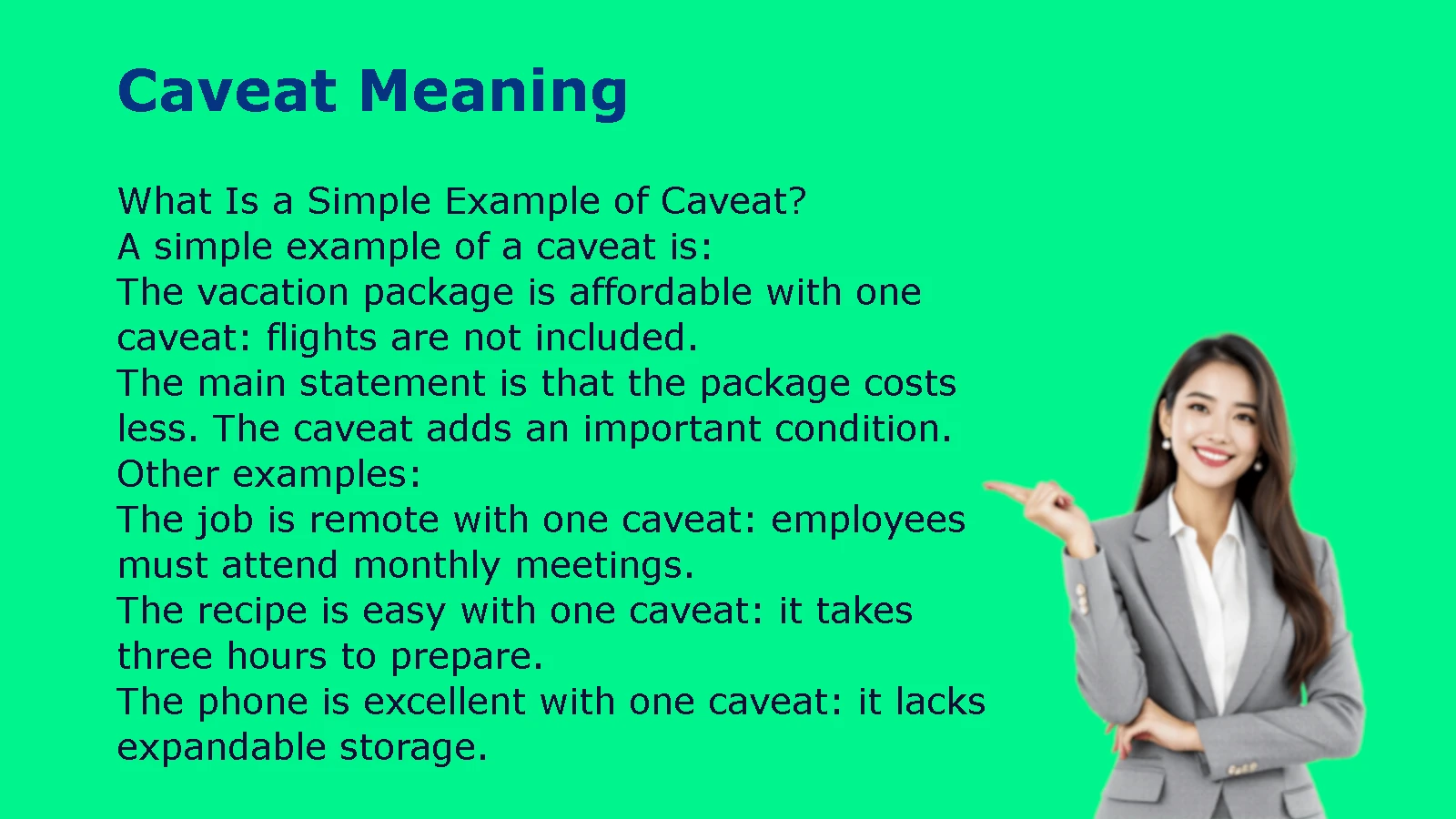
What Is a Simple Example of Caveat?
A simple example of a caveat is:
The vacation package is affordable with one caveat: flights are not included.
The main statement is that the package costs less. The caveat adds an important condition.
Other examples:
- The job is remote with one caveat: employees must attend monthly meetings.
- The recipe is easy with one caveat: it takes three hours to prepare.
- The phone is excellent with one caveat: it lacks expandable storage.
What Does “With One Caveat” Mean?
“With one caveat” means “with one important condition, exception, or limitation.”
People use this phrase when they agree with something but want to add an important detail.
Example:
I would recommend this course with one caveat: beginners may find it challenging.
The speaker recommends the course but wants to make sure beginners understand the difficulty.
What Is the Opposite of Caveat?
The opposite of caveat depends on the context.
Common opposites include:
- assurance
- guarantee
- approval
- confirmation
- certainty
Examples:
- A caveat says: “This works, but there is a limitation.”
- An assurance says: “This works and you don’t need to worry.”
Is Caveat a Legal Term?
Yes, caveat is a legal term, but it is not limited to law.
In legal contexts, a caveat can refer to a formal notice requesting that a legal action not happen without informing the person who filed it.
For example:
A person may file a legal caveat to receive notice before a court makes a decision that affects their interests.
Outside law, the word simply means a warning or condition.
Can Caveat Be Used in Everyday Conversation?
Yes, you can use caveat in everyday conversation.
However, it sounds slightly more formal than words like:
- catch
- downside
- condition
- exception
Examples:
Formal:
I recommend the service with one caveat: the subscription price increases after six months.
Casual:
I recommend it, but there’s one catch—the price goes up later.
Both are correct. The best choice depends on your audience.
What Is the Plural of Caveat?
The plural form of caveat is:
Caveats
Examples:
- The agreement includes several caveats.
- Researchers mentioned the caveats in their conclusion.
- The proposal looks strong despite a few caveats.
Like many English words borrowed from Latin, caveat keeps a standard English plural form by adding s.
How Do You Pronounce Caveat?
The correct pronunciation is:
KAV ee at
Phonetic pronunciation:
/ˈkæv.i.æt/
The first syllable receives the strongest stress.
Incorrect pronunciation often places too much emphasis on the second syllable.
Key Takeaways About the Meaning of Caveat
The word caveat may sound complicated, but its meaning is simple:
A caveat is an important condition, warning, exception, or limitation that helps someone understand the full picture.
Remember these key points:
- Caveat does not always mean something negative. It simply highlights something important.
- Caveat is commonly used in business, law, research, and professional writing.
- “With one caveat” means “with one important condition or exception.”
- Caveat and warning are related but not identical.
- Caveat adds information, while a disclaimer often limits responsibility.
- The plural form is caveats.
- The pronunciation is KAV ee at.
Final Thoughts on Caveat Meaning
The word caveat gives you a useful way to express careful thinking. Instead of making a statement that sounds overly confident, you can add a small but important qualification.
Life rarely works in absolute terms. A product can be excellent but have limitations. A plan can be smart but require adjustments. A study can be valuable but need further research.
That is exactly where a caveat fits.
When you understand the caveat meaning, you can read professional documents more clearly, communicate more precisely, and recognize the details that often matter most.
The next time someone says, “I agree with one caveat,” you’ll know they aren’t changing their mind. They’re simply adding one important piece of the puzzle.