
What Is the Shined Meaning?
Shined is the past tense and past participle of shine when it means to polish or make something bright. However, shone is more commonly used when referring to giving off light or glowing naturally.
Examples:
- She shined her shoes before the interview.
- The sun shone brightly all afternoon.
Understanding the shined meaning helps you choose the correct form, avoid common grammar mistakes, and use shined and shone correctly in everyday English.
What Does Shined Mean?
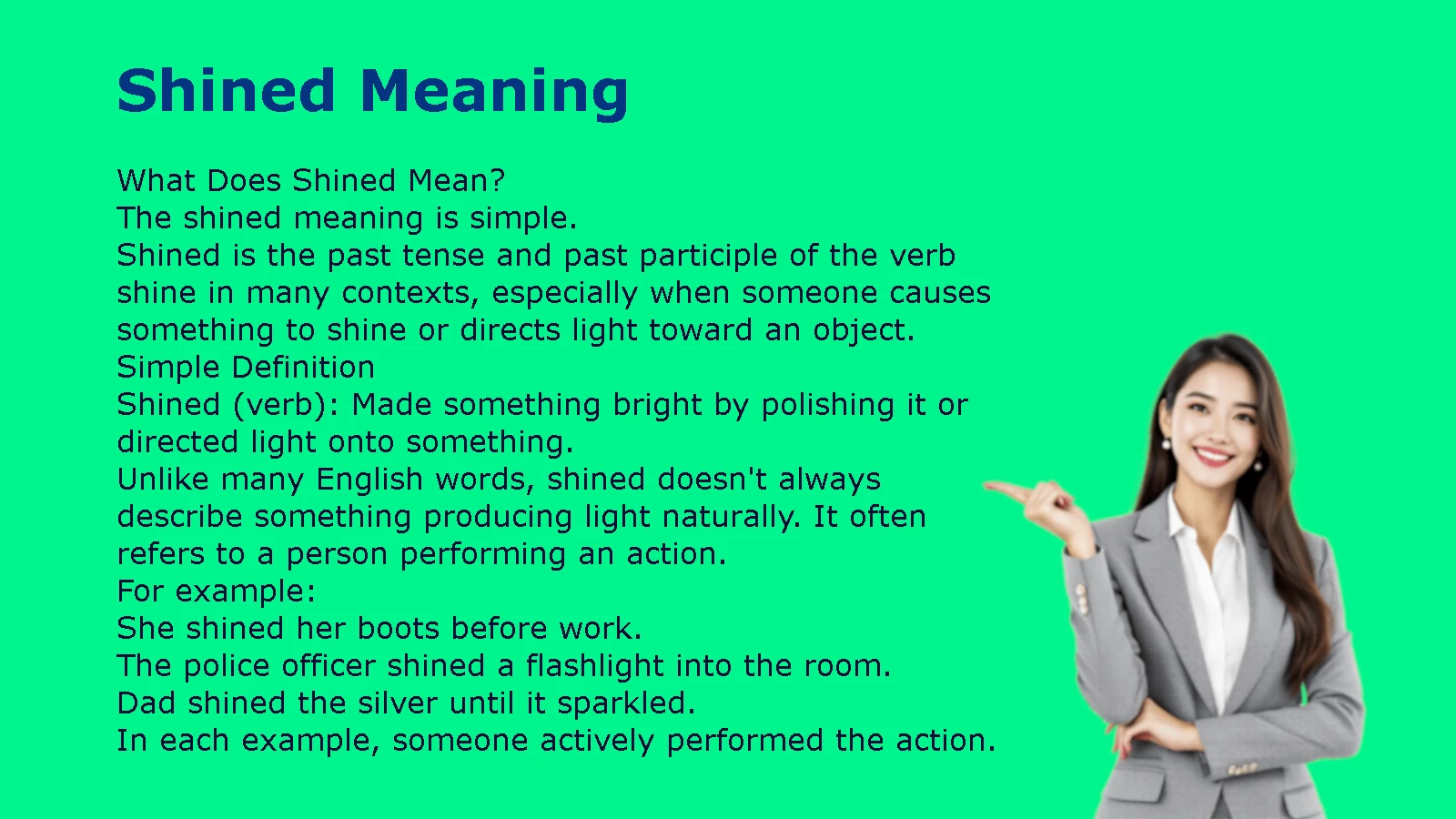
The shined meaning is simple.
Shined is the past tense and past participle of the verb shine in many contexts, especially when someone causes something to shine or directs light toward an object.
Simple Definition
Shined (verb): Made something bright by polishing it or directed light onto something.
Unlike many English words, shined doesn’t always describe something producing light naturally. It often refers to a person performing an action.
For example:
- She shined her boots before work.
- The police officer shined a flashlight into the room.
- Dad shined the silver until it sparkled.
In each example, someone actively performed the action.
Dictionary-Style Meaning of Shined
Most major dictionaries recognize shined as a correct past tense and past participle of shine, particularly in these situations:
- To polish something until it becomes bright
- To direct light at something
- To make an object gleam
- To brighten through effort or action
When talking about natural light, however, many dictionaries also list shone as the preferred form.
Quick Meaning Table
| Word | Part of Speech | Meaning | Example |
| Shine | Verb | To give off light or become bright | The stars shine every night. |
| Shined | Past tense verb | Polished something or directed light | She shined the flashlight. |
| Shone | Past tense verb | Emitted natural light | The moon shone brightly. |
| Shining | Present participle | Giving off light or appearing bright | The sun is shining today. |
Is Shined a Real Word?
Yes.
One of the biggest myths in English grammar is that shined isn’t a real word. That simply isn’t true.
Shined has appeared in English writing for centuries and remains widely accepted today. You’ll find it in newspapers, novels, academic writing, dictionaries, and everyday conversation.
Many learners become confused because they also see shone, which is another accepted past tense of shine.
Both words are correct.
The key is understanding when each one fits best.
Why Do People Think “Shined” Is Wrong?
There are several reasons.
People Learn Different Grammar Rules
Many English teachers emphasize shone because it commonly describes natural light.
For example:
- The stars shone.
- The moon shone.
- The sun shone all morning.
Students sometimes assume that shone replaces shined in every situation.
It doesn’t.
Books Often Use “Shone”
Classic literature frequently prefers shone, especially British authors.
Examples include descriptions like:
- The lantern shone.
- Her eyes shone with happiness.
- The river shone beneath the moonlight.
Because readers encounter shone more often in novels, they may mistakenly believe shined is incorrect.
American and British English Sometimes Differ
Regional usage also contributes to confusion.
In American English, writers commonly use:
- Shined the flashlight
- Shined my shoes
- Shined a light on the issue
In British English, you’ll often find shone used in more situations, although shined remains correct when referring to polishing shoes or directing light.
Language evolves, and both forms continue to appear in respected publications.
When Should You Use Shined?
Knowing the shined meaning becomes much easier when you understand its most common uses.
Generally, shined appears when someone intentionally performs an action.
Instead of light happening naturally, a person causes it.
Use “Shined” When You Polish Something
This is one of the oldest and most common meanings.
People polish objects to make them smooth, clean, and reflective.
Examples include:
- shoes
- boots
- silverware
- jewelry
- trophies
- furniture
- brass
- medals
Examples
- He shined his leather boots before the ceremony.
- She shined the antique silver every weekend.
- The soldier shined his medals until they gleamed.
- Mom shined the dining table before guests arrived.
Notice that each sentence involves effort.
Someone actively improves the object’s appearance.
Use “Shined” When You Direct Light
Another common use involves aiming light toward something.
Examples include:
- flashlight
- spotlight
- searchlight
- stage light
- torch
Examples
- The officer shined a flashlight into the car.
- She shined the spotlight on the performer.
- Dad shined a light under the sink.
- The rescue team shined powerful lights across the mountain.
Here, the subject controls the light.
That’s why shined fits naturally.
Use “Shined” When Someone Creates Brightness
Sometimes people brighten an object rather than simply polishing it.
Examples include:
- Waxing a floor
- Buffing a car
- Cleaning a mirror
- Restoring metal
Examples
- They shined the old piano until it reflected the windows.
- The workers shined the marble floor before the grand opening.
- He shined the vintage car for the exhibition.
Common Situations Where “Shined” Appears
You probably encounter shined more often than you realize.
Here are everyday situations where the word naturally fits.
| Situation | Example |
| Shoe care | She shined her boots. |
| Cleaning silver | Grandma shined the silver tray. |
| Flashlights | He shined a flashlight down the hallway. |
| Search operations | Rescue workers shined lights into the cave. |
| Theater | The technician shined a spotlight on the actor. |
| Photography | The assistant shined extra lighting onto the subject. |
| Auto detailing | They shined the car before delivery. |
| Military | Soldiers shined their boots before inspection. |
Real-Life Examples of “Shined”
Understanding grammar becomes much easier through examples.
Here are natural sentences you’ll hear in everyday English.
Around the House
- She shined the kitchen sink until it looked new.
- Dad shined the dining table before dinner.
- We shined the windows yesterday.
- My brother shined the bicycle before selling it.
At School
- The janitor shined the hallway floors overnight.
- Students shined flashlights during the science experiment.
- The drama club shined stage lights on the performers.
- The maintenance crew shined every trophy in the display case.
At Work
- The employee shined his shoes before the interview.
- The mechanic shined a work light into the engine.
- The photographer shined an additional light onto the model.
- The jeweler carefully shined each diamond before displaying it.
Outdoors
- Rangers shined flashlights into the forest.
- Campers shined lanterns around the campsite.
- Police officers shined searchlights across the field.
- The fisherman shined a light into the water.
During Special Events
- Volunteers shined the memorial plaques.
- Workers shined the ballroom floor.
- Staff members shined the silver decorations.
- The host shined decorative lights across the garden.
A Simple Trick to Remember the Difference
Many learners struggle to choose between shined and shone.
A simple question can help.
Ask yourself:
Did someone actively perform the action?
If the answer is yes, shined is often the better choice.
Examples:
✔ He shined the flashlight.
✔ They shined the brass handle.
Now ask another question:
Did the object naturally produce light?
If the answer is yes, shone often sounds more natural.
Examples:
✔ The moon shone.
✔ The stars shone.
This simple distinction solves most grammar questions.
Why Context Matters More Than Memorization
Many English learners try to memorize one rule for every verb. Unfortunately, language rarely works that way.
The verb shine changes meaning depending on the situation.
Think about these two sentences:
- She shined the silver before dinner.
- The silver shone in the candlelight.
Both describe the same object.
However, the first sentence focuses on someone polishing it, while the second highlights the object’s natural appearance after reflecting light.
That small change in context makes all the difference.
Quick Facts About Shined
| Fact | Explanation |
| Part of speech | Verb (past tense and past participle) |
| Base verb | Shine |
| Main meaning | Polished or directed light |
| Grammatically correct? | Yes |
| Common in American English? | Very common |
| Used in formal writing? | Yes, when appropriate |
| Often confused with | Shone |
| Typical contexts | Shoes, flashlights, spotlights, polished objects |
“Good grammar isn’t about memorizing every rule. It’s about choosing the word that best fits the meaning you want to express.”
The distinction between shined and shone is a perfect example. Understanding the action behind the verb helps you select the correct form with confidence.
Shined vs. Shone: What’s the Difference?
The biggest source of confusion about the shined meaning is knowing when to use shined and when to use shone. Since both words come from the verb shine, many people assume they’re interchangeable in every sentence. They aren’t.
The good news is that the distinction is easier than it looks.
In modern English, both forms are correct. The choice depends on what the verb means in the sentence and, to a lesser extent, the style of English you’re using.
The Basic Rule
A practical rule is:
- Use “shined” when someone caused something to shine, polished an object, or directed light at something.
- Use “shone” when something gave off light naturally or appeared bright without someone’s direct action.
Although you’ll find exceptions in literature and regional writing, this guideline works well in everyday English.
Shined vs. Shone Comparison Table
| Shined | Shone |
| Someone performed the action. | Light came naturally. |
| She shined her shoes. | The stars shone brightly. |
| He shined a flashlight into the cave. | The moon shone over the lake. |
| They shined the silver before dinner. | The sun shone all afternoon. |
| Often used with an object. | Often used without an object. |
| Common in American English. | Common in both American and British English. |
Compare These Sentences
These examples show how a single idea changes depending on the action.
| Sentence | Correct? | Why? |
| She shined her boots. | ✅ | She polished them. |
| The boots shone after polishing. | ✅ | They reflected light. |
| He shined a flashlight at the door. | ✅ | He directed light. |
| The flashlight shone across the room. | ✅ | It emitted light. |
| The sun shined all day. | Acceptable in some contexts, but shone is usually preferred. | Natural light. |
Notice that the first sentence focuses on what the person did, while the second focuses on the result.
Are “Shined” and “Shone” Interchangeable?
Sometimes.
In casual conversation, many native speakers use either word without thinking much about grammar. Most listeners understand the intended meaning.
However, careful writing usually follows the distinction described above.
For example:
- The detective shined a flashlight into the basement.
- The flashlight shone brightly in the darkness.
Both sentences involve the same flashlight, yet the verb changes because the meaning changes.
The first sentence describes an action.
The second describes emitted light.
American English vs. British English
Regional preferences also affect usage.
American English
American writers commonly use:
- shined my shoes
- shined the flashlight
- shined a light on the problem
Many American publications follow this pattern because it clearly separates action from natural light.
British English
British English often favors shone, even in some situations where American English prefers shined.
For example, British writers may occasionally write:
- He shone a torch into the room.
This construction is accepted in British English.
However, shined remains correct when discussing polishing objects.
Style Guide Preferences
Most grammar references agree on these points:
- Shined is appropriate when someone actively performs the action.
- Shone is preferred for natural light.
- Either form may appear in creative writing depending on style.
The key is consistency.
If you’re writing an article, report, or essay, choose the form that best matches the meaning and stick with it.
Examples of “Shined” in Sentences
Examples help you understand grammar faster than memorizing rules.
Below are examples from everyday life.
Everyday Conversation
- She shined her shoes before work.
- Dad shined the flashlight under the couch.
- We shined every window before guests arrived.
- My brother shined the old bicycle.
- They shined the brass doorknob until it gleamed.
Workplace Examples
- The technician shined a work light inside the machine.
- The janitor shined the lobby floor overnight.
- Employees shined the conference room table before the meeting.
- The jeweler shined every necklace before displaying it.
- The mechanic shined a lamp beneath the vehicle.
School Examples
- The students shined flashlights during science class.
- The drama teacher shined a spotlight on the stage.
- Volunteers shined the school’s trophy case.
- The maintenance crew shined every hallway floor.
- The art teacher shined extra lighting on the painting.
Sports Examples
- Players shined their cleats before the championship.
- Staff members shined the team’s trophies.
- The stadium crew shined powerful lights across the field.
- The coach shined a flashlight toward the dugout.
- Workers shined the locker room floor.
Home and Family Examples
- Mom shined the silver before Thanksgiving dinner.
- Grandpa shined his favorite boots every Sunday.
- We shined the antique mirror carefully.
- My sister shined her jewelry before the wedding.
- Dad shined the car for the family road trip.
Travel Examples
- Rangers shined flashlights along the hiking trail.
- Campers shined lanterns around the campsite.
- The guide shined a light toward the cave entrance.
- Rescue teams shined searchlights across the mountain.
- The captain shined a spotlight across the harbor.
“Shined” in Figurative Sentences
Although shone often appears in figurative writing, shined also appears in informal American English.
Examples include:
- She shined during the interview.
- His confidence shined through every answer.
- Their teamwork shined all season.
- The young musician shined on stage.
- Her kindness shined in difficult moments.
In formal writing, many editors would replace these with shone, but you’ll still hear and read shined in everyday speech.
Common Phrases That Use “Shined”
English includes several expressions with the word shined.
Understanding these phrases helps you recognize the word in books, articles, movies, and conversations.
Shined a Light On
Meaning: Made something easier to understand.
Examples:
- The investigation shined a light on corruption.
- The documentary shined a light on climate issues.
- Her research shined a light on childhood education.
Shined the Spotlight On
Meaning: Drew attention to someone or something.
Examples:
- The award ceremony shined the spotlight on young athletes.
- The campaign shined the spotlight on local businesses.
- The article shined the spotlight on community volunteers.
Shined Through
Meaning: Became obvious or easy to notice.
Examples:
- His honesty shined through.
- Her experience shined through every decision.
- Their dedication shined through the finished project.
Shined Up
Meaning: Cleaned or polished something.
Examples:
- Dad shined up the truck.
- She shined up the silverware.
- They shined up the old furniture.
Shined Brightly
Although shone brightly is more common for natural light, you’ll still hear shined brightly in casual speech.
Example:
- The polished trophy shined brightly under the lights.
Synonyms of “Shined”
Sometimes another word fits your sentence better.
Each synonym carries a slightly different meaning.
| Synonym | Best Used For | Example |
| Polished | Cleaning surfaces | She polished the silver. |
| Gleamed | Reflected bright light | The floor gleamed. |
| Glowed | Soft, warm light | The fireplace glowed. |
| Sparkled | Tiny flashes of light | The diamonds sparkled. |
| Illuminated | Formal writing | The lamps illuminated the room. |
| Brightened | Increased light | Sunshine brightened the kitchen. |
| Radiated | Emitted energy or light | Confidence radiated from him. |
| Beamed | Strong light or happiness | She beamed with pride. |
| Glittered | Shiny reflections | Snow glittered in the sun. |
| Burnished | Polished to a shine | The bronze was burnished. |
Which Synonym Should You Choose?
Each word creates a different image.
For example:
- Polished emphasizes cleaning.
- Gleamed emphasizes reflection.
- Sparkled suggests many tiny flashes.
- Radiated often describes emotions.
- Illuminated sounds formal and technical.
Choosing the right synonym makes your writing more precise and engaging.
Opposites of “Shined”
The opposite depends on the context.
When Talking About Brightness
- Dimmed
- Darkened
- Faded
- Dulled
- Lost its shine
When Talking About Polishing
- Tarnished
- Dirtied
- Scratched
- Smudged
- Clouded
Comparison Table
| Shined | Opposite |
| Polished | Tarnished |
| Brightened | Dimmed |
| Illuminated | Darkened |
| Gleamed | Dull |
| Sparkled | Faded |
Common Mistakes People Make
Even experienced writers sometimes misuse shined and shone.
Knowing these mistakes helps you avoid them.
Mistake: Using “Shined” for Natural Light
❌ The moon shined over the ocean.
✅ The moon shone over the ocean.
Natural light generally takes shone.
Mistake: Using “Shone” When Someone Performs the Action
❌ He shone the flashlight under the bed.
✅ He shined the flashlight under the bed.
The person actively directed the light.
Mistake: Thinking “Shined” Is Incorrect
Some learners avoid the word entirely because they believe it’s wrong.
That’s a mistake.
Shined has been part of standard English for generations and appears in respected dictionaries and style references.
Mistake: Ignoring Context
Consider these two sentences:
- She shined the silver.
- The silver shone after she polished it.
Both are correct because the meaning changes.
The first focuses on the action.
The second focuses on the result.
Understanding context is far more important than memorizing one rigid rule.
“The best grammar choice isn’t always about one word being right and another being wrong. It’s about choosing the word that accurately expresses your meaning.”
Mastering the difference between shined and shone does exactly that. It helps your writing sound clear, natural, and grammatically precise.
Is Shined Formal or Informal?
One common question about the shined meaning is whether the word sounds formal enough for professional writing.
The answer is yes.
Shined is a standard English word recognized by major dictionaries and style guides. Its level of formality depends more on how you use it than on the word itself.
For example:
- The maintenance staff shined the marble floors before the conference.
- The jeweler carefully shined each piece before placing it in the display.
Both sentences sound natural in formal writing.
On the other hand, informal speech often includes expressions like:
- You really shined today!
- He shined on stage last night.
These are perfectly acceptable in conversation, although some editors may prefer shone in figurative contexts.
Where You Can Use “Shined”
| Writing Type | Is “Shined” Appropriate? | Notes |
| Everyday conversation | ✅ Yes | Very common |
| Business writing | ✅ Yes | When referring to polishing or directing light |
| Academic writing | ✅ Yes | Use according to context |
| Journalism | ✅ Yes | Frequently used in news articles |
| Technical writing | ✅ Yes | Common when discussing lighting equipment |
| Creative writing | ✅ Yes | Choose shined or shone based on style |
The important point is that context matters more than formality.
Figurative Meanings of Shined
Although shined often refers to physical light or polishing, English speakers also use it figuratively.
In these cases, shined describes someone who stood out because of talent, confidence, kindness, or success.
For example:
- She shined during the interview.
- His leadership shined when the team faced challenges.
- Their creativity shined throughout the competition.
These examples don’t involve actual light. Instead, they compare a person’s qualities to something bright and noticeable.
Common Figurative Uses
- Talent shined.
- Confidence shined.
- Kindness shined through.
- Personality shined.
- Determination shined in difficult moments.
These expressions create vivid mental images without sounding exaggerated.
Literal vs. Figurative Meaning
| Literal Meaning | Figurative Meaning |
| He shined the flashlight. | He shined in the championship game. |
| She shined her shoes. | Her personality shined through. |
| They shined the silver. | Their teamwork shined all season. |
| We shined the floor. | His passion shined during the presentation. |
Understanding the difference helps you interpret books, speeches, and everyday conversations more accurately.
Grammar Guide for Shined
The verb shine is unusual because it has two accepted past tense forms.
Here’s a complete breakdown.
Verb Forms
| Base Form | Present | Past | Past Participle | Present Participle |
| Shine | shine / shines | shined or shone | shined or shone | shining |
Both shined and shone are grammatically correct. The choice depends on meaning and style.
Present Tense Examples
- I shine my boots every Friday.
- She shines the flashlight into the attic.
- They shine the silver before holidays.
Simple Past Examples
- I shined my shoes yesterday.
- The moon shone over the mountains.
- He shined the spotlight on the speaker.
- The stars shone brightly all night.
Present Perfect
- I have shined these boots many times.
- The sun has shone since early morning.
Past Perfect
- She had shined the silver before guests arrived.
- The lighthouse had shone for hours before the storm.
Future Tense
- I will shine my shoes tomorrow.
- The stage lights will shine throughout the concert.
Passive Voice
Although active voice is usually clearer, passive voice is still grammatically correct.
Active:
- The technician shined the spotlight.
Passive:
- The spotlight was shined on the performer.
Most professional writers prefer the active version because it sounds stronger and more direct.
Mini Case Study: Choosing the Correct Word
Imagine two students writing about the same event.
Student A
The janitor shone the hallway floor before graduation.
Student B
The janitor shined the hallway floor before graduation.
Which one is better?
Student B.
Why?
Because the janitor performed the action of polishing the floor.
Now consider another sentence.
After the floor was cleaned, it shone under the lights.
Here, shone becomes the better choice because the floor is now reflecting light naturally.
This simple example demonstrates why context matters.
Tips to Remember the Difference
Instead of memorizing dozens of grammar rules, remember these practical tips.
Think About the Action
Ask yourself:
Did someone actively do something?
If yes, shined is usually correct.
Examples:
- She shined the boots.
- He shined the flashlight.
- They shined the trophy.
Think About the Light
Ask:
Did something naturally give off or reflect light?
If yes, shone is often the better choice.
Examples:
- The stars shone.
- The moon shone.
- The lake shone in the sunlight.
Read the Sentence Aloud
Reading aloud often reveals which word sounds more natural.
Compare:
- He shined the flashlight into the cave.
- He shone the flashlight into the cave.
Most American speakers naturally prefer the first sentence.
Quick Grammar Checklist
Before using shined, ask yourself these questions.
- Is someone performing the action?
- Is the object being polished?
- Is someone directing light?
- Would “polished” fit if I replaced the verb?
If you answered yes to any of these, shined is probably the correct choice.
Frequently Asked Questions About Shined Meaning
What does “shined” mean?
Shined is the past tense and past participle of shine when someone polishes an object or directs light toward something. It can also describe someone excelling in informal American English.
Is “shined” grammatically correct?
Yes.
Shined is a standard English word accepted by major dictionaries and widely used in American English.
What’s the difference between “shined” and “shone”?
Shined usually refers to an action performed by someone, such as polishing shoes or aiming a flashlight.
Shone usually describes natural or emitted light, such as sunlight, moonlight, or stars.
Is “shined” used in American English?
Absolutely.
American English frequently uses shined in expressions like:
- shined my shoes
- shined a flashlight
- shined the silver
Can “shined” describe a person’s success?
Yes.
In informal American English, people often say:
- She shined during the interview.
- He shined in the championship game.
Many editors still prefer shone in formal figurative writing, but shined is common in speech.
Is “shined” the past tense of “shine”?
Yes.
Both shined and shone serve as accepted past tense forms of shine, depending on the context.
Can I use “shined” in professional writing?
Yes.
When referring to polishing or directing light, shined is completely appropriate in business, academic, and professional writing.
Why do dictionaries list both “shined” and “shone”?
Because English has preserved two accepted past tense forms of the verb shine. Each developed different usage patterns over time, and both remain correct today.
Common Collocations With Shined
These are words that frequently appear with shined.
| Collocation | Example |
| shined shoes | He shined his shoes before work. |
| shined boots | Soldiers shined their boots. |
| shined flashlight | She shined a flashlight into the attic. |
| shined spotlight | The crew shined a spotlight on the speaker. |
| shined silver | Grandma shined the silver every holiday. |
| shined floor | Workers shined the marble floor overnight. |
| shined trophy | The team shined every trophy before the ceremony. |
| shined jewelry | The jeweler shined each necklace carefully. |
Learning common collocations helps your English sound more natural because native speakers often use these word combinations together.
Key Takeaways
| Question | Answer |
| Is shined a real word? | ✅ Yes |
| Is it grammatically correct? | ✅ Yes |
| What does it mean? | Past tense of shine when polishing or directing light |
| Is shined used in American English? | ✅ Very commonly |
| Should I always use shined? | ❌ No. Use shone for natural light in most cases. |
| Can both words be correct? | ✅ Yes, depending on context. |
Quick Summary
If you remember just one rule, make it this:
- Someone performs the action → use “shined.”
- Something naturally gives off or reflects light → use “shone.”
This guideline covers most real-world situations and will help you choose the correct word with confidence.
Final Thoughts on Shined Meaning
Understanding the shined meaning goes beyond knowing a dictionary definition. It requires recognizing how English speakers use the word in everyday life.
Shined is the preferred choice when someone actively polishes an object or directs light toward something. Shone, on the other hand, usually describes natural light or something that appears bright without direct action. Both forms are correct, and each has a clear role in modern English.
Rather than treating them as competing words, think of them as partners. One emphasizes action, while the other highlights light itself. Once you understand that distinction, choosing the right form becomes much easier.
The next time you write about polished shoes, a flashlight, or a shining performance, you’ll know exactly which word fits the situation. That small choice can make your writing clearer, more accurate, and more natural.