
Have you ever talked to someone who seemed to be talking down to you and wondered what exactly their tone meant? The Condescending Meaning describes a way of speaking or behaving that makes someone feel less intelligent, capable, or important.
Condescending means showing that you believe you are better, smarter, or more knowledgeable than someone else. It often appears through a tone, choice of words, or attitude that makes the other person feel inferior.
Examples:
- His condescending tone made me feel like he thought I knew nothing.
- She gave me a condescending smile when I asked for help.
The confusion is understandable. People often search for what does condescending mean, condescending meaning in text, condescending meaning in chat, or what does it mean when someone is condescending because the word can describe subtle behavior as well as obvious disrespect. And here’s the kicker: someone doesn’t have to insult you directly to sound condescending.
In this guide, you’ll learn the complete Condescending Meaning, its definition, pronunciation, correct usage, and examples in sentences. You’ll also discover condescending meaning in texting, common signs of a condescending person, and the difference between condescending, patronizing, arrogant, and other similar words.
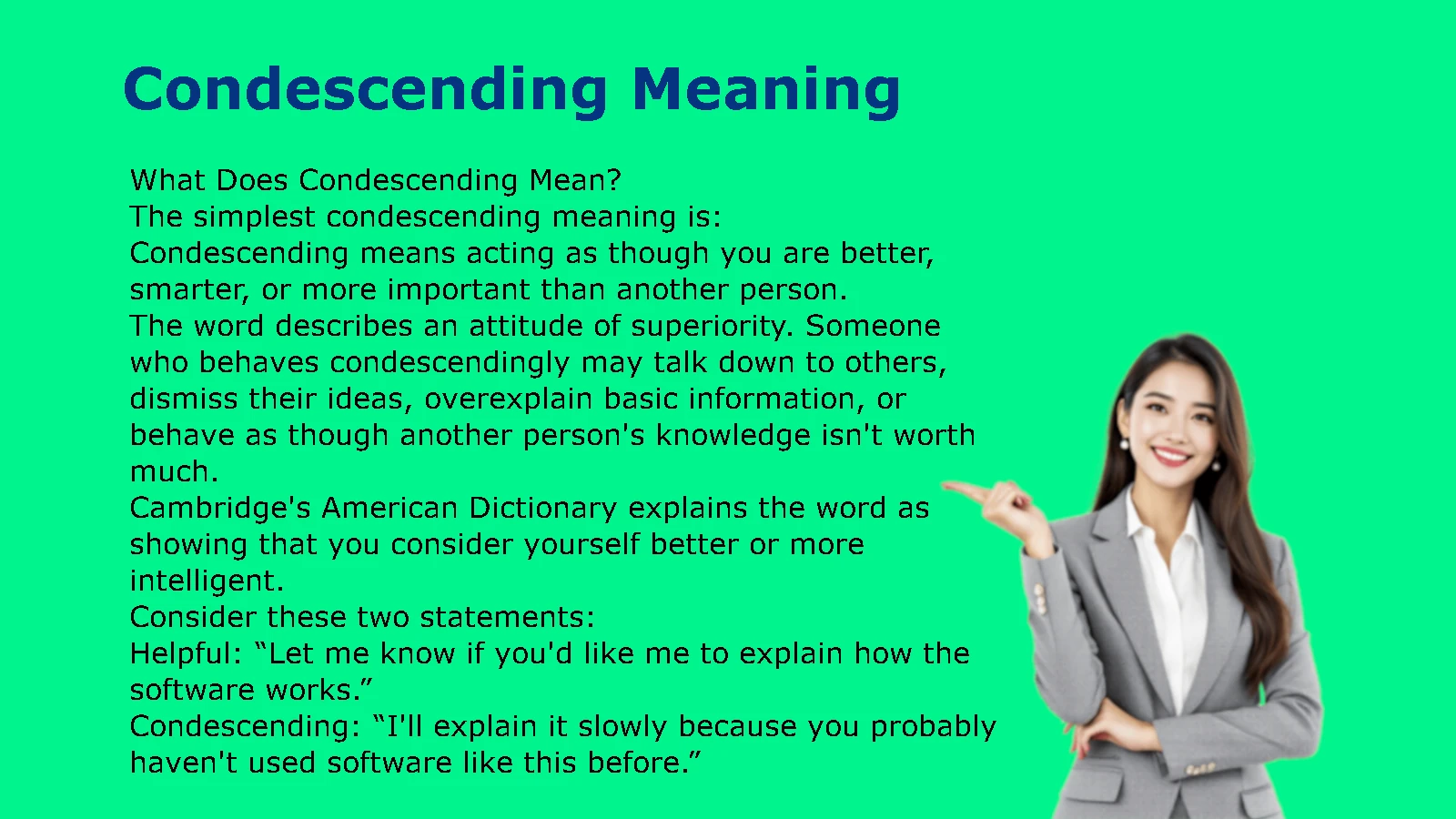
What Does Condescending Mean?
The simplest condescending meaning is:
Condescending means acting as though you are better, smarter, or more important than another person.
The word describes an attitude of superiority. Someone who behaves condescendingly may talk down to others, dismiss their ideas, overexplain basic information, or behave as though another person’s knowledge isn’t worth much.
Cambridge’s American Dictionary explains the word as showing that you consider yourself better or more intelligent.
Consider these two statements:
- Helpful: “Let me know if you’d like me to explain how the software works.”
- Condescending: “I’ll explain it slowly because you probably haven’t used software like this before.”
Both speakers may offer an explanation. The difference lies in the assumption behind the words.
The first speaker respects the other person’s ability to decide whether they need help. The second speaker assumes incompetence and presents the explanation from a position of superiority.
Condescending Meaning in Simple Words
In plain English, condescending means talking down to someone.
Imagine two people standing on different levels of a staircase. The condescending person mentally places themselves on the higher step and treats the other person as though they belong below them.
Common examples include:
- Treating an adult like a child.
- Explaining something obvious without considering the listener’s knowledge.
- Using an overly sweet or sarcastic tone.
- Acting surprised when someone understands a difficult topic.
- Dismissing another person’s opinion because they believe they know more.
- Offering unwanted explanations in a superior manner.
- Speaking as though another person’s ideas are automatically less valuable.
Not every correction, explanation, disagreement, or display of expertise is condescending. The attitude behind the behavior matters.
Condescending Pronunciation
The US pronunciation of condescending is:
/ˌkɑːn.dəˈsen.dɪŋ/
A simple pronunciation guide is:
kon-duh-SEN-ding
The main stress falls on SEN. Cambridge lists the American pronunciation as /ˌkɑːn.dəˈsen.dɪŋ/.
The word comes from the verb condescend, so learning the related forms can make pronunciation and usage easier.
| Word | Part of speech | Meaning |
| Condescend | Verb | To behave as though you are superior |
| Condescending | Adjective | Showing a superior or patronizing attitude |
| Condescension | Noun | The attitude or behavior of treating others as inferior |
| Condescendingly | Adverb | In a condescending manner |
Is Condescending a Positive or Negative Word?
Condescending is normally negative.
It describes behavior that suggests superiority, which is why dictionaries generally mark the modern sense as disapproving.
If someone says, “She has a condescending attitude,” they aren’t complimenting her communication style. They mean that she behaves as though other people are beneath her.
This distinction matters because the word condescend has an unusual history. Its earlier meanings weren’t always negative.
Historically, condescend could refer to lowering oneself willingly from a position of rank or dignity. Etymonline traces the word to Late Latin condescendere, meaning “to let oneself down,” with roots connected to descendere, meaning “to descend.”
Over time, the word developed the negative sense associated with assuming an air of superiority. Etymonline dates the adjective condescending to 1707 and notes that its older positive sense continued in some contexts until the late 18th century.
That’s an important bit of word history: the modern meaning isn’t identical to the word’s earliest meaning.
Condescending Part of Speech
Condescending is an adjective.
It describes a person’s behavior, attitude, tone, expression, comment, or manner.
Here are some common combinations:
- condescending attitude
- condescending tone
- condescending remark
- condescending behavior
- condescending smile
- condescending manner
- condescending response
- condescending comment
- condescending voice
- condescending question
For example:
“His condescending tone made the meeting uncomfortable.”
Here, condescending describes the person’s tone.
You can also use the word before a noun:
“She gave me a condescending smile.”
Cambridge’s Learner’s Dictionary specifically gives “a condescending smile” as an example.
What Does It Mean to Be Condescending to Someone?
To be condescending to someone means to interact with that person as though you are superior to them.
The superiority can involve intelligence, education, experience, social status, wealth, professional knowledge, age, or another perceived advantage.
For instance, imagine a senior employee talking to a new employee.
Respectful:
“Have you worked with this system before?”
Condescending:
“I’m guessing you’ve never used a system like this, so I’ll start with the basics.”
The second statement isn’t automatically condescending in every possible situation. A beginner really may need basic instructions. However, if the speaker assumes incompetence without asking, the remark can sound patronizing.
That distinction is crucial.
Condescending Does Not Always Mean Rude Words
A person can sound perfectly polite while still being condescending.
For example:
“Oh, that’s adorable. You actually think you can handle this project?”
The words contain no obvious swear words. Yet the attitude clearly diminishes the other person.
Likewise:
“Well, if you understood how this works, you’d know why I’m right.”
That sentence attacks the other person’s competence rather than addressing the argument.
Condescension often hides behind politeness, expertise, humor, or concern.
Examples of Condescending Behavior
Condescending behavior can appear in almost any social setting. It doesn’t require an obvious insult.
At Work
A manager may repeatedly explain simple tasks to an experienced employee without first checking what the employee already knows.
Another example involves meetings. Someone might dismiss a coworker’s suggestion with:
“That’s a cute idea, but let’s leave the serious decisions to people who understand the industry.”
The speaker doesn’t simply disagree. They undermine the other person’s competence.
In a Classroom
A teacher can explain difficult material without being condescending. Teaching becomes condescending when the teacher mocks students for asking questions or assumes they cannot understand the subject.
Compare:
- Helpful: “That’s a common point of confusion. Let’s walk through it.”
- Condescending: “This really isn’t that hard. You should have understood it by now.”
The first encourages learning. The second creates embarrassment.
In Friendships
Condescension can be especially frustrating between friends because friendship usually implies some degree of equality.
For example:
“Don’t worry about it. Adults have to deal with things like this.”
That sentence might sound harmless in isolation. Context could make it dismissive or patronizing.
In Customer Service
A customer service representative might explain a basic function to a technically experienced customer without listening to the actual problem.
The problem isn’t explaining something. The problem is refusing to recognize what the other person already knows.
Online
Online discussions can bring out condescending language because people communicate without facial expressions and vocal cues.
Examples include:
- “Maybe read the article before commenting.”
- “This is basic knowledge.”
- “Let me explain this to you.”
- “You’ll understand when you’re older.”
- “Clearly, you don’t know how this works.”
Some of these phrases can be reasonable in specific contexts. Yet people often use them to dismiss another person’s competence rather than address their argument.
Examples of Condescending Sentences
Here are natural examples showing how condescending works in different contexts:
- “His condescending tone made the new employee hesitant to ask questions.”
- “She gave me a condescending smile when I offered my opinion.”
- “The manager’s condescending attitude frustrated the entire team.”
- “His response sounded more condescending than helpful.”
- “I don’t appreciate your condescending comments.”
- “The professor explained the concept without ever sounding condescending.”
- “Her condescending manner made a simple conversation unnecessarily tense.”
- “He became condescending whenever someone challenged his expertise.”
- “The customer felt that the representative was being condescending.”
- “His condescending remark implied that everyone else lacked basic knowledge.”
- “She tried to help, but her wording came across as condescending.”
- “The speaker avoided a condescending tone and treated the audience as equals.”
- “His condescending response discouraged further discussion.”
- “The article explains a complex subject without using a condescending voice.”
- “You can correct someone without becoming condescending.”
Notice how the adjective modifies different nouns. The word doesn’t describe only a person’s personality. It can describe a tone, remark, smile, attitude, response, manner, or voice.
What Are the Signs of a Condescending Person?
One isolated comment doesn’t always prove that someone is condescending. Look for a pattern.
Common signs include:
- Overexplaining: They explain basic information you already understand.
- Dismissive language: They brush aside your ideas instead of addressing them.
- Mock surprise: They act shocked that you know something.
- Unnecessary correction: They correct minor details simply to establish superiority.
- Childlike language: They speak to capable adults as though they’re children.
- Sarcasm: They disguise criticism as humor.
- Superior tone: Their voice or wording suggests that they’re above you.
- Ignoring expertise: They refuse to recognize your experience.
- Talking over others: They assume their knowledge matters more.
- Belittling questions: They ask questions designed to expose supposed ignorance.
- Patronizing praise: They praise ordinary behavior as though it were unexpectedly impressive.
- Dismissive body language: Eye rolling, exaggerated sighs, smirking, or a knowing smile can reinforce the message.
A Useful Test for Condescending Behavior
Ask three questions:
| Question | What it reveals |
| Did they assume I knew less than I actually do? | Possible superiority |
| Did their wording diminish me rather than explain the issue? | Possible condescension |
| Would the same information sound respectful in another tone? | The importance of delivery |
This isn’t a perfect scientific test. Human communication depends heavily on context. Still, it can help separate genuine assistance from talking down to someone.
Condescending vs. Patronizing
Condescending and patronizing overlap heavily. In many everyday situations, people use them almost interchangeably.
Cambridge lists patronizing among the synonyms of condescending.
Still, there’s a useful distinction.
| Word | Main idea | Example |
| Condescending | Acting superior to another person | “He spoke in a condescending tone.” |
| Patronizing | Treating someone as though they are less intelligent, capable, or important | “Her patronizing response made him feel like a child.” |
| Arrogant | Having an exaggerated sense of one’s own importance or abilities | “His arrogant attitude annoyed the team.” |
| Haughty | Showing an openly superior attitude | “She gave him a haughty look.” |
| Pompous | Acting overly important, often in speech or behavior | “His pompous explanation bored everyone.” |
Merriam-Webster notes that condescending and patronizing are closely related, while also pointing out that words that appear synonymous can have small differences in particular contexts.
A useful shortcut is:
Condescending = “I’m above you.”
Patronizing = “You’re beneath me.”
The meanings overlap so much that either word can work in many situations.
Condescending vs. Arrogant
Arrogant and condescending aren’t exactly the same.
An arrogant person has an exaggerated sense of their own importance, abilities, or status. They may brag, refuse criticism, or assume they deserve special treatment.
A condescending person goes one step further in the interaction: they treat another person as inferior.
For example:
“He thinks he’s the smartest person in the room.”
That describes arrogance.
“He explains every basic point to his coworkers as though they’re incapable of understanding it.”
That describes condescending behavior.
A person can therefore be arrogant without being openly condescending. Likewise, someone might behave condescendingly in one situation without having a consistently arrogant personality.
Condescending vs. Rude
Rude is a broader term.
Someone can be rude by interrupting, shouting, insulting, ignoring, or behaving disrespectfully. None of those actions necessarily involve superiority.
Condescension has a more specific ingredient: a sense of being above someone else.
Compare:
- Rude: “Shut up.”
- Condescending: “Let me explain this again because apparently you didn’t understand it the first time.”
Both can hurt. Only the second clearly communicates intellectual superiority.
Condescending vs. Superior
The word superior can describe someone who is objectively better at something, but it can also describe an attitude of superiority.
For example:
“This computer has superior processing power.”
That is a factual comparison.
But:
“He has a superior attitude.”
Here, superior describes someone’s behavior toward others.
That’s why context matters when you interpret words related to condescension.
Condescending vs. Haughty
Haughty describes someone who behaves as though they are better than others.
It often suggests pride, aloofness, or social superiority.
For example:
“The haughty executive barely acknowledged the staff.”
Condescending, meanwhile, often focuses more directly on how someone speaks or behaves toward another person.
A haughty person may ignore you.
A condescending person may explain your own job to you.
Condescending vs. Pompous
Pompous often involves exaggerated self importance, especially in speech, appearance, or behavior.
For example:
“His pompous speech made a simple issue sound like a national crisis.”
A pompous person may sound grandiose.
A condescending person may sound patronizing.
The two can overlap, but they emphasize different qualities.
What Does Condescend Mean?
Condescend is the verb related to condescending.
In one modern sense, to condescend means to behave as though you are better or more intelligent than another person.
For example:
“She never condescends to her students.”
This means she doesn’t treat her students as though they’re beneath her.
Cambridge gives the American verb sense as behaving in a way that shows you consider yourself better or more intelligent than other people.
However, condescend to do something has another meaning.
It can mean agreeing to do something that you consider beneath your social position. Cambridge labels this use as usually humorous.
For example:
“Will the celebrity condescend to answer a few questions?”
Here, the phrase jokingly suggests that the celebrity considers answering questions beneath them.
Condescend, Condescending, and Condescension
These related forms are easy to understand once you see the pattern:
- Condescend — verb
- Condescending — adjective
- Condescension — noun
- Condescendingly — adverb
Examples:
“Don’t condescend to your coworkers.”
“His condescending tone annoyed everyone.”
“Her condescension was obvious.”
“He spoke condescendingly to the staff.”
Cambridge lists condescension as the noun associated with condescend.
What Is Condescension?
Condescension is the attitude or behavior behind being condescending.
If someone consistently treats others as intellectually or socially inferior, you might describe that behavior as condescension.
For example:
“The audience quickly became frustrated by the speaker’s condescension.”
The sentence doesn’t describe one particular remark. It refers to the broader attitude.
Merriam-Webster defines condescend in part as assuming an air of superiority.
Condescension in a Workplace Example
Imagine a software engineer with ten years of experience.
During a meeting, a colleague says:
“Don’t worry. I’ll explain what a database is.”
If the colleague knows about the engineer’s background, the remark becomes especially revealing. The problem isn’t the definition of a database. The problem is the assumption that the engineer needs a beginner’s explanation.
That is condescension.
Now compare:
“Are you familiar with this database system, or would a quick overview help?”
The second statement leaves room for the other person’s expertise.
That’s the difference between helping someone and talking down to someone.
Synonyms for Condescending
The best synonym depends on exactly what you want to emphasize.
Patronizing
Probably the closest everyday synonym.
Example: “His patronizing tone made the customer uncomfortable.”
Arrogant
Focuses on excessive self importance.
Example: “Her arrogant attitude made collaboration difficult.”
Haughty
Suggests an openly superior or disdainful manner.
Example: “He gave a haughty response.”
Pompous
Suggests exaggerated importance, especially in speech or behavior.
Example: “His pompous explanation turned a simple topic into a spectacle.”
Supercilious
A more formal word for someone who behaves as though they are superior.
Example: “His supercilious manner irritated his colleagues.”
Overbearing
Focuses on dominating or controlling behavior.
Example: “Her overbearing approach left little room for discussion.”
Self-important
Describes someone who thinks they are more important than they really are.
Example: “His self-important attitude quickly became obvious.”
Snobbish
Often relates to perceived social or cultural superiority.
Example: “Her snobbish comments focused on people’s backgrounds.”
Pompous vs. Supercilious vs. Condescending
These words can sound similar, but their emphasis differs:
| Word | Strongest idea |
| Condescending | Treating others as inferior |
| Patronizing | Acting superior while addressing another person |
| Arrogant | Inflated view of oneself |
| Haughty | Proud and visibly superior |
| Pompous | Excessively important or grand |
| Supercilious | Contemptuous superiority |
| Snobbish | Superiority based on status, taste, or social standing |
| Overbearing | Excessively controlling or domineering |
Antonyms of Condescending
The opposite of condescending behavior involves treating people with respect and recognizing their abilities.
Useful antonyms include:
- Respectful
- Humble
- Considerate
- Courteous
- Approachable
- Modest
- Friendly
- Understanding
- Patient
- Open-minded
- Equal
- Nonjudgmental
For example:
Condescending:
“I’ll explain it because you probably won’t understand.”
Respectful:
“Would you like me to explain that part?”
The second sentence doesn’t assume incompetence. It gives the other person control.
How to Avoid Sounding Condescending
You don’t have to hide your expertise to communicate respectfully. The trick is to share knowledge without using it as a status weapon.
Ask Before Explaining
Instead of assuming someone needs help, ask:
“Would you like a quick explanation?”
This simple question can prevent unnecessary overexplaining.
Don’t Assume What Someone Knows
If you don’t know the person’s experience, avoid guessing.
Instead of:
“You probably don’t know how this works.”
Try:
“Are you familiar with how this works?”
The second approach gathers information before making a judgment.
Correct the Idea, Not the Person
Instead of:
“You clearly don’t understand the issue.”
Try:
“I think there’s a different interpretation of the data.”
The disagreement remains. The insult disappears.
Avoid Fake Praise
Some praise sounds condescending because it expresses surprise that someone performed well.
For example:
“Wow, you actually did a great job.”
The word actually changes the emotional message. It suggests that success was unexpected.
A better version is simply:
“You did a great job.”
Treat Questions as Normal
Someone asking a question doesn’t prove ignorance.
A respectful response might be:
“Good question. There are two parts to it.”
That response creates space for learning without making the questioner feel small.
How to Respond to a Condescending Person
When someone talks down to you, the best response depends on the situation.
Calm and Direct
“I understand what you’re saying. You don’t need to explain it in that tone.”
This identifies the problem without escalating the conversation.
Professional
“I’m familiar with the process. Let’s focus on the issue we’re trying to solve.”
This works well in workplace discussions.
Firm
“Please don’t talk to me as though I don’t understand the subject.”
Short. Clear. No fireworks required.
Clarifying
“Are you explaining this because you think I don’t understand it?”
This question forces the other person to examine the assumption behind their behavior.
When the Behavior Continues
If the pattern continues, focus on specific behavior rather than attacking the person’s character.
Instead of:
“You’re an arrogant person.”
Say:
“You’ve interrupted me several times and dismissed my experience without addressing my point.”
Specific criticism is easier to defend, discuss, and resolve.
Case Study: Helpful Explanation vs. Condescending Explanation
Consider a customer who has already spent years working with computers.
A technician says:
“First, turn the computer on. You know, the button with the power symbol.”
The technician may intend to help. Yet if the customer has already explained that they understand basic computer operation, the explanation can feel insulting.
Now consider:
“You mentioned that the computer powers on but doesn’t connect to the network. Let’s focus on the connection issue.”
The second response recognizes the customer’s existing knowledge.
What Changed?
| Communication choice | First response | Second response |
| Assumes knowledge | Assumes ignorance | Recognizes stated knowledge |
| Focus | Basic instruction | Actual problem |
| Tone | Potentially patronizing | Professional |
| Respect | Potentially low | High |
| Goal | Explain everything | Solve the issue |
The lesson is simple: Expertise becomes useful when it serves the conversation instead of dominating it.
The Difference Between Explaining and Talking Down
This is one of the most important distinctions in understanding condescending meaning.
A person can know more than you without being condescending.
A doctor can explain a medical procedure. A teacher can explain algebra. A mechanic can explain an engine problem. A manager can explain company policy.
None of those actions automatically involve condescension.
The behavior becomes condescending when the speaker communicates something like:
“I’m smarter than you.”
or:
“You’re beneath me.”
or:
“You couldn’t possibly understand this without me.”
The information itself isn’t necessarily the problem. The interpersonal attitude is.
Why Tone Matters So Much
Words don’t operate alone.
Consider the sentence:
“Good job.”
Depending on context and delivery, it can communicate sincere praise or mocking surprise.
The same principle applies to:
“Let me explain.”
It could mean:
- “I want to help.”
- “Here’s the information you asked for.”
- “You obviously don’t understand this.”
The words are identical. The implied relationship changes.
That’s why condescending tone can be difficult to identify from a transcript alone. Facial expressions, emphasis, timing, previous conversations, and relationships can all influence interpretation.
Common Questions About Condescending Meaning
Is Condescending a Bad Word?
Yes, condescending is normally a negative or disapproving word. It describes behavior that suggests someone considers themselves superior to another person. Cambridge specifically marks the adjective as disapproving.
What Is an Example of Condescending Behavior?
A common example is explaining something extremely basic to someone who has already demonstrated expertise, especially while implying that the person cannot understand the subject.
For example:
“Don’t worry. I’ll use simple terms because this is probably over your head.”
The speaker doesn’t merely explain. They belittle the listener.
Is Condescending the Same as Rude?
No.
Rude is a broad term for disrespectful behavior. Condescending specifically involves an attitude of superiority.
A person can be rude without being condescending. A person can also be condescending without using an obvious insult.
Is Condescending the Same as Patronizing?
They’re very close.
Patronizing often describes treating someone as less intelligent, capable, or important. Condescending emphasizes the speaker’s superior attitude. Dictionaries frequently list the two as synonyms.
What Is the Opposite of Condescending?
The strongest everyday opposites are respectful, humble, considerate, approachable, and courteous.
The exact opposite depends on context.
Can Someone Be Condescending Without Meaning To?
Yes.
People sometimes intend to help but accidentally make assumptions about another person’s knowledge or ability.
For example, an expert might explain something in excessive detail simply because they are used to teaching beginners. The intent may be helpful even though the listener experiences the delivery as condescending.
That distinction matters because intent and impact aren’t always identical.
What Is the Difference Between Condescending and Arrogant?
Arrogant describes an inflated sense of one’s own importance or ability.
Condescending describes treating another person as though they are inferior.
An arrogant person may think highly of themselves. A condescending person communicates that superiority to someone else.
What Does “Don’t Condescend to Me” Mean?
It means:
“Don’t talk to me as though I’m inferior, unintelligent, or incapable.”
Someone may say this when they believe another person’s tone, explanation, or behavior is disrespectful.
What Does “Condescend to Someone” Mean?
In the modern interpersonal sense, condescend to someone means to behave toward that person as though you are superior to them.
Cambridge gives this sense alongside the related phrase condescend to do something.
Quick Guide to Condescending Meaning
| Category | Answer |
| Word | Condescending |
| Part of speech | Adjective |
| US pronunciation | /ˌkɑːn.dəˈsen.dɪŋ/ |
| Basic meaning | Treating someone as though you are superior |
| Typical tone | Negative or disapproving |
| Related verb | Condescend |
| Related noun | Condescension |
| Related adverb | Condescendingly |
| Closest everyday synonym | Patronizing |
| Other synonyms | Arrogant, haughty, pompous, supercilious |
| Common phrase | Condescending tone |
| Opposites | Respectful, humble, considerate |
| Main idea | Acting as though another person is beneath you |
Final Takeaway: What Does Condescending Mean?
The clearest condescending meaning is treating another person as though you are more intelligent, important, capable, or knowledgeable than they are.
The key distinction is worth remembering:
Knowing more doesn’t make someone condescending.
Using that knowledge to make someone else feel inferior does.
That’s why a teacher can explain a difficult concept without sounding patronizing. A manager can correct an employee without belittling them. An expert can share specialized knowledge without treating everyone else like a beginner.
Respect changes the equation.
When communication recognizes another person’s intelligence and dignity, expertise becomes helpful rather than hierarchical. And when someone uses expertise to establish superiority, even a perfectly accurate explanation can sound like a put-down.
In short, condescending means talking or behaving from a position of assumed superiority. If someone treats you as though you’re beneath them, especially while pretending to be helpful or polite, condescending is often the right word for that behavior.