
A premise is a statement, idea, or assumption that forms the basis of an argument, story, or conclusion. In logic, a premise is a fact or proposition used to support a conclusion. In books and movies, it refers to the central idea or plot concept. Understanding Premise Meaning helps you use the word correctly in academic writing, professional communication, and everyday English.
Examples:
The movie has an interesting premise about time travel.e premise.
The argument is based on a false premise.
In this guide, you’ll learn the Premise Meaning, explore the definition of premise, discover what premise means in writing, premise in logic, and premise examples in real sentences. You’ll also learn the difference between premise vs plot, common uses, and simple memory tips to help you use the word with confidence.
Premise Meaning
The meaning of premise depends on the context in which it’s used. In general, a premise is something that forms the foundation of another idea.
Think of it like the foundation of a house. Without a strong base, the structure won’t stand. Similarly, arguments, stories, and even legal agreements rely on a premise to make sense.
The word has three primary meanings in modern English:
| Context | Meaning | Example |
| Logic | A statement used to reach a conclusion | “All birds have feathers.” |
| Storytelling | The central concept of a story | “A lawyer who can’t lie for 24 hours.” |
| Law & Business | A building or piece of property | “Smoking isn’t allowed on these premises.” |
Although these definitions seem unrelated, they all share one common idea:
A premise is the starting point upon which something else is built.
What Does Premise Mean?
At its simplest, premise means a starting point, assumption, or central idea.
Different professions interpret the word differently because they use it for different purposes.
For example:
- A philosopher thinks of a premise as evidence supporting an argument.
- A novelist sees it as the core idea behind a story.
- A lawyer uses it to describe land or buildings.
- A teacher often refers to premises when explaining logical reasoning.
This flexibility makes the word extremely useful, but it also explains why many English learners struggle with it.
Premise as a Statement or Assumption (Logic)
In logic, a premise is a statement that provides support for a conclusion.
Every logical argument begins with one or more premises. If the premises are true and the reasoning is valid, the conclusion should also be true.
Consider this classic example:
- Premise 1: All mammals are warm-blooded.
- Premise 2: Dolphins are mammals.
- Conclusion: Therefore, dolphins are warm-blooded.
Notice that the conclusion depends entirely on the premises.
Another example:
- Every student submitted the assignment.
- Emma is a student.
- Therefore, Emma submitted the assignment.
Without the original statements, the conclusion has no support.
Why Premises Matter in Logic
Premises help people:
- Build convincing arguments
- Analyze debates
- Detect weak reasoning
- Identify logical fallacies
- Evaluate evidence objectively
A weak premise often produces a weak conclusion, no matter how persuasive the speaker sounds.
Quote:
“A conclusion is only as strong as the premises supporting it.”
Premise as the Main Idea of a Story
When writers discuss a novel or screenplay, premise refers to the central concept that drives the story.
Unlike the plot, which explains what happens from beginning to end, the premise describes the basic situation that makes the story interesting.
For example:
| Story | Premise |
| Groundhog Day | A man relives the same day repeatedly. |
| Jurassic Park | Scientists clone dinosaurs for a theme park. |
| Finding Nemo | A father crosses the ocean to rescue his son. |
Each premise can be summarized in just one or two sentences.
Professional writers often spend weeks refining their story premise before writing the first chapter because it shapes every major decision afterward.
Characteristics of a Strong Story Premise
A compelling premise usually includes:
- A unique idea
- An interesting conflict
- Clear stakes
- A central character
- A reason readers should care
For example:
Instead of writing:
“A detective solves crimes.”
A stronger premise would be:
“A detective who loses his memory every midnight must solve a serial murder before forgetting every clue.”
The second version instantly creates curiosity.
Premise as Property or Buildings (Legal and Business Usage)
The legal meaning surprises many people.
In law, premises refers to land, buildings, or property.
You’ll often see phrases such as:
- Business premises
- School premises
- Commercial premises
- Residential premises
- Factory premises
Example:
Employees must leave the premises before midnight.
This doesn’t mean employees must leave several assumptions.
It means they must leave the property.
The legal use dates back centuries when documents described everything included within a property’s boundaries.
Today, contracts, leases, insurance policies, and property laws continue using this definition.
Premise Pronunciation
Many English learners mispronounce premise because they’ve only seen it in writing.
American Pronunciation
Noun
/ˈprɛm.ɪs/
Sounds like:
PREM-iss
The stress falls on the first syllable.
Examples:
- The movie has an exciting PREM-iss.
- That’s a false PREM-iss.
Verb Pronunciation
Although less common, premise can also be a verb.
Pronunciation:
/prɪˈmaɪz/
Meaning:
To base something on a particular assumption.
Example:
“The proposal is premised on higher sales next year.”
Because the noun and verb have different pronunciations, context matters.
Common Pronunciation Mistakes
Many learners incorrectly say:
- pre-MIZE
- pre-MEES
- PRE-mice
The correct noun pronunciation remains:
PREM-iss
Origin and Etymology of Premise
The history of premise stretches back more than a thousand years.
It evolved through several languages before entering modern English.
| Period | Development |
| Latin | Praemissa meaning “things sent before” |
| Medieval Latin | Used in logical arguments |
| Old French | Adopted as premisse |
| Middle English | Entered legal and philosophical writing |
| Modern English | Expanded into storytelling, business, and everyday speech |
Originally, the word referred to statements introduced before reaching a conclusion.
Over time, writers borrowed the concept to describe the starting point of stories and ideas.
Lawyers also adopted the word to describe property previously mentioned in legal documents.
Despite these different uses, the central idea never changed:
Something introduced first that supports everything that follows.
Premise in Different Contexts
One reason English learners find this word confusing is that different industries use it differently.
Let’s explore each meaning in greater depth.
Premise in Logic
Logic relies heavily on premises.
Every formal argument consists of:
- One or more premises
- A reasoning process
- A conclusion
Consider this syllogism:
Major Premise
All plants need sunlight.
Minor Premise
A sunflower is a plant.
Conclusion
Therefore, a sunflower needs sunlight.
This structure has been taught since the time of the ancient Greek philosopher Aristotle, whose work on formal logic shaped Western reasoning for centuries.
Major vs. Minor Premise
| Type | Purpose |
| Major Premise | General statement |
| Minor Premise | Specific statement |
| Conclusion | Logical result |
If either premise is false, the conclusion becomes unreliable.
Example:
- All fish can fly.
- Salmon are fish.
- Therefore, salmon can fly.
The reasoning is valid, but the first premise is false. As a result, the conclusion is false as well.
This distinction between valid reasoning and true premises forms one of the foundations of logic.
Premise in Literature
Authors often describe the premise before they discuss characters or chapters.
The premise answers one important question:
What is this story about at its core?
For example:
- A retired spy returns for one final mission.
- A teenager discovers she’s the heir to an underwater kingdom.
- Two strangers exchange lives through a magical photograph.
Each sentence introduces the central concept without revealing the entire plot.
Literary agents frequently ask aspiring authors for a one- or two-sentence premise because it quickly shows whether the story has a compelling hook.
A strong premise gives readers a reason to keep turning pages. It promises conflict, raises questions, and hints at the journey ahead without giving away the ending.
Premise in Film and Television
In movies and television, the premise is the big idea that grabs your attention before you know anything about the characters or ending. It’s often the first thing you hear in a trailer, a streaming description, or a pitch meeting.
A strong film premise answers a simple question:
“What makes this story worth watching?”
For example:
| Movie Type | Premise |
| Science Fiction | An astronaut becomes stranded on Mars and must survive until rescue arrives. |
| Comedy | A man wakes up unable to tell a lie for an entire day. |
| Thriller | A passenger discovers someone on a flight isn’t who they claim to be. |
| Fantasy | An ordinary child enters a hidden magical kingdom beneath the ocean. |
| Mystery | A detective investigates crimes that haven’t happened yet. |
Notice that none of these examples explain every event in the story. They introduce the central idea that drives the narrative.
High-Concept vs. Character-Driven Premises
Writers often classify story premises into two broad categories.
| Type | Description | Example |
| High-concept premise | Built around a unique or unusual idea. | A world where nobody can speak above a whisper. |
| Character-driven premise | Focuses on a person’s emotional journey. | A grieving father reconnects with his family after decades apart. |
Many successful films combine both. A fascinating concept may attract viewers, but memorable characters usually keep them emotionally invested.
Premise in Business
In business, premises almost always refers to physical property.
Companies use the term in contracts, insurance policies, employment agreements, and workplace safety regulations.
Examples include:
- Business premises
- Office premises
- Commercial premises
- Company premises
- Industrial premises
Example sentences:
- Employees must display identification while on company premises.
- Visitors may not enter restricted premises without authorization.
- Security cameras monitor the premises around the clock.
Businesses also use the word when discussing maintenance responsibilities, emergency procedures, and liability.
Business Premises vs. Business Location
Although they’re closely related, they aren’t always identical.
| Term | Meaning |
| Business premises | The land and buildings occupied by a business. |
| Business location | The geographic place where the business operates. |
For example, a company may operate from several premises within one city.
Premise in Law
Legal professionals use premises in a highly specific way.
In legal documents, the word generally refers to the property described in the agreement, including buildings, land, parking areas, and other attached features when specified.
You’ll often see phrases such as:
- Leased premises
- Commercial premises
- Residential premises
- Licensed premises
- Premises liability
Example in a Lease
“The tenant agrees to maintain the leased premises in good condition.”
Here, premises refers to the rented property—not a set of assumptions.
Premises Liability
One common legal term is premises liability.
This area of law concerns injuries that occur because property owners failed to maintain reasonably safe conditions.
Examples include:
- Wet floors
- Broken staircases
- Poor lighting
- Unsafe walkways
- Falling objects
While laws vary by jurisdiction, property owners generally have responsibilities toward lawful visitors.
Premise vs. Plot
Many people mistakenly use premise and plot interchangeably.
They’re related, but they aren’t the same thing.
A premise introduces the core idea.
A plot explains everything that happens because of that idea.
Quick Comparison
| Feature | Premise | Plot |
| Definition | Central concept of a story | Sequence of events |
| Length | Usually one or two sentences | Entire story |
| Purpose | Sparks curiosity | Delivers the narrative |
| Changes? | Rarely | Constantly develops |
| Includes ending? | No | Yes |
Example
Premise
A teacher discovers she can travel back exactly one hour.
Plot
She repeatedly changes past events, accidentally creates larger problems, loses the trust of her family, and finally learns that some mistakes shouldn’t be erased.
The premise starts the story.
The plot tells the story.
Simple Analogy
Imagine building a house.
- The premise is the blueprint.
- The plot is the finished house.
One guides the direction.
The other shows the complete result.
Premise vs. Theme
Another common source of confusion is the difference between a premise and a theme.
A premise tells you what the story is about.
A theme tells you what the story says about life.
Comparison Table
| Feature | Premise | Theme |
| Focus | Main idea | Central message |
| Purpose | Begins the story | Gives meaning to the story |
| Length | Short summary | Broad concept |
| Example | A boy discovers magical powers. | Power requires responsibility. |
Example
Consider a fantasy novel.
Premise
A young farmer unexpectedly becomes the kingdom’s last dragon rider.
Theme
Courage often grows from ordinary people facing extraordinary challenges.
The premise creates the adventure.
The theme gives the adventure emotional depth.
Premise vs. Setting
Although both describe a story, they answer different questions.
| Term | Answers |
| Premise | What’s the main idea? |
| Setting | Where and when does the story happen? |
Example
Premise:
A scientist accidentally invents a machine that lets people relive memories.
Setting:
Chicago in the year 2085.
The setting supports the premise, but it isn’t the premise itself.
Premise vs. Hypothesis
These words sometimes overlap because both involve assumptions.
However, they belong to different fields.
| Feature | Premise | Hypothesis |
| Used in | Logic, writing, philosophy | Science and research |
| Purpose | Supports an argument | Makes a testable prediction |
| Must be tested? | Not necessarily | Yes |
| Outcome | Leads to a conclusion | Leads to experimental results |
Example of a Premise
All metals expand when heated.
Example of a Hypothesis
If this metal rod is heated to 300°F, it will expand by approximately two millimeters.
The premise supplies reasoning.
The hypothesis predicts what testing may reveal.
Examples of Premise in Sentences
Learning through examples makes new vocabulary much easier to remember.
Everyday Conversation
- The movie’s premise sounded interesting, so we bought tickets.
- I don’t agree with your premise.
- That’s a reasonable premise for the discussion.
- His entire argument depends on one incorrect premise.
- We accepted the premise before debating the conclusion.
Academic Writing
- The author’s central premise remains controversial.
- The research begins with a clear theoretical premise.
- Every conclusion should follow logically from its premises.
- The article challenges a long-standing philosophical premise.
Business Communication
- Employees may not smoke anywhere on company premises.
- Deliveries should arrive at the rear premises entrance.
- Security personnel patrol the premises every evening.
- Visitors must leave the premises before closing time.
Movie Reviews
- The film succeeds because its premise feels original.
- An unusual premise keeps viewers engaged.
- The premise sounds simple but becomes emotionally powerful.
- Despite a strong premise, the story loses momentum halfway through.
Legal Documents
- The tenant agrees to vacate the premises within thirty days.
- Pets aren’t allowed on the premises without written approval.
- Emergency exits must remain accessible throughout the premises.
- Surveillance equipment protects all commercial premises.
Examples of Story Premises
One of the easiest ways to understand the meaning of premise is by reading examples from different genres.
Mystery
A librarian discovers that every missing book predicts a future crime.
Fantasy
A village survives by borrowing time from an ancient clock hidden beneath the mountains.
Romance
Two strangers unknowingly exchange handwritten letters through a mailbox that connects different decades.
Science Fiction
Human memories become the world’s most valuable currency.
Horror
Every mirror in an abandoned hotel reflects tomorrow instead of today.
Historical Fiction
A young translator secretly changes royal messages to prevent a war.
Thriller
A cybersecurity expert realizes someone has erased every record of her existence.
Children’s Fiction
A talking backpack refuses to carry anything except acts of kindness.
These examples illustrate an important point:
A great premise creates curiosity before the first chapter even begins.
Common Synonyms of Premise
The best synonym depends on how the word is being used.
| Synonym | Best Used For | Example |
| Assumption | Logic | The argument starts with one assumption. |
| Foundation | General writing | Trust is the foundation of friendship. |
| Basis | Formal writing | The report provides the basis for discussion. |
| Concept | Creative projects | The movie has an exciting concept. |
| Idea | Everyday conversation | That’s an interesting idea. |
| Proposition | Philosophy | The proposition requires evidence. |
| Principle | Academic contexts | The principle guides the research. |
| Property | Legal usage | The property must remain secure. |
Choosing the Right Synonym
Use assumption when discussing reasoning.
Use concept when talking about stories.
Choosing the correct synonym makes your writing clearer and more precise.
Antonyms of Premise
A direct opposite of premise depends on the context. In logical discussions, the opposite is often the conclusion because the premise starts the reasoning while the conclusion finishes it.
Other useful antonyms include:
| Antonym | Best Context |
| Conclusion | Logic and debate |
| Result | General discussions |
| Outcome | Everyday writing |
| Effect | Cause-and-effect relationships |
| Consequence | Formal writing |
For example:
- Premise: Exercise improves heart health.
- Conclusion: Therefore, regular exercise reduces certain health risks.
The premise introduces the supporting idea. The conclusion expresses what logically follows from it.
Is “Premises” the Plural of Premise?
This question confuses many English learners because premises has two different meanings.
Sometimes, premises is simply the plural of premise, meaning multiple statements or assumptions.
Other times, the premises is a singular legal expression that refers to a property, building, or piece of land, even though the word itself ends in -s.
Understanding the difference depends entirely on context.
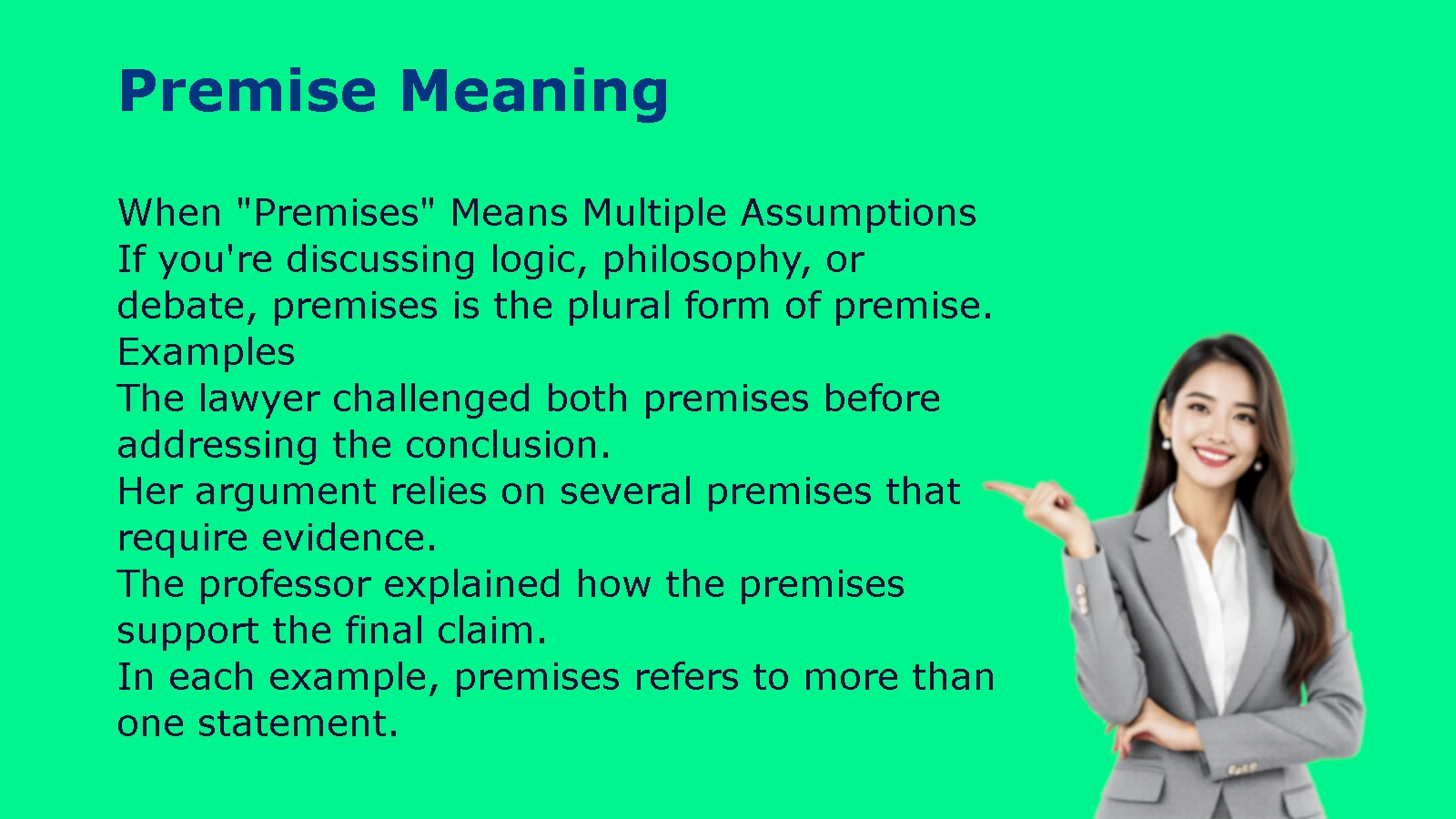
When “Premises” Means Multiple Assumptions
If you’re discussing logic, philosophy, or debate, premises is the plural form of premise.
Examples
- The lawyer challenged both premises before addressing the conclusion.
- Her argument relies on several premises that require evidence.
- The professor explained how the premises support the final claim.
In each example, premises refers to more than one statement.
When “The Premises” Means Property
In legal, business, and real estate contexts, the premises refers to a specific property.
Examples include:
- No smoking is allowed on the premises.
- Security guards patrol the premises every night.
- Visitors must leave the premises before the building closes.
- Emergency exits must remain clear throughout the premises.
Although the word looks plural, lawyers treat the premises as a fixed legal expression describing the property identified in a contract or agreement.
Quick Comparison
| Usage | Meaning | Example |
| Premise | One assumption | The premise is incorrect. |
| Premises | Multiple assumptions | The argument has three premises. |
| The premises | Property or buildings | Please leave the premises immediately. |
Tip: If you’re talking about an idea, think logic. If you’re talking about a location, think property.
Common Collocations With Premise
A collocation is a pair or group of words that naturally appear together in English. Learning them helps your writing sound more fluent and natural.
Here are some of the most common collocations with premise.
| Collocation | Meaning | Example |
| Basic premise | The fundamental idea | The book begins with a basic premise. |
| Central premise | The main idea | The central premise drives the entire story. |
| False premise | An incorrect assumption | The debate started from a false premise. |
| Underlying premise | A hidden assumption | The underlying premise wasn’t supported by evidence. |
| Initial premise | The first assumption | The initial premise shaped the research. |
| Logical premise | A reasoning statement | Every logical premise requires support. |
| Story premise | The core narrative idea | The story premise attracted publishers. |
| Main premise | The primary concept | The movie’s main premise is easy to explain. |
| Entire premise | The complete foundation | The sequel changes the entire premise. |
| Working premise | A temporary assumption | The investigation continued on that working premise. |
Examples in Context
- The novel’s central premise immediately caught my attention.
- The scientist rejected the false premise after reviewing the evidence.
- Their proposal rests on an underlying premise that market demand will increase.
- A unique story premise often makes readers curious enough to keep reading.
Idioms and Expressions Related to Premise
Although premise doesn’t appear in many traditional idioms, it frequently appears in common English expressions.
False Premise
Meaning: An assumption that isn’t true.
Example:
The argument failed because it started with a false premise.
On the Premise That
Meaning: Based on a particular assumption.
Example:
The agreement was signed on the premise that both parties would cooperate.
Based on the Premise That
Meaning: Founded upon a specific belief.
Example:
The research was based on the premise that early education improves literacy.
Accept the Premise
Meaning: Agree with the starting assumption.
Example:
If you accept the premise, the conclusion becomes easier to understand.
Challenge the Premise
Meaning: Question the original assumption.
Example:
Rather than debating the conclusion, she challenged the premise itself.
Quote
“Question the premise before accepting the conclusion.”
This principle applies to debates, advertisements, political discussions, and everyday conversations. Strong critical thinkers don’t simply evaluate conclusions. They first examine the assumptions behind them.
Common Mistakes When Using Premise
Even experienced English speakers occasionally misuse premise. Most mistakes happen because people confuse it with similar words.
Confusing Premise With Plot
❌ Incorrect:
The premise includes every event in the novel.
✅ Correct:
The premise introduces the central idea, while the plot describes everything that happens.
Using “Premises” Incorrectly
Some learners assume premises always means multiple assumptions.
Remember:
- Premises can mean several logical statements.
- The premises can refer to one property.
Context determines the meaning.
Confusing Premise With Theme
A theme communicates the story’s deeper message.
A premise introduces the story’s basic concept.
For example:
Premise
A woman inherits a mysterious lighthouse that predicts storms.
Theme
Hope often appears during life’s darkest moments.
Treating a Premise as Proven Fact
A premise supports an argument, but that doesn’t automatically make it true.
For example:
“Everyone prefers working from home.”
That’s a premise—not an established fact. It requires evidence before people should accept it.
Using Premise Instead of Hypothesis
In scientific writing, hypothesis is usually the better choice because it describes a prediction that researchers can test.
A premise supports reasoning.
A hypothesis guides experimentation.
Case Study: Why Understanding the Premise Changes Everything
Imagine two readers picking up the same mystery novel.
Reader One
Skims the book description and assumes it’s a standard detective story.
Reader Two
Recognizes the premise:
A detective investigates murders that appear in tomorrow’s newspaper before they happen.
The second reader immediately understands what makes the story unique. That single sentence creates curiosity and sets expectations without revealing the plot.
The same principle applies in business presentations, academic papers, and debates. A clearly stated premise helps the audience understand the discussion from the very beginning.
Frequently Asked Questions About Premise Meaning
What is the simple meaning of premise?
A premise is a starting point, assumption, or central idea that forms the foundation of an argument, story, or discussion.
What is a premise in logic?
In logic, a premise is a statement that provides evidence or support for a conclusion.
Example:
- All birds have feathers.
- Eagles are birds.
- Therefore, eagles have feathers.
The first two statements are the premises.
What is a premise in a story?
A story premise is the main concept that drives the narrative.
Example:
A teenager discovers she can communicate with forgotten historical figures.
This introduces the core idea without explaining the entire plot.
What is the difference between premise and plot?
A premise explains the story’s central idea.
A plot explains the sequence of events from beginning to end.
Is premise the same as an assumption?
Not always.
In logic, a premise often functions as an assumption.
In storytelling, however, a premise refers to the central concept rather than an assumption.
What does “the premises” mean?
“The premises” refers to a property, building, or piece of land in legal and business contexts.
Example:
Visitors must leave the premises before closing time.
Is “premises” singular or plural?
It depends.
- Premises is the plural of premise when discussing logical statements.
- The premises is a legal expression referring to property.
How do you use premise in a sentence?
Here are a few examples:
- The film has an original premise.
- Her conclusion depends on a weak premise.
- Everyone left the premises after the fire alarm sounded.
- The author’s premise immediately captured readers’ attention.
What is the opposite of premise?
The most common opposite is conclusion, especially in logic. Other possible opposites include result, outcome, or consequence, depending on the context.
What is a major premise?
A major premise is the broad or general statement in a logical argument.
Example:
All mammals are warm-blooded.
What is a minor premise?
A minor premise is the more specific statement that connects to the major premise.
Example:
A whale is a mammal.
Together, these premises support the conclusion:
Therefore, a whale is warm-blooded.
Can a story have more than one premise?
Most stories revolve around one central premise. However, complex novels, television series, or interconnected storylines may introduce secondary premises that support the main narrative.
Why is a premise important in writing?
A strong premise gives a story direction. It creates curiosity, establishes conflict, and helps readers understand what makes the narrative unique before the plot unfolds.
Key Takeaways
The premise meaning becomes much easier to understand once you recognize its three primary uses.
- In logic, a premise is a statement that supports a conclusion.
- In storytelling, a premise is the central idea that drives the narrative.
- In law and business, the premises refers to a property or building.
Although these meanings appear different, they all share one core principle: a premise is the foundation upon which something else is built.
Here’s a quick summary:
| Context | Meaning | Example |
| Logic | A supporting statement | All mammals are warm-blooded. |
| Storytelling | The core concept | A pilot lands on a forgotten island where time stands still. |
| Law & Business | Property or buildings | Employees must leave the premises by 6 p.m. |
Whenever you encounter the word premise, ask yourself one simple question:
Is the discussion about an argument, a story, or a property?
The answer almost always reveals the correct meaning.
By understanding these distinctions, you’ll use premise more accurately in everyday conversations, academic writing, creative projects, and professional communication. Whether you’re analyzing a philosophical argument, pitching a novel, reviewing a movie, or reading a legal contract, you’ll recognize exactly how the word functions and why it’s such an important part of the English language.