
Have you ever come across the word “inhibit” and wondered what it really means? While INHIBIT Meaning may seem a little formal or confusing, this word is commonly used to describe something that prevents, limits, or holds back an action, process, or feeling. Its exact meaning can depend on the sentence and context in which it is used.
Inhibit is a verb that means to prevent something from happening or to make someone less likely to act freely or naturally. It can describe physical processes, behavior, emotions, growth, or actions.
Examples:
- Fear can inhibit your ability to speak confidently.
- The medicine may inhibit the growth of bacteria.
The confusion is understandable. People often search for what does inhibit mean, inhibit meaning in English, inhibit meaning in a sentence, or how to use inhibit correctly because the word can describe both stopping something completely and simply limiting or slowing it down. And here’s the kicker: inhibit doesn’t always mean “stop.” In many situations, it means restrain, restrict, or hold back.
In this guide, you’ll learn the complete INHIBIT Meaning, its definition, pronunciation, synonyms, correct usage, and examples in sentences. You’ll also discover the difference between inhibit, prevent, prohibit, and restrain, plus common phrases and practical examples to help you use inhibit correctly.
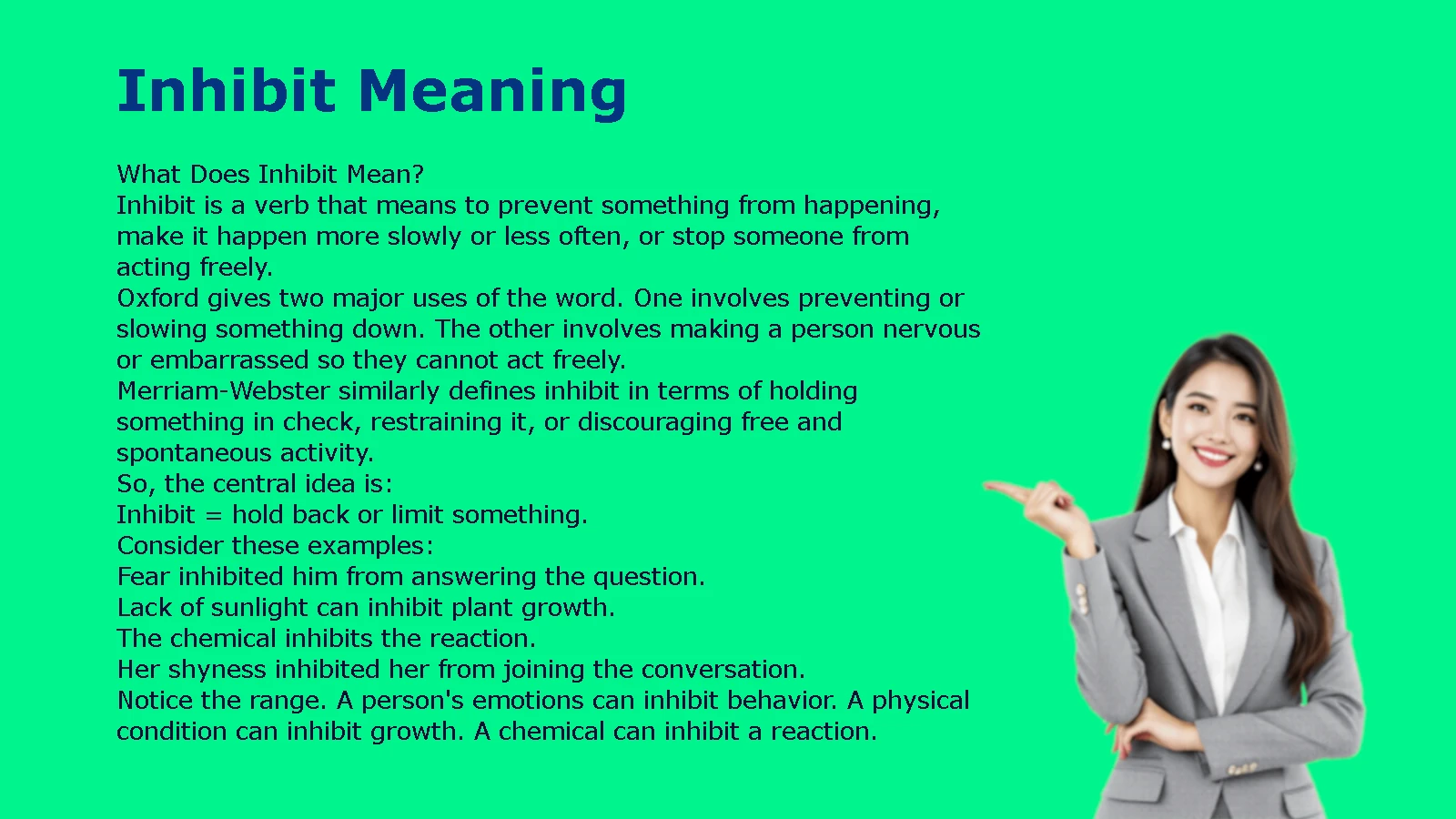
What Does Inhibit Mean?
Inhibit is a verb that means to prevent something from happening, make it happen more slowly or less often, or stop someone from acting freely.
Oxford gives two major uses of the word. One involves preventing or slowing something down. The other involves making a person nervous or embarrassed so they cannot act freely.
Merriam-Webster similarly defines inhibit in terms of holding something in check, restraining it, or discouraging free and spontaneous activity.
So, the central idea is:
Inhibit = hold back or limit something.
Consider these examples:
- Fear inhibited him from answering the question.
- Lack of sunlight can inhibit plant growth.
- The chemical inhibits the reaction.
- Her shyness inhibited her from joining the conversation.
Notice the range. A person’s emotions can inhibit behavior. A physical condition can inhibit growth. A chemical can inhibit a reaction.
Inhibit Meaning in Simple Words
In everyday language, inhibit can mean:
- hold back
- restrain
- limit
- slow down
- discourage
- prevent
- stop from acting freely
However, these words aren’t perfect substitutes in every sentence.
For example:
Self-doubt inhibited her from applying for the job.
You could replace inhibited with held back, but held back sounds more conversational:
Self-doubt held her back from applying for the job.
By contrast, inhibit sounds more natural in formal, academic, scientific, or professional writing.
Inhibit Pronunciation
The American English pronunciation of inhibit is:
/ɪnˈhɪbɪt/
You can break it into three syllables:
in-HIB-it
The stress falls on the second syllable, HIB.
The pronunciation is roughly:
in-HIB-it
Don’t pronounce it like IN-hib-it with strong stress on the first syllable. The middle syllable carries the main emphasis.
Is Inhibit a Verb?
Yes. Inhibit is primarily a verb.
It usually takes an object, which means something or someone receives the action.
For example:
Stress can inhibit learning.
In this sentence:
- Stress = subject
- can inhibit = verb phrase
- learning = object
The word has several common forms:
| Form | Example |
| inhibit | Stress can inhibit learning. |
| inhibits | The drug inhibits enzyme activity. |
| inhibited | Fear inhibited his response. |
| inhibiting | Noise is inhibiting concentration. |
Oxford lists inhibit, inhibits, inhibited, and inhibiting as its main verb forms.
How to Use Inhibit in a Sentence
The word becomes much easier to understand when you see how native English speakers use it in different contexts.
Inhibit a Person or Their Actions
One common use describes something that prevents a person from acting naturally or confidently.
The manager’s presence inhibited the employees from speaking openly.
The employees aren’t physically prevented from talking. Their behavior changes because they feel nervous, uncomfortable, or cautious.
Oxford specifically describes this construction as making someone nervous or embarrassed so that they cannot do something freely.
Other examples include:
- Her shyness inhibited her from making new friends.
- Fear of failure can inhibit students from asking questions.
- His lack of confidence inhibited him from sharing his ideas.
- The formal atmosphere inhibited casual conversation.
This use often involves psychological or social pressure.
Inhibit Feelings or Behavior
You can also use inhibit when someone controls or suppresses an emotion, reaction, or impulse.
He tried to inhibit his laughter during the ceremony.
The person feels like laughing but deliberately holds the reaction back.
Other examples:
- She struggled to inhibit her anger.
- He couldn’t inhibit his excitement.
- Social expectations may inhibit emotional expression.
- The child had difficulty inhibiting impulsive behavior.
In this sense, inhibit is close to restrain or suppress.
Inhibit Growth or Development
Another common use involves growth, development, or progress.
Poor nutrition can inhibit physical growth.
Here, inhibit doesn’t necessarily mean that growth stops completely. It can mean that growth becomes slower or less effective.
Oxford specifically uses the idea of something making a process happen more slowly or less frequently than normal.
Examples include:
- Lack of sunlight can inhibit plant growth.
- Stress may inhibit learning and development.
- A lack of oxygen can inhibit brain development.
- Financial barriers can inhibit access to higher education.
This is one reason inhibit is useful in academic writing. It can describe a reduction in progress without claiming that progress has completely stopped.
Inhibit a Biological or Chemical Process
In science, inhibit has a particularly important meaning.
A substance can inhibit a biological or chemical process by reducing or interfering with its activity.
For example:
The drug inhibits the activity of a particular enzyme.
Cambridge gives examples involving drugs, tumor growth, and enzymes.
You may also encounter phrases such as:
- inhibit enzyme activity
- inhibit bacterial growth
- inhibit cell growth
- inhibit a chemical reaction
- inhibit hormone production
- inhibit an enzyme
In these contexts, inhibit doesn’t mean that the substance simply makes something feel reluctant. It describes an actual reduction or interference in a process.
Inhibit Examples in Everyday English
Seeing the word in different situations makes its meaning easier to recognize.
| Context | Example | Meaning |
| Confidence | Fear inhibited her from speaking. | Fear held her back. |
| Communication | His presence inhibited open discussion. | People felt less comfortable speaking. |
| Learning | Stress can inhibit learning. | Stress can interfere with learning. |
| Growth | Poor conditions may inhibit plant growth. | Growth may slow down. |
| Behavior | Social pressure can inhibit certain behaviors. | Social pressure can restrain behavior. |
| Science | The compound inhibits enzyme activity. | It reduces enzyme activity. |
| Chemistry | The substance inhibits the reaction. | It slows or interferes with the reaction. |
| Medicine | The drug inhibits a biological pathway. | It reduces activity in that pathway. |
The key is to look for what is being held back.
Inhibit Synonyms
Several words overlap with inhibit, but each carries a slightly different shade of meaning.
Restrain
Restrain means to control or hold something back.
She restrained her anger during the argument.
This word often suggests deliberate control.
Prevent
Prevent means to stop something from happening.
Wearing a seat belt can help prevent serious injuries.
Prevent generally makes the result sound stronger than inhibit. If something prevents an event, that event doesn’t happen.
Restrict
Restrict means to place a limit on something.
The policy restricts access to certain files.
The focus is on limits or boundaries.
Suppress
Suppress means to force something down, stop it from being expressed, or reduce its activity.
He tried to suppress his laughter.
It’s particularly common with emotions, reactions, information, and activity.
Hinder
Hinder means to make something more difficult or slow down progress.
Poor communication can hinder teamwork.
The emphasis is usually on creating an obstacle rather than directly restraining something.
Hold Back
Hold back is a natural, informal alternative.
Fear held her back.
It’s often better for casual conversation than inhibit.
Curb
Curb means to control or reduce something, especially something unwanted.
The new rules aim to curb excessive spending.
It often appears in discussions about problems, behavior, costs, or harmful trends.
Inhibit Antonyms
The best opposite of inhibit depends on the context.
Common antonyms include:
- encourage
- enable
- allow
- promote
- facilitate
- stimulate
- support
- encourage
For example:
Fear inhibited his creativity.
An opposite idea would be:
A supportive environment encouraged his creativity.
Another example:
The chemical inhibits bacterial growth.
The opposite could be:
The nutrient promotes bacterial growth.
The exact antonym changes because inhibit has several related uses.
Inhibit vs. Prohibit
These words look similar and sometimes overlap. They aren’t identical.
Inhibit generally means hold back, limit, restrain, or slow something.
Prohibit means officially or explicitly forbid something.
Compare:
Fear inhibited him from speaking.
with:
The school prohibited students from using phones during the exam.
In the first sentence, fear makes speaking difficult. The person may still speak.
In the second, a rule explicitly forbids phone use.
Merriam-Webster notes that inhibit can overlap with prohibit when discussing preventing someone from doing something. However, the broader modern use of inhibit also covers restraining and slowing processes.
Quick Difference
| Word | Main idea | Example |
| Inhibit | Hold back or limit | Fear inhibited his performance. |
| Prohibit | Officially forbid | The law prohibits smoking here. |
| Prevent | Stop from happening | The lock prevented access. |
| Hinder | Make progress harder | Poor planning hindered the project. |
| Restrict | Place a limit on | The rule restricts access. |
A useful shortcut is this:
Prohibit = forbid.
Inhibit = hold back.
Inhibit vs. Prevent
If something prevents an event, the event doesn’t happen.
The locked door prevented him from entering.
If something inhibits an action, it may simply make the action harder, slower, less frequent, or less likely.
His nervousness inhibited him from speaking.
He could potentially speak. He simply found it difficult to do so.
Oxford explicitly defines inhibit as either preventing something or making it happen more slowly or less frequently than normal.
So don’t automatically replace inhibit with prevent. Context matters.
Inhibit vs. Hinder
Both words can describe something that gets in the way.
Hinder usually means make progress difficult.
Inhibit can mean hold back, restrain, reduce, or slow down.
Compare:
Heavy traffic hindered our progress.
Traffic created an obstacle.
Fear inhibited her ability to communicate.
Fear restrained her behavior or reduced her ability to act freely.
You can sometimes use either word, but the emphasis changes slightly.
Simple Rule
Use hinder when you want to emphasize an obstacle.
Use inhibit when you want to emphasize restraint, limitation, or reduced activity.
Inhibit vs. Restrain
Inhibit and restrain overlap when you’re talking about emotions, behavior, or impulses.
He restrained his anger.
He inhibited his emotional response.
Both sentences suggest that he held his reaction back.
However, restrain often suggests deliberate control. Inhibit can describe an internal psychological barrier or an external condition that naturally reduces activity.
For example:
Embarrassment inhibited her from speaking.
She may not have consciously decided to stay quiet. Her embarrassment simply made her reluctant to speak.
That distinction becomes even clearer in scientific writing, where inhibit commonly describes reduced biological or chemical activity.
Is Inhibit a Negative Word?
Not necessarily.
The word often appears in negative situations because things such as fear, stress, illness, or financial barriers can inhibit useful activities.
For example:
Fear inhibited his ability to communicate.
That’s clearly negative.
However, inhibition can also serve a useful purpose.
A safety system may inhibit a machine from operating under dangerous conditions.
A biological mechanism may inhibit excessive cellular activity.
A braking system can inhibit movement when stopping is necessary.
So the word itself is neutral. The context determines whether the effect is beneficial or harmful.
Think of inhibition like a brake pedal. Sometimes a brake prevents you from moving when you want to move. Sometimes it keeps you from crashing into a wall.
Common Collocations With Inhibit
A collocation is a combination of words that commonly appear together.
Learning collocations makes your English sound more natural because you learn how a word actually behaves in real sentences.
Common combinations with inhibit include:
- inhibit growth
- inhibit development
- inhibit progress
- inhibit movement
- inhibit communication
- inhibit behavior
- inhibit activity
- inhibit production
- inhibit the ability
- inhibit the response
- inhibit an enzyme
- inhibit bacterial growth
- inhibit a reaction
For example:
Excessive stress can inhibit productivity.
The compound inhibits bacterial growth.
Social anxiety may inhibit communication.
The policy could inhibit economic development.
These patterns cover everyday, academic, business, medical, and scientific English.
Common Mistakes When Using Inhibit
The word is straightforward once you understand its central idea, but several mistakes are worth avoiding.
Mistake: Assuming Inhibit Always Means Completely Stop
This is probably the most important distinction.
Inhibit does not always mean complete prevention.
It can mean slowing something down or reducing its frequency or effectiveness.
The treatment inhibited tumor growth.
This sentence doesn’t automatically mean that tumor growth stopped completely. It means the treatment reduced or slowed the growth.
Cambridge and Oxford both recognize this broader idea of slowing a process or growth.
Mistake: Confusing Inhibit With Prohibit
Don’t use inhibit when you specifically mean that an authority has officially forbidden something.
The school prohibits cheating.
That’s a rule.
Fear inhibited the student from answering.
That’s a psychological barrier.
The difference is small in some contexts but important in precise writing.
Mistake: Forgetting the “From” Construction
When inhibit describes a person being held back from an action, from is common:
Fear inhibited him from asking for help.
The formal setting inhibited them from speaking openly.
Oxford lists the pattern inhibit somebody from something/from doing something.
You can also use inhibit directly with an object:
Stress inhibited his performance.
The drug inhibits enzyme activity.
Mistake: Using Inhibit When a Simpler Word Sounds Better
Inhibit is perfectly normal English, but it can sound more formal than hold back.
Compare:
Her fear inhibited her from speaking.
Her fear held her back from speaking.
Both are correct. The second sounds more conversational.
For an academic paper, report, or scientific explanation, inhibit may fit better. In casual conversation, hold back can feel more natural.
Inhibit in Psychology
Psychology provides one of the clearest everyday uses of the word.
A person can feel inhibited when nervousness, embarrassment, self-consciousness, or social pressure makes it difficult to behave freely.
For example:
He felt inhibited around unfamiliar people.
This doesn’t necessarily mean that someone physically stopped him. His internal feelings affected his behavior.
Common factors that may inhibit behavior include:
- fear of criticism
- embarrassment
- low confidence
- social pressure
- fear of failure
- uncertainty
- excessive self-consciousness
The related noun inhibition is especially common here.
Oxford defines inhibition as a shy or nervous feeling that prevents someone from expressing their real thoughts or feelings.
Example Case Study: Public Speaking
Imagine a student who knows the answer to a question but doesn’t raise their hand.
The teacher hasn’t prohibited them from speaking.
No rule prevents them from answering.
Instead, they worry that classmates might laugh if they’re wrong.
That fear inhibits their participation.
The same basic pattern appears in workplaces, interviews, social situations, and group discussions.
Inhibit in Education
Education provides another useful context.
Several factors can inhibit learning or participation, including stress, poor learning conditions, lack of confidence, and financial barriers.
For example:
Fear of making mistakes can inhibit students from participating in class.
The students may know the material. Their concern about being judged keeps them quiet.
In formal writing, inhibit can also describe broader barriers:
Financial constraints can inhibit access to higher education.
Oxford uses financial considerations as an example of something that can inhibit access to higher education.
The important point is that inhibit doesn’t always describe a person deliberately stopping something. A condition, circumstance, or force can produce the limiting effect.
Inhibit in Biology and Medicine
In biology and medicine, inhibit often describes a reduction in the activity of a biological process.
For example:
A drug may inhibit the activity of an enzyme.
An inhibitor is a substance that reduces or interferes with a process. Oxford defines an inhibitor in chemistry as a substance that delays or prevents a chemical reaction. It also uses the term in biology for something that prevents another gene from being effective.
You may encounter phrases such as:
- enzyme inhibitor
- enzyme inhibition
- inhibit enzyme activity
- inhibit cell growth
- inhibit bacterial growth
- inhibit hormone production
- inhibit a biological pathway
The scientific use follows the same core concept as the everyday use: something holds an activity back.
The difference is that the object being inhibited is often a measurable biological or chemical process rather than a person’s behavior.
Inhibit in Chemistry
Chemists also use inhibit to describe substances that reduce the rate or extent of chemical processes.
For example:
The additive inhibits the reaction.
This means the additive interferes with the reaction or slows it down.
A related noun is inhibitor.
An inhibitor can be added to a system specifically to reduce a reaction’s activity or delay its progress. Oxford’s definition identifies an inhibitor as a substance that delays or prevents a chemical reaction.
The terminology is useful because it distinguishes reducing a reaction from simply eliminating the substances involved.
Inhibit Word Forms
The word family includes several useful forms.
| Word | Part of Speech | Meaning | Example |
| inhibit | Verb | Hold back or limit | Stress can inhibit learning. |
| inhibits | Verb | Holds back or limits | The drug inhibits enzyme activity. |
| inhibited | Verb/adjective | Held back or restrained | He felt inhibited in the new environment. |
| inhibiting | Verb/adjective | Holding back or limiting | Fear was inhibiting her progress. |
| inhibition | Noun | Restraint or limiting effect | Social inhibition affected his behavior. |
| inhibitor | Noun | Something that inhibits | The compound acts as an enzyme inhibitor. |
| inhibitory | Adjective | Having a restraining effect | The substance has an inhibitory effect. |
Merriam-Webster lists inhibitive and inhibitory as adjective forms and identifies inhibition and inhibitor as related words.
What Does Inhibition Mean?
Inhibition is the noun form related to inhibit.
It can refer to:
- A psychological barrier or feeling that holds someone back
- The act of limiting or preventing a process
For example:
She had no inhibition about expressing her opinion.
Here, inhibition refers to self-consciousness or restraint.
In a scientific context:
The inhibition of enzyme activity reduced the reaction rate.
Here, inhibition refers to a reduction in activity.
Oxford recognizes both meanings: a nervous or shy feeling and the formal sense of limiting or preventing a process.
What Is an Inhibitor?
An inhibitor is something that inhibits.
In everyday language, that might be a factor that holds someone back.
In technical fields, it often refers to a substance or mechanism that reduces the activity of a process.
For example:
The enzyme inhibitor reduced the enzyme’s activity.
The term is especially common in chemistry, biology, and medicine.
Is Inhibit Formal or Informal?
Inhibit is somewhat formal but widely understood.
You’ll see it frequently in:
- academic writing
- scientific papers
- medical writing
- business reports
- psychology
- technical explanations
- formal discussions
In casual conversation, people often choose simpler expressions such as:
- hold back
- stop
- slow down
- get in the way
- keep from
For example, a scientist might write:
The compound inhibits bacterial growth.
In an everyday conversation, someone might say:
The substance slows bacterial growth.
Neither is inherently better. The best choice depends on your audience and purpose.
Quick Comparison of Inhibit and Related Words
| Word | Core Meaning | Does It Mean Complete Stopping? | Typical Use |
| Inhibit | Hold back, limit, or slow | Not always | Formal, scientific, psychological |
| Prevent | Stop something from happening | Usually | General English |
| Prohibit | Officially forbid | Yes | Rules and laws |
| Hinder | Make progress harder | No | Obstacles and progress |
| Restrict | Put limits on | Not necessarily | Rules, access, activity |
| Restrain | Control or hold back | Not necessarily | Emotions and behavior |
| Suppress | Force down or reduce | Not necessarily | Emotions, activity, information |
| Encourage | Give support or confidence | Opposite | Behavior and development |
| Enable | Make something possible | Opposite | Ability and opportunity |
| Promote | Help something develop or increase | Opposite | Growth and progress |
Frequently Asked Questions About Inhibit Meaning
What does inhibit mean in simple terms?
Inhibit means to hold something back, limit it, restrain it, or slow it down. It can describe people’s behavior as well as physical, biological, or chemical processes.
What is an example of inhibit?
Fear inhibited him from speaking in front of the audience.
This means fear held him back and made it difficult for him to speak freely.
Does inhibit mean stop?
Not always. Inhibit can mean completely prevent something, but it can also mean slow it down, reduce it, or make it less likely to happen. Oxford specifically includes this broader sense.
Is inhibit a positive or negative word?
Neither by itself. It depends on the situation.
Fear can inhibit useful behavior, which is negative. A safety mechanism can inhibit dangerous activity, which can be beneficial.
What is the opposite of inhibit?
Possible opposites include encourage, enable, promote, facilitate, stimulate, support, and allow. The best antonym depends on the sentence.
What is a synonym for inhibit?
Common synonyms include restrain, prevent, restrict, hinder, suppress, curb, and hold back. They aren’t interchangeable in every context.
What does inhibit mean in biology?
In biology, inhibit generally means reduce, slow, or interfere with a biological activity or process. For example, a substance can inhibit enzyme activity or bacterial growth.
What does inhibit mean in psychology?
In psychology, inhibit can describe something that makes a person less able or willing to act freely. Fear, embarrassment, or self-consciousness can inhibit behavior.
What is the difference between inhibit and prohibit?
Inhibit means to hold back, limit, or reduce something. Prohibit means to officially or explicitly forbid something.
Fear inhibited her from speaking.
The rules prohibited students from using phones.
How do you use inhibit in a sentence?
A common structure is:
Subject + inhibit + object
Stress can inhibit concentration.
When describing a person being held back from an action, you can use:
Subject + inhibit + person + from + action
Fear inhibited him from asking questions.
Final Takeaway: What Does Inhibit Mean?
The simplest inhibit meaning is to hold back, restrain, limit, or slow something down.
The word works across many areas of English. Fear can inhibit a person’s behavior. Financial problems can inhibit access to education. Poor conditions can inhibit growth. A chemical can inhibit a reaction. A drug can inhibit an enzyme or biological process.
The most important distinction is that inhibit doesn’t always mean completely stop. Often, it means making something slower, weaker, less frequent, or harder to do.
Remember this quick formula:
Inhibit = hold back.
When you need a more precise word, consider the context:
- Use prevent when something stops an event.
- Use prohibit when something is officially forbidden.
- Use hinder when something makes progress harder.
- Use restrict when something has limits placed on it.
- Use restrain when someone controls an action, emotion, or impulse.
- Use inhibit when something holds back, reduces, restrains, or slows an action or process.
Once you see that central idea, inhibit becomes much easier to understand and use naturally.